Investment Opportunities in the Pharmaceutical and Chemical Industry Upgrade | Frees Fund

Technology Transfer and Innovation-Driven Growth
"

Yikai Wang, Vice President, FreeS Fund
Email: yikai@freesvc.com
WeChat ID: yikai837094
Yikai Wang focuses on investments in tech-enabled healthcare and new drug R&D. Before joining FreeS Fund, he worked at WuXi AppTec's domestic new drug R&D services division, participating in the development and clinical application preparation of multiple drug candidates. He holds a Ph.D. from Harvard University and a B.S. from Peking University's College of Chemistry, and was a postdoctoral researcher at the Broad Institute (affiliated with Harvard and MIT).
"

From pesticides and fertilizers to synthetic fibers, from rubber and plastics to gasoline and asphalt — our daily lives depend on chemical products. Put simply, anything that uses chemical methods to alter material composition, structure, or synthesize new substances falls within the scope of the chemical industry, and the resulting products are chemical products.
Beyond daily necessities, the medicines found in hospitals and pharmacies are also typical chemical products — manufactured through chemical processes. Whether it's the production of active pharmaceutical ingredients and intermediates, or the synthesis of entirely new molecules in drug discovery, broadly speaking these all belong to the realm of pharmaceutical chemistry.
FreeS Fund has long paid attention to structural opportunities arising from industrial upgrading, constantly seeking application scenarios where new technologies transform and empower traditional industries, as well as new growth points at the intersection of fields. Tech-enabled healthcare, including pharmaceutical chemistry industrial upgrading, is one of FreeS Fund's key investment focuses. We believe:
- The pharmaceutical chemistry industry faces pressure for structural upgrading
- Automation is a major trend in synthetic chemistry
- Technology transfer and innovation-driven development are the inevitable paths to industrial upgrading

China's Pharmaceutical Chemistry Industry: Large but Not Strong, Inefficient, with Rising Costs
▍The chemical industry as a whole is large but not strong
Since beginning to accept chemical industry transfers in the 1980s, China has become the world's largest chemical production base, with capacity accounting for as much as 40% of global share; additionally, China is the world's second-largest chemical consumer market after the United States.
However, China's current chemical industry remains at the lower end of the global value chain.
Take the fine chemical rate (the proportion of fine chemical output value to total chemical output value) as an example — it is one of the important indicators measuring the development level of a country or region's chemical industry and the sophistication of its chemical technology. China's current fine chemical rate has reached approximately 45%, but compared to the average of 60-70% in developed economies such as North America, Western Europe, and Japan, there remains substantial room for improvement.
Furthermore, in the 2019 global top 50 chemical companies list published by Chemical & Engineering News (C&EN) in July, Europe and North America occupied 26 seats, Japan and South Korea had 8 and 4 companies respectively, while mainland China had only 2.
▍The generic drug industry is being forced to consolidate and upgrade
In earlier years, Chinese generic drugs left an impression of poor quality and inflated prices. To address these issues, beginning in 2015 the government carried out a series of sweeping policy reforms.
If consistency evaluation solved the problem of drug quality, then the centralized procurement system aims to squeeze out cost waste in distribution and sales channels, returning profits to the production segment and bringing generic drug prices back to rational levels.
On December 6, 2018, the bidding results for the "4+7" volume-based procurement were announced, with average prices dropping 52% and some drug prices falling as much as 96%. By late August this year, the "4+7" volume-based procurement had officially rolled out across all 31 provinces and municipalities.
Today (September 24, 2019) happens to be the bidding day for the second round of volume-based procurement. Although final results have not yet been announced, based on publicly disclosed bidding information from various pharmaceutical companies, this round of "4+7" competition is even more brutal than the first, with the market structure for 25 product categories worth tens of billions facing dramatic upheaval.
On one hand, drug prices have plummeted; on the other, environmental compliance costs and labor costs have risen sharply. Even winning a bid may not guarantee profitability — for many companies, this is a life-or-death test. Industry restructuring has already begun, and transformation and upgrading are urgently needed.
▍The CRO industry serving new drug R&D also faces upgrading pressure
CROs (Contract Research Organizations) originated in the United States in the 1970s, emerging as a new industry when pharmaceutical companies began outsourcing non-core R&D activities to reduce costs. Because China has developed a relatively complete chemical industry chain, and university expansion has supplied large numbers of chemistry-related talent, domestic CROs entered a rapid growth phase after 2000, giving rise to industry giants like WuXi AppTec.
According to statistics, in 2017 the domestic preclinical CRO market reached 24 billion yuan, accounting for over 40% of the global market, with chemical synthesis services comprising roughly half.
From a per-capita output perspective, before 2005 one synthetic chemist contributed an average of $120,000-130,000 in annual revenue, but after 2015 this figure dropped to around $70,000. Over this decade, as personnel wages and operating costs rose, per-capita profit margins declined rapidly, forcing companies to maintain profit growth only by hiring more employees. Consequently, after 2015, domestic CROs entered a consolidation phase, with survival of the fittest and rapid industry reshuffling.
The Trend of Cost Structure Adjustment — Machines Replacing Humans
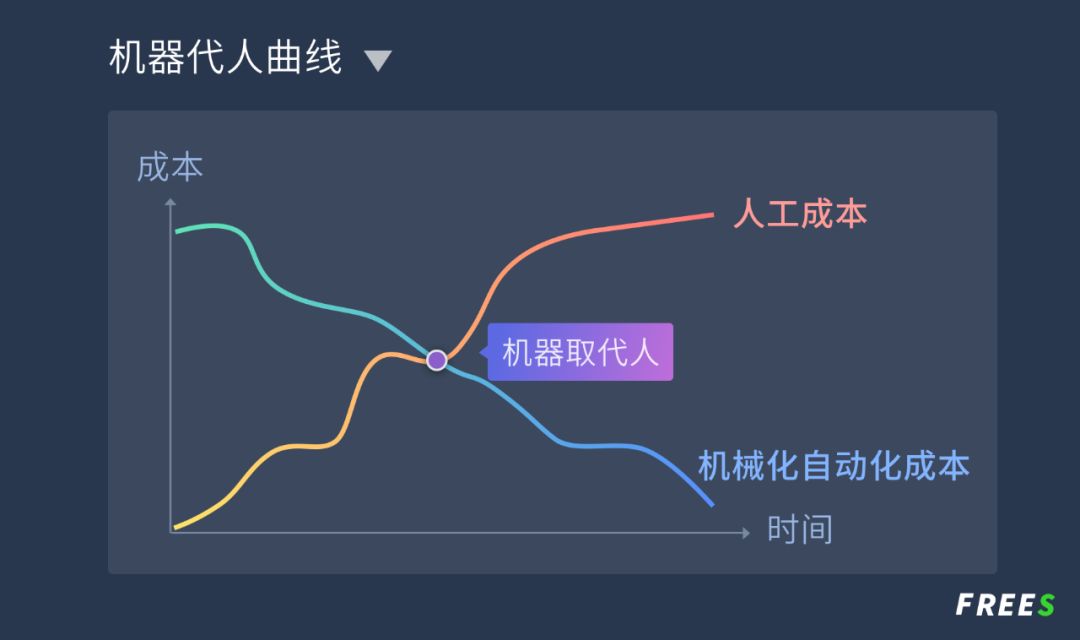
From the perspective of technological development history, there are two cost curves: one for mechanization and automation, which typically trends downward; and another for labor costs, which typically trends upward. The intersection of these two curves is the inflection point where machines replace humans. Once this occurs, it generally does not reverse. For chemical synthesis, as labor costs rise and labor supply begins to decline, the automation inflection point where machines replace humans is accelerating.
▍The brain, hands, and eyes of organic synthesis
Organic synthesis can be roughly divided into four steps: route design, reaction execution, separation and purification, and analytical characterization.
To use an analogy, route design is like the series of commands produced by the human brain — this part requires the most knowledge and experience, and is currently the least automated step.
The two middle steps — reaction execution and separation and purification — are like the limbs carrying out the brain's commands. It is not difficult to imagine that anything hands can accomplish is the most easily replaced by machines.
Indeed, from Eli Lilly and Company's robotic chemical reaction operating systems to fully automated separation and purification systems based on molecular weight, these two modular steps have essentially achieved automation.
The final step, analytical characterization, is like the eyes — not only seeing the results of limb-executed commands, but also feeding information back to the brain so it can make judgments and decisions, generating new commands. The automation level of this step is also not high; more on this later.
▍The birth of organic synthesis robots
Let us first look at the latest progress in automating the two middle steps of organic synthesis — reaction execution and separation and purification.
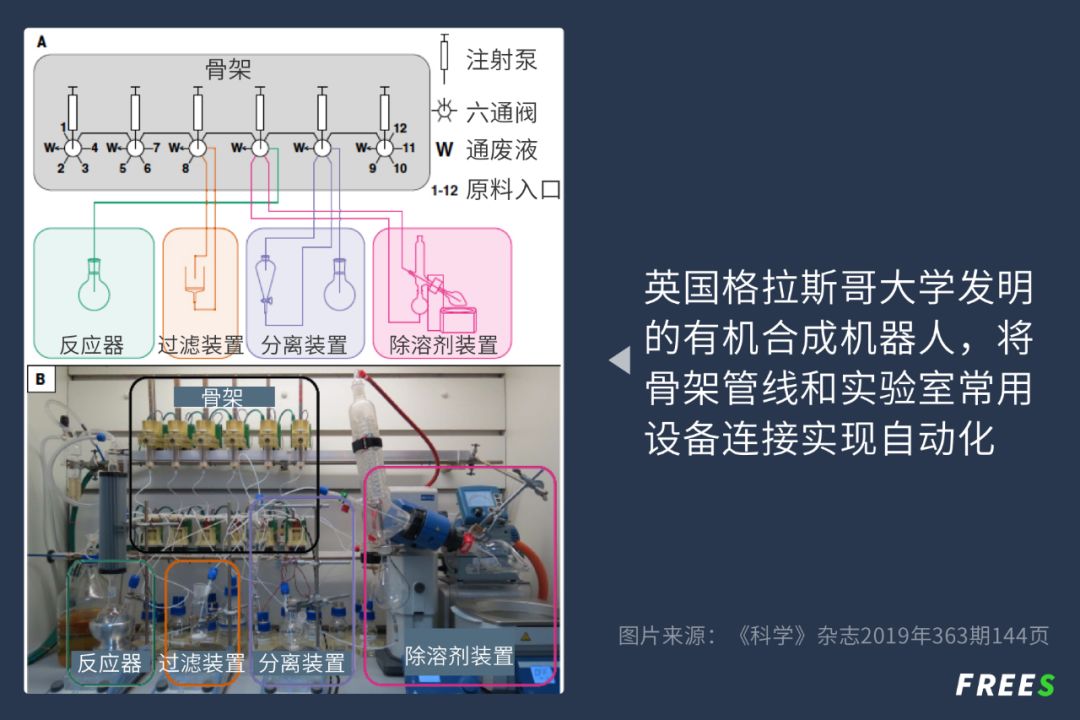
In January 2019, the Cronin group at the University of Glasgow published an article in Science reporting their invention of a chemical synthesis robot system, with which they synthesized three drug molecules.
As shown in the figure below, various glass instruments are connected through skeletal tubing, each instrument having its own physical path, while the skeleton is controlled by computer. When synthesizing a particular molecule, one need only convert the synthetic methods and steps from the literature into executable program instructions; the computer can then transmit these instructions through controlling the skeleton to add required solvents and raw materials to the correct glass instruments, completing the entire experimental process step by step.
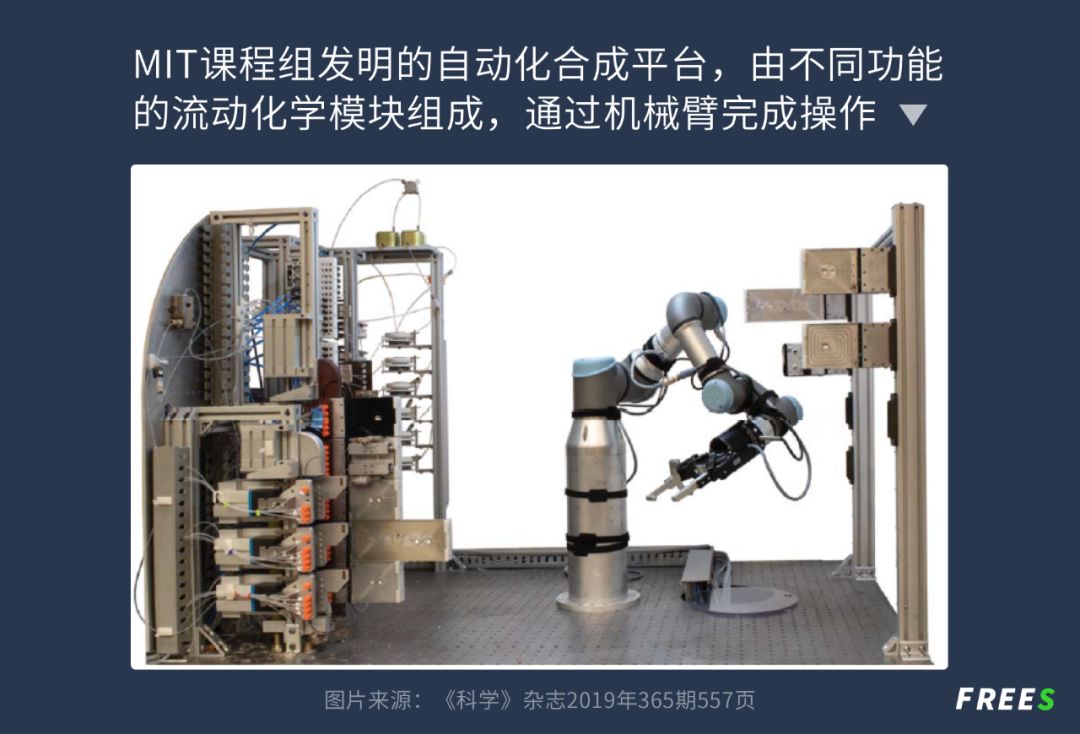
In August 2019, a research group at MIT also published in Science, reporting an automated synthesis platform combining artificial intelligence (AI) design of synthetic routes with robotic execution.
Unlike the British group's use of conventional laboratory equipment, the MIT group adopted a flow chemistry approach, where reactions occur as substances flow through very thin tubes. If steps such as dosing, mixing, reaction, separation, and purification are each made into plug-and-play flow chemistry modules, then for different molecules one can assemble the required modules like building with Lego bricks. After synthesis is complete, the bricks can be disassembled one by one, cleaned, and returned to their original positions.
▍AI-designed synthetic routes — can the human brain be replaced?
In this August Science article, beyond microfluidics replacing human execution of operations in reaction execution and separation and purification, another important advance was so-called AI-designed synthetic routes. Let us now address whether this brain function of route design can be replaced.
Designing synthetic routes is a fundamental skill for organic chemists, and the measure of their expertise lies in whether their designed routes are feasible and efficient. This process heavily depends on their training and accumulated experience.
So, theoretically, if computers could learn all chemical reaction data and extract patterns, they could surpass the human brain. Thus, since Professor E. J. Corey proposed the concept of retrosynthetic analysis (so-called route design) in the 1960s, computer-aided synthesis planning (CASP) emerged shortly thereafter, and he himself conducted much exploration and experimentation. However, in Corey's era, limited by insufficient accumulation of chemical reaction data and constraints in computing power and algorithms, this direction developed slowly.
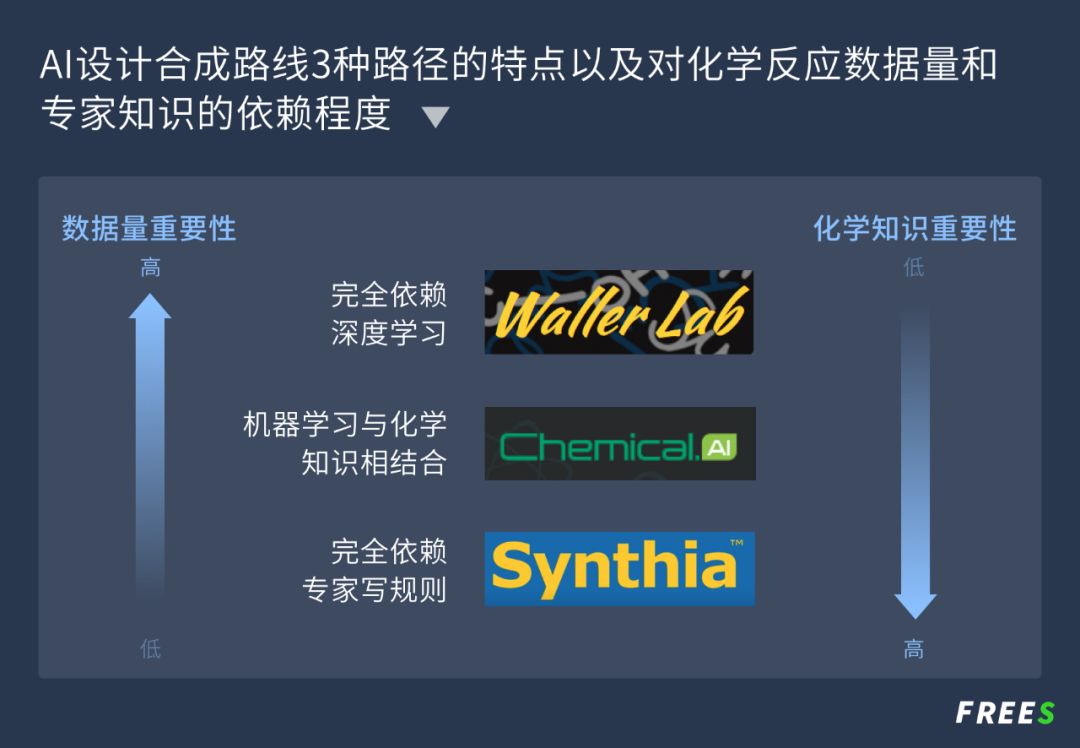
Path One: Deep Learning
In a March 2018 Nature article, the Waller group used three deep neural networks and a Monte Carlo search, learning from chemical reaction data before 2015, to reportedly achieve route design capability comparable to synthetic chemists, thrusting this field back into the spotlight.
The route design software ASKCOS developed by the aforementioned MIT group employs a similar solution.
In fact, the examples given by both the Waller group and the MIT group would not be considered difficult-to-synthesize molecules in the eyes of organic chemists — particularly in the MIT group's article, many are known molecules. Whether these deep learning and neural network-based solutions can achieve commercial viability for more complex or longer-step unknown molecules remains to be verified.
Path Two: Experience-Based Rules
A different approach is the software Chematica (now acquired by German pharmaceutical giant Merck Group and renamed Synthia™) developed by Professor Grzybowski at UNIST (Ulsan National Institute of Science and Technology) in South Korea — a solution based entirely on empirical rules.
Remarkably and admirably, starting from 2001, experienced synthetic chemists on the team spent 17 years extracting from over 7 million chemical reaction data points all reaction rules, conditions, and exceptions — writing them out one by one, roughly 70,000-80,000 rules. Then for new molecules, one need only perform search and matching to recommend one or several synthetic paths.
These two approaches each have their strengths and weaknesses. Synthia™ offers better accuracy in recommended routes, but inevitably carries human subjectivity and bias; as new reaction data continuously emerges, updating and supplementing previous rules requires substantial effort with low efficiency; it is difficult to customize and upgrade using clients' own data, remaining at the level of general-purpose software.
Conversely, purely data-based deep learning does not suffer from subjectivity and bias, and more easily integrates new data and client data; however, due to the imbalance in chemical reaction data (some reaction classes have over a million data points while others may have only dozens), data quality issues (false results or input errors), and the non-interpretability of prediction processes and results (the black box of neural networks), this path will also quickly encounter a ceiling in the near term.
Chemical.AI, a FreeS Fund portfolio company based in Wuhan, adopts a third path: machine learning guided by chemist expertise. This approach can both fully utilize data to generate rules while avoiding human subjective bias, and make the learning process interpretable and adjustable. Chemical.AI can provide clients with general-purpose synthetic route design software based on foundational data, as well as customized software services integrating enterprises' own data, and has already gained recognition from industrial users. The choice of this path stems from the founder's dual background in chemical synthesis and IT, providing deeper understanding and long-term accumulation in this direction.
▍The final link from automation to intelligence
Of course, however mature and powerful AI route design becomes, it can currently only replace 80-90% of human brain function, because the data closed loop has not yet formed — computers still lack the ability to analyze and judge based on results. So one final link remains to be connected: intelligent monitoring of chemical reactions, that is, enabling algorithms to determine whether a reaction yielded the expected product, how to optimize if yield is very low, and what to do if no product was obtained.
If starting from route design (brain) to predict the most feasible reaction route, implementing through automated synthesis instruments (hands), then monitoring results (eyes) and feeding results back to the route design software (returning to brain) for adjustment and optimization (judgment and decision-making) — if all three steps can be automated, with rapid data accumulation and iterative upgrading, then organic synthesis will not be far from true intelligence.
The Path of Industrial Upgrading: Technology Transfer and Innovation-Driven Development
Against the backdrop of pharmaceutical chemistry industrial upgrading, cost reduction and efficiency improvement together with energy conservation and environmental protection are the two major themes. Next, we focus on the role that catalytic reactions can play.
▍Catalysis is both a universal phenomenon of life activities and the foundation of modern chemical industry.
Since the large-scale production of synthetic ammonia was achieved in 1910, catalytic synthesis as the most commonly used technical means in the chemical industry has had over a century of development history.
Today, over 90% of chemical products are produced with the aid of catalytic processes, demonstrating catalysis's position in synthetic chemistry.
Over the past three decades, the catalysis field has advanced by leaps and bounds. From asymmetric hydrogenation/oxidation in 2001, olefin metathesis in 2005, palladium-catalyzed carbon-carbon coupling in 2010, to enzyme directed evolution and enzyme catalysis in 2018, the field has produced over a dozen Nobel laureates.
The core of catalytic reactions is lowering reaction energy barriers and increasing reaction rates, which can reduce raw material and related chemical usage, avoid side reactions, and improve atom economy — making catalysis one of the important means for cost reduction, efficiency improvement, energy conservation, and environmental protection in the chemical industry.
In drug R&D, catalytic reactions have particularly broad applications. In the development stage, many novel structures difficult to prepare through traditional organic synthesis can be efficiently synthesized (with high yields, shorter synthetic routes, and high selectivity) through catalytic reactions. And in the production stage, a cost-controllable, green, and safe process route is even more inseparable from catalysis.
▍The industry legend of American pharmaceutical giant Merck & Co.
Merck & Co.'s drug synthesis processes have long been renowned for high standards and excellence, virtually unmatched in the industry, and its secret weapon is the high-throughput catalytic screening platform established over 20 years ago. Merck & Co.'s long-term investment in catalysis has left many celebrated stories in both industry and academia:
In the synthesis of many small-molecule drugs approved by the FDA in recent years, many key steps are catalytic reactions. With its profound expertise, Merck & Co. has won the U.S. Presidential Green Chemistry Challenge Award three times: in 2006 and 2010 for the diabetes drug sitagliptin, and in 2017 for the antiviral drug letermovir.
In 2006, introducing novel asymmetric catalytic hydrogenation technology in sitagliptin's production process reduced industrial waste by 80%, industrial wastewater to zero, and costs by 70%.
Four years later in 2010, collaborating with Codexis, enzyme catalysis shortened the process steps, reducing total footprint by 10-13% and waste generation by 19% under original process conditions, while increasing production by 56%. The same drug, with further process optimization, won the award again.
In 2017, in letermovir's production process, high-throughput methods were used to screen for low-cost, stable, easily regenerable catalysts, reducing raw material costs by 93%, water usage by 90%, and carbon footprint by 89%.
These three Green Chemistry Challenge Awards all resulted from catalytic reaction applications making production processes both environmentally friendly and economical — truly classic cases of sustainable production in the pharmaceutical industry.
Furthermore, Merck & Co. supported Princeton University in establishing a catalytic screening center, not only for catalytic synthesis methodology research but also dedicated to accelerating the industrialization of novel catalyst systems born in universities and research institutions — a model of industry-academia-research collaboration.
▍Why is high-throughput screening needed?
Because catalytic systems involve many components and parameters, it is difficult to theoretically derive which is the optimal combination, thus necessitating experimental search and optimization.
Assuming a reaction has 4 variables, each with 5 options, this combination yields 5^4 = 625 conditions to try. In a traditional organic chemistry laboratory, even strictly trained, experienced experimental personnel would need at least several months to half a year to complete these attempts.
Using high-throughput catalytic screening technology, hundreds or even thousands of reaction conditions can be batch-screened, quickly finding the optimal combination and shortening the entire process to half a month or even three to five days, greatly improving efficiency and saving time and costs.
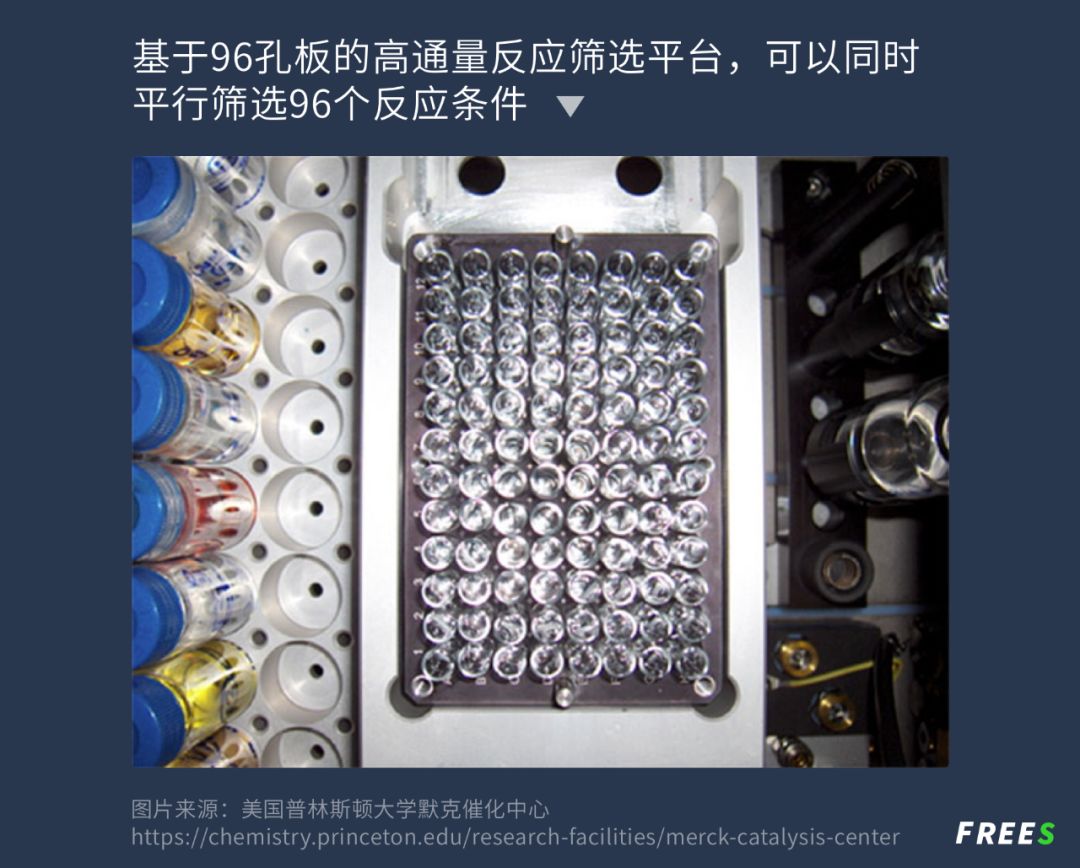
From the figure below, each small well is a reaction, allowing 96 different conditions to be explored in one go. Such small-scale reactions are easily affected by oxygen and moisture in the air, so to ensure result comparability, reactions must be performed in a glove box under anhydrous and anaerobic conditions, with uniform heating and sufficient stirring for each small well. Finally, high-throughput analytical methods are needed to accurately detect each reaction's results, which then guide the next round of optimization.
In this direction, FreeS Fund invested in Suzhou Hibiscus Chemistry (木槿化学) because the founding team has many years of experience in catalytic screening and process optimization. Suzhou Hibiscus Chemistry models itself after Merck & Co.'s high-throughput catalytic screening platform and Princeton University's catalytic screening center, providing various types of catalytic screening services for clients, while also collaborating with renowned professors in domestic catalysis to accelerate the industrial application of domestically developed research成果.
Beyond the aforementioned synthesis automation and high-throughput catalytic condition screening, disruptive technologies like synthetic biology will also provide tremendous impetus for industrial upgrading. These are all directions we are optimistic about and support in the long term.
(Feel free to read, share, and like. For republication on other public accounts, websites, or mobile apps, please reply "republication" to learn republication rules, and contact "Frees Xiaorui" (ID: freesfund) for authorization. Copyright belongs to FreeS Fund.)

▲ FreeS Report 15: Life's Gamble — The Adventurous Journey of Drug R&D
▲ FreeS Report 16: The Truth About Early-Stage Healthcare Investment and China Speed
▲ With Mission to Conquer Brain Diseases, NeuCyber Brain Galaxy Raises $4.2 Million Angel Round