A Century of IP Industry Evolution in the US and Japan: What It Means for China's IP Economy | FreeS Fund Report | FreeS Fund Report

How Can China's IP Industry Break the "Critically Acclaimed but Commercially Unsuccessful" Curse?

People are redefining "new play" through blind boxes, trading cards, and designer toys — using social currency and emotional resonance to unlock the commercial vitality of IP. In late April, Pop Mart's LABUBU 3.0 series launched offline, and the scene was familiar: lines snaking out of stores, blind boxes selling out instantly, resale prices multiplying several times over.
Capital keeps pouring in. Just yesterday, Wanda Film and Ruoyi Xingchen invested 144 million RMB in the toy company 52TOYS.
Pop Mart and 52TOYS are merely a microcosm of China's broader IP industry evolution. In our view, the sector is undergoing a fundamental value reconstruction. Young consumers happily go wild for "plastic" (blind boxes, figurines) and "paper" (trading cards). Domestic IPs have overtaken Japanese IPs in transaction volume on secondhand marketplace Xianyu. Ne Zha derivative licensing fees have doubled. China now hosts over 6.67 million businesses tied to the "goods economy" (谷子经济, fandom merchandise). AIGC is reshaping the creative ecosystem.
What's particularly notable: when viewed in comparative perspective, what China's IP industry is experiencing now mirrors the path once traveled by mature markets like the US and Japan. In this industry research piece, we focus on three questions:
- Looking at the history of IP industries in America and Japan, what common patterns and laws emerge?
- Why is China standing at the starting line of IP industry development?
- What innovation opportunities exist in China's IP sector?

We hope this offers fresh perspectives. If you follow the IP industry, feel free to reach out to the author, Changjie Meng, at mengchangjie@freesvc.com.

Reader Giveaway What innovation opportunities do you see in the IP space? Share your thoughts in the comments. By 17:00 on May 20, 2025, the three most thoughtful responses will each receive a copy of Ask Iwata: Words of Wisdom from Nintendo's Legendary CEO.

/ 01 / Why Should We Pay Attention to the IP Industry?
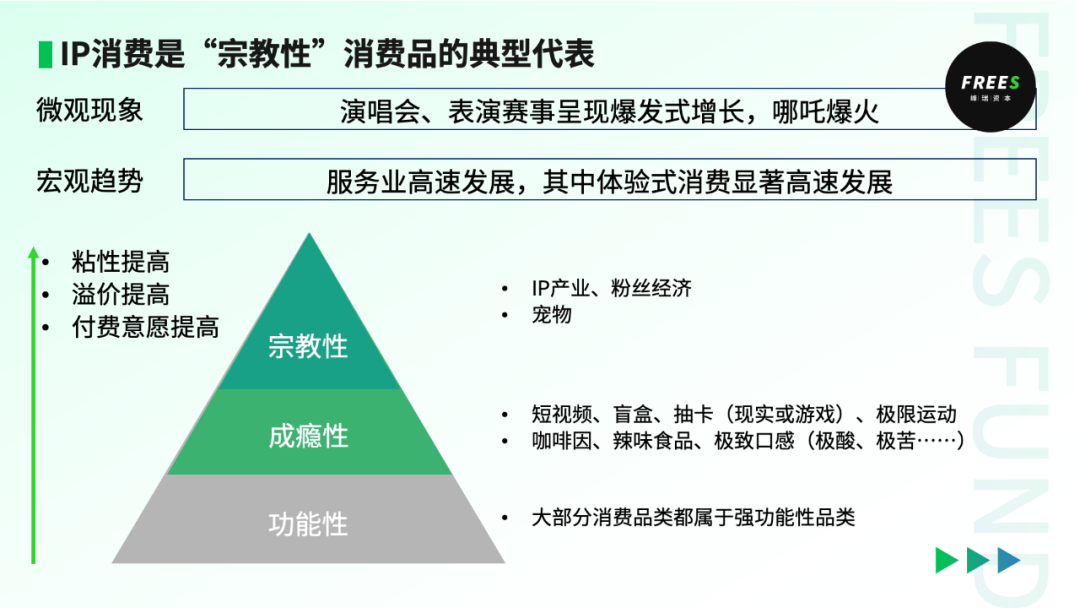
From a macro perspective, China is on the verge of entering a new phase of booming service-sector growth. While China's total retail sales of consumer goods are approaching US levels, the gap in service consumption remains significant. The rise of niche tourist destinations, explosive growth in concerts and live events, and the phenomenon of films like Ne Zha 2 all powerfully demonstrate the momentum of Chinese service consumption.
If we categorize consumer goods (including both retail products and services) into three types — functional, addictive, and religious — we find that most fall into the functional category. Some possess addictive qualities, yielding higher user stickiness. Addiction factors vary: ingesting specific substances (coffee, tea, alcohol), intense sensory stimulation (spicy food, extreme sports), rapid dopamine feedback loops (short videos). Such products typically command higher margins and stronger brand loyalty.
Above addictive consumption sits the "religious" tier. Religious consumer goods help consumers forge connections with spiritual idols, or become objects of worship themselves.
IP consumption is the quintessential religious consumer good. Through content, merchandise, and other forms of consumption, fans obtain identity and belonging. Through "fantasy" and "nostalgia," they resonate with spiritual idols and derive immense satisfaction. Vast numbers of devoted IP fans are willing to pay for life. Moreover, IP products take diverse forms — film and television, trading cards, toys — all carrying substantial premium potential, generating considerable commercial value and market opportunity for the IP industry.
/ 02 / Five Major Patterns from the IP Industry Histories of the US and Japan
In a sense, the IP industry is the product of resonance between technological innovation and human emotional needs. Reviewing the development of American and Japanese IP industries, we have distilled five patterns:
- Most new content formats originate from new content production and distribution technologies;
- Much of modern IP industry traces its roots to mythology and fairy tales;
- Content typically follows a spiral path from "telling gags" to "telling stories";
- IP aimed at children tends to have longer lifecycles;
- Most IP industry giants eventually move toward full-industry-chain integration as they mature.
I. How Do Productivity Transformations Affect the IP Industry?
Pattern 1

Most new content formats originate from new content production and distribution technologies. Companies that embrace new productive forces and new modes of production early gain first-mover advantage.
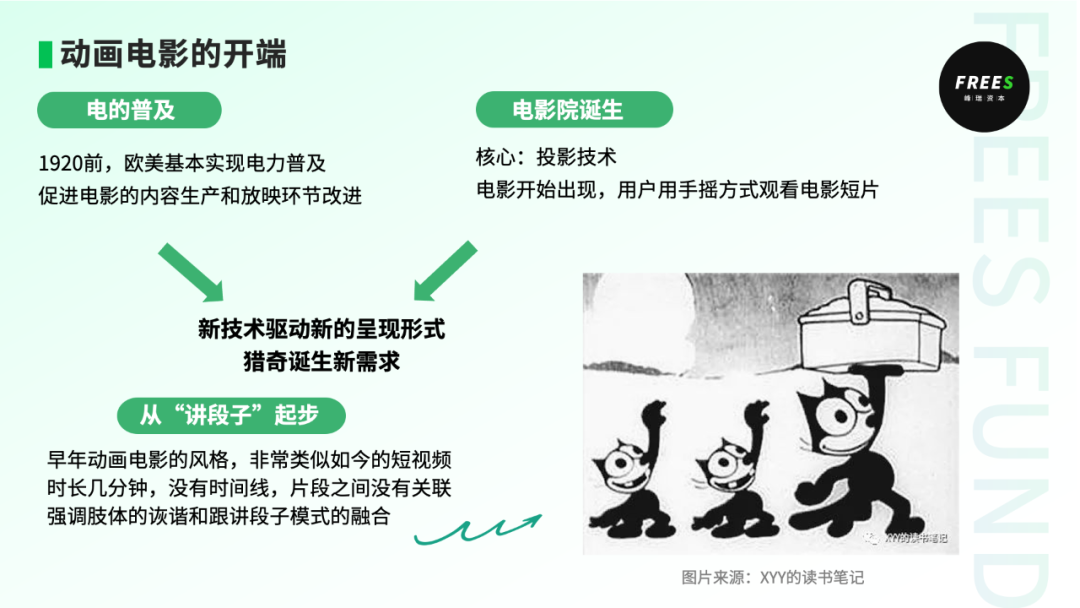
While film originated in Europe, the United States was first to achieve major technical breakthroughs in animated film, including projection technology. The world's first black-and-white animated short (The Enchanted Drawing, 1900), first color animated film (Thomas Cat's Debut, 1916), and first sound animated cartoon (Steamboat Willie, 1928) all came from America.
Steamboat Willie, produced by The Walt Disney Company, marked the screen debut of the iconic characters Mickey and Minnie Mouse.
If America established overwhelming dominance in animated film, Japan chose to "change lanes and overtake," leveraging television as a medium to develop its animation industry. As Feng (Li Feng of FreeS Fund) has noted, in Japan's post-WWII economic recovery, the country quickly established manufacturing advantages in home appliances — making them good, cheap, and widely accessible.
The nature of television as a medium spawned new content: compared to film, episodes were shorter, suited to fragmented viewing after school or work. Richer narratives often unfolded as serials, creating sustained appeal over time.
From the 1960s and 70s onward, Japan inaugurated the golden age of television animation. (Read more: "Can Short Video Be the Shortcut for Chinese Animation to Surpass Disney? | FreeS VC Dialogue")
In 1963, Japan's first serialized TV animation Astro Boy premiered. That same year, Gigantor debuted as Japan's first giant-robot-themed animation. In 1965, Kimba the White Lion became Japan's first color animated TV series.
In 1996, Japan became the first to launch consumer-grade DVD players globally. This technological shift transformed television content consumption — families no longer needed to gather around a single set at the same time to watch the same program. Personalized viewing demands could be met, and animation gradually diversified from single genres to a wide array: adventure and world-saving themes like Digimon; fantasy and ninja culture in Naruto; and Gintama, which used humor to reflect on serious social issues.
II. Where Did Early IP Content Come From?
Pattern 2
The modern IP industry originated from mythology and fairy tales, completing primitive IP accumulation through market operations and user feedback as efficient selection mechanisms, gradually transitioning from traditional IP to original IP.
According to ACGx, an anime and manga industry outlet, of the 57 animated feature films Disney released between 1937 and 2016, more than half were adaptations of classic works. Snow White and the Seven Dwarfs was drawn from the German fairy tale collection Grimms' Fairy Tales; Aladdin from the Arabic folk tale collection One Thousand and One Nights; Sleeping Beauty from the French children's literary fairy tale collection Tales of Mother Goose.
China's animated film industry followed a similar pattern. In 1941, Princess Iron Fan — Asia's first animated feature — was produced in Shanghai, then an "island" surrounded by Japanese occupation during the War of Resistance. The film circulated widely across Asia, even screening in Japan. Osamu Tezuka, the legendary Japanese animator, repeatedly credited Princess Iron Fan with giving him "immense courage to create animation" in his youth.
Early Japanese animated films likewise drew primarily from Chinese and Japanese mythology. In 1958, Japan produced its first full-color animated feature, The Tale of the White Serpent, inspired by the Chinese folk legend. In 1960, Japan released an animated adaptation of Journey to the West.
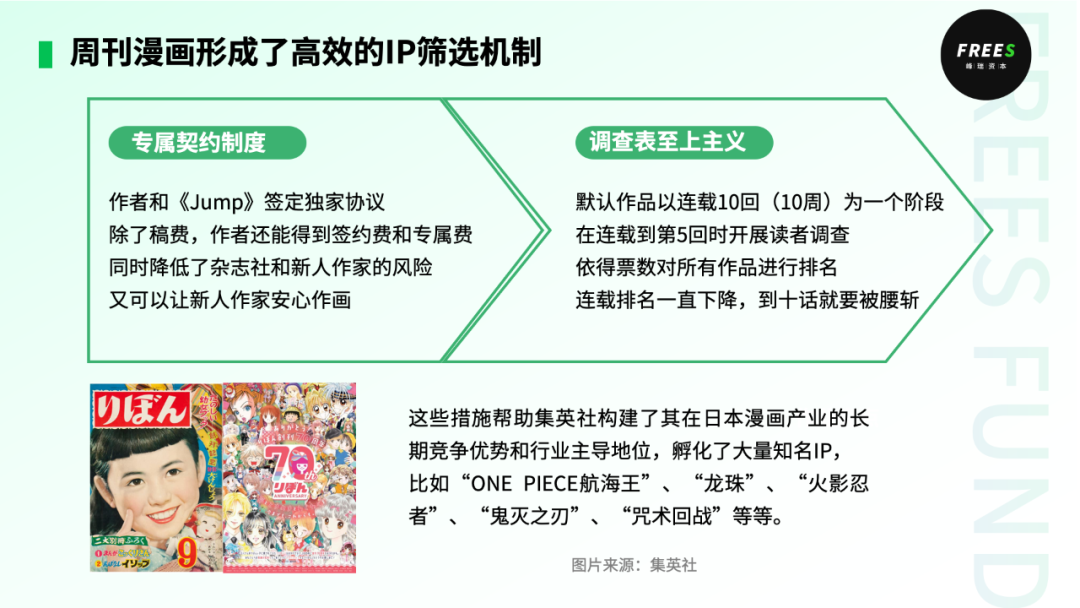
Around the 1960s, weekly manga magazines began launching in earnest. Kodansha's Weekly Shōnen Magazine and Shogakukan's Weekly Shōnen Sunday debuted in 1969; Shueisha's Weekly Shōnen Jump followed in 1968.
These weekly magazines pioneered the commercial operating model for modern Japanese manga, creating efficient selection mechanisms that propelled Japan's IP industry into the era of original, standalone intellectual properties.
Taking Shueisha as an example: on the creator side, it established an exclusive contract system. Signed authors received manuscript fees, signing bonuses, and exclusivity payments — effectively preventing talent drain and improving creator stability. On the reader side, Shueisha adhered to a "questionnaire-first" doctrine, ranking all manga based on reader survey data. A consistently declining series faced cancellation; conversely, a wildly popular title might be continued even if its creator wished to end it.
These measures helped Shueisha build durable competitive advantages and industry dominance, incubating numerous iconic IPs: One Piece, Dragon Ball, Naruto, Demon Slayer, Jujutsu Kaisen, and many others.
III. The Spiral Ascent of Content: From "Telling Jokes" to "Telling Stories"
Pattern 3
The evolution of content: In the early days of any new content format, creators are essentially "telling jokes" — short runtimes, rough production, no clear narrative arc. As technology advances and aesthetic standards rise, most content undergoes a qualitative leap from "telling jokes" to "telling stories": longer durations, polished production, complete narrative structures. When the next generation of media emerges, this evolutionary trajectory repeats.
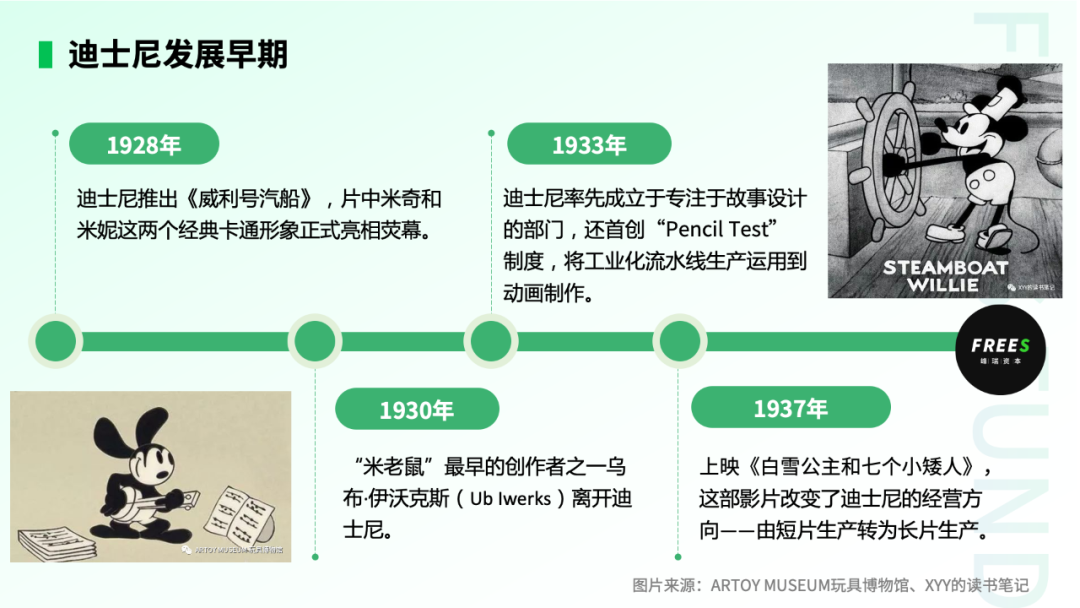
In 1920s America, animated films typically ran just a few minutes. These shorts usually lacked clear storylines, and character designs were relatively simple. Steamboat Willie, mentioned earlier, was an eight-minute short filled with scenes of Mickey being pranked and ridiculed. At the time, theaters often bundled animated shorts with newsreels and comedy films.
In 1930, Ub Iwerks — one of Mickey's original creators — left Disney. Disney recognized that relying on a single creator's vision was unsustainable, and became the first to apply industrial assembly-line production to animation.
In 1933, Disney established a dedicated story department, initiating story conferences, storyboards, and layered production processes. The company also pioneered the "pencil test" system, in which animators first completed film drafts in pencil, allowing the creative team to review and comment, improving quality.
Industrial production yielded faster IP incubation. From the 1930s to the 1940s, classic characters emerged in rapid succession: Donald Duck, Pluto, Goofy, and Snow White, building Disney's substantial "war chest."
The 1937 release of Snow White and the Seven Dwarfs — the world's first animated feature in full color — transformed Disney's business direction from short-form to long-form production.
Similarly, Japan's anime industry underwent its own spiral ascent. From the 1960s through the 1980s, Japanese animation completed its leap in "storytelling," shifting from family-oriented and robot-themed works toward multi-genre IP incubation.

During this phase, family films and robot-themed works dominated the market. In family animation, Sazae-san has aired continuously since 1969, spanning over 50 years. In the robot genre, Astro Boy, Space Battleship Yamato, and Mobile Suit Gundam propelled Japanese animation into the "super robot era."
From the 1990s onward, as existing IP accumulated and audience demographics aged, Japanese animation increasingly moved toward adult-oriented, intellectually ambitious directions. Neon Genesis Evangelion, born in 1995, featured extensive explorations of psychology, philosophy, religion, and humanity's fate.
IV. Children's IP Has Longer Life Cycles
Pattern 4
Classic IPs demonstrate remarkable longevity, with children's IPs typically enjoying the longest life cycles.
Children's IP possesses cross-generational value that far exceeds other content types. Nearly a century after his debut, Mickey Mouse still topped Forbes' "Fictional Character Rich List" with a valuation of $5.8 billion. Chibi Maruko-chan has aired for 30 years, ranking among Japan's top three animated series by viewership for over two decades. These cultural symbols have become vessels for the emotional memories of multiple generations.
From its founding, Disney recognized the long-cycle value of children's IP — or perhaps "childlike" IP. Walt Disney himself noted: "I don't make movies just for children. I make them for the child in all of us, whether we're six or sixty."
But this commitment has faced tests from shifting social currents.
Post-WWII America underwent significant cultural transformations:
In 1952, the Supreme Court ruled that film was protected under the Constitution's guarantees of free speech and press freedom. Film censorship boards were gradually replaced by the rating system.
The 1960s saw a youth-driven "counterculture movement" sweep across America.
In 1972, Fritz the Cat — an animated film for adults filled with sex and violence — was released. Considered "emblematic of 1960s American youth rebellion," its $90 million box office confirmed a market shift.
Disney held firm to its child-oriented positioning, which at times made the company commercially unsuccessful. It wasn't until the consecutive blockbusters The Little Mermaid (1989), Beauty and the Beast (1991), and The Lion King (1994) that Disney reached new heights.
Two main factors explain the extended life cycles of children's IP.
First, children typically rewatch favorite cartoons repeatedly, and IPs encountered in childhood become embedded in memory. This emotional bond creates strong loyalty that persists into adulthood.
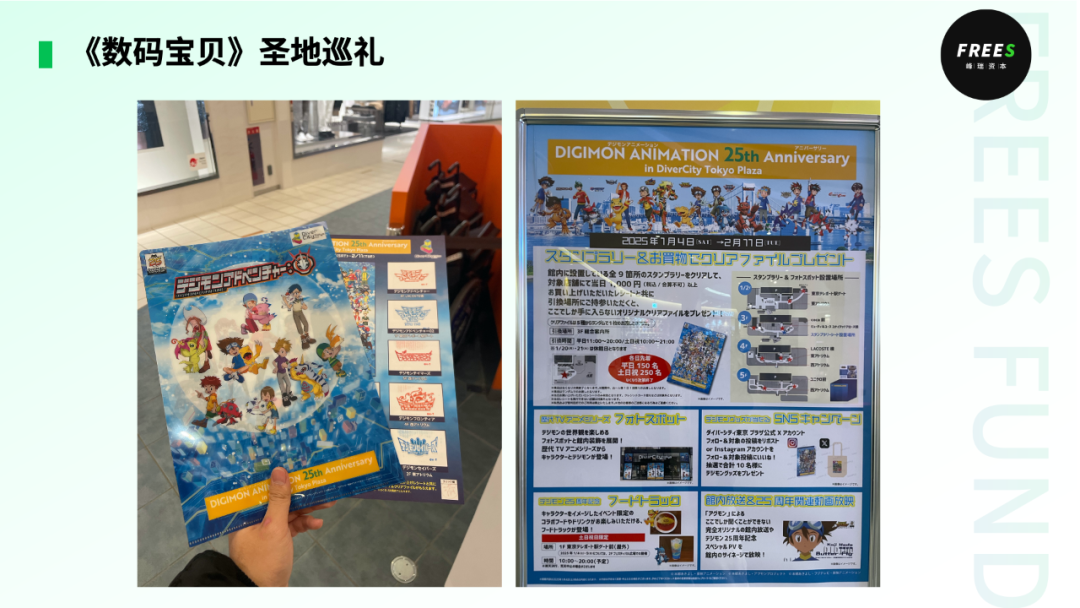
I'll use myself as an example. I've been a devoted Digimon fan since childhood, and continued spending on merchandise after graduating from university — officially licensed DTCG trading cards, designer toys, and collectibles. For my 2025 New Year's trip to Japan, I specifically planned a "Digimon pilgrimage," spending an entire afternoon collecting stamps in the commercial district around Fuji TV to redeem an officially licensed folder.
This seemingly obsessive behavior is actually a ritualistic return to childhood innocence.
Second, children across different eras but at the same age tend to exhibit similar psychological traits and aesthetic preferences. Classic animated content can transcend generations, continuously reaching new young audiences and resonating with children of each new era.
My Little Pony, launched by American toy manufacturer Hasbro in 1983, is now in its fifth generation and has recently surged back to popularity — a testament to its remarkable durability.
V. IP Development: Full-Industry-Chain Layout
Pattern 5
IP industry giants generally follow a development path from content creation to full-industry-chain deployment, ultimately forming a "content-games-derivatives" trinity commercial ecosystem. Premium content is often the starting point for IP; expanding from content into game development and derivatives is the more common trajectory. Another path moves from game IP into content and derivative development. Starting from derivatives and pivoting into content and games tends to be considerably more challenging. The IP industry exhibits extreme winner-take-all dynamics — the strong get stronger.
Currently, the global IP industry chain has formed a "content-games-derivatives" trinity business model. For instance, the animated film Ne Zha 2 achieved box office breakthroughs while launching figurines, blind boxes, themed restaurants, and other IP derivatives; My Little Pony animations and films surged back to popularity in China over the past two years, driving consumption of co-branded apparel, trading cards, and other peripheral products; and in 2024, the veteran Japanese anime IP Detective Conan collaborated with the mobile game Honor of Kings, helping the latter break through revenue records during the typically slow November season for mobile games...
Next, we'll examine how global IP industry giants — using Disney in the US and Bandai Namco in Japan as examples — have gradually built IP-centered commercial empires by continuously refining their full-industry-chain layouts and leveraging brand influence and appeal. Notably, in the process of establishing these comprehensive layouts, the giants have mostly expanded their territories through large-scale acquisitions.
1. Disney: From IP Resource Powerhouse to IP Commercial Empire
From its founding in 1926 to the present, Disney evolved from a small animation studio into a vast IP commercial empire through continuous acquisitions (Marvel Studios, Lucasfilm, Pixar, 21st Century Fox, and ABC). These strategic acquisitions not only dramatically enriched Disney's IP library but also helped it break through boundaries of user age and gender. For example, by acquiring Marvel and Lucasfilm, Disney brought thousands of Marvel IPs including Spider-Man and Iron Man, along with Lucas's Star Wars franchise, into its portfolio — successfully penetrating the American adult male film market and further broadening its audience base.
Additionally, acquisitions kept Disney at the leading edge of creative technology. Pixar, for instance, possessed leading 3D animation production capabilities that allowed Disney to maintain competitiveness in the animation market. Through the ABC acquisition, Disney expanded into television distribution channels and streaming services.
After becoming a major IP resource holder, Disney further mined the commercial value of these properties, transforming them into diverse products spanning films, games, and theme parks. Among these, Disneyland serves as a powerful pillar of the entire IP empire. Financial reports show that in fiscal year 2024, Disney Parks and Experiences accounted for more than one-third of the Disney Group's total revenue.
Beyond traditional ticket, dining, and hotel revenue, IP-based derivative sales constitute a significant component of Disneyland's income. Gift shops are positioned at the exits of many park attractions, selling various high-premium merchandise such as Donald Duck thermoses and Mickey Mouse mugs.
Furthermore, Disney has launched a series of games based on classic animated adaptations, including Aladdin, The Lion King, and Epic Mickey. These games not only carry forward the spirit of the originals but also open new revenue streams for Disney.
In summary, through continuous innovation and expansion, Disney has become a leader in the IP industry.
2. How Bandai Expanded Across the Full Industry Chain
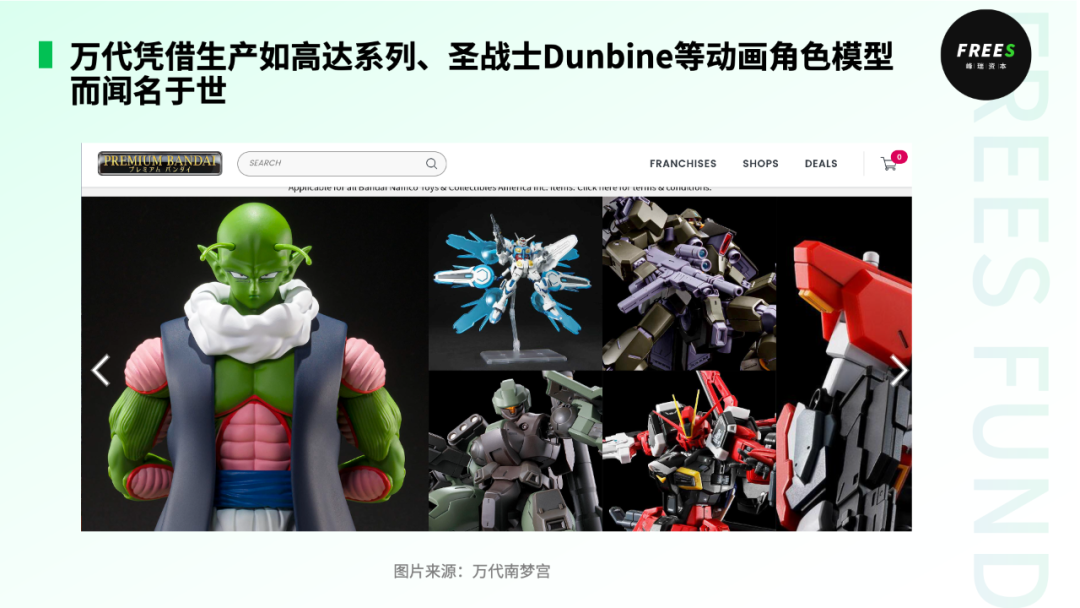
Founded in 1950, Bandai started as a small retail shop and, over more than 70 years of development, has become a leading brand in the global entertainment industry. Bandai gained worldwide recognition for producing character models from animated series such as Gundam and Aura Battler Dunbine.
In its early years, Bandai's primary business was toy manufacturing. Subsequently, at critical junctures in the game industry's development, Bandai demonstrated keen commercial instincts. In 1985, as Nintendo's home gaming consoles gained popularity, Bandai decisively entered the gaming industry and demonstrated its potential in this field by releasing Kinnikuman.
In the anime IP domain, Bandai acquired Japanese animation company Sunrise in 1994, subsequently co-developing Gundam — an IP with enduring influence. This acquisition enabled Bandai to participate in animation production as a derivatives company, forging a tighter bond between itself and this renowned IP.
After 2000, Bandai accelerated its acquisition pace, gradually expanding toward a full entertainment industry chain with a focus on animation, game, and arcade companies.
In 2005, to address global competition and market contraction, Bandai announced its merger with gaming giant Namco, forming today's Bandai Namco. This merger not only achieved complementary IP resources but also extended the industry chain from toys into games and multiple other fields.
Bandai Namco holds copyrights or development rights for numerous well-known IPs including Gundam, Ultraman, and Dragon Ball, as well as hit IPs created by Namco such as the arcade game Pac-Man and the 3D fighting game Tekken. These rich IP resources constitute Bandai Namco's core assets, maximizing IP value through multi-link coordination across different industries.
Taking Gundam as an example: since its inception, it has remained one of Bandai Namco's most profitable individual IPs. Bandai Namco has launched various types of toy models, the anime Mobile Suit Gundam: Iron-Blooded Orphans, and the game Mobile Suit Gundam: Battle Operation. Additionally, in February 2025, Bandai Namco announced plans to produce a live-action Mobile Suit Gundam film, further expanding this classic IP's influence and vitality.
Through sustained innovation and expansion, Bandai Namco has evolved far beyond being merely a toy manufacturer, developing into a global entertainment giant spanning multiple media platforms and encompassing rich IP resources.
3. The Sequence of IP Expansion
If we deconstruct an IP's core elements into content narrative and visual presentation, consumer interaction with IP typically follows this path: first attracted by visual imagery, then developing lasting emotional connections through compelling content narrative. This process can be simply summarized as "love at first sight, loyalty through substance."
Based on this, we tend to believe that content IPs, possessing stories and depth, may more easily gain market recognition when pivoting into games and derivatives. When people encounter peripheral products of a particular IP, they continuously reinforce their spiritual connection with that IP, and their willingness to consume is continually stimulated.
By contrast, IP products originating from visuals face greater difficulty transforming into content. Because consumers may form preconceived understandings of a visual IP; once subsequent official content creation diverges from their expectations, consumers may no longer buy into that content.
For example, the Hello Kitty IP has been adapted into film and television works multiple times, but most ended poorly — one version even forcibly added a mouth to Hello Kitty to make animation easier, a feature the character previously lacked. The Transformers franchise represents a rare global example of successful content creation born from toys.
Of course, this also reflects different consumer demands for different types of IP products. For instance, consumers of female-oriented content may emphasize emotional projection and character identification, thus expecting nuanced character portrayals, while consumers of male-oriented content more often consume "heroism" and "sense of conviction."
Why China Is Currently at the Starting Point of Developing Original IP
At present, China stands at the beginning of developing original IP. From the user perspective, the second and third generations of urbanization have become the main force in IP market consumption. From the IP industry perspective, although the number of Chinese original IPs remains limited, benchmark works such as Ling Cage, Douluo Dalu, and The Outcast have already demonstrated Chinese IP's potential to the world. Furthermore, we see Chinese IP companies such as China Literature Limited and Pop Mart already advancing along the path of full-industry-chain deployment.
I. China Possesses Early-Stage Conditions for IP Development Similar to the US and Japan
In horizontal comparison, we find that China already has the soil that nurtured IP industries in the US and Japan. This manifests in three aspects: young generations growing up during China's urbanization dividend period have become the main force in IP market consumption; per capita disposable entertainment time has begun increasing, creating incremental space for IP content consumption; and against the backdrop of declining marriage rates, IP's emotional companionship value holds potential to convert into commercial value.
1. The Second Generation of Urbanization Has Become the Main Force in IP Market Consumption
According to research published by Guotai Junan Securities, the second generation of urbanization in the US and Japan was the main force in improvement-oriented service consumption, with consumption preferences summarized as: services over goods, spirit over material.
In contrast, China experienced 30 years of rapid urbanization development (1990 to 2020), with the urbanization rate rising from 26.4% to 63.9%.
As China's second generation of urbanization, post-90s and post-00s generations benefited from their parents' completion of urbanization. They enjoyed relatively good material conditions growing up, had "pocket money" from childhood, and viewed "New Year's money as their own disposable income." This material security largely supports their psychology of "daring to spend on themselves" as adults.
Meanwhile, these second-generation urbanites have reached the stage of independent consumption capacity.
From figurines to blind boxes, from trading cards to plush toys... these seemingly non-essential purchases have begun seeing growth. Data from the China Toy and Juvenile Products Association in 2024 shows that post-00s have become the largest consumer group for plush toys at 43%, with post-90s accounting for 36%. The Pop Mart team has also publicly noted that "urban white-collar workers, sophisticated mothers, and Gen Z constitute Pop Mart's core consumer base."
2. Consumers Have More Leisure Time to Devote to Personal Hobbies
Economic capacity is merely the foundational condition; consumers need more leisure time to sustain investment in interest-based consumption (such as designer toys and figurines).
This has been fully validated by Japan's consumption history.
According to research by Japan's Ministry of Internal Affairs and Communications and Nomura Orient International Securities, from 1960 to 2019, Japan's per capita annual total actual working hours decreased from 2,426 hours to 1,669 hours, a drop of approximately 31.21%. Japanese nationals' weekly time spent on hobbies increased from 36 minutes in 1996 to 47 minutes in 2016 — a 30.6% increase over 20 years.
In present-day China, "anti-involution" (fan neijuan) is gradually becoming social consensus, written into the Government Work Report for the first time in 2025. Increasing numbers of enterprises are attempting to reduce burdens on employees — for example, Trip.com Group took the lead in advocating four-day work weeks, and Pang Donglai designated Tuesdays as employee-exclusive rest days.
3. Against the Backdrop of Declining Marriage Rates, IP's Emotional Companionship Value Holds Potential to Convert into Commercial Value
In recent years, China's marriage and birth rates have continued to decline. Based on our interviews and research with young Chinese anime consumers, many consider the handsome characters in otome games and virtual idols to be their ideal partners, while smart pets feel like their own children. These phenomena resemble Japan's otaku economy, which constitutes a significant component of Japan's IP industry.
Taking into account socioeconomic factors such as urbanization rates, consumers' leisure time, and marriage rates, we can roughly sketch a user profile for IP products: the parental generation has completed the foundational accumulation of family assets, and young people, driven by multi-layered needs ranging from self-indulgence and stress relief to healing companionship and personal expression, are willing to pay for things they love.
II. China May Be at the Initial Stage of a Shift from Mythological IP to Original IP
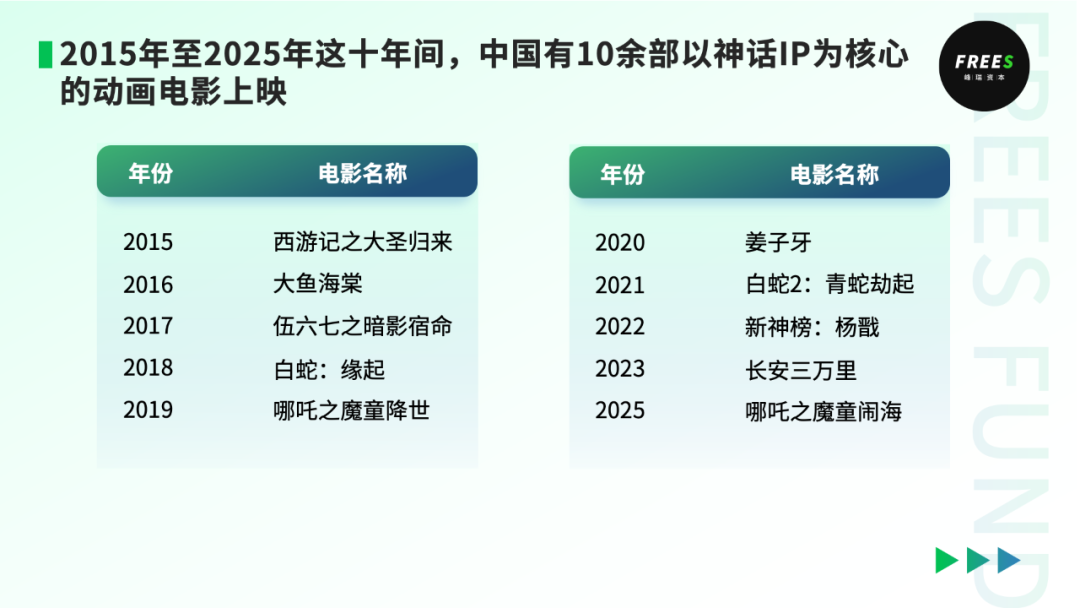
Between 2015 and 2025, more than ten animated films centered on mythological IP were released in China, including Monkey King: Hero Is Back, the Ne Zha series, the White Snake series, Jiang Ziya, and New Gods: Yang Jian.
Beyond mythological IP, China's animation market has already seen some representative original IP works. By original IP works, we mean animated productions that do not rely on traditional mythological classics but are instead based on contemporary literary works or are entirely original creations.
For example, the highly popular original animations Ling Cage and Fog Hill of Five Elements on Bilibili, as well as web novel adaptations such as Soul Land, The Outcast, and The King's Avatar, all demonstrate the diversity of content creation.
At present, China may be at the initial stage of a shift from mythological IP to original IP — some works have gained considerable popularity but have not achieved commercial success, with their reach confined to core fan circles.
When IP enters a mature stage, it manifests as key characters successfully breaking into mainstream culture, serving as leverage points to unlock greater commercial value and helping the industry gradually develop a long-chain commercialization mechanism. For instance, since 1995, characters like Pikachu, Naruto, and Luffy from Japanese anime works became massive hits, propelling Japan's IP industry to further maturity.
So, does China's IP industry have the opportunity to advance from its initial stage to a mature stage?
As we mentioned earlier, mainstream global IP markets typically follow a path from film and television incubation to extension into games and derivatives, but the Chinese market may give rise to new development models.
For example, the explosive growth of the mobile game industry has provided unique advantages for IP incubation — during the 2024 Double 11 shopping festival, merchandise items for hit game IPs under miHoYo such as Honkai Impact 3rd, Genshin Impact, and Honkai: Star Rail each surpassed one million RMB in sales, tangentially demonstrating the feasibility of a "games first" approach in the IP space.
Additionally, short-video platforms, as a distinctly Chinese communication channel, are becoming new fertile ground for IP incubation. We will elaborate on this in detail below.
III. Taking China Literature Limited and Pop Mart as Examples: How Are China's Leading IP Companies Breaking Through?
Compared to the nearly century-long accumulation of international IP giants such as Disney and Bandai, China's leading IP companies are still in an exploratory phase, though they have already demonstrated considerable explosive potential.
Next, taking China Literature Limited and Pop Mart as examples, we can see the exploration and breakthrough paths of Chinese IP companies.
1. How Many Hurdles Lie Between Web Novels and Animation?
To some extent, China Literature Limited represents a peak in China's web novel industry, holding IP rights to a vast quantity of high-quality web novels. In 2019 alone, the platform hosted 11.5 million original literary works. Yet currently, relatively few of these works have been successfully adapted into animation, and the commercial value of individual IPs may still lag behind international mainstream IPs to some degree. What are the reasons behind this?
Between web novels and animation, two major hurdles must be overcome:
First, an efficient IP screening mechanism. As mentioned above, between 1960 and 1980, Japan's weekly manga magazine industry experienced tremendous growth. Weekly manga magazines, as a low-cost, mass-distribution content channel, could efficiently screen IPs. China also once had numerous manga magazines, but with the rapid rise of online media, manga magazines gradually declined. Specifically for China Literature Limited, when evaluating a work's value, the company examines data dimensions such as subscription numbers, tipping amounts, and user retention rates on online platforms.
Second, robust animation production capacity. Compared to Japan, domestic animation production capacity is relatively constrained. One reason for this is that Chinese mobile game companies possess exceptionally strong commercialization capabilities, bringing extremely high 3D production budgets that cause the market's 3D production capacity to tilt toward the gaming industry rather than web novel adaptations.
And after animation adaptation, to elevate an IP's influence requires full-industry-chain IP commercialization capabilities. As noted earlier, Marvel possessed numerous IPs but lacked deployment across the industry chain; it was not until its acquisition by Disney that it launched excellent film and television content such as the Avengers series.
If China Literature Limited, on top of good stories, further enhances its film and television production capabilities and derivative operations capabilities, it may strengthen its commercialization capabilities.
2. Pop Mart: From Visual IP to Content IP
In recent years, Pop Mart has been gradually building an ecosystem from IP incubation to commercialization through full-industry-chain deployment.
On the IP incubation front, Pop Mart has built upon self-owned IPs such as Molly and LABUBU, enhancing user stickiness through continuous content innovation. In product development, Pop Mart has secured licenses for international first-tier IPs such as Transformers and Star Wars, forming a diversified IP matrix. In channel construction, its sales network covers more than one hundred domestic cities while continuing to expand into overseas markets.
Pop Mart appears to be developing along a path similar to Bandai Namco: starting from designer toys and gradually deepening into content creation. As mentioned earlier, the transition from visual IP to content IP is highly difficult, but this transformation holds significant meaning for enhancing an IP's vitality and commercialization capabilities.
For example, Pop Mart collaborated with Ne Zha 2 to design derivative products, achieving synchronized release with the film. Additionally, Pop Mart created secondary designs based on Ne Zha 2's worldbuilding, developing alternate designs for Ne Zha and Ao Bing as well as figure sets distinct from the film. According to information disclosed at Pop Mart's 2024 annual results briefing, Q1 2025 revenue growth is expected to exceed 100%, with one contributing factor being sales driven by Ne Zha 2 co-branded products.
What Innovation Opportunities Exist in the IP Industry?
In the process of China's IP industry advancing from its initial stage to a mature stage, we see two major innovation opportunities. On one hand, the combination of AIGC (AI Generated Content) and short video may become a unique path for IP incubation. On the other hand, with developments in AI, display technology, hardware devices, and more, the "goods" industry (谷子经济) is encountering more opportunities. Whether trading cards or plush toys, various integrations with new technologies are giving birth to new product forms.
I. AIGC + Short Video Will Become a Distinctively Chinese IP Incubation Method
Currently, China's animation industry faces two core challenges: First, the lack of an efficient IP screening mechanism makes it difficult for quality content to stand out. Animation production costs and consumption barriers are both high, and China lacks a mature comics market like Japan's or America's that can efficiently present stories in visual form to users, quickly obtain feedback, and then decide whether to continue resource investment based on that feedback. Second, insufficient animation production capacity makes it difficult for quality works to be produced. Due to the strong commercialization capabilities of China's gaming industry, the vast majority of China's top 3D animation teams are serving the gaming sector. The fact that the Ne Zha film series required the concerted effort of the entire industry perhaps, to some extent, reflects that China's animation production capacity needs improvement.
Having understood the predicament on the production side, let us now examine the user side. On short-video platforms, fragmented content has become the mainstream habit. This may mean that China's animation industry could adjust its thinking to produce animation content suitable for short-video platforms.
The combination of AIGC (AI Generated Content) and short video may become a unique path for Chinese IP incubation, addressing the challenges currently facing the animation industry. Why this particular combination of AI + short video?
On the AI front, China has already established a globally leading position in AI application, with some companies significantly improving animation production efficiency through AI-generated images, AI-generated dynamic manga, and AI-generated character motion shorts. These technologies not only lower the barrier to creation but also enable rapid IP concept testing, shortening the cycle from creative idea to execution and providing data support for screening quality IPs.
Meanwhile, China's short-video platforms may play a role similar to Japan's weekly manga magazines of the 1960s, becoming a new generation of IP incubators — on the IP development side, through high-frequency, short-cycle content updates, they can rapidly validate user feedback; on the user side, they enhance user stickiness.
II. Technology-Enabled "Goods" Economy in the New Era
"Goods" (谷子), a transliteration of the English word, refers to anime-related merchandise such as trading cards, badges ("baqi"), blind boxes, and plush toys. If we establish a coordinate system based on the two dimensions of product randomness and user acceptance threshold, we can roughly categorize goods into the following types:
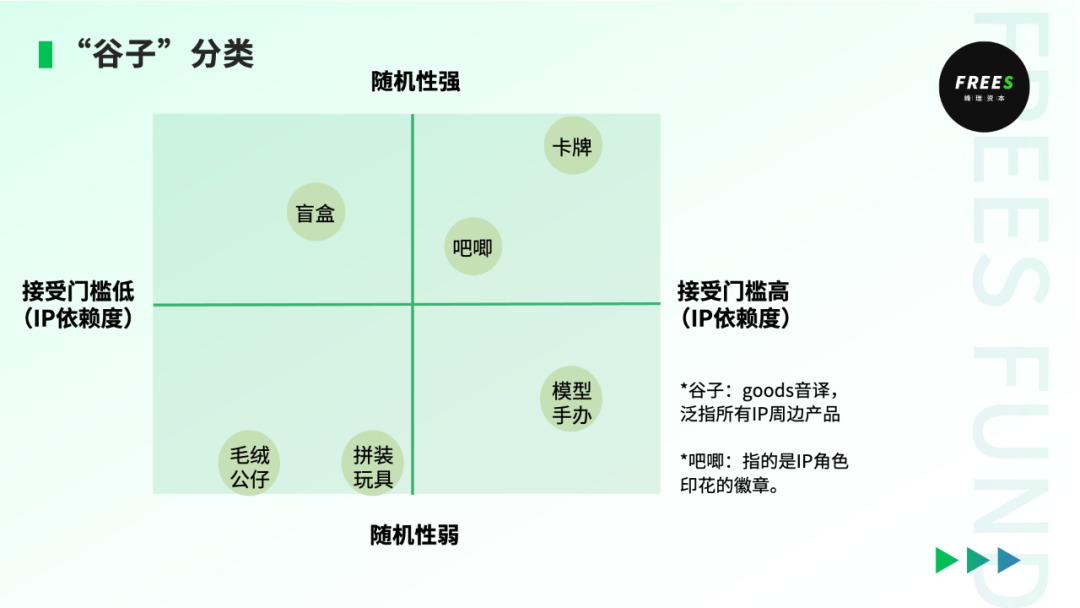
Among the many subcategories of the goods economy, we focus on trading cards and plush toys. Trading cards carry extremely high randomness and are deeply tied to IP; IP fans are more willing to pay for them, but the barrier to entry is higher for users unfamiliar with cards. Plush toys, by contrast, have lower randomness — in other words, stronger product certainty — and a lower acceptance threshold for users.
Specifically, trading cards have the following advantages:
First, strong randomness. Randomness means more possibilities. Card products have rich SKU variety, and price variance is higher in the secondary market. Especially when users buy card packs at very low prices and pull extremely rare cards, the excitement from this randomness becomes even more intense.
Second, cards with gameplay and battle attributes can create certain network effects, leading to opportunities for scale. Card games with strong battle mechanics squeeze out the survival space for counterfeit cards and long-tail brands, making it easier for major brands to emerge.
Third, the collecting nature of cards drives high repurchase rates and strong user stickiness. Both cards and IP are systematic; once a consumer owns one card from a deck, it stimulates continuous repurchases.
Fourth, cards are standard printed products with low costs and high premiums. Take Pokémon cards as an example: the "Pokémon Illustrator" card sold for $5 million in 2021, setting a Guinness World Record.
Another noteworthy subcategory is plush toys. Their cute appearance and soft texture provide psychological comfort to consumers. For instance, Jellycat, a toy brand that recently exploded in popularity on the Chinese internet, quickly rose to fame through its unique anthropomorphic design style and engaging short-video marketing.
Today, with the development of AI, display technology, hardware devices, and more, the goods industry is encountering more opportunities.
In the card direction, for example, AI technology enables more precise card identification, more transparent transactions, and more efficient price tracking.
Plush toys are even more closely integrated with AI. Since the second half of 2024, we've seen numerous product forms emerge in the market: AI electronic pets, AI toys, AI companion robots, and more, focusing on scenarios like movement, conversational education, pet interaction, and home care.
Looking ahead, with the boost of new technologies, the broader IP space will see more innovation opportunities. We welcome teams with expertise in product refinement and technological innovation to reach out to us.
Reader Giveaway
In the IP space, what innovation opportunities do you see? Share your thoughts in the comments. By 17:00 on May 20, 2025, the three most thoughtful commenters will receive a copy of Ask Iwata: Words of Wisdom from Nintendo's Legendary CEO.

▲ Walking Away from a 600 Million ODM Business to Build a Smart Wearables Brand: What Did This Company Do Right? | A Conversation with COROS Founder Haotian Niu
▲ The Right Timing, Right Place, and Right People Behind Ne Zha 2's Blockbuster Success | FreeS Research
▲ The Next Stop for Chinese Brands: From Hard Power to Global Narrative
▲ Are Short Videos the Shortcut for Chinese Animation to Surpass Disney? | FreeS VC Dialogue
Star the FreeS Fund WeChat Official Account for timely business insights delivered to your feed.