Congratulations to XtalPi on its Successful IPO: How FreeS Fund's Research-Driven Approach Learns from Investing

AI + Robotics Creates First 18C Listing — Congratulations to XtalPi
On June 13, 2024, Beijing time, XtalPi — an early portfolio company of FreeS Fund — officially listed on the main board of Hong Kong Exchanges and Clearing Limited under the ticker "2228.HK," becoming China's "first AI-driven drug discovery stock" and the first frontier technology company to go public under the Hong Kong Stock Exchange's new Specialised Technology Listing Rules (Chapter 18C).
01. Computation-Driven Biology: From the Margins to the Mainstream
Li Feng first met XtalPi founder Shuhao Wen at a startup pitch event hosted by MIT-CHIEF in Boston ten years ago. Li was deeply impressed by this MIT physics postdoc and intrigued by his focus on computational biology, expressing investment interest on the spot.
At the time, XtalPi aimed to leverage thermodynamic principles to calculate energy states between molecules, predicting and simulating the stability of different drug crystal forms to improve the efficiency and success rate of drug discovery. Li believed that the sustained decline in computing costs and continuous improvement in computational power could drive the evolution of computational biology, with significant value across broader materials science applications.
However, in 2015 when XtalPi was founded, and in 2016 that followed, computational biology as an emerging field still faced widespread controversy — whether in Boston, the global biopharma hub, or in China's rapidly growing venture capital circle.
According to Li Feng, founding partner of FreeS Fund, the pharmaceutical process was more commonly approached through the lens of traditional biology dominated by experience and experimentation. Understanding it from physics and computation was generally considered "rather marginal" or "of limited utility" within the industry.
Controversy and skepticism did not deter XtalPi's three founders and their team. After some twists and turns, FreeS Fund's investment in XtalPi finally materialized in 2016, following Li Feng's establishment of FreeS Fund and the closing of its USD fund — making FreeS the company's Series A investor.
Over ten years of development, computation and AI-driven drug discovery (AI pharma) has become a significant direction in biotechnology. FreeS Fund partner Rui Ma notes that more people gradually came to realize that as chip and computing costs decline according to Moore's Law while drug R&D costs continue rising, using computation to solve drug discovery problems aligns with first principles.
 ▲ FreeS Fund partner Rui Ma (fourth from right) at XtalPi's bell-ringing ceremony
02. Learning from Entrepreneurs, Learning About Investing Through Investment
One of the great pleasures of early-stage investing is gaining industry knowledge and investment returns by witnessing founders lead their companies forward and continually overcome challenges.
Scrolling through his WeChat chat history, Rui Ma found frequent communications with XtalPi's three founders — Shuhao Wen, Jian Ma, and Lipeng Lai — during 2018-2019. Since Ma often traveled to Boston and XtalPi was among the veteran startups there, they regularly discussed early-stage tech projects in the US and trends in AI pharma.
In 2019, XtalPi incubated METiS Pharmaceuticals, another Boston-origin company, and FreeS became the lead investor in METiS's first funding round. Today, METiS has grown into a global unicorn in delivery and mRNA — an important outcome of FreeS's continued focus on returnee entrepreneurship.
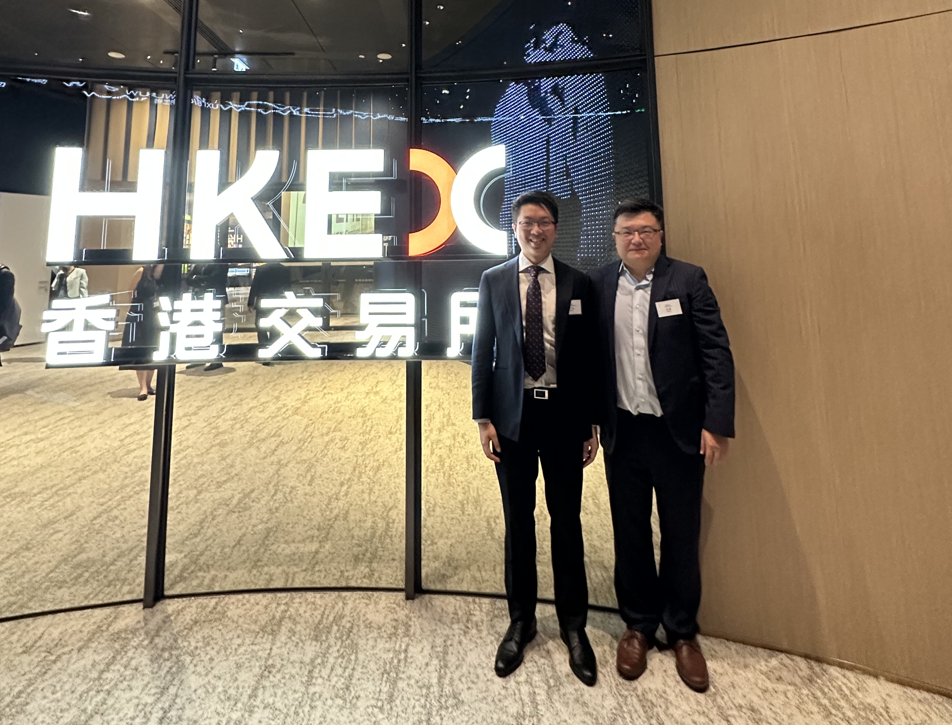 ▲ METiS Pharmaceuticals founder Caida Lai (left) and FreeS Fund partner Rui Ma (right) at XtalPi's bell-ringing ceremony
From XtalPi to METiS, and onward to four or five other early-stage projects, AI pharma has become a distinctive cross-disciplinary innovation in FreeS Fund's investment map. In Li Feng's view, these projects broadly fall into two categories:
- One is computational biology. Simply put, with better computational models and algorithms, lower computing costs, and improved simulation results, important physical properties in the pharmaceutical process can be computationally predicted.
- The other is digitalization in biomedicine. Fields like medicine and chemistry contain massive amounts of valid data. Based on this data, new methods such as computation and AI can enable novel predictions and explorations never seen before. Google's AlphaFold represents sustained efforts in this direction to enhance humanity's approaches to new drug discovery.
Beyond AI pharma, inspired by XtalPi, applying technological advances from other cross-disciplinary fields (such as AI, semiconductors, and engineering) to biomedicine — making biology increasingly data-driven — has gradually become an investment theme for FreeS Fund. The firm has made systematic investments in semiconductor-driven bioelectronics (biochips/brain-computer interfaces) and applying engineering frameworks to biology (synthetic biology), among other sectors.
03. A Decade of Grinding: Embarking on a New Journey
In Rui Ma's view, as one of the earliest teams capable of using computation and AI to improve drug discovery efficiency, XtalPi's founding team has consistently believed in the future of AI pharma. It is this strong conviction, combined with the ability to continually deliver results, that has won XtalPi support from many customers and investors.
Equally important is XtalPi's breakthrough in datafication. Having experienced the AI pharma 1.0 era together, both XtalPi and FreeS recognized that datafication was the bottleneck. Without high-quality data, even the best models could not be deployed. XtalPi therefore pushed to introduce robotics into wet lab processes, deploying hundreds of robots of various models in Shenzhen and Shanghai for chemical experiments, building new digital-intelligent infrastructure. Based on this, XtalPi gradually formed a technical framework combining quantum computing, AI, and robotics, successfully boarding the AI pharma 2.0 train.
Additionally, XtalPi has made substantial explorations in commercialization. Beyond providing solutions for different modules throughout the drug discovery and research process, the company has achieved steady growth in its small molecule, large molecule, and robotics businesses, gaining recognition from MNCs (multinational corporations), well-known domestic pharmaceutical companies, and synthetic biology enterprises.
Rui Ma believes that Gen AI (generative AI) represents the greatest technological breakthrough of this era, and AI + biomedicine is among its most important application directions. By introducing embodied-intelligence robots into biochemical laboratories and applying generative AI to drug R&D, we look forward to seeing XtalPi continue empowering companies in its ecosystem, bringing new drugs and new materials.
Congratulations to XtalPi on its successful listing! We hope that standing at this new starting point on the Hong Kong Stock Exchange under Chapter 18C, XtalPi will continue to do what is right rather than what is easy, becoming an outstanding enterprise that balances both social and commercial value.
Star the FreeS Fund WeChat official account for timely business insights delivered to you.