A Mega IPO Launches Tonight, But China's Commercial Space Sector Doesn't Need to Copy SpaceX

Is Commercial Space Really a Good Business?
"Macro Chat" is one of the most popular series on the Gao Neng Liang podcast. With your company, it has now run for over 100 episodes. Over the past few years, we've often seen comments like this: "The information density in this episode is insane — is there a transcript I can study and re-read?" To honor that hardcore enthusiasm for learning, this year we've selected some of the podcast's most data-rich conversations and condensed them into the Macro Chat column, using a format of "firm conclusions + simple first-principles explanations + concrete case studies." The compression of text inevitably sacrifices some of the vivid details in the original audio; for the full experience, please search for "Gao Neng Liang" on the Xiaoyuzhou app or Apple Podcasts. As Jared Diamond, author of Guns, Germs, and Steel, put it: under algorithmic curation, people increasingly see only content they already agree with, reinforcing existing views while instinctively rejecting different voices. In macro-level analysis, there is no absolute right, because change is constant. We merely hope to share one lens for observation — perspectives from all angles are welcome. (Note: All content in this article and column is intended solely as discussion of business logic and macro trends, and does not constitute investment advice.)
On June 12, U.S. time, SpaceX will list on the Nasdaq.
According to public reports, the company is targeting roughly $75 billion in fundraising at a valuation of $1.75 trillion — a rare "mega-IPO" in recent years. What's notable is that because of blockbuster listings like this, the top spot for global IPO proceeds may well return to the United States, a point Michael Mao raised in an earlier Macro Chat episode. SpaceX can support such a valuation not merely on the back of a Mars story. Per its prospectus, SpaceX revenue for 2025 is approximately $18.7 billion, up 30% year-over-year; Starlink alone contributes about $11.4 billion, or over 60% of revenue, with global subscribers exceeding 10 million. In other words, SpaceX is no longer just a company that tells stories — it is a genuinely profitable business. But beyond the excitement of the U.S. stock market, we want to use this moment to dig one layer deeper: Is commercial spaceflight actually a good business? What makes it hard, where does the money come from, and can China's commercial space companies catch up to SpaceX? This is the third installment of the Macro Chat column. Keywords for this issue: SpaceX IPO | data as moat | three rocket challenges | four-step ladder | engine leasing | accessibility of space tourism...
Giveaway:
Would you spend 80,000 RMB on a trip to space? Share your thoughts in the comments. By 17:00 on June 18, 2026, the two commenters with the most likes will each receive a copy of Commercial Spaceflight.
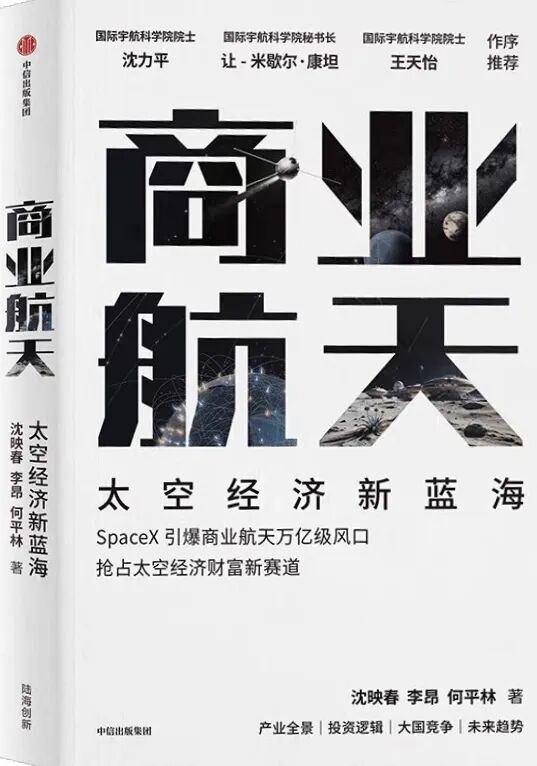

Commercial Spaceflight
By Shen Yingchun, Li Ang, He Pinglin
Citic Press Corporation
/ 01 / Where Is the Real Demand for Commercial Spaceflight?
How to obtain data and data communications will become the most critical competitive advantage and barrier to entry.
1. The real demand for commercial spaceflight is hidden in the word "data."
Many people's first reaction to commercial spaceflight is rockets, satellites, Musk. But the more fundamental question is: where does demand actually come from, and why will more and more industries need it? The answer lies in "data." How to acquire data and complete data communications is becoming the most important competitive advantage and moat across industries — and commercial spaceflight, positioned high above, happens to be able to capture data that cannot be obtained from the ground.
2. Real-time battlefield needs have pushed commercial spaceflight from "eventually" to "right now."
Commercial spaceflight has been hot over the past year, and to some extent this was "accelerated" by the battlefield. The most typical driver is the need for real-time battlefield observation: whether via satellite or related high-altitude military means, both sides in a conflict need to detect troop concentrations and fire targeting. The troop deployments and fire configuration data from the Russia-Ukraine war are the most familiar examples.
More recent, and more illustrative of hard demand, is the U.S.-Israel-Iran conflict. According to foreign media reports citing Pentagon documents, Starlink and its military variant Starshield have become the communications backbone for U.S. military drone strikes against Iran, while commercial satellite imagery has become a primary source for global media to confirm battle conditions in real time.
3. The lower you go, the scarcer orbital resources become. Occupying low Earth orbit is national strategy.
Why is everyone racing for low Earth orbit? Think of it as concentric circles: the closer a satellite is to Earth, the smaller that orbit's area and circumference, and the fewer satellites it can accommodate. Starlink is primarily deployed in the lowest of these orbits. But low orbit has a complication: satellites degrade and spiral downward over time, eventually falling back to Earth. Precisely because of this, securing low orbit resources first is increasingly important at the national strategy level for both China and the United States.
Liu Yang, founding partner of FreeS portfolio company JiuZhou Cloud Arrow, joined us for a podcast episode. According to his account at the time: low Earth orbit can accommodate roughly 100,000 satellites, SpaceX has filed for approximately 42,000, and China's various plans add up to roughly 40,000.

/ 02 / What Makes This Business So Hard?
The difficulty of rockets lies in the叠加 of three challenges: non-standardization, complex integration, and inability to trial-and-error at high frequency.
1. Three constraints叠加 to form the true bottleneck of commercial spaceflight.
Rockets are actually a fascinating subject for discussion — in principle they don't involve scientific breakthroughs that need to be solved from first principles, yet they remain extraordinarily difficult.
The reasons come down to three points. First, almost none of their components are standard parts; each must be custom-made. Second, they represent large-scale systems integration, where every part must then be connected into an extraordinarily complex whole. Third, launch windows and launch resources are limited, leaving little room for trial and error. These three factors叠加 make adjustment extremely difficult, because every change requires moving all three simultaneously.
2. A counterintuitive point: disposable rockets are actually more complex.
I had assumed that the hardest part of rocket engines was that their components are essentially disposable, so no one would bother with scaled production. But Liu Yang told me the opposite is true: disposable engine components are actually more complex, while reusable engines have fewer parts.
The reason is that use case反过来 determines product design. Disposable rockets pursue maximum performance and payload capacity, with cost and timeline as non-constraints, so they naturally grow more complex; reusable engines, driven by economics, must increase integration and reduce part count. This parallels the shift from internal combustion to electric vehicles: the complex powertrain is transformed, integration rises, and parts decrease.
3. "Everyone is reinventing the wheel."
Precisely because of non-standardization, complexity, and difficulty in trial-and-error, every company must build this entire system from scratch. This is essentially "reinventing the wheel" — high complexity, high trial-and-error cost, and low volume. This gives rise to a core question in commercial spaceflight: in a business like this, how can costs ultimately be reduced?
/ 03 / The Four-Step Cost Reduction Ladder, and Why SpaceX Leads
Rocket cost reduction must be climbed step by step, and SpaceX has already reached the top rung.
1. From getting to orbit to getting there cheaply: four rungs in between.
Rocket cost reduction can be broken into four clear steps.
Step one: getting to orbit — the most basic requirement. Step two: first-stage recovery — landing without disintegrating or being damaged. Step three: reusability after recovery — this is distinct from "recoverability"; getting it back is one thing, whether the engine can fly again is another. Step four: on the foundation of the first three steps, using processes like stainless steel single-piece forming to make rocket structures more amenable to low-cost, batch manufacturing, thereby dramatically reducing costs.
2. SpaceX has essentially completed all four rungs; China's commercial space sector is between steps two and three.
Musk is indeed ahead, because he started more than a decade earlier. In December last year, China's commercial space sector conducted two first-stage recovery tests in succession. First, a private rocket company achieved orbital flight on its maiden launch, but the first stage failed to soft-land during recovery; half a month later, the state-owned Long March 12A also achieved maiden orbital flight but failed its first-stage vertical recovery. Neither succeeded. It wasn't until February this year that Long March 10 completed China's first recovery of a first-stage rocket body from sea.
In other words, China's commercial space sector is still iterating between steps two and three, while Musk has completed the fourth. This gap is somewhat like the difference between Tesla and domestic Chinese EVs in 2017–2018, or perhaps even larger.
Regarding how SpaceX got its start, there's a frequently overlooked origin story. During the space race era, NASA received massive funding; after the Soviet Union collapsed and the competition halted, budgets were sharply cut while existing missions still needed execution, so NASA turned to outsourcing launches to private companies to reduce costs. SpaceX, founded by Musk in 2002, was among the companies that took on this outsourcing work, though early launches failed repeatedly until it finally secured NASA contracts in 2008.
3. The gap is static, and there is opportunity to catch up.
JiuZhou Cloud Arrow, which specializes in first-stage rocket engines including reusable engines, provided some more specific figures via its founding partner Liu Yang. JiuZhou Cloud Arrow has demonstrated single-engine reuse exceeding 20 times, with the upper limit not yet reached. As for the China-U.S. gap, Liu Yang calculates it differently: the static gap in commercial spaceflight is roughly 10 years, but once China completes the 0-to-1 breakthrough, the efficiency, supply chain, and productive capacity from 1-to-N will surpass those of the United States. He even boldly predicts that within five years, the number of rockets launched and payload mass from China could likely match SpaceX's total over the past 15 years.
/ 04 / China's Commercial Spaceflight Path: Standardization, Scale, and an "Engine Leasing" Business
The vast majority of airlines lease their aircraft engines rather than buying them; rocket engines may follow the same path.
1. China's commercial spaceflight advantage lies in manufacturing scale.
Unlike SpaceX's vertical integration, China's commercial spaceflight approach ultimately depends on manufacturing scale advantages: reusable, low manufacturing cost, and mass production. The standard is achieving all four simultaneously — standardization, low cost, scale, and reusability. Only when these are all achieved does "commercial spaceflight at scale" truly become viable, and accessibility meaningfully increase.
2. The future of commercial spaceflight may resemble airlines, following an "engine leasing" model.
Here's a fact many people may not notice: almost no airline purchases its aircraft engines outright; instead they pay engine manufacturers by flight hour, using what they need. Even most business jets operate this way. The reason is that engines are too expensive and maintenance too specialized and burdensome, so specialists like Rolls-Royce and General Electric (GE) have built this into a standalone business, with airlines paying by the flight hour. Rocket engines face the same category of problem — high complexity, high trial-and-error cost, and low volume.
If reusable, recyclable rocket engines eventually move toward financial leasing: rocket companies focus on rockets, while reusable engines are leased from specialized suppliers, this becomes far more economical for rocket companies. The supplier custom-builds 20 units at once to amortize manufacturing costs, then spreads past trial-and-error costs across 20 contracts — even charging only one or two million per launch, they can still profit.
If this industry achieves scale, it will likely eventually grow a position analogous to "engine leasing," just as aviation has.
/ 05 / When Costs Drop to 500 RMB per Kilogram, Ordinary People Can Take a Look at Space
At that point, the accessibility of going to space will approach that of visiting Antarctica today.
1. When costs are low enough, space travel shifts from "astronomical" to "affordable."
This is a hypothetical calculation. Putting one kilogram of payload (person, cargo, or resources) into space using a disposable rocket costs roughly 50,000 RMB (average estimate); assuming reusability with ten-plus flights, costs might drop to several thousand; assuming further stainless steel single-piece forming and scaled manufacturing, costs could drop another order of magnitude, to roughly 500 RMB per kilogram. Once costs reach this level, the math for human spaceflight changes completely. At 50,000 RMB per kilogram, an 80-kilogram person would cost over three million just for launch — far too expensive. But at 500 RMB per kilogram, the same person would cost roughly 40,000 RMB; even doubling that with add-on fees, it's about 80,000 RMB.
At that point, anyone with passing physical fitness — no heart conditions, hypertension, severe myopia, etc. — could spend a few tens of thousands to see space, roughly equivalent to a trip to Antarctica today.
2. When that day comes, the operators of space tourism likely won't be rocket companies.
What's interesting is that this business will likely be divided by specialization. Eventually, rocket companies may focus purely on rockets, while reusable, recyclable engine operations become independently run and available for lease. Many rocket companies may no longer look as they do today, instead resembling service businesses for which rockets are merely tools.
Conclusion
SpaceX's IPO is a signal, marking commercial spaceflight's transition from "storytelling" to "doing business." Yet on the path to mature commercialization, what we pursue may not be copying SpaceX, but rather another approach — using the most complete industrial chain, with division of labor and collaborative cluster advancement.
As for which path more easily reaches a future where everyone can travel to space, time will tell.
Giveaway:
Would you spend 80,000 RMB on a trip to space? Share your thoughts in the comments. By 17:00 on June 18, 2026, the two commenters with the most likes will each receive a copy of Commercial Spaceflight.
Commercial Spaceflight
By Shen Yingchun, Li Ang, He Pinglin
Citic Press Corporation

Dialogue with Yin Putianyang: After the Crayfish Wave, What's Next for Edge AI Hardware?
Global Capital Risk-Off: Where Did the Money Go? | Macro Chat
2026 Outlook: Finding Wealth Codes at the Cyclical Inflection Point | Macro Chat