Is Elon Musk Right? Will LiDAR Make It Into Production Vehicles? | FreeS Fund Chip Series

Use the right "hammer" for the right "nail."
In the second episode of the "FreeS Fund Dialogue · Chip & Semiconductor Series" livestream — Hammer vs. Nail: How Hardcore Tech Finds Its Ideal Scene — Li Cheng, founder & CEO of VisionICs, and Feng Ningning, founder & CEO of LuminWave, joined Yongcheng Yang, partner at FreeS Fund, for an in-depth conversation.
Li Cheng graduated from Texas A&M University with a degree in mixed-signal integrated circuits. He previously served on the organizing committee of the American Silicon Photonics Manufacturing Association and was a principal scientist at HP Labs in Silicon Valley, with 18 years of extensive experience in IC R&D and management.
After returning to China, Dr. Li founded VisionICs, addressing critical pain points in LiDAR: high power consumption, high cost, low reliability, and complex system design. VisionICs developed the world's first fully integrated chip based on large-scale single-photon detection arrays.
Dr. Feng Ningning earned his PhD in photonics from McMaster University in Canada, where he received the Governor General's Gold Medal. He is a senior member of IEEE and a postdoctoral researcher in materials science and engineering at MIT. With over 20 years of experience in the US optoelectronics industry in R&D and product development, more than 10 years of company management experience, and over 20 US patents.
Dr. Feng's company, LuminWave, is a global leader in LiDAR products and solutions. It is dedicated to providing pure solid-state chip-level LiDAR hardware, chips, and AI perception algorithms through emerging silicon photonics technology and self-developed optoelectronic chips, driving the upgrade of the global LiDAR and intelligent vehicle industries.
The moderator, Yongcheng Yang, partner at FreeS Fund, focuses on deep tech investments and led or participated in early-stage investments in Shenzhen Lice, LuminWave, Borui Microelectronics, Yuan Gui Technology, and Apex Photonics. Before joining FreeS Fund, Yang was general manager of Baidu's hardware ecosystem channel division. He also served as VP at Xiaomi, where he led the audio product line and founded the Xiaomi smart speaker technology and product team.
They explored the following questions:
- Is LiDAR indispensable for autonomous driving? Why do some manufacturers adopt pure vision solutions?
- Should you develop technology first and then find application scenarios, or identify market opportunities first and then develop technology? Should you build the hammer and then look for nails, or find the right nail before starting up?
- What commercial and technical challenges remain on the path to LiDAR mass production?
- How is capital currently viewing hard tech investments? For hard tech projects already underway, how should they navigate industry downturns and capital retreats?
We've compiled portions of the dialogue, hoping to offer some inspiration and food for thought. This is the sixth installment in the "FreeS Chip Series" — click here to review previous articles in the series.
Tune In
Click below to listen to the live conversation among our three guests — you won't want to miss it.

/ 01 /
Is LiDAR Essential for Autonomous Driving?
Yongcheng Yang: Hello everyone, I'm Yongcheng Yang, partner at FreeS Fund. It's my honor to chat with these two PhD founders about hard tech and market applications.
Among investors, we often use the analogy of "hammer and nail" to describe the relationship between technology and market application. The "hammer" represents the technical expertise or resulting products that a technology-focused founding team brings. The "nail" refers to the market scenarios and first alpha customers that a startup must find to land and validate its technology and products. Teams typically need to identify suitable, market-ready application scenarios and that first alpha customer to gain market and customer validation, along with revenue.
At its core, no matter how sophisticated your technology, as a startup you ultimately face market tests. However beautiful and confident your "hammer," you must find the right "nail."
Today we're fortunate to have two high-tech PhD returnee founders — Li Cheng, founder & CEO of VisionICs, and Feng Ningning, founder & CEO of LuminWave. Both work on advanced chips, with product applications spanning LiDAR and autonomous driving. Both possess impressive "hammers," have successfully matched some "nails," and continue tirelessly seeking new market directions and customers.
Welcome, both founders. From Tesla in the US to Wei Xiaoli and other Chinese EV newcomers, everyone's pushing autonomous driving. We see today's self-driving cars loaded with sensors — ultrasonic radar, cameras, millimeter-wave radar. With so many sensors and accompanying software algorithms, why do autonomous vehicles still need LiDAR?
Feng Ningning: Users demand comfort and safety in transportation — that's the macro trend. Based on this demand, every vehicle will incorporate some autonomous or assisted driving functions going forward.
Why must autonomous vehicles carry LiDAR?
From an application perspective, broadly speaking, visual data is a crucial data source for autonomous vehicles.
Cameras capture images — 2D data without target distance information. Of course, automakers could choose Tesla's multi-camera approach to obtain 3D information, but this places unusual demands on computing power and robustness (for example, whether computer software can avoid crashing under erroneous input, disk failure, network overload, or deliberate attack — that's what we mean by robustness). Accidents in autonomous driving to date, these corner cases generally stem from limitations in using 2D data to judge overall road conditions.
Millimeter-wave radar actually has 3D data capability. But due to wavelength constraints, its resolution is limited in both horizontal and vertical directions. Tesla also used millimeter-wave radar, and certain characteristics introduced errors. For instance, excessively strong reflection from metallic objects caused misjudgment of targets ahead, prompting software workarounds. This meant millimeter-wave radar didn't truly fulfill its intended role in actual autonomous driving. Additionally, its limited resolution prevents it from serving as a primary sensor for data provision.
Therefore, industry consensus holds that LiDAR, as a sensor capable of efficiently obtaining true 3D data, can reduce autonomous driving accidents and is an indispensable component for automated driving.
With high-resolution LiDAR, many corner cases can be avoided. As for why some companies choose pure vision solutions — it's a price issue. LiDAR was historically expensive, so to cut costs, companies chose pure vision. Overall, from mechanical to semi-solid-state to solid-state, LiDAR is trending toward miniaturization and lower costs.
Yongcheng Yang: When introducing LiDAR just now, Mr. Feng repeatedly used two terms: 2D and 3D. 2D is primarily planar data, not directly including distance between the driver or vehicle and obstacles. What can directly observe distance to obstacles is 3D.
LiDAR can directly provide 3D data, distance data, even velocity data directly. That's LiDAR's advantage. Cameras require algorithms to obtain distance — there's an essential difference between the two.
VisionICs' Li Cheng is an expert in vision and LiDAR. Tesla is a leader in autonomous driving, with years of exploration in sensors and algorithms. Yet Elon Musk has repeatedly downplayed the necessity of LiDAR for autonomous driving applications. And millimeter-wave radar, on Tesla's vehicles, went through a process of being added and then removed.
Mr. Li, what's your view on the future technical and market position of LiDAR and millimeter-wave radar in autonomous vehicles?
Li Cheng: This needs to be examined from both commercial and technical perspectives.
Mr. Feng mentioned challenges Tesla encountered using millimeter-wave radar. There's a term in autonomous driving called "multi-sensor fusion." When Tesla used millimeter-wave radar, false triggers sometimes occurred. With two perception systems, which one should you trust?
The fundamental reason Tesla removed millimeter-wave radar was its insufficient resolution — its tendency to false-trigger on highly reflective metallic items caused emergency braking. Tesla's pure camera solution uses 8 cameras, estimated to cost $500-800. What's truly expensive is their self-developed Tesla processing system. Now in North America, if you order a Tesla and want FSD, the price has risen to $12,000.
Using cameras as 2D sensors, the basic principle is deep learning algorithms. Raw images are input, processed through layer after layer of neural networks, eventually extracting target object boundaries, then machine learning identifies whether it's a car, person, or road sign — a series of target recognition, technically called Supervised Learning.
Take Tesla as an example — I recently read their data report. Thousands of vehicles driving, converted to kilometers, have accumulated over 4 billion kilometers. These vehicles' cameras continuously capture road conditions, uploading to their server center Dojo, where deep learning occurs, ultimately informing autonomous driving decisions.
Through continuous machine learning, recognition accuracy improves. But there's a hidden risk: with overexposure, machines struggle to identify boundaries between objects and background.
The underlying technology that Mr. Feng and I work on, LiDAR, can incorporate actual target object information into neural networks as annotated data.
Tesla recognizes this too — they use multiple cameras to reconstruct spatial information based on different angles. But problems exist: one is accuracy, and once distances increase, reconstruction becomes difficult.
Tesla's choice of cameras and removal of millimeter-wave radar likely stems from overall performance and economic considerations.
Yongcheng Yang: Mr. Li, do you think LiDAR is essential or merely needed for autonomous vehicles?
Li Cheng: I think it's essential. The reason it's not used now is cost — LiDAR is still relatively expensive.
Waymo and Uber operate a ride-hailing service model — they need to guarantee stability, reliability, and safety for every single trip. Tesla is different. Its business model is selling cars, and ultimately it's the vehicle owner who bears responsibility for driving with FSD.
Yongcheng Yang: I strongly agree with Mr. Li's point that "multi-sensor fusion" is the trend. Whether it's Tesla, domestic EV startups, or traditional automakers, they all develop their own algorithms, processors, and domain controllers. But if there's a cost-effective sensor available on the market, they won't refuse it on commercial grounds.
As long as LiDAR is cheap enough, meets automotive-grade standards, and can operate stably over the long term, car brands will most likely not reject it.
/ 02 /
Finding the Right "Nail" for the "Hammer"
Yongcheng Yang: LiDAR has been hot for several years now, though with some bumps along the way. Everyone has been exploring the optimal technical path. From the earliest mechanical LiDAR, to semi-solid-state scanning radar, to today's solid-state LiDAR, OPA, and FMCW.
After years of development, many large companies have emerged, and some domestic startups have even become "unicorns" valued above 10 billion RMB. Mr. Feng, before this venture, you also founded a company in Silicon Valley and successfully exited, earning your first pot of gold. You could have easily retired, or even retired and kept winning. Why did you decide to return to China in 2018 and start anew, founding LuminWave?
Ningning Feng: If you asked any entrepreneur here whether they'd keep going after facing so many difficulties, I believe most would answer "yes." From a personal standpoint, it's a process of constantly challenging oneself.
Join Us

LuminWave is currently hiring for VP of Production, Product Manager, Silicon Photonics Engineer, Algorithm Engineer, and other positions. Friends interested in LuminWave are welcome to follow the LuminWave WeChat official account and submit your resume.
The reason I chose to return and found LuminWave is that we felt the timing and market were ripe.
LiDAR is short for "Light Detection and Ranging." Its earliest principle came from laser rangefinders, and in the early days people weren't price-sensitive about it. This is one reason why early Velodyne units were so expensive — it was the only manufacturer. Its mechanical solution addressed the problem of "having something versus nothing." This was phase one.
Phase two: performance metrics. LiDAR needed to meet automotive-grade requirements. Mechanical solutions had limitations, so rotating-mirror and MEMS mirror-based semi-solid-state solutions emerged. Semi-solid-state LiDAR has gradually been deployed in vehicles.
Phase three: solving cost. In the long run, semi-solid-state solutions will more or less encounter problems. Vehicle shipment volumes are in the tens of millions. Each vehicle needs several LiDAR units. Compared to solid-state LiDAR with fewer mechanical structures, semi-solid-state LiDAR still has many discrete components, including moving parts. Assembling these discrete components in production while guaranteeing yield rates creates bottlenecks at scale.
What's the advantage of solid-state? Solid-state is a chip-level solution, backed by the semiconductor industry chain. This supply chain has matured over decades, and related industries like optical communications have also developed well. Solid-state has enormous room and potential for mass production — as long as semiconductor supply chain issues are solved, low-cost large-scale production becomes achievable.
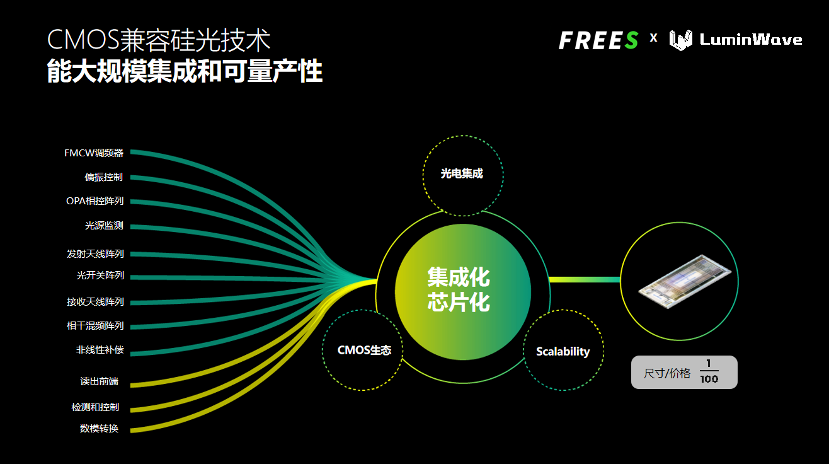
▲ Image source: LuminWave
From another angle, scanning methods — mechanical, semi-solid-state, solid-state — all refer to scanning at the transmitter end, how the light source covers the scene. There's also a trend at the receiver end. The earliest CMOS-based camera-like solution used PD (photodiodes), gradually transitioning to APD (avalanche photodiodes), and then to SPAD (single-photon avalanche diodes). The iterative goal of these solutions is clear: on one hand, continue increasing optical power at the source. Of course, increasing laser power brings many problems. The other goal is increasing receiver sensitivity.
As iteration progresses, receiver sensitivity needs to improve, gradually transitioning to frequency modulation schemes. From the principle of electromagnetic wave detection, whether millimeter wave or microwave, all detection schemes using electromagnetic wave bands will eventually transition to frequency modulation — the FMCW scheme.
Ultimately, we believe that for LiDAR: first, the transmitter end will adopt solid-state scanning methods. Second, the receiver end will eventually transition to frequency modulation (FMCW) to solve practical problems. This is the underlying logic of LiDAR development, why everyone is moving this way. The frequency modulation scheme has several overall advantages:
First, it has relatively high sensitivity. Second, strong anti-interference capability, at two levels. One is resistance to outdoor sunlight. The other is anti-crosstalk capability between radars. Right now vehicles don't have many LiDAR units installed, but in the future each vehicle may have four or five. Interference between radars is a problem that must be solved. Third, by adopting frequency modulation, you naturally obtain Doppler frequency, giving you velocity field information about targets.
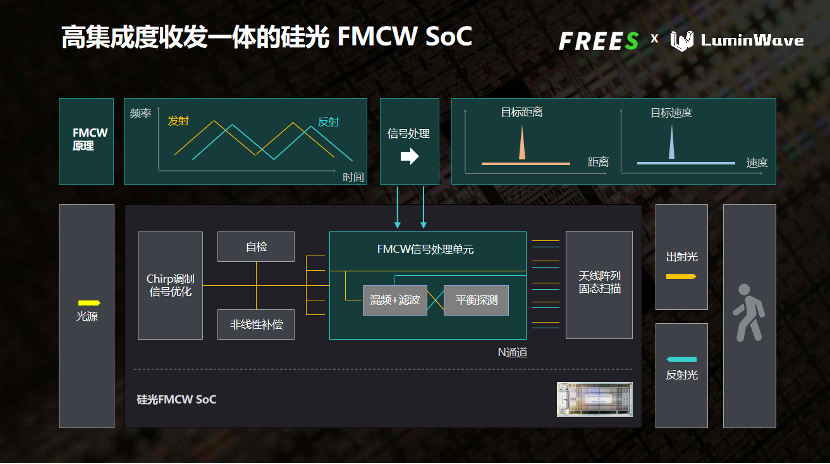
▲ Image source: LuminWave
This benefits computing power, robustness, and reducing corner cases. This is the underlying logic for why we're pushing solid-state FMCW LiDAR.
Yongcheng Yang: So this is the underlying logic for pushing solid-state LiDAR, including FMCW LiDAR. This kind of new technology is an inevitable trend for industry development — is this equivalent to a弯道超车 path in technology?
Ningning Feng: Generally speaking,弯道超车 is quite difficult. If you're always following behind others, you definitely won't succeed. You necessarily have to walk a parallel path.
Yongcheng Yang: Mr. Feng just mentioned two main LiDAR technologies, OPA and FMCW. FMCW is the frequency modulation Mr. Feng described — with the same signal, frequency modulation has better receiving capability and higher signal-to-noise ratio. Additionally, frequency modulation can reduce mutual interference between radars.
OPA is the scanning method. OPA is actually optical phased array. For example, earlier radars all looked like woks, with large mechanical structures rotating them — this accomplished scanning. Wherever that wok was pointed, that's where it was observing.
What's the development trend for microwave and millimeter-wave radar? In the Aegis combat system the U.S. built, the most important component is phased array radar, which mainly relies on electronic scanning to replace traditional rotating radio wave radars. Phased array radars contain numerous antennas, called arrays. By modulating signals to different antennas, you achieve the actual scanning effect.
Mr. Li, the technical path you've chosen is ToF. Whether mechanical or semi-solid-state LiDAR, ToF can be used at the receiver end. What are the application scenarios for this technology and product?
Li Cheng: VisionICs works on dToF technology. You've probably heard of it quite a bit. What does "d" stand for? It stands for "direct." "ToF" stands for "Time of Flight." That is, I have a laser, the light emits a pulse, and by measuring the round-trip time of the pulse in space, I get the distance to the target object. Because distance equals time times the speed of light, and round-trip time divided by two gives you the distance.
Join Us
VisionICs is currently hiring for PM, Product Assistant, Engineer, and other positions. Friends interested in VisionICs are welcome to submit resumes to hr@vidar.ai
Through this technology, you can capture the 3D contour of target objects, with measurement precision reaching millimeter level.
Now looking at dToF versus FMCW — they're two completely different technologies. If we return to the optical communications field, we see two types of optical communication. Because I personally was in the U.S. doing optical communications plus optical computing. In large data centers, called Mega Data Centers in Europe and America, with one-way distances exceeding two kilometers. Such direct optical connections basically use direct modulation. This corresponds in free-space optical propagation to dToF.
Except in large data centers, we're transmitting through fiber optics. The FMCW that Mr. Feng uses is somewhat similar to long-distance optical communication. Its biggest advantage is excellent transmission signal-to-noise ratio, and resistance to sunlight. For example, in undersea optical communication, you need a repeater every few dozen kilometers. FMCW signals can propagate very far, reducing the number of repeaters needed.
These two technical paths have both developed for decades in optical communications, coexisting with their own respective advantages. For short-distance optical communication, within two kilometers, direct modulation can be done at lower cost. For long-distance communication, it can transmit very far, but is relatively more expensive. So we see an interesting phenomenon: in the free-space optical communications domain, short-distance direct modulation desperately tries to extend to longer distances, while long-distance coherent optical demodulation desperately tries to enter data centers to reduce costs.
Overall, I think both will have their coexisting commercial domains, with overlapping spaces.
Another very common industrial example is Group IV silicon-based CMOS versus III-V semiconductors. This has existed since the birth of semiconductors. From a process perspective, Group IV silicon-based CMOS is cheap, but its performance can't match III-V semiconductors. III-V is expensive — for example, you can't cut many dies from 2-inch or 4-inch wafers, and yield rates aren't high, but the performance is good, though the price is relatively high. They're both penetrating each other's territories. I think these two technologies don't conflict; each will have its corresponding commercial domain, plus areas of mutual overlap.
Yongcheng Yang: Beyond autonomous driving applications, Mr. Li, what other applications are there for the single-photon detectors and other sensors you work on? Where are the "nails"?
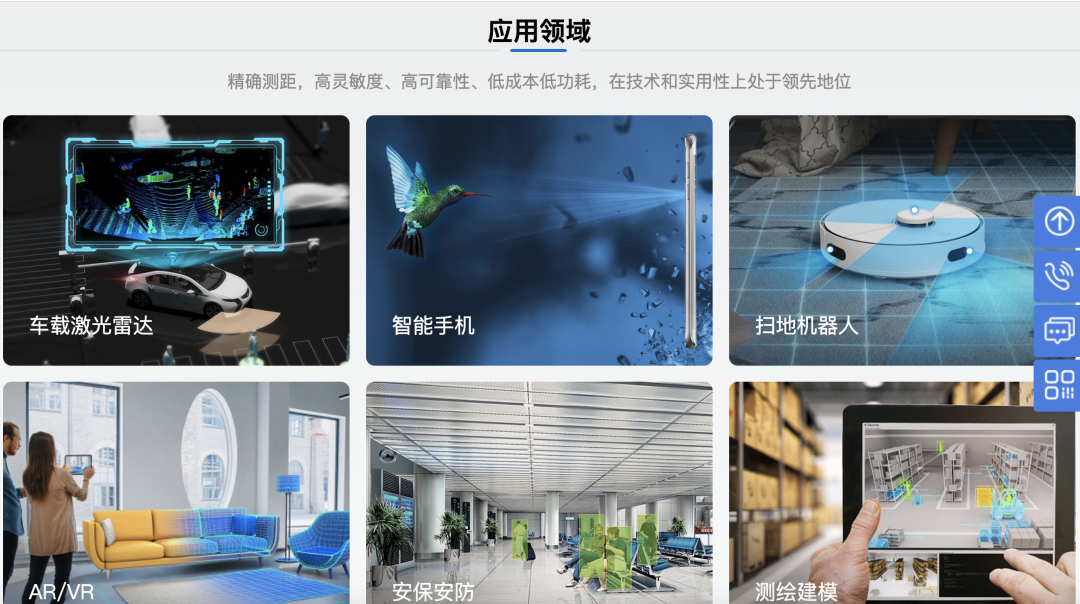
Li Cheng: To put it grandly, it's 3D imaging. In plain language, it's doing distance measurement, and there are many application fields.
Using "hammer" and "nail" to比喻 hard tech and its application scenarios is very apt. VisionICs, as the name suggests, started in Silicon Valley in 2016 with a grand vision. First make dToF LiDAR chips, then dToF LiDAR modules, then sensor fusion — combining LiDAR, camera, and millimeter-wave all together into an algorithm solution.
In 2016 we took a "big hammer" and went everywhere looking for "big nails" to hit. From 2016 to 2018, we almost broke the "hammer," and in the end we couldn't hammer anything in.
So we pivoted decisively into consumer electronics. Some people said this technology was overkill for consumer electronics, but that wasn't the case at all.
Taking this technology into consumer electronics gave us a real-world application domain to refine the company's entire operations — how do you define a chip? How do you define specifications? How do you define packaging? How do you plan testing?
▲ Image source: VisionICs
Without honing the company's operations and quality systems in consumer electronics, VisionICs would have struggled to expand into the automotive sector.
After years of entrepreneurship, my biggest takeaways boil down to two sentences:
First, the right "hammer" needs to find the right "nail" — applied to the right market. Second, there's no such thing as permanently leading technology, but there is such a thing as permanently leading operations. The camp stays iron while the soldiers flow through — that's the core competitive advantage of a company.
Yang Yongcheng: Every startup has different technical approaches, but they may all go through the same trials. Mr. Feng, you also started with impressive technology and a strong team. What are your thoughts on finding the "nail"?
Feng Ningning: All entrepreneurial teams run into more or less the same problems. At the start, we held our "technology" — the hammer. Of course you initially think this thing can knock everywhere, but in the end you discover...
Yang Yongcheng: Back then you thought it was a universal "hammer," right?
Feng Ningning: Exactly.
Yang Yongcheng: Otherwise you wouldn't have entered the arena.
Feng Ningning: This is what they call confronting reality. Ultimately, you have to sell the product. The customer's problem is the "nail" — your "hammer" needs to solve it with one strike.
What's the problem startups face? Limited resources. Including funding, market timing, and team — these resources are finite and can't be squandered without limit. With limited resources, how do you drive the "nail" home? A giant "hammer" hitting a "small nail" won't work, or a "small hammer" hitting a "big nail" won't work, or the wrong material won't work either. The most important thing is using the right "hammer" for the right "nail." In ancient terms, this is "the right timing, the right place, and the right people."
LuminWave makes solid-state LiDAR using silicon photonics technology. Why wasn't anyone doing solid-state in previous years? There was no "hammer." Silicon photonics was proposed in the 1980s and 90s, but real mass production only happened after 2015.
Chip tape-outs, complete upstream and downstream supply chains, customer demand — only when all these exist do you have the capability to solve problems, and only then do you have the "hammer."
If we view solid-state LiDAR as a "nail," then optical chips, electrical chips, hardware and software — each of these problems needs solving, and each is a "nail." When you go to solve these "nails," each requires the right "hammer," and that problem becomes enormous — impossible to fully solve.
Looking at LuminWave's LiDAR chips, we identified the core OPA chip + FMCW as the underlying "nail" we needed to solve, or rather, for our LiDAR it's the "hammer." Solving this requires a good tool — the entire semiconductor ecosystem. This ecosystem should be built by national-level forces; we just need to use this "hammer."
For startups, you need to be clear about which "hammers" you can build and which you can't — you can only use. In principle, avoid building "hammers" that don't match your capabilities; use mature "hammers" to hit the "nails" you need to solve. The benefit is that once you've fixed your "nail," it becomes your downstream customer's "hammer." For example, once you make good photonic chips and modules, they become a "hammer" for LiDAR. Once LiDAR is done well, it becomes a "hammer" for downstream autonomous driving. This drives the entire industry chain forward.
For founders, especially scientists turned entrepreneurs, the most important thing is getting your mindset right. We just talked about "hammers" and "nails" — perhaps in one domain, a very good "hammer" can't solve a "nail" in our field given limited resources and time, so you need to find the right "nail."
On one hand, you must believe in your direction, but you also need flexibility. Ultimately we're solving "nails" — customer-oriented "nails." If you just work in isolation, heads-down on your own thing, even if you build it, it won't be the right product.
On the other hand, put the right people in the right roles. From the start of entrepreneurship, think through your team's positioning. Every partner needs their own specialized domain; the founder needs to organically integrate several domains. Scientists, partners — everyone needs to put themselves in the right position. Only by maximizing the team's combat effectiveness can the company go the distance.
Overall, for hard tech startups to succeed, customers and talent are crucial.
Li Cheng: Sometimes a product that looks perfect isn't what customers need at all.
Where do good products come from? Not from your own research background, academic world, or guessing what customers need while working in isolation. You need to get out there, communicate with customers, listen.
Another issue: you might visit ten customers and get a hundred requirements. You find there's no way to satisfy all of them. This is when founders or market teams need the ability to synthesize and summarize — identify the most critical requirements, pick out the most implementable application needs. These are the common needs that all customers care about most.
**/ 03 / ** Mass Production: Industry Chain and Technical Challenges Still to Overcome
Host: What are the future technical challenges? How do you solve the problems of mass production?
Li Cheng: In the single-photon dToF chip field, you need to consider the development of automotive applications and the maturity of the entire industry.
In automotive LiDAR, Sony launched a chip called IMX459. This is likely a chip Sony developed for future solid-state automotive LiDAR.
Where's the difficulty domestically? First, domestic single-photon detector device processes need to reach Sony's level. For example, achieving high photon detection efficiency and low dark counts.
Another chip is the entire circuit architecture. You need optimized circuit architecture, good algorithms for anti-interference, denoising, etc., all built into the chip architecture.
Then there's how to achieve high-yield wafer stacking? How does the entire semiconductor manufacturing process support this? How to achieve stable mass production? Can you reach over 95% yield? These are critical points for dToF landing in automotive LiDAR.
After solving these technical problems, how do you pass automotive qualification? Temperature range, reliability, redundancy design — these are all issues solid-state LiDAR needs to consider. From initial product completion to process optimization to high-yield mass production, this requires time to settle.
Feng Ningning: LiDAR itself is a system-level solution. This demands high system-level integration capability from the team. From one chip or multiple chips, through the entire semiconductor supply chain of tape-out and packaging, to finally completing a device-level, module-level product, then integrating into a system-level solution — there are many upstream and downstream manufacturers involved. On one hand, solid-state LiDAR has high requirements for supply chain maturity, so products must be launched at the right time.
But on the other hand, companies can't wait until the supply chain is fully mature before launching products, because market demand already exists. Making the right product with supply chain constraints severely tests the team's comprehensive capabilities.
Every such chip and system needs to meet automotive-grade requirements. The automotive qualification process takes at minimum one to two years, and up to three to four years. For startups to survive and ultimately get products into vehicles, the road is long.
Long-term and short-term markets — these are somewhat contradictory, but both must be done for the company to continue sustainably.
**/ 04 / ** How Hard Tech Companies Survive Cycles
Host: The venture capital industry is currently in a downturn. As investors, what advice do you have for hard tech entrepreneurs?
Yang Yongcheng: Stay firm in your direction and have confidence in the future. In China's hard tech sector, there's substantial import substitution opportunity in frontier technologies, and market demand exists for the long term.
From a policy perspective, the country is unwaveringly supporting hard tech development. There will be policy support, but for startups to enjoy policy and market dividends, they must rely on their own efforts to win a place and establish themselves. In the long run, hard tech entrepreneurship is a favored track.
Capital retreat is cyclical in the investment industry. The industry intermittently experiences cold spells, usually preceded by overheating. During overheated periods, good "hammers," bad "hammers," and those without "hammers" all enter to start companies. When it cools, it tests teams' technology, product capability, and business model more — only by making an excellent hammer can you survive the cycle and persist to the end.
During capital retreat, startups need to watch two things:
First, no matter how good the technology, achieve commercial landing as early as possible.
Second, manage your cash flow. Follow market laws, do solid work building the company. Seize resource windows — raise funding when you should, manage cash flow, control expenses, and work on internal capabilities during the winter. When spring comes, the seeds and resources you've accumulated can better drive company growth and development.
Interactive Giveaway
Welcome to share your thoughts on hard tech entrepreneurship in the comments. The 6 readers with the most thoughtful comments will receive a bath set from FreeS Fund portfolio company Yuki (each set includes 500ml amino acid snowland moisturizing body wash and 500ml amino acid snowland smoothing shampoo).

Yuki is a comprehensive IP derivative services provider, combining IP with fast-moving consumer goods and focusing on lower-tier markets to help IP gain more exposure.

How Should Chip Companies Position Themselves Amid the IoT Industry's Rapid Growth? | FreeS Chip Series Entrepreneurial Challenges and Opportunities Behind the "Chip Shortage" | FreeS Research · Chip Series In Chips, How Do You Go From Scientific Innovation to Tech Entrepreneurship? | FreeS Chip Series FreeS's Yongcheng Yang: The Red Ocean Is the Ultimate Battle Entrepreneurs Must Face | Chip Series Livestream Registration Open Why We're Bullish on the Optical Chip Industry | FreeS Chip Series Can Domestic Semiconductor Materials Outpace International Competitors? | FreeS Chip Series
▲ Feng Li's Column | A 2 Trillion Market and 10 Trillion Output Value: Why We're Bullish on Chinese Chips ▲ How Do Tech Companies Go From "Valuable Technology" to "Profitable Technology"? | FreeS Research
▲ FreeS 2021 Outlook ④ | Endgame Speculation for Sensors Behind Autonomous Driving