Li Feng Column 16 | The Fresh Retail Wars — Learning Early-Stage Investing from the Secondary Market
Exploring the Struggle to Buy Groceries During the Pandemic — and What It Reveals About China's Fresh Retail Industry
This week, we got back to work (online). Like you, our hearts have been with the pandemic these past few days, and we've tried to do our small part (see FreeS Fund's Actions and Call to Action in Supporting the Fight Against the Novel Coronavirus). The situation remains severe, but fear itself creates no value — action is what gets us through hard times together. So we press on.
Today, I'm bringing you the 16th installment of this column. In this issue, I want to explore the difficulty of buying groceries during the pandemic and the fresh food retail industry behind it, as well as what early-stage investors can learn from the secondary market.
Regarding the secondary market, my own experience is this: first, compared to early-stage investing, the number of companies in each industry is limited and not easy to increase quickly, and they are all leading enterprises with relatively sufficient information disclosure, making them easier to compare and research.
Second, early-stage investing makes it easier to spot emerging trends and changes — in other words, standing today to look at tomorrow. But sometimes we underestimate: how a "traditional" industry's leading enterprise and its industry got to where they are today and formed the current landscape, how they respond to today's changes, and how their responses to current changes will affect the future landscape. To me, this is better described as standing today to look at yesterday. For any industry that has been fully marketized and existed for many years, this perspective is very helpful for my early-stage primary market investing.
Specifically to the fresh food retail industry. It has experienced ups and downs for three years, consistently playing the vanguard role in the new retail wave — from the intrusion and advance of internet-native newcomers, to major companies joining the fray, to various vegetable-selling models, to the recent sudden COVID-19 outbreak boosting fresh food e-commerce.
In this article, I use a listed company that has gone through turmoil and successfully transformed into new retail as my main research sample, to think about interesting commercial phenomena in fresh food retail and the essence of fresh food entrepreneurship, and to learn how the primary and secondary markets can connect and inform my daily early-stage investing.
This is the first article in a new sub-column of Li Feng's column: "Learning Investing from Investing." Going forward, we will continue through "Learning Investing from Investing" to share with you my observations on the growth and changes of portfolio companies or what I observe in the secondary market, to deconstruct the origins and future of the specific business domains they represent, and to abstract and summarize some experiences and patterns from them.
In this article, we will explore:
- For the same business, why do the primary and secondary markets have such different valuations and views? Which is more correct?
- Can "traditional" industries transform, and how? Can they catch up from behind?
- As part of retail, what rules does fresh food follow that differ from traditional retail, and what aspects fully conform to existing retail rules? Who will be the final winner (or survivor), and why them?
Based on my research of some secondary market phenomena, my approximate answers to the above questions are:
- The secondary market tends to use the slope of the extension line from past to present as growth for valuation, while the primary market more often uses the slope of the extension line from today to the more probable tomorrow as growth for valuation. Both have rationality, and both may have deviations. Especially when an industry's development happens to be at an inflection point where it recently began to become a broken line, the two will form differences (possibly quite large) and each will form some judgment errors. I will use fresh food as an example in this article.
- The core factor for "traditional" industry transformation and the continuous development capability of large companies is very consistent with early-stage investment criteria: it's "people." The founder's original intention, capability, and determination are the most critical factors affecting enterprise development, bar none.
- The biggest difference between fresh food and other retail industries is that the underlying supply is affected by the history of China's agricultural policies, so it is temporarily not easy to standardize or industrialize. Additionally, fresh food retail is still retail at its core. The final winner (survivor) is very likely to be the enterprise that can use full-chain supply chain efficiency to respond to as many user scenario demands as possible.
- Entrepreneurs should not easily underestimate traditional, fully competitive industries, because these industries contain people who can integrate supply chains and people who can improve industrial chain efficiency. Those with past accumulation who have been number one before, once they complete transformation, will have the advantage of catching up from behind.
Views in this article do not constitute investment advice. I hope to provide new angles for thinking, and welcome you to share your insights on fresh food retail in the comments at the end.

/ 01 /
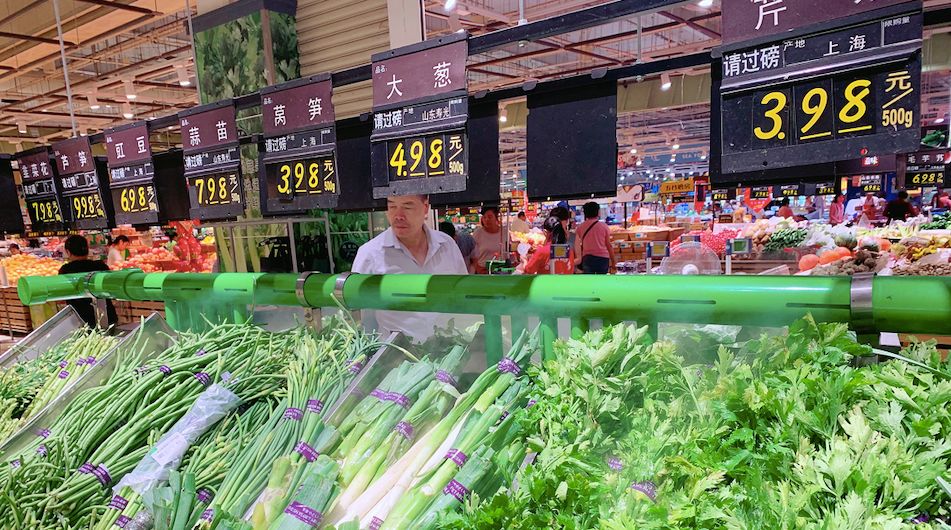
A "Magical" Fresh Food Company
If there were a fresh food e-commerce company like this, how much do you think it would be worth?
First, look at its online business data: 500,000 daily orders, 76% of stores distributed in tier-three and below cities (meaning most orders come from lower-tier markets), annual GMV reaching 10 billion RMB, average order value of 62 RMB, fresh food accounting for over 50% of sales.
Besides the high fresh food proportion, this company's out-of-stock rate is below 0.3%, and the probability of on-time delivery within one hour for goods within a three-kilometer range exceeds 99%, basically able to comprehensively and promptly respond to user demands.
Moreover, this company is growing rapidly, with total order volume increasing 50% every half year. That is, on the basis of 500,000 daily orders, current annual GMV is 10 billion RMB, and in another half year it might be 15 billion.
More importantly, it didn't achieve this by burning money (let alone burning hundreds of millions of dollars), and according to official statements, this new retail business itself is actually not losing money when accounted for separately.
"Do you think such a company exists in China's fresh food market? If so, how much do you think it's worth?" I've asked this question on several occasions to entrepreneurs and executives present.
Some said $3 billion, some said $10 billion. Once I ran into Diaoye on a flight, and he said such a company would be worth at least several tens of billions of dollars. Indeed, in the past two years, fresh food e-commerce companies have been generally sought-after in the primary market, frequently raising hundreds of millions of dollars at valuations of several billions.
The answer is revealed: such a company does exist. It's RT-Mart. RT-Mart's business in mainland China started in 1998, and it took 11 years to surpass Carrefour, Walmart, and other international retail giants in 2009, becoming the largest foreign-invested supermarket enterprise in China.
The data mentioned above comes from the online business data disclosed in the semi-annual report released by RT-Mart's parent company Sun Art Retail on August 7, 2019.
Treating this data as that of a standalone fresh food e-commerce company, based on my small-scale survey, the primary market entrepreneurs' and investors' valuation of Sun Art Retail's only half-year-old online business (several tens of billions to $10 billion) is already close to the secondary market's valuation of Sun Art Retail's combined online and offline business.
On the day after Sun Art Retail released its 2019 semi-annual report, August 8, 2019, its market cap was about 67 billion RMB (less than $10 billion), nearly half lower than its full-year 2018 revenue of 101.3 billion RMB. That is, for Sun Art Retail as a company, a "valuation inversion" phenomenon may have occurred between the primary and secondary markets.
And this "valuation inversion" phenomenon leads to a series of unsolved mysteries: Why was RT-Mart only worth over 60 billion RMB in the secondary market at that time? (This means Sun Art Retail's nearly 100 billion RMB annual offline revenue scale in recent years, and its 2018 profit of 2.588 billion RMB, were almost given no valuation.) How did RT-Mart transform its traditional supermarket business to online? What can the primary market learn from RT-Mart's development journey? Why do the primary and secondary markets see the same commercial phenomenon from different perspectives?
/ 02 /
Why Was RT-Mart Only Worth Over 60 Billion RMB in the Secondary Market Then?
An important reason RT-Mart was worth more in the primary market than the secondary market is that the primary market is extraordinarily sensitive to innovation. The secondary market is more sensitive to results. From the secondary market's perspective, Sun Art Retail originally belonged to a traditional industry, and even though RT-Mart's online business now has eye-catching data, for a long time it was a "typical" example of physical retail being hit by e-commerce.
After domestic e-commerce platforms began flourishing, supermarket retail enterprises including RT-Mart had to face not only offline competitors but also online digital legions and new demands from consumer upgrading.
RT-Mart also failed to remain unaffected in the trend of online-offline integration and the wave of consumer upgrading. In previous years, its stock price, same-store sales, and performance growth sources all showed fatigue. From early 2014 to May 2016, Sun Art Retail's stock price fell continuously. Financial report data shows Sun Art Retail's same-store sales fell 3.6% in 2015, improved in 2016 but still fell 0.34% year-over-year. According to research reports from Essence International, Sun Art Retail's performance growth in 2015 and 2016 mainly came from newly opened hypermarket stores, while already-opened stores had negative performance growth.
Even when Alibaba acquired 36.16% of Sun Art Retail for HK$22.4 billion in November 2017, Sun Art Retail's stock price only rose briefly and remained relatively low. This isn't hard to understand: although the market recognized that acquiring RT-Mart was an important step in Alibaba's offline retail layout, before Huang Mingduan's return, neither the operational level nor financial data showed obvious improvement in RT-Mart's development.
There were many reasons RT-Mart fell behind in the consumer upgrading wave, one of which was failing to seize the fresh food consumer upgrading opportunity first.
We reviewed more than ten listed supermarket companies in A-shares and Hong Kong stocks and found that the fresh food market is undoubtedly the hottest entry point for new retail currently, and fresh food is also widely recognized as a representative category of consumer upgrading.
However, in the retail format for fresh food consumer upgrading demand, RT-Mart's fresh food proportion was once not high. In 2018, fresh food accounted for 32% of RT-Mart's sales, while Yonghui had 47.6%.
Getting good at the fresh food business did wonders for Yonghui. In 2018, Yonghui was aggressively expanding in the fresh food market through its Super Species brick-and-mortar stores and mobile app, one of the few major domestic supermarket chains still maintaining roughly 20% growth. RT-Mart, meanwhile, was at a competitive disadvantage — its revenue growth, same-store sales, and sales-per-square-meter figures all confirmed this.
In 2018, Sun Art Retail's revenue growth turned negative for the first time in the eight years since its IPO, at -0.98%, while Yonghui Superstores stayed in double-digit growth territory. Sun Art Retail's same-store sales declined for three consecutive years from 2016 to 2018, whereas Yonghui Superstores posted positive growth.
Because RT-Mart stores are larger in size, it also held no advantage over Yonghui Superstores in sales efficiency per unit area. According to statistics from Lianshang.com, RT-Mart's sales per square meter declined to varying degrees for three straight years from 2015 to 2017, while Yonghui Superstores' figure remained basically stable. In 2017, RT-Mart's sales per square meter were 8,211.94 RMB/㎡/year, compared to Yonghui Superstores' 11,154.88 RMB/㎡/year.
/ 03 /
Three Key Points of RT-Mart's New Retail Transformation
RT-Mart made a resolute and thorough pivot to online within its existing format
After Alibaba took a stake, RT-Mart made many changes, particularly numerous offline adjustments to accommodate online operations.
First, it increased coordination with Alibaba on direct-to-consumer online businesses like Taoxianda and Tmall Supermarket.
Taoxianda is Sun Art Retail's new retail project in cooperation with Alibaba. Users can access the "Taoxianda" entry point within the Taobao mobile app to purchase RT-Mart's fresh food products with home delivery service. This online-offline integrated solution enables digitized operations and improves overall efficiency.
After piloting the Taoxianda project at two stores in March 2018 and proving out the model, RT-Mart rolled out "Taoxianda" across all its stores in just over nine months. For RT-Mart, this meant gaining an additional online traffic entry point. As a result, "Taoxianda" attracted and cultivated a large base of online users for RT-Mart, increasing the proportion of younger customers.
Furthermore, starting from late March 2019, the delivery radius for the "Taoxianda" service at select stores expanded from 3 kilometers to 5 kilometers, while maintaining the same product availability rate and on-time delivery rate. This effectively meant a single physical store could fulfill online orders across a wider area, generating more retail revenue and optimizing the cost structure.
Because of RT-Mart's high operational efficiency and the advantage of having over 20,000 SKUs per store, it also took on ground delivery services for Tmall Supermarket. Additionally, RT-Mart established fast-pick warehouses, pre-consolidating inventory of popular SKUs to improve sorting efficiency.
Beyond its B2C business, RT-Mart launched a B2B service called "RT-Mart e-Lufa," providing management and distribution services to retail and wholesale merchants within a 20-kilometer radius of RT-Mart stores. This was essentially shifting mom-and-pop store sales online, somewhat similar to JD Supermarket. In its 2019 interim report, Sun Art Retail stated: "B2B revenue is expected to grow 50% in 2019, joining the ranks of industry players with tens of billions in revenue in the near future."
Similar to RT-Mart, Yonghui had also attempted an online business transformation, including Yonghui stores, Super Species, and Super Species home delivery services. However, at the end of 2018, Yonghui spun off "Yonghui Cloud & Innovation," which had been operating its online business and losing money for three consecutive years, into an independently operated company. It was no longer a transformation within the same system.
Therefore, it can be said that RT-Mart was the most thorough among traditional supermarket chains in its online transformation — its online business was a newly developed capability. Of course, this was inseparable from Alibaba's influence.
▍In early 2019, founder Huang Ming-Tuan returned
When RT-Mart founder Huang Ming-Tuan resigned in early 2018, an article about him spread widely: "RT-Mart's Huang Ming-Tuan: I Beat All My Competitors, But Lost to the Era."
Later, Huang clarified that he never said those words, but in the business world, he had indeed beaten all his competitors. When RT-Mart entered the mainland China market in 1998, its rivals were multinational retail groups like Carrefour and Walmart. After 11 years of fierce competition, in 2009, RT-Mart surpassed both Carrefour (36.6 billion RMB) and Walmart (34 billion RMB) with 40.4 billion RMB in sales, becoming China's largest foreign-invested supermarket.
In 2016, the revenue of Sun Art Retail, parent company of RT-Mart and Auchan, broke 100 billion RMB — roughly double that of second-ranked Yonghui Superstores.
In November 2017, when Alibaba took a stake, Sun Art Retail received Alibaba's largest single investment to date.
There is no doubt that Huang Ming-Tuan is someone extremely capable and knowledgeable about retail itself, including the supermarket format.
In 2019, competition in the supermarket market intensified further. We saw Costco enter the China market, while simultaneously seeing foreign supermarkets retreat from it. In September 2019, Suning acquired Carrefour's China business, and in October of the same year, Metro China's operations were acquired by Wumart. Foreign supermarkets' poor performance in China wasn't because the China market was bad, but because they were no longer as competitive compared to domestic Chinese supermarket chains.
That year, Huang Ming-Tuan proved on the new retail battlefield that he had both "beaten his opponents" and not "lost to the era."
In March 2019, Alibaba CEO Yong Zhang brought Huang Ming-Tuan back to take the helm again as CEO of Sun Art Retail. This appointment received formal approval from Sun Art Retail's board of directors in May 2019.
After retaking command at Sun Art Retail, Huang still had the same fierce determination to "make up his mind and never look back." He once said: "After we complete our transformation, we will fully roll out B2C online business in 2019. We need to be prepared to lose money for a year and a half, and for our stock to be in the doldrums."
The data I presented in Part One represents the report card Huang delivered in less than six months after experiencing the pain of internet transformation and returning to Sun Art Retail.
▍Online business changed RT-Mart's understanding of offline operations
After pushing into online, RT-Mart's offline and online businesses began to merge. In this process, from an observer's perspective, I believe RT-Mart changed its understanding of offline operations, optimizing its physical stores across categories, store appearance and layout, labor efficiency, and other dimensions.
Take RT-Mart's Shanghai Yangpu store as an example. It was among the earliest to be transformed, the most thoroughly overhauled, and the most typical case.
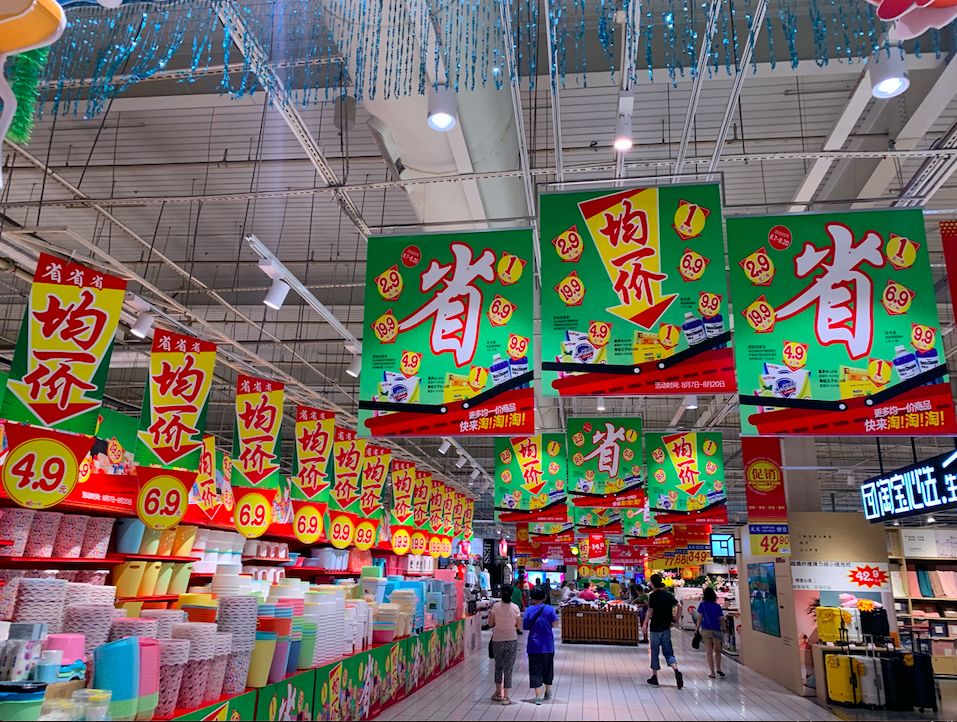
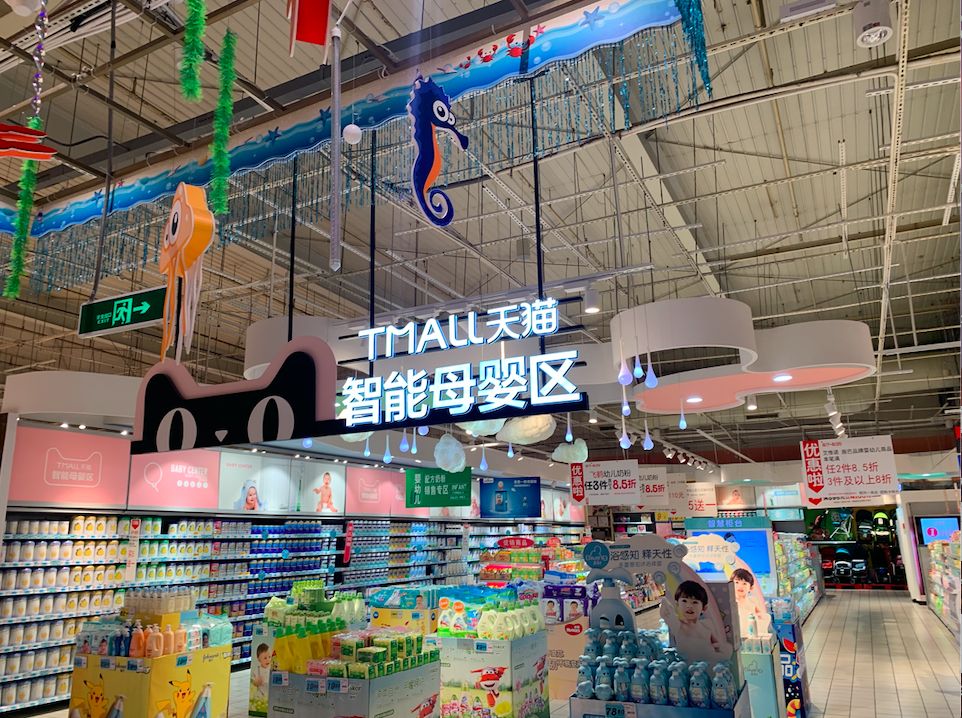
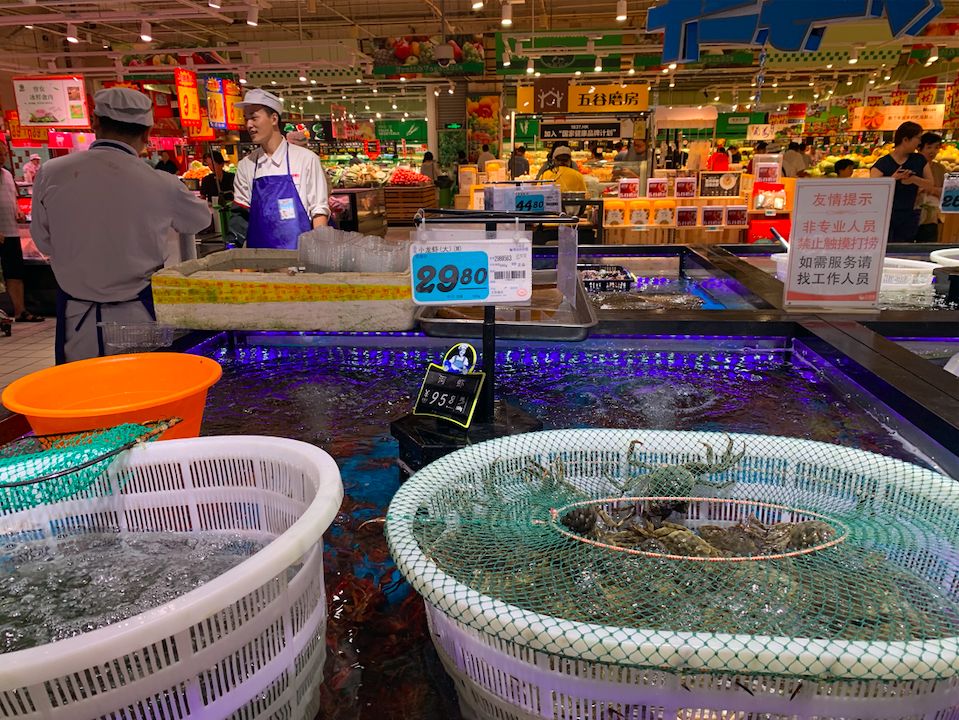
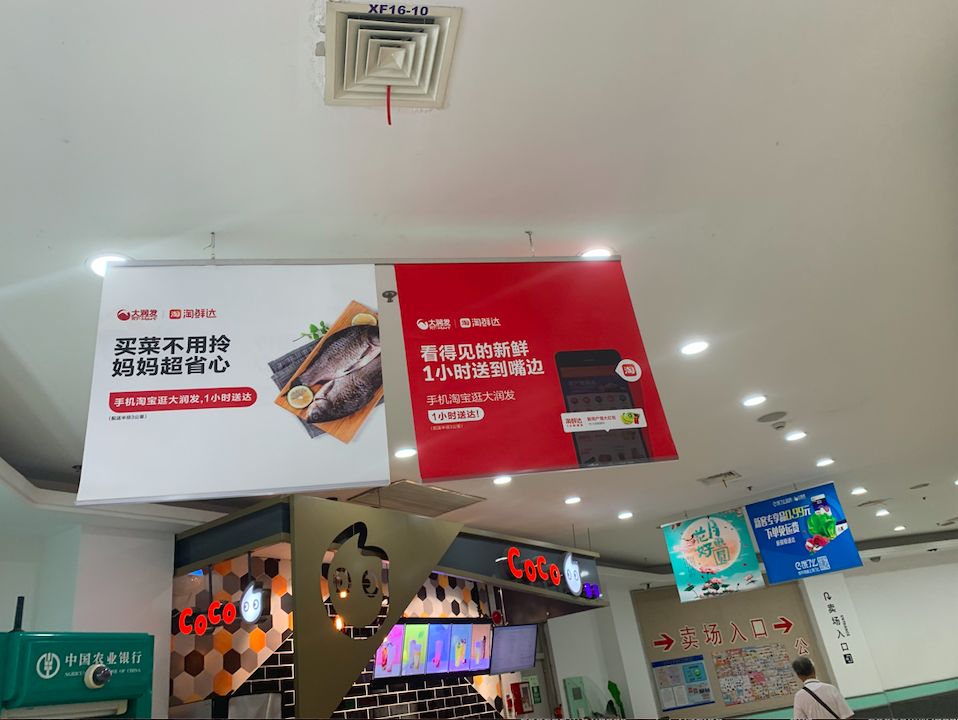
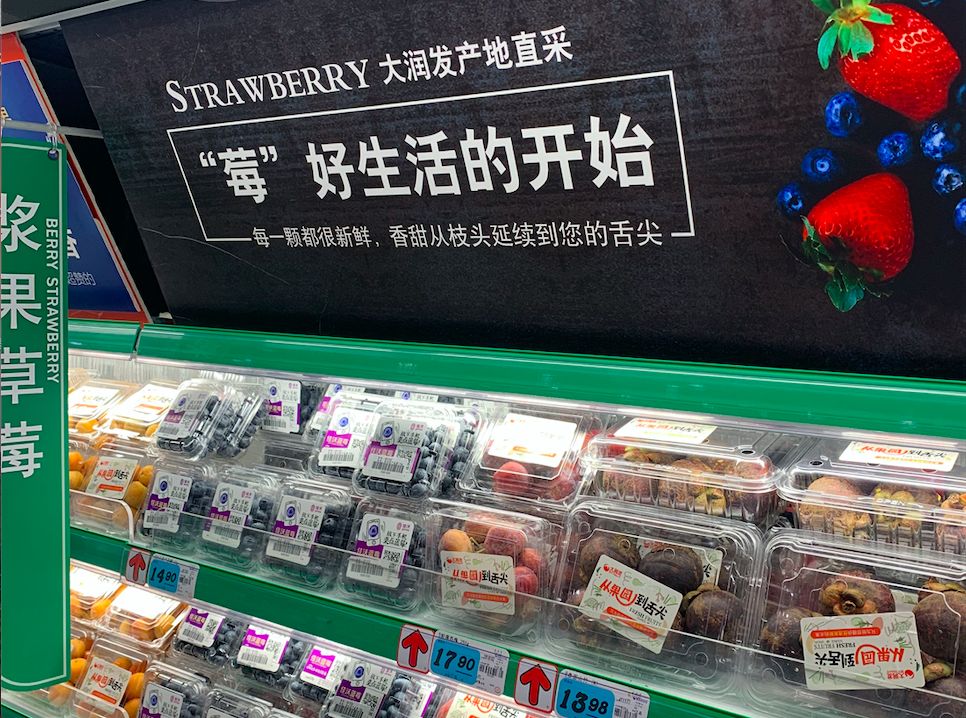
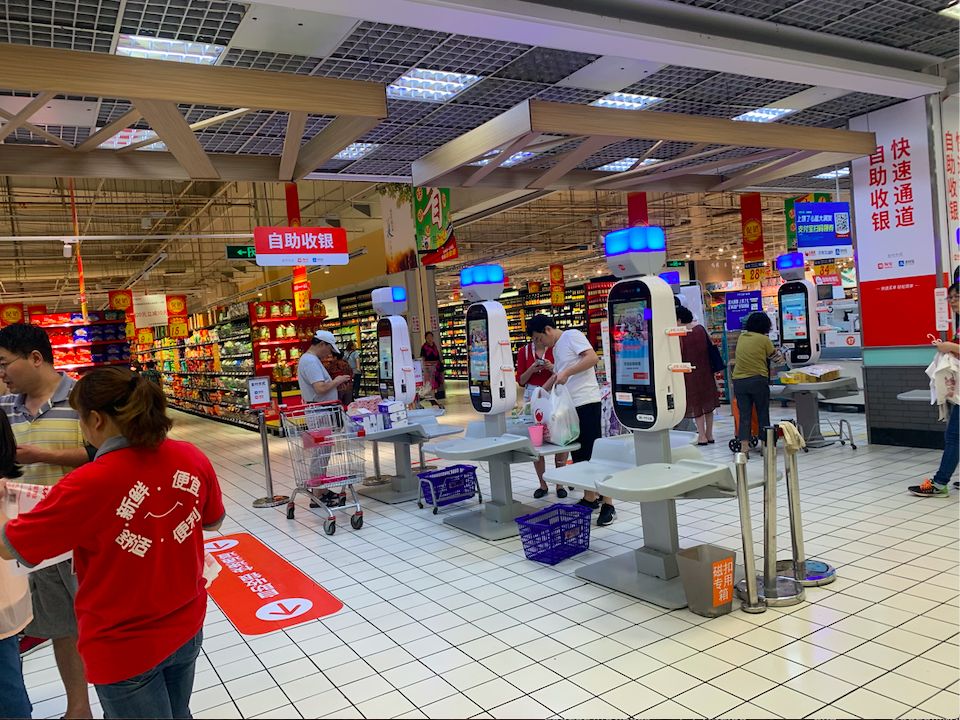
Photos taken at RT-Mart Shanghai Yangpu store, August 2019
(Swipe left/right to see more 👉)
At the category level, this store added a seafood section, introduced Freshippo's private label "Daily Fresh," and shared supply chains and products with Freshippo. The result of working to increase fresh food's sales share (from roughly 30% to over 40%) was that fresh food sales revenue at the Yangpu store grew 20% in 2019 compared to 2018. This met consumers' upgrading needs in the consumption upgrade era, attracted younger customer segments, and partially solved the problem of driving foot traffic to the store.
In terms of store appearance and layout, this store reduced packaging sizes for fresh products, adapting to the trend of smaller Chinese household consumption units and online "single-person meals." Additionally, it worked closely with Alibaba to introduce "Taobao Selection" as a store-within-a-store. Taobao's big data enabled clearer user profiling, which in turn allowed for richer product lines and better meeting the needs of young online customers.
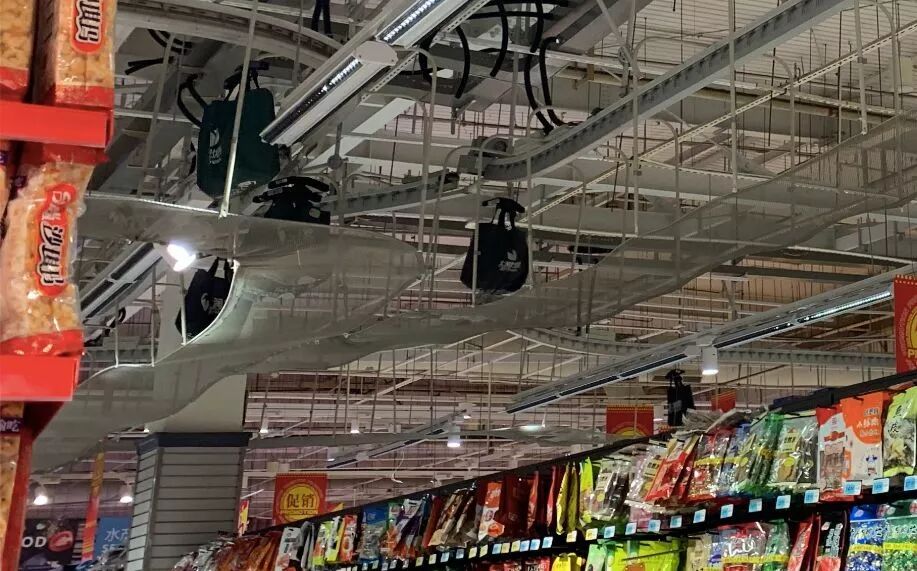 ▲ The overhead conveyor system inside RT-Mart Shanghai Yangpu store.
Furthermore, the Yangpu store adopted Freshippo's overhead conveyor system, with stocking ports set up in multiple category zones. When orders come in, products can be quickly picked and packages transported via the conveyor to the packing station. The fast-pick warehouse improves operational efficiency while also using collected online data to feed back into offline operations. Online orders help RT-Mart make SKU allocation and brand selection decisions offline.
The physical store transformation yielded visible results — this 20-year-old store was revitalized. Sun Art Retail's team mentioned at an August 2019 mid-year results meeting with TF Securities: "The renovated Shanghai Yangpu store's growth rate is roughly 10 percentage points higher than other non-renovated Shanghai stores, with fresh food same-store growth even reaching 20%."
RT-Mart has now "modularized" its offline store reconstruction process, with each store renovation taking roughly one to two months. Out of 485 stores in RT-Mart's renovation plan, 150 were renovated in 2019, and RT-Mart planned to complete renovations at another 200 stores in 2020.
/ 04 /
What inspiration can primary market investors
draw from RT-Mart?
1. What retail ultimately competes on is efficiency across the entire chain
According to data from Euromonitor provided by CITIC Securities Research & Development, China's fresh food sales reached 4.72 trillion yuan in 2017. Of all fresh food transactions, online and offline retail accounted for 47%, roughly 2.21 trillion yuan. Foodservice took 32%, while the remaining 21% went to B2B, serving various enterprises and institutions.
This means that whether you're talking about traditional supermarket retailers like RT-Mart and Yonghui Superstores, or the "new generation" of internet-native fresh food startups, everyone is fighting for a foothold in this 2.21 trillion yuan market.
And RT-Mart spent very little money to deploy a combination punch through traffic, supply chain, and store networks, improving efficiency across the entire fresh food retail chain and achieving the results mentioned above.
1) Online and offline traffic — both matter
After partnering with Alibaba, RT-Mart gained new traffic entry points through Taobao Fresh, Tmall Supermarket, and Ele.me.
According to a sharing session by Sun Art Retail Group's team with Tianfeng Securities during the August 2019 interim results briefing, of the 700 daily B2C orders, nearly half came from the Taobao Fresh entry point, around 70 orders came from Ele.me, and Tmall's "Supermarket One-Hour Delivery" contributed another 20 to 30 orders.
Beyond online traffic entry points, when we visited RT-Mart's Yangpu store in Shanghai, we found that RT-Mart also pays close attention to offline customer acquisition. It runs promotional activities directly at stores and in residential communities to convert offline users to online. This approach is admittedly traditional and common, but it remains an efficient, low-cost method for customer acquisition and promotion. Because RT-Mart is a well-known brand representing quality at low prices, users trust it, making conversion easier.
2) Using chain stores to "lock in" local supply chains, solving the challenges of fresh food at the agricultural and logistics levels
After driving traffic, you need a stable supply chain and sufficient product variety to meet user demand.
In fresh food retail, consumption upgrades start with seafood, but the subcategory users need most is vegetables. Why?
According to data from CITIC Securities Research & Development, from 2008 to 2017, vegetables consistently accounted for over 50% of Chinese household fresh food consumption, fruit made up 25% to 27%, and meat and seafood combined did not exceed 20%.
These figures may not match what you imagine or your own situation, but this is indeed the national market reality.
So starting from around mid-2018, fresh food e-commerce companies of various models — front warehouses, community group buying, chain stores — began to come to their senses and focus on attacking the vegetable market.
But selling vegetables in China faces dual challenges from underlying agriculture and logistics, and it's easy to fall into a thorny dilemma.
① Vegetable farming uses arable land, and large-scale farming has not yet been fully achieved
Vegetables occupy arable land, and once arable land is involved, scaling becomes difficult. The fragmentation of arable land traces back nearly 40 years to the household responsibility system. Although land transfer policies have been implemented for several years, we remain far from large-scale agriculture with hundreds of mu per capita.
Compared to vegetables, animal husbandry and fruit farming achieved industrialization and scale first. In fresh food, chicken was the first category in China to achieve industrialized farming. Chickens in farming facilities live in "apartment buildings." It was because chicken achieved industrialized farming that chain retail brands like Zhengxin Chicken Steak could emerge.
② Vegetables spoil easily and have low unit prices, requiring localized supply chains
Beyond the difficulty of scaling production at the source, another problem with vegetables is their low average transaction value and high water content, which causes them to spoil quickly. Low unit prices and quick spoilage mean most vegetables are unsuitable for long-distance transport and are best consumed nearby. If you want vegetables to stay fresh longer, you need cold chain logistics, which raises transportation costs. Given vegetables' low selling prices, cold chain becomes economically unappealing.
So vegetables are "troublesome," yet you can't do without them. This is a problem all fresh food entrepreneurs must confront.
Under the dual challenges of underlying agriculture and logistics, how does RT-Mart manage to sell vegetables well?
Because RT-Mart controlled the fresh food product supply chain when it was running offline supermarkets. It leveraged the network effects of its stores, first using several stores in a city to capture a local supply chain, then using the volume advantage of over 400 stores to improve bargaining power with suppliers and capture major supply chains one by one. (For more analysis on new retail supply chain issues, see "Li Feng Column 12: Speculations on the Endgame of China's New Retail | Frees Fund")
After integrating the supply chain, RT-Mart did two things.
The first is standardized products, meaning pre-packaged foods including cleaned and cut vegetables, as well as private label brands.
The combined volume of pre-packaged foods and private label brands is substantial, giving RT-Mart a very large total addressable market. Therefore, even when facing major brands like Coca-Cola and Master Kong, RT-Mart has room to negotiate.
The second is that after accepting Alibaba's investment, RT-Mart redesigned its logistics system.
RT-Mart shares a logistics system with Freshippo, not only providing ambient-temperature and low-temperature fresh food products. RT-Mart stores also make "aluminum-free fried dough sticks" and other flour-based items on-site, with online ordering and offline delivery. And when users buy fried dough sticks and flour-based items in the morning, they may also generate associated sales — for instance, conveniently picking up the vegetables they need for the day.
The overhead conveyor system mentioned earlier helps stores sort products quickly. RT-Mart also uses Ele.me's delivery capacity to provide transportation services for Taobao Fresh.
Having captured the supply chain, developed standardized products, and redesigned the logistics system, RT-Mart was able to make the vegetable-selling business work.
3) Stores as front warehouses, with rent actually making money for the company
Retail is an industry that competes fiercely on efficiency, and RT-Mart has pushed capital efficiency to the extreme.
RT-Mart has the largest single-store area among domestic supermarkets, approximately 27,000 square meters per store. Yonghui Superstores' single-store area is 7,000 square meters. Therefore, each RT-Mart store can serve as a front warehouse for online business. And with over 20,000 SKUs per store, it's sufficient to meet the various needs of both C-end users and small B users.
What's interesting is that thanks to RT-Mart's identity as a "sub-landlord," it hardly pays high rental costs for such large stores and front warehouses — in fact, it even makes money for the group through leasing activities.
Among Sun Art Retail's 485 comprehensive hypermarkets, 70% are leased stores, 29.8% are self-owned properties, and 0.2% are contracted stores. From the beginning of 2019 to the end of June, Sun Art Retail's rental income was 2.064 billion yuan (statistics in this paragraph are as of June 30, 2019).
In retail, everyone talks about how impressive Costco is because Costco doesn't make money on product margins — it makes money on membership fees. RT-Mart is also impressive. Although it doesn't charge membership fees, because its store rentals are still making money for the company, it has the ability to push product margins even lower, giving it a competitive advantage.
In terms of store distribution, 76% of Sun Art Retail's stores are located in third-tier cities and below (statistics as of June 30, 2019). Sun Art Retail's store volume and influence usually allow it to secure the best locations and negotiate the lowest rents.
RT-Mart's deep roots in lower-tier markets also have historical reasons — it could even be said to have been forced by circumstances. When RT-Mart came to mainland China in 1998 to operate supermarkets, Walmart and Carrefour were already there. In the late 1990s and early 2000s, opening supermarkets in China's first- and second-tier cities required obtaining quotas. These quotas were typically only given to international first-tier brands like Walmart, Carrefour, and Metro.
At the time, "taking a detour" to deeply cultivate third- and fourth-tier cities and even township markets instead became part of RT-Mart's core advantages today, allowing it to preemptively lock in the incremental markets that giants are now fighting hard to capture. (For more perspectives on China's consumption upgrade, see "Li Xiang × Li Feng: The Consumption Awakening of 200 Million New Urban Residents — Who Will 'Harvest' It?")
4) Using the same supply chain to meet different user needs, achieving scaled expansion
Because RT-Mart can acquire traffic at low cost, solve the challenges of fresh food in underlying agriculture and logistics, and achieve low-cost, high-efficiency operations in both warehousing and delivery, it uses the same chain and cost structure to solve four things: home delivery, in-store shopping, small B to C, and Tmall Supermarket fulfillment — and makes money on all of them.
After a series of transformations, RT-Mart's online business currently has a relatively high proportion of young users. If buying fresh food online represents the needs of young users, then the key question going forward is who can best meet user needs through full-chain efficiency.
Currently, RT-Mart has solved the problems of expansion and scaling through full-chain efficiency, achieving the effect of more, faster, better, and cheaper.
In summary, whether it's new retail or other retail, retail fundamentally competes on full-chain efficiency, because margins at every link are thin. Companies that have previously accumulated deep experience in this chain, if they can reassemble the chain according to new user needs, will have a latecomer advantage of overtaking others despite starting later — even if we tend to underestimate them and call them "traditional enterprises."
This doesn't only happen with RT-Mart. Here's another example: in the early Taobao Singles' Days starting from 2009, many Taobao-native brands ranked at the top. At the time, traditional enterprises weren't as sensitive to or familiar with the internet and e-commerce. However, after 2015, when traditional enterprises also learned to use the internet for e-commerce, most of those now topping the Singles' Day rankings have become traditional big brands. (For more thoughts on "retail is a competition of full-chain efficiency," see "Li Feng Column 11: The Middle Path of New Retail | Frees Fund")
2. The founder is the most critical factor in whether an enterprise can succeed
RT-Mart's transformation into new retail proves that a founder's capabilities, original intentions, and adaptability are key to a company's development.
RT-Mart's founder, Huang Mingduan, can be counted among the most formidable founders in China's retail industry. He spent over a decade making RT-Mart number one in offline supermarkets, then led RT-Mart's transformation into new retail.
Regarding questions about fresh food retail, I specifically sought advice from Wumart founder Zhang Wenzhong. Mr. Zhang is also a veteran of the retail industry whom I deeply admire.
In 1994, Zhang Wenzhong founded the first Wumart supermarket in Beijing and took the company public on the Hong Kong Stock Exchange in 2003, making it the first mainland Chinese private retail enterprise to list in Hong Kong. In 2015, he started anew with DMALL, aiming to empower the industry by providing digital solutions for retail enterprises. To date, DMALL has partnered with over 100 regional leading retail enterprises, covering more than 13,000 stores nationwide.
DMALL's success validates, from another angle, Zhang Wenzhong's vision, capabilities, and what a seasoned retail expert with massive supply chain advantages can achieve when transitioning to internet-based business.
That both Huang Mingduan and Zhang Wenzhong succeeded in fresh food retail — an arena that so brutally tests supply chain efficiency — is deeply admirable.
One takeaway I'd share: entrepreneurs should not underestimate traditional, fully competitive industries. These fields contain people who can integrate supply chains and improve industrial chain efficiency. Those with deep accumulated experience who have reached number one before, once they complete their transformation, have tremendous opportunity to achieve what others cannot imagine — at the lowest cost and in relatively short time.
In supermarkets, there's Huang Mingduan; in sportswear, there's Li-Ning. From 2012 to 2014, Li-Ning accumulated losses exceeding 3 billion RMB, losing its position as China's top sports brand. At the end of 2014, when the company was in dire straits, founder Li-Ning returned. By shifting from distributor-led to direct retail and strengthening proprietary e-commerce, he reached users directly, gathered feedback, and created a rapid, efficient product development-to-sales cycle. In 2018, Li-Ning's sales broke 10 billion RMB.
When a founder puts their reputation and entire being on the table, the company gains more chips to win with.
/ 05 /
Why do primary and secondary markets see things differently?
Returning to the question posed at the beginning: why do primary and secondary markets hold different views and valuations of the same company? How do their ways of thinking differ?
Broadly speaking, the primary market is highly sensitive to innovation; the secondary market is highly sensitive to results.
The two markets operate on different timelines when thinking through the same business changes.
When considering changes themselves and the trends they reveal, the secondary market typically looks backward from the business change, while the primary market tends to look forward from it.
When we look forward, it's worth noting that for retail — already such a mature domain and track — today's consumer trend shifts do not represent opportunities starting from zero. This trend provides ample room for opportunity. Such opportunity space belongs not only to newcomers creating new models, but also potentially to transformed traditional leaders.
For the latter, what's worth considering is: how did they and their industry arrive at today's格局 and form it, how are they responding to today's changes, and how will their responses to current shifts affect future格局.
Returning to RT-Mart itself: from the secondary market perspective, Sun Art Retail Group originally belonged to a traditional industry, then faced disruption from e-commerce and other new sectors. After Alibaba invested in Sun Art Retail, its stock rose briefly, but its market cap has consistently remained relatively low compared to retail groups like Walmart.
Similarly, Walmart faced disruption from Amazon. On January 31, 2020, Walmart's market cap was $324.8 billion. Approximately 60% of its sales came from the US: $324.8 billion times 60% is roughly $200 billion.
China will eventually become a larger retail market than the US. Yet RT-Mart and Yonghui, both focused on the domestic Chinese market, still have market caps below 100 billion RMB. RT-Mart, which grew from offline to become number one and successfully transformed online, theoretically has even more room for growth.
Moreover, the recent COVID-19 outbreak has confined countless people to their homes, accelerating the migration of the ancient, offline-dominated grocery shopping behavior online. This Spring Festival, we've seen multiple fresh food e-commerce companies experience surging order volumes and rapid growth. RT-Mart, with its massive offline scale and completed internet transformation, will undoubtedly benefit as well.
Things have their patterns, people have their patterns, industries have their patterns. Going forward, I will release more articles in the "Learning Investing Through Investing" series, continuing to share with you the developmental shifts I've observed in particular business domains — through the growth journeys of portfolio companies and changes in the secondary market — and abstracting and summarizing patterns and lessons from them.
In closing, a brand new decade has unfolded before us. May you have the courage to face challenges head-on, the capability to strategize effectively, and the determination to overcome obstacles. Wishing you a smooth 2020.
Summary
1 Don't underestimate traditional enterprises. In fully competitive industries, there are people who can integrate supply chains and improve industrial chain efficiency. Those with accumulated experience who have reached number one before, once they complete transformation, have the advantage of arriving late but finishing first.
2 Retail is not a track starting from zero. It is fundamentally a competition of efficiency across the entire chain; single-point high efficiency is no longer sufficient. Ideally, you need efficiency and capability across the entire industrial chain.
3 RT-Mart's advantage is that it essentially uses the same inventory, with reengineering of one chain, to achieve the lowest costs, highest turnover efficiency, while satisfying diverse consumer demands at the front end.
4 A founder's original intention, capabilities, and determination are the most critical factors affecting enterprise development — bar none.
Today's Question
Beyond fresh food retail, what other opportunities has COVID-19 created for industries? Feel free to leave a comment at the end and share your insights.
Disclaimer: This public subscription account (WeChat ID: FreeS Fund) publishes content and opinions for the purpose of exchanging views with subscribers only, and does not constitute any direct or indirect investment advice. The stock market carries risks; invest with caution. Under any circumstances, this public subscription account and its operator bear no legal responsibility for any consequences or losses arising from direct or indirect use of information and content published in this account or from investment decisions made based thereon. Regarding reprints, please reply "reprint" to learn reprint rules and contact FreeS XiaoRui [ID: freesfund] for authorization. Copyright belongs to FreeS Fund. Welcome to read, share, and like.

Li Feng's New Year Outlook | One Chart to See China's 2020 Opportunities
Li Feng Column 15 | How Long Can Live-Stream E-Commerce Stay Hot?
Li Feng Column | Why Should We Thank Chinese Manufacturing?
Li Xiang x Li Feng: 200 Million New Urban Residents' Consumption Awakening — Who Will "Harvest" It?
Li Xiang x Li Feng: Remove the Emotion — What Did China Look Like in 2019?
Li Feng Column | China Is at Its Most Precious Historical Moment
Li Feng Column | A Guess at the Final Form of China's New Retail
Li Feng Column | The Middle Path of New Retail
Li Feng Column | The Essence of New Retail, in Ten Words