Li Feng in Conversation with Larry Zhang: Reflections on Three Squirrels' IPO

The ultimate outcome of business is a choice of values.

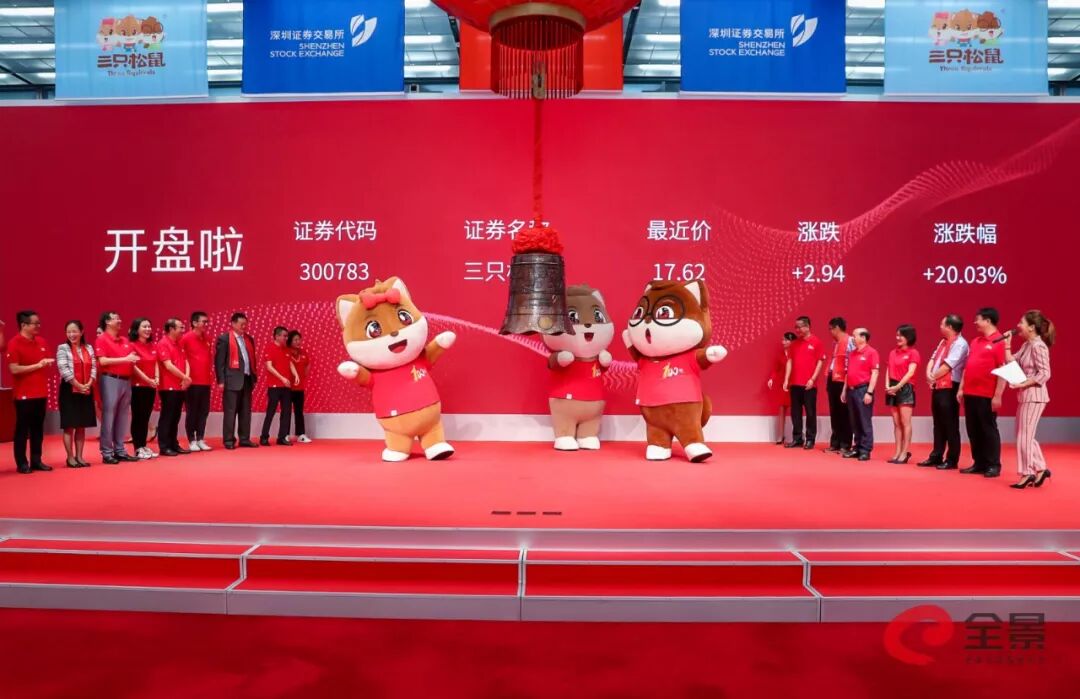
This morning (July 12, 2019), Three Squirrels went public — another milestone in its seven-year journey.
In late 2011, in Ningguo, Anhui, inside an ordinary café, something more stimulating than caffeine was circulating: a thesis — "e-commerce can give birth to new brands." Feng Shu and Daddy Squirrel saw this trend with strikingly similar clarity. A partnership, and a friendship, began.
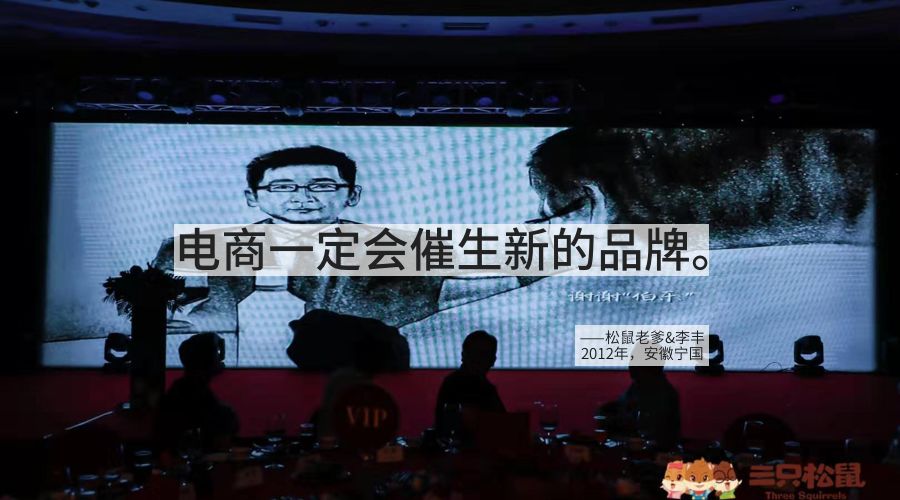
As Three Squirrels' most "loyal and long-term" investor and the friend who most enjoys "intellectual sparring," Feng Shu has witnessed many of Daddy Squirrel's lows and highs throughout this entrepreneurial journey — the decisions, reflections, and growth behind them all.
Shortly before the IPO, Feng Shu and Daddy Squirrel's routine catch-up inevitably expanded into a nearly four-hour conversation, full of resonance and sparks. At this juncture, some questions found their resolution; some lines of thought were only just beginning.
We recorded and edited this conversation to share with you, hoping it offers some inspiration.
(P.S.: We've compiled seven exclusive pieces Daddy Squirrel shared at FreeS Fund over the years — you can trace the evolution of his thinking there too. Collect it at the end of this article.)


Small companies can't do what big companies do, unless it's an exponential growth opportunity
Li Feng: Some people argue that starting a business is harder now than it was a few years ago. When you first began, how did you find your entry point and growth opportunities?
Zhang Liaoyuan: Strategically speaking, big companies can't do what small companies do, and small companies can't do what big companies do. Nothing is absolute, of course, but you shouldn't do what others have already done — unless it enables exponential growth or disruptive change.

In 2012, why were we so determined to bet everything on e-commerce? Because we knew this was viable. The basis for that judgment was the insight from our very first meeting — "e-commerce can give birth to new brands." That was the single most important sentence in our early days.
Li Feng: If new brands all had a shot, it should have been a stampede. Why did Three Squirrels emerge on top?
Zhang Liaoyuan: When we started in 2012, there were indeed many fellow travelers — in apparel, in consumer goods. Looking back, most of them from that cohort are gone now. Some categories are simply hard to scale. Apparel is non-standard; internet apparel brands tend to stay niche. Consumer goods are even tougher — offline competition is brutal. Once Procter & Gamble and other major players enter, small companies don't stand a chance.
The nut industry was different. In 2012, there was no dominant offline player yet. We seized that opportunity. Once our online scale grew larger than our competitors' offline scale, we could compete head-to-head. If Qiaqia and Laiyifen had noticed our rapid rise in 2013 and crushed us then, that would have been the end of us. Fortunately, they were more conservative and missed that critical window.
Li Feng: So in making these judgments, category and competitive environment were both crucial factors.
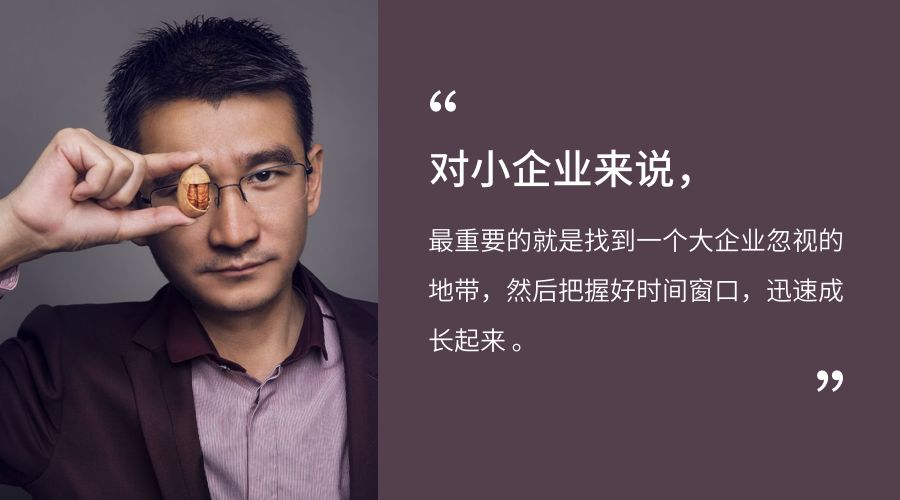
Zhang Liaoyuan: Yes. For small companies, the most important thing is to find a zone that big companies overlook, then capitalize on the time window and grow fast. Many companies ultimately lose to big players because their growth speed and time advantage aren't sufficient — they haven't become strong enough to compete head-on. For instance, the apparel industry had its influencer brands that were hot for several years, but they still couldn't beat Uniqlo. Once Uniqlo pushed online, the new brands were immediately crushed.
The essence of business is competition. I think one very misleading saying is "I never look at competitors," even though many startup leaders say this.
Of course, watching competitors doesn't mean you shouldn't think at a higher level. People often cite that example: when someone asks what a faster horse is, the answer is a car. What I mean by "benchmarking" isn't the horse itself, but the service the horse provides. In other words, we must study competitors, but not their strategies — we study their products and services.
Li Feng: How did you develop this way of thinking?
Zhang Liaoyuan: Partly forced by circumstances, partly grown through hardship. Most entrepreneurs probably can't have everything figured out from the start. Conversely, those who do might not necessarily succeed. At least in the early stages, people rely more on intuition, then trial and error. You'll make many mistakes along the way. But that's fine — entrepreneurship is war, and truth emerges from practice. However, once you grow to tens of billions in scale, you can't rely on intuition alone; you need a systematic framework.

In our early days, for Three Squirrels, the most important thing was that core insight: "e-commerce can give birth to new brands." Around this central idea, we focused on three things: first, pick a good name; second, deliver great user experience; third, concentrate resources on Singles' Day.
Li Feng: The first few years were relatively smooth sailing overall.
Zhang Liaoyuan: Yes. The story behind that is: with the name "Three Squirrels," plus that Singles' Day victory, regardless of how many competitors we faced, the subsequent battles became much easier. Because you had already won strategically — the name "Three Squirrels" plus being "number one" left a deep impression on everyone. Good supply chains want to partner with the leader, which ensured we consistently had the best product quality.
Looking back, we hadn't fully thought through everything — how to transform food manufacturing, how to leverage data, we had no clear idea at the time. But that was completely fine. Why do people say bigger companies have it harder? Because big companies need to be comprehensive, but small companies only need to find that one or two critical moves and execute them to the extreme. That can win you precious forward momentum at the starting stage.
When the sky falls, no one can predict it, but when it hits, survival comes first
Li Feng: Forward momentum eventually fades.
Zhang Liaoyuan: By 2017, ours had. This became a critical period for us, because when momentum disappears, there are typically two outcomes: either the company uses this as an opportunity to evolve further, or it can't get past this hurdle and plateaus.
There's a saying: when the sky falls, tall people get hit first, short people get hit later. The point is, no one can predict the sky falling, but in the moment of impact, the difference emerges. Whether you can recognize the problem and decide quickly is the true test of an entrepreneur's capability.

When the sky falls, survive first. Don't try to devise a perfect plan — save your life first. Once you've survived, then investigate the root cause, figure out where the problem lies. This is usually a process of continuous exploration and evolution, until you ultimately find the next growth driver.
Li Feng: Of the problems you encountered these seven years, three stand out in my memory. In 2013–2014, mainly logistics issues; by 2015–2016, profitability — you started with nuts, nuts weren't making money, so you expanded to snacks, snacks weren't profitable at first either, so you began doubting whether you could ever make money; later you became profitable, finally proving your earning power, and making money seemed to get easier and easier, then suddenly in 2017, growth stalled.
Zhang Liaoyuan: In the first half of 2017, we were making money and feeling pretty good about it. We calculated that by 2018 we could hit seven or eight billion, and we were thrilled. We were counting our cash through year-end, then realized something was off — growth had actually stalled.
Li Feng: So at that point you basically launched a blind price war. You say "blind," but were you actually thinking: since I haven't figured out what I should be doing, I'll at least make sure nobody else breaks out. Go attack others, wherever they're strong, hit them there.
Zhang Liaoyuan: Exactly. Nothing terrifies a company more than stalled growth. Once growth stops, problems flood in from everywhere. So after getting through 2017, by 2018, in my view, the company had problems everywhere. What to do? Go attack others. See what hit products they had, and we'd quickly launch our own versions. We rolled out something called the "T9 Strategy" — launching nine hit products at maximum speed. And as we fought, we started getting a feel for it.
Honestly, for a stretch last year we were fighting blind. It wasn't until early this year that we finally figured things out. This goes back to what I said at the start: first survive, find your method in the process of attacking others, keep exploring, and eventually you find the truth.
Li Feng: So this was your competitive strategy, but it also related to employee morale. Through fighting battles, you could at least get everyone united in purpose.
Zhang Liaoyuan: Right. When a company has problems, you must open up revenue sources as fast as possible. Never cut costs — the moment you start cutting, morale shifts. Also, if there's always something bad in good situations, then there's always something good in bad situations too. Our chaotic fighting somehow, inexplicably, spawned an entirely new category: cakes. When we first started making cakes in 2018, we had zero confidence. We didn't understand the industry at all, so we went around asking cake companies for advice. But once we built our cakes into a number-one brand, we suddenly understood the baking industry deeply.
Growth Above All, Everything Can Grow
Li Feng: Over all these years, have there been times you felt you couldn't keep going?
Zhang Liaoyuan: I felt I couldn't keep going from day one. Ironically, the further along I got, the more I felt I could keep going. When you're just starting, your responsibility isn't that heavy, so you just kind of think about it — this is so hard — but you keep going anyway. As you keep moving forward, the problems just keep multiplying.
Li Feng: The growing responsibility forces it out of you.
Zhang Liaoyuan: When you're pushed to the limit, there's only one path: keep going. But at this point, your cognitive boundaries have shifted too.
I now believe that company growth parallels personal growth. You'll definitely experience good and bad things, and this process is one of constantly validating your values.
Our company has a crucial value: growth above all. Where did this come from? Once a company gets slightly bigger, it easily falls into a false belief — I'm bigger now, so my growth will naturally slow. We thought this way in 2017. When problems hit in 2018, I started reflecting: that thinking isn't right. By 2019, our stance on growth became more resolute. How could we slow down? China's market is massive, we're nowhere near done, and Taobao isn't calling it quits.
So now I'm convinced: growth above all, everything can grow.
Last year, our Tmall flagship store waged a major price war. This year, internally there were voices saying there wouldn't be much growth. My position was clear: if you can't do it, I can replace you. If after two or three rounds of replacements nobody can do it, then we'll reassess. At this moment you cannot open the door even a crack — once you do, you're in trouble.
Li Feng: I agree.
Zhang Liaoyuan: At Three Squirrels, we've always emphasized competitive consciousness. In competition you must find a benchmark, and it must be the strongest benchmark possible. This has little to do with scale — even if it's small, if it can achieve over 50% growth, you must set your target above 50% growth.
Specifically on growth, you need clarity on what kind of growth matters most to you. We believe sales growth matters more than profit growth, because profit growth without sales growth is a dangerous thing.
These things must be crystal clear. Running a company requires prioritization — your first factor vastly outweighs your third factor. Don't try to do everything from the start. This is the hardest thing about running a company, because prioritization means choosing and sacrificing.
The Endgame of Business Is a Choice of Values
Li Feng: Everyone agrees values matter, but specifically in company management, how do you establish your values and truly implement them?
Zhang Liaoyuan: Let me first share my view on values. While companies at different stages might have opportunities to cut corners, I firmly believe the endgame of business is a choice of values.

Three Squirrels' internal reference documents spell out our mission (1. Make our "masters" [customers] delighted; 2. Drive food industry progress through digitalization, promote brand diversification through IP development), vision (1. Live 100 years; 2. Enter the Global 500; 3. Serve the vast majority of mass-market households worldwide), and values (Exceed master expectations; Authenticity; Strive as foundation; Innovation; Only be number one).
Clarifying mission, vision, and values relates directly to company growth. Sooner or later you have to figure this out — without it, you definitely won't get big. Values aren't something to consider only once you're big. On day one of our startup, when there were just five of us, we were already discussing what our values were.
Values are the working methods for achieving strategy, an organization's ideology, and behavioral standards for all members. Our entire company's decisions follow our values. For example, we put "exceed master expectations" first in our values for strategic reasons. Everyone can understand: when our products and services don't exceed master expectations, we're headed for demise. And indeed, during a period when we weren't doing well, upon reflection we found we'd lost sight of this principle.
Li Feng: Once values are established, how do you implement them in the organization? I know you've thought deeply about organizational structure over the past year-plus.
Zhang Liaoyuan: Values are ideology, they're concepts, and concepts alone are useless — they must be practiced. Our current internal evaluation uses a dual-track system: 50% performance, 50% values.
To evaluate values, you first need to break them down. Under each of our values are 4-5 maxims and specific rules. Take "exceed master expectations" — it breaks down into several slogans, the first being "Always maintain products and services that exceed competitors." Under that slogan we break it down further into specific rules. This decomposition process answers what "exceeding expectations" actually means.
These rules form our evaluation criteria. When it comes to scoring, each rule is rated 1 to 5. When scoring, you must provide case examples as justification, and we randomly audit these cases.
The reason for going this granular is that companies desperately need to establish a standard that makes clear to employees how they should strive. If a company's employees don't know how to strive, that company will definitely have problems.

Many People Only Focus on the "Selling" in Marketing, Not the "Operating"
Li Feng: What do you think Three Squirrels' core competitive advantage is? Many people think Three Squirrels built its brand well because of strong marketing capabilities.
Zhang Liaoyuan: For consumer goods companies just starting out, marketing capability is definitely number one. The opportunity for consumer goods startups lies in finding a very niche area that big companies won't touch or look down on, then going hard on marketing. Don't talk about technology yet — a brand's core capability early on is marketing.

Li Feng: No, technology or craft benefits are useful — they solve user pain points. For example, early on you also developed your own tools to help users crack shells.
Zhang Liaoyuan: The essence is still that we could perceive user needs, then reverse-customize: matching different products to different channels and audiences. Marketing is just the skin of user experience.
Li Feng: The reality is, what many people call marketing isn't the same thing at all.
Zhang Liaoyuan: People have probably made "marketing" pejorative. Many only focus on the "selling" (销) in "marketing" (营销), not the "operating" (营). The essence of "operating" is that when a customer wants to buy a product, you match them with the right product — it's really about the ability to read consumers.
The reason the same term splits internally is because in the industrial era, salespeople, marketers, and R&D were siloed. The salesperson gets a product and just keeps saying how great it is. Their mission is to find any way to sell it. Whether the consumer needs it or not, they don't care.
So now we've adjusted our thinking: digital-driven, emphasizing insight into users and products, reconnecting "operating" and "selling." Inside the company we integrate product people and operations people. For example, a regional manager overseeing 10 stores — their primary mission is user insight to curate products for that store. I don't need you to do promotions or street marketing.
Li Feng: That's a very high bar.
Zhang Liaoyuan: So we have to solve this through a "digitized supply chain" — rebuilding the connection between people and products. In the past, our people and our products were disconnected. From raw materials to the moment a consumer buys a snack, the chain is too long, with countless distributors. Somewhere along the way, the people running this operation forgot the most fundamental thing — users don't want brands, they want products they like. The brand means nothing to them.
That's why we're now talking about "retail de-retailing" and "brands de-branding." Because the original purpose of retail and brands was to passively sell products to users. But if the products users enjoy are truly what they want, retail and brands become far less important.
Brands Give Way to Cost and Efficiency Optimization
Li Feng: That's the philosophical level. What about operationally? What specific problems did you hit that made you feel you couldn't rely on brand alone anymore?
Zhang Liaoyuan: Simply put, brand mattered a lot early on because often what left an impression was just a name. It's like going on a blind date — maybe you're drawn to someone because they're good-looking, or have some distinctive feature, and you connect instantly. But once you've connected, you have to get back to fundamentals: what's your substance, how good is your product really?
The situation now is, when we set ourselves a target of growing by billions every year, we found brand's effectiveness is gradually declining. To be more specific, this shift involves an idea: individual snacks are homogenous. The essence of snacks is homogeneity — do you agree?
Li Feng: You need to finish the second half of that sentence. I can't judge from just the first half.
Zhang Liaoyuan: You have to agree that snacks are homogenous — whether it's Coca-Cola or Oreo cookies, I have the capability to produce the same product, no problem. So where's the differentiation? We've discussed this. In the past, snack differentiation was at the brand level. Big companies' monopoly manifested as advertising monopoly and shelf monopoly.
Li Feng: I agree, mainly shelf monopoly.
Zhang Liaoyuan: Advertising monopoly was serious too. But now we can see that brand's power to create product differentiation isn't as strong as before — including for personal care brands. The reason is that those "two monopolies" are being fragmented, especially with channels becoming diversified.
So in this context, what should our strategy be based on? What we should grab is leadership in cost and efficiency — providing higher value-for-money products, but ultimately making more money myself. That's the most powerful capability. So even though our brand still has differentiation attributes, and we'll persist with brand, we must have another more important line: cost efficiency and supply chain. Supply chain determines the product, marketing determines the brand. If before the brand was 7 and the product was 3, now it's probably reversed.

Li Feng: I actually think this relates to your changing position in the industry — you're seeing different things. You used to be an excellent startup, now you're a 10-billion-market-cap company.
Zhang Liaoyuan: Possibly. I can only say that starting with a focus on brand got us to where we are. But at our current scale, if we don't want certain brands to emerge, we have the ability to block them. For example, recently a cookie brand popped up, and we followed very quickly. I can make cookies identical to yours, but you sell at 180 yuan, I can price-war at 80 yuan and leave you no opening.
Li Feng: That's because you're big now, you can flex. You came up as small-and-beautiful too. A year ago when direction wasn't set, seeing new entrants — that still got under your skin, right?
Zhang Liaoyuan: Now I've figured it out. My philosophy is: must be number one, no matter who. Even if I can't kill them, I can make sure they don't grow big. The confidence behind this comes from our ability to build sufficiently powerful leisure snack infrastructure. This infrastructure is my moat. With this moat, I can do many things.
So now, we're no longer a single-product company. Our innovation must be platform-based. What we want to do is provide every family with richer snack solutions under optimal cost and efficiency. Individual snacks don't have much innovation, but the act of eating snacks needs massive innovation. If we define it as a product solution, this solution isn't about looking at one category — it emphasizes richness more, with different snack categories as adjustable components. I want to make you remember that your family's snacking is covered by me.
How to Hit the Mass Market, Not Get Stuck in a Niche?
Li Feng: Although China's consumer market is huge, and there are many leisure snack brands, so far none have become a 10-billion-market-cap leisure snack brand of their own.
Zhang Liaoyuan: Right, that's what I mean by the act of eating snacks still needing much innovation — because everyone is still not doing well enough.
Beverages, instant noodles, and ready-to-eat foods — these three markets are huge. Besides relating to that theory you mentioned about dietary needs, it's also because eating and drinking are still strongly tied to the mass population's purchasing power.
Li Feng: Yes, dietary composition relates to the body's composition.
Zhang Liaoyuan: Before you boiled water at home, then you drank mineral water, then flavored water. But when flavored water exceeds seven or eight yuan, that beverage's market share gets constrained. This is also something we only understood after operating for a long time: once cake exceeds 35 yuan per kilogram, it can't become a big single product, even if you think it tastes great. Our best seller is 19.9 yuan (800 grams), 20-plus slices — meaning you can spend 3 yuan every morning to eat two or three slices.
This is why I repeatedly emphasize supply chain optimization: it can enable more of the mass population to form stable snack purchasing power. For example, you can buy a week's worth of snacks from me for 19.9 yuan, and if this "fourth meal" is done well, it can even replace the third meal, increasing purchase frequency. At the same time it's sufficiently rich, and the cost is acceptable to you — then demand for this kind of thing will be very high, and only then is it conducive to building a big company.
Li Feng: That's right, providing richer choices as a substitute for instant noodles and other ready-to-eat foods.
Zhang Liaoyuan: At our scale, we can't do what small companies do anymore. For example, we discussed premium beverages. That's meaningless for us — it can't leverage the mass market.
Next 10 Years: Digitally Driven, Achieving Supply Chain Front-Loading and Organizational High Efficiency
Li Feng: From a strategic perspective, what's the point of you doing offline?
Zhang Liaoyuan: Let's not even talk about other things — China is a nation of food lovers. E-commerce has developed for so many years, yet offline still has hundreds of thousands of snack stores. The demand for offline purchasing, I think, needs no validation.
But offline is generally not being done well right now. Take the simplest example: currently some offline snack stores offer rich categories, and each bag doesn't look expensive, but once you buy, you grab a bunch, they weigh it, and it's very expensive — users have no way to anticipate this.
Also, we discovered many problems when doing online.
First, online can indeed present very rich products, but users' browsing depth is limited when selecting products. Although you can display 1,000 products, they can't browse through all of them before deciding. They might see everyone buying this, so they buy this too — tending toward purchasing bestsellers. But the problem is, bestsellers generally have low margins, making online profitability difficult.
Second, online makes price comparison very easy. Big companies, because of scale advantages, can make money through asset restructuring and supply chain overflow. But small companies have a hard time making money.
Third, online has bottlenecks. For example, there's a limiting factor online — shipping fees. Every consumer is indirectly bearing shipping fees, so product unit prices must correspondingly increase, at least sixty to seventy, eighty to ninety yuan. This constrains certain high-frequency demands.
So looking at offline again — why might offline be more profitable even with nearly identical pricing? Because offline shopping paths and logic differ from online.
First, information is less sufficient. Offline sales structure is very dispersed; the distinction between bestsellers and non-bestsellers isn't prominent.
Second, price comparison is less sufficient. By "less sufficient price comparison," I mean the feeling of browsing in-store is good, and at that moment you won't think to compare with others. Of course, our online and offline pricing is the same.
Third, our offline packaging can be smaller, with no shipping fee threshold, enabling higher frequency.
So overall, even though we sell cheaper than others, many of our offline stores can achieve gross margins of about 40%.
Li Feng: It's true that in your industry, offline and online are completely different things. Previously an entrepreneur told me that internet snack brands don't sell well in offline channels — first of all there are display problems, horizontal or vertical placement, they can't stand up, can't hang well.
Zhang Liaoyuan: Hmm, this is a small problem but must be solved. I've thought carefully: online and offline don't converge. We rose online through reverse customization; offline similarly needs reverse customization, though completely different.
We can look at the structure of our industry from a broader perspective. It mainly consists of several segments: raw materials, manufacturing, distribution, connection, and demand. Right now, the internet has only solved part of the problem — the distribution segment between manufacturing and connection. You place an order online, and a fulfillment center ships it to you. But it hasn't solved the problem completely.
Li Feng: Mainly because it hasn't reached the production side.
Zhang Liaoyuan: And there's also the reverse-customization capability. So in our industry, there are a few directions worth pursuing:
One is scale advantage, which can reduce costs on the raw materials and manufacturing sides. Second is high turnover advantage, which can reduce costs on the manufacturing, distribution, and connection sides. At the same time, high turnover also gives users a sense of freshness. Third is flexibility advantage. Not all products can achieve scale advantage — some will never get big. What they offer isn't cost advantage but flexibility. Cakes and nuts, for example, become more competitive the longer you stay in them.
Why couldn't we do this before? It's because our business model lacked a digital tool. The connections between these segments are extremely complex, with countless steps in between.
So if seven years ago we were playing the game of "new channels create new brands," then for the next decade, what we need to do is drive everything through digitalization — achieving supply chain pre-positioning and organizational efficiency.
Retail Is 100% an Efficiency Game
Li Feng: About offline stores — the question I've been asking you most lately is, why would users go offline? What categories can actually drive foot traffic?
Zhang Liaoyuan: 85% of users still buy things offline. Even if you shop online, you still buy offline. I know one big idea: Chinese people love good food, and there will always need to be a company that solves their "good food" problem. What I'm thinking about now is how offline stores can evolve.
Li Feng: I haven't thought it through completely, but I see at least a few directions. First, from a results standpoint, it has to provide a more complete solution. Second, beyond having clear offline advantages, it can also layer on other online advantages — for example, making user touchpoints more diverse.
Zhang Liaoyuan: I don't focus too much on visit frequency. I talk more about purchase frequency. Actually, what I'm targeting is the most competitive product within a vertically positioned trade area. Say within a one- to two-kilometer radius — there's definitely a big supermarket nearby, and probably some mom-and-pop shops too. What people normally come to a store for are daily consumables: soy sauce, rice, cooking oil. I'll carve out the snack segment.
Li Feng: That works, no problem. The reason I keep asking about visit frequency is because I've been thinking a lot about the future format of retail stores.
China's urbanization, population density, and transportation costs are very different from abroad. Small households dominate, urbanization is intense, and transportation costs are extremely high. This creates a fairly typical living scenario: you get off work and return to your small household. You're too lazy to cook. If there's a store near your home, you either order freshly made noodles, wontons, or some other fast food for delivery, or you go there directly to eat, and on your way home grab some fruit and other snacks.
In this scenario, the retail format that seems most viable to me right now is one that connects these three things: first, freshly cooked hot food tailored to Chinese tastes — different from what 7-11 offers; second, fresh produce, fruits, and vegetables in the store; and finally, some pre-packaged foods.
Actually, what I'm asking is: given China's specific urban environment and demographic structure, what will make people come to this store and remember it? Small stores can only survive by doing relatively high-frequency, irreplaceable things. Retail is 100% an efficiency competition — nothing else. If your efficiency can't reach the highest level, given how China's real estate market is developing, rising property prices will keep squeezing the survival space of street-facing shops. Your offline store will eventually get pushed off the street.
Zhang Liaoyuan: This will create huge opportunities for e-commerce.
Li Feng: For new retail entrepreneurs right now, what they're actually competing on is who can achieve the highest system efficiency. In the end, except for a very small number — maybe one or two — the vast majority won't survive. Look at Carrefour — sold for 6 billion.
Zhang Liaoyuan: Carrefour was sold cheap.
Li Feng: By comparison, many new retail projects today are overvalued. Despite all the different models, China's offline retail stores probably only have three paths forward: one, a one-stop comprehensive shopping solution, like a new type of Costco or Walmart; two, community convenience stores like 7-11, but they must be localized; three, certain categories can be built into specialty stores.
Zhang Liaoyuan: We're the third type.
Li Feng: That works. I've also figured it out — in the end, retail may have two formats: one is for relatively刚需, relatively scalable things, eventually becoming the Amazon or Xiaomi model, where you're simultaneously brand and channel; the other is C2C like Taobao and Kuaishou. Users don't know what they want to buy, they have no clear purchasing intent — they just come to browse. Besides these two, the survival space for everything in between will gradually get squeezed.
In the US, the manufacturing and circulation of goods went through sufficient competition one by one to improve efficiency. In China, the manufacturing and circulation of goods, and the manufacturing and circulation of information, were put into one channel — slightly sequential, but almost simultaneous. This means entrepreneurs need to adapt to both things at once, which means simultaneously solving for efficient circulation of goods and efficient circulation of information.
Zhang Liaoyuan: Adapting to both at once — there's opportunity in vertical domains.
From a pure e-commerce perspective, my view is simple now. Following the most direct approach, selling on Taobao — it's almost impossible to make serious money. Because for homogeneous products, e-commerce margins are maybe four or five points. So how do you actually play? It has to come from supply chain efficiency.
You and I are selling the same thing, but I can sell it cheaper than you. At that price, you can't make money, but I can. The difference is supply chain. Supply chain has to be pre-positioned all the way to the retail end. Put simply, in the past, supply chain information flow never reached the manufacturing segment, so supply chain efficiency was never actually improved.
Li Feng: So what's your plan?
Zhang Liaoyuan: Our advantage is the "number one brand" halo — good supply chains are willing to follow us. What I need to do is reconnect them.
Of course, with this approach, we won't be a high-margin business in the short term. No way around it. But I believe if we stick with this, once it clicks, it will keep getting better.
Li Feng: The monopoly effect will keep strengthening.
Zhang Liaoyuan: Cost and efficiency are the biggest moats. But to build that moat, you have to reach that scale.

Li Feng: So now, looking at the road ahead — do you feel it's clear?
Zhang Liaoyuan: Yes. Going offline, we face two challenges ahead: one is how to apply our reverse-customization capability — the core success gene of our e-commerce — to offline, not only providing experiences that online can't offer, but also achieving the same cost efficiency as online. The second is how to manage offline operations well, especially people management.
To achieve exponential growth, these are the two hardest things. To solve them, it still comes down to my digitalization.
Grateful for the Internet Era
Li Feng: Looking back, if an entrepreneur today wanted to start a consumer project, what advice would you give?
Zhang Liaoyuan: Find a very niche domain — something big companies aren't willing to do, something they look down on — and then go hard on marketing.
Before 2017, we captured traffic. In that stage, traffic mattered more than product; product was there to match traffic. After 2018, product mattered more than traffic; product could generate traffic.
I'm not saying I didn't value supply chain from the start. But the reality was, back then I was still small — my volume couldn't change the supply chain. You're selling 300 million a year, how do you change the supply chain?
Now we're doing several billion a year. Only then do I have leverage to talk with the supply chain. So at different stages, you have to make different choices and changes based on different strategic fulcrums. This is extremely important for startups.
Li Feng: Off-topic — have you ever thought about what you'd be doing if you hadn't started Three Squirrels?
Zhang Liaoyuan: Never thought about it. At certain nodes in a person's growth path, something inevitably crystallizes. When I joined Zhan's, I already knew: from then on, I'd sell walnuts, sell nuts.
Why? Before joining Zhan's, I'd been out in society for six or seven years, tried all kinds of things — nothing but hardship, no results. When I joined Zhan's, I summarized: I had never focused on anything before, and never found a mentor to learn from. After joining Zhan's, I told myself: selling walnuts has a low barrier to entry. I'll stay focused, learn properly inside. If I can sell well in this company, I'll sell well. If I can't, I'll walk out and still sell walnuts.
That was my biggest self-awareness at the time. With that awareness, I lasted nine years. If Li Feng hadn't appeared, I think I'd still be selling walnuts.
Li Feng: As a typical representative of internet-born "internet plus manufacturing," I feel Three Squirrels' corporate culture also has internet characteristics: transparency, sincerity, customer-centricity. Is being transparent and authentic difficult?
Zhang Liaoyuan: Authenticity is fundamentally about self-discipline. It's not easy, but it's worth defending. The information revolution brought by the internet will only make this world more and more transparent, more and more real. Many people think we're arrogant, that we don't understand how the world works — but that's not it. It's because we're authentic. What my father always taught me was to be a good person. And in the internet age, the prerequisite for being a good person is being authentic.
I'm not exaggerating when I say I'm deeply grateful for the internet era. I'm especially thankful that this business model has eliminated so many unnecessary middlemen. You just need to face consumers honestly, because the feedback they give you is honest too. You don't need to deal with so many people to get business done. That suits me perfectly.
Also, the internet opened a window for people like us from small county towns, letting us stand on the same starting line as people in big cities, bringing us onto a national platform to compete. If I hadn't encountered the internet, I probably never would have succeeded as an entrepreneur.
(This really was quite long. If you've read this far with care, I believe you've gained something. Feel free to share it to your Moments. Additionally, we've compiled seven exclusive pieces from Daddy Squirrel's sharing sessions with FreeS Fund over the years into a collection. Follow the FreeS Fund WeChat account [ID: freesvc] and reply with "squirrel IPO" to receive it. We hope it offers some inspiration.)