[Deep Dive] How Startups Can Ride Douyin's Traffic Wave | FreeS Fund Perspectives

Create content that machines can understand and users want to consume.

"FreeS Talk" is a small-scale offline gathering for CEOs in the FreeS Fund network. We invite experts who know their stuff and seasoned FreeS Fund family CEOs to share insights and experience on topics and directions that CEOs care about.
Douyin — the short-video platform with over 150 million DAUs and over 300 million MAUs — has been a frequent topic of discussion in the FreeS Fund CEO group over the past two months. The theme of this "FreeS Talk" is "Decoding Douyin, Mastering Douyin." We invited three guests to have in-depth exchanges with about 30 CEOs.
Zhang Junxiang, CEO of Erka Media and the mastermind behind Douyin's most popular short-video IP, "Dujiao SHOW," shared from a CEO's operational perspective how founders should understand content, craft content strategy, and allocate resources. Liu Bo, a FreeS Fund family CEO and founder of October Care, shared how his team made the decision to go all-in on Douyin, and the ins and outs of "doing Douyin." The October Care Douyin account hit 1.07 million followers in two months. Yan Zehua, former senior product manager at ByteDance and author of The Content Algorithm, analyzed from a content distribution platform's perspective: how recommendation algorithms work in algorithm-driven content products (like Kuaishou and Douyin), how to get good content the traffic it deserves, and how to evaluate results.
How can startups seize this Douyin wave? Share your thoughts at the end of this article. Before July 18, the 3 readers with the most thoughtful comments and the 2 readers with the most liked comments will each receive a copy of Yan Zehua's The Content Algorithm.





(Swipe left or right on images for a surprise)

/01/
The Vertical-Screen Era: A Founder's Content Mindset

Zhang Junxiang
CEO, Erka Media
Many CEOs here want to understand how to ride this Douyin wave. First, I want to say that no matter how times change, people always consume content. From text to image-text to short video to micro-video, these are all different carriers of the same system. For the present moment, micro-video platforms like Douyin are the best content format for distribution and user interaction — every CEO should take this seriously. If you're really going to do Douyin, the CEO personally needs to spend significant time on the platform.
To briefly introduce: content on Douyin broadly falls into two categories. First, general entertainment. Our company's IP "Dujiao SHOW" falls into this — it's fairly wholesome, with the goal of promoting Chinese culture. Second, vertical or KOL-oriented content: beauty, parenting, automotive, etc. This type requires teams with fairly specialized knowledge. Content turnover on Douyin is beyond imagination — our content strategy basically gets minor adjustments every two weeks and major overhauls every month.
Second, content is just a tool. I believe every company has its core thing, whether product or brand character. Before making content, CEOs should consider: for our brand, what does our user profile look like, and which users do we actually want to acquire? What help can these users provide the company — driving GMV or CPS, or elevating brand image? Whatever dimension you start from, CEOs need to first think clearly: what is your purpose, and where are your users?
I don't think there's much methodology to making content itself. You need to understand the platform, and understand the content market. I also want to share our company's operational system — this might be somewhat helpful for CEOs here. The system has four components. First, platform operations. I don't believe any of you will only do Douyin — you'll definitely go multi-platform. This requires gathering timely information about each platform's current state, relaying it to execution teams, and monitoring both process and results.
Second, the idea bank. We have an idea bank of about 25 people with two types of profiles: brand creative types, and director/writer types. Because Erka has over 100 accounts, produces another 10–20 per month on average, and Douyin content iterates extremely fast, our signed KOLs or video creation teams sometimes hit creative walls — that's when they interface with our idea bank. The idea bank serves two main functions: from a director's perspective, advising what content is more likely to blow up; and from a marketing perspective, strategizing for distribution. Because content people don't necessarily understand marketing, and marketing people may not understand content. I suggest CEOs, when building content capabilities, allocate team capacity accordingly.
Third, data analytics. We have a dedicated data analytics department in Shenzhen. We capture first- and second-hand data for secondary development, analyzing user changes, quadrant shifts, video retention patterns, what kinds of videos tend to blow up and why. This department works hand-in-hand with the idea bank.
Fourth, talent acquisition. If you're doing KOL or PUGC content, you may run into the problem of wanting to create content but not knowing where to find people. We generally search across the entire web, do campus recruiting, get referrals — all channels to scout talent. After finding people, we give them a probation period: hit the target follower count within two months and you're hired.
Finally, I want to urge everyone here to pay attention to the vertical-screen era and micro-video era. What's currently in an awkward position is 3–5 minute short video — in terms of content capacity and richness, it's inferior to both extremely short and extremely long video. Now everyone's eyeing extremely short video. Based on existing content distribution mechanisms, any company or brand with any connection to video will launch micro-video product formats: ByteDance's Douyin, Tencent's Weishi, Baidu's Nani.
The godfather of vertical-screen and micro-video was an American product that blew up ten years ago — Vine. It started at 6 seconds, later expanded to 1 minute. Many of America's top-tier influencers today got their start on that platform a decade ago. After Vine declined, musical.ly emerged in 2014, and Douyin launched in China in 2016. My main point in urging everyone to embrace micro-video is that it solves the problem of being unable to monetize or having only single monetization models — Douyin does this very well.
Additionally, as the vertical-screen and micro-video era arrives, there will be new ways to monetize traffic, such as driving online traffic offline. I believe every CEO here, with a strong team, can combine their business model with micro-video content and platforms, go with the flow, and make their company better and better.
/02/
1.07 Million Followers in Two Months: Why I Went All-In on Douyin

Liu Bo
CEO, October Care
Our company is in healthcare services. The healthcare services industry has very long cycles and significant policy volatility — many of the companies that started alongside us have "died." We haven't "died" because we have a content platform. So I'll think from the perspective of a healthcare services company about what value and meaning content creation has brought us, which also explains why we do Douyin.
They say competitive victory is decided in the user's mind. But honestly, when our company first considered doing content, the main reason was probably the same as most startups: we didn't know where traffic would come from, and content seemed like a way to get leverage. If we could build great content like Jiangxiaobai or Three Squirrels, it would be hugely beneficial for brand building and user conversion.
But what is great content? In my view, it must be expression that touches the softest emotional spots and resonates on values. In previous years we approached content with a traffic mindset — the result was high traffic but low conversion. Our editor-in-chief kept saying our values were the problem.
So now we've shifted to approaching content with a values mindset. Everyone knows Apple stores have the highest sales per square foot in the world, while Samsung stores are now deserted. Consumers' mentality and feelings differ in these two places, and subtle shifts in mentality ultimately drive changes in wallet behavior.
Why did we go all-in on Douyin? One reason is that Douyin's values are solid — it represents a beautiful life. Have you noticed how much easier it is to spend money when you're in a good mood? Why does Douyin drive such high conversion rates? Because it's full of young men and women sharing slices of a beautiful life, and these shares fill you with optimism about the future. When someone pitches you a product in that state, your purchasing desire skyrockets. So Douyin will have enormous commercial value in the live commerce space going forward.
October Care, as a medical services brand, is also riding the consumption upgrade wave. What is consumption upgrade? It's the difference between the "tea" in " firewood, rice, oil, salt, soy sauce, vinegar, and tea" and the "tea" in "music, chess, calligraphy, painting, poetry, wine, and tea." The price, packaging, and target consumer are completely different. The tea in the latter phrase is placed in a specific context, becomes quality content, and its whole tone shifts. Whether we're building a service brand or a consumer brand, we need to place our products and services in a specific mental scene for the user.
So how do we create content? First, I think you need to choose a platform and catch its红利期 (window of opportunity). Mi Meng used to write for magazines and Douban, and she wrote well. Without WeChat, Mi Meng would still be Mi Meng — but the platform changed, and so did her value, turning her into a top-tier public account.
History always rhymes. Every internet product has a golden window. Doing Douyin this year is like doing Weibo in 2012 or WeChat Official Accounts in 2015. Miss it and you'll regret it.
As for content formats, the options are text, comics, long video, short video. Why did it end up at short video? Because people are getting lazier, and bandwidth is getting wider. So which of these formats is shrinking? I believe it's text. Time spent on long video hasn't changed — people still watch palace dramas, people still watch Produce 101. But time spent reading text has shrunk. Where did it go? My bet is short video. The shift from text to short video has become a mass wave.
But platform-level companies plus short video existed before — Meipai and Miaopai, for example. So why all-in on Douyin specifically? Here's what I want to get at: algorithm and social.
Most internet platforms have two attributes: social and algorithm. The algorithm representative is ByteDance. But writers who excelled at text generally didn't perform well on ByteDance, because it downplays authors and brands, tilting the scale toward algorithm. It gives you what you like — the so-called "mother's love" algorithm.
WeChat Official Accounts represent the social attribute. The upside is that truly great writers can keep getting greater. The downside is that it's incredibly hard to break through now — even if you write as well as Jia Pingwa, the platform's红利期 has passed.
Douyin strikes a relatively balanced middle ground between these two. It balances algorithm and social. From the content creator's perspective, if your content is good, even with a small follower base, the algorithm can help you cold-start. Say your drone footage is stunning — it'll push your videos to users tagged as "tech enthusiasts" and help you gain followers. The more followers you gain, the more initial traffic the platform allocates to your future content.
Additionally, Douyin strikes a relatively balanced value across the user-platform-creator triangle, which is why there's still红利 at this stage. It lets you see people you follow, people you might want to follow, social正能量, and people Douyin's commercialization wants you to follow.
Of course this balance is dynamic. Right now it's giving users more power; going forward, I suspect if brand advertisers contribute more revenue to Douyin, they'll get more power too.
I also believe the more vertical your content, the more you benefit from algorithmic recommendation and the faster you can cold-start. Take Weibo: the first big stars were entertainment celebrities like Yao Chen. But what's actually valuable on Weibo now — in our medical services industry, for example — is pediatrician Cui Yutao. Every platform uses entertainment as an entry point to get the masses hooked. But if it's only entertainment, the platform's ultimate commercial value is limited. Bringing in vertical creators makes the platform more valuable and improves user experience.
Finally, let me decode the "Five Elements" and "Eight Must-Avoids" for creating viral Douyin content.
× Political issues = instant death
× Lack of正能量 = death
× Unclear on sensitive words = death
× Crappy video quality = death
× Niche topic choice = death
× Boring content = death
× Inconsistency = eventual death
× Sales calls offering fake followers = hang up
√ Topic choice must work
√ Production must work
√ Operations must work
√ Constant care, made invisible
√ Team comes first
Understanding Content Recommendation Algorithms to Maximize Traffic Value

Yan Zehua
Former Senior Product Manager at ByteDance, Author of The Content Algorithm
Starting from ROI, let me first explain the underlying logic of content recommendation and distribution products, offering a platform perspective for your reference.
The concept of "growth hacking" has been quite buzzy these past two years. But whether it's growth hacking or refined operations, the essence converges on ROI calculation. In other words, it's doing the math — does output match input? ByteDance products in rapid growth mode have consistently pursued ROI optimization: when ROI makes sense, they keep pouring in resources to capture the time红利 and scale fast. When ROI no longer works, they reassess investment and adjust direction.
In specific product iteration and operations, ROI also works well as a measurement standard. Final business output accumulates from countless product and operational actions. Product and operational decision-making can be distilled to: expected return of each action (reach, scale of benefit), probability of success (how likely is this to work), and input cost. Many startups, limited by scale, choose to pursue low-probability, high-expected-return actions. Sub-departments of large companies tend toward steadier approaches — higher-probability moves, with further investment determined by actual returns.
What is algorithmic recommendation? The most straightforward understanding is rule matching — tagging both users and content, then connecting corresponding content to users. But relying on manually defined rules inevitably hits an optimization ceiling. Human capacity has limits; it can't cover more complex sub-scenarios and branch cases. This is where we need algorithmic power to continuously refine user and item characteristics, improving match efficiency. The widespread application of algorithmic recommendation brings continuously improving efficiency.
Take content categorization: sports divides into basketball, soccer; basketball divides into NBA, CBA, and other leagues; within NBA, individual star players become noteworthy sub-categories. Manually defined rules can only drill down a few levels, while algorithmic recommendation can more quickly and accurately identify more valuable sub-categories, excavate consumable content within them, and serve it to users.
Algorithms iterate and refine around an objective function. For information feed products, user scale and dwell time are critical metrics — only longer dwell time leads to better retention; only more sessions enable more ad revenue. So much algorithm optimization centers on click-through rate and dwell time as core objectives.
On top of core metrics, we can add composite metrics to refine experience. Diversity is one example. Unlike search, where users can explicitly state intent, recommendation is a slow process of understanding users. While satisfying known interests, it also needs to probe and discover new ones. Ensuring content diversity ensures long-term user stickiness with the platform.
Whether for text or video, a content recommendation flow roughly follows: content understanding → cold start → collecting user feedback → diffusion/death → long-tail distribution.
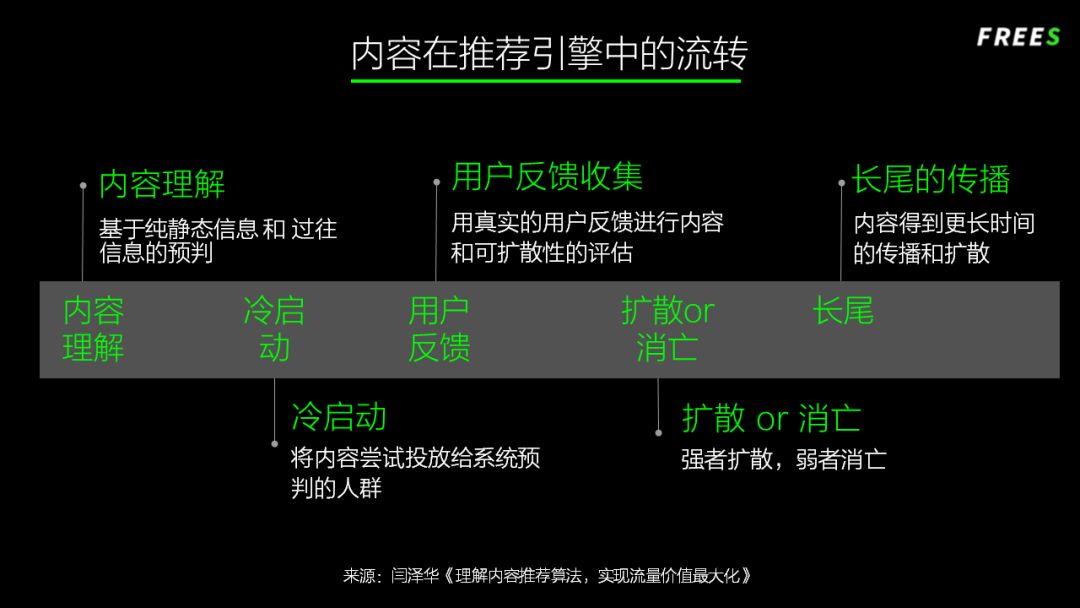
Based on content understanding, the recommendation algorithm allocates initial traffic and distribution. Text content understanding is relatively mature — through title and keyword extraction, article type and topic can be fairly accurately determined. Video has less initial information, so it relies more on creator-submitted text descriptions, creator attributes, and frame extraction for content understanding. Both content characteristics and creator characteristics affect traffic allocation. More vertical, more credible creators receive higher credit limits and get priority exposure to followers and target audiences.
The cold start phase basically determines a piece of content's life or death: if content doesn't get good feedback during cold start, it probably dies; conversely, if it performs well, it can quickly diffuse and become viral. Cold start results directly determine whether content gets diffusion or death — like jungle law: the strong get stronger, the weak get eliminated. This mechanism is very friendly to content consumers — they only see what they want to see. If a followed author posts a hard ad, users probably won't see it.
For creators, perhaps the need is to learn to adapt to the new normal under new distribution rules — you can't simply blast hard ads based on follower count anymore. In a sense, recommendation systems are also fairer. Even a creator from humble origins, as long as their content is consumable and gets good user feedback, can get reliable readership or viewership.
After explosion, content enters long-tail distribution: niche content, limited by smaller production pools, may continue receiving longer-tail traffic; while quality content has a much longer lifecycle — after initial decay from timeliness factors, if it still gets excellent user feedback, it continues to receive extended distribution.
Next, I'd like to correct several common misconceptions about content recommendation.
First, does high likes + high comments necessarily mean high play count?
They're correlated, but not strictly positively correlated. Because likes and comments relate to a content's target coverage — if the target audience is 10,000 people, even if 5,000 like and comment, the system's maximum target ceiling is still 10,000. Conversely, if your audience is relatively broad, say 50,000 or 100,000, when you have 5,000 likes and comments, it can still keep growing. Meanwhile, a piece of content's consumption is also affected by other incidental factors.
Then, to explain a joke: for recommendation systems, creator performance is "30% destiny, 70% hustle."
The "30% destiny" part refers to the inherent randomness in recommendation engines: biases built into the system itself, plus the influence of whatever content happens to be trending at that moment. It's like the running joke about Wang Feng never making the headlines — it's not that there's anything wrong with Wang Feng, it's just that something even hotter always happens to overshadow him during that window.
The "70% hustle" part is about how platform trust accumulates through consistent account building. The more vertical, long-running, and well-performing a creator account is, the more credible it becomes. From the platform's perspective, the goal is user clicks and retention. If a creator account has a substantial base of active users who regularly engage with it, that account is clearly generating positive value for the platform — and will be rewarded with higher trust limits and broader distribution.
So what content actually gets traffic?
It depends on the platform's content temperament. Different platforms have different user demographics and optimization objectives, which produces distinct content flavors. Creators should choose platforms whose temperament matches their own.
In practice, analyzing a platform's trending content over the past ten days gives you a decent read on what works there. Why ten days? Because platform strategies are continuously rolling and iterating — hundreds or thousands of A/B tests running simultaneously. Only by staying on top of trending shifts can you sense how recommendation temperaments are evolving, and adapt to the platform's distribution characteristics.
We must always remember: on recommendation-driven platforms, only content that machines can understand and users want to consume will achieve meaningful traffic success.
As for what's guaranteed to fail — beyond sensitive content, it's shortsighted attempts to game the system. Platforms naturally don't want widespread cheating, and they won't let creators trigger a broken-windows effect. Lowbrow content can easily grab traffic, but if platforms let it run rampant, it creates bad incentives on both the creator and consumer sides, damaging long-term platform interests. So platforms have zero tolerance for account-level exploitation.
Finally, content producers need to understand each phase of a platform's development goals and operational moves. If the current priority is monetization, accounts suited to commercial变现 will get preferential treatment. If there's a major operational push happening, creators who actively participate will receive extra traffic倾斜.
Ask Me Anything





(Swipe left or right for surprises)
Q1: WeChat Official Accounts are 100% private-domain traffic — follower count and open rate have a fairly predictable ratio, giving bloggers strong motivation to produce content and monetize. Douyin isn't like this; it has both follower relationships and algorithmic distribution, with throttling happening sometimes. Could this model hinder Douyin's future commercial monetization?
Zhang Junxiang: Douyin's traffic does have more randomness. But there's no point overthinking this — the trend is definitely positive, with less manual intervention over time.
Q2: If Douyin's focus is user time spent and retention, could I use strategies to increase time spent on our Douyin account to please the algorithm and get more recommendations?
Yan Zehua: Yes, improving click-through rate and completion rate definitely helps recommendation volume. But I want to emphasize: don't take a short-term trading mentality, using machine-deception or loophole-exploiting tactics. Don't make content that's too lowbrow, don't use obvious cheating methods. For example, putting teaser text in the first few seconds, or saying "stay tuned for the彩蛋 at the end" — these can definitely stretch duration and completion rates, but they're meaningless to users.
Anti-cheating is something every platform does; product managers regularly analyze statistical outliers. If average completion rate for a content category is 60%, and suddenly an account is above 80%, product ops will definitely follow up manually: if the content is genuinely good, ops will get involved; if it's a bad actor, they'll be banned outright.
Q3: For a Douyin account, should it be more vertical with visual consistency, or can one account accommodate several content styles?
Yan Zehua: I think relatively vertical is better. On one hand, for algorithmic distribution: more vertical accounts have lower machine comprehension cost, enabling more accurate distribution. On the other hand, vertical accounts help build follower recognition and accumulate fans. More eclectic accounts create unstable content consumption expectations for both users and algorithms, which hurts open rates and has negative effects.
Q4: Erka has built 100+ Douyin accounts — could you share the monetization model?
Zhang Junxiang: Currently about 60% is advertising, plus e-commerce导流, products, and offline. From the company perspective, we've been trying to reduce advertising's share of total revenue, hoping to get it down to around 30%. The reasoning is that advertising isn't a sustainable monetization method — it's actually a drain on every IP. You have to take the long view and consistently focus on content attributes and temperament.
Liu Bo: I strongly agree — taking ads damages brand. A major direction might be e-commerce.
Q5: What kinds of brands are suited to open Douyin accounts and see quick returns? Which ones are throwing money into water that actually splashes back?
Zhang Junxiang: From an ROI perspective, FMCG is still number one, though average order value tends to be lower.
Yan Zehua: Although 15-second videos seem to lower production costs, it's genuinely hard to make a good one in 15 seconds. Users are just casually scrolling — how do we get them to watch from start to finish, how do we get them to remember what we're trying to communicate? These all require careful study.
Q6: Is Douyin suited for sales conversion? Are you optimistic about Douyin's e-commerce potential?
Yan Zehua: For short-video-based transactions, two elements matter: target audience characteristics and content-to-sales conversion. First, assess the relevance between the product and the platform's target audience, and the content publishing account. Then assess whether the video content can facilitate purchase decisions in a very short time.
We've seen some novel, quirky products like cross-border e-commerce items where Douyin exposure drives a sharp spike in corresponding Taobao sales. But major brands may be more focused on building brand awareness, not necessarily completing direct conversion within Douyin.
Q7: If short video is used purely as a traffic entry point, with the ultimate business model built on e-commerce, which platform has the smallest funnel effect?
Zhang Junxiang: It still depends on category. For female-focused products, Xiaohongshu is relatively reliable with good retention. Weibo is also good — its commercial ecosystem is very well-built, whether it's the overall feed flow, CPS, or other aspects; it's a solid channel. Douyin is a new battlefield, though it doesn't yet have as mature a commercial system as Weibo or other platforms. But the investment threshold isn't high either, and with good content strategy and marketing strategy, it's worth trying.
Q8: What kind of person can help a company do brand communication or monetization through a Douyin account?
Liu Bo: I think two types. On the content production side, someone with more artistic traits — because video presentation includes topic selection, music, image selection, shot composition; these are artist things. On the operations side, it's the data analysis people. Our director is a very artistic person; our operations colleagues study platforms and analyze data daily. I've been working to bring these two groups together.
Zhang Junxiang: First it needs content attributes, then data attributes too — so you need to gather people with different attributes. But everyone definitely has their own entry point, their own way of seeing problems. Some responsibilities they can't take on, so we keep the organization very flat. I'm the final approver on all content — good or not, go or no-go, I make the call.
Yan Zehua: Sales is sales, content is content. Taking the long view, what demonstrates brand value is always good content. But in the iteration process, media content isn't made for yourself to watch — it ultimately converges on monetization goals: whether selling traffic to the platform for ad revenue share, or selling traffic to yourself for e-commerce, you need to know what kind of content the platform wants.
I've learned that some companies' approach is: a dedicated content team, paired with a data analysis team, doing different edits of raw materials for different platforms.
Q9: I want to do Douyin but haven't started yet. After defining target audience, what content format works best for entering the platform — pandering to mass taste, or brand-relevant干货 content?
Zhang Junxiang: Both can be tried. One is more KOL-style — more干货, more种草; this is the safer route. The other is based on company brand temperament, trying short skits — this is a relatively clever approach for corporate accounts on Douyin right now. As long as your content core is sound, not投机倒把, the skit format performs quite well on Douyin.
Q10: Douyin isn't the only short video platform anymore — there's Tencent's Weishi, Baidu's Nani, and Alibaba is launching a short video platform too. How do you view these Douyin competitors? Do brands need to establish presence on these platforms?
Zhang Junxiang: I've been in a wait-and-see mode on other platforms. The content industry has its own patterns, so there's no rush. Move when the timing is right; when timing isn't there, focus on what you have in hand, maintain important channel relationships, and watch how things develop.
Liu Bo: I feel like it's very hard for second and third place to overtake first place, especially with Douyin, which already has 150 million daily active users and a powerful algorithm platform. That time gap is incredibly hard to close. For now, I think focusing on Douyin is enough, though I'm keeping a watchful eye on other platforms too.
Yan Zehua: When startups choose platforms, they also need to pay attention to the relationship between platforms and content providers of different sizes. Broadly speaking, top-tier accounts are cross-platform, mid-tier accounts are platform-dependent, and smaller accounts aren't even at the stage of having platform relationships yet.
For companies just starting out with short video, multi-platform operations cost very little and basically don't involve exclusive platform choices. If you have strong platform relationships, I'd suggest binding yourself to one platform, growing from a mid-tier account to a top-tier account, and then making other plans.
Giveaway
Leave a comment at the end of this article sharing your thoughts and perspectives. Before July 18, the three readers with the most thoughtful comments and the two readers with the most liked comments will each receive a copy of Content Algorithms by Yan Zehua, former senior product manager at ByteDance.
Feel free to share this on your Moments. For republication on other official accounts, websites, or mobile apps, please reply with "reprint" to learn about our republication rules, and contact FreeS Little Rui (ID: freesfund) for authorization. Copyright belongs to FreeS Fund.

▲ BAT stars come and go — why can't you keep them?