New Playbook for Going Global: From "Air Force" to "Marine Corps" | FreeS Research Institute · Going Global Series

From Europe and America to Southeast Asia: How Can Chinese Companies "Gang Up" to Go Global?
At the "Cross-Border Future: 2022 Global Cross-Border E-Commerce Industry Conference" co-hosted by Cyzone and DHL, Chen Shi, investment partner at FreeS Fund, delivered a talk titled Trend Shifts and Entrepreneurial Opportunities in China's Global Expansion. He traced the history of Chinese companies going global, focusing on two dominant models: "internet-based cross-border e-commerce targeting developed Western markets" and "Chinese entrepreneur-led ventures in developing Southeast Asian markets." He analyzed the advantages and challenges of going global and offered his outlook on future trends.
Chen Shi spent five years in Alibaba's management ranks, serving as a senior executive in Alibaba Digital Media and Entertainment Group and the Mobile Business Group. He was deeply involved in business decisions and management execution for UCWeb, Amap, Youku, Tudou, Shenma Search, and UC International. He is also a serial entrepreneur who played core management roles in UC Browser and third-party payment company Lakala, serving as VP and CTO respectively.
Chen Shi previously served on UC International's decision-making committee, with deep responsibility for or involvement in managing well-known global internet products including UC Browser, Vmate, and 9Apps. He also served as investment partner at ATM Capital, a fund focused on Southeast Asia, where he participated in multiple regional investments.
In his view, future cross-border e-commerce players must capitalize on new media and new model opportunities, escape the red ocean of price competition, break free from traffic-centric thinking, prioritize repeat purchases from existing customers, "fight as a team" with the surrounding ecosystem of Chinese companies going global together, and strengthen their own organizational capabilities — only then can they win.
As for Southeast Asia, companies will need to shift from the previous "air force" light model to a "marine corps" heavy model, ensuring that both business operations and teams properly "make landfall." Moreover, expansion built on deep local operations and profound market insights will have the broadest prospects for growth.
This is the fourth installment in FreeS Fund's global expansion series. Click here to revisit past installments.
Before diving in, here are the key takeaways:
- The currently scaled global expansion models include: traditional foreign trade, apps, games, and cross-border e-commerce. The essence of their success lies in the overflow and落地 (transfer, recombination, and innovation) of accumulated Chinese capability势能 — business models, manufacturing, R&D, operational experience, creative artistry, and talent — into target country markets.
- China's global entrepreneurship is evolving along two main tracks: internet-based cross-border e-commerce and its surrounding ecosystem in developed Western markets, and Chinese entrepreneur-led ventures in developing Southeast Asian markets.
- China's leadership in cross-border e-commerce is driven primarily by three new transformations brought by the digital economy: new transactions, new traffic, and new media.
- A major advantage for China's internet cross-border e-commerce is that companies aren't fighting alone — they're going global alongside ecosystem partners. The challenge is that entrepreneurial teams generally need to deepen their grasp and understanding of target country users to operate at greater depth. Thus, building deep understanding of local markets and users is key to the future development of cross-border e-commerce.
Below is an edited transcript of select remarks. We hope you find them illuminating. If you're building in the global expansion space or would like to discuss these topics in depth, feel free to reach out at chenshi@freesvc.com.

Giveaway
We welcome your thoughts on global entrepreneurship in the comments section. The four most thoughtful commenters will receive a FreeS Fund gift package (each containing Saturnbird coffee, Three Squirrels dried mango, ACC Super Accessories jewelry, Wanwu Upward prebiotic solid drink, and a FreeS Fund custom notebook).


/ 01 /
A Historical Review of China's Global Expansion
▍Ancient China's Foreign Trade
While cross-border e-commerce has become a buzzword in venture capital circles in recent years, trade with overseas markets stretches far back in Chinese history.
China's global expansion "began in the Qin dynasty, flourished in the Han dynasty," dating to the 4th–5th centuries BCE. Early destination countries were mostly neighbors: Japan, Korea, India, the Arab Empire, Persia (present-day Iran), and Southeast Asia. Exported goods were primarily silk, furs, ceramics, and ironware — relatively high in technological sophistication compared to imports. The main trade routes were the overland Silk Road and the maritime routes opened after Zheng He's voyages.
▍Traditional Export Trade (1978–2010): Scaled Goods Export for New China
The three decades from 1978 to 2010 can be defined as the traditional export trade stage, when China began scaled goods exports. Under the basic national policy of "reform internally, open externally," China introduced various foreign trade promotion policies, and the industry enjoyed sustained policy dividends. A major milestone was China's accession to the World Trade Organization in December 2001. Over these three decades, foreign trade development propelled the leapfrog growth of Chinese manufacturing, earning China the title "world's factory."
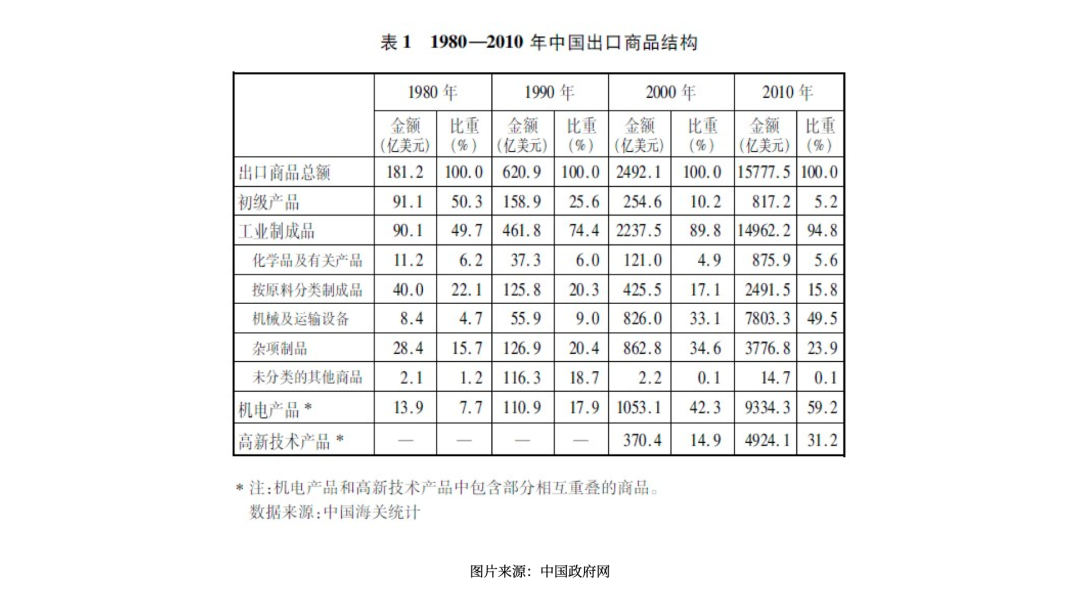
As shown in the chart below, total export value grew nearly 100-fold over these three decades. Export composition also upgraded from primary products to technology-intensive machinery and high-tech products.
▍Internet Global Expansion (2010–present): The Internet as Form and Vehicle
2010 was a pivotal node for China's digital economy and internet development. As China's mobile internet and digital economy grew rapidly, global expansion opened three new breakthrough directions that quickly achieved scaled operations: app expansion, game expansion, and physical goods expansion (i.e., cross-border e-commerce).
- App expansion: Essentially the global expansion of China's internet and digital economy models, particularly tool apps (UC, Cheetah Mobile, etc.) and content platform apps (TikTok, etc.).
- Game expansion: From small studios making reskinned games to scaled global expansion by major studios like Tencent and NetEase, driving numerous original premium games to overseas success.
- Physical goods expansion (cross-border e-commerce): Including both B2B and B2C models. B2C encompasses third-party platforms (Amazon, Wish, etc.) and independent sites.
These three directions developed in parallel and reinforced each other.
To summarize, the currently scaled successful global expansion models include traditional foreign trade, apps, games, and cross-border e-commerce. Their success lies in the overflow and落地 of accumulated Chinese capability势能 — business models, manufacturing, R&D, operational experience, creative artistry, and talent — into target country markets (transfer, recombination, and innovation).
Future Chinese global entrepreneurship will likely continue evolving along two main tracks: internet-based cross-border e-commerce and its surrounding ecosystem in developed Western markets, and Chinese entrepreneur-led ventures in developing Southeast Asian markets.
/ 02 /
Internet-Based Cross-Border E-Commerce and Surrounding Ecosystem in Developed Western Markets
Let's examine each separately. First, internet-based cross-border e-commerce and its surrounding ecosystem in developed Western markets.
▍Cross-Border E-Commerce
Why has cross-border e-commerce developed so rapidly? The primary driver remains three new transformations brought by the digital economy: new transactions, new traffic, and new media.
- New transactions
Whether on third-party e-commerce platforms (Amazon, etc.) or through DTC independent sites, these new transaction methods dramatically improve efficiency compared to traditional retail stores or trade fairs like the Canton Fair.
Take DTC (Direct to Consumer), which emerged in 2010 as a new business model. By reducing reliance on the "brand–multi-level distributor/retailer–retail store" network, DTC allows merchants to reach consumers directly, make decisions based on consumer demand, and meet needs precisely, flexibly, and promptly. Meanwhile, merchants can leverage social digital media to conduct new marketing including social content marketing, better communicating brand philosophy and creating exceptional experiences.
In sum, DTC's value lies in enabling consumer goods companies to become more cost-effective, data-driven, and agile. They can build direct customer relationships, cultivate trust, collect first-party data, and deliver personalized service. (Click to read "How to Win Over Chinese and American Gen Z Consumers? Reflections and Advances from a Streamlined D2C Skincare Brand")
So what's the difference between DTC independent sites and Amazon e-commerce?
The fundamental distinction: the former is vertical-user-centered full-chain operations, while the latter is product-centered single-point supply to all users. Users come to independent sites for full-chain service, not just to buy products. Amazon is primarily product-centered — once the purchase is made, the transaction ends. These represent different operational philosophies and methods.
Independent sites' advantages: Unlike Amazon and other third-party platforms that operate mainly on search logic, independent sites allow free customization of design and branding, conducive to gradually building user trust and brand moats. Platform costs are lower — Amazon's average commission rate is 15–20%, while according to the e-Conomy SEA Report 2019, independent site SaaS subscription rates are only 2.6%. Finally, independent sites have clear advantages in user connection and data acquisition: Amazon only provides sellers with customer names and addresses, while independent sites can obtain all data including contact information, enabling better customer connection and user operations.
However, independent sites face challenges with high traffic costs. Amazon brings its own traffic with strong purchase intent, while independent sites start with no traffic and must attract it from multiple sources, with far fewer SKUs than third-party platforms and heavy ROI pressure. Over the long term, though, there are cumulative effects and user repurchase benefits.
- New traffic
New traffic refers to emerging social content platforms including Instagram, Facebook, and TikTok, which have provided continuous traffic dividends for rapid cross-border e-commerce growth.
- New media
New media means the evolution of media formats from traditional text and images toward long-form video, mid-form video, short video, and livestreaming, bringing richer product display and interaction methods that improve conversion efficiency.
▍Internet Cross-Border E-Commerce and Ecosystem Partners Going Global Together
Currently, internet cross-border e-commerce has three main forms: third-party platforms (like Amazon), independent sites, and nascent new e-commerce models (such as live commerce on TikTok).
Amazon star enterprises include smart charging brand Anker, while independent site stars include fast fashion brand SHEIN, children's D2C brand PatPat, and fashion brand Cider. Both PatPat and Cider are early FreeS Fund investments.
Notably, a major advantage of China's internet cross-border e-commerce global expansion is that companies aren't fighting alone — they're going global alongside ecosystem partners. This ecosystem includes China's strongest full-industrial-category manufacturing capabilities,完善 infrastructure covering warehousing, logistics, and payments, rich and powerful SaaS providers, global social content platforms (like TikTok), and other ecosystem partners (such as Chinese global MCN service providers). Our global expansion is the entire ecosystem going global together.
▍Current Difficulties and Challenges Facing Cross-Border E-Commerce
Of course, cross-border e-commerce currently faces difficulties and challenges, mainly in three areas:
First, after more than two decades of internet development, structural mega-transformations have largely completed, and digital economy dividends are gradually tapering. Second, business models lack diversity — most cross-border e-commerce still focuses on extreme price competitiveness. Homogenization leads to vicious competition, and "non-standard operations" can result in platform bans; indeed, mass bans of Chinese sellers have occurred on Amazon and Shopify. Third, beyond business models, operational models also lack diversity.
Domestic cross-border e-commerce mainly operates in an "air force" model, with primary teams based in China and insufficient local operational depth. Remote operations rely on advertising ROI tactics, with weak product R&D capabilities (primarily sourcing and matching goods). So-called "refined operations" treat users as UVs and PVs — actually coarse user management. Some price-focused cross-border e-commerce resembles channel selling more than brand building.
Behind these dilemmas and challenges lies an essential cause: entrepreneurial teams generally need to deepen their grasp and understanding of target country market users to operate at greater depth.
Cultural difference is a clear barrier. A Chinese friend once joked that after nearly a decade in America, they still couldn't understand American jokes. Without foundational understanding of local users and needs, relying purely on algorithms, A/B testing, and ROI tactics easily leads astray. Thus, building deep understanding of local users and needs is key to cross-border e-commerce's future development.
Based on this, here are six recommendations for cross-border e-commerce's next development phase:
- Capitalize on new media: Overseas TikTok and short video/livestreaming dividends remain underexploited; Chinese companies should seize these opportunities.
- Escape the price competition red ocean: Strive to research how to sell products at premium prices, rather than mutually depleting each other on low margins and volume.
- Break free from traffic-centric thinking: Work to research and understand users' real needs and provide better service.
- Prioritize repeat purchases from existing customers: New user acquisition costs are too high, so strengthen private domain construction and deliver deep membership operations. We're pleased to see many global companies already experimenting with private domain operations.
- "Fight as a team": Better coordinate with China's advanced digital economy surrounding infrastructure to go global together — better cooperation produces unexpected synergies.
- Team capability building: Especially front-end user understanding and back-end product R&D grasp and innovation.
New Trends and Opportunities in Cross-Border E-Commerce
Based on this context, new trends and resulting opportunities in cross-border e-commerce include:
- New environment
Platform "crackdowns" by Amazon, Shopify, and others will produce a good-money-drives-out-bad effect. Previous behaviors competing on resource scale, execution capability, and platform rule exploitation will be suppressed, and the overall environment will improve. Excellent正规军 from China are also entering overseas markets, including outstanding product R&D and supply chain merchants.
- New people
A new wave of teams with stronger international capabilities will enter, including Chinese or ethnic Chinese who have lived or studied overseas — particularly young people with deep understanding of target country markets and cultures, who understand marketing, design, and brand operations. Their gradual加入 will strengthen global companies' understanding of local users and needs, as well as product design and brand operation capabilities.
- New marketing
Particularly noteworthy is the TikTok effect. Chinese DTC brands going global may welcome new opportunities, with potential for more "Chinese global brands." (Click to read "As Long as You Don't Lose the Domestic Rat Race, You'll Win Globally | Li Feng's New Year Consumer Outlook")
- New models
Both business and operational models have substantial room for development. Chinese entrepreneurial teams can go global together and better generate synergies.
Chinese Entrepreneur-Led Ventures in Developing Southeast Asian Markets
Is Southeast Asia "The Next China"?
Southeast Asia comprises 11 countries: Myanmar, Thailand, Cambodia, Laos, Vietnam, the Philippines, Malaysia, Singapore, Brunei, Indonesia, and East Timor. Total population is approximately 650 million across 90+ ethnic groups, predominantly of Mongoloid ethnicity, with diverse and complex religions. The overseas Chinese population exceeds 33 million, roughly 6% of Southeast Asia's total population and about 3/4 of the global overseas Chinese population. Ethnic Chinese hold prominent economic positions in Southeast Asia, with increasingly significant political standing — making it a very suitable place for Chinese entrepreneurs to expand.
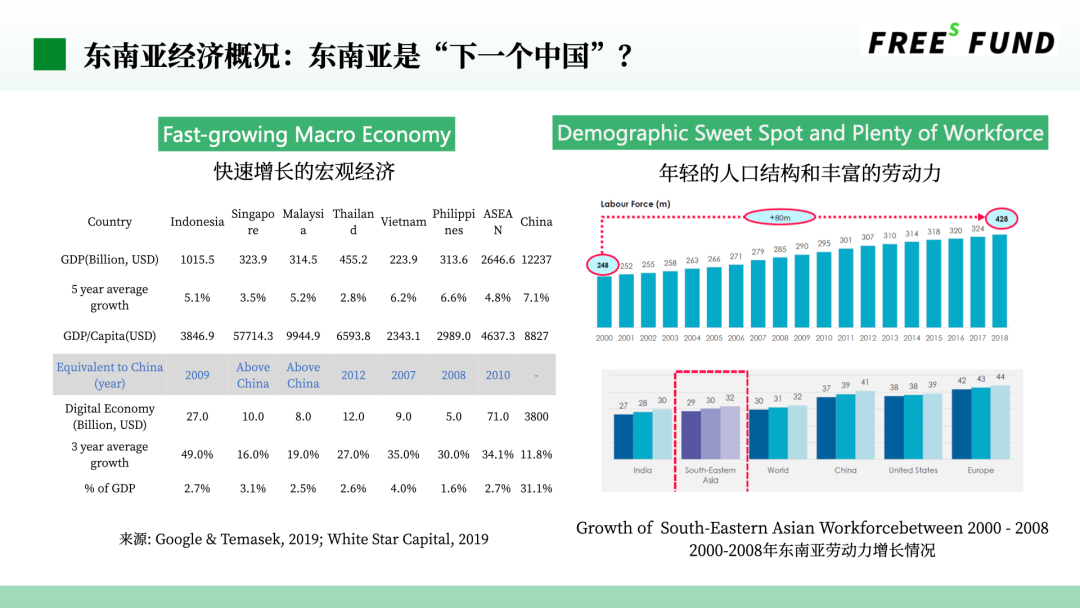
In 2019, a report from Google and Temasek suggested Southeast Asia could become the next China. As mentioned, the region's total population is roughly 650 million. As shown in the chart above, in 2019, per capita GDP in major Southeast Asian countries was equivalent to China's 2010 level (roughly a 10-year gap). The digital economy's share of GDP in major Southeast Asian countries averaged 2.7% (far below China's then-31.1%), but its digital economy had grown at an average annual rate of 34.1% over the previous three years (versus China's 11.8%) — very promising. Southeast Asia also has a relative advantage in population structure, with a high proportion of young labor, which matters for sustained subsequent development.
Infrastructure Development Gaps: Southeast Asia vs. China
In terms of infrastructure, Southeast Asia currently lags far behind China. This manifests first in insufficient local manufacturing capacity and heavy dependence on Chinese supply chains. Second, offline retail channels are fragmented and inefficient. Take Indonesia: offline retail mainly comprises a small number of shopping malls, roughly 30,000–40,000 convenience stores, and approximately 2.5 million mom-and-pop shops. Online retail penetration is also currently low — both online and offline sales channels need upgrading. Third, Southeast Asian infrastructure is relatively deficient. The most typical example is high courier costs: in Indonesia, delivery runs 8–15 RMB per package, versus roughly 2 RMB for nationwide delivery in China (sometimes even lower). These infrastructure development gaps create opportunities for Chinese companies.
For example, opportunities in chain retail expansion: KKV, MINISO, and ACC Super Accessories (an early FreeS Fund investment) have all opened stores in Southeast Asia. Or consumer goods expansion: Chinese companies have accumulated extensive methodologies in both online and offline operations. OPPO and ice cream brand Aice are examples of effectively leveraging Chinese market experience to rapidly capture market share. Or Chinese startup J&T Express, which seized this opportunity and grew in four years to become Southeast Asia's largest courier company.
Internet Industry Development Gaps: Southeast Asia vs. China
In terms of developmental stage, Southeast Asia's economy roughly trails China by 10 years; I'd estimate internet development by about 3–5 years. In terms of industry evolution, because of Southeast Asia's extensive intersections with Chinese society, many internet models are primarily Copy from China rather than Copy from America.
Because this "Copy from China" process advances across multiple tracks simultaneously, the development path differs from China's and sometimes produces different results, with certain industry divergences — of which there are numerous cases.
For example, Southeast Asia has two famous ride-hailing duopolies, Grab and Gojek (Gojek later merged with Tokopedia to form GoTo), which initially operated businesses similar to DiDi and Meituan. These two companies respectively drove two leading e-wallets, OVO and GoPay. As we know, China's e-wallet duopoly is Alipay and WeChat.
So why could ride-hailing and food delivery become leading e-wallets in Southeast Asia, while this didn't happen in China?
We can find reasons by looking at history: China's leading e-commerce companies started around 2000 (Taobao in 2003), while leading ride-hailing/food delivery companies started around 2010 (DiDi in 2012, Meituan in 2010) — e-commerce had roughly a 10-year head start.
Now look at Southeast Asia: both e-commerce and ride-hailing/food delivery launched around 2010 (Tokopedia 2009, Gojek 2010). The result was that ride-hailing/food delivery took the lead in building e-wallets (though in H2 2021, e-commerce company Shopee's e-wallet gradually caught up).
Let me extend to an even more interesting finding: why is it that in China, ride-hailing is done by DiDi and food delivery by Meituan, while in Southeast Asia the ride-hailing duopolies can do both?
A crucial reason is that in most Southeast Asian countries (like Indonesia), motorcycle orders vastly outnumber car orders for ride-hailing. In this situation, vehicles and riders are reusable — they can simultaneously accept both ride-hailing and food delivery jobs, so it's not strange that these two businesses operate together.
Thus, different industry environments and development sequences may produce different results.
Additionally, in Southeast Asia, a single country's single business line often lacks sufficient market space, so Southeast Asian startups have strong motivation to expand along both country and business dimensions. For example, Grab and GoTo's business lines = multiple countries' DiDi + Meituan food delivery + Alipay + flash delivery; GoTo adds e-commerce (via its famous e-commerce platform Tokopedia).
So, opportunities for Chinese companies expanding to Southeast Asia can be summarized as: deeply localized versions of proven Chinese digital economy models, with Shopee and J&T Express as typical cases.
Second Global Expansion: Southeast Asian Chinese Teams' Further International Development
As mentioned above, in Southeast Asia a single country's single business line often lacks sufficient market space, so teams that break through there tend to have strong willingness and capability for further international development — what we might call "second global expansion" capability.
Examples: Beyond Southeast Asia, Shopee is actively expanding into Latin America, Europe, and other countries. Beyond Southeast Asia and China, J&T has entered multiple other countries. Lalamove started from Thailand, Singapore, and other Southeast Asian countries, radiating to Latin America and beyond.
Thus, we can see that Southeast Asia can serve as the first stop for Chinese entrepreneurial teams going global — it's close to China, with similar living environments, and some regions are slightly less developed economically, suitable for model migration. Moreover, Southeast Asia is inherently a multi-country market; success here builds international capability reserves that can serve as a springboard for second global expansion into broader international markets. So the Southeast Asian market is a highly imaginative space for Chinese entrepreneurial teams.
Let me give an example: Aice ice cream. This company is quite distinctive — it's a team from China Mengniu Dairy Company Limited that went to Southeast Asia. The company entered the Indonesian market in 2015, mainly engaged in Aice ice cream production and sales. Initially, Aice used Chinese market tactics, rapidly capturing the ice cream consumer market through low-price, high-quality ice cream, quickly becoming Indonesia's second-largest ice cream brand. In 2022, Aice was acquired by China Mengniu Dairy Company Limited.
Why call it "Chinese tactics"? Because China's ice cream market also fought its way out against American brands like Wall's.
When Aice first entered Indonesia, it also encountered Wall's, but Wall's faced challenges going downmarket in Indonesia — particularly the mom-and-pop shops mentioned earlier that couldn't be covered without freezers. The Aice team very cleverly seized this opportunity (also drawing on Chinese experience and tactics), deploying large numbers of freezers to mom-and-pop shops in downmarket areas. This not only activated much previously unmet market demand but also preemptively captured massive retail terminal share. Aice is currently Indonesia's second-largest ice cream brand by sales value, but its sales volume has already surpassed Wall's. I previously heard that Aice's future goal is to operate along the entire equator — I hope they succeed.
This case also illustrates that global expansion opportunities aren't limited to internet companies. If traditional Chinese offline consumer brands have strong methodologies and capabilities, they can equally achieve global expansion.
Another "Fighting as a Team" Phenomenon
From my observations, teams going to Southeast Asia to build companies are most successful when they're organized as a team, with core members having relevant domestic industry experience. Examples: J&T Express was originally the Jiangsu team from domestic OPPO that went to Indonesia, first building OPPO Indonesia, then building the courier business. The Aice team was also formed by people from China Mengniu Dairy Company Limited who came to Indonesia together to build a company.
Moreover, in the Southeast Asian entrepreneurship process, it's important to skillfully unite with and rely on local overseas Chinese communities. This group shares cultural connections with Chinese people, is hardworking and capable, and familiar with local environments. Teams combining Chinese teams with local overseas Chinese have good complementarity and strong fighting power. For example, J&T's Indonesia CEO is a local ethnic Chinese.
Summary and Outlook: The Southeast Asia Model of Deep Localized Operations
To summarize, because Southeast Asia has a solid overseas Chinese social foundation, and China's要素势能 can provide a continuous stream of global entrepreneurial material for the region — broad industry coverage, diverse model categories, and simultaneous country and business dimension expansion opportunities. The demonstration effects of star companies and talent overflow effects from leading enterprises are gradually emerging. Future global expansion companies need to shift from the "air force" light model to the "marine corps" heavy model, ensuring that both business operations and teams properly "make landfall." Expansion built on deep localized operations and profound market insights will have the broadest development prospects.
Giveaway
We welcome your thoughts on global entrepreneurship in the comments section. The four most thoughtful commenters will receive a FreeS Fund gift package (each containing Saturnbird coffee, Three Squirrels dried mango, ACC Super Accessories jewelry, Wanwu Upward prebiotic solid drink, and a FreeS Fund custom notebook).

▲ Brand Global Expansion: How to Do TikTok and Independent Sites? | FreeS Global Expansion Series
▲ How to Build a Global Cross-Border E-Commerce Brand? | FreeS Global Expansion Series
▲ How Will the Cross-Border E-Commerce Track Develop in 2022? | FreeS Global Expansion Series