"It's Not Going Global, It's New Globalization": Here Are the Thoughts and Practices of Nearly 20 Companies

Global Vision and Chinese Wisdom

Globalization has been an enduring theme ever since Columbus discovered the Americas in 1492. Since becoming a special economic zone in the 1980s, Shenzhen has remained the most critical bridgehead for Chinese companies going global.
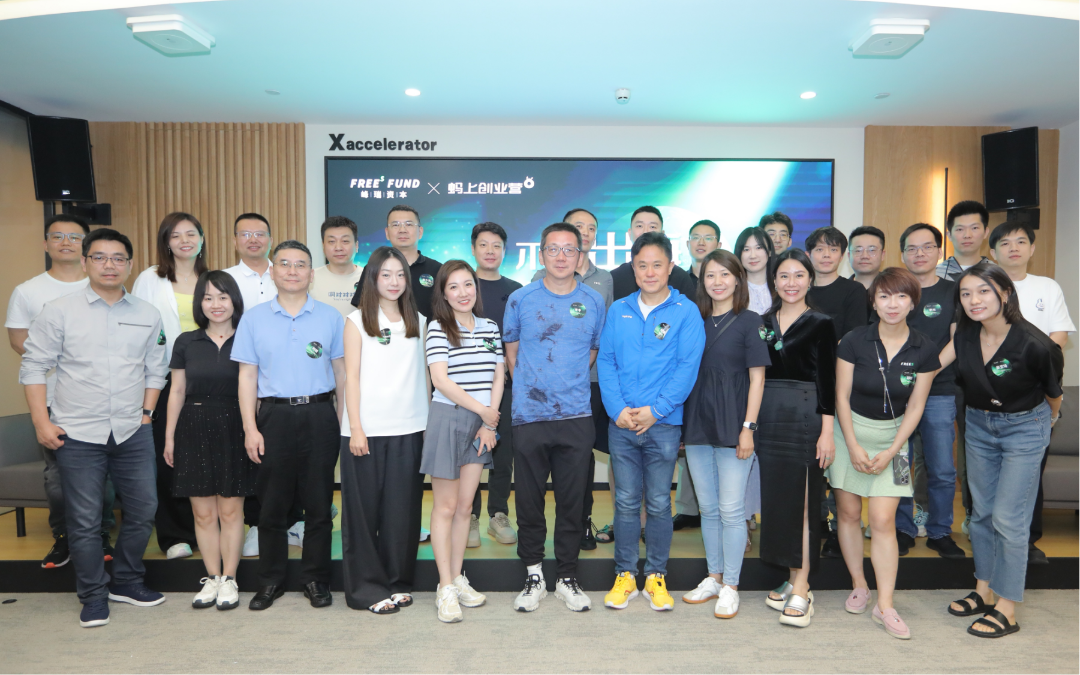
Recently, FreeS Fund and Ant Group's Ma Shang Entrepreneurship Camp co-hosted a closed-door session titled "Not Going Overseas, But New Globalization" at Xaccelerator Co-Creation Hub in Shenzhen's Nanshan District. Nearly 20 founders participated in the event.
During the opening session, founders introduced their businesses one by one, sharing their firsthand experiences and insights on globalization. Over the past year, their footprints have covered developed countries we all know well — the US, Germany, Japan, and South Korea — as well as emerging Southeast Asian markets like Singapore, Malaysia, and Thailand. They've also reached Turkey, straddling Europe and Asia, and Central Asian countries including Uzbekistan.
Following this, Feng Shu (Li Feng) and Ji Gang, Vice President of Ant Group and President of Strategic Investment & Corporate Development, who also serves as Camp Director of Ma Shang Entrepreneurship Camp, exchanged their thoughts and insights on "new globalization." Ji Gang also shared Alipay's approach and experience in going global.
Below are selected perspectives that we hope will offer fresh angles.
Review
Swipe right to see more

Swipe right to see more

Swipe right to see more

Swipe right to see more

Swipe right to see more
Highlights

Swipe right to see more

Swipe right to see more

Swipe right to see more

Swipe right to see more

Swipe right to see more

Swipe right to see more

Swipe right to see more
*Thank you to Xaccelerator Co-Creation Hub for providing the venue.
Contact Us We look forward to ongoing exchanges with entrepreneurs, researchers, and industry experts interested in globalization. Feel free to add FreeS Xiao Rui on WeChat (ID: freesfund) to connect with us.

01 / Macro Perspective

Li Feng: Chinese companies' globalization can roughly be divided into three categories. The first is capacity export — made in China, sold globally. The second is business model export. The third is global sourcing and global merchandizing — finding supply chains worldwide to serve global markets.
China is actively building a new framework for globalization, including the Belt and Road Initiative, joining RCEP — the world's largest free trade zone — and continuing to push for CPTPP accession. Shenzhen is China's top city for imports and exports. In the first four months of this year, its cumulative trade reached 1.41 trillion yuan, up nearly 32% year-over-year. For every startup, you can at least be certain that both the country we're in and the city we're standing in right now are helping hold up the ceiling for "globalization."
More global brands will emerge from China.

Ji Gang: New globalization means China is the starting point of a business, but in the future, China will only be one part of that business. In this process, how we transform into a truly global enterprise is something that requires deep thinking.
The path to globalization differs across countries. Even in Southeast Asia, which appears to have commonalities, the political, religious, and cultural differences between countries are enormous. Trying to succeed globally with a one-size-fits-all approach won't necessarily work. True globalization is complete localization. You must put down roots locally — not just hiring locally, but ensuring your services and products' tone and functionality match local needs.
China lives in a 1.5x to 2x speed world. Some Southeast Asian or South American countries might live in a 0.5x to 0.75x speed world. By comparison, China has higher efficiency in production capacity, but whether this efficiency can translate from a temporary product advantage into long-term competitive strength needs to be viewed from both sides.
On one hand, China's industrial chain advantages will persist for a long time, which brings many benefits to the world. Take today's robotics industry — perhaps the "brain" will be in the US, but the body will certainly be in China.
On the other hand, some large foreign enterprises have already begun separating their China operations from their global operations. Viewing China as a standalone market — this influence is subtle but pervasive. The question we need to consider is: in the next "tech tree" phase, how do we acquire the relevant knowledge and continue to develop?
02 / Industry Perspectives (*Listed in order of on-site remarks)

Zhou Junman: We're a game content development company that allows users to play multiple virtual characters within our product, experiencing role-play interactive content. Users can also realize new ideas through an AIGC editor, building human-machine symbiotic social relationships.
From a commercialization perspective, the US, Japan, and South Korea have always been key markets for Chinese games going overseas. For Chinese companies, new globalization isn't just about commercial brand globalization. We also hope global creators can use interactive short drama content and virtual character role-play to achieve easier, more inclusive, and more fluid exchanges of ideas — mutual understanding that contributes to world peace.

He Kai: We focus on high-altitude operations in shipping, petrochemicals, and wind power — things like rust removal, cleaning, grinding, and spraying for ships, storage tanks, and wind towers. The robots serving these scenarios have broad industry prospects, already validated domestically and ready for overseas expansion.
Whether you call it going overseas or globalization, Western developed countries started years ago. We've all witnessed or experienced foreign companies coming to China — now the positions are simply reversed. From a certain perspective, hard tech going overseas is a niche track. Unlike the "three-plus-one" model (processing with supplied materials, processing with supplied parts, assembling with supplied samples, and compensation trade), it directly participates in top-tier competition and value distribution. Going overseas is a process of building internal capabilities, setting strategy, and continuously spiraling upward. As a specialized robotics company, Xingzhixing will stick to the path of high reliability and extreme ease of use, hoping to change traditional divisions of labor through technology and secure our position in the ecosystem.

Niu Yafeng: Aeroband has always focused on digital electro-acoustic musical instruments, rooted in global markets, creating exceptional musical experiences for music enthusiasts. From our observations, users in Europe and North America have stronger willingness to pay for innovative products with significantly upgraded experiences compared to other regions. North America, in particular, as Aeroband's main market, ranks among the top globally in musical literacy and atmosphere.
After years of deep cultivation, we've also developed a methodology for hard tech consumer new categories to crack overseas markets. First, thoroughly understand overseas cultural differences to do proper user insight and localization adaptation. Second, products need sufficient innovation — investing in technology and innovation to achieve experience upgrades or significant cost reductions to ensure product advantage. Finally, find low-cost marketing approaches suitable for your category to better adapt to local markets.

Miao Shaoguang: As a logistics informatization enterprise, we went out following our upstream partners — in a sense, passive globalization. Our main clients are large enterprises in cement, coal, and high-speed rail. As China began undertaking infrastructure projects in neighboring countries, these large enterprises started going global. During cross-border transportation, their trucks use our intelligent weighing products, so we're essentially "selling tickets." Last year we went to Uzbekistan; this year we'll go to Indonesia, Thailand, and Singapore.

Wang Wei: We're a B2B AI chip company. Although semiconductor supply chains are global, facing East-West geopolitical challenges, what we need to consider is how to use going overseas to find another safe living space on the supply chain side.

Liu Qiuyang: At first we thought "AI + psychological counseling services" was a niche, relatively vertical industry, probably with higher usage rates in the US and Europe. Actually, domestic business has exceeded our expectations. Of course, we've also started trying the European and American markets this year.

Deng Zhiwei: I spent nearly half a year overseas last year. Initially I wasn't very confident. But after running around out there, my feeling is that for tool-category products like eyelash extensions, going overseas can be much bolder. Currently, overseas markets contribute the majority of our GMV.
In China, the price gap between eyelash industry products and services is roughly 70-80x; in Southeast Asia, this gap can reach 100x. In countries like Vietnam and the Philippines, the per-service price users can accept isn't lower than in China, despite their average wages being one-third of China's. Additionally, video ad ROI abroad is very high. Domestically, many brands see Douyin ROI below 1; on TikTok, falling short of 3x is almost unlikely.

Wu Chunsong: Embracing going overseas and globalization, embracing content e-commerce — this direction can't be wrong. We do TikTok track data analysis tools and AI video/live streaming tools. We're "selling shovels" to overseas brands and merchants.
The changes AI brings to content e-commerce are more constructive. We use large models like GPT for content understanding, video generation, multilingual translation, and so on. We're AI + SaaS — without large models, our SaaS simply can't run.

Zhang Wei: AI is currently shifting from specialized AI to general AI. Robotics is also in an era of transformation from specialized robots to general robots. This is a relatively long track. For fields like intelligent robots that require rapid hardware iteration, China definitely can't be "held down."
Regarding when intelligent robots can achieve commercial deployment, I'm cautiously optimistic — I think it will happen soon. Which scenario depends on business strategy. As a general robotics company, what we can focus on at this stage is improving intelligent robots' generalized operation capabilities across diverse scenarios, better preparing for the inflection point of commercial application.
The intelligent robotics track hasn't reached a state of "involution" yet. Our pain comes from the gap between people's perception of intelligent robots and reality. The process of self-growth is also painful, but this pain doesn't come from the macro environment — self-technological revolution is our biggest pain point for development.

Li Jie: For offline local life service merchants, platforms control traffic, and traffic is sold as a commodity on platforms. Therefore, what platforms can actually do is traffic empowerment, not true marketing capability empowerment.
As the AI and intelligent era arrives, we hope to create a new product and business model that truly gives small and medium merchants intelligent digital marketing capabilities on par with top internet platforms. What Shilai does is combine big data with AI to help merchants build and autonomously operate their own store private domain traffic, thereby achieving efficient performance growth.

Zhao Songgeng: For the colored contact lens track, the reason we pay attention to overseas markets is strong user demand, large market space, and relatively less competition. However, many Chinese players are now going abroad to compete, and it seems like everyone is just switching locations to "involute," with the speed of involution getting faster and faster. If we look at Southeast Asia five years from now, the market will probably be half of China's.
From the colored contact lens industry's perspective, despite macro fluctuations in 2024, our track is still growing against the trend. And from user consumption behavior, users view colored contact lenses as a necessity that satisfies their appearance needs and emotional value, so they're still willing to spend. As I put it, "colored contact lenses are like lipstick for the eyes" — their consumption also shows the so-called "lipstick economy" effect.

Zhou Qi: When we first started our business, we approached beauty devices with a medical mindset. Beauty is a trust business: how do you give users better, more beautiful results? This is a long-term endeavor requiring a more professionalized approach. Going overseas is also a direction we're considering. Some data I've seen shows the revenue ratio between domestic and overseas markets for beauty devices is roughly 6:4.

Pan Xinlei: We do personal cloud storage solutions for audio and video creators. Last year our product launched on Kickstarter, raising $1.2 million in cold start funding.
Overseas crowdfunding remains the lightest, most effective entry point for hardware and software product PMF. Crowdfunding solves two problems: first, getting early user feedback to iterate products and make them more market-ready; second, effectively solving startup capital needs.

Yang Shu: We research AI large models in fintech and tax/legal fields overseas. When evaluating international markets, look at two things: market space and market value. Southeast Asia has no problem with either market space or market value.
But what worries me is that as more Chinese companies expand abroad, if they don't differentiate and innovate, but instead homogenously engage in price wars, they might drive foreign companies out. If foreign companies exit, then overseas markets become no different from the Chinese market — ultimately still Chinese companies competing against each other. This is something everyone should pay attention to.
Lu Shengbo: The main market demand for smart pet products is overseas, especially North America and countries deeply influenced by North America.
As today's theme says, "not going overseas, but new globalization." Regarding globalization, I have two observations: First, to do global business, you need to better understand others' laws and regulations — both on and under the table — ethnic rules, and some unspoken rules. Second, in today's environment full of uncertainty, you can't afford to lose your home market in China while going global.
A Trip to the US: 6 New Opportunities in Consumer Subcategories | FreeS Research
New Playbook for Overseas Entrepreneurship: From "Air Force" to "Marine Corps" | FreeS Research · Going Overseas Series
If You Don't Lose in Domestic Competition, You'll Definitely Win Globally | Li Feng Column
How Will the Cross-Border E-Commerce Track Develop in 2022? | FreeS Going Overseas Series
Star the FreeS Fund WeChat Official Account for timely business insights