I discovered a new business loop in OpenClaw.

The real winners are the ones who can keep "breathing."

At this week's NVIDIA GTC 2026 conference, Jensen Huang officially unveiled NemoClaw — the enterprise-grade "lobster."
From Chinese tech giants racing to follow suit, to the world's most powerful compute company now bending down to enter the fray, this weekend project cobbled together by an Austrian indie developer has sparked a full-blown "lobster-raising" craze stretching from Silicon Valley to Zhongguancun.
The OpenClaw phenomenon needs no further introduction, but the more important question is: "What now?"
When an open-source project outpaces the growth of all infrastructure projects (Linux, Android, or large language models themselves), it usually signals a new track hiding beneath — one that investment institutions haven't fully priced in yet.
On March 15, 2026, Chen Shi, Investment Partner at FreeS Fund, joined a Tencent Technology livestream titled "From the Lobster Craze to Trends: The Industrial Logic and New Opportunities Behind the Agent Era" to share his views on why OpenClaw exploded and how it might evolve. In his assessment, OpenClaw represents, in the most visceral sense, AI finally leaping out of the chat box. It's not merely the arrival of a new tool, but the arrival of an inflection point for Agentic AI — and this process is irreversible.
We've transcribed and organized his share below, attempting to answer these questions:
- Why does the collective rush of tech giants into "lobsters" essentially amount to a scramble for internet traffic gateways?
- Why did OpenClaw explode at this particular moment in time?
- Why didn't American users catch the "lobster-raising" fever?
- Why is OpenClaw the only product occupying the open-domain + no-endpoint quadrant?
- Why will the next wave of entrepreneurial opportunity concentrate in vertical scenarios?
- What are the business logic revelations that OpenClaw brings?

Reader Giveaway What would you use OpenClaw for? Share your thoughts in the comments. By 17:00 on March 26, 2026, the 2 most thoughtful commenters will receive a copy of Demis Hassabis: The Mind Behind Google's AI.
Follow our WeChat account and reply with "OpenClaw" to get Chen Shi's complete PPT.

/ 01 /
From "Talk" to "Do":
Why Is Now the Inflection Point for Agents?
OpenClaw is no longer a purely technical phenomenon — it has broken through to mainstream consumers. Looking back at this trajectory, we find that the "lobster" craze was actually forged by multiple converging factors.
The Magic of Spring Festival
Remember DeepSeek around this time last year? China's Spring Festival is "magic" — both last year's DeepSeek and this year's lobster went viral during the holiday break, when people finally had the free time to sit down and experience new technology.
More crucial is the cognitive leap. For the longest time, AI was perceived as a "chat window" tool. When the lobster achieved cross-window autonomous computer operation, the impact of this "cognitive rupture" was immense — users seemed to leap directly from a chat box into a wondrous world of self-running autonomy.
Before the lobster, there were already several well-regarded Agent products in the industry. Anthropic's Claude Code and Claude Cowork, for instance, were successful and impressive products. However, likely due to safety and error-rate considerations, these products were positioned and designed with relative sobriety and restraint, limited to narrow vertical scenarios rather than facing the broader open world. I personally loved using both and frequently recommended them to friends and colleagues.
So I initially somewhat underestimated the lobster, assuming it was merely Claude Code with remote access bolted on.
Hot in China, Cold in America?
To verify this perceived user gap, I specifically wrote a program with Claude Code to scrape 30 media reports each from China and the US, extracting the top 30 keywords from each to analyze how Chinese and American media and users reacted differently.
The results showed that Chinese users tended to treat it as a "pet" to raise, most concerned with functionality and "how to raise it well," leaning optimistic and exploratory while also carrying FOMO anxiety.
American users, by contrast, were far more conservative — more than half of their top ten keywords related to risks, privacy, and API permissions. This psychological divergence made the lobster far hotter domestically than overseas.
The "Triple Convergence" of Underlying Technology
For the complete PPT, follow "FreeS Fund" and send "OpenClaw."
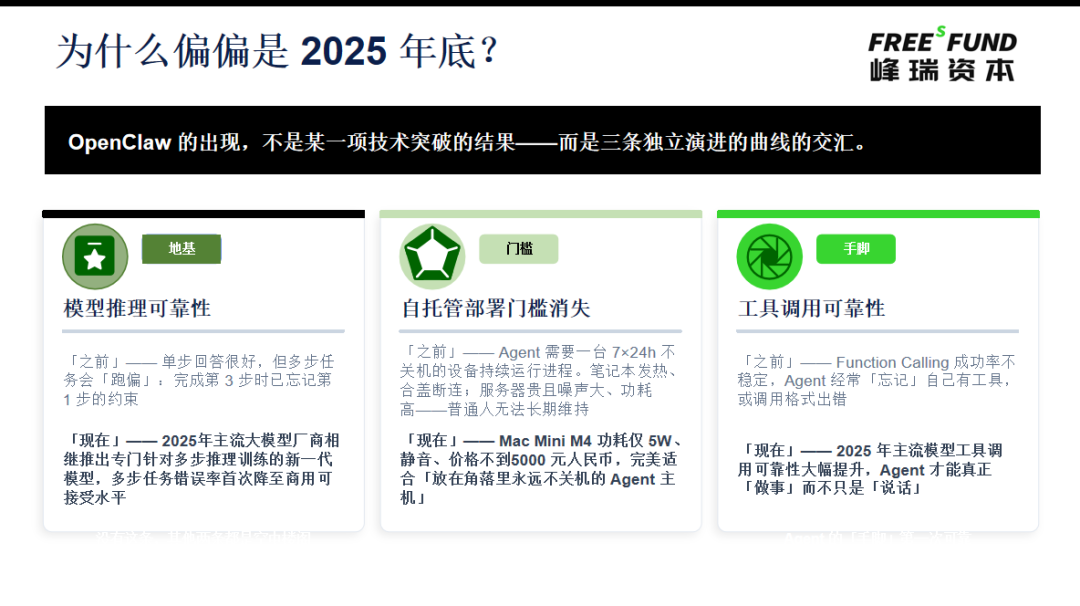
OpenClaw's explosion was no accident, but the convergence of three independently evolving technical curves at the end of 2025, pushing the product past the thresholds of functionality and commercial viability, together forming the stable triangle supporting Agent operation:
-
Foundation (model inference reliability): Iterations of new-generation reasoning models gave Agent a brain smart enough not to "drift off course" during long tasks.
-
Threshold (deployment democratization): The proliferation of low-power hardware (such as Mac Mini M4) made the cost of 7×24 resident Agent hosts accessible to ordinary users.
-
Limbs (tool-calling reliability): The success rate of Function Calling (tool invocation) and Computer Use improved dramatically, giving Agent truly capable "hands and feet" for the first time — able to work and get things done.
/ 02 /
Open Domain, No Endpoint
But environmental factors merely helped push the boat along. To understand why OpenClaw specifically became the inflection point for Agentic AI, we must return to the product logic itself.
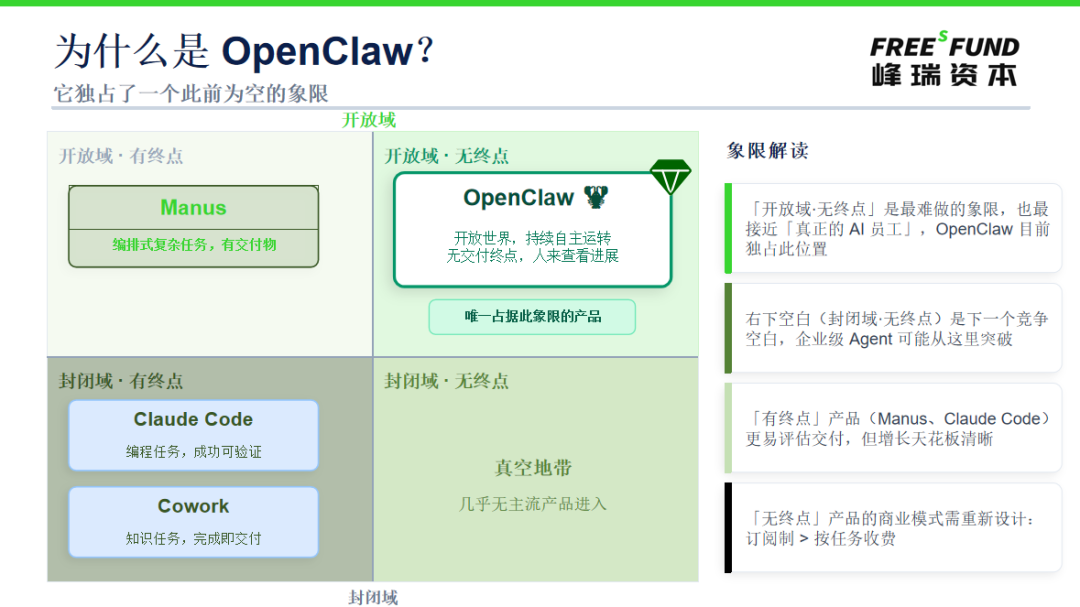
To deconstruct this logic, we examine Agent products along the dimensions of "open domain / closed domain" and "has endpoint / no endpoint." You'll discover that OpenClaw occupies a quadrant no one had previously set foot in.
For the complete PPT, follow "FreeS Fund" and send "OpenClaw."
1. Closed Domain · Has Endpoint (bottom-left): Representative products are Claude Code and Claude Cowork.
They are confined to code writing or internal enterprise workflows. Every task has a clear deliverable; once submitted, the process stops.
2. Open Domain · Has Endpoint (top-left): Representative product is Manus.
While it gathers data from various open-environment sources and tasks are relatively complex, it still terminates upon producing a concrete result (a program, a webpage, or a research report). Delivery means the end.
3. Open Domain · No Endpoint (top-right): This is territory OpenClaw exclusively occupies.
It operates continuously and autonomously in the open world, 7×24×365. It has no delivery endpoint — humans simply check in on its progress.
The Vacuum: Entrepreneurial Opportunity in Closed Domain · No Endpoint
While products like Manus or Claude Code that "have an endpoint" are easier to evaluate for delivery, their growth ceilings are also relatively clear. By contrast, the "open domain · no endpoint" quadrant that OpenClaw exclusively occupies, though enormously challenging, comes closest to what we understand as a "true AI employee."
Yet in this quadrant diagram, there remains one blank space: closed domain · no endpoint (bottom-right). This is very likely where the next enterprise-grade or vertical-domain Agent will emerge.
Currently, mainstream products have barely entered this quadrant, but this is precisely the opportunity left for developers and entrepreneurs. Applying this "resident, no-endpoint" logic to a vertical, closed domain offers two natural advantages:
-
Higher success rates: Within a specific industry, an Agent's task-handling precision improves significantly.
-
Safety guardrails are easier to build: Compared to a fully open world, security in a closed domain is easier to guarantee, better aligning with B-market hard needs.
When Agent becomes a permanently online "resident employee," its impact on hardware, software, and internet traffic gateways will be "seismic." Let's discuss in detail where this impending industry shock will strike, and where the accompanying entrepreneurial opportunities lie.
/ 03 /
Dimensional Reduction Strikes and New Orders Across Industries
When Agent becomes a 7×24 always-online "resident employee," existing industrial logic will be fundamentally reconstructed. This transformation is redefining the rules of hardware, software, internet, and embodied intelligence with the posture of a dimensional reduction strike.
The New Battlefield for Hardware and Software: From OS to Agent Runtime
The next operating-system-level war has already shifted its battlefield to Agent Runtime.
You may all recall that important news: on February 15, OpenAI announced it had hired OpenClaw founder Peter Steinberger to lead its personal AI agent efforts.
Industry consensus speculates that OpenAI aims to build an "AI version of Android." Though this remains speculation and a linear-extrapolation analogy for now, it illustrates an extremely certain trend: the new AI Agent software runtime has become contested ground that no one can afford to ignore.
If we analogize to mobile internet's development trajectory, the current AI moment closely resembles 2007–2008 when Android and iOS were just born. But we must soberly recognize that AI's explosion logic is completely different from the internet's. The internet's marginal cost was nearly zero, but AI stands on expensive token costs.
The current commercial reality is that token pricing is not equal — when model companies build applications themselves, costs are far lower than for external startups. This cost asymmetry will enormously squeeze entrepreneurial space for non-model companies.
Moreover, always-on Agents pose entirely new challenges for hardware.
Previously we evaluated chips by "peak compute"; now, the evaluation standard is shifting to "sustained inference capability" under low-power, long-standby conditions. Thus edge inference chips (such as NPU) may see explosive growth, because "resident Agents" need a heart that can breathe sustainably, not muscles that burst instantaneously.
The Impact on Internet: Scrambling for Traffic Gateways
In the internet sphere, Agent will sit in front of all software, becoming the new traffic gateway.
When Agent becomes the intermediary layer, the traffic funnel gets intercepted from the middle, and traditional business models face obsolescence: users no longer see ads, nor care about brand stories. For instance, you might choose to buy something in Austin Li's livestream because you trust him — but if you delegate "buy a pack of tissues" to an Agent, the Agent will coolly evaluate and judge based on price, quality, and other factors.
Here's a case in point: Walmart.
At the NRF conference in early 2026, Walmart announced it would embed its core shopping flow directly into Google Gemini. This means users no longer need to open Walmart's app or website — simply saying "restock my tissues for next week" in a dialog box triggers the Agent to automatically pull historical orders, compare real-time inventory, and complete one-click payment.
Walmart US CEO John Furner put it bluntly: "The shift from traditional web/app search to Agent-driven commerce represents the next great evolution in retail." A McKinsey & Company report shows that by 2030, driven by AI tools and "agentic commerce," the global retail market's potential scale could reach $3 trillion to $5 trillion.
But this also brings social-ethical dangers: if your Agent is more advanced and smarter than mine, how do I "buy that cheap pack of tissues"?
The Impact on Embodied Intelligence: From "Remote Control" to "Active Perception"
For embodied intelligence, OpenClaw has validated the feasibility of the "active perception" paradigm at the software level. Previously, robots were long stuck in a remote-control mode of "waiting for human commands," while OpenClaw achieves AI that can periodically wake itself, perceive its environment, and make autonomous decisions through its built-in "heartbeat mechanism."
For example, someone previously installed OpenClaw in a robot dog's "brain," and it began moving around the physical world, observing autonomously and completing tasks.
This means models like VLA (Vision-Language-Action) could potentially incorporate similar design mechanisms going forward, rather than being limited to command-response architectures. Currently, the middleware connecting the perception layer to large-model inference remains a technical blank space, and the most noteworthy infrastructure-level opportunity.
/ 04 /
Seeking New Continents:
Why Vertical Scenarios Are the Destination for "Resident Agents"?
Having surveyed the scope of this industry-wide "earthquake," we must ask: amid the rubble and fresh soil, where do future entrepreneurial directions lie?
In my view, the answer more likely lies in vertical domains.
There's a widely circulated joke in VC circles: VCs invest in high-tech projects all day, yet still have to manually paste invoices for reimbursement — even in highly digitized finance and accounting, truly intelligent software that can close the loop on trivial matters remains lacking.
This "invoice-pasting" pain point may be the perfect entry point for vertical Agents. In closed vertical scenarios, task boundaries are clear, safety guardrails are easier to establish, and Agent success rates and premium space will far exceed generic tools.
Finding Ecological Niches Amid "Unequal Competition" with Giants
A brutal fact: currently, 80% of AI industry application-layer revenue is captured by just two model companies — OpenAI and Anthropic. Model companies don't just make money selling tokens; they have strong impulses to enter industries themselves. Future pillar or platform-level opportunities will likely be occupied by model companies themselves.
For application-layer entrepreneurs, persistence in general-purpose directions will inevitably lead to unequal competition against large models in the medium to long term. Therefore, the more pragmatic strategy is to maintain appropriate distance from foundation models and seek opportunities in vertical domains or deep industry crevices. As I often say, don't obsess over "endgame positioning" too early — first find a way to "get a seat at the table," and adjust in the process of execution.
"Laying Eggs Along the Way" and "Scaffolding" Logic on the Entrepreneurial Journey
This year, whether in Silicon Valley or China, market attention to pure technology narratives is declining — everyone values real commercial returns more.
1. Achieve "laying eggs along the way": In the journey toward the ultimate vision, you must generate revenue at intermediate stages, ensuring the team has cash flow to keep moving forward, rather than sitting idle waiting for some "singularity" to arrive.
2. Product as "scaffolding": The essence of Agent is engineering-level organization and orchestration, also known as "context engineering" or "Harness engineering." Entrepreneurs should build upon existing frameworks and development paradigms as much as possible, allowing products to upgrade naturally as models iterate, rather than piling complex capabilities outside the model — otherwise, when the model upgrades, the original system has to be rebuilt from scratch.
Reconstructing Business Models: Farewell to "Wool from the Pig's Back"
The internet era had three classic models: direct charging, e-commerce, and advertising. Advertising's greatest innovation was achieving "wool from the pig's back." But the problem Agents face today is that every additional user means continuously generated token costs — completely different from the internet era's very low marginal cost per user.
If advertising revenue is insufficient to cover token costs, the rapid-expansion logic of traditional mobile internet becomes hard to sustain.
But OpenClaw's viral explosion has actually yielded some inspiration for how individual developers can earn commercial returns.
In traditional AI training, we needed to spend enormous sums hiring annotation companies for data labeling. But when a user "raises a lobster," every correction, every confirmation, is essentially providing the highest-quality contextual data annotation for the model. Users pay for convenience, and in the process unconsciously contribute data — enabling AI to achieve a "self-reinforcing" positive loop.
This "paid usage + automatic annotation" commercial闭环 also opens a window for individual entrepreneurs: you can develop a "vertical lobster" for a specific domain, earning money through services while collecting professional, cutting-edge vertical data — eventually having the opportunity to commercialize that value, whether for self-model iteration or as high-quality datasets sold to large companies, truly achieving "one lobster, two meals."
Conclusion
OpenClaw's significance lies not merely in its ability to write a few lines of code or search a few webpages for you, but in its proof that: the era of truly autonomously operating Agentic AI has arrived. This is not limited to software and the digital world — if equipped with hardware bodies or humanoid robots, science-fiction scenes are imminent.
In the next five years, our perspective must shift from "whose model is smarter" to "whose Agent is doing work for you." Some value will also migrate from the large-model side toward Runtime infrastructure and vertical application sides.
We stand at a critical juncture, witnessing AI completely escape the chat box and reconstruct the operating substrate of the digital world — and even the physical world.
Reader Giveaway What would you use OpenClaw for? Share your thoughts in the comments. By 17:00 on March 26, 2026, the 2 most thoughtful commenters will receive a copy of Demis Hassabis: The Mind Behind Google's AI.
Reply with "OpencClaw" in our WeChat backend to get Chen Shi's complete PPT.
