Philanthropy, Calls to Action, Bottom Lines, and Temptation: A Case Study in How a Startup Handles a Public Crisis | FreeS Fund Business School

True Stories of How Chinese Manufacturing Helped Fight the Pandemic

On June 19, Efort Automation was named to the Ministry of Industry and Information Technology's list of "AI enterprises with outstanding performance in supporting the fight against COVID-19." The list was designed to recognize and encourage AI companies' proactive response, initiative, and perseverance, as well as the positive role various intelligent technologies played in epidemic prevention and control.
Every company's actions and reactions during the pandemic, you could say, is a case study in how a business responds to public crises and balances commercial value with social value. We want to share with you the twists and turns Efort Automation experienced when it pivoted to producing mask-making machines during the outbreak.
Efort Automation is a leading enterprise in parallel robots, specializing in industrial robot R&D and manufacturing, control system development, and vision system development. It provides automation equipment to well-known companies like Apple and Foxconn, and its pick-and-place robots work on automated demonstration lines in industries including food, pharmaceuticals, 3C electronics, consumer goods, logistics, and new energy. This article is an oral account by Sai Zhang, founder and CEO of Efort Automation. A native of Jinan and born in the 1980s, Zhang earned his master's degree at Columbia University after graduating from Tsinghua University. He then worked as a senior engineer and production supervisor at Chen Hsong Group, a Hong Kong-listed company. In 2012, Zhang resigned and returned to Jinan to start his own business in parallel robots.
▲ Machine Phoenix Nirvana: Shandong TV's special interview with Efort Automation founder Sai Zhang.
In Zhang's view, once all manner of people entered the "mask arena," producing and selling mask machines became a "multi-party wrestling match." In an interview with Shandong TV, he put it this way: "What I've been through with masks is more than everything I've experienced in all these years combined... Our field engineers were detained, clients came banging on our doors at home, and suppliers reneged on deals..."
So what exactly did Zhang go through? When public crises like a pandemic strike, commerce and social responsibility become intertwined — how does a founder weigh trade-offs and make choices? Now that Efort has returned to its core business, how does Zhang reflect on the mask machine episode? Read on to learn this story from an extraordinary time.
Coming Soon & Contact Us
As the world's largest manufacturing nation, China is pushing hard for technological self-reliance while riding the wave of AI development. We believe the country will eventually produce world-class industrial automation enterprises.
What patterns will govern their emergence, and how will they grow? We'll dedicate an upcoming article to analyzing this.
We'll also use Efort Automation — currently one of China's largest parallel robot companies — as a case study to examine how an industrial robotics enterprise has grown over the past eight years.
As always, we're bullish on investment opportunities in industrial automation. Entrepreneurs and industry experts are welcome to reach out:
- Yongcheng Yang, Partner at FreeS Fund: yangyongcheng@freesvc.com
- Yao Yuan, Vice President at FreeS Fund: yaoyuan@freesvc.com

/ 01 / "When the moon rises above the willow tree, we'll meet after the pandemic"
In the early days of the outbreak, I was stuck at home in Beijing, watching news reports every day, feeling helpless that I couldn't do anything. The company had originally planned just three days off for Spring Festival, after which we'd be traveling to client sites like Lens Technology, Tianma Microelectronics, and BOE. When the pandemic hit, all that travel got pushed back, and I worried about how the business would move forward.
It was a time of severe mask shortages. For one thing, China had few mask factories to begin with, and they faced labor shortages due to restricted movement of people. Moreover, most mask companies still relied on manual labor for packaging, constraining their production capacity. It suddenly occurred to me that Efort Automation had built an automated post-production packaging system for a Korean mask factory before the new year, and it had been successfully deployed. So I discussed with the team: we'd quickly advance funds to produce multiple automated mask packaging units and offer them free to mask manufacturers.
This automated packaging technology centered on high-speed parallel robots, combined with conveyor tracking and visual recognition, enabling fully automated mask sorting, packaging, boxing, palletizing, and loading. A single system could replace 4–6 workers, more than double production efficiency, and operate 24/7. On February 3 — the tenth day of the Lunar New Year — Efort Automation published a WeChat article, and I posted to my own Moments: during the epidemic, Efort Automation would provide its automated mask packaging systems free to mask producers.
After the announcement, many people called to inquire, but even more were asking about mask-making machines.
Previously, domestic mask machine production was concentrated mainly in Dongguan, Guangdong and Xiantao, Hubei. At that time, Xiantao had halted production due to the outbreak, leaving essentially just a few Dongguan companies like Kosta and Kuaiyuda capable of building mask machines. By early February, reportedly, these companies' orders were already backed up four or five months. These mask machine manufacturers had originally been in the ultrasonic welding business — mask machines use ultrasonic welding to bond nonwoven and melt-blown fabrics.
Beyond the flood of customer inquiries, the Jinan municipal government became the catalyst for our mask machine pivot. On February 7, the city government organized an inspection team to visit Shengquan Chemical — at the time, Jinan's only mask-producing enterprise, though it too had converted to do so. To rapidly transform into mask production, Shengquan had purchased mask machines from Xiantao and Dongguan at inflated prices. One second-hand machine from Xiantao alone cost over 1 million yuan. Before the pandemic, Xiantao machines sold for around 200,000 yuan.
The municipal MIIT official on site asked: "You capable enterprises here in Jinan — could you convert to producing mask machines?" Present besides Efort Automation were several other Jinan-based automation-related companies.
Our colleagues came back and immediately consulted me. We all felt it was our duty — after all, we had automation expertise to build on. We quickly found videos of various mask machines to study, discussed it internally, and concluded it shouldn't be too difficult. Our technical reserves, mechanical staff, and electrical staff were fully capable of producing mask machines.
So we decided to take on the Jinan government's task of converting to mask machine production. The Jinan municipal MIIT reported this up to the city government. On February 8, Jinan Party Secretary Zhonglin Wang issued a directive: "Efort Automation and other companies should quickly convert to mask machine production." A few days later, Wang was transferred to serve as Wuhan Party Secretary.
After deciding to pivot to masks, I began making my way from my Beijing home back to the company in Jinan.
Leaving Beijing, I felt strangely "heroic." It was just after Lantern Festival. Thinking about not seeing my wife and child for who knew how long, I made a pact with my family: "When the moon rises above the willow tree, we'll meet after the pandemic." I didn't realize at the time that I wouldn't return to Beijing until late May.
/ 02 / "I'd never experienced customers blowing up the phone like this"
Early on February 9, wearing a raincoat, goggles, and gloves — thoroughly protected — I arrived back in Jinan. On February 10, Efort Automation officially resumed production, with strong support from the Jinan municipal government.
We immediately established a "Mask Machine War Room," with the heads of frontline production, quality, procurement, project management, and sales all working from a single office. I worked there every day too.
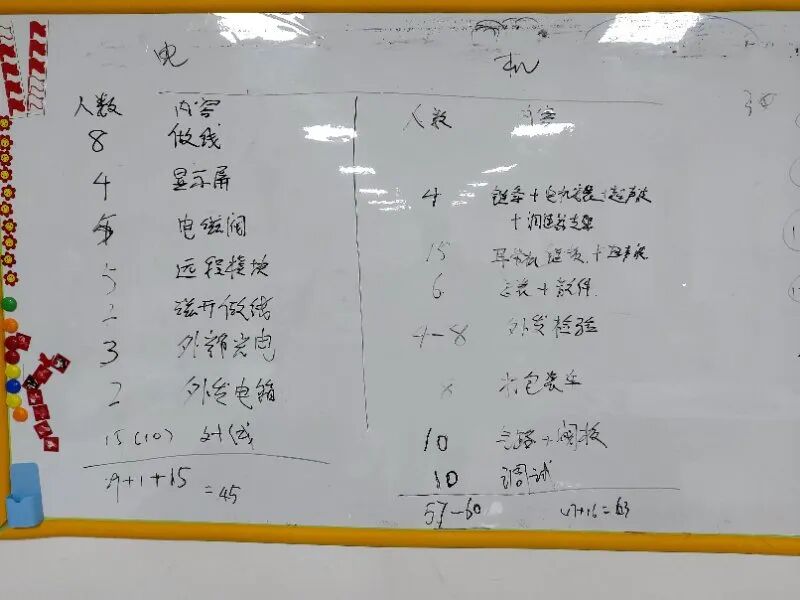
▲ Division of labor for Efort Automation's mask machine assembly.
We carefully studied mask machine videos and principles, using photos taken at mask production sites to digest materials and reverse-engineer the design. After about a week, we completed the design and placed orders for all mask machine components. When we ordered parts, we also officially began accepting mask machine orders.
Our customer service lines were overwhelmed. Sales staff said: "I've never experienced such a happy problem." "Basically a call every five minutes, and when you hung up there'd be missed calls stacked up. At peak, sixty or seventy calls a day, with clients still calling at 1 a.m."
At that time, it was clearly a strong seller's market for mask machines. In just one week, we took orders for over a hundred machines. When we first received those orders, we had no idea how to price them. Market prices varied wildly, from 300,000 to over a million yuan.
I think Efort maintained its principles and didn't blindly follow the price hikes. After all, we weren't converting to mask machines to make a killing — it was mainly about responsibility. We estimated production cost at roughly 250,000 yuan per machine. Our typical gross margin was over 30%, and comparing against historical mask machine prices, we set our price at around 400,000 yuan.
That was an extremely attractive price at the time. Many people wanted to buy, and some clients came to the factory themselves, actively offering to pay more to jump the queue. The temptation was certainly there, but we insisted on delivering to our original customers. Looking back now, there really were many "middleman speculators" in the market then — they'd buy mask machines and flip them at marked-up prices.
▲ Efort Automation's mask machine production system.
Later, mask machine raw material costs skyrocketed. Take ultrasonic welding machines — five needed per mask machine — which jumped from two or three thousand yuan each to twenty or thirty thousand, driving production costs up past 300,000 yuan. Market sellers of course raised prices even more aggressively, with some selling for one or two million yuan per machine. We still held to our original contract prices.
In retrospect, many manufacturers who hyped mask machine prices were later penalized by market regulators. Our "foolish" persistence at least meant we were never accused of "profiteering from national disaster."
It really was a crazy market.
/ 03 / "Race against time without sleep, ensure everyone has masks"
▲ At 2 a.m. on February 27, the Efort Automation team was still battling to debug their first mask machine.
Around February 27, our first mask machine was installed and began full-scale production.
From February 27, when we produced our first machine, until March 18, our entire staff of about 160 worked "997" schedules — frontline staff worked "827" (8 a.m. to 2 a.m., seven days a week). Several times we worked until 5 or 6 a.m. I lived at the company during this period, sleeping on the sofa. We bought a few air mattresses — people would wrap themselves in sleeping bags and crash right there, and some engineers simply slept on their desks. After finishing work each day, colleagues would eat some pork head meat together, drink a little, and celebrate having survived another day.
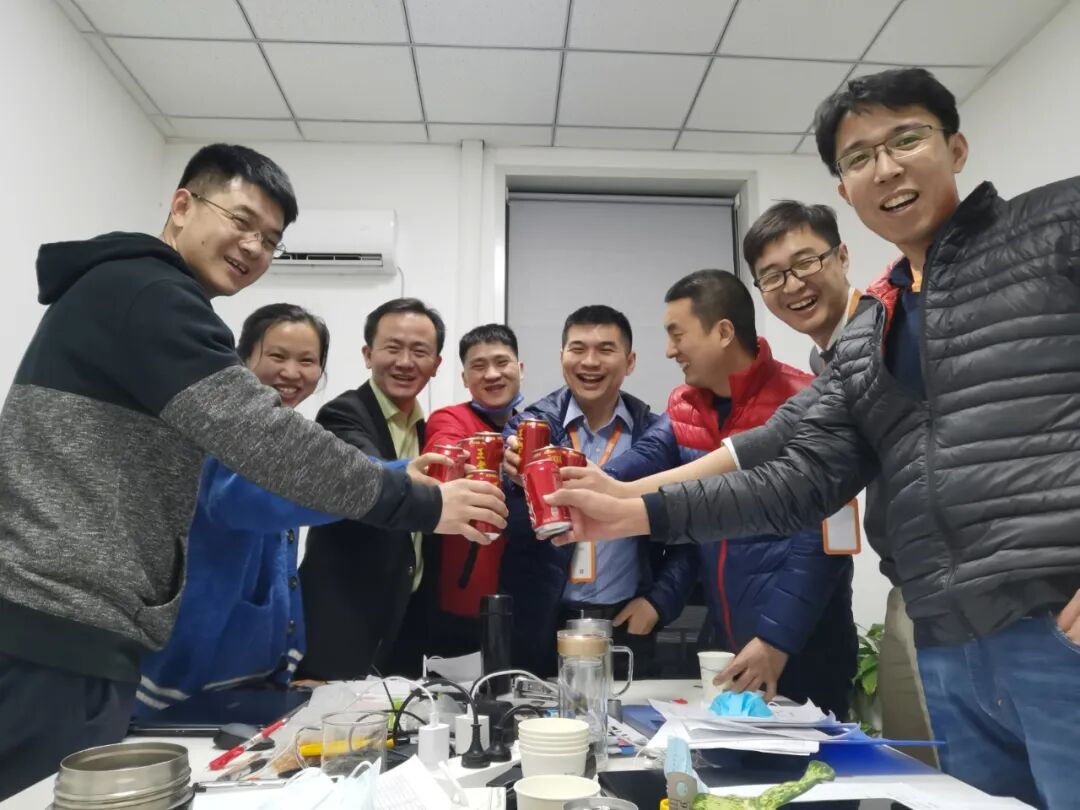
▲ "Celebrating having survived another day."
Our entire staff pushed themselves to the point of exhaustion. Sometimes we still couldn't meet delivery deadlines, so we had to bring in outside contractors. At peak mask machine production, we had over 100 external contractors. We posted banners in the workshop to encourage each other: "Race against time without sleep, ensure everyone has masks"; "Unite to fight the epidemic, work together to guarantee production."
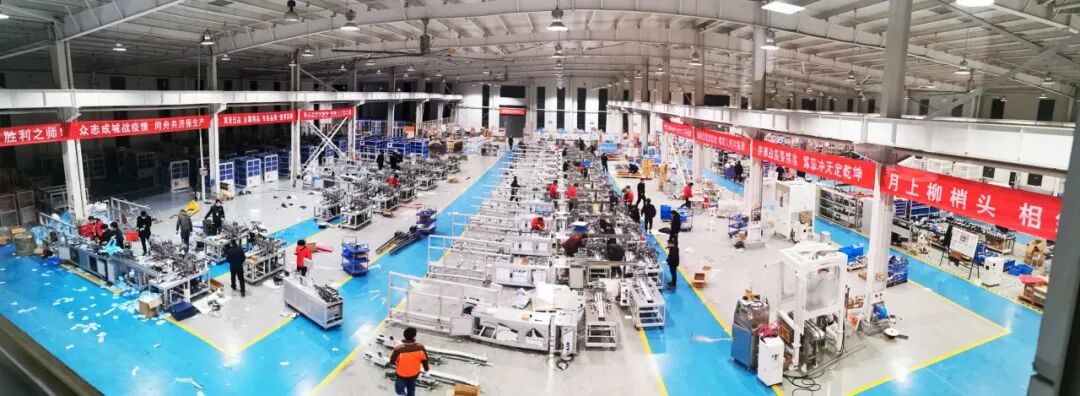
▲ Morale-boosting banners in Efort Automation's production workshop.
Producing mask machines wasn't particularly difficult technically — PLC programming could control them, no industrial PC needed. In a sense, automation companies pivoting to mask machines was a kind of "dimensional reduction." At the time, many companies producing mask machines alongside Efort Automation were robotics and automation firms like Topstar, Yinghe Technology, and Han's Laser.
But technical capability doesn't solve everything. During an extraordinary period like the pandemic, mask machine production faced multiple practical pressures.
First, component supply couldn't be effectively guaranteed. Even with suppliers throwing all their capacity into mechanical parts, ultrasonic components, and pneumatic components for mask machines, output still fell short. Some rush-produced ultrasonic components failed quality standards, seriously affecting mask machine quality and operation. To avoid impacting client use, we advanced several million yuan ourselves to buy hundreds of spare ultrasonic units for quick client replacement.
Second, many new entrants in the market were simply chasing the mask windfall to make a quick buck — never mind mask machines, many had never even touched general machinery before.
Many people imagined mask machines might work like televisions: buy it, plug it in, flip a switch, and masks pour out. But mask machines have a learning curve. It's like buying a car — you need a driver to operate it. So sometimes even after we finished debugging for clients, once our people left, some clients couldn't operate them themselves. Then came accusations of equipment problems, demands for refunds, people making trouble. Beyond financial losses, we were emotionally exhausted. But staying true to our service commitment, we still processed contract terminations and returns.
Third, sometimes mask machines produced masks that simply didn't meet standards. Later investigation revealed the mask raw materials were at fault. During the outbreak, melt-blown fabric and nonwoven materials were scarce and prices soared, and one resulting mess was substandard materials passed off as good. But we couldn't lecture clients that way — sometimes the mask machine took the blame.
Around February 21, we capped orders at 143 machines and stopped taking new mask machine orders, as we'd hit our production ceiling.
04 Cross-province engineer rescue sparked by mask machine debugging difficulties
February 29 was our first delivery date — 17 machines to deliver. In the days before, clients from all over the country came to our workshop to watch their machines, putting enormous pressure on our debugging. Once we got them roughly debugged, clients would rush to haul them away.
As mentioned, mask machine operation has a learning curve. A tiny minority of clients who already had mask production experience were able to debug the machines themselves after taking them.
But most clients, having never touched the mask industry before — they made wooden doors, newspapers, did logistics, traded goods — if their factories had no maintenance, electrical, or electrician staff at all, could barely get their mask machines running. So we generally arranged teams to provide on-site debugging at client production facilities, only leaving after normal operation. However, even after we equipment vendors finished debugging, if no one took over afterwards, the machines still couldn't be used. In such cases, we allowed clients full refunds. But some clients, after failing to get their machines running, wouldn't accept refunds and came after us instead. For a period, one client — to keep our engineers operating their machines and producing masks — detained our engineer on various pretexts. Multiple negotiations failed. The party that ultimately helped rescue our engineer across provincial lines was another enterprise waiting for our engineer to debug their mask machine. They mobilized considerable social connections, and finally our engineer was "released."
When our engineer returned to the company late at night, I organized the still-working overtime staff to line up and welcome him with a hero's reception. Seeing the spirit blazing in everyone's eyes then, that team cohesion — I believe these will carry us through challenges ahead.
After experiencing such twists, I repeatedly told staff: "Mask machines aren't flip-a-switch production. Better the machine not leave the factory than sell to a company without the technical strength to run it." Additionally, to prevent similar incidents, we produced equipment installation and debugging videos to deliver with the mask machines, and our technical staff helped remote clients complete installation and debugging through remote guidance, enabling earlier production.
05 Battling middlemen, calling police at midnight
After the "cross-province engineer rescue," an even more convoluted story followed. We encountered a middleman who sold both core mask machine components — ultrasonic welding machines — and mask machines themselves. He ordered ten mask machines from us. We spent three or four million yuan buying over 150 ultrasonic units from him. But this middleman reneged severely. The ultrasonic units he provided were poor quality, many unusable, and when we gave feedback, problems went unresolved. Our normal order deliveries were consequently affected, inevitably impacting the machines we were preparing for his clients too. When this middleman couldn't get his goods and couldn't deliver to his clients, rather than address the quality issues with his ultrasonic units, he simply "herded" all his clients to our company. Theoretically, these clients had all signed orders with the middleman. When his clients arrived, they literally lay down in front of our delivery truck wheels, blocking our other shipments: "Either deliver to me, or run me over." Truly fierce. No choice — we called the police. Police came to mediate, they "stood down." Police left, we continued shipping at midnight, they started blocking the gate again. We had to call police again. That night, we called police three times.
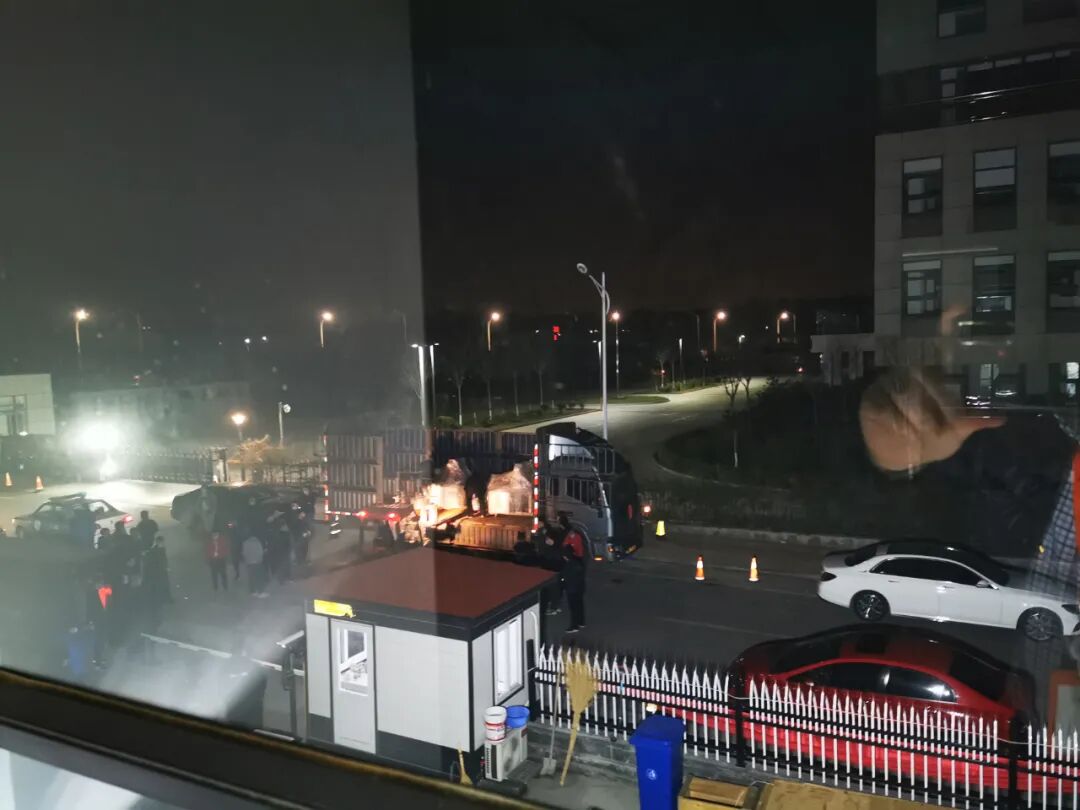
▲ Efort Automation staff forming human walls to protect truck loading.
Finally, with police assistance, our staff formed two lines of human walls to protect truck loading. We'd been working overtime until 2 or 3 a.m., already dead tired, but this incident "woke everyone up," and we suddenly worked until 5 or 6 a.m. The dispute caused by this middleman remains unresolved to this day. You could say, during the mask machine selling days, we saw every kind of person there is.
06 The mask machine "aftershocks" haven't ended, but we've decided to stop making them
For Efort Automation, making mask machines had significance on three levels. First, we weren't counting on making money from it, but at least we didn't lose money — we could use these funds to support the team. Also, mask machine cash flow was good; these tens of millions in orders were all full prepayment or cash on delivery, no payment delays. That was extremely rare. Because in our core business of parallel robots, payment cycles are very long.
Third, producing mask machines was an enormous challenge and upgrade for Efort Automation's overall production management, tremendously training the team — that significance was huge. Still, the pressure was intense at the time; if anyone got infected with COVID, the company might have been "finished." We were relatively fortunate — not a single infection. Now, we've stopped making mask machines. Mask machine demand has indeed weakened, orders dropping sharply. That's a good thing — hopefully the pandemic passes quickly. More importantly, as Efort's upstream enterprises resumed work, orders for our core business rebounded quickly, and we need to return to our main track as soon as possible.
Additionally, a small bonus from mask machine production: some mask machine clients can develop parallel robot business cooperation with Efort, and our sales staff have already begun systematically visiting these clients.
During the hardest days of mask machine production, I rallied everyone: "Let's get through this period, and this year we'll find time to all go to a Mars camp together to experience Mars life, a team-building trip."
Today (July 30), that promise is being fulfilled. From today through next Monday, we're team-building at the Mars camp in Dunhuang, experiencing another meaningful journey together.

What Exactly Did Minister Miao Wei Say About Chinese Manufacturing? | Frees Fund
▲ Li Feng Column 14: Why Should We Thank Chinese Manufacturing? ▲ Surpassing Nestlé and Starbucks on 618 to Become #1 in Instant Coffee — What Did Saturnbird Do Right? | Frees Fund — Learning from Investment ▲ 2020: Consumer Goods Entrepreneurship Enters an Era of Multiple Simultaneous Growth Drivers | Frees Fund ▲ Double 11 at Halftime: What Did Chicecream, Saturnbird, Botanee, and Huasheng Good Car Do Right?