Global Capital Goes Risk-Off: Where's the Money Going? | Macro Musings

Risk Off | The 2001 Dot-Com Bubble? | The Aftermath of the US-Iran Conflict
"Macro Chats" is one of the most popular series on the High Energy podcast. With your company, this series has now quietly passed its 100th episode.
Over this time, we've often seen comments like this: "The information density in this episode is overwhelming — is there a transcript I can study and digest at my own pace?" To honor this hardcore enthusiasm for learning, this year we're distilling select high-density conversations from the podcast into this "Macro Chats Column," using a format of "firm conclusions + simple underlying logic + concrete case studies." Of course, condensing into text inevitably sacrifices some of the vivid, engaging details from the original audio. For the full experience, we invite you to search for High Energy on Xiaoyuzhou or Apple Podcasts. But as Jared Diamond, author of Guns, Germs, and Steel, observed: under algorithmic curation, people increasingly see only content they already agree with, reinforcing existing views while instinctively rejecting different voices. In macro forecasting, there is no absolute correctness, because change is constant. So we merely hope to share one perspective — welcome to exchange and discuss from any angle. Together, we progress in an ever-changing world. (Note: All content in this article and column is for discussion of business logic and macro trends only, and does not constitute investment advice.)
This is the second installment of the "Macro Chats" column. Compared to the earlier year-ahead outlook, this time Feng Shu and Xiang focus more on "separating signal from noise" amid intense turbulence. As the international situation shifts from Russia-Ukraine to US-Iran, as US equities undergo an "onion-peeling" Risk Off shakeout, and global markets swing up and down, how do we track where the money is flowing?
Key themes this episode: Risk Off | 2001 dot-com bubble? | US-Iran conflict aftermath | Energy pricing power | Laying eggs along the way | Commercial space......
Interactive giveaway:
What do you think of the global asset Risk Off thesis? Share your views in the comments. By 17:00 on April 16, 2026, the top 3 most-liked comments will each receive a book recommended by Feng Shu.
/ 01 / The Flow of Money
Hypothesis 1: Global capital is undergoing an "onion-peeling" Risk Off
The process of Risk Off is like peeling an onion — you work from the outer layers inward.
1. AI application stocks rose first and fell first; infrastructure stocks are the final "onion core."
From the GPT wave in 2022 through late February this year, the US rally sequence was: applications first (Salesforce), then infrastructure (NVIDIA). In the Risk Off cycle from the start of 2026 through end-February, the unwind followed the same onion-peeling order — application and software companies have fallen 30%-50% from their highs, most of the Magnificent Seven are down 10%-20%, and only NVIDIA has remained relatively elevated. Digital currencies, as the outermost layer of "dollar-denominated, dollar-traded" assets, have been hit hardest by Risk Off.
2. The parallels to the 2001 dot-com bubble are sobering.
Back then, the onion core was Cisco, briefly the world's most valuable company at nearly $600 billion. The bull case was identical to today's NVIDIA — "no matter who makes money, the infrastructure is indispensable." But after the bubble burst, Cisco fell over 80%; peers like Nortel vanished outright, and Lucent was acquired. Michael Burry, the legendary hedge fund manager who foresaw the 2008 subprime crisis and was portrayed in The Big Short, has issued a warning: NVIDIA's long-term purchase commitments to lock in supplier capacity now approach $100 billion. This mirrors Cisco's 2001 predicament exactly — at peak demand, Cisco signed massive orders that became crushing liabilities when the application bubble burst and customers no longer needed routers. Burry worries that if the AI application layer fails to prove profitability, NVIDIA faces the same "rigid cost trap." Of course, we don't wish a repeat on US equities, but history's lessons merit vigilance.
3. Money staying in the US is in "HALO"; money leaving seeks opportunity globally.
In Q1 2026, capital remaining in US equities rotated from AI plays into Walmart, oil companies, and other low-valuation heavy assets — what's called HALO (Heavy Asset, Light on Obsolescence). Capital fleeing dollar assets flooded into emerging markets: Korea, riding the memory chip narrative, and Brazil, benefiting from tariff policy tailwinds, both saw sharp short-term rallies.
Hypothesis 2: Newly listed tech companies face a six-month hurdle, but the volatility pattern is traceable.
Around six months post-lockup, once the market has digested most of the floating supply, is typically a window to reassess value.
1. China's AI market previously lacked an "onion core"; this year's IPOs are seen as filling that gap.
"Since 2026, Chinese large model companies have been warmly received upon listing, and AI chip IPOs have been equally hot — foreign media even reported that Korean retail investors, known for their trading intensity, have begun adding to Chinese AI and tech stocks. But with only 5-10% free float, this scarcity can drive valuation swings of unusual magnitude in the short term. (This is a feature of market structure, not a problem with any individual company.)
2. Post-lockup selling pressure warrants caution.
Many newly listed Hong Kong stocks have high proportions of financial investors behind them (sometimes 40-60%), who have obligations to realize returns for their LPs. Once lockups expire and these shares enter circulation, the market needs time to absorb them. A-shares follow a similar pattern — take one STAR Market listing that debuted around 100 billion RMB market cap, fell back to under 20-30 billion post-lockup (typically after one year), then only recovered two years later with the AI wave. A-shares actually have longer digestion cycles due to stricter limits on减持 by directors and supervisors.
3. Companies with genuine fundraising capacity can be exceptions.
If a firm can continuously attract new strategic capital at higher prices post-lockup (e.g., Middle Eastern sovereign funds), it can climb step by step — this capital markets operational capability itself is a form of competitive advantage.
/ 02 / Geopolitics and New Dynamics
Hypothesis 3: The US-Iran conflict is reshaping the global order, with impacts far exceeding short-term market expectations.
Every country will reassess its energy structure and dependency.
1. This conflict is fundamentally different from the 2003 Iraq War.
In 2003, many NATO countries contributed troops; the US demonstrated overwhelming military superiority that shocked the world. This time, no NATO country has deployed forces, and Europe itself is divided (Spain explicitly stated it does not endorse the action). While US military capability remains absolutely superior to Iran, it hasn't shown the kind of crushing dominance that commanded global conviction in 2003 — the performance of THAAD (US missile defense), the asymmetric challenge of low-cost drones against high-cost defense systems, and large-scale attacks on US overseas bases are all unprecedented. This will lead countries worldwide to reconsider: are US bases "protection," or might they "invite disaster from above."
2. Markets are shifting from short-term panic to sustained "stagflation" pricing.
Market reaction has progressed through stages: sudden shock → thinking it's nothing → realizing it won't end quickly → discovering the impact is far greater than imagined → entering sustained panic. At the extreme, we saw scenes reminiscent of March 2020's COVID crash — most assets falling, only the dollar rising. Money worldwide began hunting for evidence of "stagnation + inflation" to reinforce the negative loop. Breaking this cycle requires a clear and credible ceasefire signal. (April 8 update: Per China News Service, the US, Israel, and Iran have agreed to a temporary ceasefire.)
3. Medium-to-long term impacts will transform global energy structure and security dynamics.
The Strait of Hormuz crisis exposed the vulnerability of oil dependence; Japan and South Korea, with the highest Middle East oil reliance, saw severe equity volatility. Every country will reassess energy dependency. Diversification of oil sources, accelerated new energy development (wind, solar, hydro, nuclear), and even covert nuclear capability advancement, are all foreseeable trends. China's "bio-manufacturing" written into its 15th Five-Year Plan shares the same root of escaping petrochemical dependence.
/ 03 / AI, Future Tech, and Commercial Space
Hypothesis 4: Companies with full-stack AI across four layers will be long-term winners; large models are becoming "cloud-ified."
Most people don't care which model you use — they care who's cheaper, faster, more stable.
1. Competition focus has shifted from model IQ to Token price.
China's Token consumption has exceeded America's for multiple consecutive weeks. For the application layer, which model matters less than Token cost — this parallels the logic when cloud computing truly took off in 2017-2018.
2. Companies owning all four layers — "chips + cloud + model + applications" — hold the strongest position.
Globally, Google has built all four layers (TPU + cloud infrastructure + Gemini + YouTube/search and other front-end applications), making it one of the largest and best-positioned. Some may consider Microsoft somewhat behind, but historically Microsoft has missed few major technology shifts — from operating systems to cloud to AI, sometimes early, sometimes late, but rarely absent. In China, Alibaba and ByteDance currently hold the strongest positions: massive front-end applications, plus cloud and large models on the back end, with Alibaba also having self-developed chips. Because their own business volume can sustain cloud costs and technology iteration speed, pure third-party cloud providers may be disadvantaged in long-term competition.
Hypothesis 5: For commercial space to truly commercialize, it must move toward "standardization + leasing."
Most airlines lease their aircraft engines rather than buy them — rocket engines may follow the same path.
1. The core bottleneck in rocketry is "non-standard, complex, and impossible to trial frequently."
Nearly every rocket component is non-standard; assembly creates extraordinarily complex system integration; and limited launch windows and resources constrain trial frequency. These three constraints叠加 together mean every company is "reinventing the wheel," keeping costs high.
2. Reusability is only step one; the cost-reduction path has "four steps."
Step one is getting to orbit; step two is first-stage recovery (landing undamaged); step three is post-recovery reuse (engines fly again); step four is low-cost scaled manufacturing atop the first three (e.g., stainless steel single-piece forming). SpaceX is nearing completion of step four; Chinese commercial space companies are mostly working to validate between steps two and three.
3. Engine leasing may be commercial space's key model innovation.
Most airlines lease aircraft engines rather than buy — too expensive, too complex, maintenance too specialized — so Rolls-Royce, GE and other specialist suppliers operate them independently, with airlines paying per use. Rocket engines face the same issues: high complexity, high trial costs, low unit volume. If reusable rocket engines eventually follow a financial leasing model, with specialist suppliers amortizing costs through scale, per-kilogram payload costs could fall from roughly 50,000 RMB today to 5,000 RMB or lower — at that price point, space travel accessibility approaches today's Antarctic tourism.
Hypothesis 6: The core of China's "future industries" strategy is "laying eggs along the way"; industrial chain upgrading is the certain harvest.
Regardless of how distant the endpoint, developing future industries greatly upgrades key industrial chain nodes along the journey.
1. Future industries' value lies at the endpoint, and in intermediate industrial chain upgrades.
Quantum computing, embodied intelligence, commercial space and other future technologies share common features: enormous underlying demand, requiring extraordinarily complex long industrial chains (hardware + chips + sensors + algorithms). Even if the endpoint requires 10-20 years, motors, sensors, edge chips, precision laser sources and other links along the way will see substantive improvement. Take one Shanghai precision laser company: purchase orders from multiple global quantum computing paths enabled it to climb from zero to one, and its high-performance sources are now standard equipment in laboratories worldwide.
2. LiDAR is a classic case of "pulling two lengths ahead to shake off competitors."
In 2015, LiDAR's high ground was in America, but China soon began climbing rung by rung: step one was NEV demand pulling Chinese firms from zero to one; step two was high-line-count scanning, when American peers began bankrupting for lack of scale demand; if step three to all-solid-state LiDAR is reached, a moat is essentially established. So the key formula is: demand on the left + industrial chain iteration on the right = continuous rung-climbing.
3. Chinese local governments' industrial sensitivity is itself a unique competitive advantage.
The moment Open Claw went viral, governments in Shenzhen Longgang, Wuxi New District, Changshu, Hefei High-Tech and others were first to issue targeted support policies, including maximum compute subsidies and benchmark project rewards. This combination of "sensitivity + competitive intensity + policy devolution" is rare worldwide.
📚 Recommended Reading This Episode
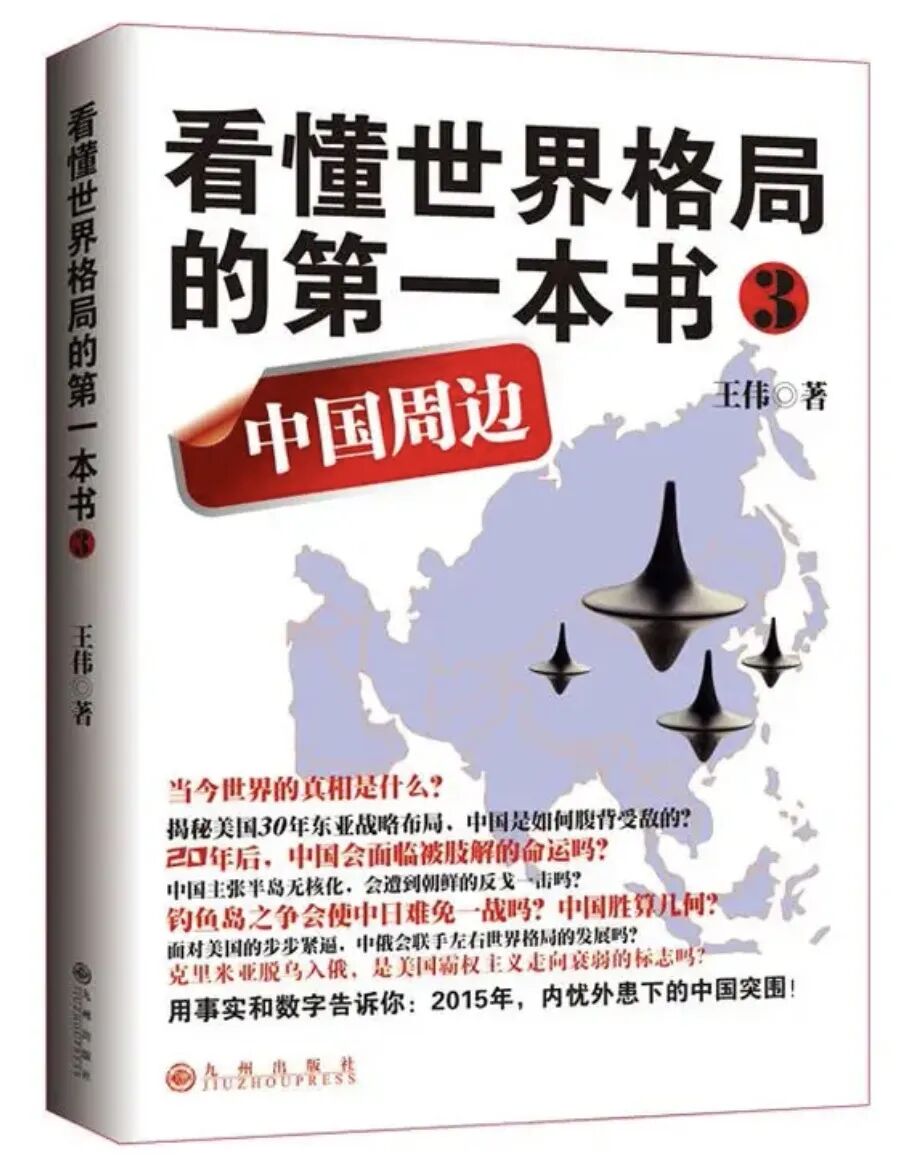

"The First Book to Understand Global Dynamics" series
By Wei Wang / Author
Lead writer, Guigu Studio
Jiuzhou Press
"This series strings together geopolitics, politics, and finance — perspectives usually scattered — and offers plenty of cold facts: why every trouble spot is a connection point, why Russia was determined to reclaim eastern Ukraine, why Germany's stance on Russia-Ukraine differs completely from France and the UK's. Though this 'is usually the kind of book old men like,' if you care about China's political economy and understanding the logic of China's past development, it's worth a browse. The volumes titled China's Periphery and Oil Wars are most relevant to China."

National Destiny: The Secret History of China's "Two Bombs, One Satellite"
By Chun Tao, Huaiguo Chen / Authors
Shanghai Literature and Art Publishing House
"Reflecting on the Iran situation, I pulled out this book. It tells how China built the two bombs and one satellite during its most difficult period. Written with novelistic drama, every chapter has tear-jerking moments — whether scientists abandoning comfortable overseas lives to return home, solving technical problems in the harshest conditions, or the emotional threads woven throughout. My biggest takeaway: China was fortunate to get this done before the 1970s. Viewed through today's international landscape, the geopolitical pressure on a non-nuclear state versus a nuclear state are completely different worlds."
Interactive giveaway:
What do you think of the global asset Risk Off thesis? Share your views in the comments. By 17:00 on April 16, 2026, the top 3 most-liked comments will each receive a book recommended by Feng Shu.

2026 Outlook: Finding Wealth Codes at the Cyclical Inflection Point | Macro Chats
Star the FreeS Fund WeChat account — timely business insights delivered to you