Shopping as Self-Expression: Can New Retail Win Over the Rebellious New Generation? | FreeS Fund Business School

Are you also an "urban wanderer with some financial means"?


What Is "Shopping"?
When was the last time you actually wandered through a mall? And how do you "shop" these days?
In the first half of the e-commerce versus brick-and-mortar battle, online retail came out swinging. But in the second half, as online penetration and reach approach saturation, we're seeing signs of a retail renaissance on the ground.
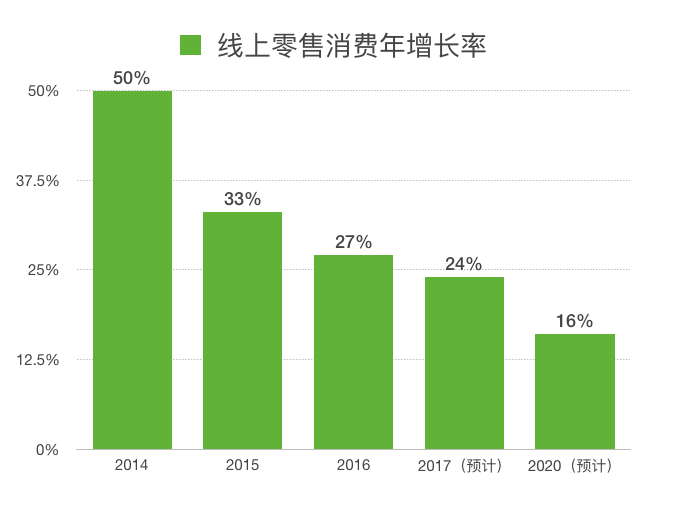
▲ After years of growth, e-commerce still accounts for only 15% of total retail sales. In 2016, online retail growth dipped below 30% for the first time. Severe homogenization and traffic bottlenecks will push that growth rate down further. (Data source: RET China Commercial Real Estate Research Center)
In this new landscape, the very purpose of physical stores has been fundamentally re-examined. "Personalization" and "consumer experience" are no longer optional. Shopping isn't simply about acquiring necessities, nor is it just clicking a mouse or "grab and go" — walking straight to a shelf, picking something up, and checking out. It's a sensory journey that engages sight, touch, smell, taste, and sound. Every element in the environment can become a factor in the decision to buy or walk away.
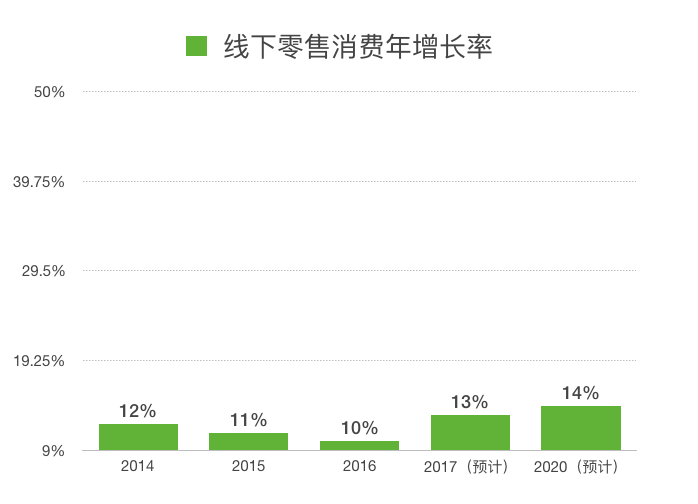
▲ The rise of e-commerce forced physical stores to recalibrate. With consumption upgrades and growing demand for experience, brick-and-mortar retail has found new room for growth and transformation. (Data source: RET China Commercial Real Estate Research Center)
Ironically, after being educated by online shopping, the new generation of consumers "relies on trying and touching products more than ever before."
This article traces the evolution of three generations of American shopping malls, telling the story of a real estate developer who rallied behind the slogan "Anti Mall" — reshaping the sensory journey of shopping and winning back the hearts of a new generation in an era of mall decline. Along the way, you'll discover:
- Why shopping malls scattered across the country became "a thousand malls, one face"?
- Why traditional malls functioned as "adult daycare centers" — and why they couldn't please a generation born to rebel?
- If consumption is a form of self-expression, why did affordable niche brands come out on top?
We'd love to hear your thoughts. After reading this on a hot summer day, go take a stroll through a mall ~

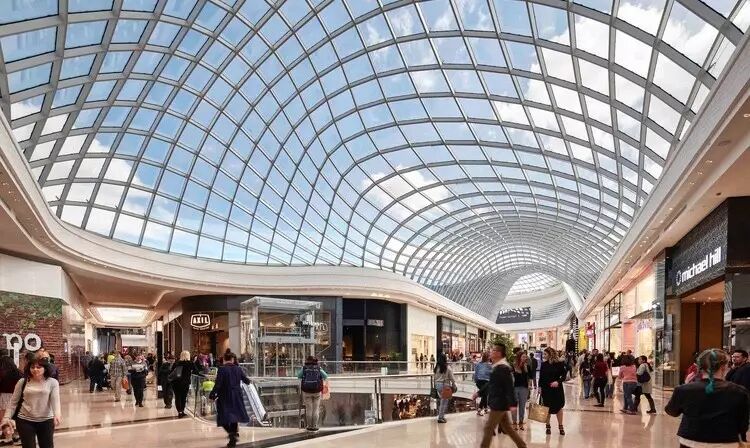
The Anti-Mall — An Era of Self and Niche Communities
By Tingwei Xu, Partner at Yonder Design, Associate Member of the American Institute of Architects (AIA), M.Arch from University of Pennsylvania
Source: Urban China (Issue 78), special issue "Beyond the City: The Dissolving Boundaries of Centralized Consumption Spaces"
The history of American shopping malls can be summarized in three main generations:
- Generation 1: The downtown department store format imported from Europe;
- Generation 2: The suburban big-box mall born from "automotive prosperity + suburban living patterns";
- Generation 3: The refined big-box format, emphasizing shopping environment and experience, stimulated by the digital economy and online competition.
This article focuses on the new trends and variations reflected in post-millennium mall projects.
The Mall as "Adult Daycare Center"
Los Angeles ranks as America's second center of economic and cultural gravity, behind only New York. Its flat terrain and expansive land resources have allowed the city to spread outward in a "pancake" pattern for over a century.
Here, mall development followed a formula of "large-scale suburban land acquisition + massive big-box commercial development." Once built, malls connected to the urban road network, easily accessible by car for family units. Consumers typically engaged in centralized shopping: arriving at the mall to spend half a day or more on shopping, dining, entertainment, and other activities.
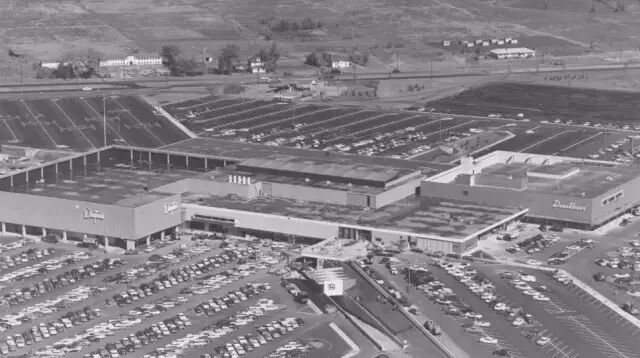
▲ The typical image of an early American suburban big-box mall.
This model rapidly filled residents' daily consumption and entertainment needs through standardized product logic. China's rapid economic development and resulting urban expansion — leading to land sales, developer acquisitions, and the construction of all-in-one big-box malls — was in many ways a replication of the Los Angeles model. Step inside any mall, and from fashion and accessories on floors one and two to the variety of restaurants above, plus multiplex cinemas and arcades, the formula is virtually identical.
These formulaic malls provided something akin to "all-ages daycare" for killing time. We can understand such malls as places to pass the hours — regardless of their specific tenant mix, they amount to "daycare centers" established by merchants to retain customers and extract profit.
In the United States, the "daycare center" model showed signs of fatigue after the millennium. Traditional department store chains like Macy's began closing locations en masse, losing their grip on a new generation of consumers.
China's mall boom in recent years can be seen as a lagging phenomenon relative to mature Western markets. The reason: demand driven by demographic dividends has yet to saturate, and the novelty of the mall experience hasn't yet reached fatigue. Even so, the phenomenon of "a thousand MALLs, one face," overbuilding, and struggling operations is hardly rare.
The lack of tax constraints on the digital economy, combined with weak domestic demand, is squeezing physical retail from both sides. Given this, the future decline of traditional malls will likely be far steeper in slope than in developed countries.
Under this pressure, developers have scrambled to upgrade around experiential consumption and personalized formats. This thinking is clearly visible in America's commercial landscape over the past decade — nearly every major mall in every city has undergone a significant renovation within the last ten years.
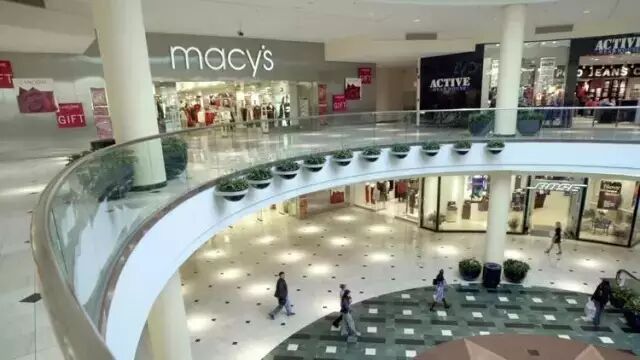
▲ Macy's, once the absolute anchor tenant, has closed hundreds of stores in recent years.
What we found: malls that were already relatively successful maintained their advantage after upgrading, while those already struggling couldn't turn things around through hardware or facility improvements alone. A mall's location, demographics, spending power, history, and other factors determine whether it can stand firm on traditional foundations — while most cannot escape a downward trajectory.
The reasons for the decline of the "daycare center" can be summarized as follows:
- In the pre-information age, shopping existed to satisfy consumers' rigid needs; in the networked age, much of this demand has migrated online;
- Mall brands are dominated by national or global chains, and inevitable homogenization leads to consumption fatigue;
- Macroscopically, the global economy has entered a prolonged trough and adjustment cycle, with weakened consumption.
Why Can't They Please the New Generation?
The question must come down to: "Where are the new commercial models?" This requires us to find suitable case studies from the perspective of actual commercial real estate project operations, examining how successful developers view brands, merchants, consumers, and marketing models.
Shaheen Sadeghi is a legendary commercial real estate operator in the Los Angeles area, rallying behind the slogan "AntiMall." From the early nineties to the present, he has personally executed three commercial projects. From these, we can clearly see how to attract a new generation of consumers in an era of mall dissolution.
Shaheen graduated from Pratt Institute in New York with a degree in fashion design. In the early 1990s, he joined an athletic fashion brand company, responsible for design and marketing. This gave him both the sensitivity to products and consumption of a fashion insider, and the business experience required of a company operator.
He quickly recognized the existence of a "Massive Cultural Shift": large chain department stores like Buffums and Broadway went bankrupt and closed. Traditional malls had lost their way in figuring out how to please new-era consumer tribes.
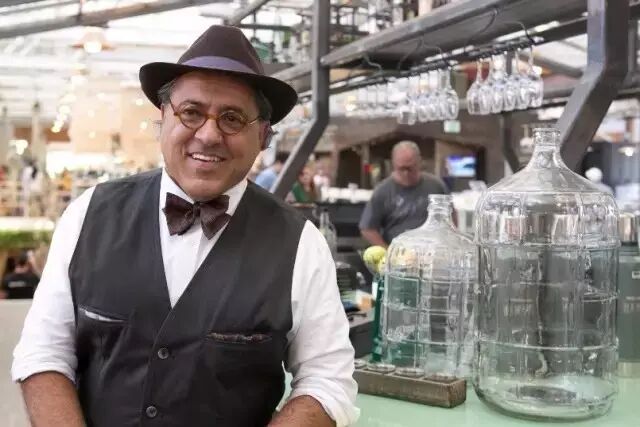
▲ Shaheen graduated from the Fashion Design Department at Pratt Institute in New York.
Shaheen founded commercial development company LAB Holding LLC, provocatively calling himself "Curator of Cool." In the commercial real estate field, this was an exceptionally ahead-of-its-time and precise formulation. A major task for commercial operators is tenant recruitment — filling the mall and opening on schedule. Shaheen didn't approach merchants from the angle of "tenants to fill space," but from the angle of "collecting exhibits." He wasn't finding merchants for a shopping center, but finding display pieces for an exhibition project.
Behind this word substitution lies a fundamental shift in purpose: not to create a place for consumption, but to create a cultural exhibition.
Shaheen noted: "Young consumers aren't interested in stepping into a fully air-conditioned shopping mall. They no longer want to wander through department stores, riding escalators through various categorized merchandise zones just to find a pair of jeans. If you ask young people in a community, what if we tore down the mall near your house and replaced it with a park? Most would say they don't care."
The traditional mall's logic: I provide the goods you need, and to get them, you must pass through piles of things you don't need, creating the possibility of unplanned purchases. In the age of online consumption, this little calculation collapses. A single click to purchase online defeats the cumbersome experience.
Consumption as Self-Expression
How to do it? Shaheen's answer was "do culture." He elevated the importance of cultural attributes for commercial shopping centers to core status, proclaiming the bold slogan "Culture is the new currency."
Culture here has many dimensions: Wanda Plaza making its facade look like blue-and-white porcelain is one kind of culture; holiday-themed event packaging at malls can also be called culture; architectural culture, brand culture — the list goes on. However, the common thread is that culture must be interpreted through very concrete "how" and "what" angles, rather than remaining merely an abstract concept.
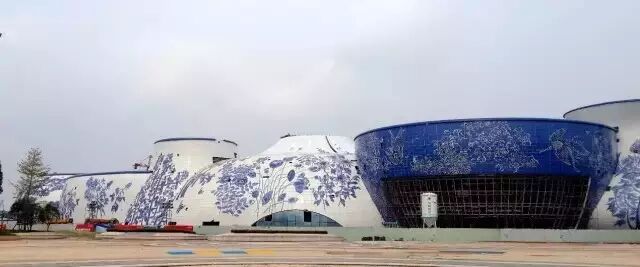
▲ The blue-and-white porcelain facade of Wanda Plaza.
In Shaheen's view, being "cultured" means a project that allows its target audience to use the project itself to proclaim "I am me." If a culture cannot become a self-positioning and expression worth defending, then it is not a culture worth boasting about.
Shaheen said: "Consumption is no longer an activity you must do to satisfy needs, but a form of self-statement and expression." From this angle, creating a blue-and-white porcelain themed facade or orchestrating Christmas events are superficial understandings of culture — these things do not constitute a statement.
In traditional commerce, "people" are statistical factors for data analysis. But commerce should study people themselves, starting directly with specific individuals. To some extent, this corresponds to today's fragmented demand network — people's needs have entered a state of dispersion never seen before. Doing business can no longer involve highly generalized appeals to everyone's tastes; you must analyze specific customers, find your position among the fragments, and build a community.
With this approach, when recruiting merchants (that is, exhibits) that correspond to community taste, Shaheen would first describe an ideal merchant in very concrete terms, then search for an "exhibit" matching that description — for example, "a restaurant offering authentic Mediterranean-style cuisine using entirely organic, natural ingredients." As for how to find such merchants, Shaheen's solution was: "If we can't find the right merchant, we'll create one ourselves."
Between 1994 and 2012 — an 18-year span — Shaheen executed several experimental commercial projects in the Greater Los Angeles area: The Lab, The Camp, and Packing House, responding to these concepts. These three projects shared a consistent development philosophy, emerging roughly every eight years, scaling from small to large. From architectural and spatial design to merchant operations, they demonstrated a deeply cultivated commercial lineage.
Case Studies
Generation 1 Commercial Format — The Lab
▍Project launch: 1994
▍Location: Costa Mesa, Los Angeles satellite city (2930 Bristol St, Costa Mesa, CA 92626)
Converted from an abandoned goggle factory. Unlike malls filled with polished marble, The Lab's overall image emphasized a "raw" feel. The building's exposed wooden truss roof, steel beams, and concrete floors retained their industrial character through the renovation.
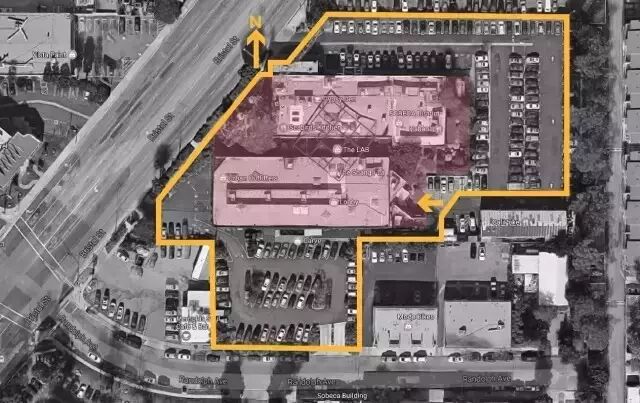
▲ Satellite view of the project.
A consumer base dominated by young people readily appreciated this post-industrial aesthetic. After opening, people flocked here not just to shop, but to view art exhibitions, watch independent band performances, and even attend charity events. Major bands took a liking to the place, frequently holding rock concerts. Gradually, it became an incubator for local independent bands.
The Lab explicitly targeted the 19-29 age demographic. Relative to other age groups, they were willing to spend more time shopping. But they were also the hardest to please, the most individualistic, and the most allergic to mainstream conventions. Among Los Angeles's several emerging shopping districts, Santa Monica's Third Street tried a hippie style, while Melrose Avenue focused on satisfying the chic sensibilities of wealthy young elites. The Lab sought to create something different: a "secret garden for young people" rooted in the vast terrain of Orange County.
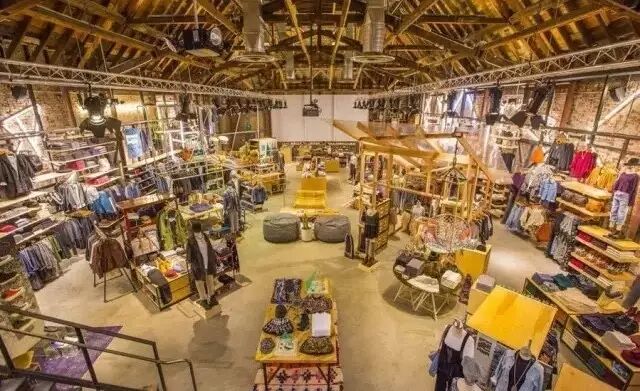
▲ The Urban Outfitters store embodies a typical rough-hewn interior style.
In tenant curation, The Lab achieved balance between high-draw anchor stores and non-chain independent shops, and on this basis launched the "Little American Plan" — integrating 16 independent streetwear brands, chef-driven restaurants, and various lifestyle services including clothing customization. This model was remarkably ahead of its time for the 1990s.
Generation 2 Commercial Format — The Camp
▍Project launch: 2002
▍Location: Costa Mesa, Los Angeles satellite city (2937 Bristol St, Costa Mesa, CA 92626)
Following The Lab's commercial success, Shaheen reached consensus with local city government on a small-scale, refined commercial renovation model. He then developed the second-generation format, The Camp, just across the street. Its scale and area were upgrades from The Lab, while design approaches continued the previous industrial sensibility using recycled materials and exposed structure.
The Camp's planning logic followed the simple circulation principles of commercial streets, with main entrances on the north and east sides, and primary circulation forming an L-shape. The entire block consists of five independent 1-2 story buildings, each with distinct architectural character. Some deliberately created a temporary, improvised feeling, with corrugated metal and glass enclosures surrounded by desert plants — full of theatrical expression.
Yet step from the rough, austere plaza into the block's interior, and you immediately sense entering a warm, lively atmosphere — creating intense contrast. This "detached yet safe" commercial atmosphere held strong appeal for individuality-seeking young people.
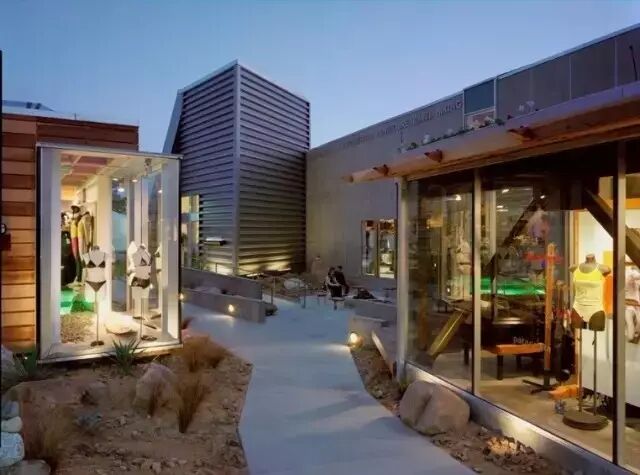
▲ Rough exterior styling, yet warm atmosphere inside the display windows.
The Camp was initially designed as a fitness-themed project, but performed poorly and pivoted. Of its current 22 stores, 3 are outdoor/athletic themed, 12 are themed dining, and 7 are lifestyle services — shaping a block theme while increasing tenant participation and everyday livability.
From this we can see that "niche" as a label provides a group with easily identifiable commonality, but in actual commerce, each individual within the niche has vastly different needs. Niche culture can serve as a light theme woven into commercial projects, rather than functioning as a restrictive format.
Generation 3 Commercial Format — Packing House
▍Project launch: 2002
▍Location: Costa Mesa, Los Angeles satellite city (2937 Bristol St, Costa Mesa, CA 92626)
Packing House represents the culmination of seamlessly fusing regional culture, architectural context, and commercial development. Shaheen spent four years transforming a factory into a small commercial complex housing over twenty independent food brands and artisan workshops. The Spanish Colonial Revival street-facing facade was preserved for restaurants, while the mall's main entrance was moved to the building's side.
Architecturally, Packing House still belongs to the single-building enclosed model — what we call a "box building." Its true distinction lies in what fills the box: not homogeneous flat commercial formats, but something with the feel of "an open street inside a box."
If The Lab and The Camp represented deconstruction of the traditional commercial center from the outside through their structural, collage-like architectural imagery and open spatial layouts, Packing House deconstructed from within the single box building itself.
Influenced by traditional markets, Packing House strove to shape place through dense local life experience. In traditional markets, people enter a relatively large space, surrounded by open counters of small vendors selling various goods. This ancient commercial model had declined with the rise of supermarkets and shopping malls. But in the eyes of a younger generation, this shopping model has become a trendy consumption experience of returning to "slow and refined" living, gaining new adherents.
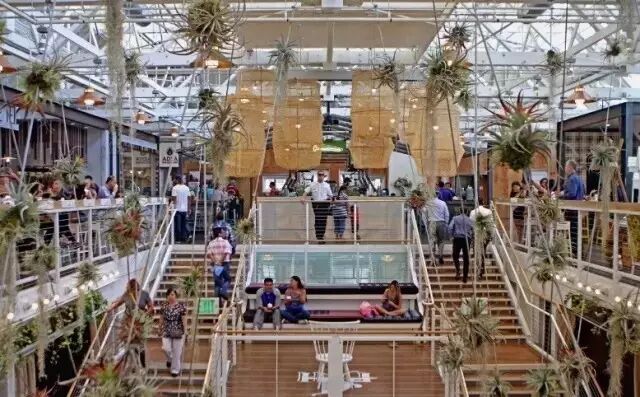
▲ Packing House's interior brims with living atmosphere.
Considered carefully, this planar form represents a more advanced, customized tenant approach. Merchant individual expression is elevated to new heights, more extremely showcased through a fully customized system spanning brand, spatial division, store format, counter design, and signage.
Here, merchants no longer present just one face to a public corridor, but have at least one display face exceeding 90 degrees. This greatly enhances each merchant's "readability" and the interactivity between consumers and merchants.
While providing merchants a stage to exercise their unique commercial concepts and brand culture, Shaheen would not hesitate to terminate or even break contracts to dramatically rotate projects within the space, keeping it in constant dynamic transformation. He insisted that commercial architecture itself is a living organism. Consumers are fickle and novelty-seeking; therefore commercial projects must continuously provide topics and stimulation to satisfy desire. This is the key to long-term prosperity.
Future Urban Commerce in an Atomized Society
In the past, whole families would happily spend time together in big-box malls, each selecting what they needed. But this social structure has gradually dissolved, replaced by individuals representing urban islands. These islands have their own attributes and preferences, and hope to find in an unfamiliar city spaces that belong to them and can define them.
Modern society has become an "atomized society." People have jobs to make a living, but lack networks of connection — in some ways, "urban wanderers with a certain degree of economic power."
This condition has spawned two powerful needs: on a latent level, people crave finding their kind — those who share interests and values; on a manifest level, people crave finding a place with a sense of belonging.
The latent need has been relatively well satisfied. In the information age, especially with the rise of mobile internet in recent years, various niche groups now have their own strongholds. But in the corresponding physical spaces, places that can adapt to change lag far behind. At least in commercial consumption spaces, projects with self-expression consciousness are exceedingly rare. If a commercial project can capture this need and provide corresponding product, its impact is enormous.
On the other hand, from a needs perspective, basic needs can currently be satisfied online or at neighborhood supermarkets. If people need to enter a commercial space to buy something, they will pay more attention to so-called "texture of life content." This texture amounts to nothing more than personal declarations and expressions about life.
This more advanced need was previously satisfied by luxury goods. But now, watered by fragmented online media, a new generation of consumers — regardless of income level — has this demand, while also requiring value for money, tending to find a "lifestyle" different from others through affordable prices at niche brands. This is precisely the logic behind the birth of fast fashion and countless niche brands, and also the purpose behind Shaheen's relentless scouring of various niche brand merchants and his advocacy of the so-called "Little American Plan."
This reflects a cultural shift — a Massive Culture Shift — and also a transformation of consumption and desire: originally multi-layered, homogeneous, large-scale, categorized traditional commercial spaces are dissolving into a new generation of smaller, more flexible, more open post-commercial spaces. These spaces emphasize self-expression, no longer attempting to please everyone, but serving only one customer tribe. And for this group, the space becomes an irreplaceable secret place in everyday urban life.
Today, this trend is already extremely evident in post-consumerist countries like the US and Japan. In China, various experiential commercial renewals are also developing vigorously. But due to the particularity of domestic land policy, after developers acquire land and confirm commercial targets, they often have no choice but to build large-scale box malls that run counter to the trend of smaller, decentralized commercial development — racking their brains over how to fill a large commercial complex and ensure its opening.
Finally, if there is any word that can summarize the future development trend of commercial centers, the author can find none more平淡无奇 yet apt than "different." All commercial projects are born to fight for customers. And in a fragmented age, how to distinguish oneself as "one" from the remaining "countless" is undoubtedly the primary task, because "different" is how you survive.
(This article is from Yonder, WeChat public account ID: yonderdesign. Yonder is an innovative professional emerging commercial real estate and planning agency, registered in both Los Angeles and Shanghai. Yonder provides full solutions from strategic positioning to design implementation for innovative commercial real estate. For business inquiries and media contributions, please contact gwu@yonder.design or call +86 15207103718. Welcome to share to your Moments.)

▲ From MUJI to Urban Convenience Stores: What Pain Points Remain in "New Retail"? | Frees Fund
▲ Why I'm Opening a Physical Store in the Retail Winter | Exclusive Conversation with Zhang Liaoyuan
▲ Why Would You Buy a Pound of Meat Online Instead of Going to the Supermarket? | The Journey