A Conversation with Liu Yang of Jiuzhou Yunjian: SpaceX, the US-Soviet Space Race, and China's Commercial Space Catch-Up

Reusable Rocket Technology, Chang'e-6, and Space Travel
刘洋: 控制三台发动机并联的难度,要比控制单台发动机难很多。但这个难度不是指数级的,大概是一个线性增长的关系。因为三台发动机并联工作时,需要解决的核心问题是发动机之间的相互影响,以及整个系统的协调控制。
李丰: 具体来说,三台发动机并联会带来哪些新的问题?
刘洋: 主要有几个方面。第一是振动问题。单台发动机工作时有自身的振动特性,三台发动机一起工作,振动会相互耦合,可能产生共振,这对箭体结构是很大的考验。第二是推力不平衡。理论上三台发动机的推力应该完全一致,但实际上由于制造公差、燃烧不均匀等因素,三台发动机的推力会有细微差别,这种差别会导致箭体受力不均,需要控制系统实时补偿。第三是启动和关机时序。三台发动机的启动时间、关机时间必须精确同步,否则会产生很大的姿态扰动。
李丰: 这次试验中,这些并联的问题都解决了吗?
刘洋: 从试验结果来看,三台发动机的并联工作是比较成功的。当然,这只是一个开始,未来在真实的发射任务中,并联的台数可能会更多,比如六台、九台,那时候的挑战会更大。
李丰: 说到未来,你们这台发动机的设计重复使用次数是多少?
刘洋: 我们的凌云发动机设计重复使用次数是不低于20次。
李丰: 20次?这和美国SpaceX的梅林发动机相比如何?
刘洋: SpaceX的梅林发动机官方宣称的重复使用次数是多次,具体数字没有公开,但据行业分析可能在10到20次之间。我们的设计指标是不低于20次,但实际能达到多少次,还需要通过大量的飞行试验来验证。
李丰: 从一次性使用到可重复使用,发动机的设计思路有什么根本性的变化?
刘洋: 这是一个非常好的问题。我用一个比喻来说明:一次性发动机就像"炸药包",它的设计目标是在一次工作中把所有的能量释放出来,完成任务后不需要考虑后续状态。而可重复使用发动机就像"燃气灶",它需要能够多次点火、多次工作,每次工作都要保证性能稳定,还要考虑多次工作后的寿命衰减、维护检修等问题。
这个区别带来了设计上的根本差异。一次性发动机可以为了单次性能而采用一些极端设计,比如更高的燃烧室压力、更接近材料极限的工作温度。但可重复使用发动机必须在性能、可靠性、寿命之间取得平衡,要留有更多的设计余量,要采用更保守的材料选择,要设计更完善的冷却系统,还要考虑多次热循环后的材料疲劳问题。
李丰: 这个"炸药包"和"燃气灶"的比喻很形象。具体来说,在工程实现上,哪些技术难点是从一次性到可重复使用必须跨越的?
刘洋: 我觉得有几个关键的技术门槛。第一个是点火系统。一次性发动机的点火系统可以设计得相对简单,因为只需要保证一次点火成功。但可重复使用发动机需要多次点火,每次点火都要可靠,而且点火次数多了之后,点火器本身会磨损、老化,如何保证第20次点火和第1次点火一样可靠,这是一个很大的挑战。
第二个是燃烧稳定性。液体火箭发动机的燃烧过程非常复杂,存在各种不稳定的燃烧模式。一次性发动机可以通过地面试验充分验证燃烧稳定性,但可重复使用发动机每次工作后的状态都会有所变化,燃烧室壁会烧蚀、喷注器会积碳,这些变化会不会导致燃烧不稳定,需要在设计中充分考虑。
第三个是热防护和冷却。发动机工作时燃烧室和喷管的温度非常高,一次性发动机可以采用烧蚀冷却,就是让材料本身烧蚀带走热量,用完就报废。但可重复使用发动机必须采用再生冷却或辐射冷却等可重复的方式,而且冷却通道在多次热循环后可能出现裂纹、堵塞等问题,需要精心设计。
第四个是健康监测和寿命管理。可重复使用发动机需要能够实时监测自身的工作状态,判断哪些部件需要维护、哪些可以继续使用,这需要大量的传感器和智能算法支持。
李丰: 这些技术难点中,哪些是九州云箭已经突破的,哪些还在攻关?
刘洋: 经过这些年的研发,我们在深度变推力技术、多次点火技术、再生冷却技术等方面都取得了突破,凌云发动机已经通过了多次地面热试车考核,包括长程试车、变推力试车、多次点火试车等。但说实话,地面试车和真实飞行还是有区别的,发动机在飞行中承受的振动、冲击、过载等环境更加复杂,我们还需要通过更多的飞行试验来验证和完善。
/ 03 / 造火箭:比飞机容易,比汽车难?
李丰: 你刚才提到,火箭发动机有点像"燃气灶",这个比喻让我想到一个问题。很多人说造火箭比造飞机容易,但比造车难,你认同这个说法吗?
刘洋: 这个说法有一定道理,但需要拆解来看。说造火箭比造飞机容易,主要是指火箭的飞行环境相对单纯。飞机在大气层内飞行,要应对复杂的气流、天气、起降条件,还要考虑乘客的舒适性、安全性,系统复杂度非常高。火箭大部分时间在大气层外飞行,没有空气阻力,飞行轨迹可以用牛顿力学精确计算,从纯物理角度来说,控制起来确实更简单。
但说比造车难,主要是指火箭对可靠性和性能的要求极为苛刻。火箭是带着几吨甚至几十吨的燃料,以每秒几公里的速度飞行,任何一个环节出问题都可能导致灾难性后果。而且火箭的研制周期很长,一次发射失败的经济损失巨大,这就决定了火箭不能像汽车那样通过大规模量产来摊薄成本、迭代改进。
李丰: 但如果从商业化的角度来看,汽车是典型的大规模民用产品,火箭目前还是偏国家任务和高端商业发射,未来民营火箭有可能像民航客机一样成功吗?
刘洋: 这是一个很有想象力的问题。我认为从技术上来说,是有可能的,但需要解决几个关键问题。
第一是成本。现在发射一公斤载荷到近地轨道的成本,即便是SpaceX这样的公司,也要几千美元。如果未来能把成本降到几百美元甚至更低,那么太空旅游、太空制造、太空能源这些现在看起来遥不可及的应用,就可能变成现实,市场规模会指数级扩大。
第二是可靠性。民航客机之所以成功,很大程度上是因为它的安全性达到了公众可以接受的水平。火箭发射目前的风险还是太高,普通人不敢坐。如果未来火箭的可靠性能达到民航客机的水平,太空旅游就不是少数富豪的专利了。
第三是频率。民航客机每天有成千上万的航班,形成了成熟的运营体系。火箭发射目前还是按月甚至按年来计,如果未来能做到每天多发,甚至像航班一样定时定点发射,那整个商业模式就会完全不同。
李丰: 你觉得这些条件,大概什么时候能够实现?
刘洋: 我觉得成本的大幅降低可能在未来10到15年能看到,SpaceX的星舰如果成功,可能会把成本降低一个数量级。可靠性的提升需要更长的时间,可能需要20到30年的积累。发射频率的提升和成本、可靠性是相关的,成本越低、可靠性越高,发射频率自然会上去。
李丰: 那在这个过程中,中国民营火箭公司的机会在哪里?
刘洋: 我认为中国民营火箭公司有几个优势。第一是中国有完整的工业体系和供应链,制造成本有优势。第二是中国航天有60多年的技术积累,人才储备雄厚。第三是中国市场对卫星互联网、遥感观测等有巨大需求,这是商业航天发展的内生动力。
当然,挑战也很明显。我们在可重复使用技术、大推力发动机等方面和美国还有差距,需要追赶。另外,商业航天的政策环境、资本市场支持等也还在完善中。
/ 04 / 世界航天史与中国航天的位置
李丰: 你刚才提到中国航天60多年的积累,能不能从世界航天的历史脉络中,帮我们理解一下中国目前所处的位置?
刘洋: 世界航天发展大致可以分为几个阶段。第一个阶段是1957年到1970年代,是美苏争霸的冷战时期,航天完全由国家主导,目标是政治和军事,不计成本。第二个阶段是1980年代到2000年,航天开始有一些商业应用,比如通信卫星、广播电视,但发射服务还是由国家机构垄断。第三个阶段是2000年至今,以SpaceX为代表的商业航天公司崛起,带来了可重复使用技术、低成本发射等革命性变化。
中国航天的起步不算晚,1970年就发射了第一颗人造卫星,但早期主要是跟随苏联模式,以国家战略任务为主。商业航天的大发展是2014年政策放开之后,比美国晚了大概十多年。所以如果说美国商业航天现在处于从1到10的扩张期,中国可能还处于从0到1的验证期。
李丰: 这个差距主要体现在哪里?
刘洋: 我觉得有几个层面。第一是技术层面。SpaceX的猎鹰9号已经实现了常态化回收和复用,星舰正在研制中,这是下一代完全可重复使用的运载工具。中国目前还没有实现轨道级火箭的回收复用,这是我们的首要目标。
第二是商业模式层面。SpaceX已经形成了从火箭制造、发射服务到卫星运营、太空互联网的完整商业闭环,自我造血能力很强。中国的商业航天公司大多还集中在火箭和卫星制造环节,下游应用还在培育中。
第三是资本层面。美国商业航天有成熟的风险投资、资本市场支持,SpaceX的估值已经超过1800亿美元。中国商业航天的融资规模、退出渠道都还在发展中。
李丰: 但中国也有自己独特的优势吧?
刘洋: 当然有。除了我刚才提到的工业体系和市场需求,我觉得还有一个很重要的点,就是国家意志和长期规划。中国的航天发展有明确的路线图,从空间站建设到探月工程到火星探测,这些大项目会带动整个产业链的发展,也给商业航天提供了技术溢出和市场机会。另外,中国在新能源、智能制造等领域的快速发展,也为航天技术的跨界应用创造了条件。
李丰: 你提到国家意志,这和美国的商业航天主导模式似乎很不同。你觉得未来中国航天的驱动力,会更多来自国家还是市场?
刘洋: 我觉得会是双轮驱动。在重大战略项目、深空探测等领域,国家的角色不可替代。但在卫星互联网、遥感服务、太空旅游等商业应用领域,市场机制会更有效率。理想的模式是国家做好基础设施和战略规划,市场在应用端充分竞争,两者相互促进。
/ 05 / 创业七年:从0到1的复盘
李丰: 我们回到九州云箭的创业历程。从2017年到现在,七年时间,你们经历了哪些关键节点?
刘洋: 有几个比较重要的节点。2017年公司成立,2018年完成天使轮融资,2019年凌云发动机完成方案设计,2020年完成首台整机试车,2021年完成深度变推力试车,2022年完成多次点火试车,2023年完成十米级垂直起降试验,2024年参与完成10公里级垂直起降试验。每一步都不容易,但回头看,我们基本按照预定的技术路线在走。
李丰: 创业过程中,最困难的时刻是什么?
刘洋: 2020年首台整机试车之前那段时间。发动机是一个复杂的系统工程,设计方案再完善,真正造出来、点起来,才知道行不行。我们第一台整机装配完成后,在试车台上第一次点火,结果出现了燃烧不稳定的问题,试车被迫中止。那时候团队压力很大,因为不知道问题出在哪里,是设计问题、加工问题还是装配问题?需要逐一排查。
李丰: 最后怎么解决的?
刘洋: 我们花了大概三个月时间,做了大量的仿真计算、地面试验,最后发现是一个喷注器的设计细节导致了燃烧不稳定。修改设计后,第二次试车就成功了。那次经历让我深刻体会到,航天工程容不得半点侥幸,每一个问题都必须找到根因,彻底解决。
李丰: 融资方面呢?商业航天是资本密集型行业,你们的融资节奏如何?
刘洋: 我们到现在完成了三轮融资,投资方包括Linear Capital、经纬中国等。融资节奏和公司的技术里程碑基本匹配,每完成一个重要节点,就启动下一轮。当然,2022年之后资本市场整体偏冷,融资难度增加了,但航天领域的投资还是相对活跃的,因为这是一个长周期、高壁垒的赛道,优质标的仍然稀缺。
李丰: 你对想进入商业航天领域的创业者有什么建议?
刘洋: 首先要有技术积累,航天不是互联网,不能靠模式创新快速起量,核心技术必须过硬。其次要有耐心,航天产品的研制周期以年为单位,不能急于求成。第三要找对伙伴,航天是系统工程,需要多学科、多工种的紧密协作,团队磨合非常重要。最后要敬畏风险,每一次发射都是高风险的,必须把可靠性放在第一位。
李丰: 最后一个问题,你对九州云箭未来三到五年的规划是什么?
刘洋: 短期目标是在2025年左右,实现凌云发动机的轨道级飞行和回收验证。中期目标是研制更大推力的发动机,支撑下一代可重复使用运载火箭。长期目标是成为国际一流的液体火箭发动机公司,为中国乃至世界的太空经济发展提供动力。
李丰: 期待你们的好消息。今天的对话非常有收获,谢谢刘洋。
刘洋: 谢谢丰叔,也谢谢各位听众。
Liu Yang: For recovery, controlling one engine versus three engines doesn't represent an exponential increase in difficulty. In an actual recovery scenario, typically only the center engine performs thrust vectoring during the final ignition for the landing burn. Only in certain cases would additional engines be needed during other ignition phases of the recovery process.
Li Feng: Got it. So everyone can now roughly reconstruct the entire process of this rocket launch.
/ 03 / Seven Years, Two Rocket Engines; Turning the Ignition System from a "Firecracker" into a "Gas Stove"
Li Feng: From when you started your company developing rocket engines to today, it's been seven years. What score would you give your efficiency and speed?
Liu Yang: The efficiency has been extremely high. If I were to give it a score, I'd say 95 or even 100. Because in these seven years, we've developed two engines, which was very difficult to achieve in the past.
Take the Longyun engine used in this test — we initiated the project in 2020, and in just over three years, it had already matured through ground testing. And this is a reusable engine with wide-range thrust throttling and multiple restarts. I'm quite satisfied with this efficiency.
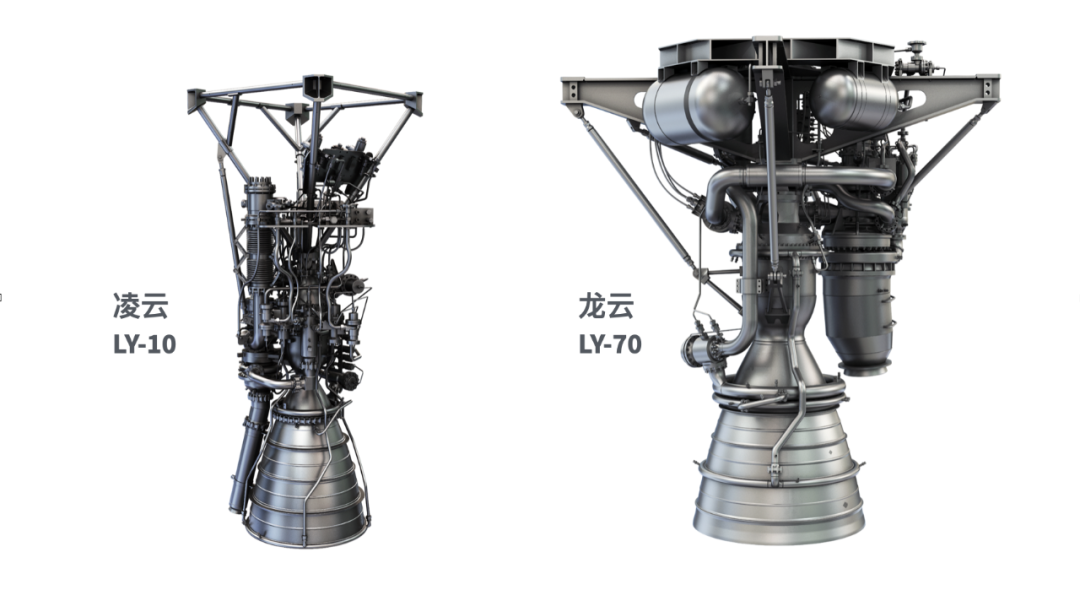
▲ The two engines developed by Jiuzhou Yunjian. Image source: Jiuzhou Yunjian
Li Feng: If I recall correctly, your earliest engine development wasn't primarily focused on reusability, and the thrust was relatively smaller — is that right?
Liu Yang: Our strategy for developing these two engine types was as follows. For the first type, the Lingyun engine, we used a relatively small-scale, 10-ton-class engine to first break through the core technologies of reusability, multiple restarts, thrust throttling, and all-nitrogen servicing and maintenance.
After achieving these breakthroughs, we then developed the 70-ton-class Longyun engine — it was simply a matter of scaling up the thrust class. There were no functional breakthroughs in the R&D, because we had already established that foundation with the 10-ton-class engine.
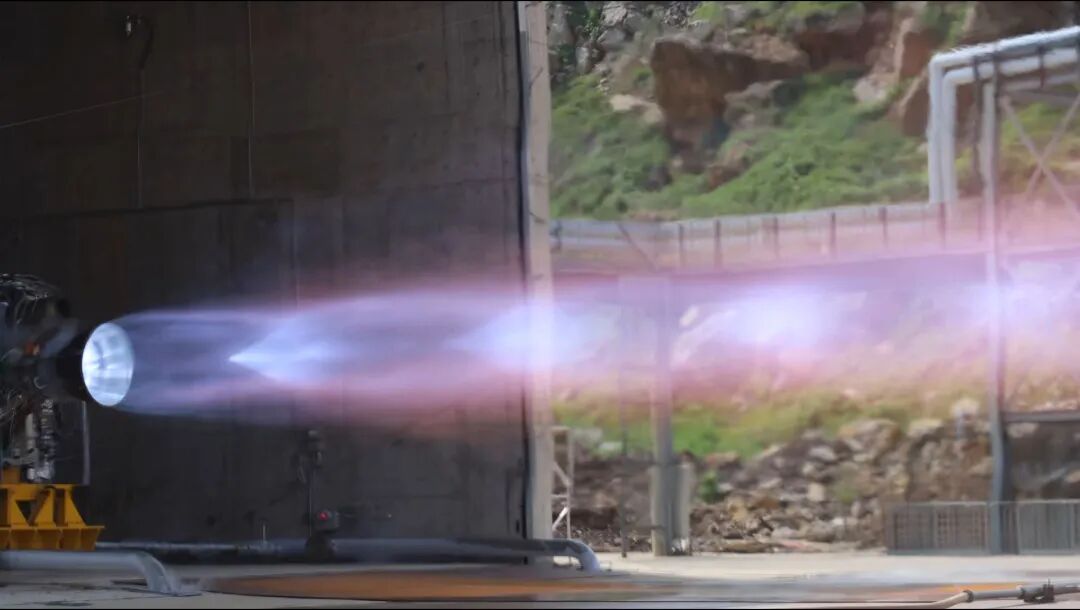 ▲ Longyun engine hot-fire test footage. Image source: Jiuzhou Yunjian
Li Feng: Compared to the disposable rocket engines we see in the news, what's the biggest technical difference that needs to be overcome in developing these reusable rocket engines?
Liu Yang: The biggest difference comes from new capabilities. Take "multiple restarts," for example — this requires the rocket engine to be able to start and stop at will during flight, shutting down and reigniting.
This is fundamentally different from the design philosophy of traditional disposable engines. To use an imperfect analogy: it's like transforming the ignition system from a "firecracker" into a "gas stove." With a gas stove, you can cook multiple meals, turning it on and off several times. But a firecracker doesn't work that way — once it explodes, it's gone; if you want another explosion, you need another firecracker.
Another major difference is wide-range thrust variation. If you want the rocket engine to operate across a broad thrust range, first, you face challenges in active control of thrust throttling. Compared to a disposable rocket engine, a reusable rocket engine needs many additional subsystems to enable active thrust throttling control. This function is like the water pipe in your home — you want more flow, you get more flow; you want less, you get less.
Second, when flow rates are constantly changing, all the engine's component assemblies need to maintain normal operation — for example, the turbopump. The turbopump can be analogized to a human heart. If you require a person to survive across a very wide range of blood pressure, you're placing new demands on the heart. Similarly, there are many other technical changes that cascade from these altered requirements.
So, compared to disposable engines, reusable engines involve more changes at the overall system level. They may look similar, but in reality, virtually every aspect is different.
Li Feng: Most of us have difficulty truly understanding the specific details of engines. Could you give us a popular science explanation of how large the difference is between disposable and reusable engines when designing the complete system?
Liu Yang: From a system architecture perspective, the difference might be on the order of 30%. But from a component and parts perspective, the difference rate could be even higher.
Li Feng: Despite these challenges, reusability in commercial space still plays a massive role in reducing costs. How many times can current reusable engines be reused?
Liu Yang: In our actual testing, a single engine has achieved more than 20 reuse cycles. As for where the upper limit lies, we haven't found it yet.
/ 04 / The Historical Context of Global Space Development, and China's Commercial Space Catch-Up Race
Li Feng: When talking about commercial space and rockets, today what people pay most attention to are still a few major powers. Of course, perhaps foremost among them is the United States. Rockets or spaceflight can be traced back even earlier to the U.S. "Apollo Program" 50 years ago. During the Cold War, the competition between the U.S. and USSR in lunar landing, space shuttles, rockets, and other areas undoubtedly greatly promoted the development of space technology on both sides.
From today's perspective, the United States is still the United States, but after the Soviet Union's dissolution it became different countries, with Russia inheriting most of the Soviet Union's space legacy.
China, as another country with at least a relatively large economic scale, is running hard in the space field. Compared to today's Russia, the United States, and others, approximately where does China's commercial space sector fall on the scale?
Liu Yang: Today when we do commercial space, what we look at most is the gap between China and the U.S. In the United States, SpaceX's Falcon 9 first achieved launch and recovery at the end of 2015.
Based on currently known clues, if we calculate when China could achieve this same milestone, the earliest would be 2025. From a purely static perspective, this gap is 10 years.
But what's the difference between domestic and international situations? Once China achieves a breakthrough from 0 to 1, then going from 1 to N, its efficiency, overall supply chain capability, and productivity level will be better than that of the United States.
So I boldly predict that this scenario may occur: in 2025, China could achieve orbital launch and recovery of reusable rockets, and in the subsequent five years, the number of rockets and payload mass that China launches will very likely catch up to the total that SpaceX achieved over 15 years.
Li Feng: There are several interesting historical events here. Let me review them with my limited aerospace knowledge. A major reason for the rapid advancement of global manned space technology was the competition between the U.S. and USSR over space programs — this is an unavoidable reality of history.
From the American perspective, before the "Apollo Program" came the "Manhattan Project," which was about building the atomic bomb. These two cases were rare instances of the United States mobilizing its "entire national strength," or "concentrating resources to accomplish major tasks."
So NASA began receiving enormous funding, began massive recruitment, and rapidly expanded its space endeavors. By the late 1980s and early 1990s, the competition between the U.S. and USSR had undergone obvious changes, especially after the Soviet Union's dissolution. NASA's space projects became less urgent, and the R&D funding and teams involved were significantly scaled back.
Nevertheless, NASA still wanted to continue missions already in execution, so "outsourcing" emerged — delegating execution to external parties. Thus, around 2000, Jeff Bezos's Blue Origin and Elon Musk's SpaceX appeared successively.
However, SpaceX's Falcon 1 rocket failed in its first three launches basically, and finally succeeded on the fourth attempt — this was the turning point in SpaceX's development. After the successful launch, it gained commercial support and large-scale capital investment, which led to today's reusable rockets and so forth.
This is roughly the broadest-strokes historical story of American commercial space and SpaceX that I can describe.
Today, China's commercial space exists in a completely different historical context. Regarding satellite frequency and orbital resources, we are also currently facing competition with the United States. I have a few small questions of interest.
The first question is: today China's commercial space, including both private and state-owned commercial space, obviously operates in a different context from the U.S.-USSR situation during the Cold War, and from the post-Cold War American situation. Considering today's environment between China and the world, how do you view the situation facing China's space sector including the entire commercial space industry, and what are the expectations of a private startup company for the future?
The second question is: the intense U.S.-USSR competition back then gave space technology funding and personnel investment far exceeding normal circumstances, driving the first phase of space technology's supercharged development. Today, without great-power competition on the scale of the U.S.-USSR Cold War, how will commercial space in China and the United States develop? Especially China?
The third question is: some time ago, China and Russia signed a joint statement mentioning cooperation related to space technology. In your view, does Russia's commercial space technology today offer anything that China can learn from or借鉴?
Liu Yang: Let me address the third question first. I believe Russia, as a traditional country with relatively strong heavy industry, certainly has some historical accumulation, particularly in space.
You just mentioned why the United States was able to mobilize its entire national strength and had such great determination for rapid development in the space industry. My rough understanding is that it was primarily because the United States was lagging behind at the time. Compared to the Soviet Union, the United States was behind on several early milestones in space technology — such as the first satellite launch, the first astronaut in space, and so on. This lag stimulated its determination. This also happens to prove that the Soviet Union's space technology had sufficient historical accumulation.
So, do we still have room for learning from or cooperating with them? For space in general, I believe there is. But for commercial space specifically, perhaps it's hard to say.
Speaking of SpaceX — whether SpaceX received some U.S. government support, or whether, as you just mentioned, it was a result of the "afterglow" of the space race — I believe that in our current commercial space endeavors, we are not vigorously promoting the question of "competing with whom."
From an objective standpoint, if we compare ourselves with the world's most advanced commercial space nation — the United States — we are the lagging party in commercial space.
If we compare between the past U.S.-USSR relationship and the present China-U.S. relationship, I believe our country's determination to develop commercial space may be even stronger.
Specifically, this may be because near-Earth orbital resources are relatively limited. From what I understand — and this may not be entirely accurate — near-Earth orbit may be able to accommodate about 100,000 satellites. SpaceX has filed for 42,000, and various Chinese entities combined have plans for roughly 40,000. These limited orbital resources, I believe, are a driving force for our country's vigorous development of commercial space.
Additionally, SpaceX's vertically integrated model is extremely efficient. It absorbed some U.S. Cold War-era technology and foundation — essentially innovating on the shoulders of giants.
But I don't believe we necessarily need to be exactly like them. Why?
Because at that time, the United States was not the global hegemon, so it had not yet become a country simply playing with cutting-edge technology and finance. During the U.S.-USSR competition, it still had a very strong industrial base, with numerous enterprises supporting it.
However, placed in the current context, facing competition in commercial space, my personal feeling is that for the United States to "rally" that spirit again, first it needs determination, and second it needs a relatively long time. Because the United States is currently still in the leading position, asking it to regain that determination — I don't think that's easy.
By contrast, in the current development and competition of commercial space between China and the U.S., our advantage is that having reached this stage, we remain the country with the most complete industrial chain globally. Whether within the state system or among private players, our industrial supporting capabilities are very strong.
Under the effect of this advantage, we don't necessarily need to produce a single company like SpaceX to compete on the world stage. We can fully leverage our industrial chain for division of labor and collaboration, giving play to respective strengths to form a cluster-optimized state. That is, our commercial space industry as a whole may be superior, but any individual company within it might not be as comprehensive as SpaceX.
/ 05 / What Makes Building a Rocket Hard, and What Are Its Commercial Prospects?
Li Feng: That makes sense. Aerospace technology involves a rather long industrial chain, encompassing materials, equipment, components, assembly, sensors, control systems, and so on. Let's set aside these complex control or digitalization aspects for now. Excluding payload and the satellite on top, what share of a rocket's total manufacturing cost does the rocket engine account for today?
Liu Yang: Roughly about half.
Li Feng: Okay, excluding payload and the rocket engine, what's the approximate complexity level of the entire rocket manufacturing process?
Liu Yang: My personal feeling is that building a rocket is probably less complex than building an airplane, but more complex than building a car.
Li Feng: From a manufacturing perspective, what's the hardest part of building rockets and rocket engines?
Liu Yang: I can only answer this question with regard to rocket engines. For rocket engines, there isn't too high a manufacturing barrier, with a few individual processes excepted.
Li Feng: I used to think the hardest thing about rocket engines was that they're basically one-off components — that people wouldn't scale up production for these parts, keeping multiple standard items in stock.
Liu Yang: This relates to the stage we're in. China's commercial space is still at a relatively early stage — that's our assessment.
If we use a 100-meter sprint as a metaphor, perhaps in the past couple of years everyone was still at the starting line getting ready. Now it's as if the starting gun has fired, and people are just beginning to move.
A typical characteristic of the commercial space industry reaching a highly mature stage is: rockets can deliver payloads to space at very high frequency.
At that point, the industry's total demand for rockets becomes completely different.
We've always held a view: commercial space, especially domestic commercial space at this stage, is currently in a phase where supply creates demand — or in other words, a phase where supply is too scarce. The imagination for satellite-side, payload-side, and even ToC application scenarios hasn't opened up at all, because there still aren't many payloads that can truly go to space.
Many people might have this question: does reusable rocket technology mean fewer rockets will be needed than expendable ones? No.
If we forever remain in the era of expendable rockets, we'll never create more demand. Because the capability to access space is too weak, it will only ever be a very niche industry.
However, when reusable technology matures and costs become sufficiently low, the scale of the entire market will open up. Once that scale opens up, the total volume of rockets and engines will grow.
When that total volume reaches a certain level, the non-standardization problem gets solved.
Li Feng: I have a rough concept for cars — a vehicle consists of several thousand to about ten thousand components, of course counting something like a screw as an individual part. So what's the approximate order of magnitude for rocket engine components?
Liu Yang: The magnitude is under ten thousand. But traditional expendable engines may not be — they might be made much more complex.
Li Feng: The expendable ones are actually more complex?
Liu Yang: This is exactly the point I was making earlier — the application scenario or development objective will in turn influence the product's design.
If you're building a traditional expendable rocket, what do you care about? That it has the highest performance, the greatest payload capacity, the highest specific impulse — with cost and timeline being no object. At that point, would you consider simplifying its design to make it cheaper, more reliable, more durable? No.
So some expendable rocket engines have more complex components, while reusable engines have fewer parts.
Li Feng: This is like the shift from internal combustion vehicles to new energy vehicles — the number of car parts decreased because economic considerations led to higher integration. Though it might also be because the more complex powertrain system was changed, reducing complexity in that area.
/ 06 / How Did Chang'e-6 "Dazzle" with Its Landing?
Li Feng: Turning back to controlled descent or recoverability, let me ask something slightly tangential related to a recent newsmaker — the Chang'e lunar exploration mission. Chang'e-6 recently retrieved about two kilograms of lunar soil from the far side of the moon, and other countries can apply for samples.
I briefly looked at the coverage. What amazed and impressed people about Chang'e was its "landing" — both landing on the far side of the moon and returning to land on Earth. What are the approximate difficulty levels of these two feats? You work on reusable rocket engines, which is somewhat related — from your perspective, what kind of process is this?
Liu Yang: The lunar landing process and the commercial reusable rocket's retropropulsion landing can be simply analogized, except on the moon gravity is weaker. The technology of retropropulsion deceleration and landing on the moon wasn't first used on Chang'e-6 — it was already validated on Chang'e-4 and Chang'e-5.
Chang'e-6's lunar landing was autonomously controlled in a closed loop. It had its own "brain" that could adjust engine thrust based on altitude, velocity, and other parameters.
The main differences between the landing engine and a rocket launch recovery engine are: first, the scale is different, because in space you don't need to overcome such strong gravitational force; plus relative to a rocket, the lander itself is quite light, so the landing engine's thrust is relatively small.
This smaller thrust creates a significant difference from launch rocket engine systems: it no longer has the "heart" device we mentioned earlier — the turbopump responsible for increasing pressure. The propellant it carries is naturally high-pressure, entering the engine through pressurized feed to achieve retropropulsion.
What's good about this approach? Thrust adjustment and control become much easier. To use an imperfect analogy, it really becomes like the water pipe in your home. That's the lunar landing technology.
As for the post-return landing process, that's actually somewhat distant from our professional field — I only have a basic understanding. Chang'e-6's landing process was somewhat similar to spacecraft or manned capsule returns. The biggest difference is that it entered the atmosphere twice to decelerate before landing at our country's landing site.
Why did Chang'e-6 need to enter the atmosphere twice?
Because it was returning from lunar orbit, its return velocity was the second cosmic velocity, 11.2 km/s. The velocity for safe return to Earth orbit is the first cosmic velocity, 7.9 km/s.
So for a typical space station return capsule, which is orbiting Earth at first cosmic velocity, it only needs to complete the deceleration from 7.9 km/s to 0 for landing.
For Chang'e-6, it needs to complete two processes: first, decelerate from second cosmic velocity to first cosmic velocity; second, decelerate from first cosmic velocity to 0. So to complete the first step, it must first enter the atmosphere and rely on atmospheric friction to reduce speed to first cosmic velocity.
We might wonder: why doesn't Chang'e-6 first reach Earth orbit, then slowly decelerate to 7.9 km/s before descending?
That's because decelerating from 11.2 km/s to 7.9 km/s might require carrying a tremendous amount of extra propellant — carrying so much might prevent it from even reaching the moon, making this approach potentially unworkable. So it had to brute-force decelerate from second cosmic velocity all the way to zero.
You could understand it as Chang'e-6 "skipping like a stone" through the atmosphere before finally landing. This is completely different from reusable rocket recovery.
Li Feng: One more small topic — looking at photos of Chang'e-6 after landing, many people said there seemed to be ablation on the exterior, that heat-resistant materials could still improve. I have two questions: first, is it reasonable for people to evaluate based on surface condition? Second, when we launch and recover rockets, do similar ablation issues occur on the rocket surface, or can this problem be better solved?
Liu Yang: For the first question, two aspects: first, judging the degree of heating by surface color is possible. But using color and surface condition to indirectly judge technical level — I'm not very familiar with that. Because as mentioned, for Chang'e-6, the process of decelerating from second cosmic velocity to first cosmic velocity is quite brutal.
For the second question, whether there's anything worth learning for rocket recovery. As we mentioned, the biggest characteristic of rocket recovery is that the rocket can generate reverse thrust to help decelerate. And generally what's recovered is the first stage — before recovery, the first stage's terminal velocity isn't as fast as first cosmic velocity, because the second stage needs to further accelerate the payload.
So first, the first stage's initial velocity isn't that fast; second, it has main engines producing very large thrust for retropropulsion. This means its heating is much less than Chang'e-6 or other spacecraft.
Li Feng: Curious — do SpaceX's recovered rockets, or recovered first-stage engines, show obvious ablation marks on the surface?
Liu Yang: SpaceX's Falcon rockets do come back with blackened surfaces, but it's not ablation. It's mainly because they use liquid oxygen-kerosene propellant. The combustion gas from liquid oxygen-kerosene inherently involves coking, carbon deposition, and other oxidation processes.
Future Outlook for China's Commercial Space
Li Feng: Back to our main topic. Let's set aside the "rivalry-style" comparison with the U.S. we were doing earlier, and just look at China's commercial space. Picking an arbitrary timeframe, what do you think China's commercial space will look like in 5-10 years, what technical levels will we achieve, what will we be able to launch, and how will commercialization change?
Liu Yang: Seven or eight years out, I think it's foreseeable that at minimum, domestic reusable rocket orbital insertion costs will definitely be lower than SpaceX's current Falcon rockets. Second, in seven or eight years, I believe relative to now, the domestic commercial space market will see fairly significant changes.
Li Feng: At that point, besides scientific and commercial payloads, could our commercial space sector carry people?
Liu Yang: Possibly slightly aggressive, but not impossible.
Li Feng: Then how much longer do you think would be more likely for crewed flight?
Liu Yang: Probably around ten years.
Additionally, a major characteristic of commercial space is that engines can perform large-range thrust adjustment, which will greatly improve comfort whether you're entering suborbit or in orbit.
Because expendable rockets operate at full throttle from liftoff all the way up — full power — the g-forces, acceleration, and vibration they impose are all very high. But variable-thrust engine technology can allow people to ride rockets to space with reasonable comfort.
Li Feng: Assuming crewed flight in 10-15 years — though it's hard to extrapolate linearly — what's your estimate of per-person cost? Say 1.5 million? 3 million?
Liu Yang: Per-person cost, that needs calculation. It shouldn't need that much. Cost per kilogram might drop to around ten thousand.
Li Feng: So roughly several hundred thousand RMB would get you up there.
Today, astronaut selection is still quite a hassle — lots of tests, lengthy training, specialized exercises under different conditions, and so on. Though of course, that might also be because astronauts have so many missions to carry out.
But by that time, based on what you're saying — with variable thrust, assuming there's a comfort mode, assuming it's ordinary people — how complicated would the pre-flight prep be? How high would the bar be?
Liu Yang: It won't be as complex as it is for today's astronauts. Also, I think by then there will definitely be companies that emerge to handle everything for you after you buy your flight ticket — all the training, preparation, and the end-to-end service right up until launch.
I still stand by what I said earlier: when rocket capacity is strong enough and costs are low enough, it will spawn many different business models that connect rockets directly to consumers. That's a direction I'm particularly bullish on.
And the company operating this tourism business in the future — it won't necessarily be a rocket company, and in fact there's a very high probability it won't be a rocket company at all. Many rocket companies by then may no longer look like the rocket companies we see today. They might look more like airlines, service-oriented, with rockets being just a tool to them.
Li Feng: Since you mentioned airlines, we can actually look at airline history for reference. When the airplane was first invented, people might have thought "I'd like to see that," but probably didn't have much chance of actually flying in one. Of course, within less than a hundred years, people had plenty of opportunities to fly — and now it's even more commonplace.
The business model of aircraft had a special evolution.
Because for today's airplanes — especially commercial airliners — buying the plane and buying the engine are two separate things. Most aircraft engines we see today are actually sold or leased to airlines by specialized engine companies, either as engine products or as service packages including maintenance and repair. This is probably because engines require separate production, maintenance, and upkeep, and because they represent a relatively high share of costs.
Assuming, as you just described, that rocket commercialization reaches a certain stage — would the rocket body and engine become decoupled in the same way? That is, like how airplanes and aircraft engines are separate?
Liu Yang: We believe so. In a more distant future form, engines will definitely be monetized through flight-time sales or per-flight sales.
Li Feng: Very similar to today's aircraft engines.
Liu Yang: Yes, very similar.
Li Feng: So is this why today you're building a "rocket engine" R&D company — and of course also a rocket engine production and service provider?
Liu Yang: Yes.
Li Feng: Jiuzhou Yunjian's engine supported this 10-kilometer-level reusable vertical takeoff and landing test, which could be called a first small breakthrough. So for the second step — higher altitude, even with attitude-adjusted flight and recovery — when do you think that will be achieved?
Liu Yang: Very soon. The expected timeline is end of this year.
Li Feng: As shareholders, we might have the chance to witness this "fly up, fly down." For the second flight up and back down, roughly how long would the flight duration be?
Liu Yang: Don't know yet, but it's already being planned. Should also be several hundred seconds.
Li Feng: How far is it from step two to step three? That is, true orbital flight with payload and recovery after reaching orbit.
Liu Yang: Step two to step three should be within a year.
Li Feng: Great, then we eagerly await the beginning and completion of phase two, then moving into phase three. Perhaps as you said, by 2025 China will have achieved reusability, completing the zero-to-one breakthrough in commercial spaceflight. Then your company's development can move faster into the next stage, giving me a chance — before I get too old — to take a look from near-Earth orbit in comfort mode. And of course that would also mean enormous commercial success for you.
Liu Yang: Thank you, Uncle Feng.
Li Feng: Alright, let's work on this together. Thank you so much today, CEO Liu Yang, for your time, and thank you all for listening and reading. If you or any friends around you happen to have both the capability and the willingness, and are in relevant technical directions, and would like to join Jiuzhou Yunjian to co-create the future of China's commercial spaceflight — we warmly welcome you to send your resume to zhaopin@jzyjspace.com
▲ "The Higher You Stand, The Farther You See": The Origins and Future of the Satellite Communications Space Race | FreeS Report 34
▲ New Listings and New Funding: 10 New Developments in the Height of Summer | FreeS Family Funding News Vol. 19
▲ Li Feng in Conversation with Ji Yu: Understanding NVIDIA, Deconstructing NVIDIA, Challenging NVIDIA
▲ The Private Cloud Era Arrives: How AI NAS Reshapes Your Digital Life | FreeS Research Institute
▲ Congratulations on XtalPi's Successful IPO: FreeS Fund Stays Research-Driven, Learning to Invest Through Investing
▲ The Road to Embodied Intelligence | FreeS Report 37
Star the FreeS Fund WeChat Official Account — timely delivery of original business insights