Tang Ning x Li Feng: How Can Startups Seize the Trillion-Dollar Wealth Management Transformation Opportunity?

What should the composition of a future-oriented portfolio look like?
As personal wealth continues to grow, Chinese households' investable assets surpassed 200 trillion RMB in 2019. In the capital markets, we are facing a wave of asset reallocation on the order of hundreds of trillions, bringing dual shifts and opportunities in both asset management structures and wealth allocation targets.
At the same time, as healthcare system reform deepens, the curtain is rising on insurance market innovation. Emerging technologies like blockchain and AI are gradually finding real-world applications in finance. China stands at the starting line of a new round of financial innovation.
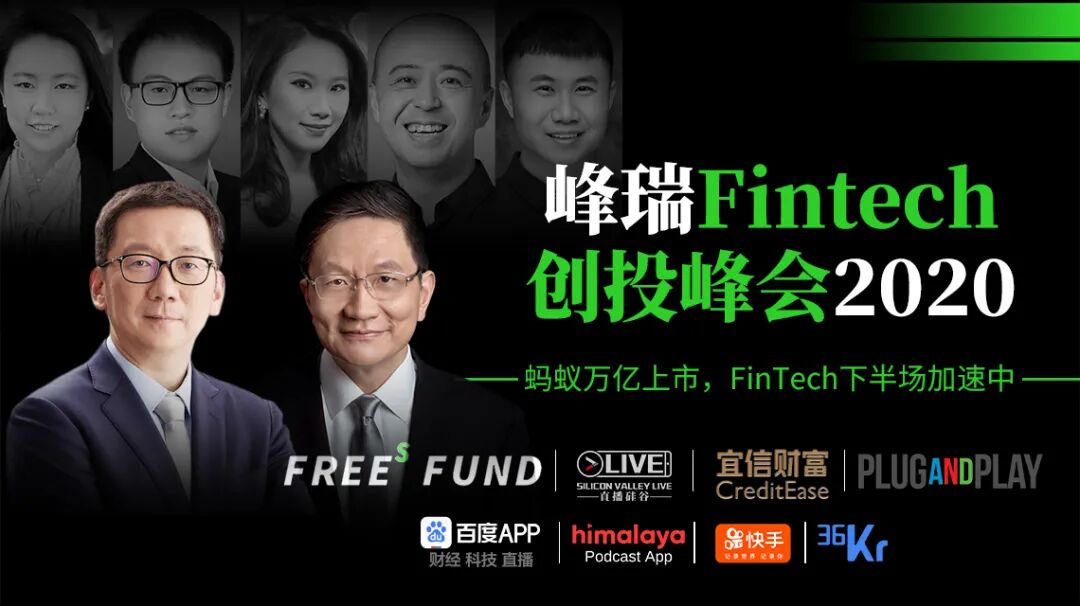
How to seize this hundred-trillion-level opportunity? At the online broadcast of the "FreeS Fund Fintech Venture Summit 2020," in a deep conversation moderated by Silicon Valley Multimedia founder Qian Chen, FreeS Fund founding partner Feng Li and CreditEase founder and CEO Ning Tang discussed structural opportunities in wealth management and trends and innovation opportunities in fintech.
Before diving in, a few key takeaways:
- The era of inheritance and the era of asset allocation are arriving. These two high-growth engines will bring enormous opportunities to the wealth management industry over the coming decades.
- To win in fintech, you must win at the intersection: combining industry insight with technological sensitivity, and bringing together financial talent and logical depth with the network effects of technology.
- In finance, lasting longer beats moving faster. The reasons: first, you must survive cycles; second, you must respect finance's inherent laws; third, it's a risk business.
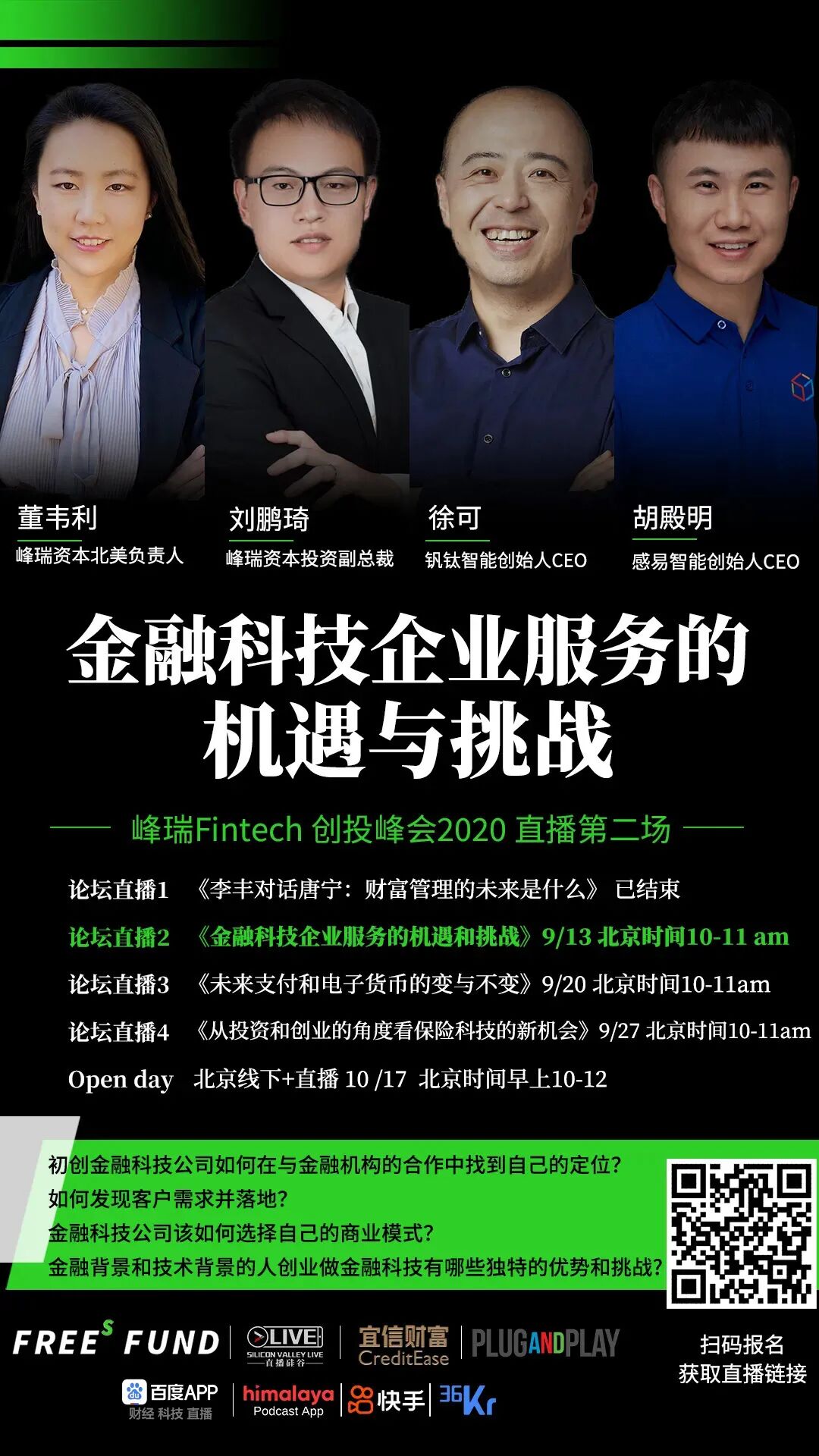
Below is the essence of their conversation. We hope you find it valuable. The second session of the "FreeS Fund Fintech Venture Summit 2020" will air on September 13 from 10-11am — scan the QR code in the image below to join.
Contact Us
We continue to be bullish on innovation opportunities in finance. Feel free to reach out:
Pengqi Liu, Vice President at FreeS Fund
We also welcome those interested in investing to join us (hr@freesvc.com).

/ 01 / How to "Capture" Wealth Management's Two Main Battlegrounds?
Qian Chen: Compared to wealth management in Europe and the US, what unique opportunities and challenges does China face today?
Ning Tang: From my personal experience, wealth management will be a major trend and tailwind for China over the coming decades. I summarize this trend as "dual-engine growth."
The so-called hundred-trillion-level opportunity in China mainly involves the wealth held by two types of people.
One is high-net-worth and ultra-high-net-worth individuals, with average investable assets above $1 million USD, or roughly 6-10 million RMB. This group exceeds 1 million people in China, approaching 2 million, and their combined investable assets approach 100 trillion RMB.
The other is what we call the mass affluent — slightly above middle class, with assets ranging from several hundred thousand to $1 million USD. They have asset allocation needs but cannot access traditional private banking's one-on-one service. This group numbers roughly 30 million and also controls approximately 100 trillion RMB in assets, who must be served through technology.
These two groups' wealth combined is nearly 200 trillion RMB. These are wealth management's two main battlegrounds: first, private banking 2.0 and even 3.0 for high-net-worth and ultra-high-net-worth individuals; second, using technology to better serve the mass affluent.
The remaining users are "beginners" in wealth management — still growing, perhaps just out of school, just entering the workforce, just beginning to create wealth.
When we speak of "dual-engine growth," what are these two engines? In my view, they are the structural opportunities brought by wealth inheritance and portfolio transformation.
Take the 100 trillion held by high-net-worth and ultra-high-net-worth individuals. Over the next 10-20 years, two things will certainly happen as these wheels begin to turn.
First, this 100 trillion in investable assets will change hands, from the wealth-creating first generation to the second generation — whether "rich second generation" or "entrepreneurial second generation." This demand didn't exist 10 or 15 years ago, because then the "first generation" hadn't reached that age; they were in their prime of wealth creation and business building. But 10-20 years out, the next generation of the "first generation" has matured and reached the point where succession becomes relevant. How to complete the transition of family business, the inheritance of portfolio wealth, and even the inheritance of values — these are the issues that high-net-worth and ultra-high-net-worth individuals will face at that point. This is one wheel.
In this process of asset transfer, the opportunities and needs arising from structural change are numerous: establishing family offices, using family trusts and insurance trusts to achieve inheritance, tax planning, cultivating the second generation, building modern corporate governance, and so on.
Inheritance represents both enormous challenge and opportunity for the wealth management industry — the first engine of "dual-engine growth."
Second, the other wheel is change in asset allocation. In 10 or even 15 years, the allocation ratio of Chinese high-net-worth and ultra-high-net-worth individuals' portfolios will be fundamentally different from today or from 10 years ago.
Current portfolios are dominated by physical assets like real estate, plus some bank wealth management products, fixed income, individual stocks, and so on.
But what should the portfolio of the future look like? It should be more scientific, rational, and balanced asset allocation.
This population can bear higher risk. To achieve higher returns, their portfolios will contain large or even very large proportions of alternative assets. By alternative assets, we mean non-standard, private assets that generate returns through active management.
Structural change in asset allocation will create returns for various niche alternative asset managers. Of course, risk control must accompany this — for example, through small-sum diversification, using technology, and other means to form portfolios with controllable risk and promising returns. This is the second engine of "dual-engine growth."
The same dual-engine dynamic plays somewhat differently for the mass affluent. The wealth management industry cannot serve this class through private banking's one-on-one approach. Compared to high-net-worth individuals, this class's pockets aren't deep enough; they mainly allocate assets through standardized public fund products, likely with little private investment.
So those helping this class of investors with asset allocation will likely be robots behind mobile terminals. Though real experts design the algorithms behind these robots, algorithms can run 24/7, aren't affected by emotions, and may even outperform humans in many respects.
But fundamentally, the era of inheritance and the era of asset allocation are arriving. These two high-growth engines will bring enormous opportunities to our wealth management industry over the coming decades.
/ 02 / Four Major Changes We See in Finance
Qian Chen: Same question for Feng — how do you think technology can empower the wealth management industry?
Feng Li: I started investing in China's financial sector slightly before the term "internet finance" even emerged — around 2011, when I participated in investing in CreditEase and learned a great deal from Tang and the CreditEase team. From 2012-2015, we invested in roughly several dozen different types of financial companies including 360 Finance and IceKredit. In 2012-2013, I also participated in the earliest wave of digital currency-related investments, including Coinbase and Ripple. In 2017-2018, due to regulatory reasons, FreeS invested relatively little in finance; after 2019, we began actively repositioning in financial investments again.
We re-entered because we saw certain changes and trends.
First, industry change: in June 2018, the National Development and Reform Commission's official website revised its foreign investment catalog, opening China's financial markets to foreign capital. This was a clear policy change at the time, whose effects have drawn increasing attention in recent months. Some Chinese joint-venture investment banks, as well as large foreign public and private equity funds, have registered their wholly-owned companies in China.
Second, also visible in policy: since the national home purchase restrictions were reinstated in September-October 2016, all policy has trended toward "housing is for living, not speculation," controlling the flow of large amounts of capital into real estate. This marks the first time since the early 1990s commercial housing pilot that policy has consistently guided against property speculation.
Third, changes in banking: whether the recent national adjustment of maximum lending rates to encourage banks to offer lower-rate loans to SMEs and individuals, or the need to redirect capital from real estate into new directions, both represent structural adjustment of bank assets.
Fourth, a once-controversial statistical finding: a report from the PBOC's Survey and Statistics Department Urban Household Asset-Liability Survey Research Group showed that Chinese urban residents' ratio of physical to financial assets is roughly 8:2 — meaning only 20% of assets are allocated to financial assets, and of this 20%, the vast majority is in bank products with guaranteed returns, with only small amounts in floating-return products; insurance also falls in this category.
What opportunities lie behind these phenomena?
Let's start with banks' asset transformation. Accompanying economic structural adjustment, this is also a hundred-trillion-level transformation. As assets shift from real estate-type assets toward SMEs and individual consumption, this represents both enormous opportunity and enormous challenge for banks. After all, real estate assets have relatively large unit sizes, greater predictability, and better collateral.
The opportunity born in this transformation lies in who can help banks complete this asset shift, and how — while also conforming to national policy direction.
In helping banks transform assets, China's biggest difference from foreign markets is that thanks to e-commerce development, China's overall internet penetration is high: on one side, private enterprises' internet adoption has been rapidly increasing, even more so post-pandemic; on the other, after nearly 10 years of infrastructure rebuilding, domestic banks' IT infrastructure and digitalization are both advanced and sophisticated. From this perspective, both supply and demand sides have relatively good digital infrastructure.
Additionally, China's current asset allocation situation contains enormous opportunity for the wealth management industry. Take the US as an example — setting aside total volume, US household asset allocation is almost the inverse of China's: financial assets comprise 70%, physical assets only 30%. With real estate no longer positioned as the economic driver, financial assets will dominate the future. Chinese residents' asset allocation landscape will certainly shift significantly, even converging toward US levels. Overall, virtual assets' proportion will substantially increase, with floating equity-type assets' proportion increasing even more dramatically; meanwhile, this average household wealth of 3.1 million will certainly see large-scale growth over the next 10-15 years.
Both of these increases will bring enormous entrepreneurial opportunities aligned with this structural shift.
China's market also has its particularities. These come from policy opening and stimulus, accompanied by enormous capital market changes, and the supply-demand contradictions in healthcare reimbursement systems are pushing insurance development even faster. These are all major driving forces China's market gives the wealth management industry, beyond internal structural adjustment and economic development stage.
/ 03 / To Win in Fintech, Win at the Intersection
Qian Chen: What cutting-edge technologies can create value and find application in fintech's main scenarios?
Ning Tang: When discussing fintech, many companies start from technology, but I believe we should start from finance, from users' unmet financial pain points. Looking for demand while holding technology is very difficult and ungrounded.
So what specific needs exist? For example, how to serve high-net-worth and ultra-high-net-worth individuals during the pandemic? Previously we always served one-on-one offline, but continuing this model during the pandemic would mean no business at all. So starting February 3, we did two recorded broadcasts, but immediately realized this wouldn't work — we needed real-time, interactive formats that directly established relationships with clients, and quickly switched to livestreaming.
This kind of technology innovation and model innovation truly solved customer pain points.
At that time, many entrepreneurs were extremely helpless, and it happened to be when their wealth management faced enormous challenges.
First, what about their businesses? In the past, lacking digital capabilities might mean barely surviving; now, lacking digital capabilities was a dead end. For example, when flexible employment needs emerged, corresponding consulting and solutions were needed.
Second, what about their asset portfolios? The pandemic was a major test — improper asset allocation led to very bad outcomes.
Facing such challenges, how do we establish effective engagement when clients need us most? Technology plays a huge role. Our multi-to-one client service model for high-net-worth and ultra-high-net-worth individuals today can combine online and offline; experts from the US, Hong Kong, and Europe can join advisory teams online — this too is technology application.
Another example. Alternative investment "runs deep" with high barriers and high risk but can bring high returns. In recent years, alternative assets and long-term investment have risen, with alternative assets' proportion in high-net-worth clients' portfolios growing ever higher — but how exactly to invest? Big data must be used.
For example, how can I know whether FreeS's next decade will be as impressive as its past five years? I can look at historical performance, but past performance doesn't necessarily predict the future. I can also dig into attribution analysis — what differentiated things did it do to achieve today's results, and examine whether this system can sustain over the next decade.
These were all master craftsman's skills in the past. What can we do with technology now? We use AI plus fund-of-funds investing to perform fund identification, mapping private funds across 60+ dimensions including team, strategy, and history. We possess nearly 10 years of this private information and data, plus publicly available market data and other obtainable data sources, enabling us to generate genuine intelligent due diligence on these funds.
Previously, master craftsmen obtained some very useful information through first- and second-degree connections to aid judgment; but using big data technology, knowledge graphs connect all of this. Our master craftsmen, armed with this tool to ask questions, can dramatically reduce "information asymmetry," greatly improve efficiency, and ask very beautiful, very effective questions.
Information asymmetry in alternative asset investment can be solved this way, but I must return to what I said at the beginning: technology application must be problem-oriented and demand-oriented.
I have a fundamental belief: as long as a problem can be clearly defined, current technology tools can generally solve it. In asset management, we're not lacking technology or tools — what's lacking is deep insight into how to use technology innovation and model innovation to solve needs, and the application and implementation of technology.
This intersection is extraordinarily valuable. To win in fintech, you must win at the intersection. Win with industry insight plus technological sensitivity, bringing together financial talent, finance's logical depth, and technology's internet effects to form what we call platform models, ecosystem models.
In Finance, Lasting Longer Beats Moving Faster
Qian Chen: From a VC perspective, in the overall wealth management direction, how is the balance struck between finance and technology on this scale? What opportunities remain for startups?
Feng Li: Looking back to 2013, when I was still at IDG, we established a small principle in internal discussions about fintech investment: within a sufficiently large scope, prefer to invest in finance people doing internet; be relatively cautious about internet people doing finance.
This isn't to slight the internet — it's just that the internet as a tool and means must conform to financial laws.
If you're interested in the financial industry, you'll find a truth validated worldwide: in finance, lasting longer beats moving faster. In other words, as long as you survive long enough, you eventually have the opportunity to become a very large enterprise. The reasons: first, you must survive cycles; second, you must respect finance's inherent laws; third, it's a risk business.
When internet companies enter finance, in exploring boundaries, cycles, and risk, they need to spend more time understanding and respecting the financial industry; finding business boundaries and essence is relatively harder for them than for finance people doing internet.
The strong regulatory cycle China has experienced over the past five years has more or less proven the demand-driven issue Tang raised, and more or less validated what we discussed then: finance-leaning versus internet-leaning.
So I think the most important thing for fintech entrepreneurship is: as long as you persist, survive long enough, and experience more than one cycle, as long as you're aligned with demand and solving problems in this direction, you'll likely have the opportunity to develop at some node.
Looking at the directions discussed above, let's examine startup opportunities one by one.
Starting with the largest bank asset transformation: a crucial question in this process is how to assess risk for individuals, SMEs, and private enterprises that banks are unfamiliar with? This is clearly enormous opportunity, relating to data, technology, and finance itself, and containing banks' business transformation.
Imagine how large this market is. Between 2000-2010, when banks' entire POS systems needed IT upgrading, numerous listed companies and large companies were born. That was just banks' infrastructure transformation; this time it's asset structure transformation — imagine how much larger.
Next, household wealth reallocation transformation: from physical to virtual assets, within virtual assets from fixed-income to floating-return assets, and onward to insurance. This too is at minimum a several-dozen-trillion to hundred-trillion-level opportunity. Within this, whether you're helping investors, investment institutions, or ordinary people with various data analysis and management, these are certainly excellent opportunities.
The other side of this coin: from a regulatory perspective, more technological advancement is also needed. In all rapidly opening and high-growth transformation markets, regulators also need synchronous advancement in regulatory technology.
Finally, looking at one more major category: insurance.
Assuming it grows from over one trillion per year to over ten trillion per year in incremental industry, it similarly faces many problems and naturally many opportunities.
Looking at individual-facing life insurance and health insurance: ordinary people leave all kinds of traces on the internet — consumption, interests, reading, purchases — none of which existed when the US entered its insurance cycle 50 years ago or Japan 30 years ago. Now, to ensure risk control and payout rates, insurance can leverage this new data and massive personal behavioral traces.
But which data can be used, how should data be used, how to improve insurance risk control and reduce payout rates, which data for which populations — solving all these problems provides enormous challenges and entrepreneurial directions for startups.
Summary
- The era of inheritance and the era of asset allocation are arriving. These two high-growth engines will bring enormous opportunities to the wealth management industry over the coming decades.
- Bank asset transformation, policy opening and stimulus, and household wealth allocation transformation contain enormous opportunities for fintech startups.
- Fintech opportunities must start from users' unmet financial pain points; technology innovation and model innovation that truly solves customer pain points will find opportunity.
Discussion & Giveaway
What innovation opportunities do you see in wealth management?
Share your thoughts and observations in the comments. By 9:00 PM on September 17, the 5 readers with the most thoughtful comments will receive a FreeS Fund custom notebook.
Hiring Investors | Beijing, Shanghai, Shenzhen, Three Directions
We are seeking investors in Beijing, Shanghai, and Shenzhen for biopharma, deep tech, and consumer/TMT. We welcome those with industry backgrounds interested in investing to join us, and also welcome referrals of excellent candidates. Please send resumes to hr@freesvc.com with email subject: Application for "[Specific Position Name]" - "[Work Location]". Click link for recruitment details: Year Six Moving Forward: FreeS Fund Hiring Investors | Doing What's Right, Not What's Easy
"FreeS Fund Fintech Venture Summit 2020"
Still Open for Registration
From September to October, FreeS Fund, Silicon Valley Multimedia, CreditEase Wealth Management, and Plug and Play jointly present the "FreeS Fund Fintech Venture Summit 2020," featuring 4 online broadcast sessions (1 already held) and 1 Fintech-focused Open Day. The summit will discuss topics of concern to fintech entrepreneurs including wealth management, financial enterprise services, payments/digital currency, and insurance.
On September 13, from 10-11 AM Beijing time, the second session of the "FreeS Fund Fintech Venture Summit 2020" will go live, exploring opportunities and challenges in fintech enterprise services.
The summit's online broadcast forums and Fintech-focused Open Day (offline + online) remain open for registration.
We welcome fintech entrepreneurs, aspiring entrepreneurs, and practitioners and students in related fields to register for the "FreeS Fund Fintech Venture Summit 2020."
Scan code to register. Those currently overseas are welcome to join via video conference. P.S. The Beijing Fintech Open Day on October 17 is limited to 30 offline participants; please fill in the registration form carefully. We will notify specific location by email after application review.

Year Six Moving Forward: FreeS Fund Hiring Investors | Doing What's Right, Not What's Easy