The Great Leap Forward of Vending Machines: Real Demand or Just for Show? | Frees Fund

Mini KTV booths, photo printers, and shared power banks are popping up everywhere — but can they actually turn a profit?


Two questions we're asking about vending machines:
As labor and rent costs keep rising, and payment convenience and user experience keep improving, all kinds of vending machines have rapidly spread across malls, residential compounds, and office buildings within just six months. From food and beverage machines to service-based offerings like mini KTVs, mini gyms, and shared power banks, they're constantly trying to satisfy individualized consumer needs.
According to Huang Hai, VP at FreeS Fund, the following questions are worth paying attention to:
▍Is there strong channel resource support?
The channel question refers to how self-service devices get into shopping malls and restaurants, where they're placed, and who has the authority to decide. This is crucial.
Take shared power banks as an example. From a channel perspective, Meituan might be the best-suited company for this business. It controls resources for millions of restaurants nationwide. Compared to startups negotiating and securing placements restaurant by restaurant from scratch, Meituan is far more efficient. When multiple shared power bank companies compete to enter the same restaurant, Meituan's influence over that restaurant will also come into play.
▍Are you building a user business or a traffic business?
A traffic business means which device users choose depends entirely on which one they happen to see. Claw machines, for instance, are virtually indistinguishable to consumers. A user business means users remember and actively choose a specific device, creating more commercial opportunities. If a mini KTV could save users' song histories, build points, ratings, and reward systems, and enable social interaction, it would have a chance to attract genuine loyal users.
Pure traffic businesses are heavily constrained by channel capabilities, while user businesses have the opportunity to build their own moats.
This article analyzes the underlying logic of self-service devices from a supply chain restructuring perspective. Regarding the questions of channels versus user businesses, which of these ubiquitous self-service devices actually address your real needs, and how long can this wave of enthusiasm last? We'd love to hear your thoughts.
Feel free to share your thinking. The top 3 most-liked comments and 3 readers with the "most compelling viewpoints" will receive a gift~

Mini KTVs, Photo Printers, Shared Power Banks...
What's the logic behind this wave of unmanned self-service projects?
Author / Liu Pangpang, independent internet commentator, senior product manager, WeChat ID: leslie0724
Source / WeChat public account "A Fat Man's World" (ID: we_the_people)
Let me start with three depressing facts:
- Online traffic is getting increasingly expensive;
- Online user growth has basically stalled;
- Pure online products eventually become prey for giants (killed off or acquired).
Numerous offline projects have emerged. Some have eliminated traditional store formats and switched to providing self-service. Some operate under the banner of "sharing" but are actually in the time-based rental business. Some make originally paid offline services free, trying to revitalize online products. These projects have all received venture capital attention to varying degrees. What's the logic behind this?
It might be "restructuring."
What is restructuring? Here's an excerpt from an article I published in 2013, "Real O2O Uses Internet Characteristics to Restructure Traditional Industry Supply Chains":
"Traditional industry supply chains have multiple nodes. Restructuring means eliminating a node that was previously essential, or reversing the order of two nodes.
Before the internet appeared, most traditional industries had developed for thousands of years, making restructuring nearly impossible because these nodes had already been optimized to the extreme. What people competed on was essentially the resources at hand, and who could achieve the highest efficiency at each point.
However, the emergence of the internet made restructuring traditional industries possible.
The first wave of the internet achieved the most basic surface-level restructuring: the restructuring of information aggregation and distribution methods.
For example, portals like Sina restructured traditional newspapers and magazines, providing massive, uninterrupted information aggregation services that the latter completely couldn't match. Meanwhile, blogs and Weibo allowed ordinary people to voice their opinions without going through layers of editorial review. Toutiao then restructured again on top of portals, leveraging portals' massive content productivity and using personalized recommendations to restructure the editorial model that portals relied on for survival.
The second wave of restructuring was supply chain restructuring of procurement, production, and delivery across various industries.
You can list out all the commercial activities of a traditional enterprise in order. For example, a restaurant's entire business activities include: site selection, decoration, menu design, dish innovation, ingredient procurement, order acceptance and processing, cooking and preparation, as well as chef and server recruitment, service process standardization, central kitchen, branches and franchising, advertising and marketing, and so on.
Among these activities, which parts can be moved online? Which parts must remain offline?
Move whatever steps can be moved online online, eliminate whatever steps can be eliminated, swap the order of a few steps (temporal or logical order), and you can start using internet characteristics to restructure traditional industry supply chains."
Unmanned Self-Service:
Why Mini KTV?
Unmanned self-service projects have all undergone varying degrees of "restructuring" in their supply chains.
Mini KTVs eliminated four components of traditional KTVs — that is, four nodes in the supply chain: large-scale venues; attentive human service; optional room sizes; and centralized locations.
Mini KTVs only preserved the most core part of the complete KTV service: song selection and singing. At the same time, by eliminating four nodes, they greatly improved the convenience of delivering core services (access to entertainment and leisure venues). This was precisely their originally weakest link.
▲ Mini KTVs only preserve the basic service of "singing."
Self-service beverage machines work the same way. Take orange juice machines and coffee machines as examples. They eliminate human service and multi-category selection, providing extremely fast single-item service, and try to penetrate various venues including office buildings and malls.
Two points to note:
-
Self-service beverage machines must consider the attribute differences of specific products sold: An orange juice machine only needs to put oranges in the machine; as long as there are enough oranges, the product can be delivered. A coffee machine involves multiple ingredients including coffee beans, milk, sugar, hot water, etc. If any one of these runs out, the product cannot be delivered.
-
Compared to "products," "services" can better absorb offline traffic dividends. Self-service beverage machine projects, while having supply chain restructuring, still provide standardized products. Similar products can easily be enjoyed by users at convenience stores, coffee shops, or through delivery services. The substitutability and competitive intensity of such projects are relatively high. Mini KTVs, on the other hand, provide a service that must be completed offline — the process of singing cannot be replaced by standardized products.
Essentially, any offline service can become an unmanned self-service. But why haven't unmanned supermarkets, unmanned movie theaters, unmanned food stalls, and similar projects appeared? Why aren't there more unmanned self-service projects yet? What kinds of projects can actually become unmanned self-service projects?
In the book The Innovator's Solution, Harvard Business School professor Christensen elaborated in detail on when "disruptive innovation" becomes useful: when the previous "sustaining innovation" (the left diagonal line in the figure below) exceeds the line of "just meeting user performance needs" through continuous updates and iterations, "disruptive innovation" with lower cost structures or providing services in entirely new ways (essentially restructuring the supply chain) gets its chance to appear (the right diagonal line in the figure below).
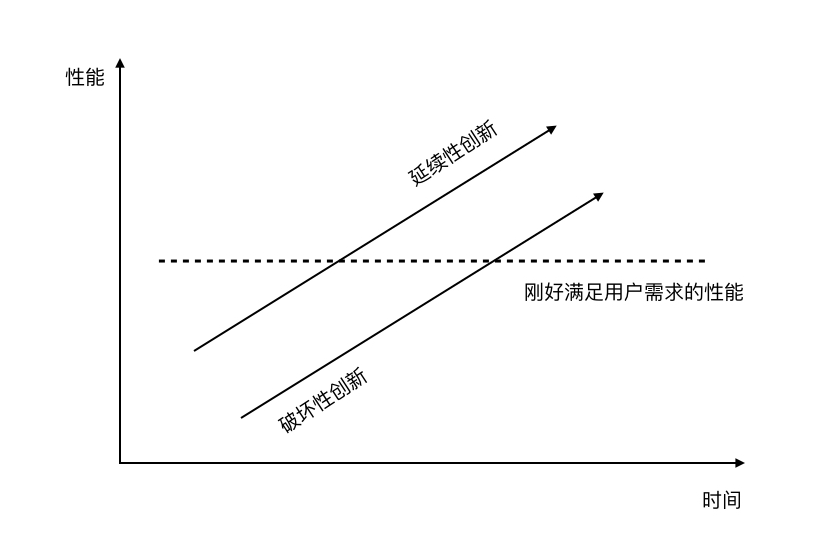
Users will gradually leave "too good" "sustaining innovation" and turn to "disruptive innovation" with better cost performance, or better convenience, or more personalization. We often see examples where users no longer care about product quality and pay more attention to product appearance or convenience.
And those projects that are already "too good" in existing services only have the opportunity to innovate and truly scale when combined with unmanned self-service methods to restructure the supply chain.
For example, the iPhone from the first generation to the third generation wasn't good enough — it was a product used by a small group of people in small circles. It wasn't until the iPhone 4 and 4s appeared that mainstream consumers consistently found it good, and then chased after 5, 5s, 6, 6s, all the way to the current 7.
We've found that Apple's phone market share has started to decline. On one hand, this may be due to fading brand heat; on the other hand, it may be because it keeps introducing new features that most people don't use. Despite flashy packaging, people feel it's no longer worth spending thousands of yuan to buy the latest generation.
This can also be used to explain the KTV project. Humans are born with a need to sing — singing is an instinct for self-expression. But the initial offline KTV service was far from good enough, below the dashed line of "meeting user performance needs." Users hadn't been educated yet either. Microphones in KTVs often broke, the song selection system was hard to use, and server assistance was essential.
Later, microphones became reliable and easy to use, various room types could satisfy different groups, and touchscreen song selection systems were convenient too. But all these costs were included in the price users had to pay. KTV users were mostly students and young white-collar workers just entering the workforce. Did they really want to pay for luxurious rooms and lighting/audio effects, plus 24-hour human service, every single time?
High-end users are willing to pay for it, but more users only want to pay for the parts they need. Unmanned self-service projects essentially stem from this user need: Users no longer need such excellent service.
Therefore, unmanned, self-service, and mobile payment are all just surface phenomena. Whether a project can become an unmanned self-service project depends on whether its service is already "too good" — so good that many users don't want to pay such a high price to enjoy the full service.
Photo Printers:
Offline Scenes Feeding Online Products
Offline-born projects often need to create new user usage scenarios, do a good job of online-offline linkage, and extend user lifecycle, in order to fully enjoy offline traffic dividends.
The O2O wave that gradually rose around 2011 took offline services (group buying, food delivery, etc.) as the core, connecting basically to existing scenarios, with user processes still being online to offline. Now the gameplay of this wave of offline projects has changed — more creation of incremental scenarios, with user processes becoming offline to online.
Moreover, offline projects can also have network effects — an effect long thought to exist only on the internet.
Take photo printers as an example. Traditional photo printing shops were paid services. In the era of film cameras, this was a decent offline business. But after digital photos became mainstream, the gameplay of this business changed. Rapidly deployed large numbers of printer outlets allowed users to print photos for free. The prerequisite for free printing was that users had to first follow a WeChat public account. That is, costs previously borne by users were shifted to advertisers.
This is a highly profitable business: calculating based on a single machine cost of 3,000 yuan, monthly maintenance of 300 yuan per machine, 50-150 followers attracted per machine per day, and follower cost of 1.5 yuan each, payback can be achieved in about two months. The payback speed is much faster than mini KTVs, self-service beverage machines, and the shared power banks mentioned below.
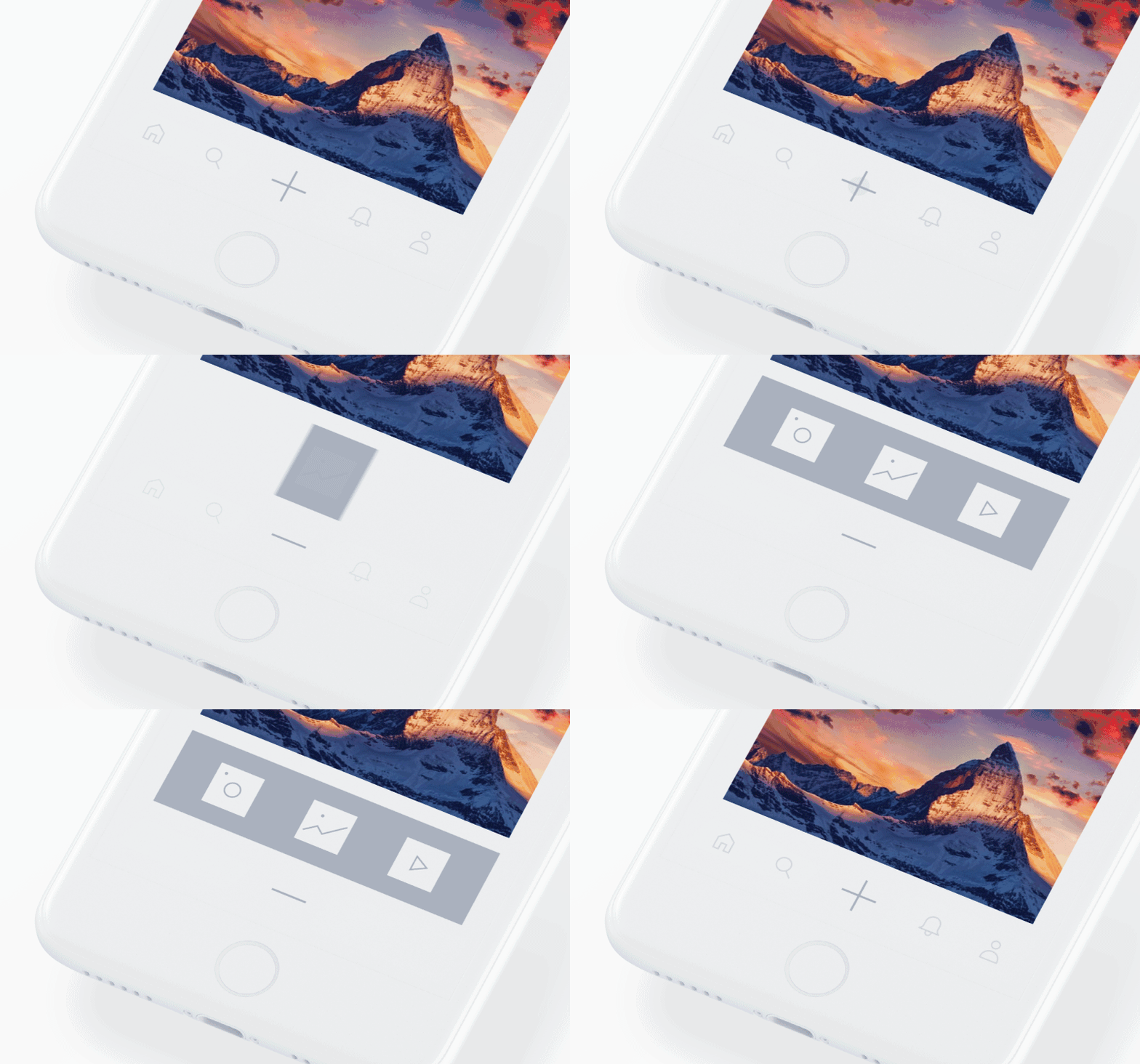
▲ Photo printers can become offline traffic attraction points for apps.
When building products, doing something with a certain feature as the "starting point of use" versus as the "ending point of use" can make a world of difference.
For example, the same location-based information, used for check-ins and food delivery versus used for stranger social networking, produces vastly different results. The same camera, used for photo editing, live streaming, and video social networking, produces vastly different results. The same offline photo printer, used for paid photo printing versus used for directing fans online or online linkage based on offline scenarios, also produces vastly different results.
Even though digital photo storage has long become mainstream, the enduring sales of Polaroid cameras show that users still need beautiful physical photos, especially young users. For internet products targeting young users, photo printers are an excellent offline traffic attraction point.
A social product called in, targeting post-95s young users, not only provides free photo printing services for following public accounts and downloading the app in its offline smart interactive terminals (photo printers), but also uses built-in cameras to turn each machine's placement into a pop-up spot, reactivating the "sticker photo" scene that was wildly popular among student groups back in the day.
Moreover, users can take photos with friends on-site, then use filters and sticker tools in the app to beautify photos and publish them in the community. This makes both the demand for free offline photo printing and offline social scenarios into traffic attraction points.
From a user experience perspective, taking sticker photos and printing photos are both free, with no other forced follow behaviors — just continuing services around photos, photo beautification, and social scenarios, driving app downloads and activity.
Meanwhile, in's devices are mostly placed at entrances to restaurants, exhibitions, and amusement parks where young people go for weekend leisure, fully utilizing the traffic dividends of the "waiting in line" fragmented scenario. If smart interactive large screens are subsequently used for traffic distribution, interactive advertising, and customized activities, commercial value will be further amplified.
By providing incremental services, the commercial value of photo printers keeps migrating backward: earliest through direct charges for photo printing, later through charging for user acquisition, and still later through providing services via online products, thus capturing as much offline traffic dividend as possible.
Shared Bikes vs. Shared Power Banks:
Where Are the High-Frequency, Hard-Need Scenarios?
According to 36Kr: "The shared power bank industry's total financing exceeds 1.2 billion yuan, nearly 5 times the funding shared bikes received when they first appeared."
The two do have quite a few things in common: "Shared power banks are a continuation of the shared bike logic — no need to use online traffic, customer flow comes from offline; they leverage the convenience of rapidly spreading mobile payment; and they have cash flow from day one."
But in fact, the logic behind these two is completely different.
Regardless of how crazily shared bikes are burning money to scale now, when they first appeared, there were hard-need scenarios supporting them: Mobike started in first-tier cities. Although public transportation already covered the vast majority of travel routes, the last 1-3 kilometers after exiting the station was a huge pain point. ofo started on university campuses. Many campuses are huge, and bikes were already the most relied-upon transportation tool for students. But buying your own carried theft risk, and you had to sell it when graduating. These usage scenarios were all sufficiently high-frequency, with target users likely using them 1-3 times per day.
In comparison, while shared power banks do have users who need them — such as those who forgot to bring their power bank and urgently need to use their phone — overall this is only a "minority's occasional need," not a universally existing need.
▲ Shared power banks are a "channel is king" business.
Actually, power bank time-based rental is a very profitable business (rental doesn't equal sharing), generally achieving payback within 2-6 months. But this fragmented type of traffic (stalls at school gates, passageways on certain floors of malls, etc.) can support a good business, but not a good business model.
When power bank time-based rental transforms into "shared power banks," whether desktop-style, small cabinet, or large cabinet, they all face the problem of being held hostage by channels to varying degrees. Shared power banks attach to specific consumption scenarios and depend on channels. Users rarely go to a restaurant specifically to charge their phone for a while. And for restaurants, there are also risks: the presence of power banks might reduce their table turnover rate.
Moreover, Meituan, for whom channel is king, has also entered. Any offline project with merchant expansion as its core competitive advantage will have a hard time going forward.
Additionally, the two main actions of shared power banks — renting and returning — are both unfree. You must borrow from a specific place and return to a specific place, losing the convenience of mobility. It's somewhat like city rental bikes before shared bikes appeared: there's demand, but hard to explode.
(Feel free to share to your Moments.)
— This Issue's Gift —
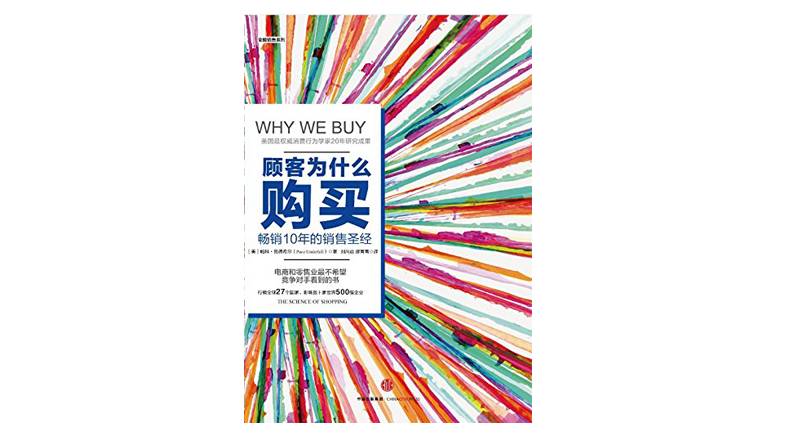
Why We Buy: The Science of Shopping
By Paco Underhill
Translated by Miao Qingqing, Liu Shangyan
The author spent 20 years deeply researching what triggers people's inner purchasing desires, why some customers leave stores fully loaded while others leave empty-handed, and whether online shopping will replace large shopping malls, among other questions.
We will give a copy of Why We Buy: The Science of Shopping to the top 3 most-liked commenters and 3 readers with the "most compelling viewpoints." Gift deadline: 18:00 on Friday, June 30, 2017.

▲ 8 "Unexpected" Things About Consumption Upgrade, and Unreserved Sincerity
▲ From MUJI to Urban Convenience Stores, What Pain Points Remain in "New Retail"? | Frees Fund
▲ Starbucks 1987-1997: Cold Start and "Clunky" Expansion of a Coffee Empire | FreeS Fund