The Perfect Storm Behind *Nezha 2*'s Blockbuster Success | FreeS Research FreeS Fund

*Nezha 2*: What Its Blockbuster Success Reveals About Culture, Technology, and Investment

In 2025, China's film market welcomed a mega-hit — Nezha: Mo Tong Nao Hai (hereafter referred to as "Nezha 2"). From becoming the highest-grossing film in Chinese box office history during a Spring Festival season, to the top-grossing animated film globally, and cracking the top ten of all-time worldwide box office rankings, Nezha 2 shattered a series of records.
▲ Image generated by Doubao AI.
Why did Nezha 2 become such a phenomenon? Will we see another Nezha 2?
Our consumer investment team at FreeS Fund conducted relevant research. In this article, we'll explore the reasons behind Nezha 2's explosive success through three lenses: timing (tian shi), terrain (di li), and people (ren he). We'll also analyze the investment insights from the "10-billion-yuan Nezha phenomenon."
In our view, beyond Nezha 2, blockbuster products like the video app TikTok, the game Black Myth: Wukong, and the large language model DeepSeek all share one common trait: they are built upon China's unique and robust underlying infrastructure. This infrastructure includes a massive market, advanced technology, and complete industrial chains. When these elements combine, China will produce more globally viral products.
Of course, before these hits became widely known, they may have been incubating in marginal territories for years. Going forward, we hope to see more genuine local innovation emerging from more non-consensus spaces.
Giveaway What moved you about Nezha 2? Share with us in the comments. We'll randomly select 5 readers by 5:00 PM on February 28 to receive the latest industry research handbook written by the FreeS Fund team.


/ 01 / Timing: Why China's Film Industry Desperately Needed This Victory
I. Great Films Reflect the Mood of an Era
The 2025 Spring Festival box office set a new record in Chinese film history, with Nezha 2 contributing over 50% of total ticket sales.
Nezha 2's explosive popularity was a much-needed victory for China's film industry.
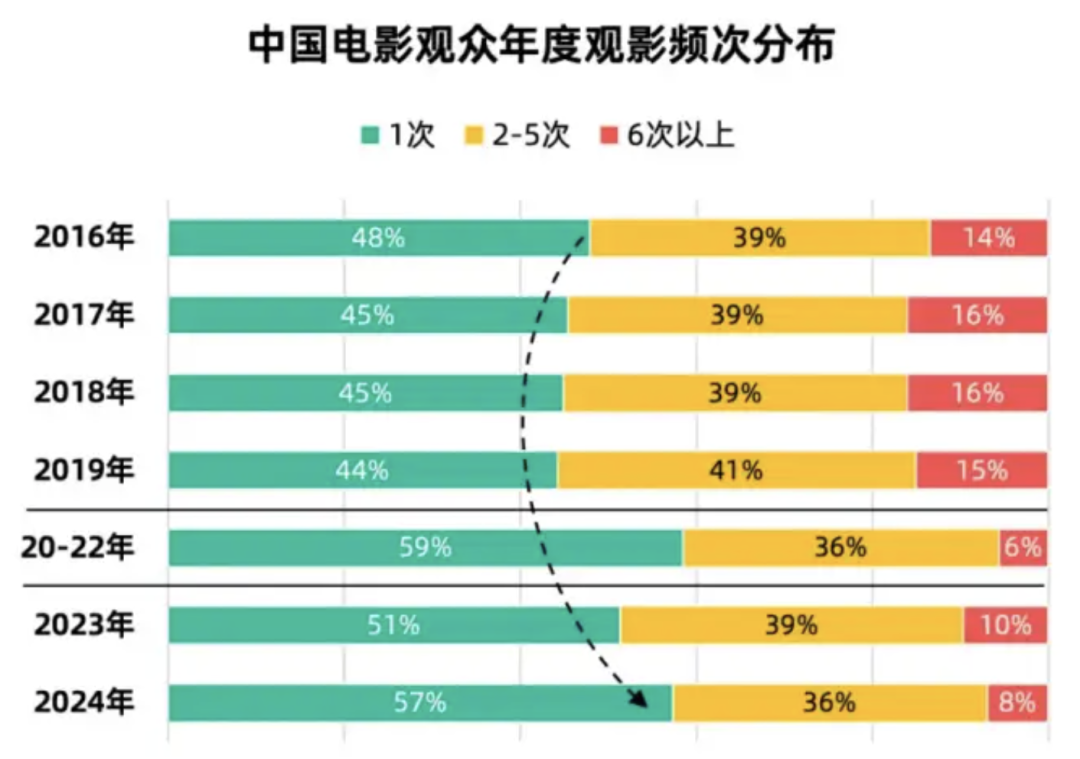
Prior to this, 2024 had been an exceptionally difficult year. Data from the China Film Administration and Maoyan Research Institute showed that total box office revenue for 2024 was just 42.5 billion yuan. Nearly 60% of moviegoers only watched one film all year, and over 80% of theaters failed to surpass 5 million yuan in annual box office revenue.
▲ Image source: Beacon Research Institute
These figures illustrate the severe challenges facing the industry, yet it's precisely during economic turbulence that great works are often born.
History offers no shortage of examples. In 1997, as the Asian financial crisis erupted, Hayao Miyazaki's Studio Ghibli released Princess Mononoke. The film profoundly reflected Japanese audiences' weariness with and reflections on the bubble economy era. Upon release, it quickly topped Japan's all-time box office, creating a mythic 19.3 billion yen record.
In 2001, Miyazaki released his masterpiece Spirited Away. It arrived just as Japan's stock index fell below 10,000 points, yet it still rapidly claimed the top spot in Japanese box office history — a record it held for 19 years. Spirited Away sharply satirized the overtime culture of its time, using the iconic "No-Face" character to critique runaway financial systems and monetary frameworks.
A great film, it seems, can broadly mirror the emotional tenor of its era, resonating deeply with audiences and provoking reflection.
II. Where Did Nezha 2's Box Office Growth Actually Come From?
So why did this era choose Nezha? Or more precisely, where did Nezha 2's incremental box office actually come from?
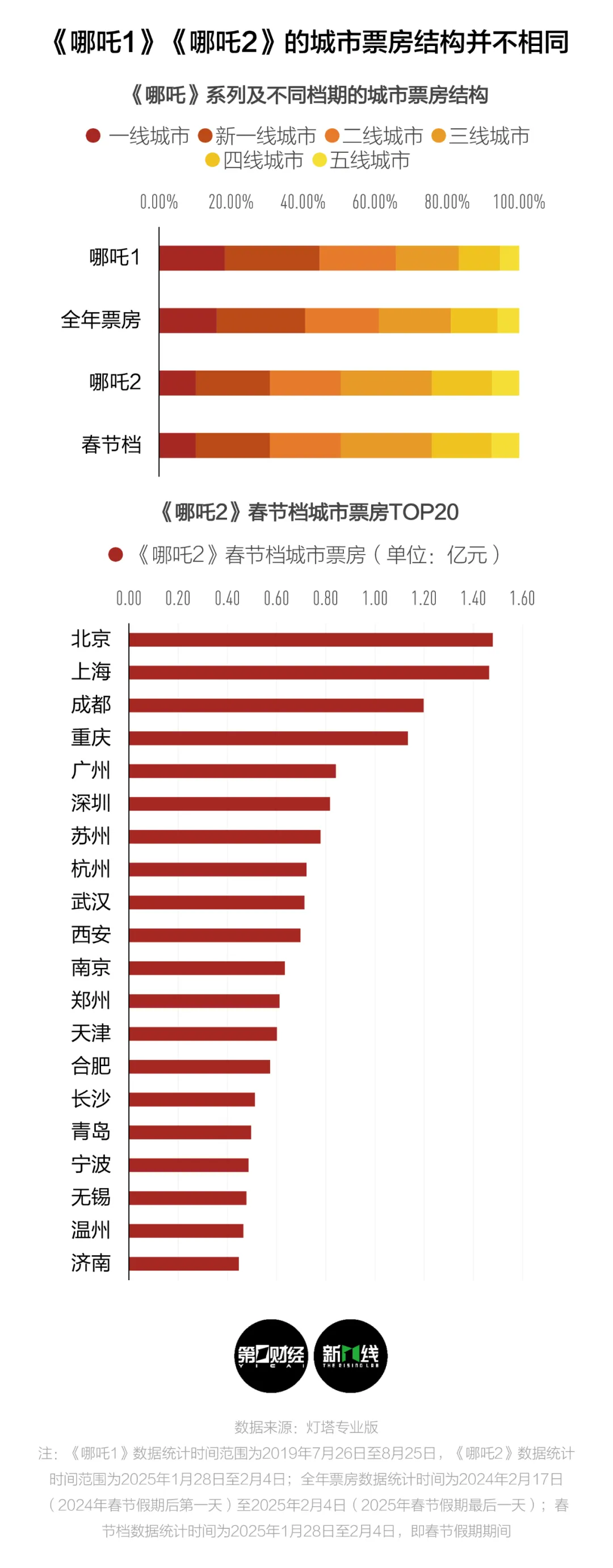
According to Maoyan box office data analysis, as of February 16, Nezha 2 earned 6.508 billion yuan in third- and fourth-tier cities, accounting for 56% of national total box office.
Yicai's New First-Tier City Research Institute found that compared to the first Nezha film, Nezha 2's box office share in first-tier and new first-tier cities dropped by roughly two percentage points year-over-year. Third-tier cities absorbed this outflow from first- and second-tier cities, with average per-city box office net growth of 0.11%.
▲ Image source: Yicai · New First-Tier City Research Institute
The research institute correlated each city's migrant worker population with box office fluctuations, discovering that Nezha 2's box office share growth showed clear negative correlation with the number of non-local working residents — the more people who needed to return home for Spring Festival, the more pronounced the Spring Festival box office decline.
Spring Festival season means different things to different cities. For first-tier and new first-tier cities, it accounts for only about 20% of annual box office. However, third- and fourth-tier cities typically derive one-third or more of their annual revenue from this single period. In these smaller cities, theaters only come alive during Spring Festival.
III. The Massive Migration of Non-Hukou Urban Residents and the Resonance of Era-Specific Emotions
Thus, one core reason for Nezha 2's success is that it attracted non-hukou, mobile populations who rarely watch movies throughout the year. Returning home for the holiday, they went to see Nezha 2 during Spring Festival.
Nezha 2's narrative is suffused with delicate portrayals of family bonds and friendship, showcasing scarce emotional support systems in a highly uncertain social environment — content that resonates powerfully with migrant populations.
Take family bonds: the scene where Lady Yin bids farewell to Nezha reminded many netizens of leaving home after every New Year's reunion. And Ao Guang's line, "The experience of elders comes from the past and may not all be right; your path is yours to forge," embodies a precious perspective of equality, respect, and inclusive familial love.
Take friendship: Nezha and Ao Bing are kindred spirits bound by life and death, described as each other's "only friend." In an era where the "loneliness economy" prevails, such friendship feels especially precious.
Take self-actualization: the film shapes multiple characters pursuing their own worth. Shen Gongbao, for instance, was analogized on social media to the archetypal "small-town exam ace" — completing his transformation from "tool" to "awakened one," from diligent heavenly bureaucrat to lone rebel against three dragons, resisting the very system he once served.
Such stories reflect the struggles of many in contemporary society. Numerous viewers wrote in reviews: "I found my own shadow in many characters."
Online, many secondary creative videos interpret Nezha through a workplace lens. This shows Nezha's broad resonance with contemporary workers. Particularly striking are Nezha's declarations like "If there's no path ahead, I'll blaze one" and "If heaven and earth won't accept me, I'll overturn them" — words representing an uncompromising determination to overcome obstacles and reclaim agency over one's fate.
Perhaps, in some sense, Nezha's story is director Jiaozi's story of quitting his job and spending three years at home teaching himself animation; it's Yocar's story of leaving a game company where he felt stifled to create Black Myth: Wukong; it's Wenfeng Liang's story of starting quantitative investing with 80,000 yuan in capital.
These innovators, once on the margins but always centered in spirit, changed their fates through their own capabilities. This is precisely the character archetype that today's workers crave amid fierce competition, and the new cultural footnote our era demands.
/ 02 / Terrain: "Nezha" in the Coordinate System of Chinese Culture
▲ Image generated by Doubao AI.
Let's examine the Nezha figure from geographic and cultural perspectives.
Placing Nezha within the entire coordinate system of Chinese culture, China's historical civilizational genes are suffused with the spirit of "my fate is mine, not heaven's." Chinese myths — Nüwa mending the sky, Yugong moving mountains, Yu the Great controlling floods — all embody humanity's unyielding will to change the world through effort.
And these myths, reinterpreted by successive generations, acquire new spirit for new eras. In our view, Nezha is a product of his times; his rebellion is "the rebellion of the era."
I. Nezha's Rebellion Is "The Rebellion of the Era"
1. Nezha in the Ming Dynasty Novel Investiture of the Gods
Nezha was a pioneering "demonic child" from the very start.
The complete story of Nezha first appeared in the Ming Dynasty novel Investiture of the Gods, born amid the dominance of Cheng-Zhu Neo-Confucianism. This philosophy emphasized "preserving heavenly principle, eliminating human desire," and the unshakable "three bonds and five constants."
Against this backdrop, Nezha's image and actions appeared especially bold and rebellious. The episodes of flesh-returning-to-mother and bone-returning-to-father reflected popular questioning of and resistance to absolute patriarchal authority and rigid hierarchical order. These episodes not only gave Nezha his distinctive personality but also made him a symbol of challenging traditional authority.
2. Nezha After the "Cultural Revolution"
The Nezha image most familiar to Chinese audiences comes from Shanghai Animation Film Studio's Nezha Conquers the Dragon King. This animated film was created after the Cultural Revolution ended, during a crucial period when China's animation industry sought revival. At that time, Shanghai Animation Film Studio gathered the nation's top animation talent to reinterpret and adapt traditional Chinese myths.
In this Nezha Conquers the Dragon King version, creators made bold cuts and refinements to the original Investiture of the Gods. They removed the original's complex explorations of ethical hierarchy and fatalism, concentrating the plot on the core "dragon king conquest" event and focusing on the theme of justice versus evil. Through this approach, Nezha was shaped into a pure, vivid image full of heroic energy.
3. Nezha After 2000
Perhaps those born in the 1990s are most familiar with the Nezha from The Legend of Nezha. This work was born in 2003, as television rapidly penetrated Chinese households. During this period, China imported large quantities of American and Japanese animation. By the early 2000s, the State Administration of Radio, Film and Television issued the Notice on Strengthening Management of Animation Import and Broadcasting, creating opportunities for domestic Chinese animation to rise.
In this Legend of Nezha, the production team experimented extensively with new digital technology, adding numerous fashionable elements to Nezha. In the childhood memories of post-90s generations, Nezha was not merely a playful image but a character rich in human warmth.
Overall, then, Nezha is a character with spirit of era-specific rebellion. Each era has its unique adapters who give Nezha new vitality. The adapter for our era is director Jiaozi.
II. The Value Proposition Behind Nezha 2
Many viewers have hotly debated whether Nezha 2 contains political metaphors. Some speculate whether the recruitment token in Wuliang Xianweng's hand symbolizes a green card, whether the symbol on the Tianyuan Cauldron's switch hints at the dollar sign, or even whether the forest suppressing the cauldron relates to the Bretton Woods system.
In exploring these questions, we might examine the style and themes in director Jiaozi's previous works. In 2008, Jiaozi released his original animated short — Beat, Beat a Big Watermelon. Through a realistic lens, the short portrayed the US-Soviet Cold War political landscape and delivered biting satire of war. This shows Jiaozi was not attempting metaphor to express political views and social commentary for the first time.
From Nezha 1 to Nezha 2, the film's themes ascend from personal predicament and fate-reversal to more grand narrative angles, questioning the unfair order of the entire cosmic universe. Director Jiaozi, through Nezha's mouth, proclaims: "What gods, demons, and immortals — they're merely shackles imprisoning the fate of other races."
If we imagine boldly, perhaps the film embodies an intention to break so-called Western value judgment systems, particularly those transmitted through Hollywood and other major channels. Meanwhile, the film may also imply that amid China-US competitive dynamics, Chinese people hope for the rise of Eastern culture to open new, inclusively spirited world orders and value propositions.
**/ 03 / ** People:
The Victory of Technological and Organizational Innovation
We'll now examine why Nezha 2 became a phenomenon from the angles of technology, organizational innovation, and capital support. In our view, Nezha 2's victory was not only a victory of technological innovation but also of organizational innovation.
I. Technological Innovation Built on Chinese Aesthetics
According to Xinhua and The Beijing News, Nezha 2 contains 1,900 VFX shots, while the previous film's total shot count was only 1,864.
Such massive VFX volume relied on technological innovation in the animation industry. The film extensively employed advanced computer graphics techniques to enhance visual effects. For instance, particle system technology breaks complex effects into countless tiny particles, using algorithms to control each particle's trajectory and property changes, thereby generating various animation effects.
In Nezha 2, the flame effects on the Huntian Silk and the ice crystal armor on Ao Bing were both achieved through particle systems. The spectacular battle at Chentang Pass, with over 200 million characters clashing in the air, was accomplished by simulating flocking bird movements combined with particle systems.
Furthermore, Nezha 2 made innovative attempts on the foundation of Chinese aesthetics. Building on particle systems, the production team added dynamic noise perturbation during rendering, causing water flows to exhibit textures resembling ink wash brushstrokes, further highlighting the unique artistic conception of virtual-real fusion in traditional Chinese ink painting.
Examining Nezha 2's entire production pipeline: in terms of technical tools, public information shows that from concept design to 3D modeling to post-production compositing, most production pipelines still followed Hollywood tool pipelines.
However, encouragingly, in some segments, director Jiaozi's team used domestic alternative tools. For example, in the animation rigging process (transforming 3D models into animatable characters), some characters used the "ArtMesh" plugin developed by Tencent NExT Studios, simplifying facial expression control workflows. Additionally, in rendering, the film used GPUs from domestic company Moore Threads, significantly improving rendering efficiency for certain scenes.
Thus we can see that throughout the production pipeline, substantial opportunities for domestic innovation exist.
II. Organizational Innovation — 138 Animation Companies, 4,000 People, a "Ten Thousand Scales" Division Network
This production united 138 animation companies, mobilizing over 4,000 people to form a "ten thousand scales" division network. Behind this feat lies the engineer dividend and digital infrastructure strength accumulated over more than two decades of Chinese animation's industrial development.
For example, the particle-ink technique mentioned above was selflessly made available by the Deep Sea animation film team to director Jiaozi's Kekedou Studio. FreeS Fund portfolio company 2:10 Animation was among the co-production companies for both Nezha 1 and Nezha 2. In Nezha 2, 2:10 Animation and its subsidiaries deeply participated in visual effects production for major scenes including underwater dragon clans, sea demon iron chains, and heavenly soldiers — totaling over 100 shots — and completed modeling, rigging, and rendering for more than 50 characters.
Nezha 2's success, one could say, is the success of this collective wisdom and open-sharing ecosystem behind it, the result of collective efforts from China's animation and game industry engineers. It also once again demonstrates China's innovation pattern: accumulating sufficiently deep engineer dividends across long-range digital production chains, then driving explosive applications through sufficiently large market capacity when technological inflection points arrive.
III. Capital Supporting "Poor but Persistent" Founders
Nezha 2's success also depended on the union of people and capital.
Director Jiaozi came from a medical family and originally studied medicine. In his third year of university, he discovered his passion for animation. Though his mother earned only 1,000 yuan monthly at the time, she fully supported her son abandoning medicine for animation. Jiaozi persisted for over two decades, single-mindedly focused on animation creation. This is already a well-known story.
Beyond this, talent also needs capital support.
Enlight Media invested in Jiaozi's team over a decade ago, with the vision of becoming "China's Disney." At a 2019 Nezha: Birth of the Demon Child roadshow in Zhengzhou, Enlight Media team members stated that their criteria for selecting directors were "animation practitioners who are poor yet still persisting."
**/ 04 / ** Investment Implications
I. China Possesses the Underlying Infrastructure for Blockbuster Products
In Feng Shu's view, beyond the film Nezha 2, blockbuster products like the video app TikTok, the game Black Myth: Wukong, and the large language model DeepSeek all share one commonality: they are built upon China's unique and robust underlying infrastructure. Specifically:
- Market scale: The Chinese market provides vast user bases for various applications and products.
- Technology level: Many advanced technologies have reached inflection points where they can be more widely applied, such as AI and algorithm optimization. Broader application creates "flywheel effects," helping accumulate technological advantages.
- Complete industrial chains: China's past "migrant worker" dividend lowered manufacturing chain development costs; now, the engineer dividend is providing strong support for industrial chain upgrading.
When these elements combine, China will produce more globally viral products.

II. Cultural Export Opportunities
Today, as trade export, product export, and brand export are already in full swing, China's cultural export is also beginning to show initial signs.
From 2024's Black Myth: Wukong to 2025's Nezha 2, this trend is evident. Black Myth: Wukong art director Yang Qi stated that overseas sales accounted for roughly 30%, "already exceeding expectations." According to China News Service, as of February 20, Nezha 2's overseas box office surpassed 100 million yuan, with North American box office contributing $11.25 million. The film opened in 945 North American theaters, breaking the record for largest North American release scale for a Chinese-language film from mainland China.
The market space for entertainment export is substantial. Take Japan as an example: according to data from the Association of Japanese Animations, Japanese anime began large-scale overseas expansion starting in 2015. By 2019, Japanese anime's overseas market scale had reached parity with its domestic market. During this five-year period, Japanese anime's overseas market roughly tripled.
But cultural export is no easy feat. As director Jiaozi states: "Creation must be rooted locally, but craft must benchmark against the world." Entertainment works must both draw from profound Chinese culture and benchmark against world-class production techniques.
Furthermore, in cross-cultural communication, we must attend to universal content — such as Nezha 2's themes of "defying fate to change destiny" and "new system versus old system" — allowing works to disseminate vital, globally resonant culture.
Oscar Academy member Ellen Eliasoph told CCTV News: "(Nezha 2) has not only wonderful action sequences but also many deeply moving scenes, even incorporating philosophical reflection. It combines multiple levels of expression — this is a remarkable achievement."
III. Attending to the Unique Needs and Psychological Characteristics of Consumer Groups
For brands, attention must be paid to workers striving in first- and second-tier cities without local household registration — their consumption choices will become the most important structural increment in China's future consumer market.
By the numbers: China's permanent resident urbanization rate is 65%, but household registration urbanization is only 45%. The gap between 45% and 65% means roughly one-third of people living in cities lack local hukou. Where these people ultimately live and how they live represents a massive long-term, slow-moving variable.

When brands communicate consumer value and propositions, they must fully consider these groups' unique needs and psychological characteristics, paying greater attention to: ordinary people's self-actualization; rebellious spirit that breaks prejudice and reverses fate; and emotional support of respect, care, and inclusion.
IV. Abundant Domestic Replacement Opportunities in Animation Tool Ecosystems
As discussed earlier, while Nezha 2 largely followed Hollywood production pipelines, it also used some domestic alternative tools. We believe substantial domestic replacement opportunities exist in China's animation tool ecosystem. The open, reciprocal industrial ecosystem generated by Chinese animation and games may cultivate more technology innovations originating from China.
V. Film IP-Related Opportunities
Nezha 2 also ignited the "goods economy."
The "goods economy" refers to the consumption culture and economic form surrounding 2D IP merchandise. Its core concept "goods" — from the Japanese pronunciation of "goods" — denotes merchandise surrounding copyrighted works from anime, games, novels, etc.
"Nezha" IP-related trading cards, blind boxes, badges, and figurines have been chased by young users. According to Tech Planet, Nezha trading cards with Jiaozi's signature have been speculated up to 100,000 yuan per card.
We've also seen how a major IP like Nezha generates cross-industry influence. According to CCTV News incomplete statistics, over 20 brands have already collaborated with Nezha, covering toys, food and beverage, personal care, maternity and baby products, automobiles, electronics, publishing, and other categories.
VI. People Are Always Most Important — Continually Attend to Founders' Spiritual Pursuits
Extending from Nezha 2 to our investment industry, we tend to believe that titles and labels cannot comprehensively reflect a person's true capabilities and potential. What truly matters is the project itself, and the founder's personal spiritual pursuit.
Therefore, when communicating with founders, we especially attend to whether they possess the mental fortitude to "persist to the end, break and rebuild," and the innovative spirit of continually exploring boundaries.
Finally, sharing a line from Nezha 2: "Be a towering flame, be a single rebellious scale, be the moment called yourself." May we create more genuine Chinese local innovation in more non-consensus territories.
Giveaway What moved you about Nezha 2? Share with us in the comments. We'll randomly select 5 readers by 5:00 PM on February 28 to receive the latest industry research handbook written by the FreeS Fund team.

▲ 3/2 Suzhou Offline Event Registration | 4th Biomedical Innovation and Translation Summit
▲ DeepSeek's 7 Core Questions Explained | FreeS Report
▲ Short Video: Is It the Shortcut for Chinese Animation to Surpass Disney? | FreeS VC Dialogue
▲ [Long Read] 20 Years of Chinese Animation: Rise and Fall | FreeS Business School
Star FreeS Fund WeChat Official Account for timely business insights