"There Will Come a Moment When Technology Defeats Human Experience" | A Conversation with FreeS Fund

"There will come a moment when technology surpasses human experience."
Today's story touches on biopharma, that perennial "sunrise industry," but it's not a tale of chasing trends. Beneath the surface of biopharma — an industry that appears rigorous, restrained, and walled off — the passion, fervor, twists of fate, and pivotal moments its entrepreneurs experience rival anything in more visibly dramatic sectors.
Ning Xia, founder and CEO of ChemAIRS, has spent over a decade immersed in the intersection of "computing + chemical synthesis." He believes in the value of technology-driven progress and data accumulation, and is convinced that biopharma will reach a turning point where technology surpasses human experience. Now, the convergence of technological innovation and surging demand may accelerate that turning point's arrival.
Before founding Keyin Biotech, its founder and CEO Yikai Wang made a transition from industry to investing. He believed that the emergence of novel tool-platform companies and efficiency tools would give China a genuine shot at developing globally competitive products — so he returned to industry and became an entrepreneur himself.
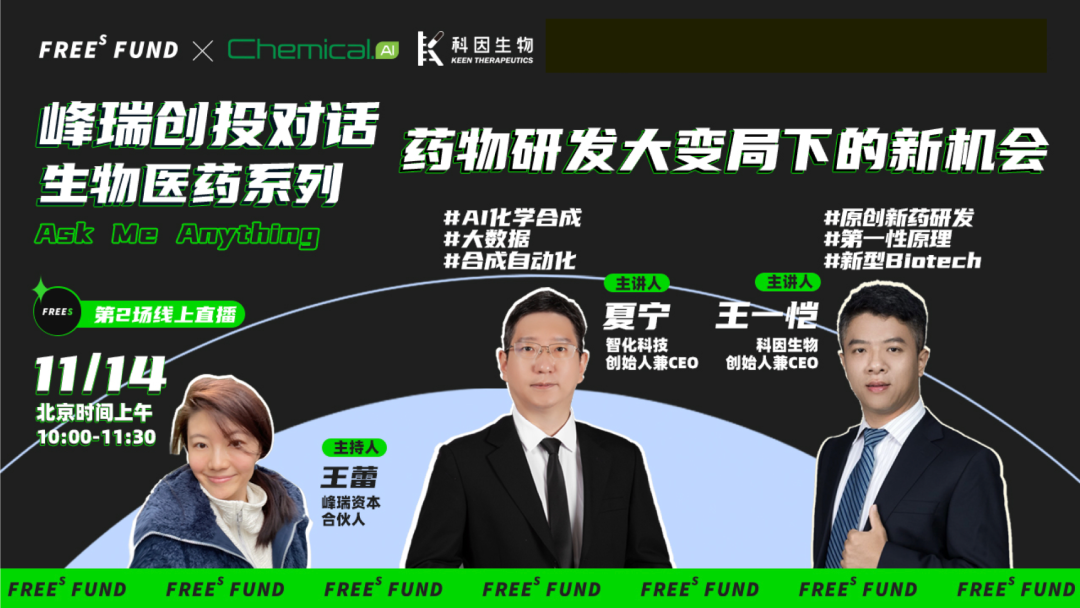
In the second installment of the "FreeS Fund Dialogue" biopharma livestream series, Ning Xia of ChemAIRS, Yikai Wang of Keyin Biotech, and Lei Wang, partner at FreeS Fund, engaged in an in-depth conversation.
Beyond opportunities in the industry, they also discussed failure. In their view, biopharma is a failure-driven industry. One's relationship with failure and uncertainty may itself be a dimension that distinguishes people from one another — learning to "embrace failure" is essential.
We've compiled excerpts from their conversation to share with you. We hope you find them illuminating. Their discussion covered:
- What new variables have emerged in drug R&D in recent years? How did the two founders identify their opportunities?
- How should we view the two technical paths of large molecules versus small molecules?
- Over the next three to five years, what "uncharted territories" in novel drug R&D are worth exploring?
- How can emerging biopharma startups coexist and win alongside large pharmaceutical companies?
- What is the outlook for novel tool platforms and new biotech enterprises?
- How can talent from medicinal chemistry, organic chemistry, AI, and other backgrounds leverage their strengths in novel drug R&D? And why does "one's relationship with failure and uncertainty become a dimension that distinguishes people"?
We welcome your thoughts and perspectives in the comments.
Contact Us We look forward to meeting more innovators in biopharma. Pitch us your deck at bp@freesvc.com. We're also hiring for those interested in joining our investment team at hr@freesvc.com.

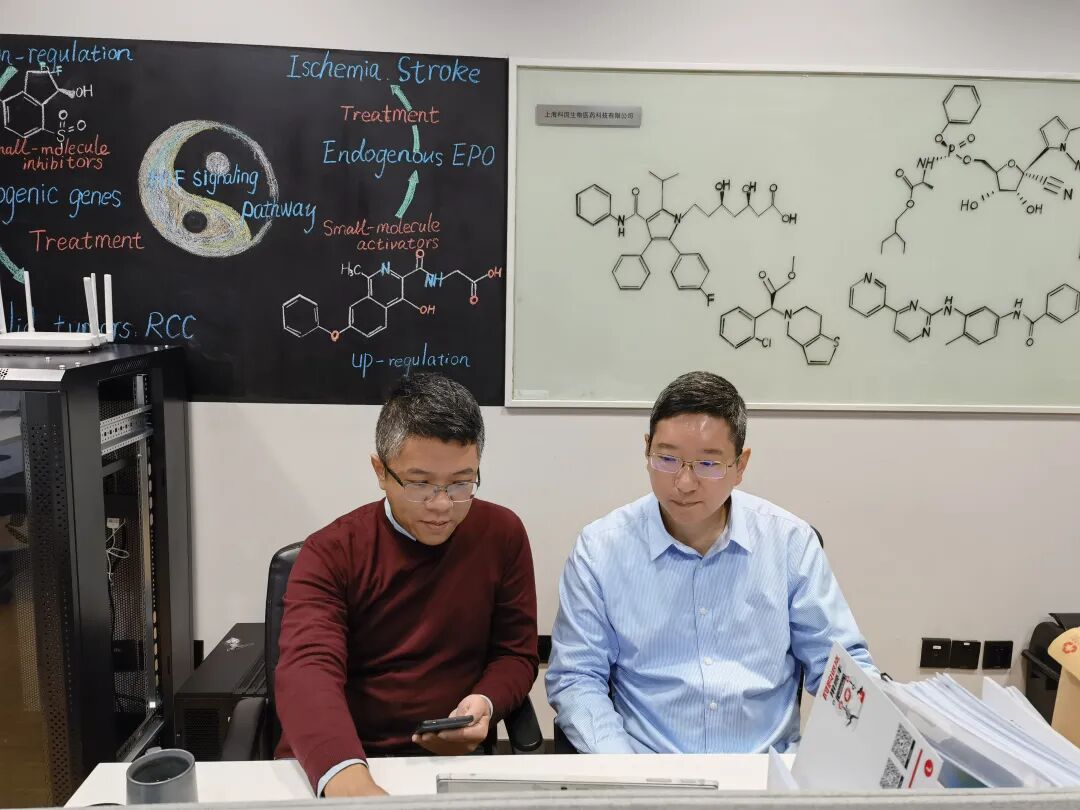
▲ Dr. Ning Xia and Dr. Yikai Wang during the livestream
/ 01 / 13 Days from Introduction to Investment Decision
Lei Wang: Let's start with Dr. Yikai Wang and Dr. Ning Xia — please share how each of you found your way to entrepreneurship.
Yikai Wang: Two chapters in my career have shaped my path to founding a company. First, I worked in WuXi AppTec's domestic drug R&D services division, participating in numerous project pipelines and developing deep familiarity with China's novel drug R&D landscape. This laid the groundwork for my eventual return to industry.
Second, in March 2018, I joined FreeS Fund to focus on early-stage biopharma investing. "Entrepreneurship and investing are two sides of the same coin." In early-stage work, this genuinely holds true — the evolution of your portfolio companies' teams, strategic direction, and technical breakthroughs all feel deeply personal.
When I joined FreeS, I strongly identified with its investment thesis: identifying early directions and interdisciplinary domains, with particular attention to novel infrastructure and the new product companies built atop it. Following this logic, FreeS paid close attention to new tool platforms and technological iterations in novel drug R&D.
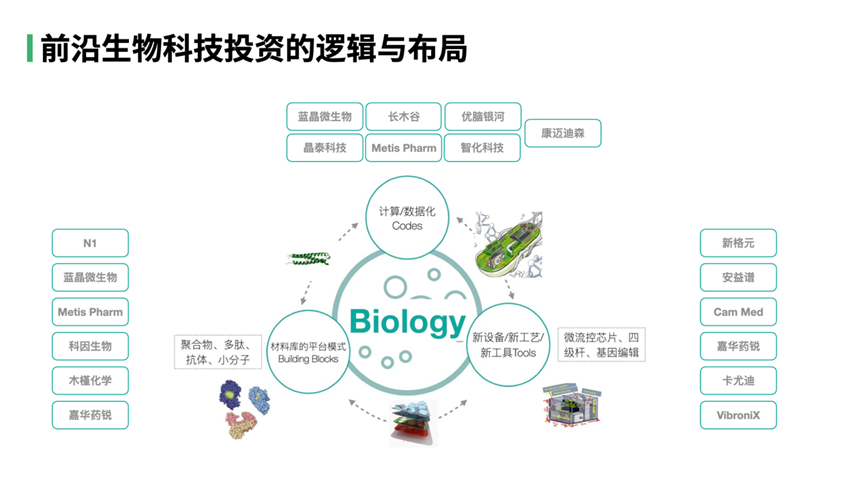
In September 2020, I founded Keyin Biotech, a novel biotech company, born directly from this overarching thesis — that only with the emergence of new tool-platform companies and efficiency tools could China truly begin developing globally competitive products for the first time.
At our age, in mature Western industries, many peers would still be drilling deeper along their original tracks, never gaining exposure to the full panoramic, end-to-end chain, rarely getting the chance to translate their ideas into practice. I feel extraordinarily fortunate to have made two identity transformations — from industry to investing, and back to industry.
Ning Xia: I'm the founder and CEO of ChemAIRS. I'm particularly grateful to Dr. Yikai Wang, who was my angel investor.
Since completing my PhD in 2008, I've spent over a decade doing essentially one thing: using computing, big data, and AI to improve the efficiency of chemical synthesis. I wasn't chasing trends or seizing opportunities — I believed this would work.
Though I trained in pure organic chemistry, I grew up programming under family influence and maintained a genuine passion for it. I was constantly searching for where chemistry and programming intersected, and how computing could solve chemical synthesis efficiency problems.
In 2018, researchers published a paper in Nature using AI for chemical synthesis route design. But by then, we had already been conducting extensive R&D and building capabilities in this space for years.
At the end of 2018, I decided to start a company. I happened to connect with Dr. Yikai Wang at FreeS Fund, who recognized and endorsed our direction and approach. In the two to three years since FreeS invested in ChemAIRS, we've entered a period of rapid development — iterating quickly and maturing technologically.
Yikai Wang: I reviewed the timeline of our ChemAIRS investment.
March 8, 2019 — I added Dr. Xia on WeChat. March 17, a Sunday, we met for the first time in Shanghai's Pudong district. After that meeting, FreeS quickly initiated the project. On the 21st, I went with "Uncle Feng" (Li Feng) to Wuhan, visiting ChemAIRS's original office. We spoke with Dr. Xia for roughly half an hour, and the investment decision was essentially made.
FreeS typically moves fast on early-stage investment decisions, but from adding WeChat on the 8th to finalizing the decision on the 21st — that pace stands out even for us.
This speed reflects FreeS's enduring convictions. I also came from an organic synthesis background and had long followed the direction of using data to accelerate and improve organic synthesis efficiency.
When we invested in ChemAIRS, dozens of teams globally were tackling retrosynthetic route analysis for organic synthesis, with numerous startups in the space. Today, ChemAIRS ranks among the global leaders.
Why did ChemAIRS succeed?
It's not necessarily that American universities couldn't do this work — rather, the organic synthesis industry, whether measured by supply chain, talent pool, or market, is concentrated in China. And this industry happened to coincide with booming investment in novel drug R&D. China's iteration in organic synthesis thus became faster and more effective than elsewhere.
This pattern extends beyond retrosynthetic analysis to cryo-EM, AI algorithm applications, novel detection tools, high-throughput testing technologies, and more — all developing at remarkable speed in China.
My eventual decision to return to industry was directly connected to these new platform tools like ChemAIRS.
We all know novel drug R&D has long cycles and low returns. For sustainable growth going forward, the industry's underlying infrastructure must evolve. New technologies related to drug R&D infrastructure, if they can take root in China, will receive substantial funding support and find application across numerous scenarios.
Keyin Biotech focuses on discovering novel small-molecule drugs against new targets. Our core aspiration is to use computing — targeting relatively novel protein targets, with structures (or simulated structures) — to generate molecules. This represents a focal point and active challenge for the industry. In recent years, this broad direction of protein simulation, prediction of protein-small molecule interactions, and small molecule generation has seen considerable technological innovation.
Keyin Biotech has built a strong computational team and our own platform. Naturally, ChemAIRS became a downstream partner for us — for the synthetic routes of our designed molecules and their ultimate execution, ChemAIRS provides excellent solutions, even full delivery.
/ 02 / "The Low-Hanging Fruit Has All Been Picked; What Remains Hangs High"
Lei Wang: The drug R&D industry has undergone considerable changes in recent years. What new variables or opportunities have each of you observed?
Ning Xia: I've been in this industry over a decade and witnessed substantial shifts.
First, environmental changes. Early on, the broader environment wasn't particularly conducive to innovation in novel drug R&D. For example, synthesis relied primarily on manual labor. But in recent years, labor costs — especially in medicinal chemistry — have risen dramatically. Some industries have even outsourced to places like India or Vietnam to manage labor costs.
Second, innovative drugs, particularly small molecules, have become increasingly complex and difficult to develop. "The low-hanging fruit has all been picked; what remains hangs high." Molecules designed through AI and other emerging technologies today are generally not easy to synthesize, placing greater demands on synthesis capabilities.
The most fundamental shift, however, is technological. Early in my entrepreneurial journey, I had the vision and the ideas, but couldn't execute — the technology simply wasn't mature enough. Today, cloud computing and GPU-based high-throughput computation form the core infrastructure enabling algorithms to tackle pharmaceutical complexity.
Additionally, our openness to new technologies has evolved. The pharmaceutical industry traditionally leaned conservative in its thinking, but in recent years — whether driven by various hype cycles or genuine technological emergence — people have become more willing to experiment with new approaches. This shift in industry mindset is critically important.
Yikai Wang: How did ChemAIRS seize these opportunities?
Ning Xia: We had the idea of using technology to improve synthesis efficiency very early on. My two previous entrepreneurial experiences were also closely tied to computation plus synthesis. We experimented in various directions and accumulated experience that would prove valuable later.
When we saw breakthroughs in relevant technologies, we immediately moved to apply them and put our ideas into practice. It just so happened that we showed up right when the market had demand. You could say this opportunity arose from the intersection of two lines: technological innovation and market demand.
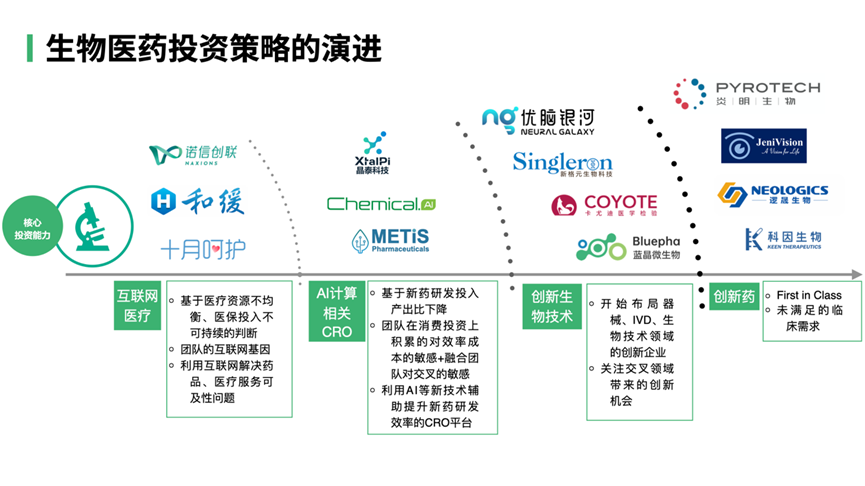
Yikai Wang: Let me say a bit more from the downstream industry perspective. Over the past few years, domestic innovative drug R&D has been booming. Many projects received funding and policy support. There was probably some bubble in there, and recently the secondary market has been correcting.
The reason this situation emerged is that the vast majority of previous projects were "fast follow" — waiting until foreign targets and molecules had already entered clinical trials, seeing others' results, and then jumping in. The biggest risks had already been validated by foreign companies. So we can understand why this led to a certain degree of involution domestically.
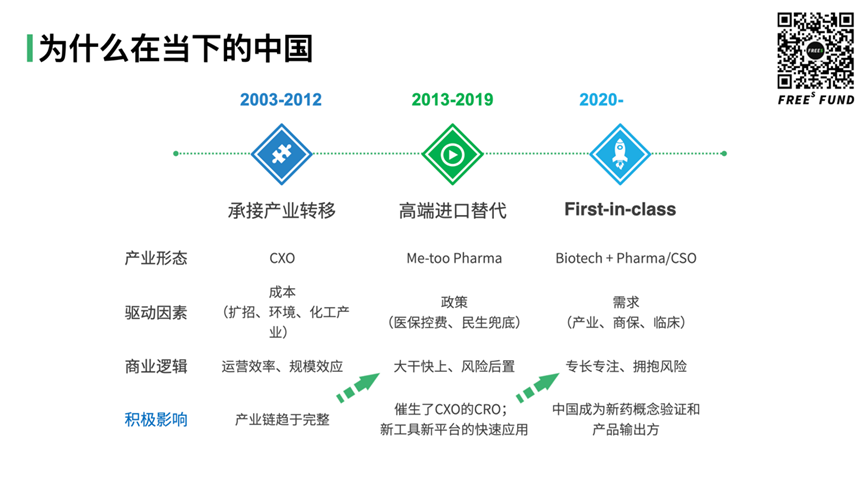
But after the pandemic, China's biopharma industry started talking about first-in-class. The risk of doing first-in-class is extremely high. The core challenge is "crossing the valley of death." How to cross it? Honestly, it's a cycle called DMTA. Large pharma companies probably started doing this cycle over 20 years ago — every time a new technology emerged, they would apply and iterate on it. Going forward, this cycle may become a problem that everyone has to solve. (For more on the DMTA cycle and thinking about new drug R&D efficiency, see FreeS Report 23: Crossing the "Valley of Death": Systemic New Opportunities in Small-Molecule Drug Discovery)
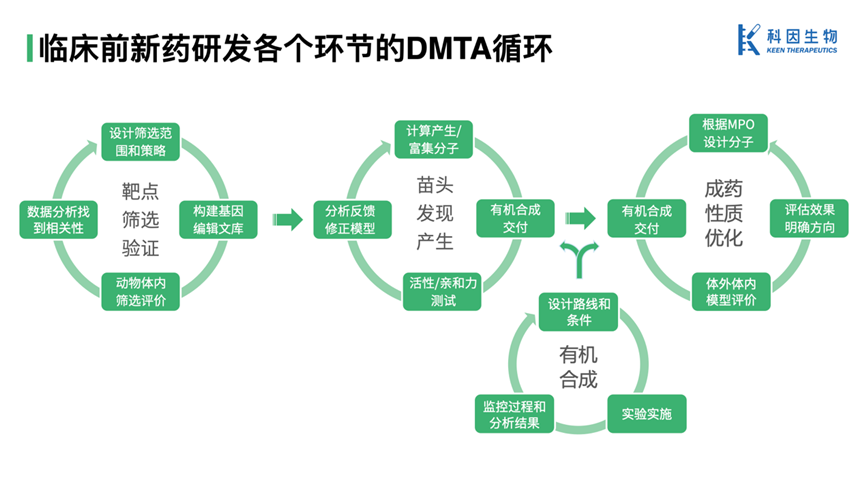
As I mentioned earlier, China has seen many new tool platform companies emerge. Doing this integration and acceleration cycle domestically may already be more efficient than partnering with European companies. After all, local communication is easier, there's no time difference, and these companies are growing and developing well in China.
With this foundation in place, it will in turn encourage people to tackle harder targets and more difficult molecules. Seeing this opportunity, I hope to throw myself into it, achieve first-in-class, and develop products that meet clinical needs.
03 Over the Next Three to Five Years, What "Uncharted Territories" in New Drug R&D Are Worth Exploring?
Lei Wang: In the next three to five years, what "uncharted territories" remain in the new drug R&D industry? Or what technologies are not yet widely applied but have tremendous potential worth exploring?
Ning Xia: I'm quite optimistic about solving problems from a computational angle. Right now, we often rely on experience and data, and efficiency is still relatively low. I hope that in the future, quantitative computational approaches can become more precise. Or that new methods emerge — for example, using computation to predict problems involved in synthesis, rather than relying on data.
Second, quantum computers are also in development. If GPU efficiency improves by several more orders of magnitude in the future, that could also have enormous impact.
Yikai Wang: I very much agree. On the tools and methods for studying biological systems, throughput will become higher — this is already being applied to varying degrees. Whether it's new testing tools, single-molecule imaging, single-molecule characterization, and so on, these are gradually being adopted in the industry.
Whether in biology, chemistry, or drug R&D, the role of computation will continue to manifest. Recently, AlphaFold achieved breakthrough progress in predicting protein complexes.
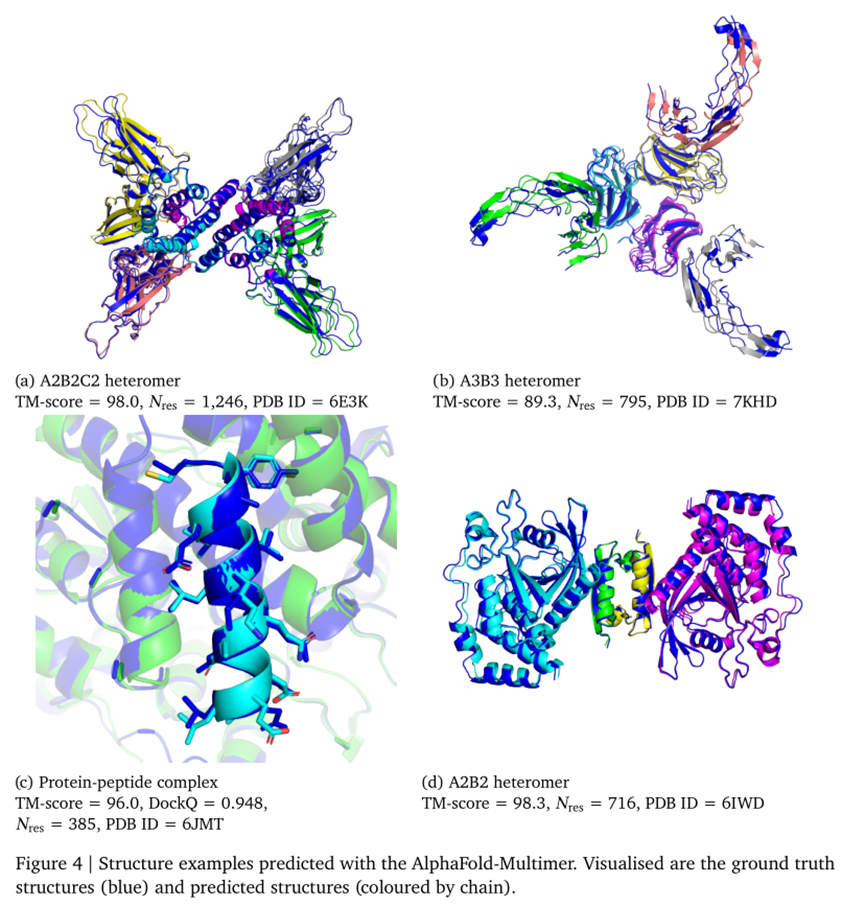
▲ AlphaFold-Multimer predicting protein complex structures. True structures are marked in dark blue, with other polymer chains distinguished by different colors. Image source: IntelPharm.
Going forward, as computational breakthroughs continue and tools like molecular dynamics simulation are more deeply applied in early-stage drug discovery, our understanding of biological processes will be updated and iterated. There will be new directions, methods, and tools that can accelerate the drug R&D process, thereby reducing late-stage failure rates and improving return on investment.
04 How Do You View the Two Technical Routes of Large Molecules and Small Molecules?
Lei Wang: In the healthcare field, large molecules, biotechnology, and gene therapy are all very hot. Given existing drug discovery methods, how do you two view the directions of large molecules, small molecules, and biotechnology — which route is most likely to first produce new methods and platforms that customers will recognize?
Yikai Wang: I come from a chemistry background and work on small molecules now. Whether facing investors as an entrepreneur or when recruiting, I more or less hear judgments like "large molecules and gene/cell therapies are extremely hot, small molecules are yesterday's news."
But in reality, if you look at companies incubated by several large US VCs in recent years, their investment in small molecules hasn't decreased at all. Small molecules have many new developments.
Additionally, with CRISPR for new target discovery and validation, discovering and researching intracellular targets that small molecules can act upon, and even establishing screening workflows, has all become much easier.
So through the small molecule route, China launching truly original drug products and giving birth to newer, more effective technology platforms actually has greater possibility.
Ning Xia: Small molecules and large molecules are actually two complementary fields — it's not about one replacing the other. Their mechanisms of action and corresponding diseases are different.
For example, after COVID-19, there were both vaccines as biological large molecules and small-molecule oral drugs. The two work differently and have different resistance profiles.
And approaches like computational empowerment and AI empowerment are easier to achieve breakthroughs with small molecules. Relatively speaking, small molecule structures are simpler and easier to compute. Large molecules still require a lot of trial-and-error or biological approaches.
In the future, large molecule and small molecule routes will coexist long-term, and both will develop better and better.
05 How Can New Tool Platforms and Biotech Companies Coexist and Win with Big Pharma?
Lei Wang: Having discussed changes and opportunities in the industry, I'm curious how you two founders understand the relationship between new tool platforms or biotech companies and existing big pharma. How can these companies coexist and win together? How do new companies convince big pharma to try new technologies, and to what degree can they improve efficiency for these big pharma companies?
Ning Xia: ChemAIRS is primarily service-oriented. When we talk to big pharma about collaboration, they'll ask: "Is your stuff actually good? How do you prove it really works?"
We do need to conduct testing within pharma companies for a certain period. Because the synthesis problem is relatively easy to validate — through their own experience or some simple experiments, they can tell how effective it is.
Of course, there are also some newer technologies that may be harder to validate, requiring big pharma to believe in the logic of the approach. For example, our core logic is using data to replace human experience. If a large company buys into this logic, they're willing to try.
Especially in the current era, pharma's core pain point is extremely clear: accelerate R&D and reduce costs. From this angle, even if you haven't yet completed a relatively full validation process, some companies will still be willing to support you.
Yikai Wang: I think for new tool platform companies, delivery capability is very important. We're currently working on new target project R&D. Some molecules designed through computation are not easy to synthesize. Of course, having just a synthesis route isn't enough — you must obtain the final molecular entity to validate whether it's effective in biological experiments.
From this you can see that organic synthesis and the new drug R&D industry as a whole may differ somewhat from the internet industry, because the end result in new drug R&D requires experiments to form a closed data loop.
For Kein Bio, how do we understand the relationship with big pharma?
We're also collaborating with a foreign pharma company's accelerator. We were recognized because our efficiency in molecular discovery is high enough. Of course, we still need final validation to close the loop. Only after obtaining data and results do we have the opportunity to communicate and discuss collaboration with these large pharma companies.
Ning Xia: In ChemAIRS's collaboration with clients, we also focus on results — ultimately there must be a verifiable process. Speaking with facts is absolutely mandatory.
Relying solely on concepts cannot sustain collaboration long-term. ChemAIRS places extreme internal emphasis on the validation process, using experiments to validate designed routes. This is a problem that all computation-driven companies in the new drug R&D field must face.
Yikai Wang: Indeed, what matters most is the molecule, not a feasibility report or route.
06 Will You Stay in Services or Move to Products in the Future?
Lei Wang: For new tool platform or biotech companies, do you plan to stay in services going forward, or might you jump into making products and become important players in the industry?
Ning Xia: Both paths are viable, but the approach differs. The core of AI is having enough data volume to build moats. If you choose to do products, you may not have enough funding for many pipelines, so overall data volume would be relatively small. But if you do services, we can quickly serve many pipelines, and overall data volume will be large. From this perspective, ChemAIRS's strategy remains services — this is how we can truly build our data moat.
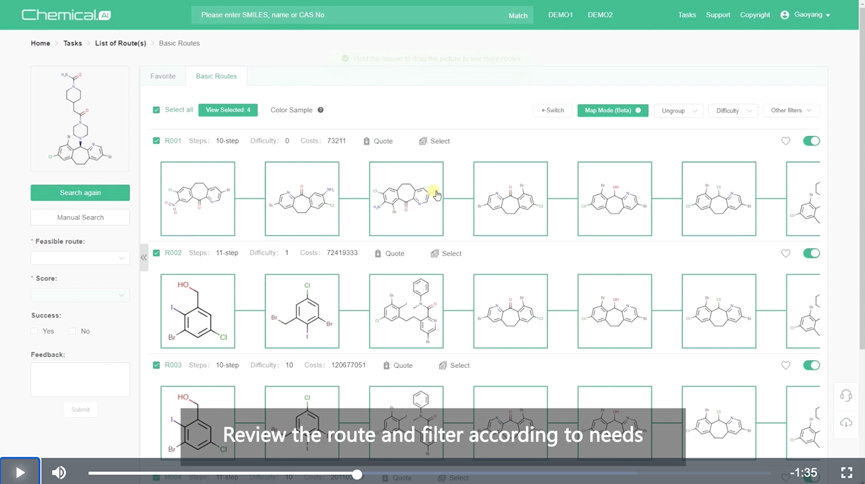
▲ ChemAIRS product demo. Image source: ChemAIRS (chemical.ai) official website.
Yikai Wang: Without a doubt, biopharma is a sunrise industry that will remain hot. Of course, the premise of this heat is that every player needs to achieve excellence in their specialized direction and stage.
In the future, China's biopharma industry may evolve to resemble Europe and the US, with finer division of labor and sharper focus on specific directions and stages. There will be emerging biotech startups alongside big pharma players like BeiGene and Hengrui. Only by leveraging the strong late-stage clinical and commercial capabilities of big pharma can biotech-developed drugs reach patients more effectively. We need all types of companies in the industry to build a healthy ecosystem together.
The ones with the harder lot in this picture are probably the biotech companies — their failure rate is extremely high. But new targets and directions carry enormous risk, so failure is normal. In fact, in a mature industry chain, although biotech companies have very high failure rates, they also deliver the highest returns on investment. This structure incentivizes continuous exploration of new things to address unmet clinical needs.
Wang Lei: On data accumulation, one audience member asks: "Big pharma has surely accumulated synthesis data over many years, and in massive volumes. They can also build their own automation and algorithm platforms. How does ChemAIRS compete in this space?"
Xia Ning: If we're talking about products, pharma companies have indeed accumulated substantial data, but the pace of accumulation may be relatively slow year over year. If we're talking about services, there's greater potential for data growth.
The data that pharma companies have accumulated certainly has value. But if that data is to be used for AI training, the granularity needs to be extremely fine and standardized. Accurately and systematically recording data is not a bottleneck for startups.
Wang Lei: Beyond computational and software technology, how is ChemAIRS thinking about hardware product integration — specifically, what is your layout in automated synthesis?
Xia Ning: ChemAIRS also has a footprint in automation, which we're currently developing internally. To rapidly accumulate large volumes of data, and data standardized enough for machine learning, we do need to pursue automation.
Wang Lei: Some synthesis experts at CRO companies have反馈 that synthesis software may be more useful for beginners and relatively less useful for experienced practitioners. Do you think this is the case? How significant is the advantage that ChemAIRS can bring?
Xia Ning: This is indeed a question many people care about. We can draw an analogy to Go. As AlphaGo continuously learned and evolved, eventually defeating top human players, people realized that humans could no longer compete with AI.
When synthesis software technology first emerged, it might have outperformed PhD students with three or four years of experience, but compared to veteran experts with ten years of synthesis experience, its capabilities were still quite limited.
But if individual expertise can be preserved and aggregated in the form of data, allowing all machines to learn from this experience, the end result is a superhuman. This superhuman might possess the combined experience of hundreds or even thousands of senior chemists, with extraordinary retrieval and computational capabilities. This may be the true pathway to solving organic synthesis problems.
From a developmental perspective, this turning point is destined to arrive. There will come a moment when technology surpasses human experience. After that, a consensus will form that this is something AI can simply do.
07 Where Is the Ceiling for New Drug R&D?
Wang Lei: I'd like to ask both of you to share your thoughts on the prospects of the new drug R&D industry and where the ceiling might be.
Xia Ning: From the perspective of building a tool platform, the prospects are quite good. The industry's demand for efficient tools is extremely strong. At the same time, the ceiling is high enough. With services, you might see a revenue ceiling for any single product, but you can serve companies across China and globally. Moreover, synthesis itself has a fairly high ceiling. Synthesis isn't just a problem for biomedicine — new materials, agrochemicals, and personal care industries all need it.
From a data and computation angle, this industry has relatively deep barriers to entry and isn't prone to descending into red-ocean competition. Our competitors are limited, and as time goes on and R&D goes deeper, we can build very core moats.
These moats may eventually translate into data moats. At that point, we become somewhat like internet companies. When an internet company grows large enough, it becomes difficult for others to replicate from a market and data perspective.
Yikai Wang: In drug discovery, there's the concept of "chemical space" — the number of drug-like molecules may be on the order of 10^60. This means our current exploration of druggable molecules is extremely limited. That's one dimension of the problem.
Another dimension is that many protein targets we see as viable were previously inaccessible due to technical limitations. But now, with advances in tools and biology, they're gradually becoming part of the explorable biological space.
Connecting these two spaces creates many opportunities worth trying and iteratively exploring. And it's precisely because new tools and more efficient synthesis technologies have emerged that the cost of exploration can become acceptable.
Going further, in new target discovery, we now have the ability to explore more druggable molecules. In the past, a project might produce a thousand molecules. In the future, with more efficient organic synthesis, we might be able to make ten thousand. Those thousand molecules used to be concentrated around a single scaffold structure; going forward, we might have the opportunity to explore ten or a hundred scaffolds. Through this approach, we can get closer to globally optimal molecules, and the probability of success will increase substantially.
So there's quite a lot to explore — there isn't really a ceiling.
"How one perceives failure and uncertainty may also be a dimension that distinguishes different people"
Wang Lei: I'd like to discuss with both of you the talent question that everyone cares about. As new tool platforms and new types of biotech companies continue to develop, what opportunities and challenges lie ahead for different types of talent — medicinal chemistry, organic chemistry broadly, biology, AI, and so on?
Xia Ning: Based on our company's experience, the talent we need now is overwhelmingly interdisciplinary. Interdisciplinary doesn't mean knowing a bit of chemistry and a bit of programming — it means truly understanding both chemistry and programming deeply, which is extremely rare.
Currently, our talent cultivation system still leans heavily toward single disciplines: chemistry majors study chemistry, computer science majors study computer science. We haven't yet achieved cross-disciplinary training.
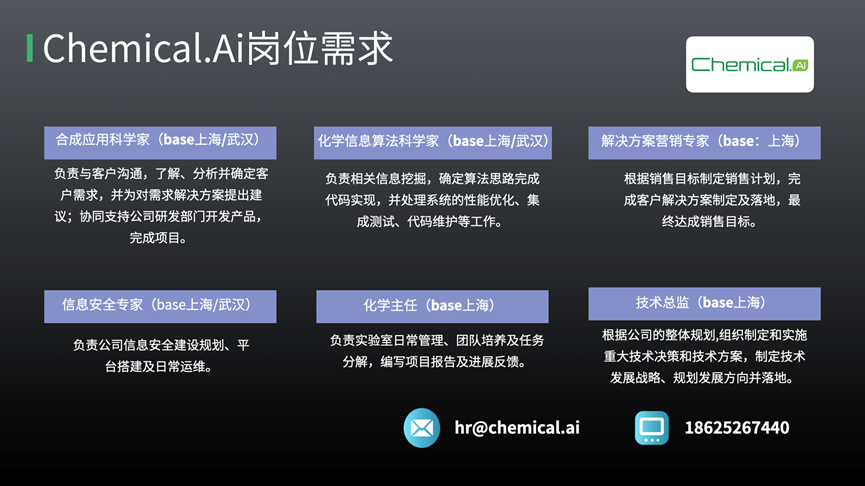
I suggest everyone try to develop in interdisciplinary directions. Personally, through a series of fortunate circumstances, I studied chemistry through my PhD and eventually ended up in cheminformatics writing code. Our company also cultivates talent: if you have deep accumulation in one area, such as synthesis or pharmaceutical subfields, and are just getting started in another area like programming or algorithms, we warmly welcome you. We've seen many people on our team with extremely strong learning abilities who quickly master these technical skills through practice. This September, Huazhong University of Science and Technology and ChemAIRS jointly established an "AI Chemistry Experimental Class" to jointly cultivate talent with dual backgrounds in chemistry and AI.
Students interested in AI-enabled automated synthesis, please follow us and join us.
Yikai Wang: Dr. Xia mentioned interdisciplinary development — truly achieving this is very difficult. For most people, doing deep work in one direction is already quite good.
To go further from there requires an open mindset. Drug development is a long-term endeavor that requires teamwork. You need to know what other teams in your company are working on, what new tools they have, and how they can contribute to your own work and project development. Only when you understand the other side can you have deeper collaboration, rather than working in isolation.
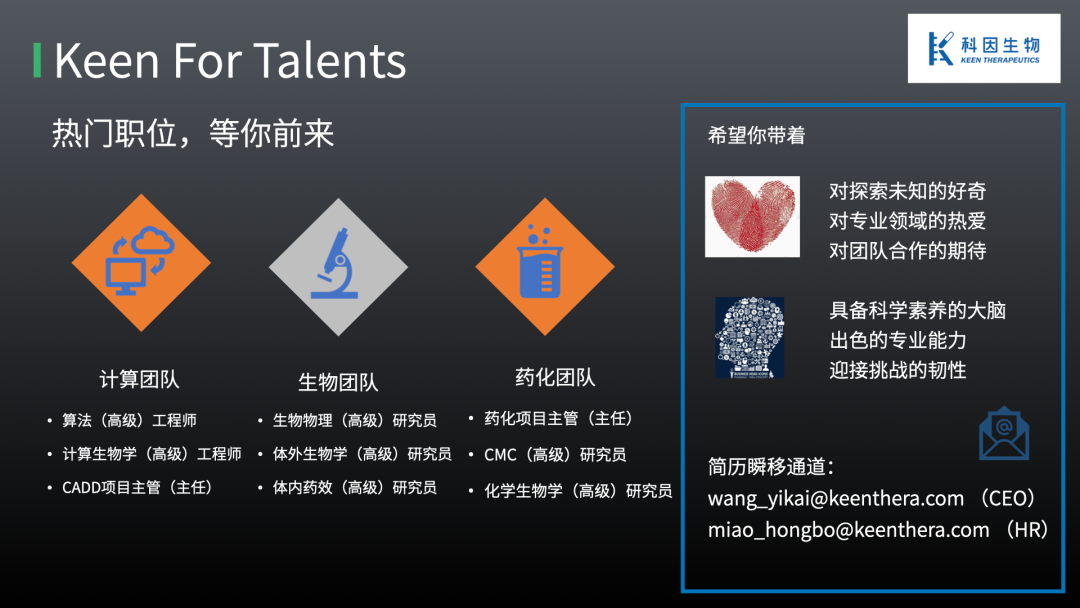
In our past interviews, we've encountered quite a few candidates who worry about the risks of doing new things. How people perceive failure and uncertainty is actually a dimension that distinguishes different people.
Any breakthrough in science or technology involves enormous uncertainty; failure is the norm. Especially in new drug R&D, probably over 95% of molecules will ultimately be "discarded" for various reasons. You can actually set a default assumption: this thing is definitely going to fail. That way, when you're working on a project, you won't be so afraid of failure.
We hope to establish a value system in our company around understanding risk. We want everyone to embrace risk and not fear trial and error. From the company side, we'll also provide various support and resources to let people explore fully. Only then can we accumulate true innovation at the foundational level.
Frankly, in the entrepreneurial process, I've faced many challenges myself — how to prove myself, how to do this kind of work, how to collaborate with people, what the profit model looks like... What I'm grateful for is that the tolerance for risk and failure in China, and the industry's embrace and recognition of new things, have developed faster than I imagined.
And in this industry, there are many partners willing to accumulate with us, willing to take risks, willing to be battered by disappointing data every day, with the resilience to attempt delayed gratification. What's most valuable in this process is that everyone accumulates true industry know-how and experience with new tools.
Xia Ning: "Embracing failure" is equally important in our algorithm R&D. People might think algorithms are deterministic, but in reality, we find truly viable methods through continuous failure. Failing ten times and succeeding once is already pretty good. From this perspective, we're a failure-driven R&D enterprise — just like pharmaceutical companies.
Wang Lei: One audience member wants to know: at this stage, between domain knowledge and computational capability, which is more dominant?
Xia Ning: Both are actually very important. If forced to choose one, domain knowledge is probably more important. Because chemistry or the pharmaceutical industry itself has very high barriers to entry; without this foundation, trying to enter directly through computation or AI would be quite difficult.
Yikai Wang: In this industry, whether we're ultimately providing molecular synthesis services or drugs themselves, everything needs to land as a product. Our core thinking is about the logic and demands of product development. On this foundation, if algorithms, data, and computational capabilities can accelerate this process — even making the early drug discovery workflow as programmable as possible — they can empower and accelerate. Of course, using these tools well still requires very deep domain knowledge. For organic synthesis, domain knowledge may in the future be presented in a new form, such as data.
Discussion
In this piece, the author shares research on new drug R&D. We especially welcome you to share your observations and thoughts in the comments: How do you view the development of the new drug R&D industry, and what opportunities have you identified?
Contact Us
We always look forward to meeting more innovators in the consumer space. Please send your pitch deck to bp@freesvc.com. We also welcome those interested in consumer investing to join us at hr@freesvc.com.
Livestream Replay
For those interested in the second installment of the "FreeS Fund Dialogue" biopharma livestream series held on November 14 — "New Opportunities Amid the Great Transformation in Drug R&D" — more exciting content is available by scanning the QR code below to replay the livestream.
Baidu Live Replay
Scan the QR code above to watch the replay 👆 If the link doesn't open after scanning, press your phone's back button to bring up the livestream page.
Sina Tech & Sina Finance Live Replay
Scan the QR code above to watch the replay 👆 If the link doesn't open after scanning, press your phone's back button to bring up the livestream page.
▲ Expansion or Store Closures? Reassessing Offline Opportunities | Li Feng Column
FreeS Report 24 | Embracing the "Smartest" Frontier: Investing Boldly in Brain and Neuroscience
Why Is AI Drug Discovery So Hot, and Why Now? | FreeS Fund Biopharma Investment Summit Transcript
Early-Stage Medical Aesthetics Investment Moves Toward Underlying Technology | FreeS Research
Investment Opportunities in Pharmaceutical and Chemical Industry Upgrading | FreeS Research