Untangling the Ins and Outs of Carbon Emissions to Find the Path to Carbon Neutrality | FreeS Research Institute

What Investment Opportunities Exist in the Hundred-Trillion-Yuan Carbon Neutrality Market?
Carbon neutrality is a critical topic for exploring the continuation of human society and Earth's civilization. Concepts like "dual carbon," carbon neutrality, and carbon peaking have surged in popularity over the past couple of years. Hydrogen energy, smart grids, nuclear power, and energy storage are all more or less connected to the dual carbon agenda. The topic is vast — not confined to any single industry or sector, but a systemic challenge where every move affects the whole.
This is the second installment in FreeS Fund's environmental protection and dual carbon series. Pengqi Liu, Executive Director at FreeS Fund, will systematically break down questions related to "dual carbon."
Pengqi Liu holds a bachelor's degree in Electronic Engineering from Tsinghua University and a master's degree in Computer Science from Carnegie Mellon University. Before joining FreeS Fund, he worked as a software engineer at Microsoft headquarters, where he focused on search advertising algorithm R&D. He also served as head of the big data department at Dmall, where he built out the big data platform, search and recommendation systems, and data operations infrastructure. Currently, Pengqi focuses on technology-enabled industrial upgrading. His representative investments include iBackCheck, GanYi Intelligence, iSelect Technology, and Ujiex Future.
This article will peel back the shell of "carbon neutrality" layer by layer, clarifying technological innovation opportunities in the context of dual carbon. We'll explore:
- Why was the "dual carbon target" proposed in the first place?
- Where exactly do carbon emissions come from?
- What are the pathways and methods for reducing carbon?
- What investment opportunities exist under the dual carbon framework?
We hope this offers fresh perspectives, and we look forward to exchanging ideas on green innovation technologies. Feel free to reach out to the author, Pengqi Liu, at pengqi@freesvc.com.
Livestream Preview
Starting in September, we'll launch the "FreeS Fund Dialogues: Environmental Protection & Dual Carbon Series" livestreams. We'll speak with innovative companies about how industries like consumer goods, new energy, and biomedicine can ride the wave of environmental protection and dual carbon to capture new growth opportunities. As an investment firm, FreeS Fund will also share the insights we've learned from founders.
The first livestream, Synthetic Biology: From Groping in the Dark to Riding the Wave, will go live on September 4 (this Sunday morning). Haotian Zhang, co-founder and CEO of Bluepha, and Teng Li, co-founder and president, will join FreeS Fund partner Rui Ma for a conversation on green innovation opportunities in synthetic biology.
Scan the QR code to register and submit your questions on environmental protection and dual carbon. We'll curate and pose selected questions to our guests. We'll also send out the livestream link via email beforehand and invite you to join our industry community.
Scan the QR code to register 👆
01 Why Do We Need the Dual Carbon Target?
First, let's explore why the dual carbon target was proposed in the first place.
The big picture: global annual carbon emissions (including not just CO₂ but also methane, nitrous oxide, and other greenhouse gases) exceed 45 billion tons. Left unchecked, this level of emissions will keep driving up Earth's temperature, leading to global warming and ecosystem collapse. The world has reached consensus on the need to reduce carbon emissions.
If nothing is done, by the latter half of the 21st century, global temperatures will rise by more than 2°C — an irreversible process. Currently, the world is adopting various measures to control temperature increases. In the most optimistic scenario, the temperature rise could be kept below 1.5°C by the latter half of the century.
To achieve this step by step, countries have set two phased targets.
The nearer-term target is carbon peaking: the point at which a region or country's CO₂ emissions reach their maximum and then begin to decline. Many countries have already achieved this — mostly developed nations, along with some developing countries with small economies and limited manufacturing, whose emissions were already low.
China is the world's second-largest economy and still growing rapidly. Carbon peaking won't be easy for China, so the target year is set at 2030.
The longer-term target is carbon neutrality: over a given period, greenhouse gas emissions are offset through afforestation, energy conservation, and emission reductions to achieve "net zero." Some underdeveloped countries with high forest coverage have already achieved this, such as Suriname and Bhutan.
But for both developed countries and developing nations like China, carbon neutrality is challenging. Sweden aims for 2045, while the UK and France target 2050. China's goal is 2060.
China ranks first globally in carbon emissions — higher than North America, Europe, and any Asian country. The difficulty and pressure of emission reduction are immense. Despite being relatively unaffected by the 2020 pandemic, China's share of global carbon emissions actually rose above 30%. Achieving dual carbon will be extraordinarily difficult for China and will require extraordinary effort.
02 Where Do Carbon Emissions Come From?
Having understood why carbon neutrality matters, we need to figure out where these emissions actually originate.
Carbon emissions mainly come from energy use and production processes. Globally, the major sources are: power generation, heating, transportation (including automobiles, aviation, and shipping), manufacturing, construction, and agriculture.
As the world's manufacturing powerhouse, China faces heavy pressure to reduce emissions from direct energy use — power generation, heating, manufacturing, and construction.
Over the long term, developed countries will also face significant pressure to cut emissions from transportation, services, agriculture, and livestock.
Carbon emissions can be divided into two broad categories: direct energy use and production processes. How should we understand these?
Direct energy use means burning oil, coal, and natural gas to obtain thermal energy, which can be used directly or converted to mechanical energy and then to electrical energy. The energy released from burning fuels powers all our applications: steel, non-ferrous metals, chemicals, automobiles, aviation, shipping, and more.
Energy use accounts for 80% of carbon emissions; the remaining 20% comes from production processes. In manufacturing, for example, product manufacturing, raw material sourcing (selection, transportation, and storage), and the processing and use of finished products all inevitably produce CO₂ and other greenhouse gas emissions.
Take cement production: we mine limestone and calcine it, producing quicklime — a process that inevitably emits CO₂.
Another example is livestock. Cattle and sheep release significant methane through flatulence, and their manure also produces methane. Cows consume carbon-containing grass and feed to provide humans with beef and milk, but this process inevitably involves waste that generates additional carbon emissions.
From the chemical industry perspective: ammonia synthesis requires hydrogen, much of which is produced from water and coal — a process that releases large amounts of CO₂.
03 Pathways and Methods for Carbon Reduction
Since emissions come from energy use and production processes, how do we reduce them?
First, energy use. There are two approaches. One is improving energy productivity and utilization efficiency to reduce CO₂ from fossil fuel combustion — a relatively moderate method. The more direct approach is replacing fossil fuels with new energy sources to provide the thermal and electrical energy needed for production, daily life, and industry.
How to reduce carbon in production processes? Substitute raw materials, reduce end-product consumption, use end-products whose production doesn't generate CO₂, and adopt new processes to lower production emissions.
Additionally, if CO₂ production is truly unavoidable, carbon capture, utilization, and storage (CCUS) technology is an option.
This is fairly straightforward: if emissions are truly inevitable, collect the CO₂ for secondary use or sequester it underground rather than releasing it into the atmosphere. There are also economic and market-based methods that can contribute to carbon reduction.
Having understood this broad context, let's learn from history and examine how humanity has progressively harnessed natural energy sources throughout its evolution.
The advancement of human civilization is absolutely positively correlated with our ability to harness energy. We can roughly divide energy use into pre- and post-Industrial Revolution phases.
Before the Industrial Revolution, human energy use came almost entirely from direct extraction from nature. The ultimate source was the sun, which generates energy through nuclear fusion — so the source of all energy is nuclear. Whether there are other ways to create new nuclear energy to ultimately solve our energy problems remains to be discussed.
Sunlight brings temperature changes, which create water and wind energy. In traditional societies, people directly used these energies. Light energy enabled agriculture, forestry, livestock, and wildlife — essentially food, which sustained people. People who ate food could work, and work produced mechanical energy. Eighty to ninety percent of mechanical energy was provided by human labor itself.
Because productivity was so low, this mechanical energy largely went back into agricultural production, which in turn fed these same people. It was essentially a dynamic equilibrium. Therefore, before the Industrial Revolution, the world never achieved rapid economic growth or significant population increases. Humanity had no surplus energy or capacity to develop other industries.
Of course, a small portion of natural energy could be used in handicrafts — for instance, minimal wind energy could power windmills to generate mechanical energy, or water energy could turn water wheels. But this proportion was so small that societal development remained slow. This was how we harnessed natural energy in the most natural state.
There was one branch of energy: fossil fuels. Light energy produced abundant wildlife and plants, which after death underwent hundreds of millions of years of deposition, becoming fossil fuels buried underground. Before the Industrial Revolution, a small fraction may have been used, but the vast majority lay untouched.
After the First Industrial Revolution, human technological capabilities advanced dramatically, increasing fossil fuel extraction and utilization. Combustion produced thermal energy, powering steam engines and internal combustion engines. Mechanical energy enabled transportation and manufacturing. The Second Industrial Revolution brought electricity, which could be converted into mechanical, thermal, and light energy needed in daily life, empowering millions of households and industries. Electricity could also be networked, and weak currents enabled the information industry.
Early humans could only harvest natural light and wind energy — these were process energies. You had 24 hours' worth; use it or lose it. What wasn't captured simply disappeared. Later, oil energy accumulated over hundreds of millions of years was extracted all at once to support 400 years of development. Using fossil fuels created major problems. First, the energy itself is unsustainable. Second, it generates massive greenhouse gas emissions that damage ecosystems, forcing us to find solutions.
How to solve this? The answer is actually quite direct.
Looking back at history: how did humans earliest harness solar energy? Through water, light, and wind — just as we do now. But the methods were extremely inefficient: just water wheels and windmills. Today we can harvest these energies far more efficiently through wind turbines, photovoltaic generation, and hydroelectric stations, converting them to electricity and thereby reducing fossil fuel dependence. Dual carbon encompasses these technological pathways like photovoltaic and wind power.
Another important pathway is nuclear fusion. All energy originates from nuclear power. If we could build an artificial sun, wouldn't all problems be solved? This path hasn't yet been cracked, though many are researching it.
There's also a secondary pathway: nuclear fission to address some problems. But it poses various challenges, leading many countries to abandon this route.
Currently, global attention focuses mainly on light and wind energy. But these applications face challenges. Light energy comes from nature — there's no guarantee of sunlight every day, consistent intensity, or 24-hour availability. Wind energy also isn't stable around the clock. Yet the electricity we need must be controllable, adjustable, and flexible.
Solar and wind power are inherently ill-suited for direct injection into the grid, which is why energy storage has emerged as a concept. Many investment firms are now backing storage technologies. Storage represents a technical pathway born from the need to better integrate these new energy sources into existing grid infrastructure.
Another critical piece is batteries. Lithium batteries are currently booming. Because electricity requires grid connection to be usable, many industries operate off-grid. Transportation is a prime example — the cars we drive cannot plug directly into the grid. In the past, they had to run on gasoline refined from petroleum. Now we convert electrical energy into portable chemical energy, pack it into vehicles, and use that electricity to power them. People continue to push R&D and evolution on batteries.
The framework for major technical pathways in new energy has largely clarified. Beyond replacing existing fossil fuels with new energy sources, for those irreplaceable energy applications, we can improve energy efficiency. These are the two primary directions today.
**/ 04 / **
Primary and Secondary Energy
Having mapped out the technical pathways for carbon reduction, let's circle back to how energy is classified.
Primary energy is drawn directly from nature without any processing or conversion — ready to use as-is. Examples include raw coal, crude oil, natural gas, solar energy, and hydropower. But most energy used in current industrial production undergoes some degree of conversion to become secondary energy.
Regardless of whether it undergoes one, two, or three conversions, it's all called secondary energy — collectively, transformed energy that can be directly applied in our social lives, such as electricity, coal gas, gasoline, kerosene, and diesel.
What we use in daily life is mostly secondary energy. And secondary energy has two crucial concepts: process energy and embodied energy. These two cannot substitute for each other.
Process energy is energy produced during the movement of matter. Natural wind, solar, and hydropower are examples. Water must flow to have energy. Wind must blow to have energy. But once it blows past, that energy is gone. Electricity works similarly — it requires grid connection to be applied, and cannot be directly stored or transported on its own.
Embodied energy contains energy within itself, available for storage and transport. Gasoline and diesel are examples. Why were batteries invented? People think batteries store electricity — they don't. They store chemical energy. Electrical energy is converted into chemical energy, which can be stored and transported. In social life, we must use both process energy and embodied energy simultaneously; neither can replace the other. If society ran entirely on electricity with no embodied energy, would that work? It shouldn't be feasible. To get cars to use electrical energy, it must first become a battery before it can go in the vehicle. Understanding primary and secondary energy concepts explains why hydrogen energy needs to develop.
**/ 05 / **
Where Does Hydrogen Fit in the Energy Conservation System?
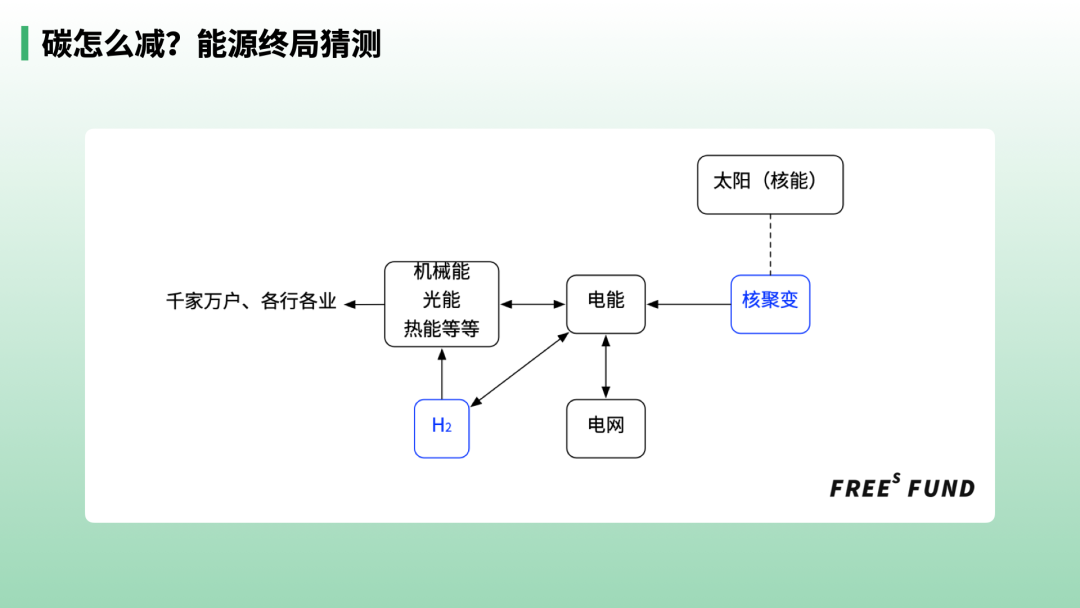
The ideal form of process energy is electricity — this is beyond doubt. Electricity serves as the intermediary for all energy utilization.
What should embodied energy be? Under the new dual-carbon environment, what should embodied energy become? This remains disputed, or at least not fully mature. In the past, embodied energy meant gasoline and diesel; now these need replacing.
What's the current solution? Lithium batteries — converting electricity into chemical energy that can be transported and stored. But lithium batteries face challenges: relatively low energy density, performance degradation in cold temperatures, and dependence on mining finite natural resources like lithium, cobalt, and nickel.
Beyond lithium batteries, we need to find another alternative for embodied energy. Hydrogen has become the most discussed and relatively ideal candidate for embodied energy.
Hydrogen is the lightest atom. It has low decay rates and high energy density, making it theoretically well-suited for embodied energy.
But current technology isn't mature enough for complete replacement of existing energy sources. The industry generally believes hydrogen will start landing in scenarios with high energy requirements, replacing existing diesel and kerosene.
I'll offer a bold long-term vision. In an ideal future society, all primary energy comes from nuclear fusion, process energy comes from electricity, and embodied energy comes from hydrogen — this is the ideal state for solving these problems. The pathway: nuclear fusion generates electricity, which interconverts with hydrogen, though this hydrogen would necessarily undergo multiple conversion steps to extract. With abundant electricity, we achieve efficient energy utilization and reduced emissions.
**/ 06 / **
Why Does Production Generate Carbon Emissions? How to Reduce Them?
Production process emissions roughly equal the carbon content of raw materials minus the carbon content of final products — the carbon lost in between gets emitted.
Knowing this principle, how do we reduce carbon?
On the input side, can we use low-carbon raw materials? Can we substitute some inputs — for example, using hydrogen to replace carbon monoxide as a reducing agent in steelmaking, eliminating CO2 production?
On the product side, can we avoid high-carbon products? Or substitute products with lower production emissions?
In investment, areas like bio-based materials and related processes can reduce CO2 emissions. This is a key focus area for FreeS Fund.
Take cement production, a massive carbon emitter. In 2021, China produced 2.36 billion tons of cement, ranking first globally. Yet for decarbonization, cement production faces limited options for raw material substitution and constrained process upgrades. So can we simply use less cement at the endpoint?
By 2060, urbanization will largely conclude, construction demand will decline, and cement output will decrease accordingly. Alternative solutions will gradually emerge — prefabricated construction that enables material reuse, reduced production waste, or new materials replacing conventional concrete. These represent innovation areas drawing significant attention.
Agriculture is often overlooked in emissions discussions, but farming and livestock generate substantial emissions. Beyond CO2, there's methane and nitrous oxide — totaling 10-12% of global emissions in CO2 equivalent terms.
Agricultural land use, fertilizer degradation from flower and egg production, and rice cultivation itself all produce considerable emissions. Livestock farming also generates emissions throughout the process. From inputs to final products, opportunities exist to reduce emissions:
- On input substitution, some feeds can be upgraded and fertilizer structures modified to reduce chemical fertilizer use.
- On process, improving rice cultivation environments, reducing greenhouse gases from straw, and enhancing secondary utilization of straw.
- Reducing rice flooding to cut methane from microbial fermentation in submerged fields.
- On end products, as widely known, using animals to convert protein is inefficient. How to directly improve protein creation efficiency? Cultivated meat, biosynthesis of keratin proteins — these areas merit attention.
In chemicals, emissions account for 4% — not high in aggregate, but carbon emissions per unit of output exceed industrial averages. New inputs like bio-based materials, and processes using synthetic biology for chemical production, can deliver emission reductions.
Compared to chemicals, cement faces greater decarbonization pressure. Per China Cement Association data, cement industry CO2 emissions represent roughly 7% of global emissions and about 13% of China's. In 2020, China produced 2.38 billion tons of cement, over 50% of global output.
For industries like cement and steel where bio-based raw material substitution isn't viable, how to reduce carbon?
Carbon capture, utilization, and storage (CCUS) is one approach. Carbon can be captured, concentrated from low to high density, and combusted. Main technologies include pre-combustion capture, post-combustion capture, and oxy-fuel combustion capture.
For carbon utilization, food-grade CO2 (carbonated beverages) offers delayed release. CO2 can also serve as a feedstock for chemical reactions with other substances to produce new products, such as CO2 hydrogenation to methanol.
Carbon sequestration involves storing CO2 in geological formations for long-term atmospheric isolation. Methods include onshore storage, saline aquifer storage, and depleted oil/gas field storage. These technologies require heavy capital investment.
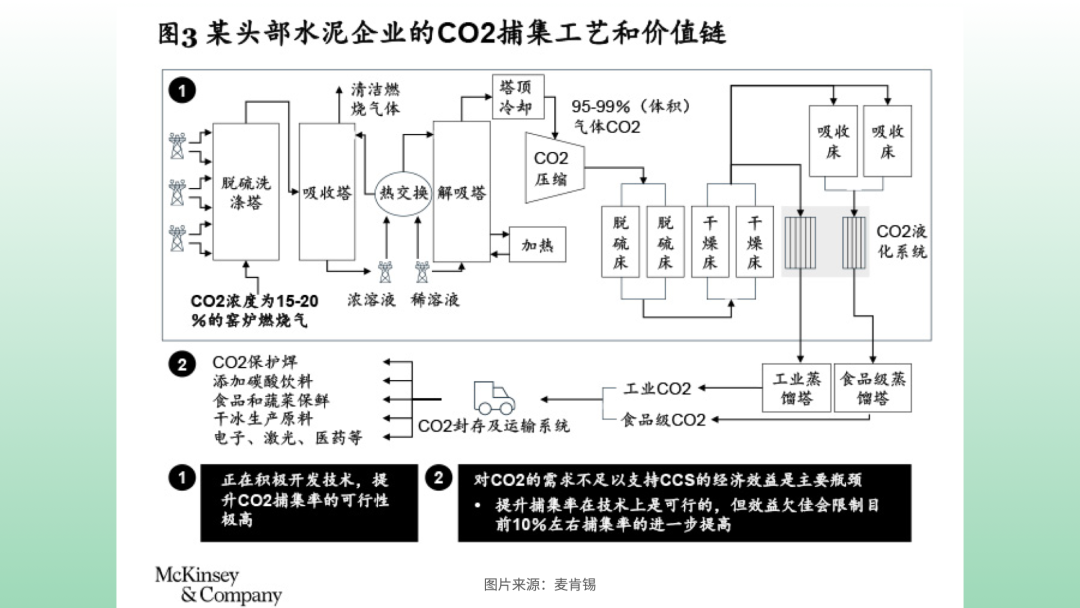
The image shows a typical cement enterprise CO2 capture case. After production generates CO2, it undergoes desulfurization and cleaning. Purity increases, density increases, and it's ultimately used for food industry processing and similar applications. This is a viable pathway, but cost considerations remain in actual implementation.
**/ 07 / **
Economic Considerations in Carbon Reduction
The main challenge for carbon reduction implementation is currently cost. As discussed on the supply side, whether through technological innovation to replace existing energy sources or production processes, the essence is balancing market economic development with carbon reduction targets.
There's an interesting metric: the green premium, originally coined by Bill Gates — the cost increase percentage of using zero-carbon technology versus existing high-carbon production technology. The key to carbon neutrality lies in reducing this green premium. The critical measure for lowering zero-carbon costs is technological advancement, such as replacing traditional thermal power with photovoltaic and wind generation.
The challenge is that across electricity, transportation, and manufacturing, zero-carbon technology costs are high. Zero-carbon tech cannot achieve widespread adoption quickly; many technologies require volume to iterate.
For industries to adopt zero-carbon technology, market regulation is essential, as are policy subsidies and social governance support. At the market regulation level, economic mechanisms can be introduced, such as carbon markets and carbon pricing.
That is, industries have two choices: continue with high-carbon production and pay taxes on those emissions, or face emissions caps and purchase additional allowances on the market if exceeded. This increases the cost of high-carbon production.
If zero-carbon technology costs drop to match high-carbon technology, industries will naturally choose zero-carbon.
For dual-carbon goals to materialize, technological value must deliver lower green premiums alongside better commercial viability and policy alignment. FreeS Fund will continue investing in technologies that reduce green premiums — this is the right major direction.
**/ 08 / **
Investment Opportunities in Carbon Neutrality
When it comes to concrete investment practice, carbon neutrality implies a market of hundreds of trillions and opportunities across multiple directions.
Research by the Global Energy Interconnection Development and Cooperation Organisation (GEIDCO) shows that China's cumulative investment in its energy system will reach 122 trillion RMB by 2060, driving overall investment to exceed 410 trillion RMB and contributing over 2% to China's GDP. According to incomplete statistics from FOF Weekly, the total amount of carbon-neutrality-related funds in the primary market already reached 200 billion RMB in 2021.
Two layers are worth watching: foundational technologies and digitalization.
Foundational technologies target industries in their early to growth stages. At this phase, downstream and midstream segments haven't yet achieved scale, leaving substantial room for technological iteration. In batteries, for instance, new materials like silicon-carbon anodes, sodium-ion batteries, and liquid sulfur batteries. These technologies are mostly cross-disciplinary, combining hardware and software. Opportunities in foundational technologies exist across photovoltaics, hydrogen, nuclear fusion, carbon utilization, synthetic biology, energy storage, new building materials, and more.
Digitalization targets newer, mature industries that have entered a stock phase — the key here is energy conservation and emissions reduction. Energy manufacturers can use SaaS platforms, sensors, operations research, and intelligent decision-making to optimize scheduling. Smart grids can optimize electricity utilization. Companies can manage carbon collection — you need to know how much you've emitted before you can manage it, trade it, and even participate in green finance systems.
Reader Giveaway
From your perspective, what innovative opportunities exist in the environmental protection and dual-carbon space? Share your thoughts in the comments. The 6 most thoughtful commenters will receive a FreeS Fund custom edition of Trends 2030: Eight Trends Reshaping the Future of the World. We look forward to finding certainty amid change and staying sharp together.

Livestream Preview
Starting in September, we'll launch the "FreeS Fund Dialogues: Environmental Protection & Dual-Carbon Series" livestreams. We'll speak with innovative companies about how industries like consumer goods, new energy, and biomedicine can ride the wave of environmental protection and dual-carbon goals to capture new growth opportunities. As an investment firm, FreeS Fund will also share what we've learned from founders.
The first livestream, Synthetic Biology: From Groping in the Dark to Riding the Wave, will go live on Sunday, September 4. Bluepha co-founder and CEO Haoqian Zhang, co-founder and president Teng Li, and FreeS Fund partner Rui Ma will discuss green innovation opportunities in synthetic biology.
Scan the QR code to register and submit your questions about the environmental protection and dual-carbon space — we'll screen and pose selected questions to our guests. We'll also send livestream links via email beforehand and invite you to join our industry community.


Scan the QR code to register 👆

Baidu Finance · FreeS Fund Video Channel · 36Kr · Sina Tech · Sina Finance

BioSpark · BioBoat · CEO Chinese Entrepreneurs Organization · CMU Summit · CMU China-U.S. Innovation and Entrepreneurship Summit · CVEC Cornell Venture Capital Club · Harvard Venture Club · MITCEO MIT Chinese Entrepreneurs Organization · OxfordCSSA Oxford Chinese Students and Scholars Association · UCLS-VC China-U.S. Biotech Youth Venture Capital · UChicago China Forum
Listed alphabetically; no ranking implied

▲ How We Think About Green Investing | FreeS Research Institute
▲ How to Think About Biotech Opportunities in the Next Decade | FreeS Fund Dialogue ▲ Synthetic Biology: The Coming "Tiangong Kaiwu" for the Next Twenty Years | 2021 FreeS Fund Annual Investor Summit ▲ Shize Bio Founder Xiang Li: The Latest Intersection in Biotechnology — The Spring of Stem Cell Therapy | 2021 FreeS Fund Annual Investor Summit ▲ FreeS Report 18: Reflections Amid a Stock Market Frenzy — Where Are the Opportunities in Fintech? | FreeS Research Institute