Venture Capital Lens on the Two Sessions: Six Core Topics and Policy Roundup | FreeS Research --- Every March, China's "Two Sessions" — the annual meetings of the National People's Congress (NPC) and the Chinese People's Political Consultative Conference (CPPCC) — draw widespread attention. For investors and entrepreneurs, the government work report and policy signals released during this period serve as a critical compass for the year ahead. In this article, the FreeS Research team examines the 2024 Two Sessions through a venture capital lens, identifying six core topics most relevant to the tech and startup ecosystem: **AI and digital economy, hard tech and advanced manufacturing, new energy and carbon neutrality, biotech and healthcare, consumption and domestic circulation,** and **capital markets and fundraising environment.** We also map out the specific policy measures and investment implications for each. --- ## 1. AI and the Digital Economy: From "Development" to "Application" AI was elevated to a new level of urgency at this year's Two Sessions. The government work report explicitly called for **"deepening R&D and application of AI"** and **"launching the 'AI+' initiative"** — a notable shift from previous years' emphasis on "development" and
Hoping this can offer a fresh perspective and some food for thought.

In mid-March, the 2025 Two Sessions concluded.
2025 marks both the final year of the 14th Five-Year Plan and a critical moment for laying the groundwork and setting the stage for the 15th Five-Year Plan.
We noticed that "vigorous implementation" emerged as a clear signal from this year's Two Sessions. The Government Work Report stated that "policy rollout and implementation should be as early as possible — better early than late — racing against various uncertainties. Once the direction is clear, deliver full support in one go to enhance policy effectiveness."
This reminded us of how, in early-stage investing, when we identify a promising, deep and wide赛道 (beta) and an outstanding founding team (alpha), we also provide full support in one go to ensure the project's long-term development.
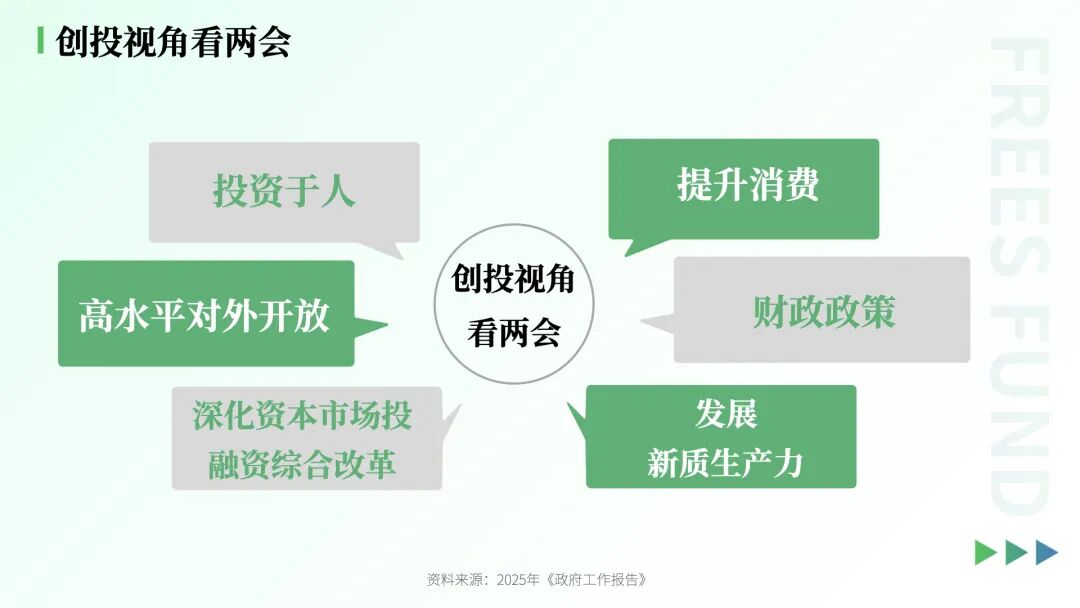
As an early-stage investment institution, we saw several policies closely relevant to the venture capital industry, along with potential opportunities. In this research note, we share our takeaways and reflections across six dimensions: boosting consumption, fiscal policy, developing new quality productive forces, comprehensive capital market reform, high-standard opening up, and investing in people.
We hope this offers a fresh perspective. You're also welcome to check out our Two Sessions discussion on the Xiaoyuzhou app or Apple Podcasts by searching for and subscribing to "High Energy" (Gao Nengliang).


Engagement Giveaway Feel free to share in the comments what new opportunities you spotted from the Two Sessions. By 5:00 PM on March 27, we'll randomly select three readers to receive the latest edition of our research handbook, written by the FreeS Fund team.

/ 01 / Boosting Consumption
Let's start with an economic indicator closely tied to household consumption — CPI (Consumer Price Index).
This year, the Government Work Report lowered the CPI target from "around 3%" in 2024 to "around 2%." According to Securities Times, this marks the first time China's CPI target has fallen below 3% since 2004.
Yan Jie, a scholar at Renmin University of China, believes the 2% CPI target reflects a pragmatic assessment of recent price trends and represents a proactive response to current deflationary pressures.
We also see that consumption tops this year's government work priorities, with commitments to vigorously boost consumption, improve investment efficiency, and expand domestic demand comprehensively.
I. Consumer Side: Restoring Consumer Confidence
In 2025, China will issue 1.3 trillion yuan in ultra-long special treasury bonds, with 500 billion yuan allocated to support the "Two New" initiatives. Specifically: 300 billion yuan for consumer goods trade-in programs, an increase of 150 billion yuan from last year; and 200 billion yuan for equipment upgrades, an increase of 50 billion yuan.
2024 was the first year of the "Two New" policy implementation. According to NDRC data, the policy drove a 15.7% year-on-year increase in equipment and器具 purchases investment, contributing 67.6% of total investment growth.
Take automobiles as an example. Based on data from the China Association of Automobile Manufacturers, driven by the trade-in policy, over 2.92 million vehicles were scrapped and replaced, and over 3.7 million were traded in for upgrades in 2024 — totaling more than 6.62 million vehicles and generating over 920 billion yuan in auto sales. Among trade-ins, over 60% involved switching to new energy vehicles.
This year, the "Two New" product categories have expanded from 8+N to 12+N, adding smartphones, tablets, smartwatches, and smart bands. This move could accelerate technology-enabled consumer goods supply chains, making products more intelligent, tech-driven, and digital — thereby increasing product value-added and further stimulating both supply and demand.
Additionally, the Government Work Report introduced for the first time the concept of "good housing" — not just ensuring people have places to live, but enabling them to live better. Meanwhile, the goal to "stabilize the property and stock markets" was also included in the Government Work Report for the first time.
Chen Changsheng, Deputy Director of the State Council Research Office and a member of the Government Work Report drafting team, noted that the property and stock markets are important barometers of overall economic performance. Real estate in particular represents the largest component of household assets. Stabilizing asset prices in these markets can unlock wealth effects.
Following the Two Sessions, the government released the Special Action Plan to Boost Consumption, proposing to strengthen consumer brands, expand cultural, sports, and tourism consumption, and promote ice and snow consumption. These measures may encourage more diversified consumption patterns and facilitate industrial upgrading and consumption structure adjustment.
II. Government Side: Creating a Favorable Consumption Environment
The Government Work Report proposes accelerating the shift of certain consumption tax collection points from production to retail and transferring these revenues to local governments, increasing their fiscal autonomy.
Feng Shu (Li Feng) previously mentioned on a podcast that moving consumption tax from production to consumption is a transition that occurs when a country evolves from a manufacturing-focused economy to one that balances consumption and manufacturing. Taxing at the point of consumption means cities must shift their focus to figuring out how to get people to "spend money here" — similar to what we've seen with cities like Zibo and Harbin in recent years. Local governments may thus invest heavily in urban development and public services.
 ▲ Scan the QR code to listen to Feng Shu and Li Xiang discuss the impact of consumption tax adjustments.
III. Business Side: Comprehensive Rectification of "Involution-style" Competition
Comprehensive rectification of "involution-style" competition was written into the Government Work Report for the first time. From rampant price wars to substandard products exposed by the recent 315 Gala, this race-to-the-bottom competition harms both businesses and consumers. We understand this rectification effort aims to ensure consumers can buy quality products and services, while enabling enterprises and localities to achieve sustainable development.
/ 02 / Fiscal Policy
The Government Work Report proposes implementing more proactive fiscal policy. This marks the first time since the 2008 financial crisis that the fiscal policy stance has shifted from "proactive" to "more proactive," suggesting the government will release more liquidity to boost market confidence.
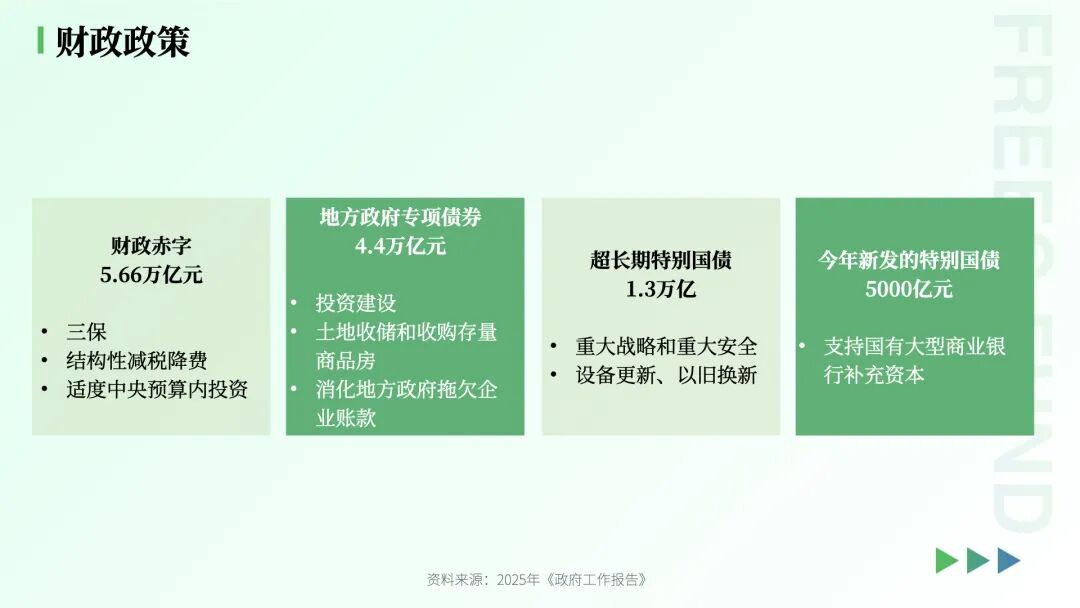
This year's total new government debt reaches 11.86 trillion yuan, divided into four major components: fiscal deficit (5.66 trillion yuan), local government special bonds (4.4 trillion yuan), ultra-long special treasury bonds (1.3 trillion yuan), and a newly issued special treasury bond of 500 billion yuan.
I. Fiscal Deficit
The report states that the deficit-to-GDP ratio is set at around 4% for this year, one percentage point higher than last year, with a deficit scale of 5.66 trillion yuan, an increase of 1.6 trillion yuan.
The 4% deficit ratio is a historic high. According to Yicai statistics, before the COVID-19 outbreak in 2020, China's officially reported deficit ratio had never exceeded 3%. Yang Zhiyong, President of the Chinese Academy of Fiscal Sciences, believes that raising the deficit ratio allows the government to raise more fiscal funds for livelihood protection and promote healthy economic and social development.
Of the 5.66 trillion yuan fiscal deficit, 85.9% is central government deficit, mainly used for: increasing grassroots "three guarantees" (guaranteeing wages, operations, and livelihoods), including pensions, medical insurance subsidies, and childcare subsidies; supporting technology innovation industries; and moderately expanding central budgetary investment.
II. Local Government Special Bonds
According to the budget report, this year's new local government special bond quota is set at 4.4 trillion yuan, an increase of 500 billion yuan from 2024, supporting local governments to intensify efforts to fill gaps in key areas, with further tilt toward implementing major regional strategies, developing new quality productive forces, and promoting high-quality development.
In December 2024, the General Office of the State Council issued a document expanding the scope for special bonds to be used as project capital, adding several key areas including information technology, new materials, bio-manufacturing, low-altitude economy, quantum technology, and commercial aerospace — specifically infrastructure and computing equipment for these emerging industries. These happen to be areas where many innovative companies are actively exploring, and we see investment opportunities there.
III. Ultra-Long Special Treasury Bonds
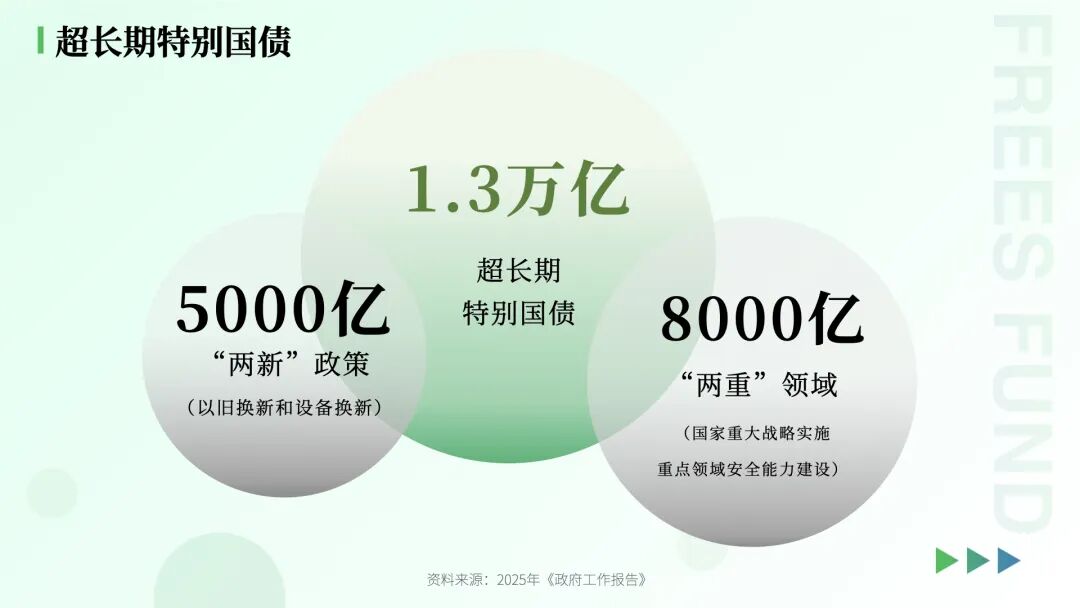
As mentioned above, this year's ultra-long special treasury bonds total 1.3 trillion yuan. In addition to supporting the "Two New" initiatives, the government will allocate 800 billion yuan to support major national strategies and security capacity building in key areas (the "Two Heavy" policy).
The "Two Heavy" policy covers: 1. Major national strategies: encompassing a series of national-level strategic deployments, such as coordinated development of the Beijing-Tianjin-Hebei region, Guangdong-Hong Kong-Macao Greater Bay Area construction, and the Belt and Road Initiative. 2. Security capacity building in key areas: involving security and development across multiple critical domains, including political security, military security, territorial security, economic security, cultural security, and social security.
We noticed that during the Two Sessions, the Shanxi delegation submitted a proposal to the assembly: to include cultural heritage and museum security capacity building within the scope of the national "Two Heavy" policy support. We hope such policies can provide more support for China's cultural heritage protection and the broader cultural sector.
IV. New Special Treasury Bonds
In 2025, the government plans to issue 500 billion yuan in special treasury bonds to support capital replenishment for large state-owned commercial banks. Lian Ping, Chief Economist at Guangkai Chief Industry Research Institute, estimates that this 500 billion yuan injection is expected to drive over 4 trillion yuan in additional credit capacity.
Once these funds flow into banks, they will further unlock market credit space and push more credit resources toward the private economy. These funds may also further supplement liquidity in the stock and bond markets.
/ 03 / Developing New Quality Productive Forces
Developing new quality productive forces was a major topic at the Two Sessions. The concept was first introduced in September 2023 and was further strengthened in the Government Work Report as developing new quality productive forces according to local conditions and accelerating the construction of a modernized industrial system.
Which fields fall under the scope of new quality productive forces? The report proposes launching large-scale demonstration applications of new technologies, products, and scenarios, and promoting the safe and healthy development of emerging industries such as commercial aerospace, low-altitude economy, and deep-sea technology. It also calls for establishing growth mechanisms for future industry investment and cultivating future industries such as bio-manufacturing, quantum technology, embodied AI, and 6G.
How to develop new quality productive forces? The report mentions advancing high-level self-reliance in science and technology... leveraging the leading role of technology enterprises, strengthening enterprise-led integration of industry, academia, and research, and institutionally guaranteeing enterprise participation in national science and technology innovation decision-making and major science and technology projects.
This means enterprises with technological strength, core technologies, or technological moats will receive more attention, and the principal role of enterprises in technological innovation will be strengthened. According to data from the China National Intellectual Property Administration, in 2024, enterprises held 3.506 million valid invention patents, accounting for 73.7% of the domestic total.
/ 04 / Accelerating Venture Capital Development and Growing Patient Capital
The Government Work Report emphasized the importance of deepening comprehensive reform of the capital market's investment and financing functions, and vigorously promoting the entry of medium- and long-term funds into the market. The report also proposed improving differentiated regulatory systems for venture capital funds, strengthening policy-based financial support, accelerating the development of venture capital, and growing patient capital. (Welcome to read "Tian Xuan x Li Feng: How Is Patient Capital Cultivated? | Li Feng Column")
 ▲ Scan the QR code to listen to Feng Shu and Tian Xuan's detailed interpretation of patient capital.
We've also compiled some policies closely related to the venture capital industry released since 2024:
I. Promoting Medium- and Long-Term Funds into the Market
Since 2024, the government has issued the Guiding Opinions on Promoting Medium- and Long-Term Funds into the Market, the Implementation Plan for Promoting Medium- and Long-Term Funds into the Market, and a series of related measures.
These measures include but are not limited to: public funds' holdings of A-share tradable market value must grow by at least 10% annually over the next three years; accelerating the second batch of insurance capital long-term equity investment pilots, with a scale of no less than 100 billion yuan; large state-owned insurance companies should play a "leading goose" role, striving to allocate 30% of annual new premiums to stock market investment; and extending the evaluation cycles for public funds and the National Social Security Fund.
The Guiding Opinions on Promoting Medium- and Long-Term Funds into the Market emphasizes that the main goals are to significantly increase the scale and proportion of medium- and long-term fund investment, create a more rational investor structure in the capital market, and comprehensively strengthen the long-term nature of investment behavior and the market's inherent stability.
II. Relaxing Restrictions on Foreign Capital Inflows
In recent years, the government has introduced numerous preferential policies to attract foreign investment, sending positive signals for cooperation. For example, the 2025 Action Plan for Stabilizing Foreign Investment supports foreign capital's deep engagement in the Chinese market through encouraging foreign-invested equity investments in China, removing restrictions on foreign-invested holding companies' use of domestic loans, facilitating foreign investors' merger and acquisition activities in China, and broadening financing channels for foreign-invested enterprises.
III. Supporting Quality Unprofitable Technology Companies to Go Public
In August 2023, the CSRC proposed "temporarily tightening the IPO pace to promote dynamic balance between investment and financing." According to statistics from financial media outlet Elephant IPO, in the year following the new policy, monthly listings across the Shanghai, Shenzhen, and Beijing exchanges decreased by 20 compared to pre-policy levels.
During this year's Two Sessions, CSRC meetings expressed support for quality unprofitable technology companies to go public, the prudent resumption of applicability of the fifth set of STAR Market listing standards, and better promotion of integrated development between technological innovation and industrial innovation.
Feng Shu believes that high value-added enterprises often require substantial R&D investment and high talent density in their early development stages, and may even experience losses for a period. For these enterprises, the capital market's funding structure is more suitable.
 ▲ Scan the QR code to listen to Feng Shu and Li Xiang discuss recent hot topics in the macro domain.
IV. Supporting Reasonable Cross-Industry M&A
In September 2024, the Opinions on Deepening Reform of the Listed Company M&A and Restructuring Market (known as the "M&A Six Articles") proposed supporting reasonable cross-industry mergers and acquisitions and relaxing requirements for acquiring unprofitable assets. Additionally, the government encourages private equity funds to participate in M&A and restructuring, offering multiple preferential policies: for example, where private equity funds have held investments for five years, the lock-up period in third-party transactions is shortened from 12 months to 6 months.
These policies provide more exit channels for the venture capital market. According to PwC's China M&A Market Review and Outlook 2024, China's M&A market transaction volume grew 24% in 2024 compared to 2023.
V. Establishing a National Venture Capital Guidance Fund
In March 2025, the government announced the establishment of an "aircraft carrier-level" national venture capital guidance fund. This national fund has a lifespan of up to 20 years, far exceeding the typical 5-10 year lifespan of most funds. The fund will focus on frontier areas such as artificial intelligence, quantum technology, and hydrogen energy storage, investing in seed-stage and startup enterprises through market-based mechanisms, with appropriate consideration for early- and mid-stage small and medium enterprises. We look forward to this "aircraft carrier-level" fund bringing more "fresh water" to the venture capital market and helping innovative enterprises achieve both commercial and social value.
05 High-Standard Opening Up
Measures to boost consumption, proactive fiscal policy, and developing new quality productive forces represent efforts to enhance internal development conditions. Building a friendly, interactive, and mutually beneficial external environment is equally indispensable for economic development.
We noticed that from the previous "promoting stable foreign trade growth" to this year's "more actively stabilizing foreign trade and foreign investment," the government has proposed higher-standard opening-up policies, such as:
- Developing new types of offshore trade: cultivating new growth points in green trade and digital trade, supporting eligible localities in developing new types of offshore trade, and actively developing border trade.
- Stabilizing foreign trade policies: optimizing financial services for financing, settlement, and foreign exchange, expanding export credit insurance coverage, and strengthening support for enterprises participating in overseas exhibitions.
- Easing market access: revising the Catalogue of Industries Encouraging Foreign Investment to attract foreign participation in high-end industrial chains, such as the Suzhou pilot for full-chain opening in biomedicine.
- Orderly opening across multiple sectors: removing all foreign investment access restrictions in manufacturing; advancing comprehensive pilot demonstrations for expanding service sector opening, promoting orderly opening in internet and cultural sectors, and expanding opening pilots in telecommunications, healthcare, and education.
Regarding promoting orderly opening in the cultural sector, we mentioned in a previous article that while product exports and brand exports are already in full swing, China's cultural exports are beginning to show promise. Black Myth: Wukong in 2024 and Ne Zha 2 in 2025 are both typical examples. (Welcome to read "The Right Timing, Place, and People Behind Ne Zha 2's Explosive Success | FreeS Research")
06 Investing in People
We can sense this year's Two Sessions' attention to people's livelihood. For example, the Two Sessions proposed a highly forward-looking concept — "investing in people."
"Investing in people" can perhaps be understood on two levels: first, improving people's quality of life; second, providing people with more development opportunities.
The Government Work Report proposed deepening elderly care service reform and formulating policies to promote the silver economy; implementing and optimizing vacation systems to unlock consumption potential in culture, tourism, sports, and other areas. These policies reflect attention to improving people's quality of life.
Development opportunities mainly refer to support in education, training, and employment, enhancing people's capacity for innovation, creation, and wealth generation. For example, during the Two Sessions, multiple "Double First-Class" universities announced enrollment expansion, with majors concentrated in frontier technologies, basic disciplines, and interdisciplinary fields. FreeS has always believed that interdisciplinary fields typically represent the best directions and opportunities for technological innovation — breakthrough innovations usually occur at the intersection of sciences.
07 Summary
The Two Sessions embodied both an unchanged spirit of pragmatic progress, stability with progress, and promoting stability through progress, as well as continuous efforts to explore change and pursue better, more efficient, and higher-quality development paths.
We observed that the government is working to balance development issues across multiple dimensions. Whether boosting consumption, fiscal policy, developing new quality productive forces, achieving high-standard opening up, capital market investment and financing reform, or investing in people — all these measures aim to seek public welfare and pursue high-quality development.
To use an imperfect analogy: if we view the nation as a large investment firm, we can see its PE (private equity) thinking — on one hand, actively supporting chain-leading enterprises like Huawei and CATL; on the other hand, attracting overseas companies like Tesla to leverage "catfish effect" in boosting new industries. Additionally, the national emphasis on investing early, investing small, investing long-term, and investing in hard tech, while enhancing high value-added and sustainable core competitiveness, aligns with the philosophy we as early-stage VC (venture capital) institutions have been consistently practicing.
Engagement Giveaway
Feel free to share in the comments what new opportunities you spotted from the Two Sessions. By 5:00 PM on March 27, we'll randomly select three readers to receive the latest edition of our research handbook, written by the FreeS Fund team.

▲ Ten Thousand-Word Feature: The "DeepSeek Moment" for China's Biopharma | FreeS Report
▲ DeepSeek Fired the First Shot, But What's More Worth Looking Forward to Is AI for All | Conversation with Xingyun Integrated Circuit's Ji Yu
▲ One Article Explaining 7 Core Questions About DeepSeek | FreeS Report
▲ The Right Timing, Place, and People Behind Ne Zha 2's Explosive Success | FreeS Research
Star the FreeS Fund WeChat Official Account for timely business insights