How Should We Think About the Present and Future of Drug R&D? | FreeS Fund Dialogue Vol. 2 — Final 2 Days to Register
What new variables and opportunities are emerging in the drug development industry?

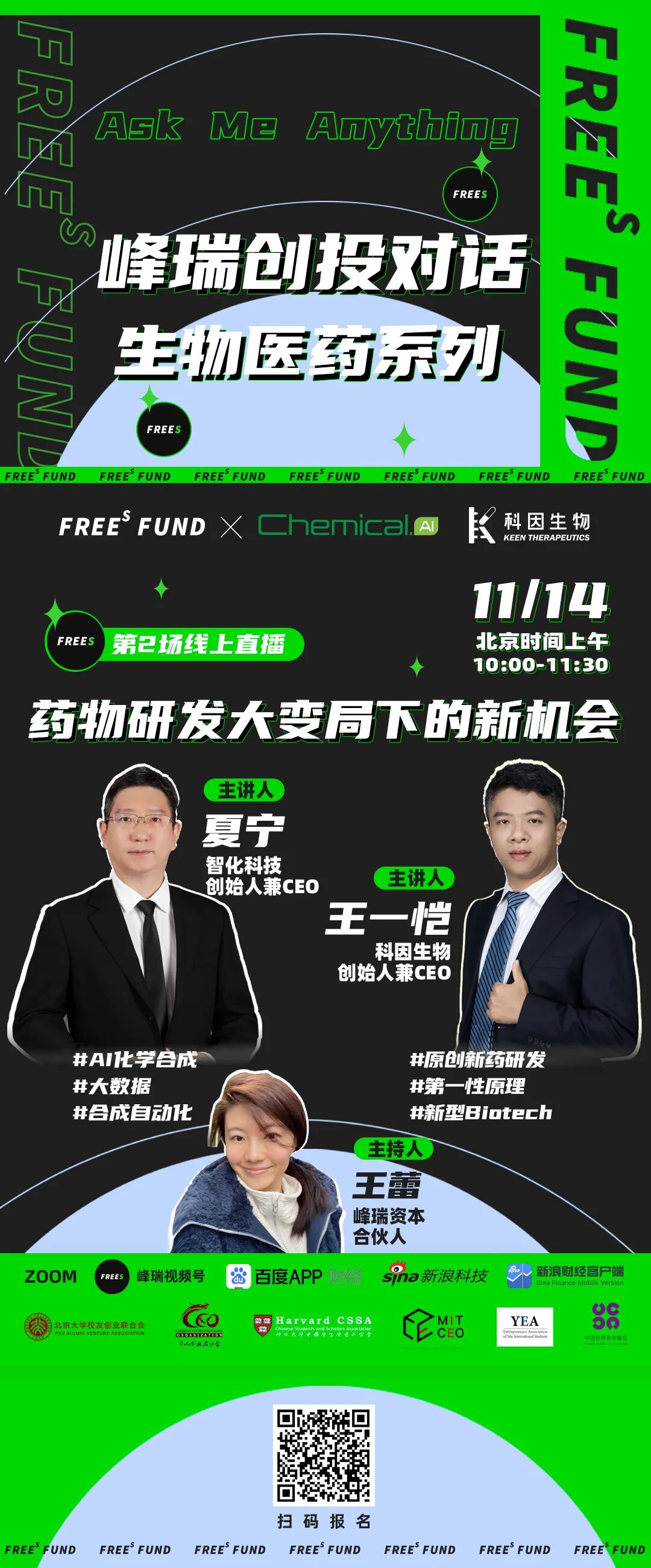
This Sunday, November 14, marks the second installment of the "FreeS Fund Dialogues" biopharma livestream series — New Opportunities in Drug R&D's Great Transformation. We're bringing together Ning Xia, founder and CEO of Chemical.AI, and Yikai Wang, founder and CEO of Coingnite Bio, for an in-depth conversation with Lei Wang, partner at FreeS Fund.
▍What they'll cover:
- What new variables have emerged in drug R&D in recent years? How did the two founders spot their opportunities?
- Why start a company? What's the core competitive moat?
- How can emerging biotech startups coexist and win alongside big pharma?
- What's the outlook for novel tool platforms and new biotech companies? How long is the road from finding an entry point to becoming an industry player?
- How can medicinal chemists, organic chemists, AI specialists, and other talent types leverage their strengths in new drug development?
▍How to register:
If you're interested in joining the Zoom webinar or signing up for our future offline event "FreeS Open Day," scan the QR code on the poster or click the "Read More" link at the end of this article to register.
We sent Zoom links via email to our first wave of registrants on November 10 — please check your inbox. Welcome to join our event group through the QR code in that email; we'll send reminders and share relevant materials there.
Special thanks to the following organizations for their support:
Baidu Finance, Sina Tech, Sina Finance
Peking University Alumni Entrepreneur Federation, CEO (Chinese Entrepreneurs Organization), Harvard Venture Capital Club, Harvard CSSA, MITCEO, Yale Entrepreneur Association (YEA), China World Youth Summit
Before the livestream, we'd like to share some thoughts from Yikai Wang of Coingnite Bio and Ning Xia of Chemical.AI on drug R&D — we hope these spark your interest, and we look forward to more interaction with you during the November 14 broadcast.

**/ 01 / **
FreeS Report 23: Crossing the "Valley of Death": Systemic New Opportunities in Small-Molecule Drug R&D
By: Yikai Wang
▍Why China, why now?
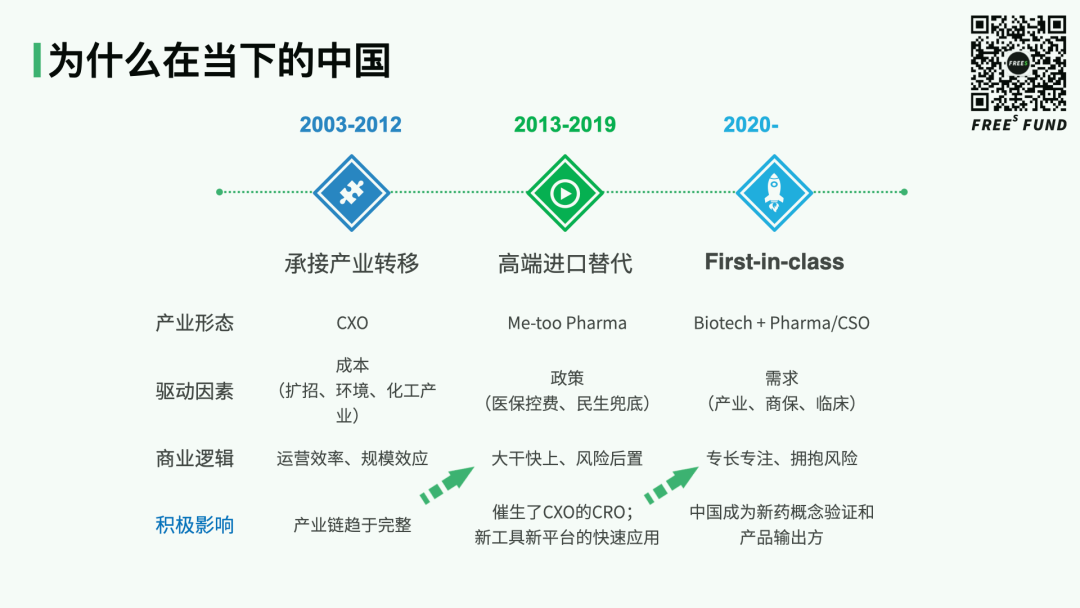
China's biopharma industry over the past two decades can be roughly divided into three phases. The first, from 2003 to 2012, was primarily about accepting industrial transfer. The second, from 2013 to 2019, focused on high-end import substitution. Starting in 2020, we've entered the most challenging phase: original innovation in new drug development.
Early in the 2020 pandemic, we analyzed trends in domestic innovative drug development, predicting a shift from copycat innovation to original and systemic innovation. In retrospect, this transition arrived even faster than anticipated.
This was made possible, first, by Phase One's foundation of university enrollment expansion ensuring talent supply, with CRO/CMO as the dominant industry form. The industrial chain became increasingly complete, R&D personnel gained experience, and efficiency improved.
Next, Phase Two — driven by policies addressing new drug supply and medical insurance cost control, with biopharma as the industry form — saw a surge of innovative drug projects launched simultaneously. R&D and manufacturing outsourcing demand spiked dramatically, not only spawning more efficient CROs serving CROs/CDMOs, but also driving widespread adoption across the industry of all the new technologies, cross-disciplinary tools, and algorithms mentioned earlier.
With investment fervor, massive demand release, and industrial upgrading pressure all coexisting, these new efficiency tools received such abundant capital investment and rapid iterative development — something that never occurred even in the relatively mature US and European markets.
Starting in 2020, China's innovative drug market ended its rapid growth phase from zero to one and entered a stock market. Business models relying on scale-and-speed and marketing prowess have begun to "involute"; product quality and whether drugs truly address unmet clinical needs are becoming core competitive differentiators.
On the foundation of an increasingly complete industrial chain and continuous commercialization of new tools and technologies, the systemic new opportunity for small-molecule drug R&D lies in whether companies can achieve better or newer products through low-cost, rapid trial and error.
▍What kind of company can seize this opportunity?
In recent years, with investment and markets running so hot, many CRO companies and novel technology firms have hoped to expand downstream into new drugs — the end product itself. This impulse is understandable, but from a business logic standpoint, it may not be the optimal choice. Product development carries product risks; services follow service logic. Whatever path you choose, you need the ability to continuously iterate on core technology — that is, the capability to efficiently and cost-effectively complete the DMTA (Design-Make-Test-Analyze) cycle. Companies that can accumulate data and refine technology through this cycle, thereby raising barriers, will become the standouts.
Of course, new drug R&D involves long processes, extensive chains, and high risks. The birth of great companies especially requires a more open, collaborative industrial ecosystem where players focus on their specialties. In the coming years, we believe the pharmaceutical industry will see not only "Huawei" and "BYD"-type companies built on product strength, but also new infrastructure players like "CATL" and more efficient service outsourcing enterprises like "Luxshare Precision Industry Co., Ltd."
(For more thoughts on small-molecule drug R&D, click here for the full report: FreeS Report 23: Crossing the "Valley of Death": Systemic New Opportunities in Small-Molecule Drug R&D)

Scan to register 👆
**/ 02 / **
Why Is AI Drug Discovery So Hot, and Why Now? | FreeS Biopharma Investment Summit Transcript
By: Ning Xia

▍What is Chemical.AI trying to break through?
Chemical.AI's English name reflects our vision: to shape the future of chemistry by merging chemistry with artificial intelligence and big data technology, with particular emphasis on dramatically improving chemical synthesis efficiency — thereby accelerating drug discovery speed and success rates.
A core business of Chemical.AI is providing chemical retrosynthesis route design tools for large domestic and international pharmaceutical companies and CROs. We're currently world-leading in this technology.
In the preclinical chemistry R&D stage, beyond designing virtual molecules, you need to actually synthesize the physical molecules. This synthesis route design itself demands extremely high levels of chemist skill and experience. We're attempting to use computational methods — big data plus AI — to design optimal routes and avoid failures. This can, to some extent, accelerate drug discovery and substantially save costs. We're also exploring synthesizability assessment and de novo molecular design.
From the retrosynthesis angle, Chemical.AI's technology was developed relatively early on a global scale — we weren't behind or copying foreign approaches. We produced our earliest version in 2012. When expanding overseas, we were essentially among the first to engage with these top-tier clients. After extensive evaluations, they found our product genuinely superior.
▍Why is AI drug discovery so hot? Why now?
I'll offer perspectives from two angles: macro trends and technology development.
From a macro standpoint, we've reached an era remarkably willing to embrace new technologies to find solutions.
Drug R&D has "three highs": high cost, long timelines, and high failure rates. But R&D investment returns have now dropped to such lows that without addressing this, sustainable drug development becomes difficult. Drug R&D concerns humanity's fundamental need for health and longevity — we must solve this problem.
National policy has also designated biopharma as a priority industry, driving an investment wave that generates more biopharma demand. We hope to leapfrog and narrow the gap with large foreign pharmaceutical companies. In this process, we must experiment with new technologies — using AI, big data, and high-throughput methods to reduce costs and improve efficiency. Market demand for new technologies is unambiguous.
Second, from a technology development perspective, new drug R&D is about first principles. Theoretically, computation can solve many problems. Previously, technical bottlenecks in data, computing power, and algorithm development prevented large-scale investment by many companies. Currently, computing power, data accumulation, and algorithm maturity have, to some degree, met the infrastructure requirements for AI drug discovery. Solutions to previous technical bottlenecks exist, though still at relatively early stages.
The difficulty of AI drug discovery is unquestionably enormous; it will be a long journey. But the direction is sound. Through continuous R&D and accumulating various returns, large pharmaceutical companies and biotech firms alike are embracing this technology.
AI drug discovery is a highly promising new technology with clear market demand — so its popularity is entirely natural.
Overall, AI drug discovery remains at a very early stage. Using a 100-meter dash as analogy, we've perhaps run five meters. Of course, in our specific segment — retrosynthesis route design — we may be in a faster-running domain. Recently, papers in Science and Nature have produced excellent results, even solving problems that chemistry researchers struggled with.
Chemical.AI has accumulated over a decade of R&D experience in AI drug discovery, bringing algorithms to a practically usable stage. In this field, algorithms may reach the level of quite skilled chemists within a few years, and potentially exceed human capability after some time — this is the goal we're actively pursuing.
(For more thoughts on AI drug discovery, click here: Why Is AI Drug Discovery So Hot, and Why Now? | FreeS Biopharma Investment Summit Transcript)
Scan to register 👆
**/ 03 / **
Hammer and Dance: Investment Opportunities in Healthcare's Next Wave Amid the Pandemic | FreeS Research Institute
By: Yikai Wang
▍Healthcare's next investment opportunity: from copycat innovation to original and systemic innovation
While continuing to support domestic substitution, FreeS Fund is also highly optimistic about original innovation in biopharma.
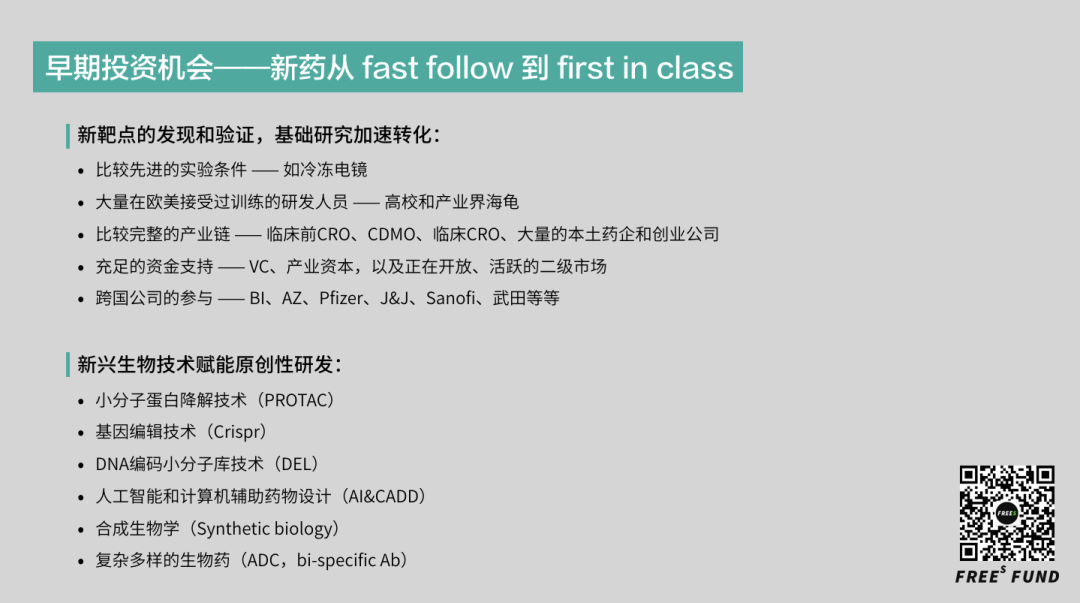
In past years, domestic biopharma companies primarily developed me-too drugs — new drugs with independent intellectual property targeting already-validated foreign targets, with efficacy comparable to first-in-class counterparts.
Developing me-too drugs requires less investment, shorter timelines, and offers higher success rates — a first step in upgrading from generics to innovative drugs. However, as more companies entered and validated targets proved limited, clustering around the same targets became common. Severe product homogenization makes global competition difficult and rapidly erodes investment returns.
In the next phase, capital will increasingly favor first-in-class products with higher risk but higher returns. Beyond investment returns, this judgment rests on two additional considerations.
From an industrial accumulation standpoint, ample R&D funding has given us world-class scientific research infrastructure; multi-year talent recruitment programs have attracted large numbers of researchers with systematic training in Europe and America to return for basic and translational research; and as multinational pharmaceutical companies outsourced substantial R&D and manufacturing work to China, the domestic new drug R&D chain — from preclinical CRO to clinical CRO to CDMO — has become quite complete.
From market competition and corporate strategy perspectives, if Chinese innovation offers lower costs and higher efficiency, its attractiveness to multinational pharmaceutical companies will exceed that of US domestic options. Leading domestic new drug companies, once their existing products generate profits, will also be more willing to invest more in and support original innovation — because this is the foundation and source of their long-term competitiveness.
Synthesizing this analysis, we believe China-developed first-in-class drugs will become the focus of industry and market attention over the next five years.
As biotechnology has accumulated and broken through, numerous so-called platform companies have emerged in Europe and America, attracting investor attention and pursuit. Such companies typically build on general-purpose technologies with the continuous ability to generate innovative products; they often focus on intellectual property generation and preclinical/early clinical research, with clinical-stage development primarily handled by closely collaborating large companies. Moderna, the global leader in COVID-19 mRNA vaccines, is precisely such a platform company based on mRNA synthesis and delivery technology, focused on developing mRNA medicines.
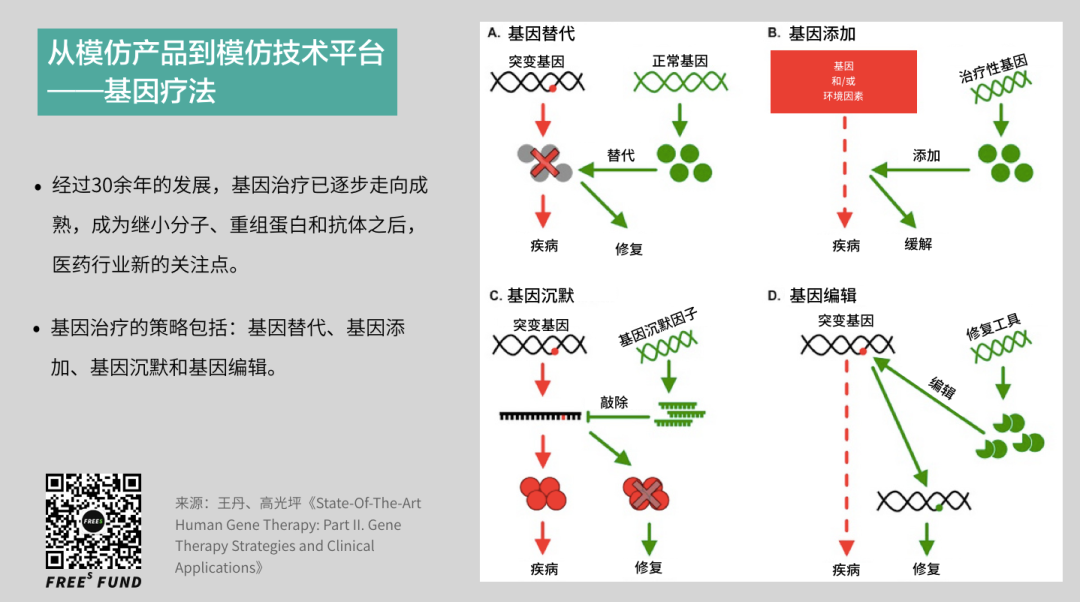
Beyond mRNA, novel biotechnologies including gene therapy, small nucleic acids, viral and non-viral drug delivery vectors, and protein degradation have spawned numerous star companies with notable performances in capital markets and M&A transactions.
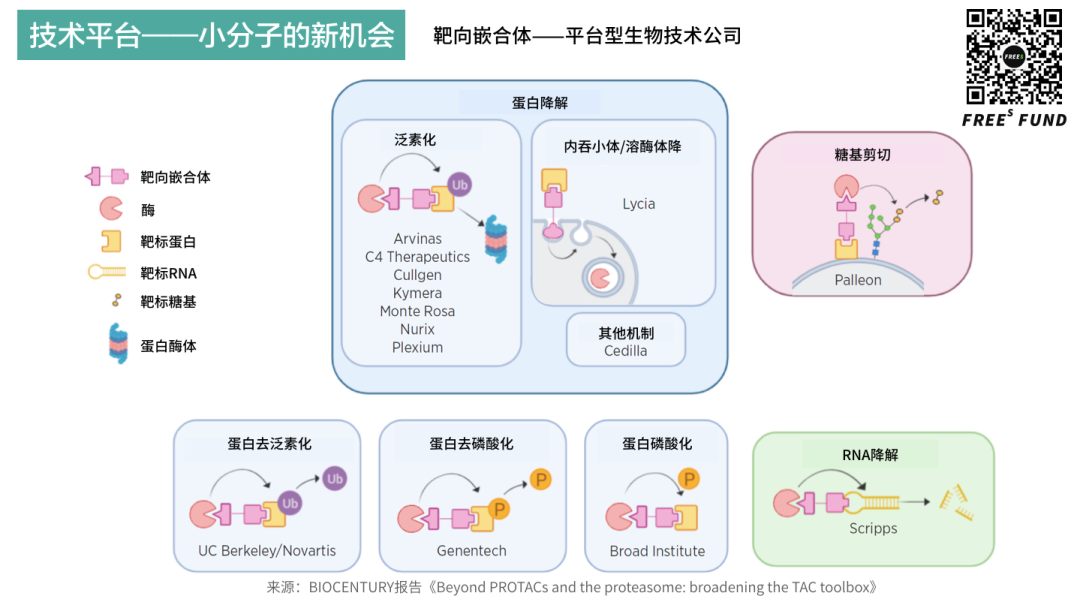
Unlike developing a first-in-class drug for a new target, platform companies often require combining multiple underlying technologies, demanding higher levels of systemic innovation and industrial chain collaborative innovation. Take mRNA vaccines: they require both mRNA optimization and synthesis, and lipid nanoparticle research and preparation — ultimately, a stable, controllable, scalable manufacturing process is indispensable for drug approval.
As more domestic companies begin positioning in this direction, with systemic innovation and domestic substitution proceeding in parallel, China's healthcare industry will turn a new page.
(Click here for the full article: Hammer and Dance: Investment Opportunities in Healthcare's Next Wave Amid the Pandemic | FreeS Research Institute)
Scan to register 👆
On November 14, we welcome you to watch the livestream via Zoom, Baidu Finance, Sina Tech, Sina Finance, FreeS Fund's video channel, and other platforms — see you there!
Star-follow the FreeS Fund WeChat official account for first-hand industry research
