Hammer vs. Nail — How Hardcore Tech Finds Its Ideal Use Case | May 8 Livestream Registration

See you online on May 8!

On April 24, the first episode of the "FreeS Fund Venture Dialogues: Chips & Semiconductors Series" livestream — Tackling World-Class Problems: The Present and Future of Photonic Chips — went live. It was broadcast across Zoom, Baidu, Sina, FreeS Fund's WeChat video channel, Lieyunwang's video channel, and Chuangke Zuixian's video channel, drawing over 100,000 viewers. Thank you all for your attention and time.
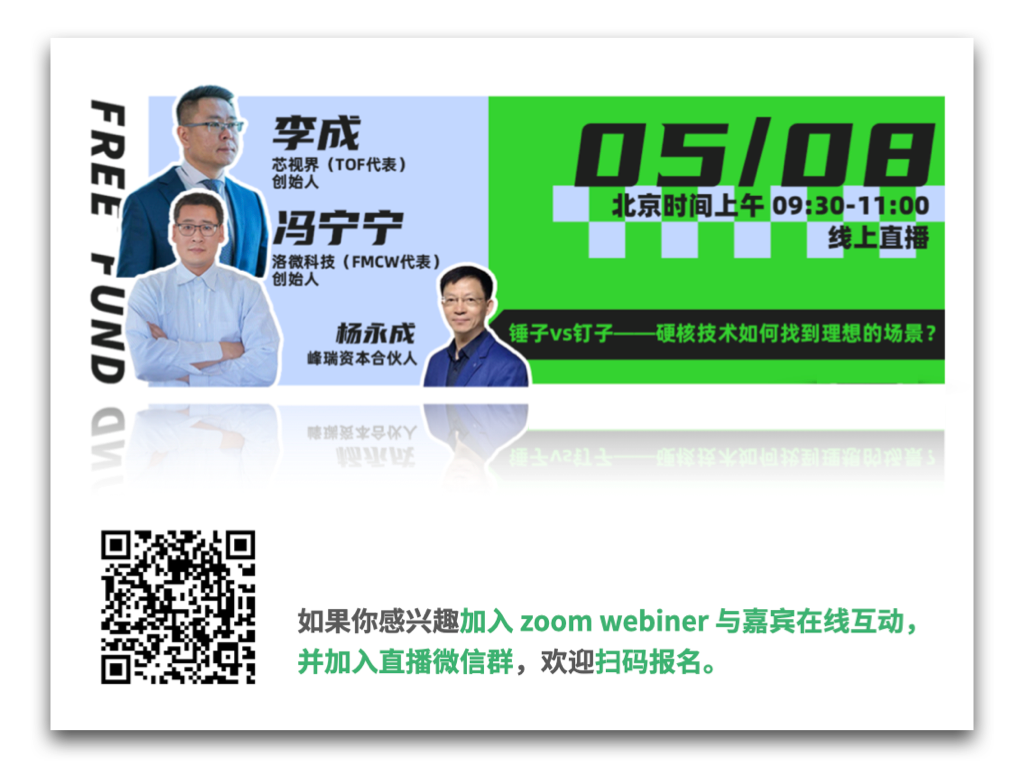
On May 8, the second episode of the series — Hammer vs. Nail: How Hardcore Tech Finds Its Ideal Scene — will feature Li Cheng, founder & CEO of CoreXVision, and Ningning Feng, founder & CEO of LuminWave, joining Yongcheng Yang, partner at FreeS Fund, for an in-depth online conversation about how hardtech entrepreneurs can turn their visions into reality.
▍Why tune in?
Dr. Li Cheng and Dr. Feng Ningning share several things in common: both moved from academia to industry, each brings roughly two decades of experience, and both founded their current companies in 2018. Operating within the broad chip sector, they approached from different angles — ToF and FMCW respectively — and after years of refinement, have applied leading-edge technology to real-world industries.
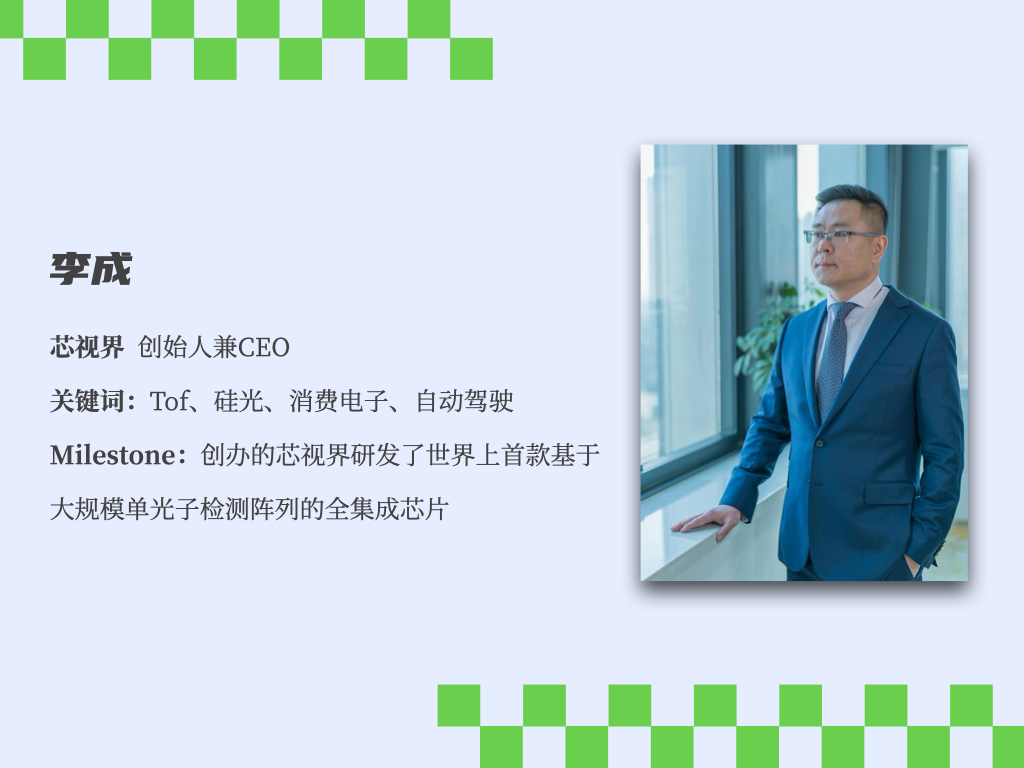
Dr. Li Cheng holds a Ph.D. in analog and mixed-signal integrated circuits from Texas A&M University's Department of Electrical Engineering. He previously served on the organizing committee of the American Silicon Photonics Manufacturing Consortium and as a principal scientist at HP Labs in Silicon Valley, amassing 18 years of integrated circuit R&D and management experience. He has published over 100 influential papers in top international conferences and journals (ISSCC, JSSC, TCAD, etc.), holds dozens of international patents with over a thousand citations, and has received more than 20 awards and honors.
After returning to China, Dr. Li founded CoreXVision Microelectronics Technology Co., Ltd. Addressing critical pain points in LiDAR — high power consumption, high cost, low reliability, and complex system design — CoreXVision developed the world's first fully integrated chip based on large-scale single-photon detection arrays. LiDAR systems built on this chip deliver precise distance measurement with low power, low cost, high sensitivity, and high reliability, placing them at the global forefront both technically and practically. The chip products are widely used in consumer electronics such as robot vacuums, drones, and smartphones, as well as in virtual and augmented reality, smart home, and autonomous driving LiDAR applications.
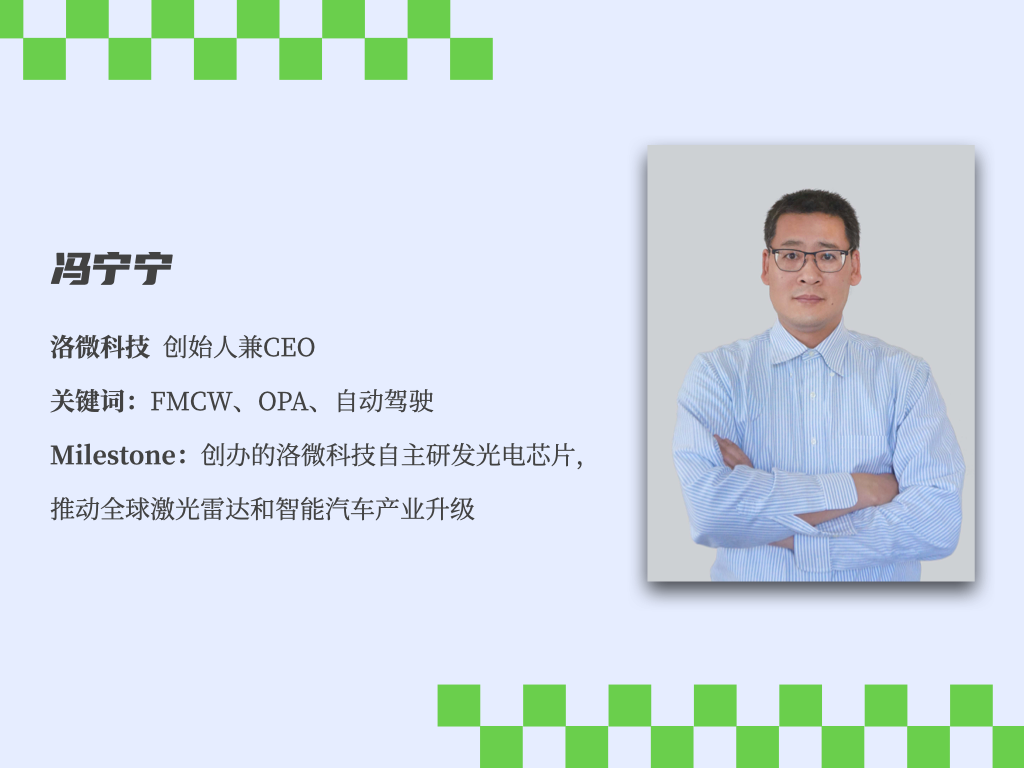
Dr. Feng Ningning earned his Ph.D. in photonics from McMaster University in Canada, where he received the Governor General's Gold Medal during his doctoral studies. He is a senior member of the IEEE and was a postdoctoral researcher in materials science and engineering at MIT. He brings over 20 years of R&D and product development experience in the U.S. optoelectronics industry, more than 10 years of corporate management experience, over 50 papers published in international core journals with more than 3,000 citations, and over 20 U.S. patents.
Dr. Feng founded LuminWave, a global leader in LiDAR products and solutions. The company is committed to providing pure solid-state chip-level LiDAR hardware, chips, and AI perception algorithms through emerging silicon photonics technology and self-developed optoelectronic chips, driving the upgrade of the global LiDAR and smart vehicle industries. Based on proprietary chips and optoelectronic technology, LuminWave has independently developed the pure solid-state wide-FOV blind-spot-filling LiDAR D Series (Diversity Series) and the silicon photonics FMCW 4D long-range LiDAR F Series (Foresight Series), covering scenarios from commercial to passenger vehicles for autonomous driving and ADAS applications.
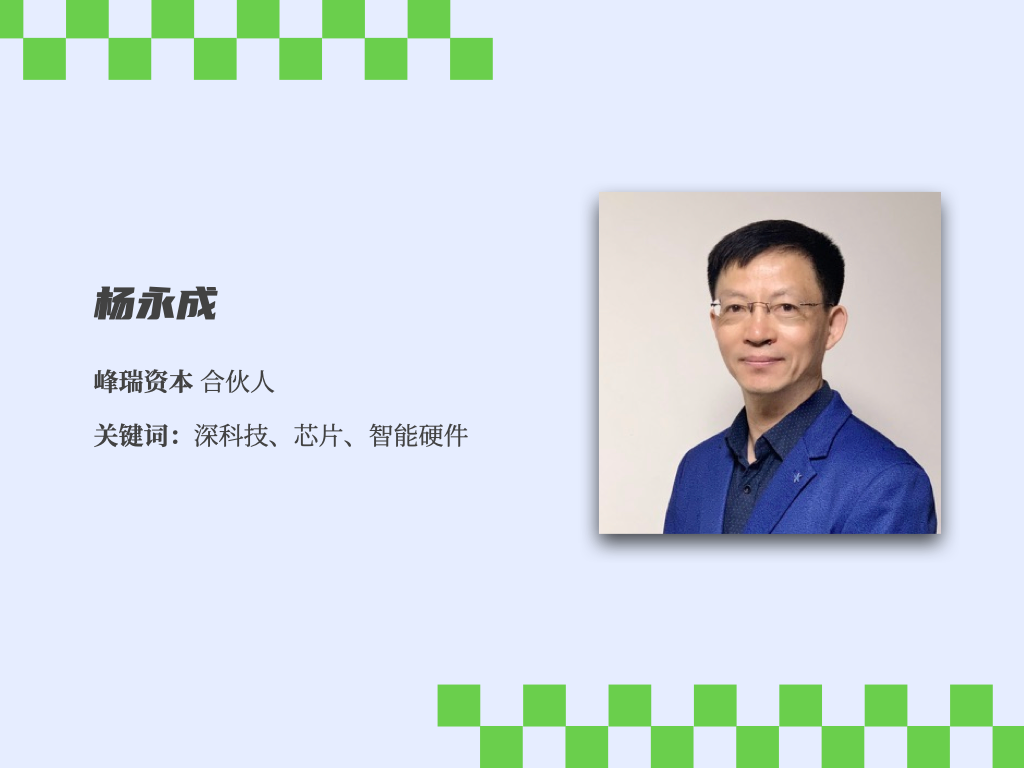
The moderator for this conversation, Yongcheng Yang, is a partner at FreeS Fund focused on deep tech investing. He has led and participated in early-stage investments in Shenzhen Liche, LuminWave, Borui Microelectronics, Yuan Gui Technology, and Anpai Core Research, among others. Before joining FreeS Fund, Yang served as general manager of Baidu's Hardware Ecosystem and Channel Division, overseeing product design and mass production, e-commerce platform development, and channel expansion. He was also previously vice president at Xiaomi, where he led the audio product line and founded the technical and product team behind Xiaomi's smart speakers.
▍How to register?
Hammer vs. Nail: How Hardcore Tech Finds Its Ideal Scene is the second livestream in the "FreeS Fund Venture Dialogues: Chips Series," launching May 8. We also plan to host one offline seminar in the future. If you're interested in joining the Zoom webinar to interact with our guests live and entering the WeChat group for the broadcast, please scan the QR code in the poster or click the "Read More" link at the end of this article to register.
▍Further Reading
Explore FreeS Fund's collection of articles on the chips and semiconductors industry (click the blue link to access the full collection) This collection captures FreeS Fund's thinking on the chips and semiconductors industry. We explore the stories behind China's chip ambitions and why we're bullish on the photonic chip sector; whether domestic semiconductor materials can compete; and our predictions for the ultimate sensor configuration behind autonomous driving.
Why We're Bullish on the Photonic Chip Industry | FreeS Fund Chips Series Can Domestic Semiconductor Materials Compete Globally? | FreeS Fund Chips Series FreeS Fund 2021 Outlook ④ | Predicting the Endgame for Sensors Behind Autonomous Driving Li Feng Column | A 2 Trillion Market and 10 Trillion Output Value: Why We're Bullish on China's Chips?