What Does a Day and a Half Up Close With Huawei Feel Like? | FreeS Talk
How do you work hard and split the money right? How do you stay ahead of technology trends?
Gartner data shows that in 2020, Huawei Cloud jumped to second place in China and fifth globally in the worldwide IaaS market. This standout performance was highlighted by Richard Yu during his first official appearance as Huawei Cloud CEO at the Huawei Developer Conference 2021 (Cloud) on April 25.
A little over a week before the conference, on April 16–17, Huawei Cloud partnered with FreeS Fund's FreeS Talk to bring nearly 20 CEOs and CXOs from the FreeS family into Huawei for an inside look at strategy and organization, and an exploration of cloud's development and future. FreeS Talk is a small-scale offline gathering for FreeS family CEOs. We invite experts or seasoned FreeS family CEOs to share knowledge and experience on topics and directions that CEOs care about.
At the Huawei ICT Exhibition Hall, we got a first look at Huawei's technology infrastructure and its落地 applications across smart cities, finance, automotive, and other industries. After brief opening remarks by Feng Wenbin, VP of Huawei Cloud and General Manager of Shenzhen Huawei Cloud Business Department, and Gu Kun, FreeS Fund's post-investment partner, we heard from:
- Wang Feng, Head of Strategic Insights at Huawei Cloud & AI, on ICT Industry Trends — sharing Huawei's views and understanding of current technology trends.
- Wang Taiwen, former Head of Huawei's Financing Department and Senior Management Advisor, a veteran Huawei instructor and senior management advisor who has long conducted management training for senior clients and employees. On Huawei's Enterprise and Values Heritage Practices, he covered Huawei's organizational transformation experience, cultural values building, and the related benefit distribution mechanisms.
- Zhu Siyang, Huawei Cloud's cloud-native solutions expert, and Zhang Zhizhong, Huawei Cloud's internet industry solutions director, on Technology + Practice: Empowering Enterprise Cloud-Native Upgrades — introducing industry落地 cases and offering technical advice to FreeS portfolio companies.
The founders also joined Huawei guests for two collaborative workshops:
- One on people and organizational management and iteration
- One on technology upgrades and business落地
Below are selected highlights that we hope will offer some inspiration.

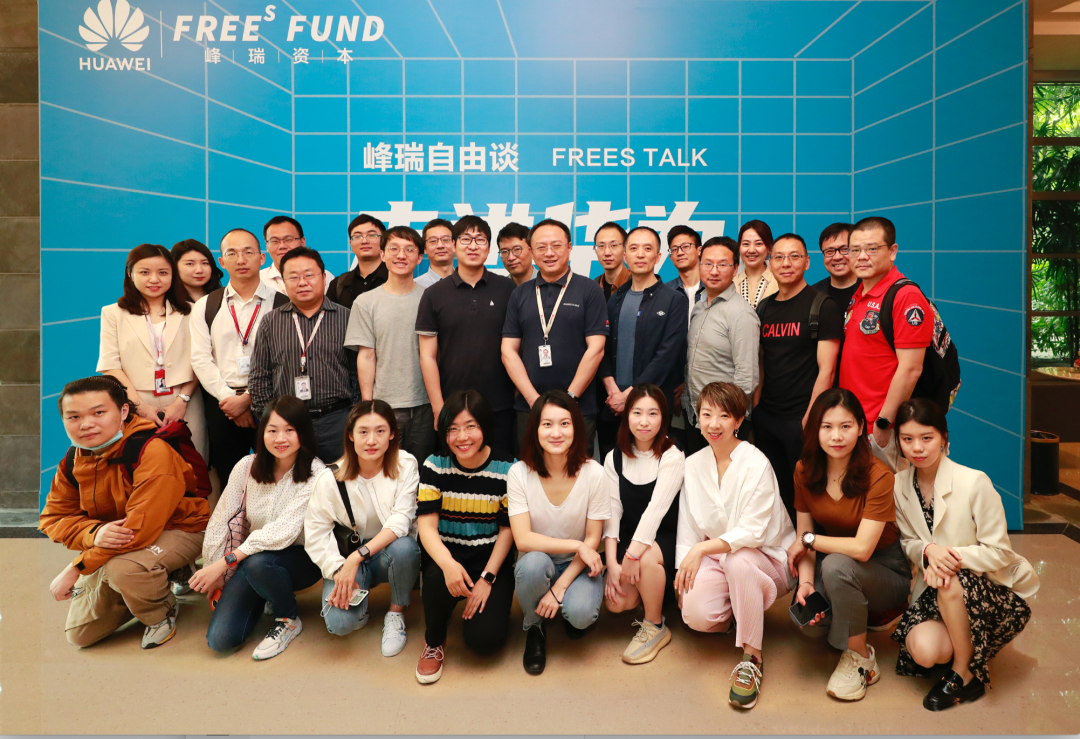
▲ Huawei Cloud partnered with FreeS Talk to bring nearly 20 FreeS family CEOs and CXOs into Huawei


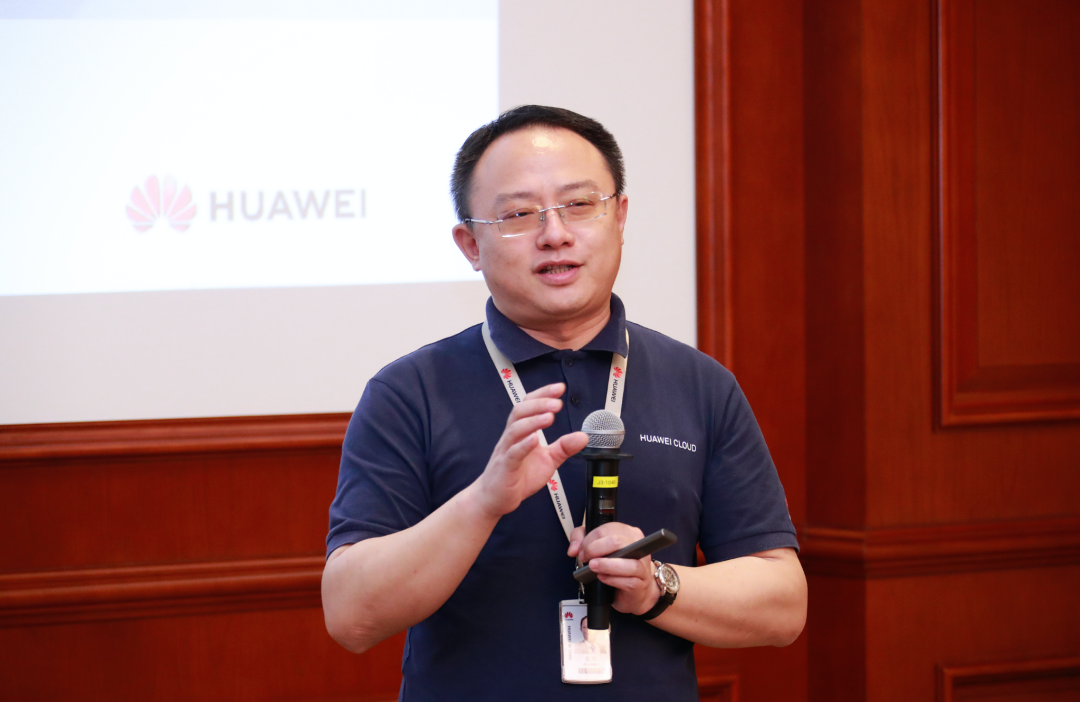
▲ Wang Feng, Head of Strategic Insights at Huawei Cloud & AI, on ICT Industry Trends — sharing Huawei's views and understanding of current technology trends
Wang Feng of Huawei Cloud & Computing Strategy stated that the entire ICT industry is being restructured and transformed around cloud and AI. "This restructuring and transformation isn't superficial — it's not just applications changing. It's change from top to bottom. From cloud at the top to IT architecture below, all the way down to the most fundamental chips, everything is changing. These changes will drive competition in computing, with innovation moving from single-point technology to multi-point collaborative innovation. Top cloud providers are all adopting DSA architecture and using self-developed chips to achieve this."
On AI's development bottlenecks and trends, Wang also had keen insights: "If AI is just a technology, it's hard to monetize. AI's path forward must be solving customers' core problems, even becoming a solution." He said, "AI has entered the production phase. It can重构 experiences, optimize processes, and enable innovation."
A third insight Wang shared: SaaS will become mainstream, and software will be restructured. He believes software's future isn't process-centered, but data-centered in building entire software systems. Cloud extension is the core of architecture, and ultimately data will become the core asset. "Over 50% of data will be generated at the edge. Cloud-edge collaboration is an inevitable trend. At the edge, Huawei needs many partners to work together. We hope there will be more opportunities to collaborate with Huawei in the future."

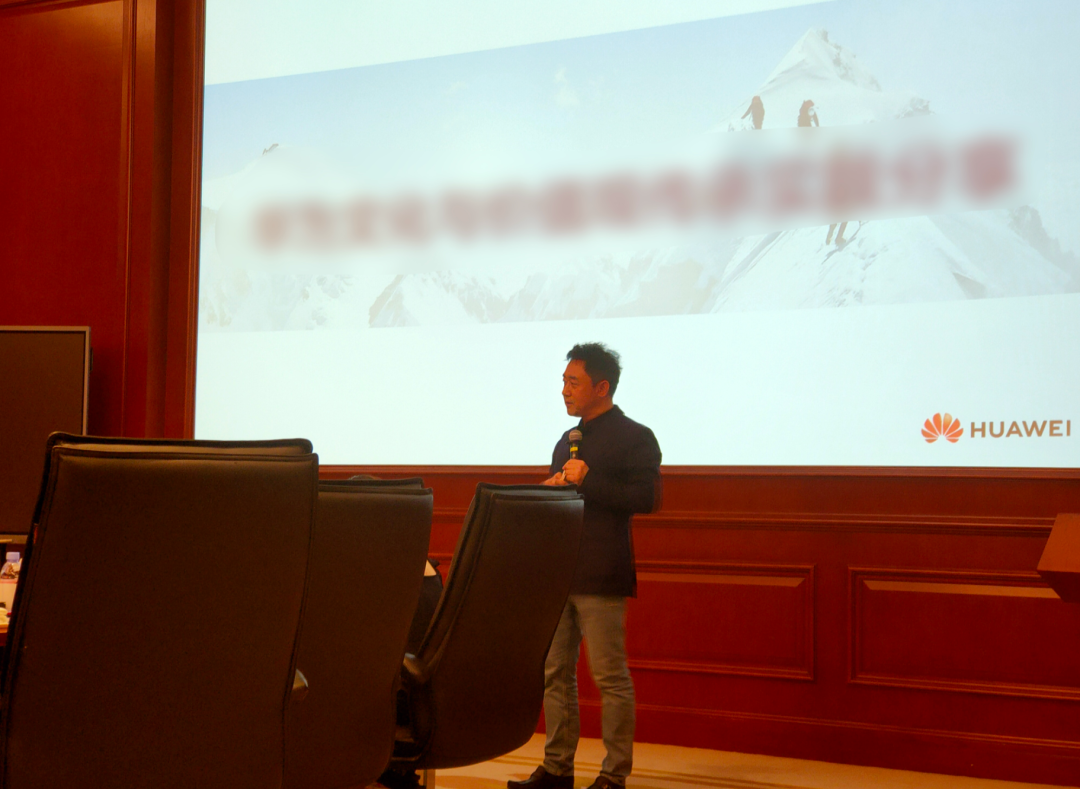
▲ Wang Taiwen, former Head of Huawei's Financing Department and Senior Management Advisor, introduced Huawei's organizational transformation experience, cultural values building, and related benefit distribution mechanisms
Harvard Business Review once wrote: "Huawei's corporate culture is the key to its success."
Huawei Senior Management Advisor Wang Taiwen resonated deeply with this summary. In his view, core values are the internal driving force that has supported Huawei in reaching today and continuing forward.
At the event, Wang Taiwen elaborated on Huawei's four core values one by one: customer-centricity, dedication to contributors, long-term hard work, and commitment to self-criticism. He said, if Huawei is compared to a high-speed train in motion, these four core values are the weapons that ensure its smooth progress.
"Customer-centricity points the direction forward. The power system is dedication to contributors." As for what constitutes dedication, Wang Taiwen explained: creating value for customers is dedication — otherwise, no matter how hard one works, it doesn't count. Furthermore, "only by advocating long-term hard work can this high-speed train maintain its momentum. But our path forward is absolutely not a straight line. If it deviates, even goes backward, we need a correction mechanism to bring it back on track. This correction mechanism is commitment to self-criticism."
In Wang Taiwen's view, with these four safeguards, the high-speed train can to some degree achieve "autonomous driving." In other words, this reaches the ultimate state that enterprise management seeks — building human capability into the organization, reducing dependence on individuals.
Cultural values require guidance, management, and practice; knowledge and action must be united. A crucial step in practice is that incentive mechanisms must embody core values. Specifically for Huawei, value distribution tilts toward contributors, as do opportunities and treatment. Tilting means breaking balance and widening gaps. Huiwen Wang said, "The key to distributing money is distributing it correctly. You must dare to recognize that employees' value differs, and tilt toward excellent core employees."
The day-and-a-half deep exchange contained enormous amounts of information. We tried to glimpse a few perspectives from five CEOs.

Many points were deeply impressive. The most profound was feeling that Huawei as a company is super authentic. It's particularly pragmatic — many things go straight to the crucial point. Most of the time, people are unwilling to state that crucial point, even though it may be simple. The reason for not saying it is perhaps because it's too real, to the point of worrying about possible negative effects. But Huawei isn't like this. What it does is rational and authentic.
Although Huawei is large, some of what we encountered and learned over these two days is still applicable. For example, on the first day, Teacher Wang Taiwen covered Huawei's entire cultural system building. I feel that Huawei's cultural system building accompanied its continuous growth throughout. It took over 30 years to continuously find this logic. This process is something every enterprise must go through. Looking at Huawei's experience of this process is like looking at the future tense, because we're still very small now. Because Huawei is such a large enterprise, it's naturally a learnable object. If you also have many similarities with it in actual business, the fit is even higher.

First, Huawei's sales last year were close to 1 trillion yuan, basically what many great companies look like at their endgame. Understanding what a great company's endgame looks like can help us startups better plan the path from 0 to 1, 1 to 10, 10 to 100, or 100 to infinity.
Second, Huawei's values and organizational management system are widely recognized as formidable. Following Teacher Wang Taiwen's explanation, we had the opportunity to see how Huawei's values grew. Undoubtedly, they didn't fall from the sky, nor are they just top-level architecture. Their formulation relates to business, operations, people, organization, and so on, and also evolves gradually alongside enterprise development. We're also thinking about our own values right now. I feel they shouldn't just be a few lines written on the wall — honesty, integrity, innovation, pioneering. They must fit the background of the company's founding and also relate to the founder's original intention.
Third, on the second day I heard the concept of cloud-native, which doesn't have much to do with our business but is quite interesting. I call this "usefulness of the useless." As founders, we need to understand many things outside our own industry, to broaden our cognitive range more. The usefulness of the useless is the greatest usefulness.

Visiting Huawei, my biggest feeling was that Huawei's core values — "customer-centricity, dedication to contributors, long-term commitment to hard work, and commitment to self-criticism" — these four sentences aren't independent of each other, but an all-or-nothing relationship. In other words, values shouldn't be several isolated slogans, but a value judgment framework: with internally coherent logic, core pillars, and concrete visible external manifestations.

We work on 3D sensor underlying technology and signal processing chips. A quite rewarding point is that Huawei also started from hardware, with very strong core technology. From the construction of the entire technical team, including incentive systems, to the management of large systems later on, it's very instructive for our future efforts to build our company well. So I actively participated throughout the event, whether speaking or exchanging with Huawei colleagues — learned a lot. Our business may also have some points of契合 with Huawei in the future.
I came to Huawei with something of a pilgrimage mindset. Corporate culture is an expression of the founder's values. Boss Ren is indeed someone many in the industry revere. For an entire enterprise to reach 200,000 people and 800 billion yuan in sales — absolutely fought its way through gunfire and bullets. Previously we were also doing some cultural and values deployment internally, and setting up corresponding incentive systems. After this systematic listening, it indeed validated some points in my mind, and also reminded me of points I'd previously neglected and hadn't thought of. For example, the many twists and turns Huawei encountered throughout its implementation process, even constant adjustments, constant self-reflection and self-criticism. We indeed hadn't thought sufficiently about this before.
Overall, different stages definitely can't copy Huawei wholesale. Combined with one's own industry, in the current new international and domestic environment, make corresponding adjustments and apply flexibly.

My gains were very clear. We've always faced issues of digitalization and intelligent architecture. Our field is the home renovation aftermarket, mainly doing house repair, renovation, and改造, which leans somewhat traditional. How to first informatize traditional business, after informatization how to digitize it, and as digitization accumulates some data it becomes big data, and finally achieves artificial intelligence. Through these two days of sharing, the logic of this progression became quite clear.

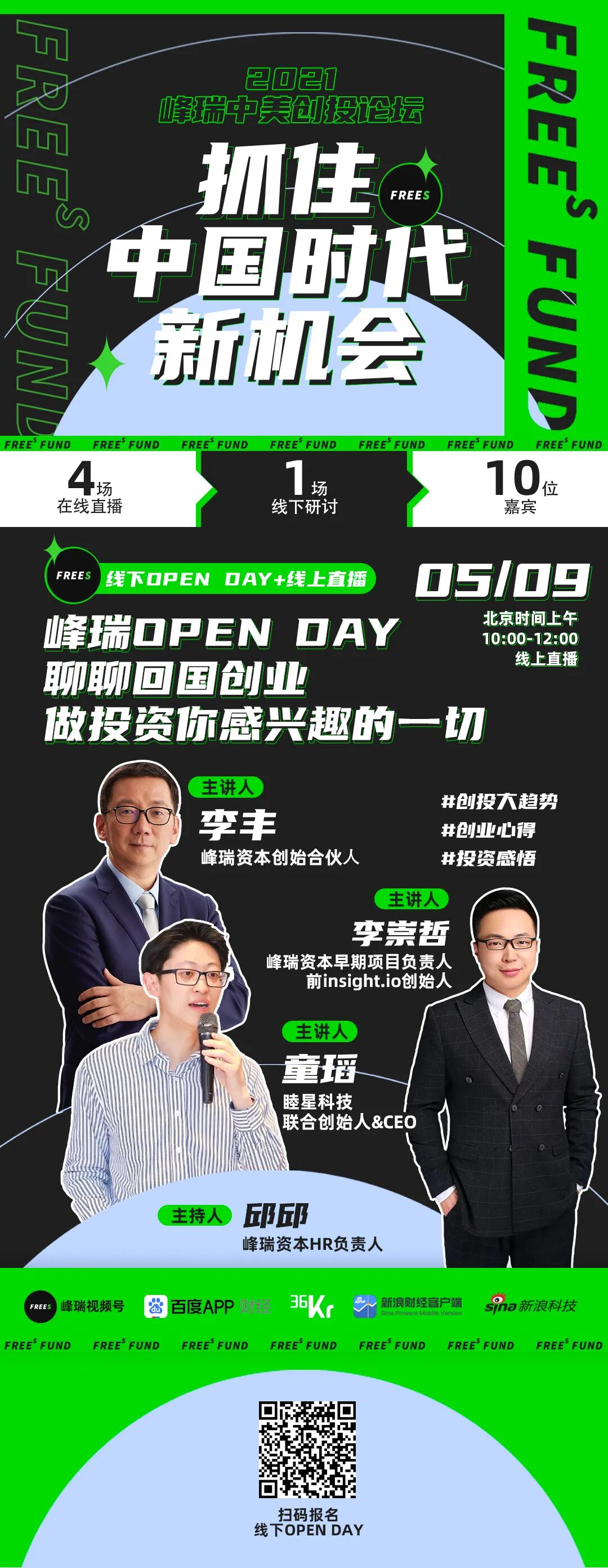
The fourth event in the 2021 FreeS China-US Venture Capital Forum series Seizing New Opportunities in China's Era — FreeS Open Day, Welcome to Sit a While — will go live promptly at 10 AM on May 9.
Feng Shu will be joined by Tong Tao, Co-founder & CEO of Muxing Technology, and Chongzhe Li, FreeS Fund early-stage project lead and former founder of insight.io, to chat with you about returning to China to start a business / do investing... everything you're interested in and care about.
Welcome to watch the livestream on FreeS's video channel, Baidu, 36Kr, Sina Finance, and Sina Tech!
If you're interested in signing up for our May 9 offline event "FreeS Open Day," please scan the QR code below. We've already sent invitation emails to some previously registered friends. For those who still want to get on board, please sign up quickly.
We're currently seeking investors in biotech, deep tech, and consumer/TMT in Beijing, Shanghai, and Shenzhen. If you're interested in joining, we especially welcome you to sign up for our offline open day. How to participate: scan the QR code above. Of course, you're always welcome to send your resume directly to hr@freesvc.com.