What Infrastructure Opportunities Exist in the Booming Cross-Border E-Commerce Space? | FreeS Fund Interview

How do you find the right startup opportunity in a fast-growing sector?
Cross-border e-commerce is one of the hottest sectors in venture capital right now. Since 2014, despite the combined impact of U.S.-China trade friction and the pandemic, the industry has maintained a compound annual growth rate of over 20%. Meanwhile, cross-border e-commerce's share of China's total import and export volume has been steadily increasing. With growing policy support, more and more new players are flooding into this fast-growing track.
Qbit, a fintech service platform founded in 2019, focuses on the localized operational financial needs of Chinese companies going global — particularly in cross-border e-commerce. Starting from the "spending" side, it provides enterprise users with one-stop financial infrastructure for their global operations. Over the past year and a half, riding the wave of pandemic-era cross-border e-commerce, Qbit has grown rapidly.
As a financial services provider in the cross-border space, Qbit offers a valuable window into the cross-border e-commerce industry and its ecosystem. Recently, we sat down with Qbit's founder and CEO, Yujun Wu. Wu holds dual bachelor's degrees from Shanghai Jiao Tong University and Purdue University, and a master's degree from Stanford University. A serial entrepreneur, Qbit is his third venture. He shared his perspective on the current state and opportunities in cross-border e-commerce, as well as his own entrepreneurial journey — how a startup can expand from a single point to a broader vision, and how he has grown and evolved as a repeat founder.
We hope his reflections offer some useful insights.
01
Beyond PayPal and Stripe, what opportunities exist for emerging fintech companies like Qbit?
FreeS: Why did you start Qbit?
Yujun Wu: In 2019, I wanted to exchange some USD and found the bank process for currency settlement cumbersome and expensive. That pain point was one reason I founded Qbit.
Another major driver was the broader trend of Chinese companies going global.
Wu identifies two structural shifts in the cross-border e-commerce industry
My hometown is near Yiwu. Yiwu has many cross-border sellers. At the time, many business owners were shifting to Amazon — some reached annual revenues of 100-200 million RMB within a year. And they were maintaining strong growth momentum. As mobile internet dividends gradually faded, entrepreneurial opportunities in the internet sector became harder to find. By contrast, manufacturing — especially cross-border trade — showed very impressive growth figures. From a policy perspective, the government was also encouraging foreign trade development. Taken together, this industry had enormous potential.
Convinced of this direction, I started thinking about what entrepreneurial opportunities existed. That brought me back to the pain point I'd personally experienced. Banks still had significant gaps in cross-border asset management services. So Qbit was born.
FreeS: Who does Qbit primarily serve?
Yujun Wu: Simply put, any enterprise with overseas fund management needs is our target customer.
Both banks and clients have needs. On one hand, the pandemic pushed traditional banks to seek new growth opportunities. On the other hand, Chinese cross-border e-commerce companies that survived the pandemic test were booming, and these small and medium-sized enterprises going global urgently needed more convenient fund management experiences.
For many Chinese cross-border sellers, the next decade represents a critical window for globalization. Their overseas expansion is no longer limited to selling on platform e-commerce sites like Amazon — many are planning to build independent DTC sites. Running your own independent site overseas comes with challenges: compliant fund operations, localized operations, overseas traffic acquisition, and so on. To accomplish this series of ambitious goals, you first need an overseas bank account. That's the first problem Qbit can solve for you.
FreeS: Can you explain the difference between Qbit and international financial companies like PayPal and Stripe? People inevitably ask — why not just use these established services?
Yujun Wu: Qbit provides financial infrastructure and more convenient, efficient, low-cost one-stop fund management solutions for SMEs going global. PayPal is primarily a wallet; Stripe is a payment service provider for merchant acquiring. Sellers can integrate both PayPal and Stripe to receive consumer payments. We don't compete with PayPal — PayPal is upstream from us. Funds in PayPal can be withdrawn to Qbit accounts. Before we existed, or if customers don't use us, they go to traditional banks.
▲ Image source: Qbit
FreeS: What are Qbit's product advantages?
Yujun Wu: Two main dimensions.
First, compared to traditional banks, our most significant advantages are convenience, efficiency, and lower costs.
We partner with banks in the U.S., Europe, and other regions. We connect at the infrastructure level through API integration. This means customers who want to open an overseas bank account don't need to spend weeks finding intermediaries or visiting physical bank branches. Through Qbit's online platform, they can get set up in as fast as one day. We also optimize the overall user experience. Additionally, because we've integrated extensive local payment networks, Qbit's remittance fees can be 90% cheaper than traditional banks.
Second, compared to some domestic startups also focused on cross-border collections, our advantages are clear. Some virtual account providers typically offer customers virtual accounts — these belong to the payment company itself. Our approach is different: we partner with banks to open genuine bank accounts for our customers.
FreeS: What are the benefits of real accounts versus virtual accounts?
Yujun Wu: First, customer funds are more secure. Virtual accounts are designed so that all money flows into a single pooled account.
On the Qbit platform, every account is the customer's own independent account — identical to what they'd get opening an account at a physical bank branch — and each carries $250,000 in deposit insurance.
Second, the supported use cases are more diverse. Virtual collection accounts typically only receive funds from specific scenarios, with very narrow outbound payment paths. But with a Qbit account, you get an enhanced version of a bank account. Within compliance boundaries, there are no geographic or scenario restrictions on receiving funds. For payments, we not only support multi-currency payments across different countries but also direct RMB settlement.
FreeS: Similar to a Type I account in China.
Yujun Wu: Right. There's no such terminology overseas, but it's a useful analogy. It's essentially like opening a Type I account abroad.
FreeS: Why can you open accounts so quickly — as fast as one day?
Yujun Wu: Because we've obtained authorized qualifications from banks. For some overseas banks, their understanding of Chinese enterprises is limited. After reviewing our anti-money laundering credentials and determining we're reliable, they grant us certain permissions to conduct customer due diligence and onboarding on their behalf. With these permissions, our product takes the bank's foundational modules, deconstructs them, and reassembles them into a better user experience — streamlining the onboarding process and reducing transaction costs.
02
How to establish a dominant position in the cross-border services ecosystem?
FreeS: Are there other domestic companies with a similar model?
Yujun Wu: To my knowledge, we're one of the few domestic companies that has actually established direct bank integration channels. However, underlying supply chain resources — the banking partnerships — are certainly not exclusive. I can't say you can only work with us. Will other players enter this space in the future? I'm sure they will.
That said, in supply chains, volume always determines bargaining power. If multiple players can establish supply chain connections, the one with greater volume will have relatively stronger cost advantages, greater pricing flexibility in the market, and be better positioned to win more and higher-quality customers. It's a virtuous cycle.
FreeS: Who are your representative clients?
Yujun Wu: Currently, we serve several thousand enterprise clients, 90% of whom are cross-border e-commerce related. The largest segments are DTC brand e-commerce companies and emerging consumer brands just beginning to go global. Over the past year, a number of major sellers that started on Amazon have begun building their own independent sites, becoming our customers.
Another typical client category is service providers for global expansion — website building platforms, supply chain finance platforms, advertising platforms, and so on.
This year, clients from other industries going global have also approached us, such as education companies expanding overseas.
FreeS: For you, the more independent sites there are, the greater the market opportunity.
Yujun Wu: Exactly. Platform e-commerce generally has relatively homogeneous fund flow needs, so our advantages don't stand out as much. Independent sites have richer needs, creating more opportunities for our business expansion.
FreeS: What are their main use cases?
Yujun Wu: As companies expand into European and U.S. markets, they generate increasing localization needs. "Localization" doesn't necessarily mean having a physical team on the ground — but you do need to establish a legal entity framework. For many companies without overseas experience, the localization process is extremely cumbersome. Many fairly large domestic companies don't know how to register entities or structure their corporate architecture when going global.
We initially addressed this by providing overseas bank accounts for companies with these needs. Then we began offering value-added services, such as one-click overseas entity registration. Going forward, we'll integrate with additional service providers to create full-process services.
Overall, we want to transform from a digital bank that doesn't control scenarios into one that does — achieving scenario closure by connecting upstream and downstream through value-added services. Once you control the scenario, user stickiness improves significantly.
FreeS: The cross-border e-commerce services ecosystem where Qbit operates has seen heated fundraising activity in recent years. What are the relationships between players? Could they become your distribution channels?
Yujun Wu: Yes. ERP systems are all evolving toward comprehensive middle-office platforms. We're a service provider ourselves, but we also hope to develop more service providers as our clients.
FreeS: Have you already begun some open integration attempts? Are you inclined toward vertical integration?
Yujun Wu: We have. For example, we provide APIs to certain service providers to enhance their capabilities, building a BaaS (Banking as a Service) offering. Take a service provider that helps clients with VAT refunds — previously they could only connect the information flow; we can help them integrate both information flow and capital flow. This gives our accounts more diverse use cases.
Additionally, we can "empower" e-commerce clients by helping solve their most pressing growth and retention challenges. For instance, one client recently raised a need for cashback red envelopes. Unlike large platform e-commerce, independent sites face the fundamental challenge of driving repurchase. They need to employ various operational tactics to improve repurchase rates, and cashback is one such method. We can implement these functions through our virtual card module.
We hope more and more clients will use our BaaS products, combining different strategies and approaches — the potential upside is substantial.
03
Next steps: Building the brand, building trust
FreeS: What's your biggest challenge right now?
Yujun Wu: The depth and breadth of our service to global e-commerce companies still needs strengthening — we need more potential clients to know about us. Many brands, when deciding to go global, still first think of finding agents. They may end up spending two-plus months, a lot of money, and making physical trips to open bank accounts. Many people have told us, "If only we'd known about you sooner." So going forward, we'll invest more in brand building and trust.
FreeS: What kind of brand image do you want to build?
Yujun Wu: I want our brand to be cutting-edge, forward-looking, with attitude and warmth. Using more B2C approaches to serve B2B clients, proactively helping customers solve problems.
FreeS: What's the thinking behind this?
Yujun Wu: It's about making customers feel cared about, not treated coldly.
I spend almost all day dealing with banks — domestic and overseas. The contrast is stark. Very large banks tend to have bloated organizational structures, long response cycles to market needs, relatively traditional mindsets, and high costs for trial and error.
On the client side, they have numerous pain points in cross-border finance that urgently need solving. Based on technological advances, many of these problems can now be well addressed, yet banks haven't fully responded to these needs. These gaps are opportunities for startups. So we want to stay closer to customers — innovating while truly helping clients solve pain points and grow their businesses better.
Brand building will be an important direction for us going forward. Beyond brand and trust, another priority is product richness. This ties back to the vertical integration we discussed — combining more scenario-based functions around core product capabilities.
FreeS: Buy Now Pay Later is a particularly hot concept overseas right now. China's situation is different.
Yujun Wu: China's market conditions are different. A few major e-commerce platforms essentially monopolize their respective spaces. For payments, there's Alipay and WeChat Pay. For lending, Alibaba has Huabei, JD.com has JD White Card, and so on. Large platforms that own the usage scenarios have largely divided up the market. There's not much room for independent platforms to grow.
FreeS: Is there an overseas benchmark for your model?
Yujun Wu: Yes. For example, Mercury Bank — started in 2019, reached a $1 billion valuation in two years. Chime, a U.S. consumer-focused mobile bank, hit a $25 billion valuation this year. And Revolut, a European neobank, saw its valuation jump from $5 billion to $30 billion during the pandemic year.
FreeS: Do you experience user churn? What are the main reasons?
Yujun Wu: Yes, mostly due to changes in the clients' own businesses. For example, some companies pivot away from cross-border operations.
What's it like to be a serial entrepreneur?
FreeS: What do you see as the hardest part of this track?
Yujun Wu: The knowledge in this domain is extremely fragmented. What's domestic regulation like? What's overseas regulation? What are different banks' compliance requirements? What do cross-border e-commerce companies actually need?... Very fragmented. For our company, this creates challenges in both hiring and sales training.
FreeS: How do you address this?
Yujun Wu: Constant learning, building out our knowledge base, and internal training. Colleagues responsible for different areas — product, financial channels, etc. — regularly share updates to increase mutual understanding across business functions.
FreeS: Ensuring team alignment?
Yujun Wu: Right. For startups, the core competitive advantages come down to two things: first, sharp market insight; second, execution capability based on that insight. For us, daily reflection centers on these two points.
First, we examine whether our market insight is accurate. If the insight is accurate, we then look at whether execution is strong enough. If execution is lacking, we identify what's hindering it. Often it's misaligned cognition causing small deviations in collaborative execution. Recently, as our team expanded from 30 to 50 people, maintaining internal cognitive alignment has become even more critical.
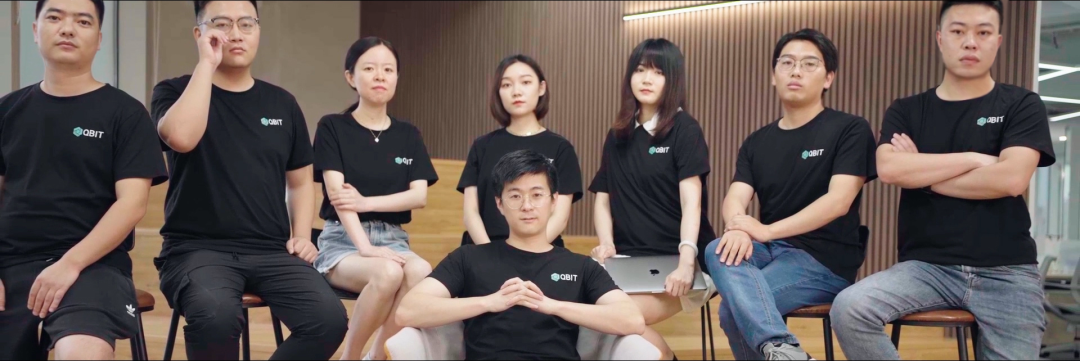
▲ Qbit team photo
FreeS: What management challenges do young CEOs face?
Yujun Wu: Many. I think early-stage startups all grow through "chaos" — having this capacity is crucial. In a company's early growth, the CEO doesn't have much energy to devote to management, nor is it particularly necessary. Below 50 people, the most important thing is finding one or two key employees and building the team around them to drive the business forward. At this stage, the company can't really talk about management.
But 50 people is an inflection point. Once the team expands, management becomes important. This is when you need to bring in a seasoned HR director. Leave specialized work to specialists. An HR director can connect the company's various departments, align everyone around shared goals, and clarify individual growth paths. This is what I'm currently building out.
FreeS: This is your third venture. What trait do you value most in yourself?
Yujun Wu: Being good at filling capability gaps.
**FreeS: You came from a technical background.
Yujun Wu: Yes. What I enjoyed most was building technology and products from zero to one. But once Qbit's technical and product framework was established, we needed to do business development and partnerships. I used to be reluctant to put myself out there, too embarrassed to constantly follow up with people asking when they could try our product or discussing pricing.
But entrepreneurship means you can't just stay in your comfort zone. Products are like building blocks — without customers to serve, you can't create anything interesting. So when I rotated into sales, I had to step outside my comfort zone and learn to do things I wasn't good at.
Now, after about four to five months in sales, I've personally closed most of the company's major accounts. Only by figuring out sales myself can I build a proper sales team.
Next, the company faces the challenge of raising brand awareness and trust, so the next phase will focus on marketing and brand. My home turf may shift from sales to marketing and branding.
FreeS: Compared to your previous two ventures, how does this one feel different?
Yujun Wu: First, Qbit's track has better prospects. Second, it aligns better with my background. Finally, with previous entrepreneurial experience under my belt, my mindset is more balanced.
When I first returned to China in August 2016, I was quite lost, spending a lot of time trying to find the most suitable, most promising direction. Life then was anxious — I demanded of myself a hundred-meter sprint mentality every day, eager to see results.
Now I'm more balanced, understanding that entrepreneurship inevitably encounters all kinds of frustrations. For a period, our growth wasn't particularly strong. In the past, if I didn't see a turnaround in three months, my mindset would crumble somewhat. Now I'll tell the team, it's fine, we can try other approaches, giving everyone more time to experiment. Entrepreneurship is a marathon — you must maintain a healthy mindset.
FreeS: More composed.
Yujun Wu: Yes. When entrepreneurship becomes your lifestyle, you may not be so anxious anymore.
FreeS: After switching tracks, how did you convince other startup team members to continue with you?
Yujun Wu: Honestly, I'm not someone who's great at "brainwashing" people, rallying them around values and mission. For an engineering-minded person, compared to "drawing a big pie," more tangible things matter more. What I'm good at is technology and product — so I use those to move people.
When I started this venture in March 2019, it was initially just three people. With this small team, I first built out the product MVP. When others recognize the project and can see its prospects, they're willing to join.
FreeS: Any hiring lessons?
Yujun Wu: From my experience, core team members are rarely recruited through headhunters — they mostly come from personal networks. So maintaining industry connections is important. Being social is quite necessary for entrepreneurship. In the process of networking, you meet industry friends who may become future partners to fight alongside.
FreeS: What's your next milestone?
Yujun Wu: Serving brand globalization clients well, and building the company to $10 billion.


"There will come a moment when technology defeats human experience" | FreeS Fund Dialogue
Building Virtual Idols: The Pitfalls and Barriers | FreeS Interview
"DJI is already so big, how do you survive?" A Story of Taking on Giants | FreeS Business School
▲ FreeS Report 18: Thoughts Amid Market Euphoria, Where Are Fintech Opportunities? | FreeS Research Institute
