How Will Humans Work in the Future? | FreeS Fund Report 26

The Twilight of the Corporation vs. The Dawn of New Ways of Working?
The subject of this report is a bit unusual — it touches every working person and entrepreneur.
We turn the magnifying glass on the company as an organizational model, examining how this mode of work, widely used by humans for over a century, is changing; what entrepreneurial and investment opportunities these changes hold; and how they will influence our career choices and thinking about the future of work.
Some changes have already become new consensus. You don't have to be in an office to work — in April 2022, Airbnb announced that employees could work remotely permanently without pay cuts. You don't have to be full-time — more young people are monetizing specialized skills in education, law, finance, consulting, photography, and other fields through part-time work. You don't have to be in traditional industries — according to the 2022 National Youth Talent Employment Trends Insight report, health management specialists and influencer content creators became the two most desired new careers among fresh graduates.
"Our natural gift for collective action is meeting our new tools here." Clay Shirky's 2008 book Here Comes Everybody: The Power of Organizing Without Organizations provided the footnote for these new changes. In his view, electronic networks are spawning new forms of collective action, and may also give rise to collaborative groups larger and more dispersed than ever before.
In this report, we introduce new organizational forms such as remote hiring platforms, volunteer collaboration communities, and decentralized autonomous organizations. They may become options for your career, or provide reference when you're thinking about organizational models for your own startup.
Topics covered in this report include but are not limited to:
- What new forms of work are emerging? What are the advantages and disadvantages of each, and which types of people do they suit?
- How will people's ways of working change in the future? What entrepreneurial and investment opportunities do these changes contain?
- Why has crowdsourcing, a traditional method, become a "new species"?
- How did remote hiring become popular?
- Can volunteer collaboration communities defeat corporate organizations?
- How do Web3 and NFTs revolutionize the creator economy?
Welcome to read on — we hope this brings new angles of thinking. If you're interested in topics around the future of work, or are building a startup in related directions, feel free to contact the author Chen Shi at chenshi@freesvc.com.
Interactive Giveaway
We welcome you to share your thoughts on the future of work in the comments section. The 6 readers with the most thoughtful comments will receive a box of Saturnbird ultra-instant specialty coffee (each containing 3 No. 3 and 3 No. 5 coffee pods).
01
The Evolution of Human Work Organization
Stanford University professor Ian Morris, in his book Foragers, Farmers, and Fossil Fuels: How Human Values Evolve, proposed a view: in the past twenty thousand years of human history, societal values have roughly gone through three systems — those of foragers/gatherers, farmers/agriculturalists, and fossil fuel users (corresponding to gathering society, agricultural society, and industrial society respectively).
In the "forager" stage, humans mainly survived by gathering wild plants and hunting wild animals. This work could be completed by independent individuals, so human society at that time consisted mainly of small-scale groups (families, clans, or small settled tribes), was highly mobile, and relatively egalitarian.
In the "farmer" stage, humans needed to domesticate animals and cultivate plants to survive — work far more complex than gathering and hunting. At this stage, human society began to develop hierarchical systems and division of labor habits to carry out complex production activities and maintain stability of survival.
In the "fossil fuel user" stage, humans mainly extracted plant fossil energy already transformed into coal, gas, and oil to carry out various industrial manufacturing activities, thus generating more and more complex needs for division of labor and cooperation, which also drove changes in social organization and values. In other words, changes in humanity's mode of production bring about the evolution of values and forms of production organization.
Professor Morris's analysis and observations lean toward the values level. This report wants to follow Professor Morris's analytical framework, focusing on the evolution of human work organizational forms. Especially now that we have arrived at the "post-industrial era," with the internet and information technology leading the development of human society, what new changes and trends will emerge in our work organizational forms?
From the perspective of organizational methods, human society is composed of three types of units.
One is hierarchical organization — most institutions and companies use this organizational model. It is the main battlefield where people work. In hierarchical organizations, the hierarchical structure is typically composed of a single/group of power at the top, with subsequent levels of power below. This means that in hierarchical organizations, each entity has different levels of management, power, or authority.
The second type is the individual unit. There used to be self-employed individuals; now concepts like the creator economy have emerged, with more and more tools and platforms gradually empowering individual units to complete work independently.
The third is loose organizations, such as open source communities. In conventional thinking, one might assume loose organizations struggle to accomplish things and are inefficient. But now people have made quite a few interesting new discoveries about loose organizations, which we will elaborate on below.
This article mainly explores two topics: first, the continuous iterative evolution of hierarchical organizations; second, the birth of new organizational forms and the entrepreneurial and investment opportunities within them. First, an overview:
-
Crowdsourcing (gig economy): Traditional outsourcing is a self-optimization of the corporate system (replacing in-house production organization with external cooperation), but crowdsourcing is a more socialized and efficient form of outsourcing. Because of its massive scale, it has evolved into a large-scale social organizational transformation — a new species.
-
Remote hiring: Remote hiring is somewhat similar to crowdsourcing; its starting point is also the self-optimization of the corporate system (hiring employees from lower labor-cost regions to work remotely, a form of geographic arbitrage). Under the pandemic, remote hiring has become increasingly popular; in the future, this trend may become even more pronounced.
-
Creator economy: Web 2.0 brought massive demand for individual creative content, thus generating a large-scale creator economy. The starting point of the creator economy is generally the self-employed individual, because the production of creative content particularly depends on individual creativity.
-
Volunteer collaboration communities: Volunteer collaboration communities emerge free from the constraints of corporate management costs, and are also a new organizational form. With the support of new internet collaboration technologies, communities can also gather large-scale populations with relatively high coordination efficiency and extremely low cost. Communities can conduct distributed exploration, spontaneous innovation, and repeated trial and error, thus in some fields achieving results that hierarchical organizations previously failed to attain.
-
Decentralized autonomous organizations (DAOs): DAOs can to some extent solve the major issues at the production relations level for new species such as the creator economy and volunteer collaboration communities, including trust and governance, distribution and property rights attribution. NFTs in Web3 also hold significant meaning for the healthy development of the creator economy. However, regulatory compliance is an unavoidable prerequisite.
Next, we will examine each in turn.
02
New Organizational Form One: Crowdsourcing (Gig Economy)
Crowdsourcing refers to companies publicly soliciting a non-specific, large population to complete certain tasks. Its essence is flexible employment or free employment, with relatively short cycles and a large potential workforce. In daily life, delivery drivers, food delivery riders, and ride-hailing drivers mostly cooperate with their respective platforms through crowdsourcing.
Crowdsourcing originated from traditional corporate outsourcing, replacing in-house production organization with external cooperation. Outsourcing targets a limited number of parties, sometimes one-to-one, with greater emphasis on specialization. Crowdsourcing is a one-to-many relationship — enterprises may face thousands or tens of thousands of contractors.
Crowdsourcing has advantages in cost, speed, quality, flexibility, scalability, and diversity. Additionally, internet platforms, remote work, and online collaboration tools provide the technical foundation for crowdsourcing.
As a more socialized and efficient form of outsourcing, crowdsourcing has evolved into a large-scale social organizational transformation due to its massive scale — it is a new species.
Many enterprises, institutions, and research and art institutions are using crowdsourcing mechanisms for co-creation. Common crowdsourcing categories include collective voting (Reddit), crowdfunding (Kickstarter), prize competitions (TopCoder), creative crowdsourcing, crowdsourced transportation (food delivery and express delivery), crowdsourced problem-solving, micro-tasks (MTurk), professional tasks (Upwork), and more.
Next we introduce three representative cases.
▍Micro-task crowdsourcing platform: Amazon Mechanical Turk
Amazon Mechanical Turk is a micro-task crowdsourcing platform. Users can post small tasks on the platform, typically completable in a few minutes. The site launched in 2005; by 2018, it had reached 100,000 simultaneous online users.
The name of this micro-task crowdsourcing platform has an interesting origin. An 1857 issue of The Chess Monthly mentioned that in the 18th century, a European nobleman built an automatic chess-playing machine. This nobleman traveled from country to country, using the machine to defeat many people, including Napoleon and Benjamin Franklin. But in fact, inside the machine hid a Turkish chess master, whom people called "The Mechanical Turk."
Behind the Mechanical Turk website, similarly, is a crowd of people taking tasks and providing services. These tasks include questionnaire surveys, machine learning-related image recognition, missing person searches, collaborative art creation, and more, with corresponding compensation upon completion.
▍Professional task crowdsourcing platform: Upwork
Unlike the micro-task platform mentioned above, tasks on professional task crowdsourcing platforms require higher skills and take longer to complete — typically days to months.
Take Upwork as an example. Its predecessor was Elance-oDesk, an American freelancing platform where businesses and individuals could connect and conduct business. In 2015, Elance-oDesk was renamed Upwork. China has similar crowdsourcing service platforms, such as ZBJ (Zhubajie).
As of 2021, Upwork had 18 million registered freelancers and 5 million registered clients. Work posted on this platform covers website and software development, data science and analytics, engineering and architecture, design and creative, writing, translation, legal, administrative support, accounting and consulting, and more.
▍The story behind the Ten Thousand Cents print: Research and art exploration based on crowdsourcing platforms
Since around 2010, many research institutions and companies have been exploring how to use crowdsourcing platforms to complete relatively complex and creative tasks, such as writing novels, finding matching inventions from patent databases, and formulating rules and regulations.
In 2008, American artist Aaron Koblin and Japanese artist Takashi Kawashima collaborated to complete the art piece Ten Thousand Cents through paid commissioned creation. They hired 10,000 users through the Mechanical Turk website, asking each to independently create a tiny portion of a $100 bill, with each person paid one cent. The two artists used computers to assemble the collected pieces into $100 bill prints, each sold for $100, to fund a charity providing low-cost laptops to children.
When curators Jeffrey Stark and Manuella Nave evaluated Ten Thousand Cents, they noted: "The artists, on one hand, distributed tasks through a professional labor market website, matching the theme of creative labor by strangers; on the other hand, the completely transparent creative process allowed the artists to raise related issues, including changes in the creative process, conditions in the labor market, and more. More importantly, this process enabled exploration of how new technologies and media are changing artistic creation."
Humanity continues to make more attempts and explorations in the crowdsourcing direction. In the future, crowdsourcing is expected to penetrate broader and deeper industries in terms of breadth, and develop toward relatively complex, collaborative tasks in terms of depth.
/ 03 /
New Organizational Form Two: Remote Hiring
The Rise of Remote Hiring: "Zoom Towns" and "Earning Dollars from Abroad"
Remote hiring, as the name suggests, allows employees to work from locations outside the company's offices without commuting. It emerged in the 1970s, proposed as a viable solution to reduce commuting amid the Middle East wars and oil crisis.
Remote hiring enables companies to recruit employees from regions with lower labor costs to work remotely — a form of geographic arbitrage. For instance, the U.S. faces a significant shortage of tech talent, while developing countries like China and India have abundant engineering resources. According to data from the U.S. Department of Labor, 1.4 million new software engineering positions were added in 2020, yet only about 65,000 computer science degrees were awarded that year. China currently has roughly 7 million skilled software engineers in its talent pool, with millions more STEM graduates entering the workforce annually — and they offer better "value for money" than local American engineers.
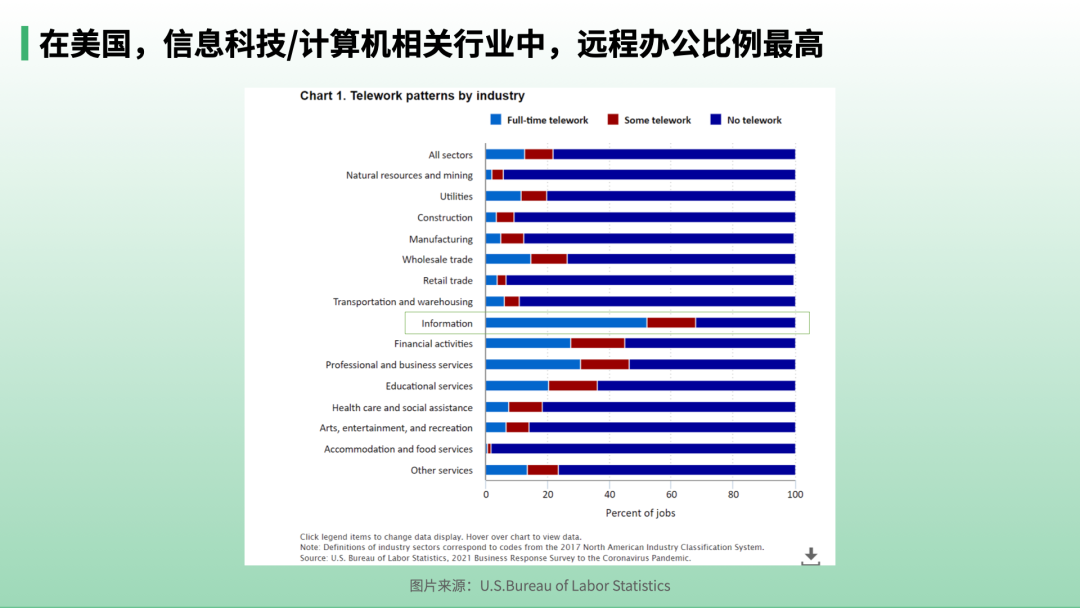
Remote hiring represents an extension of hierarchical organizations like corporations into the digital realm. As mobile telecommunications, internet access, video conferencing, collaboration software, and cloud computing have advanced and become widely adopted, remote work has grown increasingly normalized. The pandemic further accelerated its popularity. For employees, it's a way to better balance work and life.
A 2022 Pew Research Center survey found that 60% of remote workers said they would prefer to continue working from home after the pandemic if given the choice. Large numbers of remote workers have flocked to small towns with scenic beauty and livable conditions. These digital nomads typically rely on video conferencing tools like Zoom for online meetings, earning such towns the nickname "Zoom Towns." In China, many have likewise fled Beijing, Shanghai, and Guangzhou to return to their hometowns, living a life of "earning dollars from abroad."
Data from LinkedIn, the global professional networking platform, shows that as of March 2022, approximately 20% of newly posted jobs on the platform were "remote positions." Meanwhile, browsing and new job applications for remote positions rose from 3% before the pandemic to 30% and 27% respectively. If remote hiring continues to evolve, it may give rise to organizational forms we can scarcely imagine today.
Entrepreneurial Opportunities in Remote Hiring
The remote hiring ecosystem presents numerous entrepreneurial opportunities: hiring platforms, compliance services, remote HR, collaboration tools, workplace platform hosting, and more. Tools traditionally designed for managing in-person companies have opportunities to be adapted or rebuilt entirely for remote hiring scenarios. Some businesses have even emerged offering corporate culture-building services tailored specifically to remote hiring contexts.
Remote hiring allows employers to efficiently mobilize human resources globally. Within the remote hiring platform segment, this has given rise to platforms like Turing.com, Gigster, and Brix. Turing was founded in March 2018 by two Indian-American Stanford CS master's graduates, Jonathan Siddharth and Vijay Krishnan, in the U.S. Positioned as a "talent cloud" platform, it provides American companies with remote assessment, hiring, onboarding, and engineer management (including HR and compliance). Turing now has over one million registered developers across more than 140 countries and regions.
In 2022, FreeS Fund invested in remote hiring platform Brix. Founded by Alex Yang (Shuwei Yang) in the U.S., Brix offers American companies a one-stop solution for hybrid local and cross-border teams through an intelligent SaaS + Marketplace model, providing services including engineer hiring, team building, and remote management.
Currently, Brix's engineer talent pool is predominantly Chinese. When matching engineers with employers, Brix focuses not only on essential technical skills but also on traits valued by American companies, such as problem-solving ability, proactive communication, and teamwork. Beyond recruitment, Brix helps companies make management decisions through full-lifecycle data collection and AI automation — covering team structure, hiring matching, personnel management, and promotion assessments.
/ 04 /
New Organizational Form Three: The Creator Economy
The Creator Economy, Born of Web 2.0
If crowdsourcing and remote hiring represent extensions of existing corporate structures, the creator economy signifies the rise of the individual.
According to statistics from American investment firm SignalFire, platforms like YouTube, Instagram, and gaming livestream platform Twitch collectively host over 50 million creators, with roughly 2 million choosing to create content full-time and about 47 million doing so part-time. Data from Ocean Engine (巨量算数) shows that as of June 2022, Douyin had 3.2 million creators with over 10,000 followers, a year-on-year increase exceeding 48%. During the same period, the 2022 Kuaishou Creator Ecosystem Report indicated that Kuaishou had over 2 million creators with 10,000+ followers, up 40.8% year-on-year.
The creator economy typically begins with sole proprietorships. Creative content depends heavily on individual creativity, which varies dramatically from person to person. When multiple people collaborate, the difficulty of predicting output volume, quality, popularity, and monetization potential in advance makes equitable profit-sharing challenging — the result of 1+1 may not exceed 2.
The creator economy comprises two components: the creators themselves, and internet platform tools. The latter primarily help creators achieve user growth and monetization.
Internet platform tools fall into two categories: social content platforms like Douyin, Kuaishou, and Bilibili; and creator service software tools such as newsletter platform Substack, creator economy platform Patreon, fan subscription platform OnlyFans, knowledge monetization tool Knowledge Planet (知识星球), and membership platform Aifadian (爱发电) connecting creators with fans.
Typically, creators gain popularity on social content platforms, and once they have sufficient followers, can use tools like Substack, Patreon, and Aifadian to gradually de-platform, providing exclusive content directly to fans.
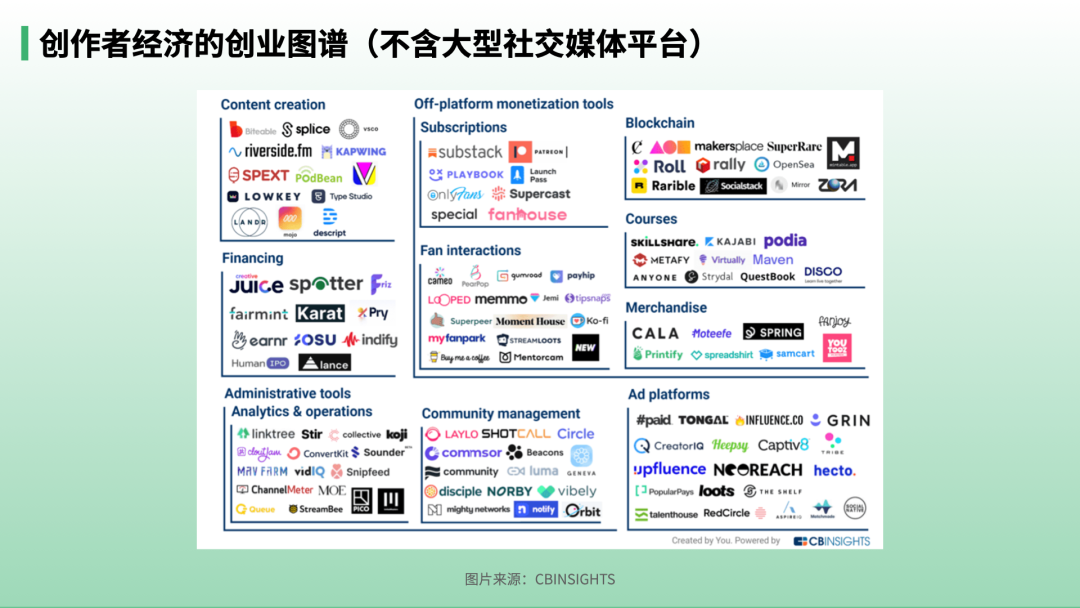
The chart above summarizes various tools serving creators, including content production, de-platforming subscription tools, financial tools, management tools, and advertising platforms.
Creator monetization draws from multiple revenue streams. YouTube was among the first to offer creators ad revenue sharing, followed by brand sponsorships, fan tipping, and e-commerce livestreaming.
The primary driver behind the creator economy's rise is the massive transformation of digital content industries. Especially with the emergence of Web 2.0, content became increasingly personalized, diversified, and fragmented. Web 2.0 refers to a new category of internet applications relative to Web 1.0 (the pre-2003 internet model), typically corresponding to the mobile internet era. In the Web 2.0 era, unlike traditional content generation dominated by professional media institutions, ordinary users began leading content production. On Web 2.0 platforms like Facebook, QQ, and Weibo, massive numbers of users create content daily.
Additionally, creators' mindsets are shifting — they increasingly prioritize personal fulfillment from their work, flexibility in controlling their time, and autonomy. Fans likewise want to see their favorite creators doing work they love, self-sustaining without needing to secure a position at some company.
Four Trends in the Creator Economy
In 2021, the global creator economy market exceeded $100 billion. YouTube's ad revenue reached $28.84 billion, while Douyin's ad revenue was 150 billion yuan — with the majority of content on both platforms produced by creators.
Currently, the creator economy exhibits four trends:
First, de-platforming from major platforms. For overseas creators, de-platforming means leaving large platforms like YouTube and TikTok to shift toward private domains (email, websites, apps) and tool software (subscription and interaction tools). However, breaking away from platforms is no easy feat. In China, some creators are making efforts in private domains, but overall they remain more closely partnered with platforms.
Second, some creators are choosing to operate as businesses, assembling teams while the creator themselves remains focused on content creation.
Third, in the Web 2.0 era, platforms and creators engage in continuous negotiation. Platforms prefer to see forests throughout their ecosystems rather than a few towering trees absorbing all nutrients. Hence, we see creators continuously rising on certain platforms, but few maintaining long-term prominence.
Fourth, amid this platform-creator negotiation, new developments have emerged. For example, combining Web3 with the creator economy, using NFTs in a decentralized manner to intervene in the creator economy and help creators capture more value. We'll expand on this in the next section.
Overall, the creator economy consists largely of user-generated content (UGC), reshaping content industries previously dominated by organization-generated content (OGC) and professionally generated content (PGC). It has profoundly influenced the trajectory of media, entertainment, advertising, and education. From Sina and Sohu to WeChat official accounts, from iQiyi, Youku, and Tencent Video to Douyin and Kuaishou, we can discern the evolution of media and entertainment. Advertising shifts alongside media changes. In education, knowledge influencers have transformed the stereotypical image of teachers.
However, the creator economy has clear limitations. Individual-produced content is inherently limited in scale and difficult to replicate. Moreover, pronounced head effects exist in the market — most "mid-tier" and "long-tail" creators lag significantly behind top creators in follower count and commercial partnerships.
How Web3 and NFTs Could Transform the Creator Economy
Web3 refers to a new internet paradigm incorporating decentralization, blockchain technology, and token-based economics, viewed as the successor to Web 2.0. NFTs (Non-Fungible Tokens) are a type of token within the Web3 ecosystem that can represent a unique "digital asset," serving as electronic certification or proof of ownership for virtual goods such as photos, videos, and audio.
In the Web 2.0 era, platform companies like YouTube, Instagram, and Douyin hold the power to monetize digital content. Meanwhile, ownership of this digital content likewise belongs to platform companies, indirectly converted into their valuations or market capitalization. Additionally, digital content products struggle to achieve "scarcity" like physical goods, leading to piracy, monetization difficulties, and creators' inability to establish and manage rights over their content.
Web3 and NFTs introduce "scarcity" to digital content products, forming unique "digital assets." The associated rights primarily include honorary status (such as becoming a superfan), special privileges (communicating with creators, meeting them, accessing exclusive communities), and partial ownership or revenue rights (locked through technical means like smart contracts).
Creators can raise funds by directly selling "shares" of these digital assets (i.e., NFT tokens) to users, enabling them to sustain the creation of high-quality content, attract more fans, and build greater influence. A portion of the creator's earnings can also be automatically distributed to holders of the digital asset through smart contracts.
If this vision of rights distribution becomes reality, we'll see new internet platforms emerge on Web3, hosting large numbers of creators and fans. On these platforms, people will be able to exercise more robust governance rights, distribution rights, and ownership of financial assets.
It's worth noting that Web3 and NFTs currently face regulatory compliance challenges in every country—resolving these will be essential for long-term development.
▍Two Creator Economy Innovation Cases
As mentioned earlier, the creator economy is primarily enabled by two types of players: internet platforms and software tools. Platform entrepreneurship opportunities are relatively scarce; most opportunities start at the tools layer. Content production, financial tools, management tools, and advertising platforms all represent potential areas for new ventures.
There's a saying that on short-video platforms like Douyin and Kuaishou, you should first figure out what content you can produce, then consider what products you can sell. Producing quality video content requires good content production tools. FreeS Fund portfolio company Tabcut (Te Kan Technology) is dedicated to serving global video-commerce businesses through video SaaS. Tabcut primarily addresses the video needs of overseas e-commerce companies (especially cross-border businesses going global), providing services across tools, content, and operations. Tabcut not only uses AI to help streamers swap faces, but also helps them analyze marketing data and serves as a business intelligence advisor.
Beyond the content domain, the creator economy is also penetrating digital service industries. FreeS Fund portfolio company Bodypark represents a new creator economy model in fitness. On the BodyPark platform, trainers serve as both creators and service providers, using the platform's AI technology and online teaching tools to offer users more convenient and efficient online personal training. Specifically, AI can recognize trainees' movement posture key points in real time, evaluate repetition count and quality, and provide gamified instant feedback to enhance training immersion. Meanwhile, AI assistance significantly frees up trainers' attention bandwidth, allowing them to serve more trainees simultaneously, thereby improving service efficiency and generating greater per-unit-time economic returns.
New Organizational Form Four: Volunteer Collaboration Communities
"New technologies make new kinds of groups possible." In the view of Clay Shirky, author of Here Comes Everybody: The Power of Organizing Without Organizations, electronic networks are giving rise to new forms of collective action, and collaborative groups larger and more dispersed than ever before in history will emerge as a result. The work these non-institutional groups can accomplish poses a profound challenge to traditional company-based collaboration.
Volunteer collaboration communities are one such new form of group. They refer to spontaneously organized groups formed through social tools for information sharing, cooperative coordination, and collective action. Wikipedia and open-source communities are typical examples of volunteer collaboration communities.
Volunteer collaboration communities have distinctive characteristics: First, membership boundaries are completely open, with relatively free entry and exit. Second, intellectual property is open and shared among members and with outsiders, avoiding redundant reinvention of the wheel. Third, members can freely choose tasks that interest them—there is no mandatory assignment. Fourth, volunteer collaboration communities typically lack cash incentives; motivation comes more from psychological rewards such as learning new things, meeting like-minded friends, and gaining community status.
Compared to hierarchical organizations like companies, volunteer collaboration communities escape the constraints of management costs and can aggregate large populations at extremely low cost. They enable distributed exploration, spontaneous innovation, and repeated trial-and-error. In some domains, they may achieve results previously unattainable by hierarchical organizations—such as software, hardware, food and beverage, and digital content. In the future, volunteer collaboration communities have the potential to expand into multiple industries.
Termites Building Nests: A Self-Organizing Coordination Mechanism Called "Stigmergy"
We can discover the secrets of group collaboration in the biological realm. Stigmergy (also translated as "consensus activeity") was proposed by biologist Pierre-Paul Grassé. The core rule of stigmergy is that individuals influence partners by releasing information into the environment, ultimately forming collective intelligence. This coordination mechanism is well-suited for large-scale group collaboration and communication—it requires no central control and proves more effective than verbal communication or direct observation.
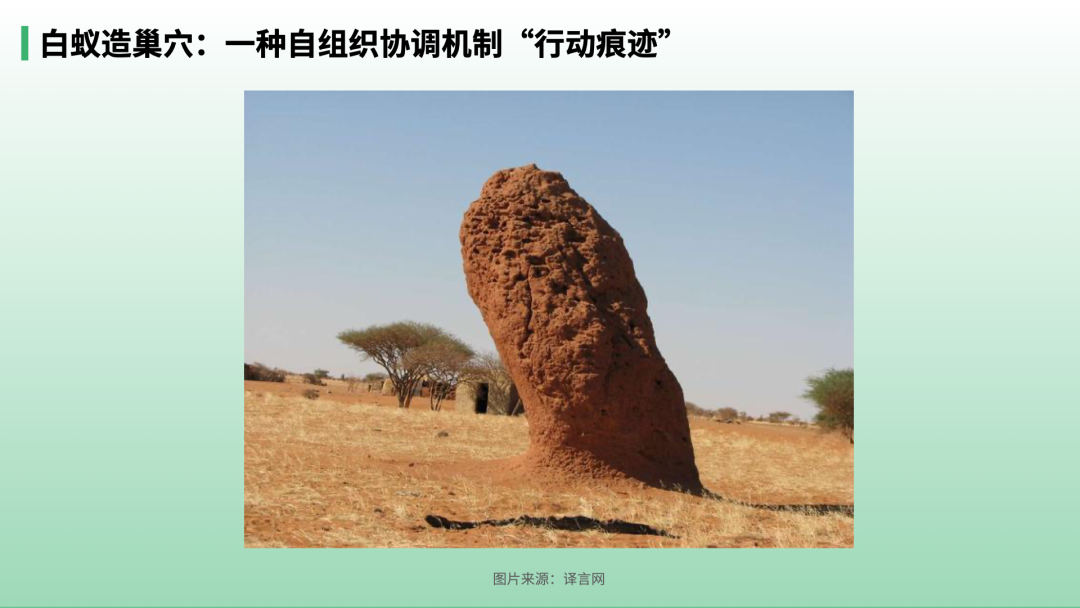
This scholar's research found that seemingly weak termites can build nests several meters tall thanks to this self-organizing coordination mechanism. A termite takes a mouthful of soil, secretes liquid to form it into a ball, injects pheromones into it, and places it on the ground. Other termites sense these pheromones and add their own pheromone-laden mud balls to the pile. The larger the mound grows, the more attractive it becomes, and the more mud termites add—thus completing nest construction. Through these simple rules, they find the optimal solution of collective intelligence and successfully adapt to diverse ecological environments across Earth.
The cases of Wikipedia and open-source communities discussed below represent large-scale human collaboration mediated through the environment, producing collective intelligence.
Wikipedia: Everyone Can Participate, Yet No Need to Fear "Vandalism"
Wikipedia is a multilingual free online encyclopedia written and maintained by an amateur volunteer community through open collaboration based on the wiki editing system. As of November 2020, Wikipedia received 2 billion unique device visits and over 17 million edits per month (1.9 per second), with approximately several hundred thousand monthly active editors.
Wikipedia has earned praise for its content reliability. When browsing Facebook and YouTube, users sometimes see a Wikipedia link alongside content, alerting them that the information they're viewing may be questionable and suggesting they click through to Wikipedia for verification. During the COVID-19 pandemic, the World Health Organization partnered with Wikipedia to debunk misinformation related to the virus.
Wikipedia wants anyone to be able to participate in editing any entry, but this freedom raises the question: does it lead to "creative destruction" or "creative construction"? Practice has shown that if someone deliberately vandalizes content, volunteers will correct it, and users can also access historical versions to circumvent information chaos caused by malicious changes.
It's difficult for any company in the market to gather several hundred thousand people to continuously update tens of millions of entries without paying wages. This is the essence of Wikipedia's vitality.
Open-Source Communities: How Does the "Bazaar" Compete Against the "Cathedral"?
The open-source model is a decentralized development approach that encourages open collaboration, making source code, blueprints, and documentation freely available to the public. There's even an open-source cola. Unlike traditional Coca-Cola, which guards its formula as a trade secret, open-source cola's recipe is publicly released and people are encouraged to reuse it.
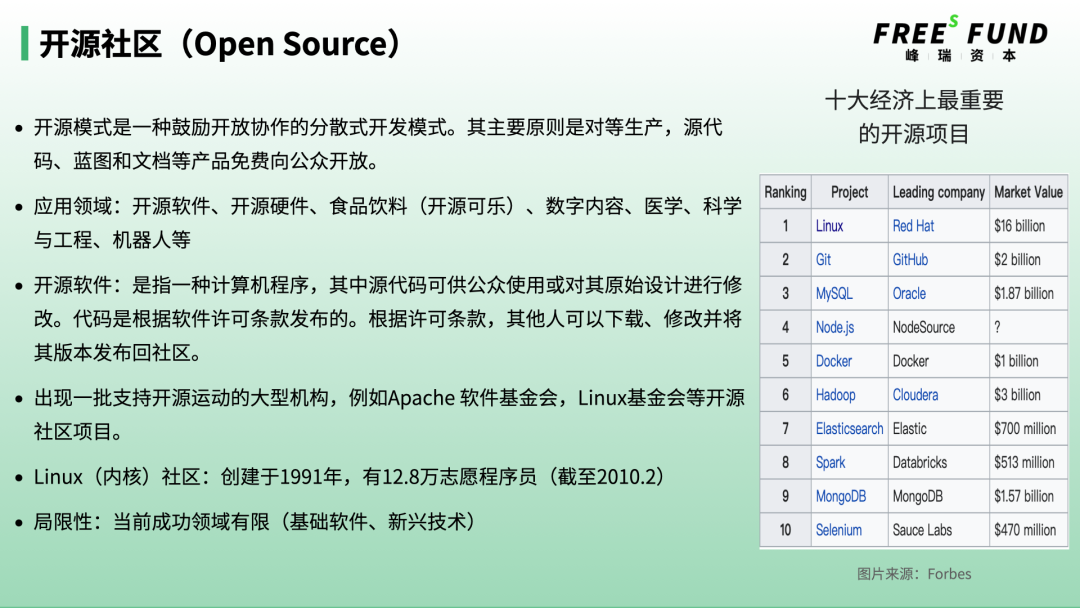
The best-known application of the open-source model is open-source software. The figure above lists the ten most economically valuable open-source projects, with Red Hat Linux at the top, valued at approximately $1.6 billion.
Eric Steven Raymond discussed the cathedral and bazaar development models in The Cathedral and the Bazaar. Commercial software adopts the cathedral model: more centralized management, stricter processes, crafted by professionals in relatively serious and closed environments, with source code not released after software distribution. Open-source software adopts the bazaar model: source code is made public on the internet during development, with early release, frequent release, and heavy delegation—highly open.
Why could a bazaar-model community like Linux (referring to the kernel hereafter) defeat some commercial software?
First, open-source software communities can freely aggregate large populations for rapid iteration. As of 2010, Linux had 128,000 volunteer programmers. Nearly 130,000 people jointly building an operating system kernel. Everyone contributes, enabling massive spontaneous innovation and repeated trial-and-error through distributed exploration. Commercial companies cannot afford to hire this many employees to work together.
Second, open-source software communities have "Linus's Law." Linus is the founder of Linux; he stated that with enough testers and developers, bugs are easily found and fixed. Moreover, open-source communities make information public and source code open, which facilitates rapid bug resolution.
Third, open-source software communities are better positioned to capture genuine user needs. In communities like Linux, most users are enthusiasts or actual users of the software. The community can continuously collect feedback from these groups to know which direction the product should develop. Most commercial software, by contrast, is developed behind closed doors, making it difficult for developers to gather user opinions at scale.
An Economic Interpretation of Volunteer Collaboration Communities: Doing Serious, Complex Work Below the Coasean Floor
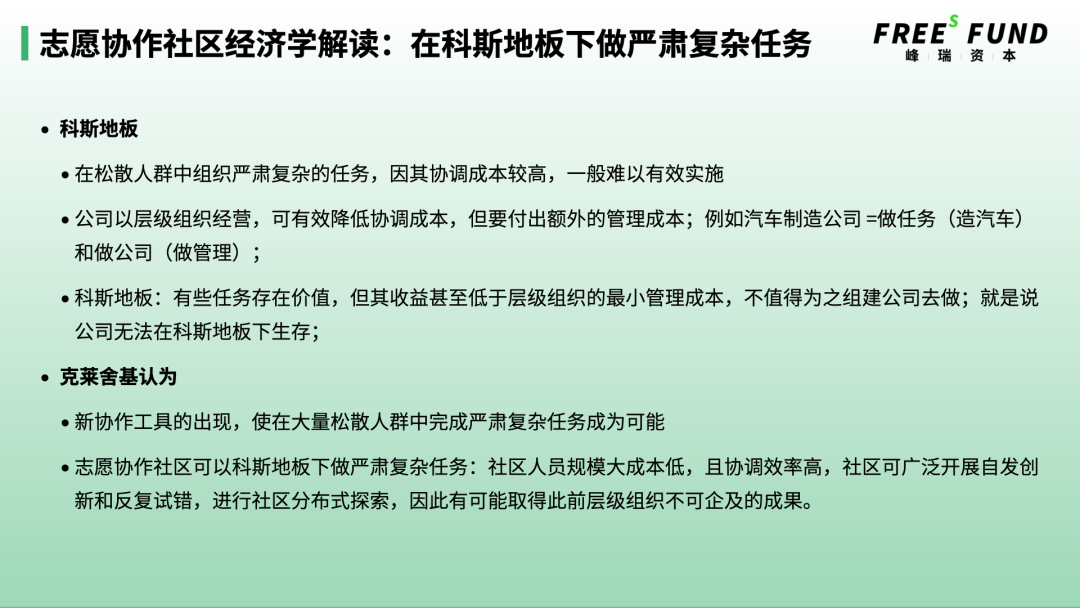
From an economic perspective, we can also see the revolutionary significance of volunteer collaboration communities.
Economist Ronald Coase explained the nature of the firm: firms emerge because the cost of organizing production through firms is lower than the cost of everyone transacting directly and providing services to one another. Simply put, loose groups struggle to accomplish things because coordination costs among members are relatively high, while hierarchical firms reduce coordination costs by paying management costs.
Clay Shirky, in Here Comes Everybody: The Power of Organizing Without Organizations, proposed the corresponding concept of the "Coasean floor": the emergence of various social tools enables people to achieve large-scale coordination at low cost, allowing serious, complex work to be implemented without institutional direction. Loosely coordinated groups can now achieve results previously difficult for organizations to attain because they operate beneath the "Coasean floor," unconstrained by its theory.
Today, various social collaboration tools are maturing. Especially in technology, where iteration, development, transformation, and cyclical upgrading occur on IT foundations, digital coordination tools improve efficiency and reduce overall management costs. Thus, open-source communities like Linux can operate beneath the "Coasean floor," building an operating system kernel that defeats commercial software at extremely low management cost.
3DR vs. DJI: Can Community Organizations Defeat Hierarchical Organizations?
It is generally believed that community organizations perform better at unexpected innovations and are more suited to accessing hidden knowledge. When innovation becomes complex and uncertain, however, communities often underperform compared to companies.
We can find examples in the business world that confirm these conclusions. 3D Robotics (hereinafter referred to as 3DR) and DJI both made drones — the former was primarily community-driven, while the latter was a typical hierarchical organization. To some extent, both experienced similar technological changes, but their strategies for solving problems differed, and their ultimate outcomes were vastly different.
In 2007, Chris Anderson, former editor-in-chief of Wired magazine, created an online community for drone enthusiasts called DIY Drones. To address the community's emerging need for manufacturing components, Anderson founded 3DR within the community in 2008. Thus, 3DR's innovation was primarily based on a community of 1,000+ users. In 2006, Wang Tao, then pursuing a master's degree at The Hong Kong University of Science and Technology, decided to start a company to tackle consumer drone solutions.
Stanford scholars published a paper comparing how the two approached innovation practices: Experimentation, Bottlenecks, and Organizational Form: Innovation and Growth in the Emerging Drone Industry. The paper identified three critical development junctures for both organizations:
1. How to fix product architecture flaws?
When drones first appeared, they were difficult to control and lacked safety. In 2009, several core 3DR community members discovered the quadcopter architecture in an online drone racing enthusiast community. Community members quickly completed quadcopter flight control code, quadcopter frame design and assembly, and DIY toolkits. 3DR refined the design and began producing and selling DIY kits in 2010.
Meanwhile, in 2010, the DJI team was still working to improve helicopter-architecture flight controllers. In 2011, prompted by a New Zealand distributor, DJI also began developing and completed a quadcopter flight controller, launching DIY kits in 2012.
To some extent, 3DR won this stage — it discovered hidden knowledge through the community and rapidly applied it to products.
2. How to find the killer app
The second bottleneck was discovering the killer application. Starting in 2011, the DJI team ran parallel experiments across multiple vertical markets, exhibiting domestically and internationally and conducting in-depth interviews. They identified high-quality aerial photography as a potential market opportunity, but drone footage quality was poor, requiring development of a drone gimbal. However, drone gimbals are extraordinarily complex, requiring expertise across multiple disciplines while ensuring integrated design, with tightly coupled components that easily affect one another. In 2012, DJI developed a gimbal and rapidly iterated to complete gimbal R&D, thus opening the high-quality aerial photography market.
The 3DR team, however, was slow to discover the aerial photography market and failed to recognize low-quality video shooting as a major bottleneck. In 2014, 3DR attempted to organize core community members to develop a gimbal, but because community members wanted open-source development while 3DR sought intellectual property rights, R&D stalled. With no alternative, the 3DR team decided to outsource, yet setbacks continued. In 2016, with community member assistance, 3DR finally completed gimbal development.
In this contest, DJI was first to identify the product bottleneck, tested multiple solutions, and — with an engineering team aligned in goals and pace — rapidly advanced product development. 3DR relied too heavily on ideas emerging from the community, and because the R&D chain was complex, the community's ability to mobilize and integrate was comparatively weak, causing it to miss development opportunities.
3. How to make drone assembly easier for users?
Before RTF (Ready to Fly) drones were developed, users had to assemble drones themselves — a significant challenge for beginners. The market urgently needed a "take it out of the box and fly" drone.
Starting in 2012, DJI adopted a "modular yet integrated" approach, using parallel competing teams in a "horse race" format, gradually replacing key components with self-developed ones. In 2013, DJI launched its first RTF drone. It wasn't until autumn 2013 that 3DR began R&D on RTF drones, adopting an overall modular design approach. Communities are well-suited to modular R&D, but system integration difficulty was a major hurdle for 3DR.
In 2015, 3DR launched its RTF drone two years after DJI. But by then DJI had released new products and significantly cut prices on older models, causing severe inventory backlogs for 3DR. In 2016, 3DR exited the drone hardware industry.
In summary, community organizations easily discover innovative solutions because of broad exploration and low-cost individual experimentation; community output tends to be rewarded when emerging markets are just beginning. But when markets develop to a certain point and innovation becomes complex and uncertain, communities generally underperform compared to companies.
This isn't absolute, however. Sometimes communities can solve complex problems too. Modularity and increasingly rich digital communication and coordination tools allow large volunteer collaboration communities to coordinate production more efficiently.
Of course, beyond the reasons mentioned above, DJI's victory in the drone hardware market also relates to the company's location in Shenzhen, closer to China's hardware design and manufacturing supply chain.
▍Problems and Solutions for Volunteer Collaboration Communities
Volunteer collaboration communities face two obvious challenges. One is participant motivation — the vast majority participate out of passion, and sustained motivation is questionable. The other is ownership of leadership — how to handle property rights while ensuring sharing. Both involve issues at the level of production relations.
In theory, Web3 governance mechanisms like DAOs might address these problems. For example, in March 2022, a DAO called tea was established, dedicated to solving incentive problems for contributors to foundational open-source software projects. Through tea, open-source contributors receive token rewards based on total software usage and contribution level.
**/ 06 / **
New Organizational Form Five: Decentralized Autonomous Organization (DAO)
A decentralized autonomous organization (DAO) is a new organizational form based on blockchain technology. Its major organizational rules are predetermined and automatically executed by smart contracts, thereby ensuring aligned participant interests and jointly achieving organizational goals.
Compared to traditional companies, the new organizational forms mentioned earlier — creator economy, crowdsourcing, volunteer communities — each have their own advantages in improving productivity and production efficiency. But at the level of production relations, these new organizations face numerous challenges, such as participant incentives, ownership of leadership, platform governance, and distribution system design. If these new organizations simply copy production relation systems designed for traditional corporate organizations, they will inevitably experience "incompatibility." One view holds that organizational systems like DAOs may represent one new pathway for solving such new organizational management challenges.
▍DAO: A New Blockchain-Based Approach to Organizing People
A DAO is a transparent, smart-contract-based organization controlled by all stakeholders, unaffected by centralized institutions. A DAO's financial transaction records and program rules are stored on the blockchain, immutable. The organization achieves self-operation, self-governance, and self-evolution through transparent management rules and token economic model incentives, thereby maximizing organizational effectiveness and value circulation.
Compared to the traditional corporate paradigm, DAOs have more equal and freer organizational structures. DAOs are founded based on community consensus; members share relatively aligned positions, participate voluntarily, and are free to join or leave. Second, DAOs have more flexible incentive mechanisms. Community members are both laborers and owners; interest and value distribution is guaranteed through smart contracts, with completely transparent decision-making and operations.
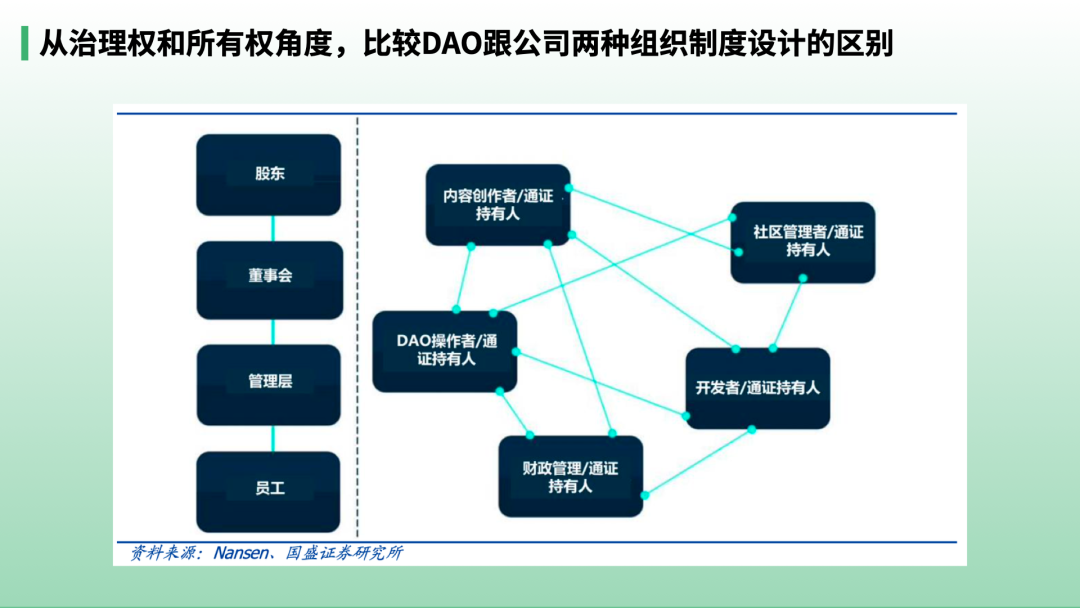
The above image compares DAO and corporate organizational system designs from the perspectives of governance rights and ownership. Compared to corporate systems, DAO governance rights and ownership are more dispersed, accommodating various stakeholders.
For those accustomed to corporate systems, this organizational design seems somewhat idealistic, and immediately raises questions: Does this design make decision-making more complex? Does it reduce operational efficiency? Does it weaken incentives for core members? After all, traditional corporate management models tend toward elite governance, where a small number of people make important decisions independently after hearing input from most internal stakeholders.
Second, for startups, we typically want core teams to hold a large proportion of company shares, to provide greater motivation to overcome all obstacles and build something significant. But currently, core team share concentration in startup DAOs is often lower than in "traditional" startups.
DAOs still face many problems and challenges, but their innovations and highlights should not be overlooked. Through continuous trial and error by entrepreneurs and adventurers, DAO system designs are also iterating and optimizing.
▍Current Types of DAOs
Based on organizational goals, DAOs can be divided into several major categories, as shown in this chart from Guosheng Securities Research Institute.
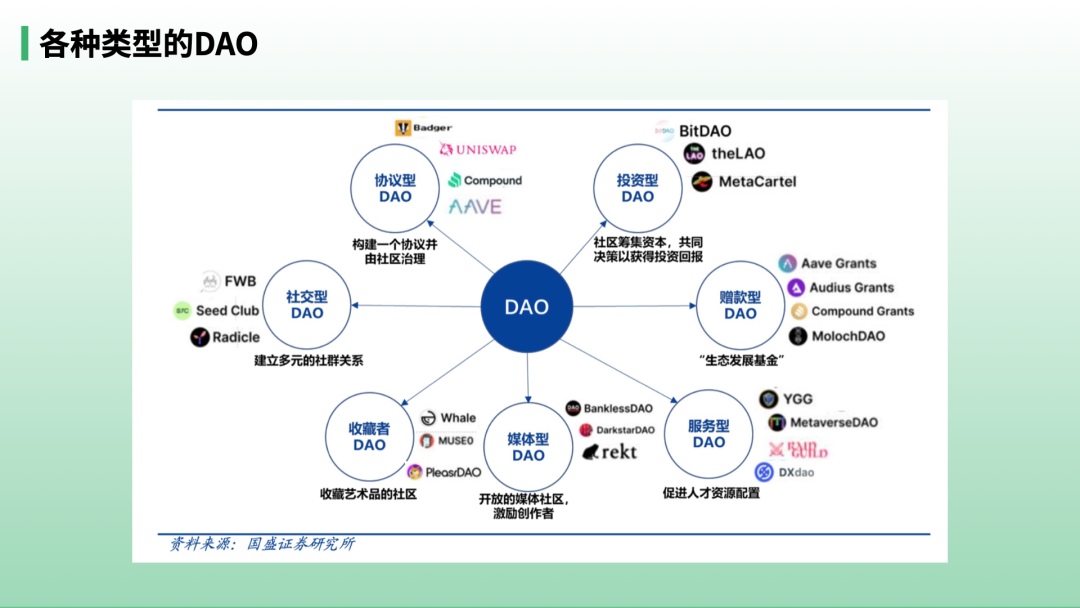
Take service DAOs as an example: their goal is to gather various talents and provide consulting, R&D, marketing, and other services to other blockchain projects in small team formats. This somewhat resembles the crowdsourcing platforms mentioned earlier, but with improvements and iterations on that foundation.
Media DAOs look somewhat like Wikipedia, but more like creator-friendly content creation platforms. In the future, will media content platforms like YouTube, Instagram, and TikTok emerge on the blockchain?
▍DAO Cases Related to Work and Employment
Some DAO organizations related to work and employment have already emerged. Let's introduce one called Braintrust.
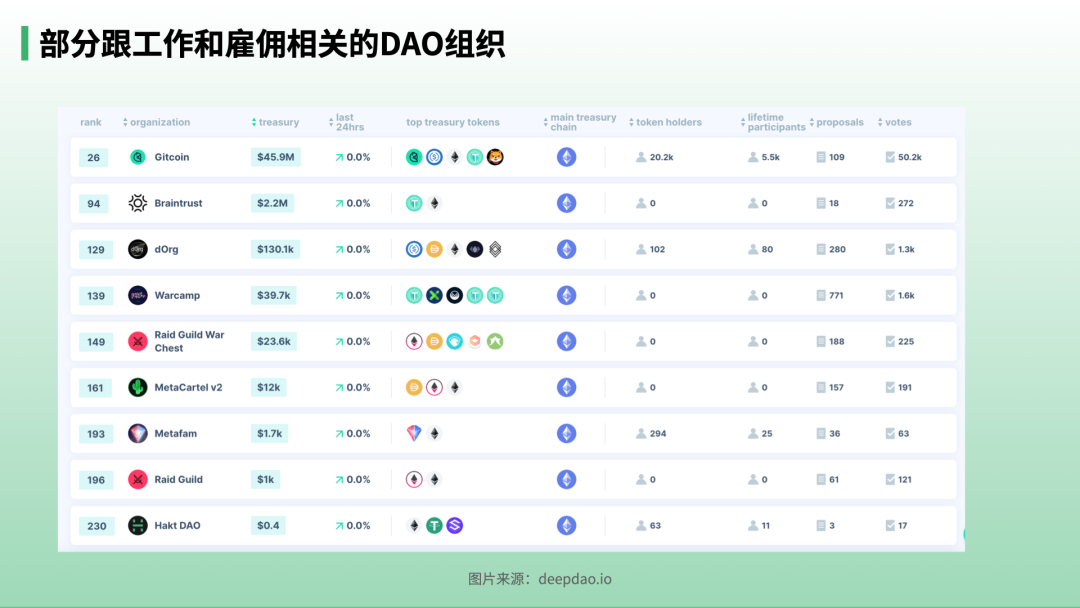
Braintrust is a talent marketplace powered by blockchain technology and cryptocurrency. Compared to traditional talent intermediary platforms, Braintrust charges lower fees and gives users governance rights. Braintrust allows users to choose work flexibly, efficiently, and freely. In June 2020, Braintrust's client base more than tripled. In 2021, job postings on the platform more than tripled. Braintrust's business model somewhat resembles the professional task crowdsourcing platform Upwork mentioned earlier, but it is a DAO organization on the blockchain.
▍Challenges and Problems Facing DAOs
As a new organizational form, DAOs currently face numerous problems and drawbacks. First, because DAOs are built on public blockchain infrastructure (primarily Ethereum), they encounter issues around regulatory compliance and legal protection. Second, communities need to make complex, integrated decisions and execute on them — processes that may not be fully realizable through code and smart contracts alone. Third, decision-making and execution in large communities can be slow and require further optimization.
That said, developing any new organizational mechanism is always a lengthy process. The theories and tools surrounding the corporate system also underwent long iterations and evolution. Given time, the governance frameworks designed for DAOs can gradually mature through continued exploration.
It's worth noting that Web3 and NFTs in any country currently need to resolve regulatory compliance issues in order to achieve more sustainable development.
**/ 07 / **
Summary
▍Future Trends in Human Work
1. Work will take more diverse forms
Boundaries will be broken — of time and space, language, and identity. Beyond humans, non-human agents will also be able to participate in work interactions.
Organizational forms will become more varied. They may be companies, communities, individuals, or some combination of the three, or even entirely new organizational types. Centralized and decentralized structures may coexist.
Individual choice will be respected. When choosing work, people will be more driven by interest, join voluntarily, and exit flexibly, meeting their needs for work-life balance.
Deep global collaboration. Future work will have opportunities to organize talent from around the world for in-depth collaboration across production, R&D, creativity, and more.
2. The core remains the double-helix upgrade of productivity and production relations
Productivity will keep rising. Upgrades to various production tools (including organizational forms, coordination methods, and remote collaboration) will bring major gains in efficiency and improvements to individual work experiences.
Production relations will be continuously optimized. Governance and incentive mechanisms will keep improving. By combining the strengths of volunteer communities, DAOs, and corporations, and by thoughtfully designing production relations, governance and distribution can become fairer and more efficient — further improving individual work satisfaction.
▍Entrepreneurship and Investment Opportunities Related to Future Work
1. Work going online: With the development and widespread adoption of mobile telecommunications, internet access, remote conferencing, collaboration software, cloud computing, and other technologies, online work is becoming normalized. Tools ordinarily used for offline company management have an opportunity to be rebuilt for remote employment scenarios — such as online collaboration tools, cross-border compliance services, and remote HR.
2. Volunteer collaboration communities: Volunteer collaboration communities currently have relatively limited application scenarios. Going forward, there are opportunities for them to penetrate deeply into every industry, including but not limited to software, hardware, food and beverage, and digital content. This space likely contains significant entrepreneurial opportunities.
3. Flexible employment: The development of flexible employment has two trends: in breadth, penetrating into a wider range of industries; in depth, moving toward more complex tasks requiring collaboration. In this evolution, entrepreneurial opportunities exist — such as creating the "Upwork" or "Uber" of new sectors or directions.
4. Creator economy: There are potential entrepreneurial opportunities in content production, financial tools, management tools, and advertising platforms. The creator economy is already showing a trend of expanding from content production into digital services, which also presents considerable startup and investment opportunities.
5. Compliant products inspired by DAO thinking: DAOs as a new organizational form have innovative value, but still have a long road ahead in terms of regulatory compliance in various countries. Creating compliant products that draw on DAO concepts is also a promising entrepreneurial direction and investment opportunity.
Reader Engagement
Share your thoughts on the future of work in the comments section. The 6 most thoughtful commenters will receive a box of Saturnbird instant specialty coffee (each box contains 3 No. 3 and 3 No. 5 coffee capsules).


How to Further Explore the Body's "Smartest" Organ? | FreeS Research Institute
▲ New Strategies for Going Global: From "Air Force" to "Marine Corps" | FreeS Research Institute · Going Global Series
▲ FreeS Report 25: Food Investment Through the Lens of China's Dietary Structure
▲ FreeS Report 24 | Embracing the "Smartest" Opportunity: Investing Boldly in Brain and Neuroscience
▲ FreeS Report 23: Crossing the "Valley of Death": Systemic New Opportunities in Small-Molecule Drug R&D