What Are the Opportunities for Biotech Over the Next Decade? | A FreeS Fund Conversation

Breaking Through the "Great Stagnation" in Technology: Biotechnology Is a Critical Breakthrough
Not long ago, at the "2022 Penn Wharton China Summit (PWCS)" biotech roundtable, FreeS Fund partner Rui Ma joined XtalPi co-founder and Chairman Shuhao Wen, Bluepha co-founder and CEO Haotian Zhang, NeuraMatrix co-founder and CEO Kecheng Wei, and ZSFab co-founder and CEO Jing Zhang for a discussion on the opportunities and challenges in biotech venture capital over the coming decade. We've edited portions of the roundtable conversation into this article.
Dr. Shuhao Wen is co-founder and Chairman of XtalPi, and an adjunct professor at Zhejiang University. He spent 11 years studying, researching, and working at the Chinese Academy of Sciences, University of California, and MIT, building extensive research experience and theoretical contributions in computational physics and quantum chemistry. The prediction algorithms he led the development of enable fast, accurate predictions of complex molecules, representing a breakthrough technological advance for the field. In 2014, while conducting postdoctoral research at MIT, Wen co-founded XtalPi with partners and became Chairman.
In 2016, FreeS Fund invested in XtalPi's Series A+ round. We've witnessed XtalPi's efforts along the pharmaceutical value chain — from algorithms and computing power to automated experiments and foundational research — applying new artificial intelligence algorithms to broader chemical space for drug discovery, predicting key drug properties, biologics discovery, and optimizing late-stage small-molecule drug development processes.
Haotian Zhang is co-founder and CEO of Bluepha. He holds a bachelor's in biological sciences and a Ph.D. in integrated life sciences (physics) from Peking University, with over 20 research papers published in top academic journals. He also serves as a committee member of the Synthetic Biology Branch of the Chinese Society of Biotechnology, Chairman of the Synthetic Biology Design and Manufacturing Joint Innovation Center at the Chinese Academy of Sciences' Shenzhen Institute of Advanced Technology, and editorial board member of Synthetic Biology magazine. This year, Zhang was selected for 36Kr's "X·36Under36" annual "S-tier Entrepreneurs" and Fortune's annual "40 Under 40" business elites.
Bluepha is a FreeS Fund angel-round investment, with FreeS Fund participating in six consecutive rounds — because we believe in synthetic biology, and in the greener, healthier, more powerful products that biotechnology can bring.
The moderator for this discussion was FreeS Fund partner Rui Ma, who focuses on materials and biotech investments, with particular attention to computation-driven approaches, synthetic biology, frontier technologies, and novel therapeutics. Representative portfolio companies include Bluepha, NeuraMatrix, XtalPi, METiS Pharmaceuticals, ChemX, ChipSage, and XinYong Technology. Before joining FreeS Fund, Ma worked at the Ministry of Ecology and Environment, with deep involvement in national policy and planning development. He holds a Ph.D. in civil and environmental engineering from Carnegie Mellon University, and master's and bachelor's degrees from Tsinghua University.
Ma and the two founders explored the following questions:
- Under the "capital winter" in U.S. equities, how should we view biotech investment opportunities over the next decade?
- To break through the "Great Stagnation" in technology, where lies the breakthrough point?
- How can artificial intelligence accelerate drug R&D?
- Why can synthetic biology bring new possibilities for manufacturing transformation and upgrading?
- From laboratory to industrialization, what challenges does synthetic biology face?
- Faced with uncertainty, what can startups do?
- Why does the ability to achieve innovation test organizational capacity?
- What challenges and opportunities does an immature entrepreneurial ecosystem bring?
We hope this offers fresh perspectives, and look forward to exchanging ideas with you. Feel free to contact Rui Ma at FreeS Fund (marui@freesvc.com).
Giveaway From your perspective, what entrepreneurial opportunities exist in biotech? Share your thoughts in the comments. The 6 most thoughtful commenters will receive a FreeS Fund custom edition of The New Megatrends: Eight Forces That Will Shape the Future. We look forward to finding certainty amid change together, and staying sharp.


/ 01 /
Biotech is a crucial breakthrough point for breaking through the "Great Stagnation"
Rui Ma: I'm Rui Ma, and I lead biotech investing at FreeS Fund. Before we begin the roundtable, I'd like to share some brief thoughts on "biotech investment opportunities over the next decade."
In his article "Biotech's Dulled Horns: A Survivor's Guide to the Downturn," RA Capital founding partner Peter Kolchinsky noted that compared to its 2021 peak, the overall biotech sector has lost roughly 60% in market value. Even compared to 2018, this decline is substantial and prolonged. Of the 477 publicly traded biotech companies in the U.S., about one-fifth trade below their liquidation value.
This situation stems partly from the historic rally in U.S. biotech equities during 2020–2021; the downturn since February 2021 reflects a natural valuation correction. By late 2021,叠加 macro factors — particularly U.S. inflation, interest rate hikes, new COVID waves, the Russia-Ukraine war, and resulting supply chain fragmentation — the sector continued to decline.
However, for the U.S., the "science-innovation-commerce" connection hasn't fundamentally broken. The top 20 large pharmaceutical companies continue to generate record profits and replenish their pipelines and ammunition. These companies generate roughly $700+ billion in annual drug sales, with perhaps $200+ billion reinvested into R&D. Meanwhile, while the growth rate of primary market funding has slowed, the absolute amount remains substantial.
So even from today's vantage point, while U.S. equities may be in a so-called "winter," the commercial essence from research to product remains intact. For China, the issue may still be insufficient innovation requiring sustained investment — a gear shift or adjustment period.
Taking a longer historical view, contrary to many people's intuition, productivity growth or technological advancement over the past two decades hasn't been particularly high. If we measure this using "total factor productivity" (TFP) — an indicator of productivity development and technological progress — TFP grew roughly 2.1% annually in the 1950s–70s; after 2005, however, this metric has only maintained about 0.17% annual growth. This is why the past two decades have been characterized as a "Great Stagnation" in technology. Innovation has been largely confined to the digital world (computing, connectivity, mobile internet), and to break through this phase, biotech is undoubtedly a crucial breakthrough point.
To achieve TFP annual growth above 2%, three things matter — and spoiler alert, all point to biotech. First, there must be major scientific breakthroughs and the scaled application of these technologies. Second, this technology should ideally be built on a digital foundation; biotech may be the best suited for digital integration, exemplified by the increasingly emphasized IT + BT (information technology plus biotechnology convergence). Finally, with technology as the underlying layer, it must be able to radiate outward to other industries. Giants like Alibaba and Tencent operate within the boundaries of the digital world, but synthetic biology (biotech) can connect the digital and physical worlds. This means that biotech, from a long-term perspective, is inevitably an industry very much worth anticipating and investing in.
Based on this overall assessment, here are four related observations:
First, future biotech will feature both technological breakthroughs and commercial applications: in mRNA, gene editing, protein structure prediction, AI drug discovery, synthetic biology, brain and neuroscience, and novel therapeutics — all these fields show potential for both technical breakthroughs and large-scale application.
Second, the "14th Five-Year Plan for Bioeconomic Development" issued by the National Development and Reform Commission in May clearly communicated the development path for the bioeconomy — that is, with biotechnology as the underlying foundation, it can broadly radiate outward to pharmaceuticals, health, agriculture, forestry, energy, environmental protection, materials, and other industries.
Third, optics, imaging, microfluidics, and single-cell technologies are driving the intersection of physics and biology, generating new data. New data brings new biology, allowing us to consider disease through more complex, more realistic conceptual models. New biology plus new tools (delivery, modification, AI) and modalities brings more novel therapeutics.
Fourth, R&D tools or enabling technologies previously considered to offer insufficient returns (enabling technologies refer to one or a series of widely applicable, multidisciplinary technologies that accomplish tasks and achieve objectives) shone brilliantly in 2020–2021. Advances in these technologies and equipment will push the entire biotech industry further forward.
/ 02 /
Bringing algorithms into the microscopic world
Rui Ma: Now I'll hand the floor over to our CEOs. First, please welcome Shuhao Wen, co-founder and Chairman of XtalPi. He'll share on "The New Paradigm of AI in Drug Discovery."
Shuhao Wen: XtalPi's work sits at the intersection of two fields — artificial intelligence and drug discovery — both trillion-dollar industries. The convergence of biotech and AI has become an inevitable trend in industrial development. A few years ago, many biologists might still have questioned whether AI could predict protein structures, but now this field has seen disruptive breakthroughs. In recent years, nearly all first-tier pharmaceutical companies in Europe and America have been exploring how to integrate AI into their solutions. Second, from a capital markets perspective, as Rui mentioned, policy documents have explicitly proposed the digitalization, automation, and intelligentization of the biopharmaceutical industry — a direction containing enormous opportunity.
XtalPi works on AI-driven drug discovery. Drug discovery traditionally relied mainly on human experience and experimental exploration; now we're introducing algorithms, computing power, and robotics. Algorithms were once applied primarily to the macro world, but the macro world is constrained by internet population limits. Now we're bringing algorithms into the microscopic world, where infinite variation offers vastly greater room for imagination.
Pfizer was our first client. They have an article on their website specifically introducing their collaboration with XtalPi. As an industry benchmark, Pfizer still places fundamental physical theory before AI, but also advocates introducing algorithmic computing power to assist underlying foundational scientific R&D — for example, through cloud-based supercomputing to help complete predictions for certain critical steps in the drug discovery process, thereby guiding and reducing experimental research.
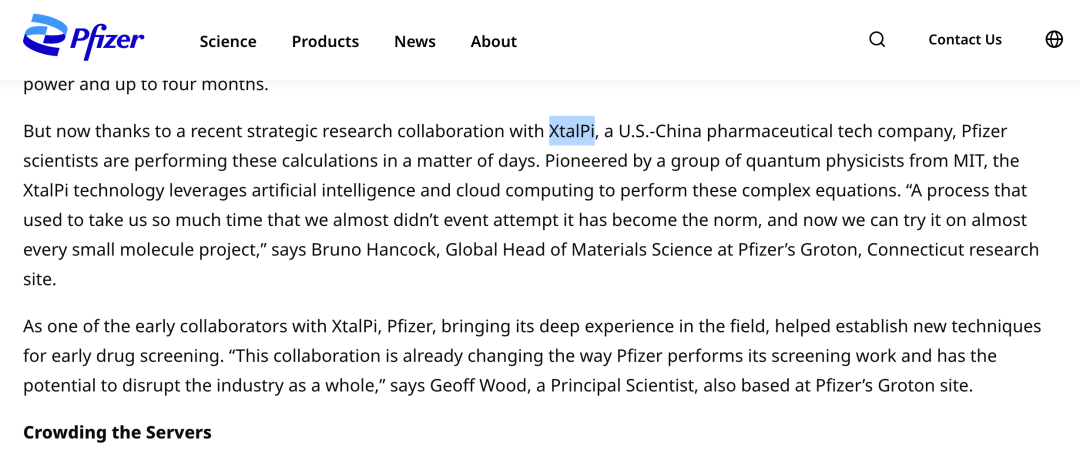
▲ Image source: Pfizer website
The XtalPi team covers quantum physics, computational chemistry, artificial intelligence, cloud supercomputing, automated robotics, and other frontier technology fields. Our team also has the fastest headcount growth globally — by year-end we'll likely have around 1,200 people, including over 200 Ph.D.s. Our intelligent drug discovery platform includes both data-based models and algorithms, as well as high-precision physical models that don't rely on data.
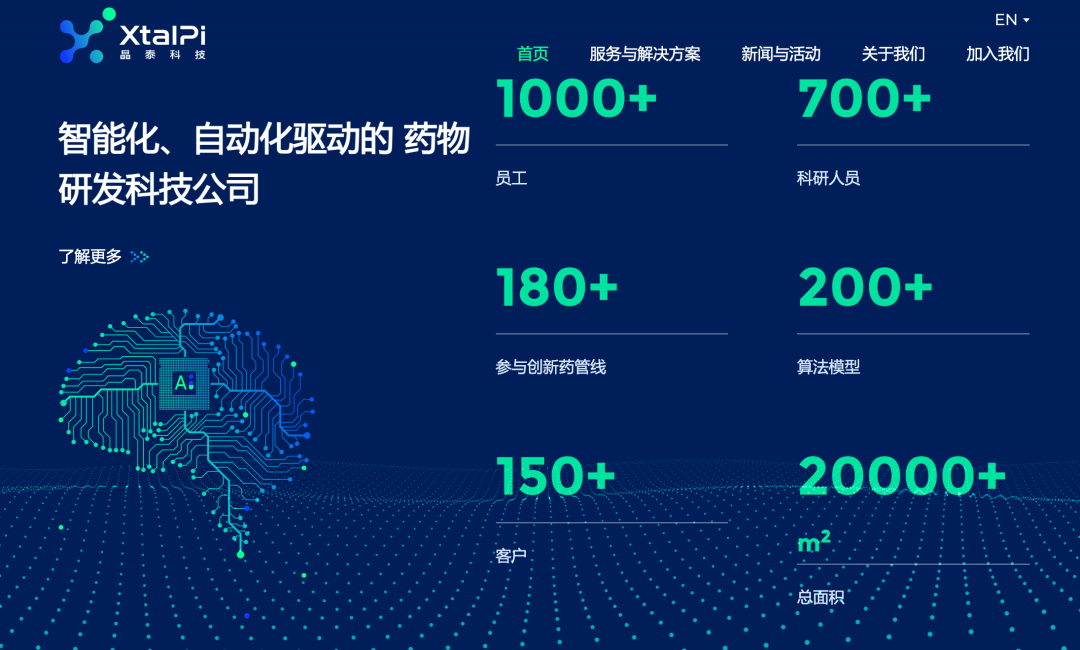
▲ Image source: XtalPi website
Additionally, we've built a concurrent exploratory robot cluster. A major bottleneck in drug discovery is the massive molecular synthesis and testing required. Through robotic experiments, we can easily accomplish concurrent, scaled work — enabling 365 days a year, 24 hours a day of continuous exploratory experiments, with results fed back to our AI algorithms. This is completely different from past human-dependent models. Meanwhile, standardized experiments can avoid much irreproducible work and reduce resource waste.
/ 03 /
Industry acceptance of new technical solutions takes time
Shuhao Wen: At the industry level, acceptance of new technical solutions takes time — from trial to validation to reaching critical mass. Currently, among the world's top 20 pharmaceutical companies by revenue, a large portion are our paying clients. These clients have the most stringent requirements for quality, data, accuracy, and safety standards. If we can satisfy these benchmark clients, our market will be broader in the future, and the promotion and popularization of automation and intelligent technologies will further lower the threshold for drug discovery and reduce costs. This is why our clients include not only major pharmaceutical companies but also many emerging pharmaceutical companies on the rise — they have strong innovation capabilities, and by leveraging our underlying digital infrastructure, they can also push breakthroughs in their drug discovery. Take the development of an oral COVID treatment as an example: we helped compress months of research into six weeks, helping this drug reach the market sooner.
XtalPi is a platform company driven from the bottom up, building new digital R&D infrastructure to make drug development more standardized and scalable, helping the pharmaceutical industry develop more drugs with the same resources and time, more efficiently. Even getting a drug to market one day earlier carries enormous significance. Overall, globally, pharmaceutical companies' demand for new R&D technologies is substantial and very clear. The direction of AI drug discovery will certainly bring greater contributions to human society in the future.
/ 04 /
Traditional manufacturing faces severe challenges; synthetic biology offers new possibilities
Rui Ma: Thank you, Shuhao. Next, please welcome Haotian Zhang, co-founder and CEO of Bluepha. His presentation is titled "Synthetic Biology: The Tiangong Kaiwu of the Bioeconomy Era."
Haotian Zhang: We work in synthetic biology. I must admit, it wasn't until two years ago that my parents finally understood what I do. At first I thought explaining synthetic biology to them would be difficult, until I remembered a book at home — Tiangong Kaiwu (The Exploitation of the Works of Nature). I told them that this book's author was Song Yingxing, a scientist from the late Ming to early Qing dynasty. His book compiled production techniques from agriculture and handicrafts — machinery, bricks and tiles, ceramics, sulfur, candles, paper, weapons, gunpowder, textiles, dyeing, salt production, coal mining, oil pressing, and so on — essentially summarizing the manufacturing technologies of that era. By analogy, synthetic biotechnology can be understood as using biotechnology to assist the transformation and upgrading of manufacturing.

▲ Image source: Bluepha
Over the past three decades, traditional manufacturing based on petrochemicals has faced multiple challenges: climate change, sustainable development, and exhausted growth potential. Innovation in molecules and materials in the petrochemical sector has largely stagnated — demand persists, but the ability to respond to that demand has encountered significant obstacles. A McKinsey report studied 130 business units of major global chemical companies, finding that innovation investment based on new markets and new technologies yielded average internal rates of return of only 8–12%, barely sufficient to cover most chemical companies' cost of capital (typically 9–12%). Bio-manufacturing based on synthetic biology can use renewable feedstocks to produce entirely new molecules and materials, bringing many new possibilities for industrial and product innovation.
Another crucial point is the rapid evolution of underlying technologies over the past two decades, including gene sequencing, DNA synthesis, and gene editing — advancing faster than Moore's Law, driving the explosion of synthetic biology with potential even exceeding that of the early semiconductor industry.
Furthermore, machine learning is rapidly penetrating biotechnology, providing powerful design tools for synthetic biology. Advances in high-throughput experimental technologies and others also enable faster, more intelligent iteration in synthetic biology's "design-build-test-learn (DBTL)" closed-loop construction and cycling.
From laboratory to industrialization, synthetic biology faces new challenges
Haotian Zhang: However, new challenges have also emerged. In the process from laboratory to industrialization, because industrial and laboratory environments differ enormously, once you push toward industrial scale, all kinds of problems arise: at the fermentation stage, industrial-scale production environments bring entirely new challenges for process development; in purification, industrial-scale separation and purification must simultaneously achieve high recovery rates and low costs. For example, in a laboratory environment, using distilled water is fine, but using distilled water in industrial production would be enormously costly, so you might consider using filtered tap water. But this raises many issues, because tap water varies greatly by region, and different ions in the water have major effects on enzyme growth in microorganisms.
Because synthetic biology's product innovation chain is extremely long, Bluepha has accumulated substantial process data and engineering experience in PHA R&D and industrialization. The company uses Industry 4.0 technological elements such as automation and digitalization to capture these data and experiences, reusing them in subsequent new product R&D and commercialization, gradually building an industry-leading strain and process R&D platform with flywheel effects covering the entire product development process. In the future, this will also become one of Bluepha's core competitive advantages.
For example, in the past when we did experiments, perhaps less than 5% of data was effectively usable. Now we use various sensors to capture data during experiments in real time, uploading to the cloud to form databases. All this data is traceable — including who used what methods, did what, used what reagents, at what dosages. Many sensors are being applied in biotechnology for the first time; previously they were mostly used in chemicals, electronics, microelectronics, and other fields. This accumulated data can then be used to train algorithmic models, helping expand the boundaries of human rational cognition. Sometimes things difficult to discover through direct human observation become immediately clear through data comparison. Currently, Bluepha's synthetic biology database leads globally in data scale, quality, and dimensionality.
Let me share some of our more interesting products. Our lead pipeline is "Bluepha™" (PHA produced by Bluepha). Bluepha™ can completely decompose into water and carbon dioxide in virtually all natural environments. 100% of carbon atoms in Bluepha™ come from CO₂ captured from the air by bio-based feedstocks. By our estimates, each ton of Bluepha™ product can bring roughly 2 tons of biological carbon sequestration, helping Bluepha build a demonstrative synthetic biology "zero-carbon industry chain." Beyond carbon footprint, Bluepha™ has also achieved significant reductions in comprehensive costs. In terms of performance, our Bluepha™ can be made into very thin biaxially oriented films with good barrier properties — something we're quite proud of.
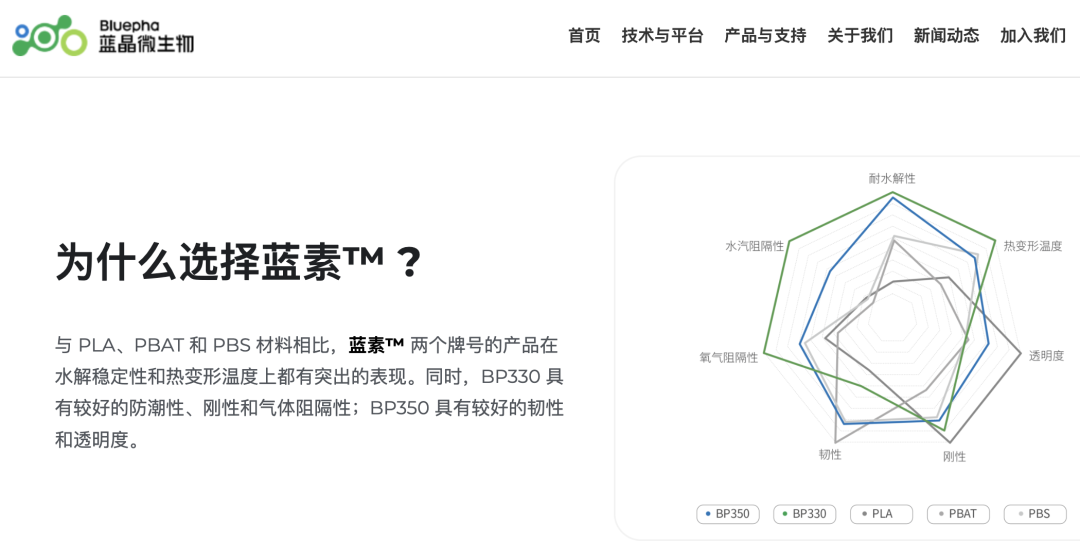
▲ Image source: Bluepha website
Beyond Bluepha™, our main product pipelines also include regenerative medical materials, novel functional beauty ingredients, and new food additives. Going forward, together with more and more partners, we hope to launch a mass-market product every one to two years.
Rui Ma: Right. Recently, Haotian and Bluepha initiated the "Tiangong Kaiwu" Bioeconomy Industry Acceleration Platform. Bluepha Microbiology will gather resources from across the industry to jointly drive sector development.
Faced with uncertainty, grasp what you can and make it your foundation
Rui Ma: Now let's move to the panel discussion. First question: things were going well for everyone these past few years, with plenty of funding raised. Looking ahead, there's considerable uncertainty — whether from COVID fluctuations, U.S.-China relations, or capital markets conditions. How will this affect your strategies?
Shuhao Wen: First, despite all the external uncertainty, it's essential to see clearly the major trends over the next five to ten years. Second, since there's so much external noise, focus internally — build digital and automation capabilities, and solidify organizational and operational capacity.
Additionally, for companies that have raised money, while others may be focused on survival, you need to develop your business counter-cyclically, with customer and market orientation. I also tell colleagues internally that many external clients now face business pressures or challenging R&D situations — as long as they have needs and we can take them on, we should. Building good cooperative relationships and trust with clients lasts longer, which in turn drives our own internal algorithms, processes, and team building. Any great company must have gone through entrepreneurial cycles; the more it's like this, the more opportunities it may contain.
Whether you can achieve innovation tests organizational capacity
Haotian Zhang: I very much agree with Shuhao — first do your own things well. In synthetic biology, people and teams that truly possess both R&D and industrial capabilities are extremely scarce. No company doesn't want to innovate, but whether you can actually achieve innovation tests organizational capacity. Once a company passes 100 people, especially 200, founders face entirely new challenges and need to shift some externally-focused energy appropriately to internal construction — getting the organization right. In China, the industrial ecosystem environment is relatively less mature, so how to organize people and do innovation well is extremely challenging.
There used to be a saying that in the U.S., the internet helped industries improve efficiency; while in China, the internet was the industry. For example, before Alibaba, retail existed but wasn't fully developed — Alibaba's emergence not only reshaped retail but created a new e-commerce economy. Now entering the bioeconomy era, biotechnology faces a similar situation. Currently, as biotechnology companies, to a large extent we're not simply helping industries improve efficiency — we ourselves are becoming the industry. So-called "product selection" isn't you choosing what product to make; it's actually you choosing what industry to build, which of course means greater challenges.
These past two years we've indeed faced much uncertainty, but for entrepreneurs, the most reliable approach is to grasp what you can, and make it your foundation, focusing on that. Over the past half year, we've also made some preparations — for example, if we need to fully retreat to the domestic market, we must abandon some overseas markets with ideal growth prospects, so how would we respond? So over the past half year we've been "cutting fat and building muscle" to prepare for uncertainty in coming years.
Rui Ma: Mm, both of you just mentioned that the most important thing is doing what you can do well, honing core competitiveness, seeking certainty, and establishing bottom-line thinking. Next question: both of your companies hold industry-leading technologies and innovation platforms. I'd like to ask how you understand the relationship between platform and product.
As an investor, I used to prefer investing in companies with platform technologies, but now we increasingly focus on whether a company has products or pipelines, whether it can generate sustainable cash flow. But this shift can also reverse, because focusing only on products has limitations — we must also pay attention to innovation; both are indispensable. So I'm very interested to hear how you've resolved this tension in your companies' development.
Shuhao Wen: The drug industry has two business models: CRO and pharmaceutical company. The domestic leaders are WuXi AppTec and Hengrui Medicine. AI transforming the drug industry most directly means combining with robotics to offer more competitive service models, because it was previously labor-intensive, and now rising labor costs pressure gross margins. So whether you use algorithms or robots, you're solving for energy efficiency ratio — delivering higher quality products at lower cost, users will pay, and you'll make money.
AI as a technology, whether making products or providing services, creates value. As in some examples I gave earlier, for some already-marketed drugs, clients can even clearly tell us how much time we helped them save in reaching market. And from a statistical standpoint, when you've served hundreds or thousands of clients or projects, you can calculate that AI-driven early drug discovery success rates might reach say 80%, significantly improving pharmaceutical companies' innovation ROI — this is the scaling benefit of AI drug discovery, which will become increasingly apparent. Currently, we're more focused on cash flow-generating business, which is also creating real value.
Challenges and opportunities from an immature entrepreneurial ecosystem
Haotian Zhang: As I mentioned earlier, a common dilemma facing domestic entrepreneurs is that China's industrial innovation ecosystem isn't that mature. At first, everyone tends to do what they're good at. But as you go along, you discover your upstream and downstream aren't mature enough, and the result is you need to vertically do many things yourself to reach customers, meet demand, and make money. So you end up building a platform.
Of course this immaturity also means opportunity: if you can capture some vertical scenarios, get some minimum viable products recognized by clients, and complete the entire closed-loop verification from R&D to product commercialization, that means a huge blue ocean lies behind it waiting for you to develop, and the competition you face isn't that fierce. So this is something with both opportunities and challenges. Once you've built platform capabilities, they can also help you achieve horizontal expansion faster.
Rui Ma: Mm, actually in the U.S., the definition of platform technology is that it has more than one pipeline or product. What both of you said was excellent — the original intention was project or mission-driven, then solving common platform problems, gradually building technical platforms. This platform can produce not just one product, but can be reused, iterated, and produce more products. While incomplete industry chains bring certain challenges to entrepreneurship, they also bring unique opportunities — the opportunity to build the industry itself. Doing what's right rather than what's easy, then working hard to produce valuable products, will be very meaningful and will encounter historic opportunities in the future.
Giveaway From your perspective, what entrepreneurial opportunities exist in biotech? Share your thoughts in the comments. The 6 most thoughtful commenters will receive a FreeS Fund custom edition of The New Megatrends: Eight Forces That Will Shape the Future. We look forward to finding certainty amid change together, and staying sharp.

Synthetic Biology: The Tiangong Kaiwu Belonging to the Next Twenty Years | 2021 FreeS Fund Annual Investor Summit Shize Bio founder Xiang Li: The Latest Intersection of Biotechnology — The Spring of Stem Cell Therapy | 2021 FreeS Fund Annual Investor Summit How Can Single-Cell Sequencing Technology Help You Understand the 40 Trillion Cells in Your Body? | 2021 FreeS Fund Annual Investor Summit

Click "Read More" at bottom left to view the full 2022 Penn Wharton China Summit speaker lineup.
