When instruments and AI rush toward each other, how do we define performance for the next era?

AI creates the possibilities; hardware connects them to reality — taking ordinary people from "listening to music" to "playing with music."

By now, AI large language models have refined their craft of human language to an almost microscopic degree. Music — what Schopenhauer called "the universal language understood everywhere" — is only just beginning to see AI make its deep entrance.
In 2024, Suno burst onto the scene, hailed as the "ChatGPT moment" for music. It achieved end-to-end full song generation for the first time, capable of producing tracks up to 8 minutes long in a single pass. By 2026, its annual recurring revenue surpassed $300 million. A string of eye-catching figures confirms the explosive momentum of AI music.
Yet on the other hand, the industry knows full well: AI can generate melodies, but it cannot replace the authentic physical sensation of fingertips on strings; software can produce works, but it struggles to carry the emotion and expression of performance itself.
As Niu Yafeng, founder of Dair Music (戴乐科技), puts it: "The smartphone was the gateway to mobile internet. Smart instruments combined with large models are the gateway to our emotions — a global link for emotional exchange."
AI creates possibilities; hardware connects reality. Moving ordinary people from "listening to music" to "playing music" — this is the core proposition of next-generation music.
In March 2026, Dair Music closed a nearly 100-million-yuan Series A round, establishing itself as a global innovation leader in smart instruments. Niu Yafeng started his entrepreneurial journey in college, seeding it with 150,000 yuan in competition prize money, and spent a decade bringing smart instruments to the world.
In "Fengshu" Li Feng's view, using AI to reimagine smart hardware represents a unique opportunity for Chinese entrepreneurs. And Dair's story is a quintessential example of the symbiosis between technical rationality and musical sensibility.
Breaking down century-old barriers to instrument learning through smart hardware, lowering creative thresholds through digitization and AI, making music an emotional outlet within everyone's reach. Not long ago, Shen Ying, executive director at FreeS Fund, sat down with Niu Yafeng for a conversation on spotting the next core opportunity in AI music hardware.
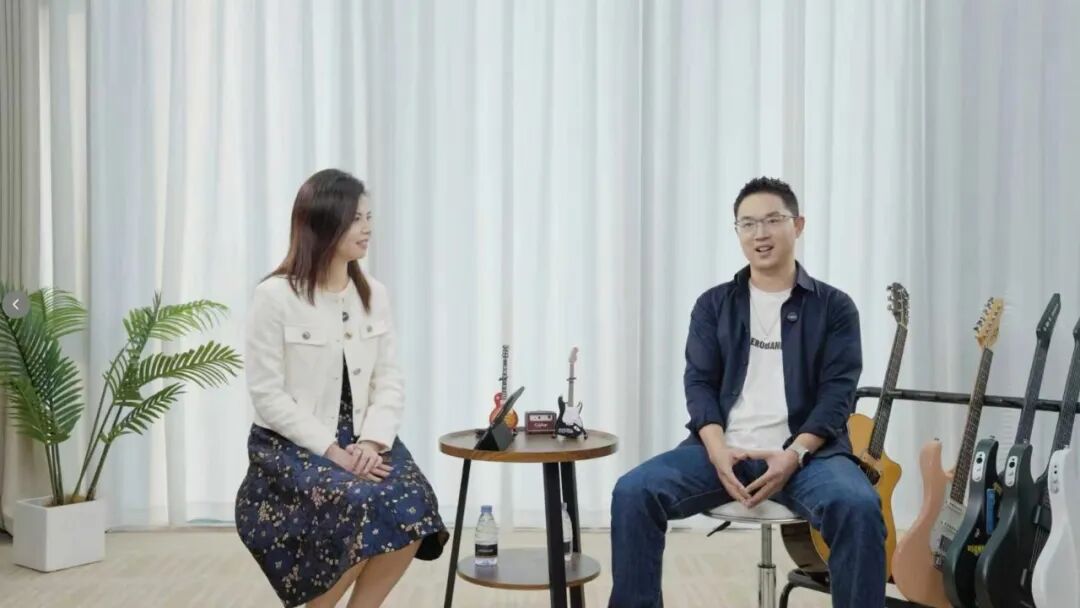
The main topics they covered:
-
How should a great smart hardware product be defined?
-
What is the biggest change AI brings to smart instruments and the music industry? Conversely, how does the massive performance data collected by hardware feed back into model evolution?
-
How can technically-minded entrepreneurs excel at social media and brand marketing? Can "engineer thinking" and "artist soul" be perfectly fused in a single smart instrument?
-
When AI hardware entrepreneurship encounters a flood of hot money, how should founders stay cool? The barriers to entry may seem lower, but where does core competitiveness actually lie?
We've compiled portions of their dialogue, hoping to offer a fresh perspective for practitioners following the "consumer + hardware" track. We also look forward to walking alongside more innovators — feel free to reach out to Shen Ying, executive director at FreeS Fund (shenying@freesvc.com), or send your pitch deck to bp@freesvc.com.
Interactive Giveaway:
Do you think smart instruments could become a new choice for your daily leisure? Share your thoughts in the comments. By 17:00 on April 29, 2026, the two most thoughtful commenters will receive a copy of Life Burns Hot Because of You.
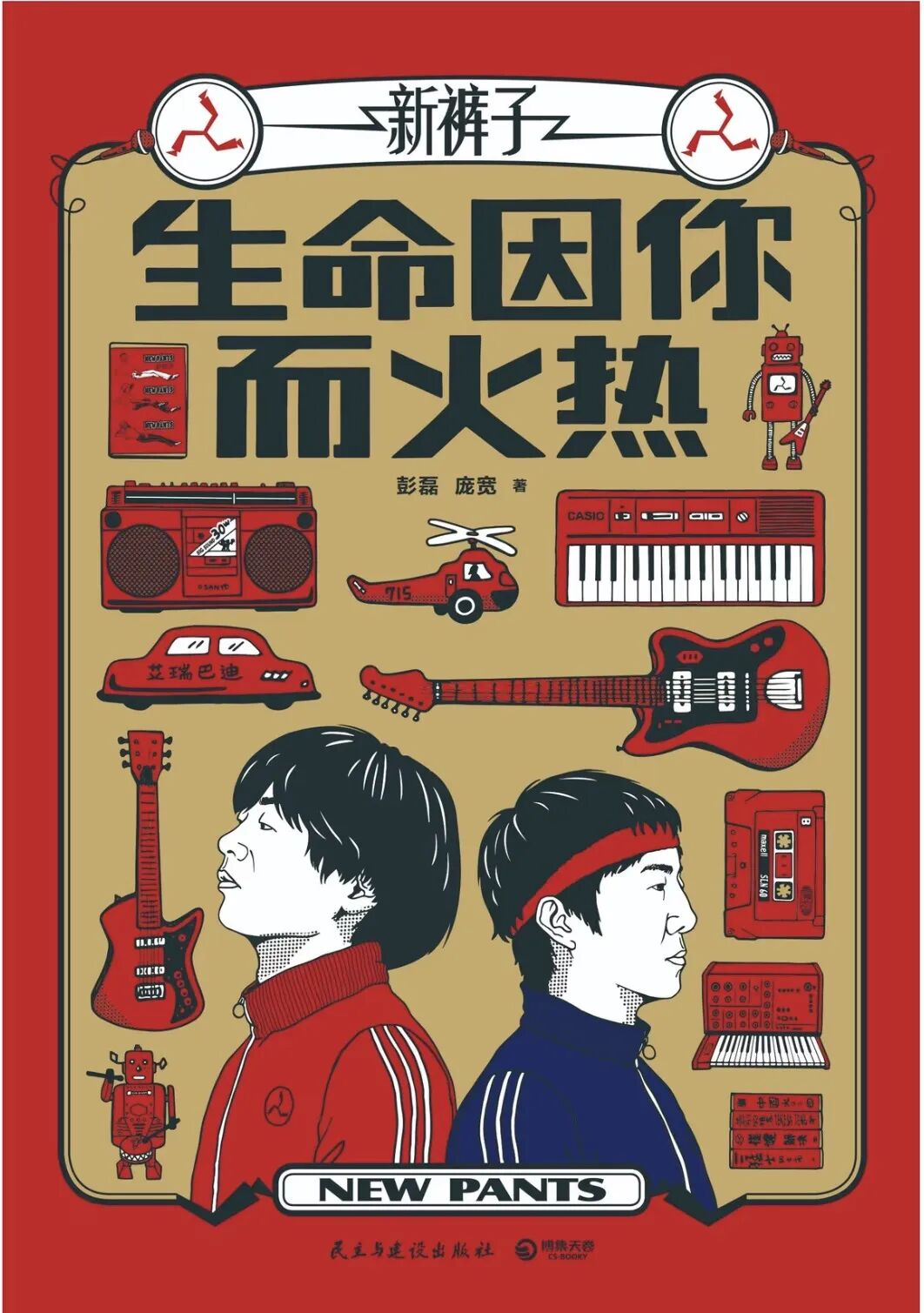

Life Burns Hot Because of You
By Peng Lei, Pang Kuan
Democracy and Construction Press

01 You Can Always Find Another Job, But Entrepreneurial Timing Waits for No One
Shen Ying: Let's start with some quick-fire questions. Your age and hometown?
Niu Yafeng: Born in '93, so 33 this year. From Luoyang, Henan.
Shen Ying: How long have you been entrepreneuring?
Niu Yafeng: Ten years.
Shen Ying: What does your company do?
Niu Yafeng: We use technology to redefine instruments, lowering the barrier to entry so more people can play music more easily.
Shen Ying: What sparked your decision to start a company?
Niu Yafeng: In college I tried to learn guitar but couldn't get the hang of it. With my engineering background, I turned the guitar into a project for a tech innovation competition. Later I won a China-US entrepreneurship competition — first place, with 150,000 yuan in prize money — and just registered the company and started.
Shen Ying: How did you decide to start right after graduation instead of gaining experience at a big company?
Niu Yafeng: I agonized over it, talked to lots of people. No one could give you a definitive answer. Eventually it clicked: you can always find another job, but entrepreneurial timing waits for no one.
Shen Ying: Why this passion for inventing and creating?
Niu Yafeng: I've been obsessed with tech and electronics since I was a kid. Pretty much every appliance in the house that could be taken apart got taken apart. There's a joke: "If you're well, all is sunny; if you're not well installed, it's a thunderbolt." Lots of things I couldn't put back together, but I loved it anyway. I majored in electronics, joined the lab freshman year to learn programming and do electronic inventions — built up maker experience through those early college years.
Shen Ying: Favorite hardware product?
Niu Yafeng: The most classic, maybe most cliché answer: Apple. The experience is impeccable.
Shen Ying: As a music entrepreneur, favorite singer and song?
Niu Yafeng: Singer: Pu Shu. His "No Fear In My Heart" really moves me. You can feel a kind of power in the music — looking inward to the extreme, and what you find is actually light.
02 Reconstructing How Humans Interact with the World of Music
Shen Ying: We saw many guitars at your company — besides your products, there were acoustic and electric guitars too. Could you walk us through the differences between them and their history?
Niu Yafeng: Around 1850, the guitar began rising in popularity. The technology then was wood plus steel strings, producing the bright sounds of folk and country music. By the 1920s, an inventor at Gibson applied telephone coil technology to guitars, using pickups to capture vibrations, then amplifying the sound through effects pedals and speakers. This enabled the rich tones of rock and roll, and that approach has lasted over a hundred years.
Today, every industry is being transformed by digitization and intelligence. Our guitars are no exception — they've achieved complete digitization.
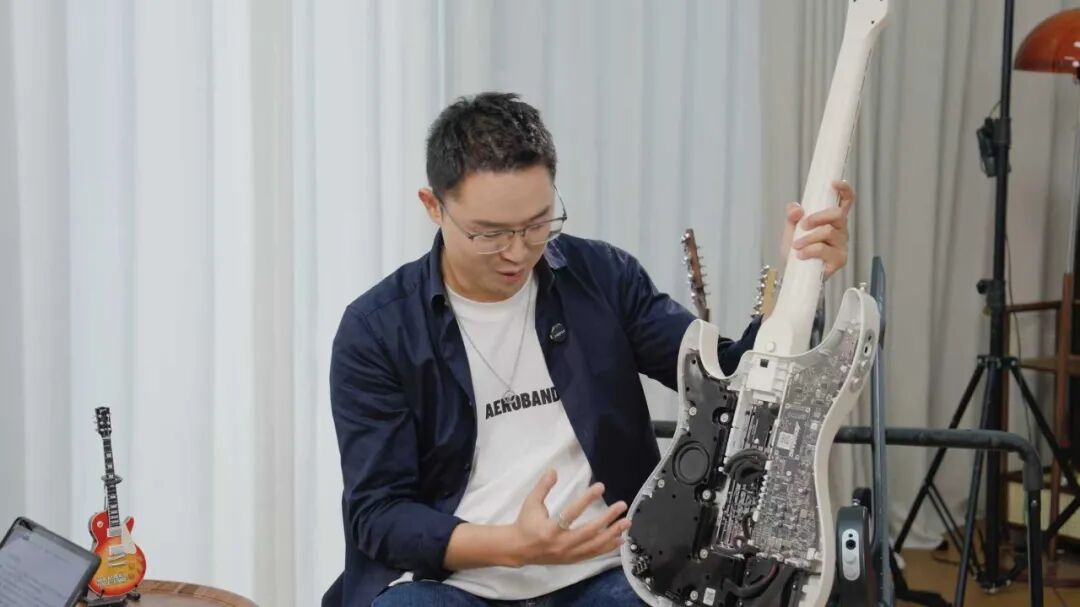
In auto-chord mode, it redefines fingering positions. One button equals one chord; one string can represent strumming or muting actions, and the app gives real-time error feedback. In the future, the masses will be able to use it for rapid creation. After digitization, a niche market that previously existed at a certain scale can expand 10 to 20 times, drawing more people in.
We want to reconstruct how humans interact with the world of music. The key is shifting from wood + steel strings to sensors + digital solutions, lowering the barrier for interaction. Operation isn't the first principle; the first principle is that through my actions, I can fluidly play songs I love. Once you reconstruct this layer, more people can express emotions very easily.
Shen Ying: Many people question smart instrument products — is this an instrument or a toy? How do you define your product?
Niu Yafeng: Toys have low barriers; instruments lean more professional. Our product escapes this binary. Its value is higher-dimensional: making it easier for ordinary people to express emotions through music.
We retain real strings and fingering logic, which means it's a genuine smart instrument, not purely a toy. You won't be discouraged after three minutes, nor need three months of painful practice before strumming and singing a favorite song. It's something people can actually learn, and keep advancing with.
Entry, learning, advancement, and finally creation — all achievable with one guitar. A good product, like Apple as I mentioned, reveals extraordinary complexity when opened up, but when closed and placed in the user's hands, the experience is remarkably simple.
/ 03 / AI Makes Hardware Proactive: What You Feel Is What You Play
Shen Ying: You've been inventing and creating since your student days. How has "smart hardware" evolved compared to back then? What fundamental changes has AI brought?
Niu Yafeng: Ten years ago, many products called themselves "smart" just by adding Bluetooth, Wi-Fi, and an app connection, but truly intelligent experiences were hard to deliver. In the past two years, AI integration has given hardware capabilities beyond basic functions — organizing, analyzing, even simple decision-making. Over the next decade, all sensor-equipped hardware, powered by large AI models, will possess these capabilities, achieving true intelligence.
Shen Ying: What's the biggest change AI has brought to the music industry?
Niu Yafeng: If the "hardware + app" traditional model was the 1.0 era, AI's arrival has ushered us into the 2.0 era.
With AI, when you play songs, it recognizes your frequently chosen tracks, understands your aesthetic preferences, recommends more songs you'll love; it also analyzes weak points through practice data, scores your performance, and gives targeted improvement suggestions. We can also break melodies into segments, recombining and matching them according to the user's aesthetic level.
AI makes hardware proactive — shifting from humans controlling hardware to AI interacting with humans. This companionship-style development creates emotional bonds between users and smart instruments.
Shen Ying: Music is emotional expression; AI represents rationality. In your product logic, what role does AI play?
Niu Yafeng: When AI combines with smart instruments and apps, it becomes more like a private music teacher or companion. AI can fully understand all user behaviors, including hardware operations — something traditional instruments can't do. An acoustic guitar has no sensor layer, but a smart instrument knows which passages of a song excite you as you play. Many subtle things, this digitized instrument knows.
AI enables truly personalized service. Everyone's musical preferences and stage needs differ; AI lets the guitar transcend pure tool status, becoming a medium for exchange between people and the world of music.
Shen Ying: You mentioned your favorite music AI model earlier. Could you introduce what today's AI models can do that wasn't possible before?
Niu Yafeng: We've been experimenting with Suno recently, and its capabilities are already quite mature. From originally generating a complete song end-to-end, it can now do stem separation.
But Suno is purely software after all, while instruments have the essence of performance, human physical sensation and movement, plus sound — a higher-dimensional interaction. Like learning to drive: simulating versus actually being on the road. Hardware will become a higher-quality, more authentic vehicle for AI.
Also, current models are still mostly end-to-end. If you can generate many songs with one click, users struggle to feel a personal connection.
We break drum beats, main melodies, piano, chord progressions, rhythmic patterns into combinable musical segments. Users don't need to debug from zero — just combine through the app and hardware to quickly create works matching their aesthetics and personality, with much stronger sense of participation. In the future, large models and smart instruments will move toward integration.
What does integration mean? Say I'm feeling relaxed right now — I can directly improvise a piece of relaxing music. Previously this required musicians to store vast amounts of segments and creative ideas in their heads, but now novice users don't need to hold all that.
Shen Ying: This is exactly what's most beautiful about hardware — listening versus playing yourself feels completely different.
Niu Yafeng: Right, the future is "what you feel is what you play" — emotions expressed directly through instruments, returning to music's essence as a language. Just as the smartphone was mobile internet's gateway, smart instruments combined with large models are our gateway to emotions, a global link for emotional exchange.
Shen Ying: Hardware can collect massive amounts of performance data. How do you use this data to feed back into AI models?
Niu Yafeng: We're building the infrastructure to support future AI. Every user performance action, every output signal, gets converted into standard MIDI signals — this is AI's "nutrition." With this data, AI can answer user questions about guitar functions, assemble new courses based on user level, even become a "band leader" in the future, connecting people with different interests to form bands.
We may evolve into such a platform, opening these creativity-and-AI combination points to users. Users might bring unexpected new ways to play.
Shen Ying: Over the years, what features have you developed that never launched?
Niu Yafeng: In 2020 we made a first-generation smart drum kit with lighting effects — the drumsticks glowed when struck, very visually striking for overseas launches. But many professional drummers feedback that they preferred preserving the wooden feel. So in the second generation, we reverted to a raw wood style.
Often, cool and usable need balancing. You can't define good products unilaterally — you must look at real user needs, making trade-offs and balances based on demand.
/ 04 / Engineer Thinking + Artist Thinking: The Left and Right Wings of Product
Shen Ying: An engineering guy entrepreneuring in something as emotional as music. What difficulties have you faced over this decade?
Niu Yafeng: I've constantly been shaped by products, users, and market feedback. Early on it was engineer thinking — make whatever seems cool. Later I realized products are for people to use, especially emotion-value products; you need artist thinking to understand human individuality and human nature.
Engineer thinking and artist thinking are the left and right wings of product. The better the fusion, the more likely a product becomes good or even art. Technically-minded entrepreneurs must also fully understand humanities, the emotional side, giving products more warmth.
Shen Ying: Making consumer-facing AI hardware products, what pitfalls have you hit in balancing tech functionality with musical experience?
Niu Yafeng: Early on we made gloves you could play in mid-air — sounded cool, but users were confused. Later iterated to wristbands, even wanted to add time display functions. Spent nearly a year on a demo; user testing still produced confusion: "is this a wristband or a music product?"
Good products actually need subtraction.
Shen Ying: Dair Music users span the globe. Can you talk about differences between users in different countries?
Niu Yafeng: Music extends differently with culture. Asia overall leans toward karaoke culture; China has developed its own musical atmosphere on this foundation. Most domestic users start from singing, with relatively low exposure to instruments, so designing around strumming-and-singing instruction achieves good PMF (product-market fit).
The West is different. Guitars and other instruments began popularizing in 1935; rock culture spread in the 1950s-1960s. Many families have some instrument or vocal training, with high guitar acceptance. They don't just need to strum and sing others' works — they want to show personality, create exclusive content. DIY products are popular overseas.
After full hardware digitization, through standard MIDI protocol you can directly connect to professional DAW software like Cubase; users with technical foundations can do deep creation directly. Ordinary users can use fragmented musical segments and AI to complete their own works with low barriers. Different markets have different needs, but the hardware foundation can be unified.
/ 05 / Either Make Users Addicted, or Make Users Relaxed
Shen Ying: After attracting users, how do you make them more loyal?
Niu Yafeng: It's mostly organic. We continuously refine hardware functions and app content — now there's new feature iteration and optimization every two weeks.
Shen Ying: Yes, I even gave you some product suggestions; your app has a suggestion window.
Niu Yafeng: So user voices keep coming in, helping us continuously optimize.
We counted last year: over 100,000 users' cumulative usage time approached 2 million hours. Many people, when work is dull or emotions are suppressed, spend 30 minutes playing a favorite song, learning content they're interested in, even using creation to express emotions. A high-retention product either makes people addicted or makes people relaxed — and "relaxation" is actually an extremely scarce need right now.
Shen Ying: One colleague got your guitar and quickly got the hang of it, playing frequently. Later got his son and father learning too; eventually all three could play the same song together from different spaces.
Actually, Chinese classical instruments like the guzheng appeared thousands of years ago, with basically unchanged form. Now many people wonder: why should I spend years learning an instrument? Why can't it be like your smart guitar, pick-up-and-play in minutes? Have you analyzed this underlying consumer need from first principles?
Niu Yafeng: Different eras' people have different demands for music. In ancient times music accompanied hunting celebrations, charges into battle. Through human development, music's richness and aesthetic sophistication constantly increased. Ancient music was niche and refined; later gradually popularized, with core reason being tool advancement itself.
Early instruments had high barriers for ordinary people; human-instrument interaction complexity was high. As technology developed, barriers kept lowering.
Past decades focused on material needs — solving food, clothing, housing, transportation was already hard enough. After material satisfaction, spiritual needs began emerging. Especially post-pandemic, marathons, outdoor activities have risen. Users no longer obsess over cost-performance or functions, but whether they can relax and gain joy through use.
Shen Ying: Besides our track, what other smart hardware categories are you optimistic about? In the next 3-5 years, what could become phenomenon-level personal consumer products?
Niu Yafeng: Directly guessing which product will blow up is actually quite hard, but the underlying logic is similar. Like I said, gotta have sensors — only with sensors can you perceive environment; AI can't do this itself, it needs hardware with sensing capabilities to help.
Another is execution capability — AI is virtual, can't directly operate, so you need executable endpoints that complement AI. Simple example: home cameras can perceive environment; combined with AI they can analyze whether the owner came home happy or irritated, what state they're in. Then if there's an execution device, like air conditioning, noticing the owner came back agitated, quickly blast some cool air.
Many possibilities, but which scenario commercializes more successfully depends on great product managers. Not everything needs AI forced in — that's unnecessary. Gotta find the right pain-point scenarios.
/ 06 / Early Survival Matters; Entrepreneurs Must Use Business Common Sense
Shen Ying: Ten years of entrepreneurship, from Beijing to Nanjing to Shenzhen. What were the most important inflection points?
Niu Yafeng: First inflection point was drumstick product overseas market expansion (2019-2020). Overseas is relatively easier to establish roots; domestic market competition is fierce, even if you blow up it's hard to defend. Hardware involves R&D, supply chain, mass production, delivery — a very long chain. Fortunately we built those capabilities overseas then. Early survival is so important for a company; if you can't survive or defend your position, you're out.
Second inflection point was moving to Shenzhen. In Beijing it's hard to assemble 200-plus innovative components into a product, but in Shenzhen efficiency is much higher. Professional things need to be done in professional places.
Third inflection point was choosing the guitar category. To open a larger market, you need to enter a big category and do foundational innovation. The traditional instrument market is over 20 billion USD; guitars account for half, nearly 10 billion, with tens of millions sold annually. Entering through a big category lets you expand the company's accumulated energy faster, achieving rapid growth.
Shen Ying: From your perspective, is hardware entrepreneurship getting easier or harder?
Niu Yafeng: From a funding perspective, many investors are quite feverish about AI-hardware integration projects now; teams with decent backgrounds can quickly get funding, startup costs lower than in earlier years. We started with 150,000 yuan; now some teams can get 15-million-USD-level funding.
But on the other hand, you still must return to commercialization essence. Many embodied intelligence projects have large addressable markets, but teams need to think: in which commercialization scenarios, which pain points can our products and solutions truly solve?
Investor money can't burn forever; you need to quickly find PMF and landing scenarios, know how to survive when hype dies down, how to keep developing — mindset must be steady. More capital means more players, market competition gets more aggressive, even spec wars. But if you can't create long-term value, when the bubble bursts projects will face difficulties.
Shen Ying: Dair just raised a new round. In this round, what were investors most concerned about or what challenged you most?
Niu Yafeng: After meeting many investors, I found that those truly willing to invest don't need much explanation. Like whether the product solves real pain points — sales already validate that.
Investors care more about ceiling height. From industry and category perspective, markets aren't all red oceans; some projects seem to have high ceilings but actual landing difficulty is large, requiring comprehensive analysis.
Fundraising is more about matching with investors who understand and recognize the project, jointly building brand and industry together. Entrepreneurship has highs and lows; founders can also反过来 understand investors' investment logic, ensuring mutual alignment.
Shen Ying: So finding investment or fundraising isn't just about money exchange — it's mutual understanding, shared cognition of market and track. We've seen Dair grow extremely fast these years. Yafeng, after you moved the company to Shenzhen, the office relocated several times, team grew from a few people to a dozen, now nearly 200. What do you want to build long-term?
Niu Yafeng: This year's focus is the second-generation product, continuously refining product functions and content.
Meanwhile we're laying out brand content. Extracting emotional value, user value beyond product concepts and functions, then sharing great user-created content with more people.
Offline investment is also increasing, letting more users experience smart instruments firsthand. Direct experience is crucial; we'll deploy offline resources globally, covering more types and needs across three product lines for differentiated markets like Europe and America.
Shen Ying: Thanks for sharing today, Yafeng. Finally, I'd like you to give the program a special ending. In January I attended your tenth anniversary annual meeting, and heard a moving entrepreneurial story — when you were student entrepreneuring, you practiced Chang Chenyue's "Goodbye," used this song in many entrepreneurship competitions, won placements and funding that sustained the company for three to four years. Now guitars and drumsticks sell in dozens of countries globally, iterated through countless versions, with worldwide users. Looking back, so many emotions. I hope revisiting this song continues to inspire your future entrepreneurial path.
Niu Yafeng: Alright, then I'll return to my old trade. Through this song, let more people feel the love music brings, and hope more people can embark on their own musical journey from here.

Interactive Giveaway:
Do you think smart instruments could become a new choice for your daily leisure? Share your thoughts in the comments. By 17:00 on April 29, 2026, the two most thoughtful commenters will receive a copy of Life Burns Hot Because of You.
Life Burns Hot Because of You
By Peng Lei, Pang Kuan
Democracy and Construction Press
