Where Does Live E-Commerce End? | Frees Fund

Live commerce is the outcome, not the goal.

In yesterday's first installment, we discussed the current mainstream form of livestream e-commerce: "Juhuasuan with sound and color" — essentially group-buying with a multimedia twist. By reviewing the evolution of group-buying, we can see that mastery of traffic and supply chain determines whether such businesses thrive or die. This means that to reach the top tier, livestream e-commerce in the "Juhuasuan with sound and color" mold requires both traffic acquisition and supply chain capabilities.
In today's second installment, we'll dive deeper into another livestream e-commerce model: "SMZDM with sound and color" — examining how the history of shopping-guide e-commerce can illuminate the endgame for guide-oriented livestream commerce.
Before we begin, two premises:
- When traffic platforms and e-commerce platforms cannot directly connect, a bridge-building business model emerges between these two mountains. The precondition for this bridge model: the traffic platform has no self-operated e-commerce business, and has not yet integrated with e-commerce platforms.
- Unlike the group-buying function represented by "Juhuasuan with sound and color," livestream e-commerce possesses another capability: shopping guidance — not necessarily based on massive traffic, deep discounts, or high commissions. Though currently less mainstream, more vertical and niche, its share of the livestream e-commerce landscape will grow.

/ 01 /
The Chinese-Style Shopping Guide Model — Bridge-Building
The precondition for bridge-building: traffic platforms and e-commerce platforms cannot directly connect
Currently, short-video traffic is dominated by Douyin and Kuaishou. Neither has achieved efficient integration with Taobao and Tmall. If a startup wanted to replicate Pinduoduo's path — capturing traffic from traffic platforms and directing it to its own e-commerce platform, serving as a bridge between traffic and e-commerce — the opportunity exists.
This is a distinctly Chinese opportunity. When traffic platforms and e-commerce platforms cannot directly connect, a bridge-building business model naturally arises between these two mountains.
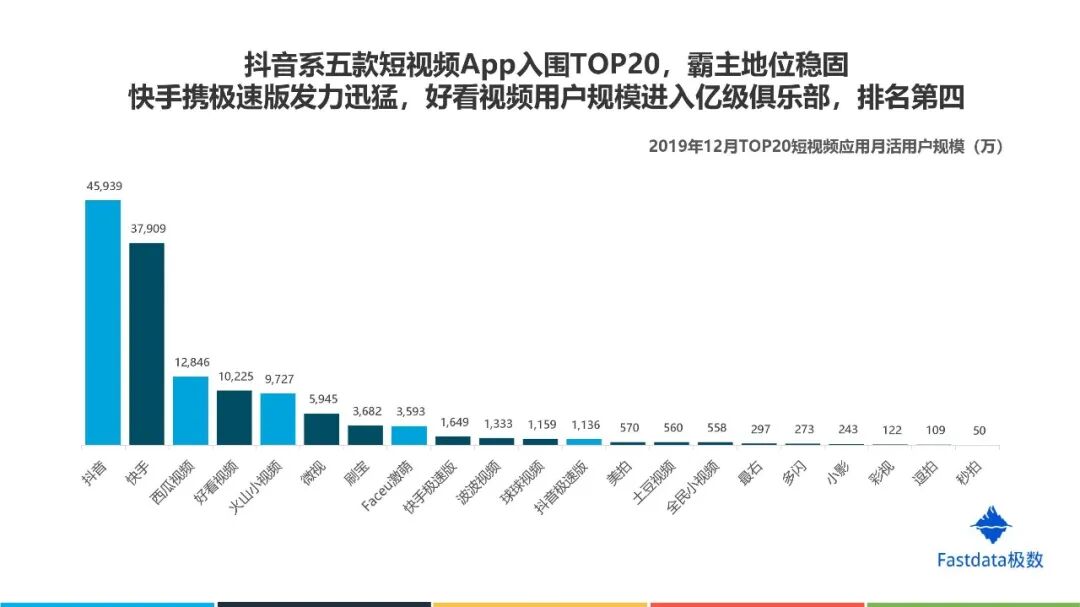
▲ Top 20 short-video apps by monthly active users, December 2019. Source: Fastdata
But this model is constrained by shifting dynamics among giants: first, how long will the disconnect between video traffic platforms and e-commerce platforms persist? Second, do traffic platforms intend to build self-operated e-commerce?
Case studies: influencer commerce, Meilishuo and MOGU, and Pinduoduo
In 2014, influencer commerce was all the rage.
At that stage, Weibo, as an emerging media format, commanded massive attention, and it hadn't yet integrated with Taobao. Influencer commerce flourished, producing listed companies like Ruhnn.
But how did the story unfold?
Influencer commerce never achieved the large-scale growth initially anticipated. For one, users were maturing and diversifying their information channels, becoming less dependent on lifestyle guidance for apparel and cosmetics. Second, once traffic platforms and e-commerce platforms connected, the need to pool traffic and redirect it disappeared — users could jump seamlessly with one click. Ultimately, influencer commerce returned to the old battlefield of supply chain.
This similarly evokes the tumultuous saga of Meilishuo and MOGU.
Launched in 2009 and 2011 respectively, Meilishuo and MOGU operated in the women's fashion vertical, where users could recommend, share, and review products, and repost content to larger social platforms like Weibo, QQ, and Douban. Product links came from external e-commerce sites like Taobao, and the platforms earned revenue through display ads, clicks, and purchase commissions.
In their early years, these thriving shopping-guide platforms showed potential to become new traffic gateways. According to Taobao Union official data, in 2012, guide sites including MOGU and Meilishuo earned over 600 million yuan in commissions from Taobao. At that stage, nearly 10% of Taobao's traffic came from guide communities represented by Meilishuo and MOGU.
Yet two events in the following year altered the trajectory.
On April 29, 2013, Alibaba and Sina Weibo announced a strategic partnership. This meant a top traffic platform and the largest e-commerce platform were joining forces. The road between them was paved — no "bridge" needed. Bridge businesses like Meilishuo and MOGU were severely impacted.
In August 2013, Taobao issued a ban on third-party guide platforms. MOGU and Meilishuo had to accelerate their pivot to building self-operated e-commerce platforms.
The bridge-building model has also spawned new e-commerce stars. How large can this model become? Currently, the most typical example is Pinduoduo, founded in 2015 and now valued at nearly $60 billion.
The rift between Alibaba and Tencent created Pinduoduo as the largest "bridge" to date. Over the past five years, Pinduoduo has enjoyed exclusive access to WeChat, the nation's largest traffic pool — after all, this 1-billion-DAU ecosystem was inaccessible to Alibaba, China's largest e-commerce platform, and Tencent itself wasn't pushing into e-commerce.
However, with the rise of new traffic platforms like Kuaishou and Douyin, and the blocking maneuvers of e-commerce giants like Alibaba, Pinduoduo has been drawn into new traffic wars.
In the livestream e-commerce era, what opportunity exists for such bridge-building guide platforms?
Applying the logic above: the condition for monetizing between traffic platforms and e-commerce platforms is that the traffic platform has no self-operated e-commerce business and hasn't integrated with e-commerce platforms. Therefore, the opportunity to accumulate traffic on traffic platforms and monetize on e-commerce platforms exists.
Currently, a smooth, wide-open road between top traffic platforms like Kuaishou and Douyin and e-commerce giant Alibaba seems unlikely. If so, bridge-building opportunities will persist, as long as e-commerce brands have demand to sell via livestream on traffic platforms.
Yet the width of this bridge depends on others — specifically, how wide the gap between e-commerce and traffic platforms remains. With zero interoperability, the bridge can be wide. With partial compatibility but incomplete integration, it narrows.
Pinduoduo's rise, for instance, partly stemmed from the former scenario: WeChat and Taobao/Tmall were completely disconnected, with Taobao links banned on WeChat.
Regardless, to build a sturdier bridge, you need attractive pricing and products, brand recognition, and sufficient sales volume to persuade brands to "break" their pricing systems for you. Traffic and supply can reinforce each other.
This exploration of the "bridge" model sets up a foundational question for our subsequent discussion of guide-oriented livestream e-commerce: how should we understand the connection opportunities between internet traffic platforms and e-commerce platforms? Undoubtedly, compared to the partial bridge attributes in some group-buying platforms, guide platforms represent the quintessential "bridge."
Next, we'll map out the "SMZDM with sound and color" model of livestream e-commerce.
/ 02 /
Viewing Livestream E-Commerce Through the Lens of Professional Category Guides for Vertical Audiences
The evolution of professional shopping guides
Unlike the "Juhuasuan with sound and color" or group-buying function mentioned in the first installment, livestream e-commerce possesses another function: shopping guidance — not necessarily based on massive traffic, deep discounts, or high commissions.
In reality, group-buying livestream and guide-oriented livestream aren't strictly separated. For simplicity's sake: the former chases actual sales volume, while the latter leans toward brand exposure; the former shouts "buy it" with urgency, while the latter painstakingly breaks down a product's merits and features; the former mainly earns sales commissions, the latter primarily lives on advertising fees.
Guide sites initially took the form of vertical media. Take ZOL (Zhongguancun Online), founded in 1999 as an IT interactive portal focused on sales promotion. It displayed market quotes and taught users how to select and purchase computers.
Content-based guide platform SMZDM ("What Is Worth Buying") launched in June 2010. Early on, it was simply a geek community for electronics enthusiasts. When it entered e-commerce, its initial category structure focused heavily on 3C digital products. Notably, unlike MOGU and Meilishuo, SMZDM deliberately avoided C-stores (individual sellers) and had minimal ties to the Taobao ecosystem — hence it wasn't affected by the ban.
SMZDM mainly solved two problems. First, it helped you discover which channels offered good discounts. Second, it directly told you which electronics suited which users.
By translating cumbersome technical data and specs into content that novice users could easily grasp, SMZDM lowered the technical barrier and built trust with users. According to its 2019 IPO prospectus, revenue came mainly from information promotion services, including e-commerce guide commissions and advertising displays — the common profit model for guide platforms.
From this logic, for consumer product categories with certain technical or professional barriers, requiring explanation, where users cannot build brand and product recognition through repeated consumption, users will trust specific channel recommendations. Thus, professional guide pathways emerge.
Only these pathways keep changing form. Perhaps previously vertical media, now video livestream; formerly text and images, now video.
Therefore, we can understand currently popular guide-oriented livestream e-commerce as "SMZDM with sound and color." To illustrate: if a person, media outlet, or channel I trust recommends something, and the recommendation is strongly content-driven — meaning I trust this person, enjoy the information and content they share, and can understand it — this mechanism holds value.
Such formats may appear niche, but they're more vertical and sticky.
Will "SMZDM with sound and color" remain niche forever?
We don't think so. We might glean some insight from the evolution of WeChat official account commerce.
If you recall, from 2014 to 2016, many WeChat official accounts were selling products. Now few do — most have returned to advertising, to reaching and occupying mindshare among specific audiences.
Why?
First, supply chain is hard to crack. Second, you need influence over vertical audiences that compels them to open their wallets. Several elements must align: establishing professional authority in somewhat specialized domains, while users are still in the entry-level phase. For instance, cosmetics newbies, or health supplement beginners. Fail these, and you'll struggle to move product — though you might collect some ad revenue.
To summarize: "SMZDM with sound and color" differs from "Juhuasuan with sound and color" in that the former doesn't rely on deep discounts and impulse purchases, but on planting seeds in (novice) users' minds. It's relatively vertical and niche.
However, drawing on the evolution of WeChat official account commerce, even if "SMZDM with sound and color" doesn't appear particularly typical now, it will certainly claim an important place in the future. This is our projection for livestream e-commerce's development trajectory.
A recent supporting example: according to public reports, in late April, Xiaohongshu launched a 10-billion-traffic support plan, with "video, livestream, and verticals" as its three keywords. Xiaohongshu creator account lead Jess stated that driving sales is an outcome, not the goal.
For "SMZDM with sound and color," video format is both an advantage and a disadvantage.
The advantage: video involves direct human communication and interaction, making trust-building easier. Meanwhile, because expression varies and video can deploy more tools and sensory channels, content richness and impact are stronger — better helping users understand relatively complex or dry subjects. This is especially important for "shopping guidance."
But we must also acknowledge that video content has low browsing efficiency, and thus low decision-making efficiency. This means "SMZDM with sound and color," like "Juhuasuan with sound and color," will struggle to become the primary sales channel for most product categories.
Finally, over the long term, users will mature in their consumption needs and brand awareness. The result: users won't need as much guidance. In familiar domains, most users will likely complete purchases quickly based on cost-performance or their own needs. On the other hand, mature users will also develop more personalized demands. The discovery and guidance of these specific product needs for particular audiences and cultural groups will be the opportunity for guide-oriented livestream e-commerce.
Summary
1 From the development logic of the e-commerce industry, we can divide livestream e-commerce into "Juhuasuan with sound and color" (group-buying-oriented) and "SMZDM with sound and color" (guide-oriented). For the former, reaching the top tier requires both supply chain and traffic capabilities. The latter is currently less mainstream, more vertical and niche, but its share of livestream e-commerce will rise.
2 "SMZDM with sound and color" (guide-oriented) has opportunity because top traffic platforms like Kuaishou and Douyin remain heavily disconnected from e-commerce giant Alibaba, with no signs of direct bridge-building or pathway creation between them.
3 It seems livestream e-commerce is being seen by many as a "savior" — mainly because with offline retail constrained by the pandemic, plus user curiosity, a media-side dividend has emerged. But this dividend is temporary, and moreover, its consumption efficiency isn't high. Like text-and-image group-buying and shopping guides before it, livestream e-commerce will ultimately become a standard feature of e-commerce in either group-buying or guide form, yet will struggle to become the primary sales channel for most product categories.
Discussion Question
Q: Among existing sales formats, which do you think most resembles livestream e-commerce?
Welcome to hit "View" and reply "e-commerce" in the WeChat official account backend to see our preliminary answer.
(Welcome to read, share, and hit "View." For reprint requests, please reply "reprint" to learn reprint rules and contact Feng Xiaorui [ID: freesfund] for authorization. Copyright belongs to Frees Fund.)

▲ How Long Can Livestream E-Commerce Stay Hot? | Li Feng Column
▲ What Did Minister Miao Wei Actually Say About Chinese Manufacturing? | Frees Fund
▲ One Chart to Understand Globalization or Deglobalization | Li Feng Column
▲ 2020: The Reshuffle and Restart of the Travel Industry | Frees Fund
▲ After the Pandemic, Education's Survival Elimination Round | Frees Fund
▲ After the Pandemic, the New Landscape for Fresh Food, Dining, and Food Products | Frees Fund
▲ After the Pandemic, the New Era of "Good Companies" | Frees Fund
▲ Li Feng Column 16 | Fresh Food Retail — Learning Early-Stage Investment from the Secondary Market
▲Li Feng's New Year Outlook | One Chart to See China's 2020 Opportunities