Who Can Save Young People From Hair Loss? | FreeS Fund's Daily Business Musings

A 3-Minute Guide to Hair Loss (Video Inside)

Welcome to FreeS Fund Daily Business Musings, a special series we've launched. Here, we'll break down everyday business phenomena in short videos or brief articles that take just 1 to 3 minutes to consume.
In this edition, we explore two short videos on the noticeably growing hair-loss population and the anti-hair-loss care market in recent years, tackling questions many people care about: What actually counts as hair loss? How should you treat it? And what's the science behind anti-hair-loss products?
We're packaging the videos and their transcripts for you — hope they offer some useful insights. (There are giveaways at the end of the video and at the bottom of this article.)
Giveaway
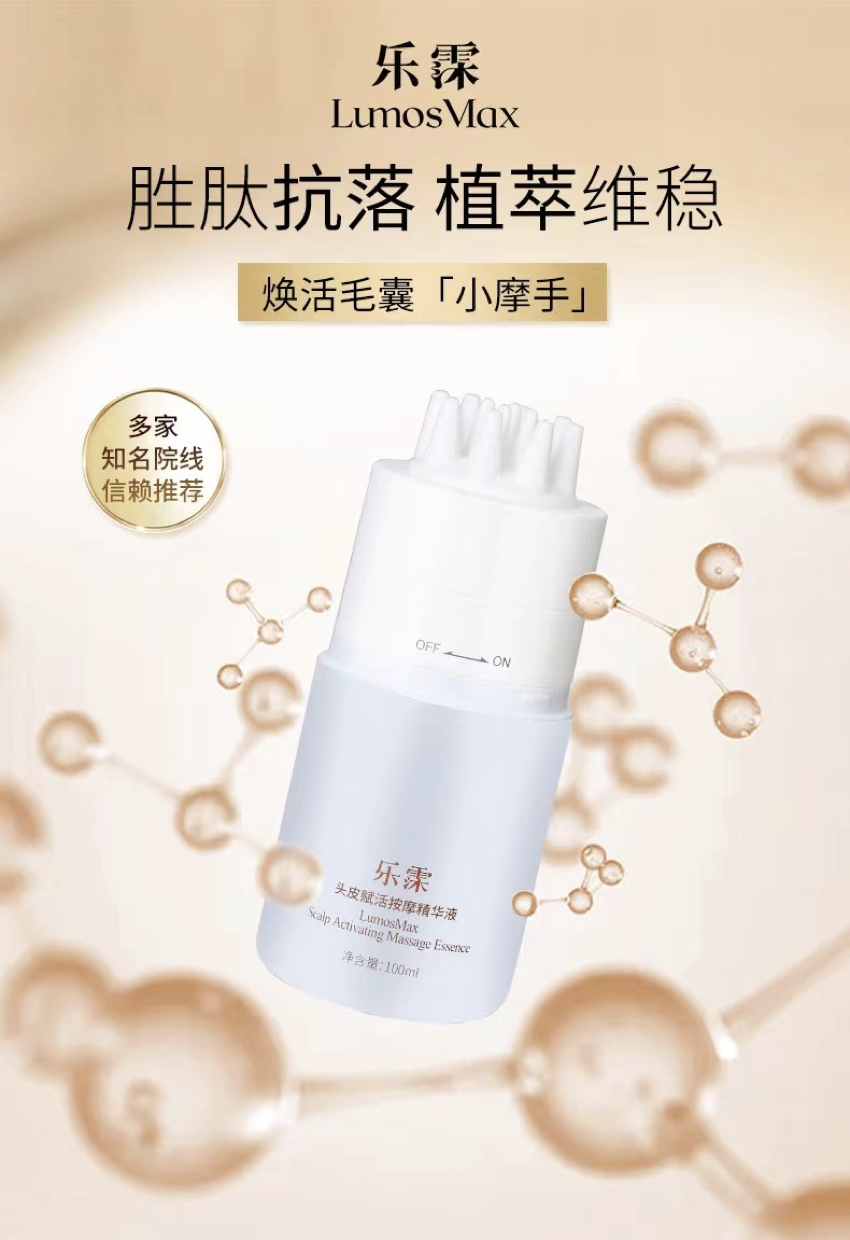
What are your tips and experiences with hair loss and prevention? Share your thoughts in the comments. We'll select 6 thoughtful commenters to receive a Lèmù Scalp Care Massage Essence (retail value: 399 RMB).

Please watch the original video by FreeS Fund
Scan the QR code to follow FreeS Fund's video channel 👆

/ 01 /
The Hair-Loss Crisis of Contemporary Young People
Click to watch the video — there's a surprise at the end 👆
For adults today, alongside work stress and life pressures, there's another daily worry — hair loss.
Research shows that normal shedding means losing 50 to 100 hairs per day. If you run your fingers through your hair and lose 3 to 5 strands, that's perfectly normal. If your daily hair fall falls within this range, there's no need to worry too much.
But many people nowadays feel their hair loss exceeds this normal range, even affecting their daily lives. According to a 2020 survey on hair-loss populations released by the National Health Commission, China's hair-loss population has surpassed 250 million — meaning roughly 1 in 6 people may be affected. Additionally, about 70 million people struggle with thinning hair.
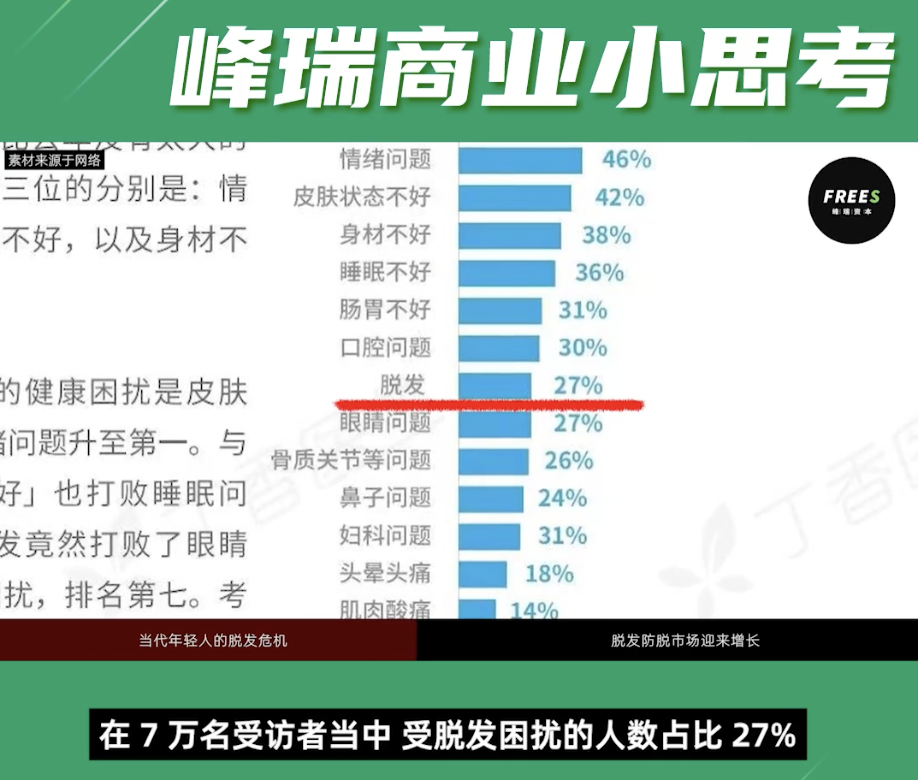
Media outlets including DingXiang Doctor jointly published the 2020 National Health Insight Report, which showed that among 70,000 respondents, 27% reported being troubled by hair loss.
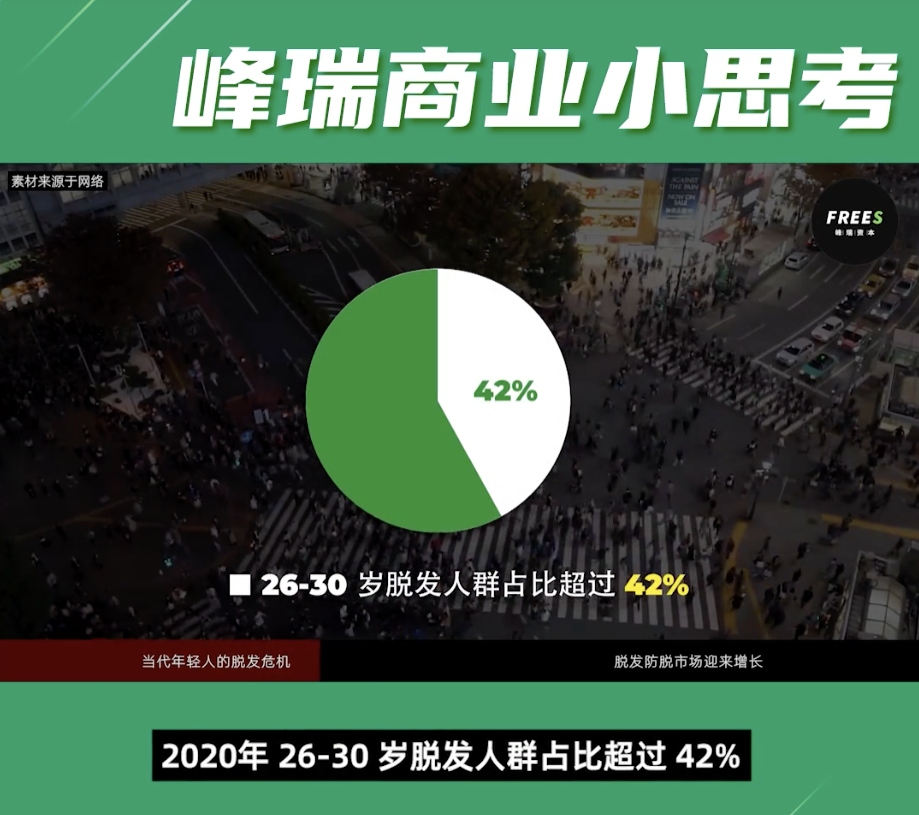
And looking at age trends, the average age of those affected by hair loss has shifted younger. National Health Commission data from 2020 shows that people aged 26 to 30 accounted for over 42% of the hair-loss population. Post-80s and post-90s generations are increasingly becoming the main consumers of anti-hair-loss products and services.
In today's fast-paced environment, frequent overtime, habitual late nights, and excessive stress can all trigger a cascade of mental and physical health issues that affect follicle health and lead to hair loss — not to mention chemical treatments and dyeing that damage hair quality.
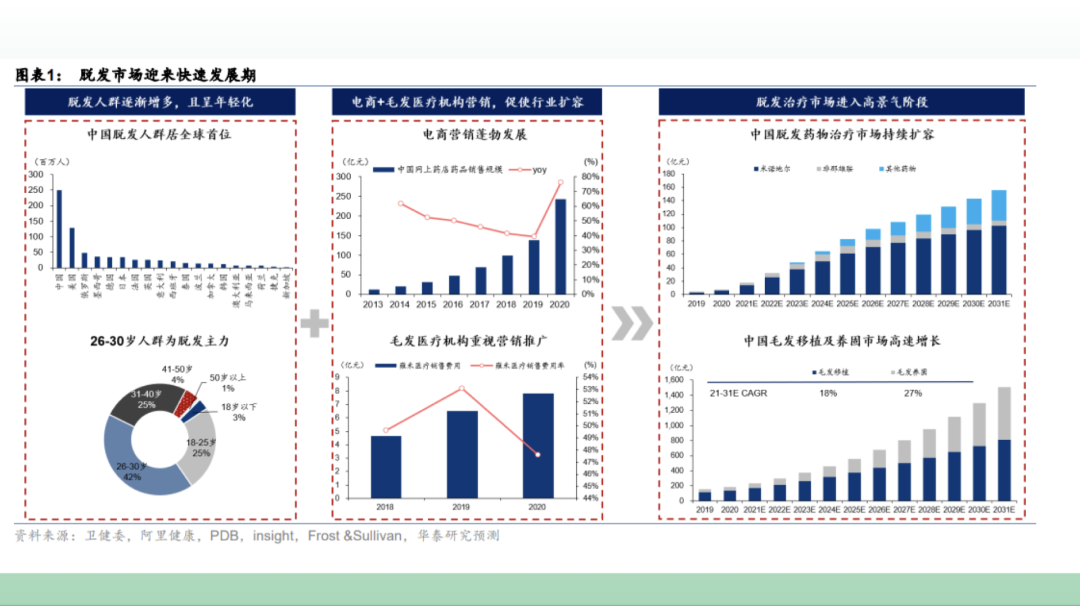
Corresponding to this expanding population is a rapidly growing hair industry consumer market. According to a Frost & Sullivan report, China's hair-loss drug treatment market was approximately 700 million RMB in 2020, while the hair medical services market reached about 18.4 billion RMB.
The hair-loss industry is poised for rapid development over the next decade. Frost & Sullivan predicts that by 2030, China's hair medical services market could exceed 130 billion RMB. Here's why:
- The hair-loss demographic is trending younger. Young people tend to place more importance on appearance and show stronger willingness to spend on anti-hair-loss products, making them more receptive to education around scientific hair-loss prevention.
- Online pharmacies and hair medical institutions are developing quickly, expanding the consumption scenarios for anti-hair-loss products.
- Industry visibility is increasing. From 2018 to 2020, upstream pharmaceutical and device manufacturers and midstream medical service providers significantly increased advertising spending. (In 2019 alone, OTC minoxidil advertising filings were 3 times the total of the previous 8 years combined.) Industry awareness is rising rapidly, and scientific anti-hair-loss concepts are quickly capturing the minds of younger consumers.
/ 02 /
How to Choose Anti-Hair-Loss Products and Services
Click to watch the video — there's a surprise at the end 👆
So from a consumer's perspective, how do you choose the right product from thousands of anti-hair-loss SKUs?
Before answering, we first need to determine whether we're dealing with physiological or pathological hair loss.
Physiological hair loss refers to the normal daily growth and metabolic cycle of follicles that causes hair shedding, typically in the range of about 50 to 100 hairs. Normal physiological hair loss doesn't reduce overall hair volume, as new hair quickly grows from the follicle.
In this case, you can selectively use anti-hair-loss shampoos for prevention and maintenance. These typically work by improving the scalp environment and providing nutrients to follicles. Most anti-hair-loss shampoos on the market fall into this category.
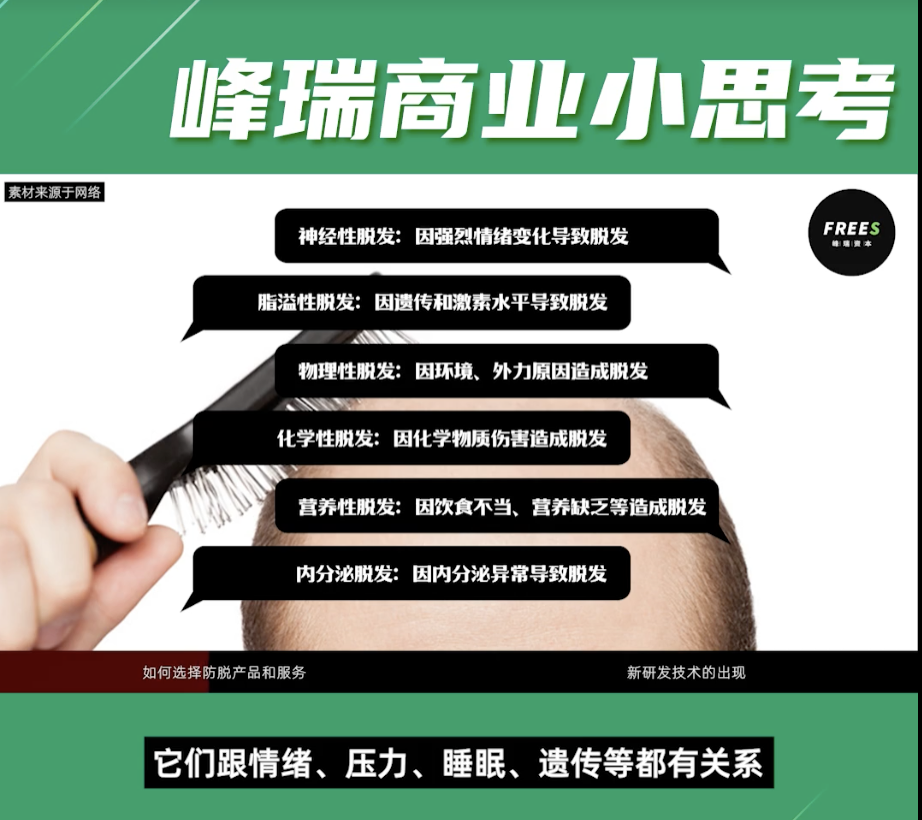
But if you're experiencing excessive shedding, visibly decreasing volume, or a receding hairline, you may have pathological hair loss. Causes typically relate to emotions, sleep, stress, genetics, illness, or bacterial infection.
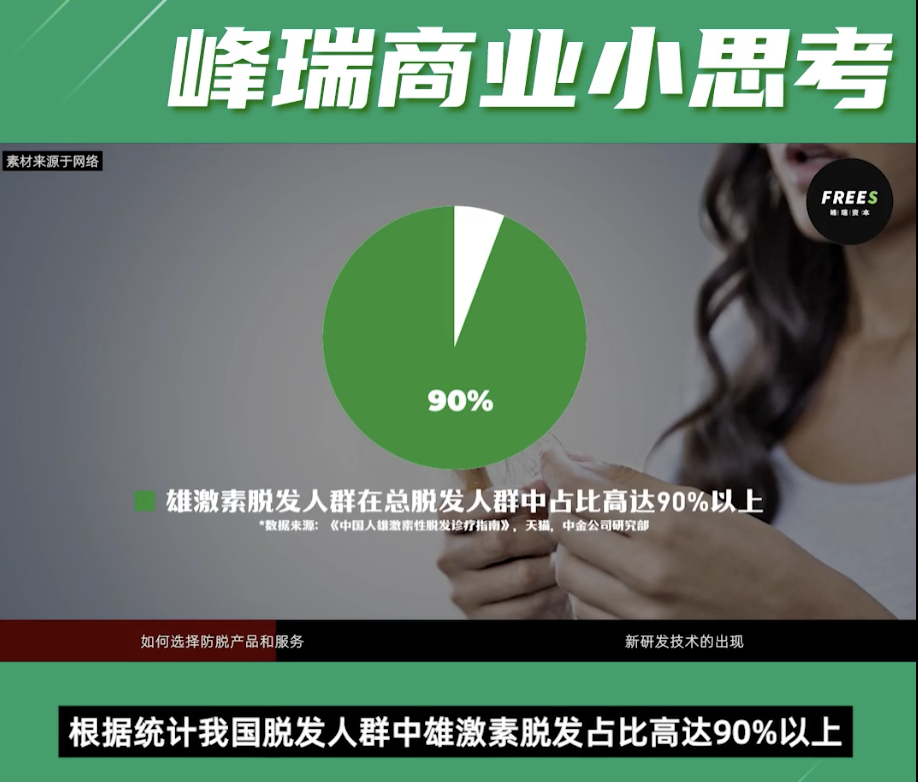
Among pathological hair loss patients, seborrheic alopecia (androgenetic alopecia) accounts for a significant proportion. According to statistics, over 90% of China's hair-loss population has androgenetic alopecia. Due to differences in hormone levels, this condition is more common in men, with a prevalence of about 21.3%. The prevalence in women is relatively lower, at about 6%.
Generally, medical professionals recommend small-molecule chemical drug treatments for seborrheic alopecia patients, targeting early-stage conditions. These drugs come in topical and oral forms — topical treatments typically contain minoxidil, while oral medications mainly use finasteride. Both are prescription drugs and cannot appear in cosmetic-grade anti-hair-loss shampoos.
Of course, beyond androgenetic alopecia, many other causes of pathological hair loss exist, requiring diagnosis by professional medical institutions.
We can also categorize hair loss by severity, roughly divided into seven grades:
- Grades 1–2: Hair appears relatively healthy; use regular anti-hair-loss shampoos to nourish follicles as a preventive measure.
- Grade 3: Noticeable hair loss symptoms begin; hair care products can still help improve scalp condition.
- Grades 4–5: Mid-stage hair loss; medical treatment under doctor's supervision is needed, with hair care products as supplementary treatment.
- Grades 6–7: Severe hair loss; by grade 7, follicles are typically fully atrophied and drug treatment is ineffective. Patients may need hair transplant surgery to improve their condition.
As the hair-loss population grows, people's awareness of scalp care is gradually strengthening, with increasing demand for anti-hair-loss, hair strengthening, and repair solutions. We believe that as the market rises and capital flows in, anti-hair-loss products and services will become increasingly diverse.
In conventional anti-hair-loss shampoo production, researchers typically obtain ingredients through chemical synthesis or natural extraction. The ingredient validation logic tends to follow: build a molecular library first, then screen and verify mechanisms of action, and finally synthesize relevant raw materials.

But with advances in biotechnology, research into cellular mechanisms has deepened, bio-target molecular research has developed rapidly, and the industry's approach to efficacy ingredient R&D is evolving. The industry has gradually begun applying synthetic bio-manufacturing technology, enabling targeted production and extraction of ingredients based on how cells themselves function.

To summarize the shift in industry R&D in one sentence: researchers are now thinking more about "working backward from results." R&D teams are starting from the essence of hair loss and follicle health, targeting one question — what kind of scalp microenvironment is needed for follicles to grow healthily?
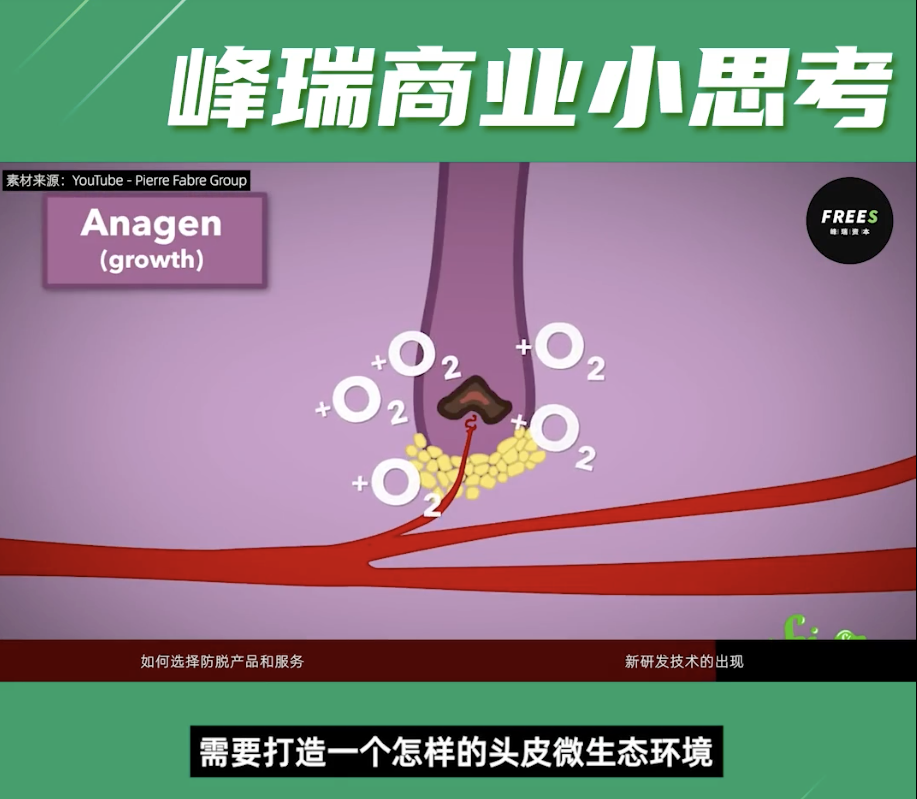
This targeted thinking path allows them to more clearly define the mechanism of action their products should have. Combined with bio-manufacturing technology, they can develop ingredients with specific goals, providing the nutrients needed for healthy follicles and their microenvironment. Through bio-manufacturing, they can obtain ingredients that mimic natural structures with clearer targeted mechanisms, creating more precise, gentler anti-hair-loss scalp care products. The entire production process is safer and more efficient.

Pictured: Lèmù, a scalp care brand from Meimu Technology, a FreeS Fund portfolio company. It focuses on the cellular escape mechanism of hair loss, and has developed a patented composite protein peptide technology with anti-hair-loss efficacy using synthetic bio-manufacturing, applied in its anti-hair-loss care products.
That said, hair loss is ultimately a medical condition. Before pursuing any treatment, please consult qualified medical professionals.
Wishing you a healthy head of hair.
Giveaway
What are your tips and experiences with hair loss and prevention? Share your thoughts in the comments. We'll select 6 thoughtful commenters to receive a Lèmù Scalp Care Massage Essence (retail value: 399 RMB).

Why Are Chinese and American VC Drifting Apart? | Li Feng Column Will 2022 Be a Capital Winter? | Li Feng Column
Scalding Noodles + Sizzling Capital: Can This Build China's McDonald's? | FreeS Fund Daily Business Musings "Interconnection" Begins: What Are the Long-Term Impacts on Consumer Brands? | FreeS Fund Daily Business Musings Understanding the Instant Food Boom in 4 Minutes | FreeS Fund Daily Business Musings