Why Are There Still So Many Opportunities in Tech Consumer Products? The Smart Musical Instrument Industry as a Case Study | FreeS Fund Venture Dialogues

Intelligentization is an open playbook for Chinese brands going global.

Smartphones, smart homes, smart wearables... Over the past few years, the trend toward intelligence has become the keyword for transformation and upgrading across industries, most visibly in the consumer market. Against this backdrop, have you ever imagined that musical instruments — the tools we use to play music — would also undergo an intelligent revolution?
Learning an instrument typically demands long hours of practice and patience, and even after significant investment, many people still "drop out" halfway through.
Intelligent instruments can lower the barrier to entry for learning music and offer users entirely new musical experiences. This transformation process holds enormous opportunities. The smart instrument brand "Dail Technology (Aeroband)" is one example of a company diving into this space. Dail combines consumer innovation with smart technology, using motion-sensing capture and digital audio synthesis to develop products like air drum kits and smart guitars. For instance, their drum kit uses two drumsticks and foot pedals paired with an app or speaker, allowing users to simulate playing drums in mid-air.
Dail targets both overseas and domestic markets, selling through independent sites, Amazon, and domestic e-commerce channels. The company recently exhibited at the NAMM Show in Los Angeles — the world's largest trade show for musical instruments.
Dail Technology founder Yafeng Niu and FreeS Fund VP Ying Shen appeared on the High Energy podcast to share their observations from the show and discuss their analysis of the Chinese and American instrument markets:
- How should we view the current trend toward intelligent instruments?
- Compared to traditional instruments, what are the competitive moats and innovation points of smart instruments?
- What challenges do startups face in advancing smart instruments, and how can they be addressed?
- What are the differences between the Chinese and American instrument markets? How can startups build global brands?
- How can AI technology integrate with the instrument industry, and what new changes might it bring?
We've edited portions of their discussion into this article, hoping to offer fresh perspectives. We invite you to continue observing and exploring with us. You can also find the full episode on Xiaoyuzhou, Apple Podcasts, or Ximalaya by searching for "高能量" (High Energy). If you're a founder or practitioner in new consumer brands or global expansion, feel free to reach out to Ying Shen at shenying@freesvc.com.

Giveaway Do you play an instrument? What do you think of China's instrument market? What innovation opportunities might exist? Share your thoughts in the comments.
By 5:00 PM on February 28, the five most thoughtful commenters will receive a FreeS research handbook plus a book recommended by Feng Shu.

/ 01 / NAMM Show: What's New After the Pandemic?
Yafeng Niu: Hi everyone, I'm Yafeng Niu, founder of Dail Technology. I founded the Aeroband brand in 2016 with the goal of redefining traditional instruments through technology, lowering the barrier for everyday people to engage with music, and allowing everyone to enjoy the beauty of music.
Ying Shen: I heard you're currently at a trade show in Los Angeles. Could you tell us what this show is like?
Yafeng Niu: The NAMM Show I'm attending is the world's largest musical instrument trade show, held in Los Angeles. Instrument manufacturers, music retailers, educational institutions, artists, and industry professionals from around the globe all come to participate. It takes place every January and lasts four days.
Exhibitors from across the world showcase their latest products, share insights from different fields, and create opportunities for global exchange and collision within the music industry.
▲ At the NAMM Show, users experience Dail Technology's guitars and "Pocket Drum."
Ying Shen: We saw the videos and photos you sent over. Could you share some interesting experiences from the show?
Yafeng Niu: This year's show was mainly divided into exhibition areas and conference sessions. First, the exhibition areas — companies displayed their latest products, ranging from well-known brands to small startups, covering every imaginable category of instruments. Global top-tier brands like Yamaha and Fender had booth spaces spanning hundreds of square meters, while startup brands might only have tiny booths, but their innovative products still drew considerable attention.
For example, our smart drum kit attracted crowds of attendees to watch and try it out during performances. Within just two days of exhibiting, many of the products we brought had already been purchased. It shows how much exposure new products can get at this kind of show. Besides exhibitors and industry clients, music school students and enthusiasts also travel from various places to attend.
Then there were the packed conference schedules, covering everything from marketing in the instrument industry to integrating education into instruments, and even global overviews of music creation software.
One particularly interesting session was a marketing summit specifically for the instrument industry that invited American entrepreneurs to share how they use GPT tools to automatically generate marketing materials tailored for different platforms, helping exhibitors market more effectively.
Ying Shen: I recall from our previous conversations that you had attended NAMM Show before the pandemic, and this was your first time back since restrictions lifted. Could you share how the show has changed?
Yafeng Niu: During the pandemic, both exhibitor numbers and foot traffic at NAMM Show dropped significantly, especially among Chinese exhibitors. This time around, the scale of exhibitors and crowds have both increased. Looking closer, there were some shifts. Beyond established names like Yamaha and Fender, innovative music brands also garnered attention. We also noticed that the number of white-label or unbranded Chinese exhibitors appearing in groups had decreased.
We arrived in the US a week before the show and privately visited many guitar shops and offline channels of various sizes. We found that American consumers have very strong preferences for well-known brands, making it difficult for Chinese products to break into the US market. In physical stores, the main displays featured leading brands like Fender and Yamaha; Chinese brands were relatively scarce. This may explain why low-end traditional instrument manufacturers struggle to make inroads in offline markets.
So while startups might hope to land big orders at the show, those opportunities are actually quite limited. Most exhibitors have something distinctive — either differentiated positioning or an intelligent approach — otherwise the major brands will continue to dominate the prime traffic spots.
Ying Shen: From your description, I noticed that NAMM Show has not only expanded in scale post-pandemic, but exhibitor products have also tilted more toward technology and innovation — a positive trend. Were there other interesting products at the show worth sharing?
Yafeng Niu: Actually, differences among traditional instruments mainly come down to brand. Leading brands like Yamaha tend to emphasize heritage in their booth design. Some brands display guitars from over a century ago in glass cases. Even though these instruments are falling apart, the older the product, the more it seems to represent brand value.
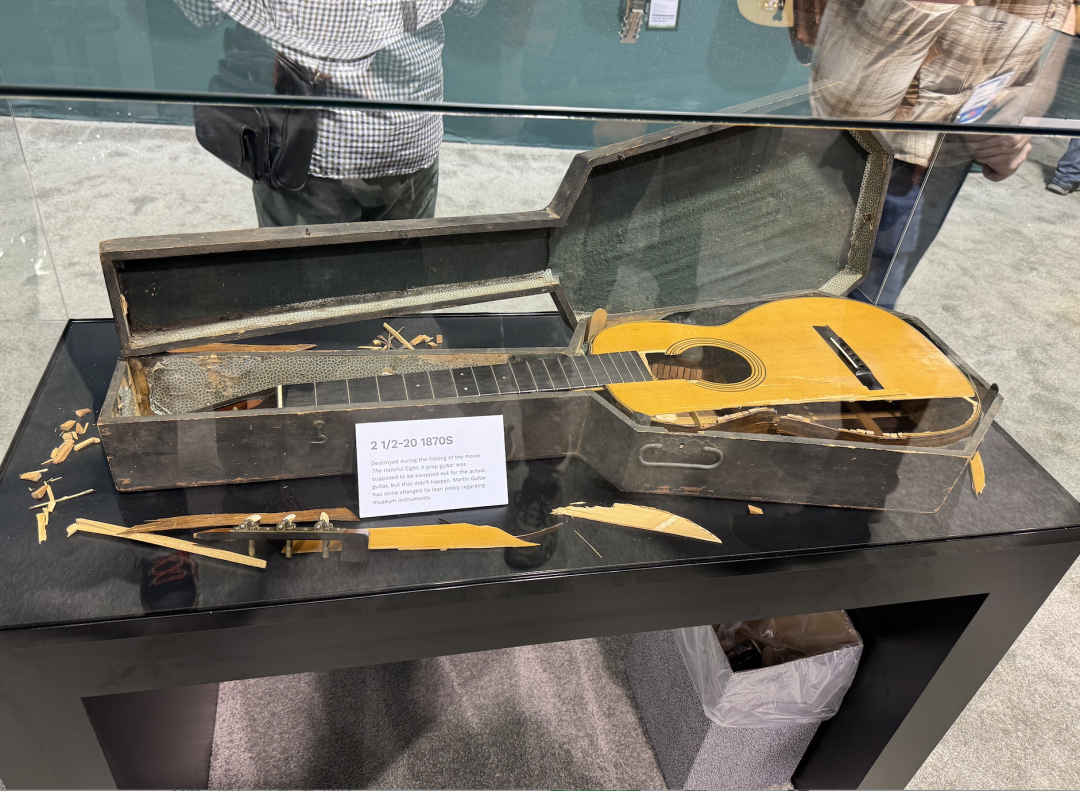
▲ A 19th-century antique guitar on display at NAMM Show.
Image source: Dail Technology
On the other hand, we also saw some new types of instruments — for example, devices similar to synthesizers that let equipment produce different tones, as well as some intelligent wind instruments.
The show also featured innovative, bold instrument designs, such as double-neck guitars combining bass and standard guitar, or vertically played guzhengs. There were also traditional effector accessories, including guitar straps and picks. Overall, while intelligent instruments were quite popular at the show, they remained relatively scarce.
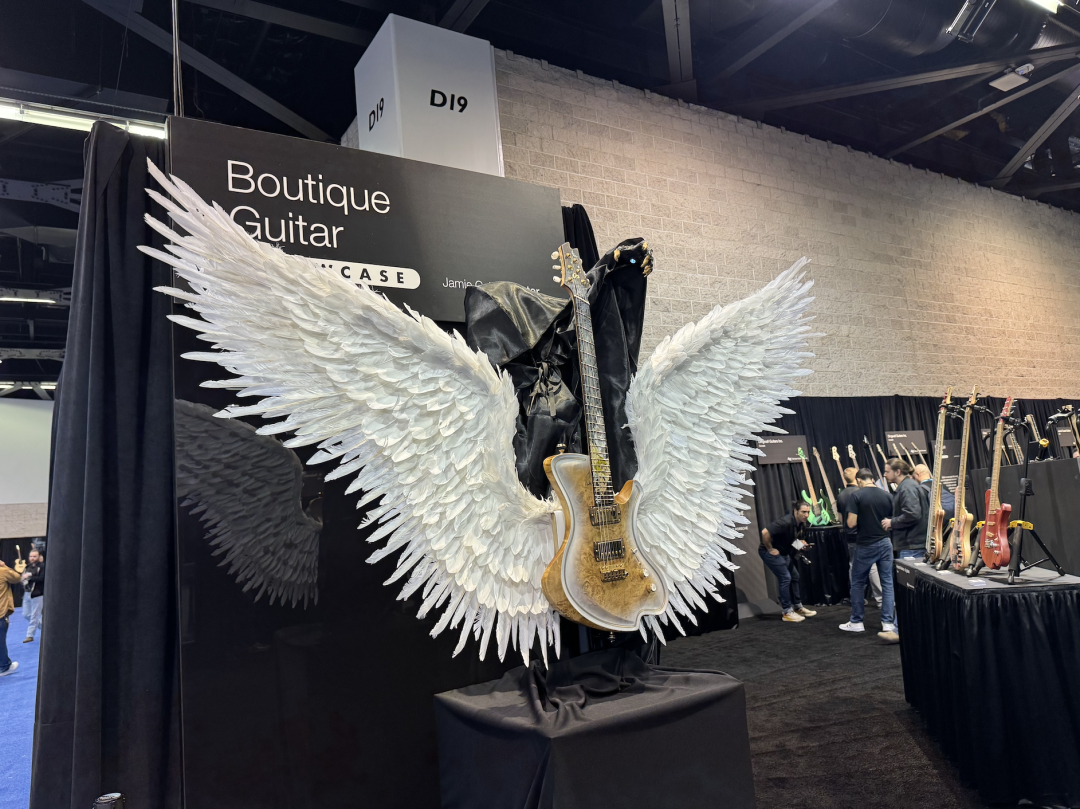
▲ A distinctive guitar at NAMM Show.
Image source: Dail Technology
The US market has enormous demand for musical instruments. Students are encouraged to learn instruments starting from elementary school; school districts make centralized purchases and send teachers to instruct students on how to use them. Overall, American users have very strong foundational musical literacy. In such a market, traditional instrument brands still have considerable room for innovation, and innovative, intelligent products can mine tremendous opportunities.
/ 02 / Innovating Traditional Instruments: How Do You Make Drums and Guitars Intelligent?
Ying Shen: While introducing NAMM Show, you also mentioned Dail Technology's products. Could you specifically share your main products and how these instruments embody innovation and intelligence?
Yafeng Niu: We mainly focus on innovating and adding intelligence to drum kits and guitars. Starting with drums — the kit uses two drumsticks and foot pedals paired with an app or speaker, allowing users to simulate playing drums in mid-air. These modifications significantly reduce the physical space required to play drums, minimize disturbance to others during performance, and make it easier for users to get started.
We've simplified the complexity of drum kits and created a product called "Pocket Drum," applying motion-sensing technology to drumsticks to make playing anytime, anywhere possible. This product has already gained significant attention in the US market, with many users discovering us through social media on TikTok and Instagram and actively coming to experience it on-site.
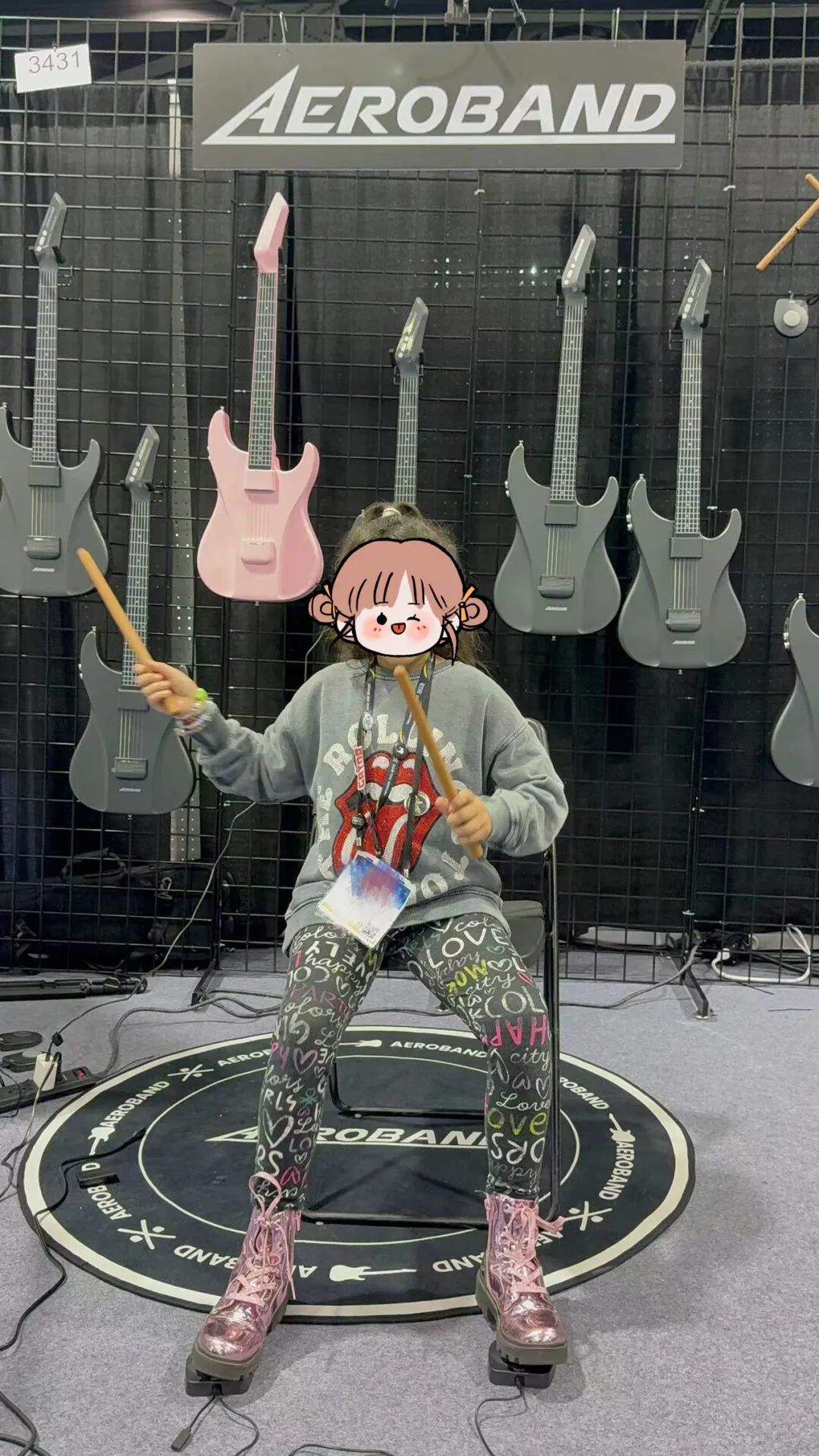
▲ At the NAMM Show, a user tries out Aeroband's "Pocket Drum."
Image source: Aeroband
Our second product is a smart guitar, featuring silicone strings and an integrated speaker and microphone. We noticed that finger pain is the first obstacle most guitar beginners encounter. With traditional guitars, the steel strings will callus your fingers. Even after getting past that hurdle, another problem arises — when practicing complex chords like F major, the technical difficulty is so high that many people give up.
In fact, many people learn music so they can perform or sing along smoothly in various settings. So we started from first principles, thinking about how to create a product that would let ordinary music enthusiasts get started quickly, enabling people to learn to play and sing a song in just three minutes. To achieve this, we completely reimagined the guitar's design — its structure, strings, and sound production — ultimately developing this instrument.
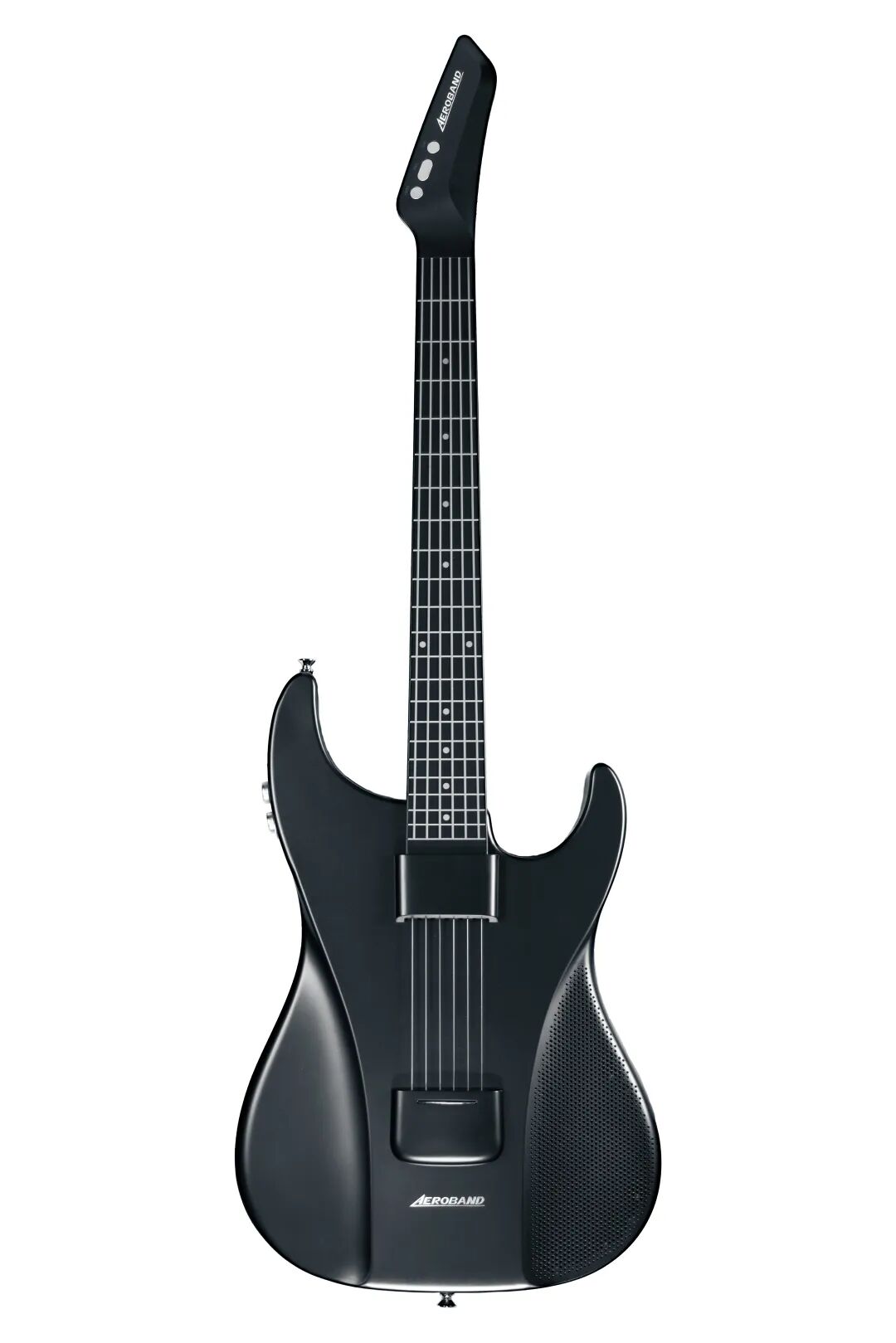
▲ The pain-free digital guitar developed by Aeroband.
Image source: Aeroband
Shen Ying: This electronic drum kit lets users play in mid-air with just two drumsticks and foot pedals. The smart guitar, as a tech product, also makes it easier for beginning music lovers to learn.
I'm curious — what inspired you to reform these instruments, and what drives your innovation?
Niu Yafeng: Though I come from an engineering background, I have a deep love for music. I've bought guitars and tried drum kits myself, experiencing all the pain points I just mentioned. I studied automation and have been fascinated by electronics since childhood — I believe nothing is unchangeable. When these two passions collided, I started thinking about whether there could be new ways or innovative products to help ordinary music enthusiasts enjoy music without painstaking practice or bleeding fingers. After all, not everyone needs to become an instrument expert or master.
Many ordinary music lovers like myself might just want to play an instrument at a certain moment to express our emotions, or express ourselves through music at gatherings, on the street, or in various other settings. This insight is what drives us to develop smart instruments. We've digitized the guitar, innovating across the entire chain from physical sound production to synthesizers, power amplifiers, and microphones, and combined it with our app to provide users with a completely new music experience.
Our app has many fun features built in. Complete beginners with zero foundation can choose game mode, following gamified content on the app to play and sing songs they like. Users who aren't yet familiar with complex chords can also define new chord configurations through the app. More experienced users looking to experiment can simulate different tones like piano, bass guitar, or bass on the app, allowing one person to play like an entire band.
The core of an instrument is letting users play music they love and express their emotions.
Shen Ying: I remember in college, I'd occasionally see guys with guitars singing downstairs in the dormitories. Those moments were probably the highlight of their college lives.
Niu Yafeng: So we want to help those who love music but can only watch from the sidelines, telling them that they can play music too. We hope that by providing smart instruments like Aeroband, we can give users the ability to cross that threshold, experience and enjoy music, and have their own highlight moments.
Shen Ying: Music really is a hobby for many people, and also a way to express emotions that transcends culture, country, and language. However, whether it's guitar or other instruments, the barrier to entry is genuinely high.
In investing in Aeroband, our original intention and thinking aligned with yours — we want to further penetrate and popularize music and instruments, letting more enthusiasts enjoy the joy of music with a lower barrier to entry.
There are other smart instrument brands on the market, like Lava Music and Enya, which launched products earlier. How do you think Aeroband differs from these smart instrument brands?
Niu Yafeng: It's great that there are innovative instrument brands in the domestic market — it shows there's demand for this type of product. All of us brands want to attract different audiences or positioning of users to better enjoy music.
For example, Lava Music designs guitars using carbon fiber techniques, plus screens and effects, probably targeting users who want serious study or professional guitar players. Enya offers instruments in different categories like ukuleles, also positioned toward users pursuing professional learning. Our goal is the incremental user base — attracting people who originally couldn't enjoy the highlight moments of playing music, or those who tried before but gave up because of the long learning curve required.
Shen Ying: I'm curious — traditional instruments are just hardware, while Aeroband has done extensive work in software innovation, like the chord innovations you mentioned earlier. You're also considering entering the children's music market in the future and creating your own music content. What's the thinking behind these moves?
Niu Yafeng: For music enthusiasts, whether they have some foundation or no experience at all, simply providing a hardware product often can't satisfy their learning needs. After all, traditional instruments are extremely complex with high barriers to entry. So the app we've developed, through gamified content and intelligent teaching feedback, greatly enhances the fun and efficiency of user learning. The app can display in real-time where users press their fingers for each position, giving instant feedback on whether each chord is correct, helping users understand what they're playing well and what needs improvement.
Content innovation is equally important. We realized that when users practice, they often look for songs they like, but frequently can't remember lyrics, aren't familiar with sheet music, or even need to learn music theory from scratch. So we've made sheet music more dynamic and gamified, presenting it in the app as sliding blocks that users can follow more intuitively.
In the future, we also plan to introduce community features and online bands, letting users connect with each other, collaborate, and perform together, forming a complete user experience闭环 that makes learning music simpler, more fun, and more interactive.
Hardware functionality and experience are limited — the app provides users with a platform to explore more features, performance content, and connections with others. But app development is meticulous, deep work that can't be rushed. Especially since we're also globalizing, making the app support 10 languages. Users in each country may have different content needs, which requires time and careful iteration.
Targeting Globalization: Innovation Is the New Opportunity for Chinese Instrument Brands
Shen Ying: You mentioned the app supports 10 languages. We know that Aeroband positioned itself from day one as a brand rooted in China but facing the world. The brand has garnered over 500 million exposures on YouTube, Instagram, and TikTok. How did you choose to enter the US market, and how do you view it?
Niu Yafeng: We chose the US market mainly based on two factors: music penetration and user purchasing power. These determine whether a product can successfully commercialize. Data shows that 40% of the global music market share is in the US, and guitars alone account for half of the instrument market. Per capita annual music spending in the US is far higher than in China — $24 in the US versus roughly $1 in China.
In 2019 and 2020, many new domestic brands chose to go overseas. We also tried overseas crowdfunding and ended up selling over 5,000 Pocket Drum sets in one month.
Since then, we've focused more on overseas markets, particularly the US, gradually building up on Amazon and our own independent site, establishing a short-video-based content commerce strategy, and progressively developing overseas markets.
Shen Ying: China has a large population of instrument enthusiasts, and many parents want their children to learn instruments. How do you view the differences between the Chinese and US markets? What are your company's plans or strategy for the Chinese market going forward?
Niu Yafeng: In the US, music education penetration is extremely deep — from elementary through high school, almost everyone has been exposed to instruments. In comparison, China's music penetration is still not high.
But China has 1.4 billion people. Once material needs are met, spiritual needs will certainly grow. Many Chinese parents place great importance on their children's talent education, and many working professionals are also finding spiritual sustenance through instruments. So China's instrument market is growing rapidly. The key to breaking through lies in what product can lead the trend in music consumption. While we focus on developing overseas markets, we also have some presence in the domestic market.
Shen Ying: Speaking of global instrument brands, famous ones include Steinway pianos, Yamaha keyboards, and Fender guitars. Chinese brands haven't yet achieved comparable international recognition. However, China is already the world's largest instrument manufacturer. How do you think Chinese instrument brands can gain recognition in overseas markets? How do you become a brand rather than just a manufacturer?
Niu Yafeng: In the short term, it's difficult for Chinese brands to compete with these overseas giants that have decades of user recognition accumulated. Like in the traditional internal combustion engine vehicle space, overseas brands have dominated for years, with Japanese and European brands each having their unique positioning. It's especially hard for Chinese brands to challenge long-established overseas brands like Mercedes-Benz and BMW. But as cars gradually shift to the new energy track, Chinese auto brands have the opportunity to overtake on the curve.
Chinese instrument brands face a similar situation. Although China produces 70% of the world's instruments, most are OEM manufacturing for overseas brands. In the high-end market, Chinese instrument brands are virtually absent — most products are either contract manufacturing or can only compete in the low-end market.
But smart instruments provide a new opportunity for Chinese brands. At this exhibition, in the area where Chinese exhibitors were concentrated, while there were still many traditional instrument manufacturers, there was no shortage of novel, innovative products. Our smart drum kit and guitar attracted considerable attention when being played.
We believe that innovative and smart products will open new global market opportunities for Chinese brands, demonstrating our innovative capabilities distinct from traditional manufacturing. Many companies are developing global brand awareness, no longer relying merely on imitation but grounded in genuine innovation.
We share creative content on TikTok and Instagram, showcasing our innovative instruments and attracting music lovers' attention. Through social media exposure and distribution, we've successfully raised user awareness of new instrument categories, and through KOL collaborations and advertising, achieved sales across major platforms.
Overall, innovative instruments provide Chinese brands with the opportunity to overtake on the curve, just as electric vehicles are revolutionizing the traditional auto industry. Music is the same — we use technology to lower the barrier to learning instruments. As more people recognize smart instruments, China will gradually develop global smart instrument brands.
Shen Ying: You mentioned that Aeroband mainly focuses on music enthusiasts or beginners, perhaps not directly competing with major brands but instead entering a broader incremental market — this is an excellent entry point. After these general music audiences or beginner users learn Aeroband's guitar or drum kit, can they smoothly transition to traditional guitar or drums?
Niu Yafeng: It's a very natural process. If we can elevate the musical abilities of the broader population and help them enjoy music, that's already a success. And if some users develop higher ambitions and want to advance to more professional instruments, that's even better. Although our products incorporate many disruptive innovations, they're still grounded in fundamental music knowledge — guitar chord fingerings, for instance, remain the same as traditional instruments.
Our products help users start from zero, reducing the resistance and fear around learning music. From this perspective, we've preserved the professional aspects of traditional instruments while discarding the elements that prevent people from engaging with music.
Going forward, we hope that like DJI drones, the vast majority of users will create more content through this new product category. We care more about the person behind the instrument than the instrument itself — the form and playing method can be redefined, as long as users can express emotion through it.
Shen Ying: How receptive are professional users to Aeroband?
Niu Yafeng: From a user experience and human nature standpoint, most people prefer to avoid pain or difficulty. Our guitar uses silicone strings to provide a gentler playing experience, and we invited several professional music teachers to try it — they generally preferred this new approach. Even though these teachers had developed calluses from years of playing, they still experienced discomfort during performance. Similarly, our drum kit has been well-received for its portability and digital features, allowing users to play easily anytime, anywhere.
Beyond comfort, we're also creating new experiences for users. Our guitar, for example, can simulate piano sounds while playing.
Once users experience this, it's hard to go back. It's like Apple's touchscreen technology — initially unfamiliar, but over time people discovered this new interaction method was far more convenient than keyboard operation.
One user flew in from New York specifically to see our products at NAMM Show. He's a musician who had nearly given up guitar due to a hand injury, but regained his ability to play through our instrument. These details inspire us — Chinese innovations helping users globally, whether professional or amateur. That's tremendous motivation for us.
Shen Ying: You mentioned earlier that technology and instruments are vehicles, with the ultimate focus on deeper human needs. China has many excellent traditional instruments — guzheng, erhu, pipa, guqin, and others. I studied guzheng from childhood myself; it has a long learning curve, is inconvenient to transport, and playing contexts are limited, yet mastering it brings great enjoyment. I'm curious whether you'd consider entering the Chinese traditional instrument market with technological transformation?
Niu Yafeng: The Chinese traditional instrument space holds significant opportunity, and we may enter it in the future. First, even within China, many excellent traditional instruments haven't achieved wide普及, and overseas markets have barely encountered Chinese traditional instruments at all.
Instruments like guzheng and pipa are highly non-standardized — sound quality varies dramatically based on materials and age, which actually creates room for digitization and smartification. Traditional guzheng, for instance, is large to ensure proper frequency resonance. But if we digitize it, the physical size can be reduced while using sensor technology loaded with high-quality tones to achieve the playing experience.
Shen Ying: AI technology has exploded in recent years, becoming a hot topic across industries. How do you think AI will integrate with the instrument industry and bring new changes?
Niu Yafeng: In the instrument space, the key is enhancing user experience — both sensory and operational efficiency. Our goal is lowering the barrier to instrument use. As the user base expands, their demands on instruments will increase too. For example, users might want to compose melodies or songs within specific emotional atmospheres. This is where AI becomes crucial — providing foundational templates, recommending chords based on emotional keywords users input, enabling easy music creation through our app.
AI can also contribute to music transcription. For instance, AI can analyze a song's melody, convert the recognized melody into sheet music, and upload it to the app for users to try playing.
Additionally, we can integrate instruments with virtual reality (VR) and augmented reality (AR) technologies. We're currently developing virtual drum kits — in the future, users wearing specific glasses will see virtual drum sets, stages, even entire music festival audiences, creating a comprehensive audiovisual experience that further enhances product appeal. I believe these technologies will add value to our product experience, and they're worth exploring and embracing going forward.
The Entrepreneurial Journey: Persistence Driven by Passion
Shen Ying: As a hardcore entrepreneur, you started your entrepreneurial path while still a student — relatively rare among university students. Many peers were still exploring themselves or the world. What was the catalyst that made you decide to start a company?
Niu Yafeng: I believe interest was the greatest driving force. From childhood I was fascinated by electronics, enjoying disassembling them to understand how they worked. This curiosity led me to study automation and electronics, and eventually to entrepreneurship. When our team turned initial ideas into reality, we discovered more people needed such products — and we stepped onto the entrepreneurial path.
In the entrepreneurial process, you constantly encounter new problems and challenges. Solving each one brings tremendous satisfaction, like continuously "leveling up" in a game. From university to now, this experience has accumulated rich expertise and deep understanding of building tech brands and products.
At Aeroband, we've cultivated a company culture we call "3C Culture." This doesn't refer to the traditional 3C (computer, communication, consumer electronics), but three core philosophies: Challenge, Change, and Create.
First, "Challenge" manifests in our development of entirely new smart instruments. We challenge not only traditional instrument manufacturing principles and sound production methods, but also entrenched mindsets. And the transformation from university student to entrepreneur is itself a challenge to oneself.
Next, "Change" requires us to continuously step outside our comfort zones, iterating ourselves daily through new methods and understanding. From a university student knowing nothing about the world to selling products domestically and internationally while gradually building a brand — this process is full of challenges. Building a brand is extremely difficult, but by changing ourselves every day, evolving our product, evolving our market brand, we eventually form a substantial system.
Finally, "Create" means continuous innovation. When we bravely challenge industry conventions and self-imposed limitations, and persistently change every day, we will inevitably innovate new things. While challenging tradition, we must possess innovative capabilities and thinking — embracing new technologies, new communication and marketing methods, and exploring new markets. Only then can we create what we truly want.
Shen Ying: We can feel your passion for the entrepreneurial process, but entrepreneurship is often a long journey with uncertain outcomes. How did you convince yourself and persist to the end?
Niu Yafeng: The entrepreneurial path is filled with challenges and difficult moments. It was through entrepreneurship, specifically through marathon running, that I learned how to persist. I once ran a trail marathon — 50 kilometers total. At the 30-kilometer mark, I nearly hit my limit, with cramps in both legs.
Then I devised a method: along the route, every few dozen meters there was a red ribbon. I made each short segment my next target. Step by step, I ran the final 15 kilometers. This process made me realize that entrepreneurship also requires breaking large goals into a series of small targets, tackling them one by one. The key is believing you can reach the finish line.
Shen Ying: What kind of company do you hope to build Aeroband into?
Niu Yafeng: Our vision is to become the world's most innovative music technology company, reaching music enthusiasts globally and enabling them to create better content, express emotions more effectively, and showcase themselves through these products!
Interactive Giveaway Do you play instruments? What are your thoughts on China's instrument market? What innovation opportunities might exist in China's instrument market? Share your views in the comments.
Until February 28, 17:00, the 5 readers with the most thoughtful comments will receive a FreeS Fund industry research handbook + a book recommended by Feng Shu.

17 industry research reports + 1 podcast for you — wishing you a prosperous start to work
A trip to the US: 6 new opportunities in consumer sub-sectors we discovered | FreeS Research
What new opportunities did AI bring to the gaming industry in 2023? | FreeS VC Dialogue
Star the FreeS Fund WeChat official account for timely business insights.