Why We Seek Unique Investment Opportunities at the Intersection of Disciplines | Frees Fund — Learning About Investing Through Investing

Breakthrough innovations tend to happen at the intersection of disciplines.
"Learning from Investments" is a column we launched in 2020. Its purpose is to reconstruct the trend hypotheses and validation processes that informed some of FreeS Fund's most representative investment decisions; it's also our way of paying tribute to founders — sharing what we've learned about their industries by watching them lead their companies forward and continually overcome challenges.
In this sixth installment, we want to share what we've observed about competitive moats in online education, and why we're optimistic about innovation opportunities at the intersection of disciplines, through the growth and experimentation of MiMo Music.
Not long ago, MiMo Music — the education brand under MiMo Technology — announced that it had raised tens of millions of RMB in an A+ round led exclusively by FreeS Fund. From last November through this summer, MiMo Music achieved double-digit month-over-month compound growth, with revenue increasing more than tenfold.
This wasn't entirely due to the pandemic. There's no question that nearly all online education companies grew during COVID-19. What merits thinking through and distinguishing is which ones will earn users' long-term favor and retention once the pandemic passes. So far, MiMo Music's growth trajectory has continued.
In this piece, we want to share MiMo Technology's pivot and development, as well as our thought process over four years of investment:
- Is music education merely a "nice to have"? Is there opportunity for spiritual consumption in China?
- In the post-pandemic online education market, how does one build a moat?
- Why is interdisciplinary innovation the best direction for innovation?
Before diving in, three preliminary conclusions:
- Interdisciplinary fields typically represent the most promising directions for technological innovation. What MiMo Music does is difficult precisely because it requires strong combined capabilities in computer science and music — software algorithms, hardware (phone microphones and chips), and music.
- The post-pandemic online education market will be more competitive; good products can push internet-native characteristics to their limits to create differentiated offerings.
- Optional consumption and spiritual consumption are macro trends — incremental markets worth investing in.
Contact Us
We hope this offers fresh perspective, and we look forward to ongoing exchange with founders and industry experts in education and entertainment. Please reach out to:
Jintong Xian, Vice President, FreeS Fund jintong@freesvc.com
You can also connect with us via WeChat: freesfund
01 What Opportunities Lie in Interdisciplinary Fields?
MiMo Technology is a company focused on audio technology and music education. It operates two apps: MiMo Music, launched in March 2018 for adult users (with approximately 4 million accumulated users), and MiMo Kids Piano, launched in July 2019 for children aged 3–8 (with nearly 1 million users).
Unlike many music apps, both MiMo Music products teach ukulele, guitar, and piano through human-computer interaction and game-based level progression.

▲ MiMo transforms the process of learning an instrument into a route of advancing through levels.
This is a promising market. Over 600 million people in China listen to music, but only a minority can play instruments. According to MiMo Music founder Yipei Xiang, instrument penetration in China is below 10%, compared to over 40% in developed Western countries — substantial room for growth. In his words, it's a market of "Africans without shoes" — a classic incremental market.
On one hand, new-generation parents generally emphasize cultivating their children's interests and talents, and music is an unavoidable market. On the other hand, adults also value self-improvement, and after generations of internet product immersion, adults — particularly young people — are more receptive to learning music online. Overall, music education in China will become more mass-market, spanning broader age ranges.
However, digitizing music education is a particularly tough nut to crack. K-12, art, and other fields already have sizable online education companies, but music education remains fragmented offline — it hasn't been effectively digitized or scaled. We believe technological progress can accelerate the digitization and intelligentization of music education, creating new educational models with superior learning experiences and outcomes compared to existing ones.
This direction is difficult because it requires teams that understand both technology and music — the combined capabilities of software algorithms, hardware (phone microphones and chips), and music. For example, in building its product, MiMo Music employs AI audio interaction technology: using phone sensors plus algorithms to accurately identify each pitch of each instrument and provide real-time correctness feedback.
In our view, MiMo Music represents one of the most promising innovation directions today: cross-boundary, interdisciplinary work. Put differently, it's about combining knowledge from different domains, then practicing, then abstracting — generating developments that push these different disciplines forward from the intersection or middle ground between them.
We're already seeing that innovation today is entirely cross-boundary; breakthrough innovations mostly occur at disciplinary intersections. For example: biology + data and computing, biology + electronics (automation, sensors), chips + algorithms, biology + materials, chips + consumer scenarios, consumption + data...
There are many reasons why interdisciplinary fields have become more fertile ground for potential and value. First, current disciplinary systems and knowledge categories were largely constructed on the basis of industrial revolution-era mass production — going back decades if not a century. But the society we face today, and its ongoing development, is increasingly characterized by the cross-pollination and fusion of various technologies and knowledge across domains. Information and biology, retail and internet, smart logistics and chip sensors — these are all opportunities for significant efficiency gains born from cross-domain intersection.
Over the next decade, the interdisciplinary trend will only intensify. We've already begun applying big data, AI, and various other technologies to industrial production and the real economy; going forward, these new technologies will affect an ever-wider range of service sectors, including finance, culture, and arts.
So looking ahead ten years, we'll need more people capable of bridging and integrating across different fields, disciplines, and knowledge systems — enabling more innovation to emerge from these intersection zones.
For us as an investment institution, this presents a challenge: building our investment team's capacity to cover different industries and collaborate across boundaries is essential. Our investment team must not only make professional judgments about technical capabilities but also possess domain-specific know-how.
Entrepreneurship at interdisciplinary intersections also requires founders with compound capabilities. Happily, MiMo Music founder Yipei Xiang has long straddled music and computer science. He studied piano and oboe from childhood, was a competitive pianist with perfect pitch, went through Tsinghua University's electronics department and served as principal oboist of the symphony orchestra, then pursued music in the US, earning a PhD in music from UC San Diego. Before founding MiMo, he spent 10 years as an audio engineer at Qualcomm, becoming an algorithm expert with nearly 50 invention patents. Yipei Xiang's background and experience align closely with the direction MiMo Music is pursuing.
Remarkably, MiMo Music has also attracted a group of cross-boundary people: programmers who play guitar well, musicians obsessed with showing off IT skills, drama-trained arrangers, finance majors who insist on being music education product managers. These people often serve as translators when working with colleagues. Together, they've built a music education app that represents a rare combination of art + technology + smartphones — earning the favor of app platforms like Apple and Google.
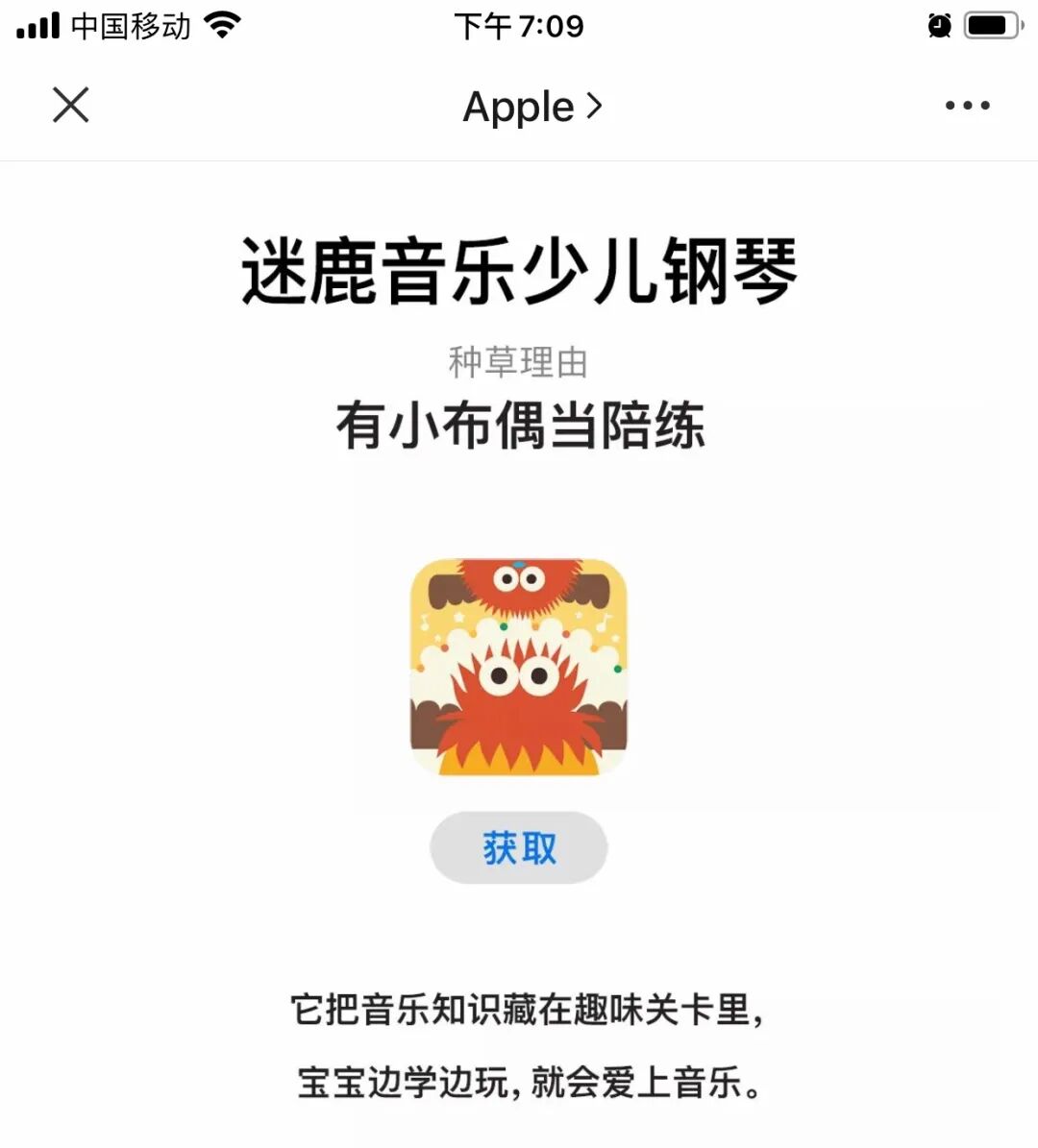
▲ "MiMo Kids Piano" was selected as one of Apple's Best Local Apps of 2019.
Over the past two years, MiMo Music has received multiple official recommendations from Android app markets and Apple's App Store. MiMo Kids Piano was selected as one of Apple's Best Local Apps of 2019 — only four apps in China received this honor, and MiMo Kids Piano was the sole domestic education product.
Yet before this validation from investors, users, and partners, MiMo Technology went through two very difficult years.
In 2016, virtual reality was gaining momentum in both the US and China. Social giant Facebook even listed AR/VR alongside artificial intelligence as the two pillars of its long-term vision. MiMo Technology entered from a technical angle, focusing on panoramic audio technology and products: self-developing spherical harmonic sound field compression algorithms, bare-ear 3D panoramic audio rendering, 720-degree invisible microphone arrays, real-time 3D audio game engines, and other technologies, while launching pioneering experimental products like the MiMo VR Virtual Cinema, MiMo VR Workstation, and MiMo 3D Audio SDK. MiMo Technology also contributed creative sound design for projects including Ximalaya's Xiaoya AI speaker.
However, the VR industry's momentum fell short of expectations, and consumer applications remained far from an inflection point. Yipei Xiang realized it was time to explore new directions. During two years as a panoramic audio technology service provider, MiMo Technology accumulated capabilities in audio hardware and software-hardware integration solutions. In 2018, MiMo Technology pivoted to music education, applying these technical capabilities.
A small observation here: for early-stage startups, changing direction early on is quite common — nothing to be embarrassed about. Even when pivoting, those that successfully transition and ultimately gain market recognition rarely leap to domains completely disconnected from the founder's or team's DNA (Elon Musk being the exception). Most often, the new endeavor extends from the founding team's prior experience.
Interactive Giveaway
What interdisciplinary, cross-boundary innovation opportunities do you see?
Share your thoughts and observations in the comments. By 9:00 PM on September 1, the 5 readers with the most thoughtful comments will receive a free MiMo Music online experience course (guitar, ukulele, or kids piano — your choice) and a FreeS Fund custom notebook.
02 Smartphone + Instrument + Human × Fragmented Time = ? How Do Online Education Companies Build Moats Post-Pandemic?
The pandemic forced adoption of some professional, high-barrier, low-frequency, high-value applications — online education among them. MiMo Music's growth during COVID-19 partly stemmed from offline music training temporarily shutting down, driving users online; once they tried the product, discovered its value, and liked it, they stayed.
However, as we noted in "After the Pandemic: Education's Survival Elimination Round", the post-pandemic period will be springtime for online education, but not necessarily for online education companies. More new entrants have flooded the market, users have become more sophisticated, and competition is fiercer than before. Offline education brands, having acquired the tools to operate online and optimized full-chain efficiency, may actually hold advantages over online-only brands.
For online education to form moats, structural adjustments driven by technology support and course quality are needed. We see three evolutionary paths for online education products:
- From the supply side: increasing supply of quality educational resources, optimizing cost structure, and improving efficiency;
- From the demand side: pushing internet characteristics to their limits to provide experiences that offline cannot offer;
- Innovating on educational content itself, expanding the boundaries of paid educational content.
(Founders with these ideas and characteristics — we'd welcome connecting and collaborating.)
MiMo Music's efforts lean more toward the second path. It uses intelligent audio recognition to achieve real-time audio interaction and teaching feedback; animated video, gaming, and other approaches make the learning process highly entertaining and interactive, sparking curiosity and exploration.
These happen to hit pain points in instrument learning.
Instrument learning is a discipline requiring muscle training and repetitive practice — the process is tedious and serious. Its learning model is heavy: you need to go to a practice room with a teacher for instruction or accompaniment, occupying blocks of time. Moreover, its gratification cycle is typically long — perhaps passing a grade exam, perhaps performing a piece at an important occasion. Because of this, instrument learning is hard to sustain. After the initial novelty of buying and beginning an instrument wears off, it often ends up in a corner or hung on a wall, becoming a symbol of being "artsy."
Yipei Xiang, who has played music since childhood, knows this all too well. Thus, he's been thinking about how to make music education accessible to more people, framing the challenge as a question: Smartphone + Instrument + Human × Fragmented Time = ?
Through two years of exploration, his preliminary answer is this: whether for adults or children, what MiMo Music currently does is serve users at the beginner stage. Beyond building a scientific teaching and research system, using technology and entertainment to empower music education — lowering barriers and enhancing experience — becomes especially important.
At this point, MiMo Music has developed a methodology for educational content production, with course output capabilities steadily maturing.
Take its kids piano product. Based on deep study of the Dalcroze, Kodály, and Orff music education systems, MiMo Music continuously develops more timely new curricula through novel interaction methods for "digital natives."
Notably, Yipei Xiang always urges colleagues to set aside their professional understanding of behind-the-scenes music industry work, and instead think from children's cognitive developmental stages and limitations — how they understand sound and melody, how they resonate. "MiMo creates with shackles on, so kids can spread their wings and learn joyfully," Yipei Xiang says.

▲ MiMo Music created two cute, compact puppets to teach children piano.
In Yipei Xiang's view, children's worlds differ greatly from adults'. First, their eye level is different. "In excellent picture books, children's worlds are full of table legs, elephant legs, parents' legs." So MiMo Music created two lively, adorable puppets matched to children's age and height to teach piano — the child and puppet are at eye level, and the interaction feels like playing with a companion, making trust easy to establish.
Additionally, children are naturally active and typically struggle to concentrate, but they can be deeply drawn in by singing and dancing. Thus, MiMo Kids Piano carefully arranges and animates every knowledge point, transforming them into original nursery rhyme MVs that are educationally meaningful, pleasant-sounding, and stylish. The lyrics themselves contain the knowledge points, with lively melodies; children learn through following along with rapping and game-based level progression. The entire process is simple, fun, and engaging.
For adult guitar and ukulele courses, MiMo Music also uses AI interaction to overcome the limitation of video tutorials lacking real-time feedback. Gamified design paired with polished background music creates an immersive practice environment, banishing the tedium of instrument learning.
In Yipei Xiang's view, gamification mechanisms are especially important. Every time users complete a level, every correct note they play, the app produces beautiful sounds and gorgeous visuals — each an affirmation of their learning progress, an immediate and sustained delivery of the joy of instrument learning.
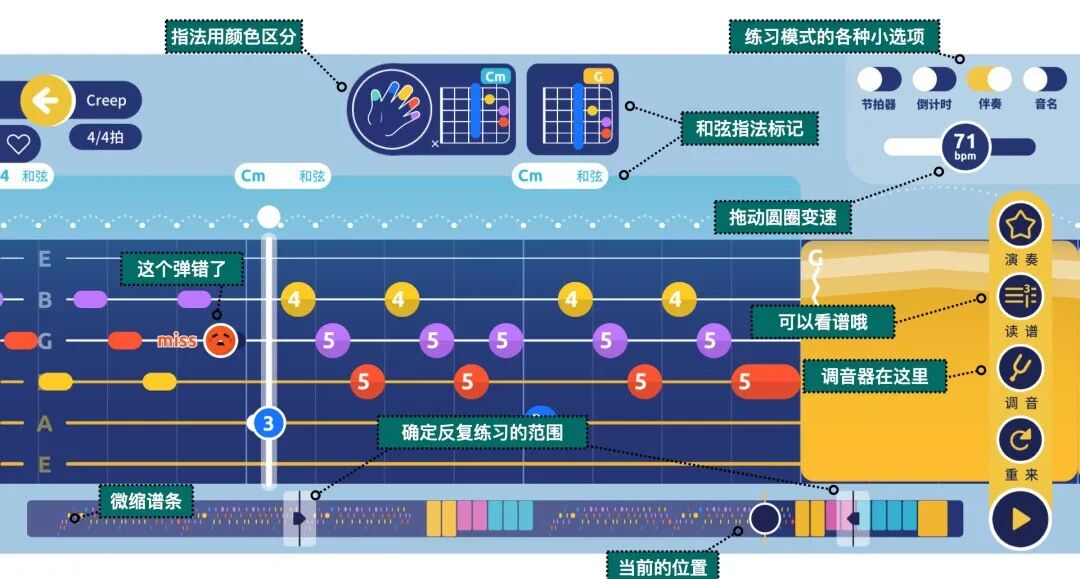
▲ The AI interaction interface in the MiMo Music app.
Overall, MiMo Music's efforts represent a typical case of pushing technical capabilities and internet characteristics to their limits to provide experiences that offline cannot offer. Thus, it helps users better utilize fragmented time, with greater interactivity and more personalized fulfillment.
Shanbay, another FreeS Fund portfolio company in online education, does similarly. Take its English product: it arranges users' learning progress and content according to memory curves based on their familiarity with words. Users can also play word battle games with WeChat friends to learn vocabulary through competition.
Similarly, Onion Academy uses technology to achieve educational personalization, creating a direct connection with students online. It understands users' concentration levels through their online learning behavior, records learning outcomes, and adjusts course progress and question difficulty based on test results. While achieving personalization, it also improves efficiency — efforts that are difficult to scale offline.
Firmly Optimistic About Innovation Opportunities in Optional Consumption and Spiritual Consumption
All populous developed countries have gone through three typical stages in consumption development: durable and household necessity goods consumption; popularization and branding of optional consumer goods; and diversified consumption upgrading. The US and Japan followed this pattern; China is no different.
However, China has two special characteristics. First, when we were in stage one, the internet hadn't yet entered retail — hence the rise of Gome and Suning. In the subsequent second stage, China had Taobao, and internet access reached all city tiers simultaneously. Second, China's large geographic area and relatively rapid development mean different city tiers have been at different stages at different times. Currently, nearly all cities have completed stage one — durable and household necessity goods consumption as the dominant pattern — though some are in stage two (optional goods popularization and branding) and others in stage three (diversified consumption upgrading).
Thus, we pay particular attention to and are optimistic about innovation opportunities in optional consumption and spiritual consumption. Especially in the consumption upgrading process, beyond "better" and "more beautiful," China's consumption upgrading also manifests as strengthening spiritual value. Because consumption upgrading is, to some extent, iteration of spiritual-level demand. We could cite many examples, and will analyze this specifically in future pieces.
Specifically, beyond physical consumption, we are long-term bullish on spiritual-level consumption and have increased investment in this area over the past two years. We focus primarily on two directions:
- Entertainment-oriented: covering audio/video content, community and social, gaming, etc.;
- Education-oriented: including not only K-12 exam-oriented education but also self-improvement and growth at all ages.
(Founders with these ideas and characteristics — we'd welcome connecting and collaborating.)
Music education, where MiMo Music operates, represents art + technology — a typical direction for making people's spiritual experience better.
In Yipei Xiang's words: "Music has always been a medium for emotional expression, and everyone has the need to express emotion. When material and social development reach a certain level, playing instruments and learning music will become as natural and essential as drinking a cup of coffee."
Measures promoting quality-oriented education and gradually canceling art specialty bonus points for school admissions will, in Yipei Xiang's view, also help music education move away from utilitarianism and return to its fundamental value of bringing joy.
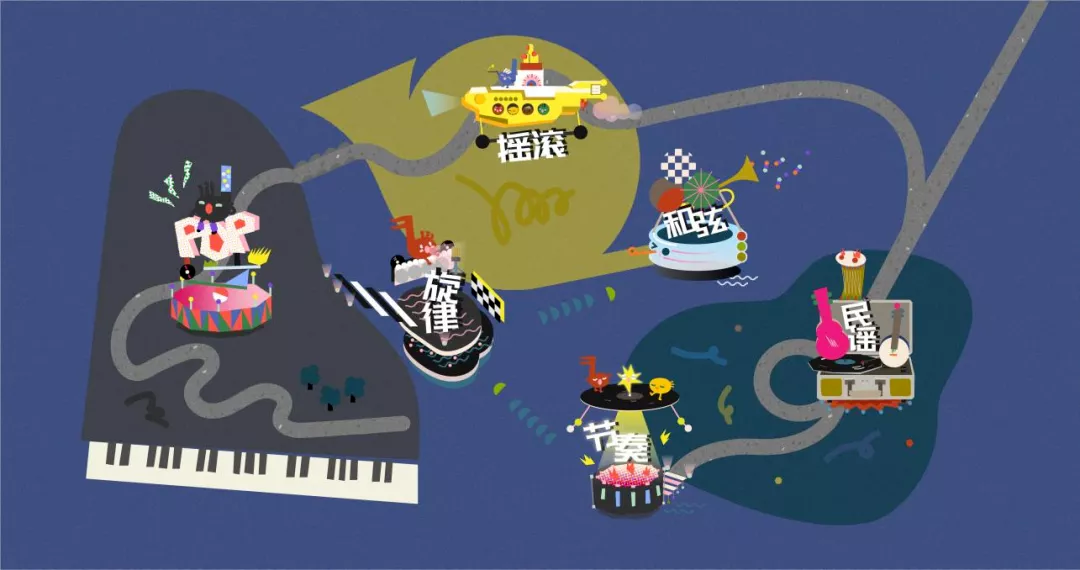
▲ In July 2020, MiMo Music launched a new "Musical Sense World" section requiring no instrument.
Currently, MiMo Music remains an early-stage startup. Its theme for 2020 is extension and breaking out of its niche. Building on its two existing apps and content, MiMo Music will gradually introduce new instrument learning and practice阶梯 content and products this year, while increasing internationalization.
Summary
1. Interdisciplinary fields typically represent the most promising directions for technological innovation. What MiMo Music does is difficult precisely because it requires strong combined capabilities in computer science and music — software algorithms, hardware (phone microphones and chips), and music — but this is also why it has the opportunity to build moats.
2. The post-pandemic online education market will be more competitive; companies that emerge will need structural adjustments driven by technology support and course quality. Good online education products can push internet characteristics to their limits to create differentiated offerings.
3. FreeS Fund pays particular attention to and is optimistic about innovation opportunities in optional consumption and spiritual consumption. Especially in the consumption upgrading process, beyond "better" and "more beautiful," China's consumption upgrading also manifests as strengthening spiritual value.
Interactive Giveaway
What interdisciplinary, cross-boundary innovation opportunities do you see?
Share your thoughts and observations in the comments. By 9:00 PM on September 1, the 5 readers with the most thoughtful comments will receive a free MiMo Music online experience course (guitar, ukulele, or kids piano — your choice) and a FreeS Fund custom notebook.
Contact Us
We hope this offers fresh perspective, and we look forward to ongoing exchange with founders and industry experts in education and entertainment. Please reach out to:
Jintong Xian, Vice President, FreeS Fund
You can also connect with us via WeChat: freesfund

How to Invest in Industrial Robots? | FreeS Research Institute — Learning from Investments
Li Feng Column 16 | The Fresh Retail War — Learning Early-Stage Investment from the Secondary Market