Why We're Bullish on Optical Chips | FreeS Fund Chip Series

What unexpected challenges do chip startups face?
In June 2021, Shanghai released its 14th Five-Year Plan for Strategic Emerging and Pioneer Industries, identifying photonic chips and devices, brain-inspired intelligence, and others as "pioneer industries for future-oriented strategic layout." The plan called for breakthroughs in the R&D and application of next-generation photonic devices such as photonic chips, aiming to achieve disruptive innovation across industrial chains including data centers, supercomputers, autonomous driving, household robots, telecommunications equipment, and defense systems.
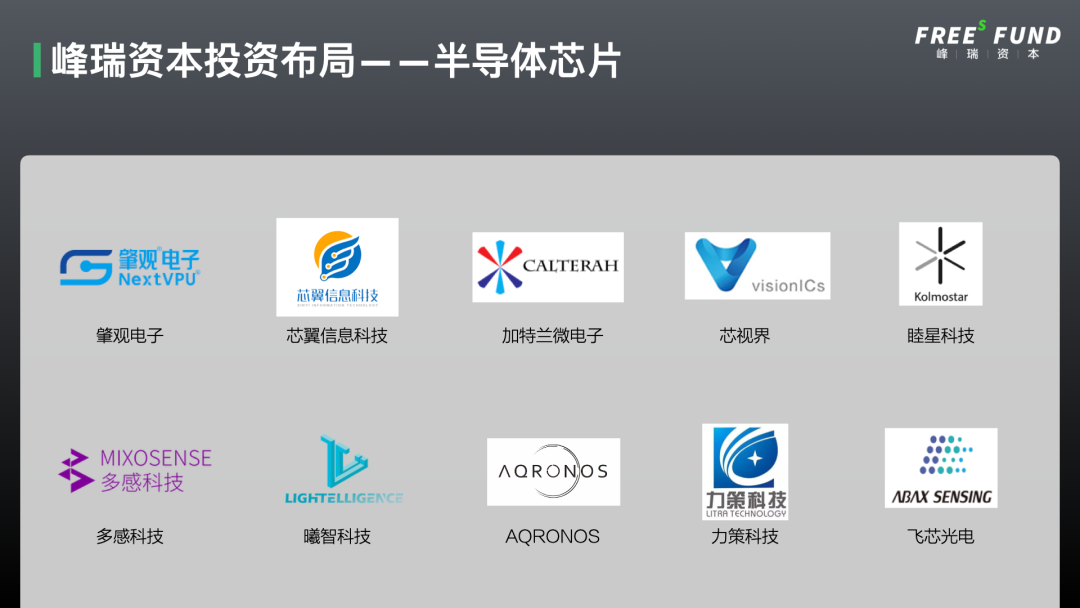
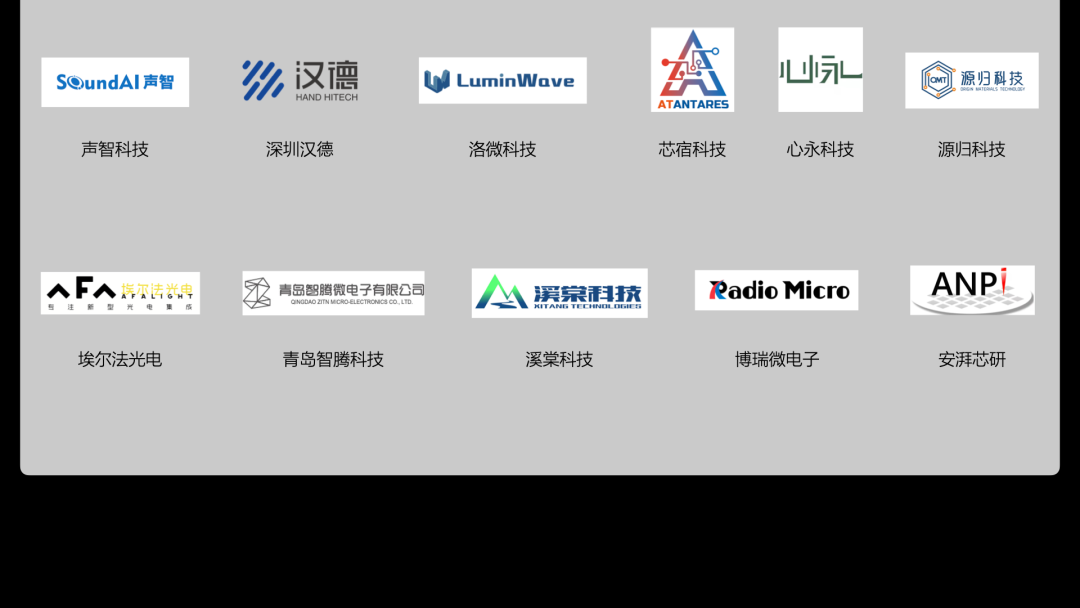
Semiconductor and chip-related projects have long been a key investment focus for FreeS Fund, with considerable energy devoted specifically to photonic chips. Compared to electronic chips, photonic chips are regarded by the industry as critical infrastructure and core support for the future information industry. Since its founding in 2015, FreeS has invested in projects including Shenzhen Lichear, Duosense Technology, Lightelligence, CoreXVision, Luowei Microelectronics, and Alpha Optoelectronics in this direction. Through discovering and supporting these companies' growth, we've developed a deep appreciation for both the prospects and challenges this field presents.
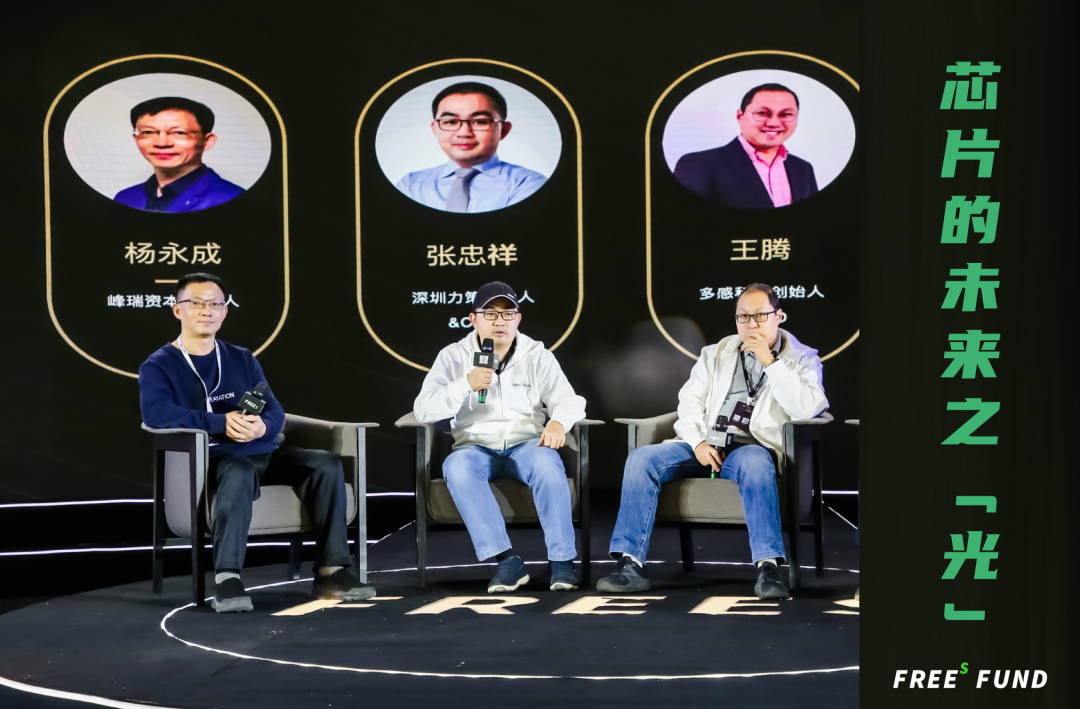
Not long ago, FreeS Fund partner Yongcheng Yang invited two chip industry founders to a roundtable titled "The Future of Chips: Light." The two founders were Zhongxiang Zhang, founder & CEO of Shenzhen Lichear, and Teng Wang, founder & CEO of Duosense Technology — both combining research backgrounds with industry experience. Both have been committed to "doing what's right, not what's easy." Zhang remained steadfast in research and development even during the "darkest hour" of the lidar industry. Wang returned from Europe to start a business, diving headfirst into a red ocean and integrating deeply with upstream and downstream industry players, confronting competition directly.
At FreeS, Yongcheng Yang oversees deep tech investments. Before joining FreeS Fund, he served as General Manager of Baidu's Hardware Ecosystem Channel Department and as Vice President at Xiaomi. In his view, FreeS's heavy focus on light-based technologies stems from two technical reasons: first, light enables higher communication speeds and better sensor resolution; second, light is less susceptible to external electromagnetic interference. As a result, optical applications are becoming increasingly widespread and performant — think fiber optic communications and lidar, which most people have heard of.
Yang and the two founders discussed the following questions:
- Why is OPA (optical phased array) something "right but not easy"? What's difficult about it?
- How do you adjust your mindset when your entrepreneurial direction isn't favored in the short term?
- Why is it said that "in the watershed year for the lidar industry, companies that raised money and those that didn't ended up on completely different paths"?
- What unexpected challenges do chip startups encounter?
- For returnee entrepreneurs doing technology startups in China, what capabilities need to be developed?
- Why is it said that opportunities sometimes belong to those who aren't fully prepared?
This is the first installment in our chip series. We hope it brings you some insights.
Reader Giveaway: What are your thoughts on photonic chips? Share your unique perspectives in the comments. The 3 most thoughtful commenters will receive a 2022 FreeS Fund commemorative T-shirt.

/ 01 /
In the watershed year for the lidar industry, companies that raised money and those that didn't ended up on completely different paths
Yongcheng Yang: Semiconductor and chip-related projects have always been among FreeS's key investment priorities. Our chip investments span intelligent IoT and communications, millimeter-wave radar, VPU AI accelerators, 5G base stations, low-power high-efficiency GPS, and more. We've also invested in companies bridging electronics and photonics — like Nanjing-based CoreXVision, which makes single-photon detector (SPAD) chips; Alpha Optoelectronics, which makes consumer-grade optical engines; and pure silicon photonics chip companies.
Why so many chip investments? That's hardly a question that needs asking anymore. Semiconductors are an industry with sustained demand throughout future industrial development. Going further — why has FreeS invested so much effort in focusing on the optical direction within chips?
There are two fundamental technical reasons.
First, from a physics perspective, light is high-frequency electromagnetic waves — its frequency is far higher than the communication frequencies we use daily in 2G/3G/4G/5G, meaning the usable bandwidth is much greater and the wavelength much shorter. In application, this means light can provide higher communication speeds and better sensor resolution, as with lidar.
Second, humanity's current control and utilization of light is still imperfect, and light propagates more like narrow-beam straight-line transmission. So in practical applications, light isn't easily disturbed by external electromagnetic signals. Whether used for sensors or long-distance communications, light has inherent signal-to-noise ratio advantages.
Based on these technical factors, we're seeing optical applications become increasingly widespread and performant — fiber optic communications and lidar being familiar examples.
Today we're fortunate to have with us two entrepreneurs who are experts and pioneers in the photonic chip industry. Both were once PhD students and top students in optics, and are now working hard at entrepreneurship. Please introduce your respective companies.
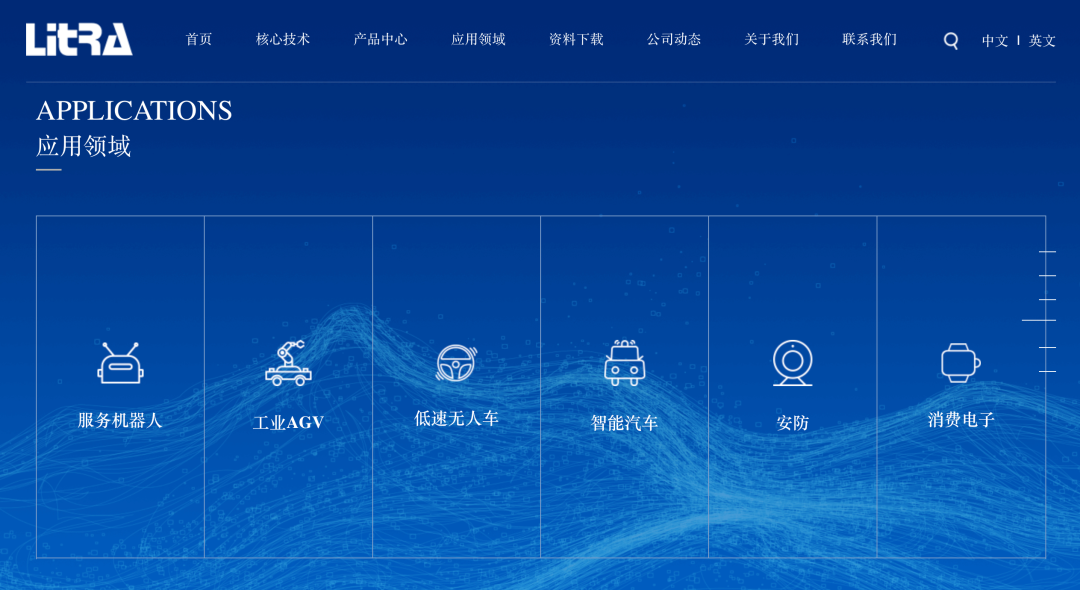
Zhongxiang Zhang: Shenzhen Lichear was founded in 2013. Our products mainly comprise two series: first, optical phased array (OPA) radar chips, used for designing lidar products for automotive navigation; second, mechanical lidar, targeting service robots, industrial AGVs, logistics AMRs, and similar applications. On our mechanical lidar product line, we've already achieved leading domestic shipment volumes with considerable revenue. On OPA lidar chips, we've completed multiple tape-outs, with all chip metrics meeting expectations and production-grade technical standards. We're currently working on the corresponding lidar system design.
I studied computer science as an undergraduate at USTC. My graduation thesis combined quantum cryptography with computer science directions. When I went to The Chinese University of Hong Kong for my PhD, I formally switched to photonics, working on research such as optical antennas. Later, I chose photonic chips as my entrepreneurial focus — a technical point highly related to my previous research area.
Yongcheng Yang: Let me try to describe in accessible terms what Shenzhen Lichear does and how it differs from other lidar companies on the market.
As everyone knows, lidar is a very hot entrepreneurial direction right now. But from a technical route perspective, the market currently sees multiple directions developing in parallel.
For example, the earliest and highest-volume mechanical lidar; MEMS technical routes; Flash/TOF and other technical routes; and the OPA phased array lidar we're discussing today.
Shenzhen Lichear's chosen direction is OPA optical phased array lidar.
Zhongxiang Zhang: Actually, when Lichear Technology first started, we also wavered between MEMS lidar and optical phased array (OPA) lidar technical solutions.
The reason for wavering wasn't uncertainty about which technical direction was better or which better met automotive-grade requirements.
In fact, from the day lidar was born, academic consensus has been that phased array (OPA) lidar represents the industry's future — this was never in dispute.
Our key consideration was weighing technical difficulty against time cost. But after comprehensive analysis of MEMS, OPA, and other possible technical outcomes, our core conclusion was: although MEMS technology uses semiconductor processes to shrink mechanical structures (micro-mirrors) to chip scale, its essence remains an electromechanical structure, still inheriting some defects and limitations of mechanical lidar.
So we ultimately chose to commit resolutely to tackling the challenge, selecting the OPA lidar technical direction. Fortunately, it now appears this was indeed something "right but not easy."
▲ Image source: Shenzhen Lichear official website
Yongcheng Yang: Yes, yes. I remember very clearly. Around 2019, fundraising for the OPA technical direction in the lidar industry was very difficult.
Zhongxiang Zhang: Yes. I could say that FreeS's investment timing wasn't just the most difficult period for our company, but also the lowest point for the entire lidar industry.
Although OPA was academically recognized as the optimal lidar solution, at that time several OPA startups domestically and abroad had raised hundreds of millions in funding and signed various strategic cooperation agreements with major automakers — yet years later, hadn't produced convincing results.
So a view circulated in the market suggesting that OPA technology might not be conquerable in the short term, that practical application remained very far away.
Yongcheng Yang: That's right. Before FreeS invested in Lichear, I also visited some industry experts and professors at well-known universities. Their relatively consistent conclusion was: the direction is right, but execution is extremely, extremely difficult.
However, FreeS has always advocated "doing what's right, not what's easy" as an early-stage fund. After various due diligence assessments, we ultimately decided to invest in Lichear. Or rather, CEO Zhang and his team ultimately gave us confidence.
Zhongxiang Zhang: Indeed, 2019 was a watershed year for the lidar industry. That year, companies that raised money and those that didn't basically ended up on completely different paths. We were very fortunate to receive FreeS's lifeline funding.
Yongcheng Yang: The industry was so difficult then — why did you feel the OPA path was worth persisting with? What was your mindset at the time?
Zhongxiang Zhang: Actually, as you said, we chose OPA because we felt that even if it's difficult, the right thing is worth persisting with.
We can look back at what the industry controversy points were. OPA initially sparked an investment frenzy around 2016, when solid-state lidar pioneer Quanergy first proposed industrializing silicon photonics lidar. In 2016, their Series B alone raised $100 million. The entire industry basically pinned its hopes for the ultimate lidar solution on silicon photonics OPA.
The progress of silicon photonics-based lidar technology lagged far behind the fundraising pace. Even now, many in the industry believe that while OPA's direction is correct, no team will produce results within ten years. Why? Precisely because this direction is so difficult.
Yongcheng Yang: What's difficult about it?
Zhongxiang Zhang: Generally, entrepreneurs tend to choose something technically mature, or at least physically mature. But OPA itself isn't physically mature. We were basically running a company while doing work similar to university laboratories.
Our tape-outs continued for nearly four years before achieving some very clear breakthroughs. In May 2021, we published our OPA chip results and architecture at an academic conference, with peer review. At the industry level, we also received investment from Xiaomi.
/ 02 / Returning from Europe to start a business, diving straight into a red ocean
Yongcheng Yang: Speaking of "right but not easy," Teng Wang's Duosense Technology is the same. Please give a brief introduction.
Teng Wang: I graduated from Tongji University for undergraduate studies, then did my PhD at Chalmers University of Technology in Sweden. After my PhD, I worked at IMEC (Interuniversity Microelectronics Centre) in Belgium for six years before returning to China in 2018 to found Duosense Technology.
I come from an integration engineering background. Duosense Technology essentially does integration of key technical modules. We started with sensor chips, then innovated on this chip foundation by integrating special optical structures on-chip, adding specially matched software and algorithms, to manufacture sensor products.
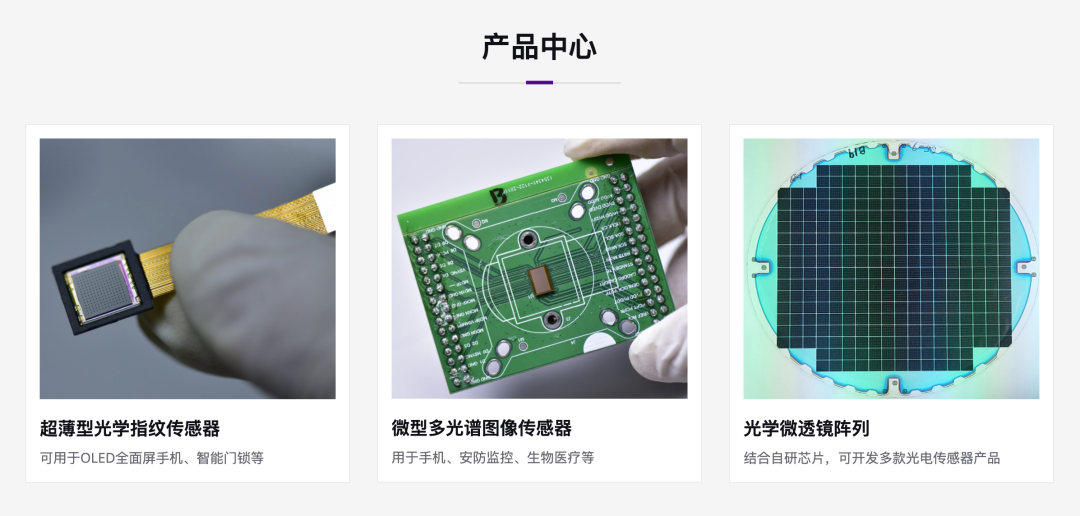
The company now has three product lines: ultra-thin optical fingerprint sensors for under smartphone screens, photoelectric sensors for smartwatch rotating crowns, and miniature multispectral image sensors. The core is getting the right foundational elements right, then leveraging mainland China's advantageous supply chain in manufacturing — such as packaging modules, traditional optical coating, etc. — through integration innovation to provide extremely miniaturized and cost-effective photoelectric sensor products for consumer electronics, intelligent hardware, and other industries.
▲ Image source: Duosense Technology official website
Yongcheng Yang: Wang's "not easy" differs from Zhang's. His "not easy" comes from Duosense working in supply chains for phones and smart homes. The market size and value-add potential of these two consumer-facing markets is unquestionable, but the supply chain is a complete red ocean. You returned from Europe to start a business, diving straight into this red ocean — what difficulties did you encounter?
Teng Wang: Like most chip startups, we're a fabless company. What's somewhat different is that we touch many more links — from chip design to traditional optical coating factories, optical processing factories, packaging factories, module factories, we have to engage with all of them. Each link also involves some degree of innovation.
As a startup, we need to convince large companies to iterate with us multiple times, quickly; to show them why something can't immediately generate economic value in the next year or two, but will be very promising in the long term.
Yongcheng Yang: This is a very important capability for founders.
Teng Wang: Yes. I should say my experience at IMEC developed this capability — how to technically persuade different links in the industry to work together on something with huge long-term value. This is the expected challenge that all startups encounter.
Yongcheng Yang: This is also why Wang has grown into a "jack of all trades." In Europe, he might only need to focus on his own work. For example, doing under-screen optical fingerprint recognition, he'd just need to get the chip right — others would assist with software matching, like fingerprint recognition software, distortion correction software, etc.
But domestically, these largely need to be pushed forward by oneself. This makes you become an expert in more fields while certainly enduring countless difficulties and challenges. What challenges were unexpected?
Teng Wang: Actually, team building. After returning to start a business, especially these past two years, because we do both software and hardware — hardware being chips and optics, software's core being algorithms — these happen to all be particularly hot directions. Hiring is much harder than imagined. We can only seek solutions through various means without affecting product progress.
Yongcheng Yang: People always say opportunity favors the prepared, but the vast majority of entrepreneurial teams find it hard to start only when "everything is ready." I suspect that if Wang had known that starting a business in China requires doing everything personally, he might not have returned so resolutely — he might have waited to get the team together first, and by missing the entrepreneurial window, might never have started at all. So from this perspective, sometimes opportunities also belong to those who aren't fully prepared.
FreeS has been deploying in the chip industry for many years. We remain bullish on the industry's development prospects in China. China will inevitably upgrade from the world's largest semiconductor consumer to a design and manufacturing powerhouse. We hope all entrepreneurs can gain more support and realize their dreams.

Brand Going Global: How to Do TikTok and Independent Sites? | FreeS Going Global Series
Women Rising Upward: 18 Voices in the World of Entrepreneurship | FreeS March 8 Special
FreeS 2021 Outlook ④ | Final Speculation on Sensors Behind Autonomous Driving
How to Build a Global Cross-Border E-Commerce Brand? | FreeS Going Global Series