Is Home Maintenance and Renovation a Good Business Under the "Housing Is for Living In, Not Speculation" Policy? | FreeS Fund Interview

Delivery is core; digitalization is the future.
In December 2021, the Central Economic Work Conference reaffirmed the principle that "housing is for living in, not speculation" and called for "city-specific policies to promote a virtuous cycle and healthy development of the real estate industry." Under this top-level regulatory framework, the real estate market has been shifting from new construction to existing stock, and from investment to owner-occupation. Two months later, in February 2022, at a press conference on promoting high-quality development in housing and urban-rural construction hosted by the State Council Information Office, Minister of Housing and Urban-Rural Development Wang Menghui outlined priorities for 2022, including "advancing renovation of old urban residential communities" and "further promoting measures such as attracting social capital participation, innovating financial support methods, and facilitating the adjustment of existing housing usage."
As revitalizing existing housing became a key strategy for addressing living needs, market demand for post-renovation home maintenance and remodeling has grown steadily. To understand the current state and prospects of this market, we recently spoke with Chen Junhua, founder and CEO of Yiniaokeji (益鸟科技).
Before founding Yiniaokeji, Chen spent years working on large-scale engineering maintenance and renovation projects, accumulating extensive experience in engineering technology and strategy. In March 2016, he launched Yiniaokeji in Chengdu, focusing on the post-renovation home maintenance market. Through its "self-operated stores, self-employed technicians" model, Yiniaokeji has built an intelligent maintenance system powered by big data, artificial intelligence, and IoT technologies, aiming to drive standardization and digital transformation in this traditional industry.
Our discussion covered the following topics:
- How do macro regulatory policies affect the real estate industry's supply chain?
- What are the pain points in the home maintenance and remodeling market? What are their root causes? How can they be addressed?
- Why is the self-operated model the inevitable choice for achieving full-chain digitization?
- How should we view platform players entering this space?
- How to validate and solve for geographic expansion?
- How to distinguish between fake demand and suppressed real demand?
...
We hope his insights offer you some food for thought.
Engagement Giveaway: We warmly welcome your thoughts in the comments section. The three most thoughtful commenters will each receive a FreeS Fund custom notebook set (including two notebooks in different designs). Comment screening closes at 12:00 PM, March 10, 2022.

/ 01 / The Future Maintenance and Remodeling Market Will Be Larger Than the Renovation Market
FreeS: What are Yiniaokeji's main business lines?
Chen Junhua: Home maintenance and renovation remodeling. Maintenance focuses primarily on water leakage and decorative surface issues. Remodeling mainly targets older homes and pre-furnished properties.
FreeS: How do you view the size of the home maintenance market?
Chen Junhua: In recent years, the "housing is for living in, not speculation" policy has driven two notable market shifts: first, from new construction to existing stock—that is, from new homes to resale homes. Second, from investment to owner-occupation.
On the new construction side, the proportion of pre-furnished homes has been rising. On the existing stock side, many are owner-occupied resale homes, with a large share being first homes or刚需 residential properties. As investment gives way to owner-occupation, average residential tenure also increases. Whether it's maintenance and remodeling needs for resale homes, remodeling needs for pre-furnished homes as family structures change, or maintenance needs arising from longer tenures, all are trending significantly upward.

Starting in 2018, on the developer side, leading property companies had high pre-furnishing rates. Major brands like Evergrande and Vanke made substantial investments, with new home pre-furnishing rates generally exceeding 50%. Even developers ranked below the top 50 saw rapid growth in pre-furnishing rates.
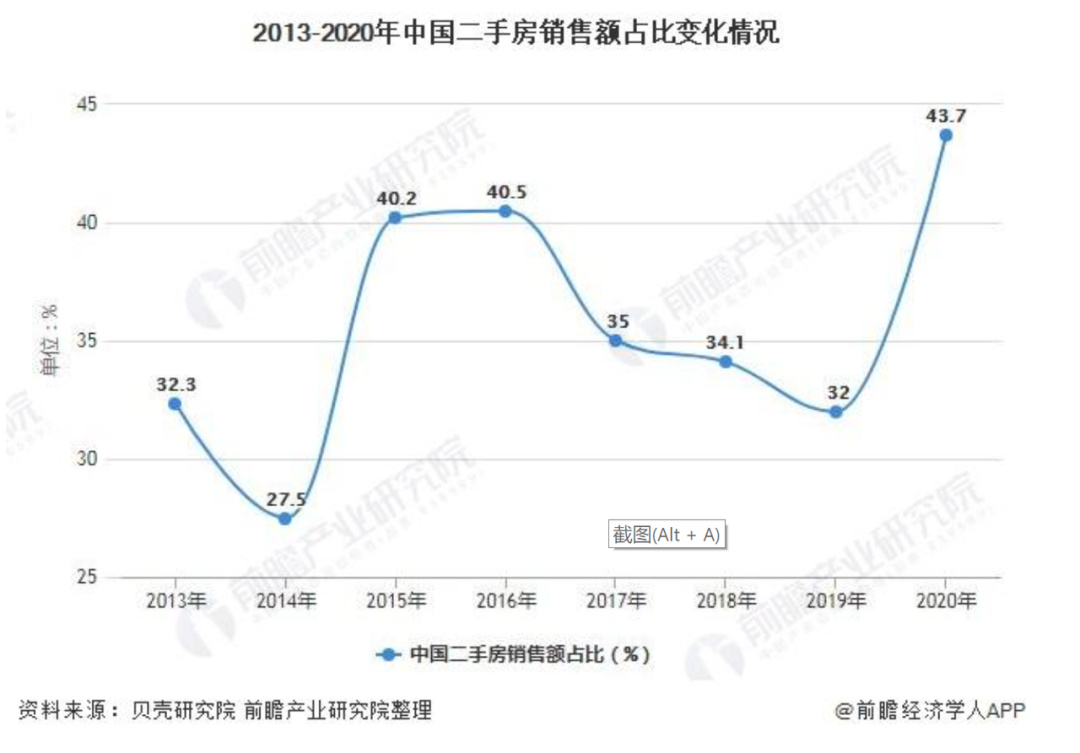
As new housing markets in first-tier cities approach saturation, the real estate industry is gradually entering the stock era. According to KE Holdings data, in 2020, resale homes accounted for approximately 43.7% of China's commercial residential sales. Resale transactions are becoming the dominant component of residential trading in first- and second-tier cities.
In the past, investment properties represented a larger share, with more new homes, and the corresponding supply chain was renovation companies—hence the prevalence of pre-furnished new homes. But as real estate policies have adjusted, the cycle-matched supply chain has shifted from renovation companies to home maintenance and remodeling companies.
FreeS: So what you're doing is equivalent to what renovation companies were during the new home cycle.
Chen Junhua: Yes, but we have advantages over renovation companies. Renovation companies are mostly one-off businesses. Although the market is large and many have gone public, true branding has proven difficult because they never achieved industrial digitization.
Maintenance and remodeling are different. The purchase frequency is higher, and there's opportunity to achieve full-process standardization and digitization, which enables scale. If you also deliver good experience, you can grow into a brand company. So, considering the shifts in real estate, if we can achieve standardization, scale, and branding in this industry, we'll have more growth potential than renovation companies.
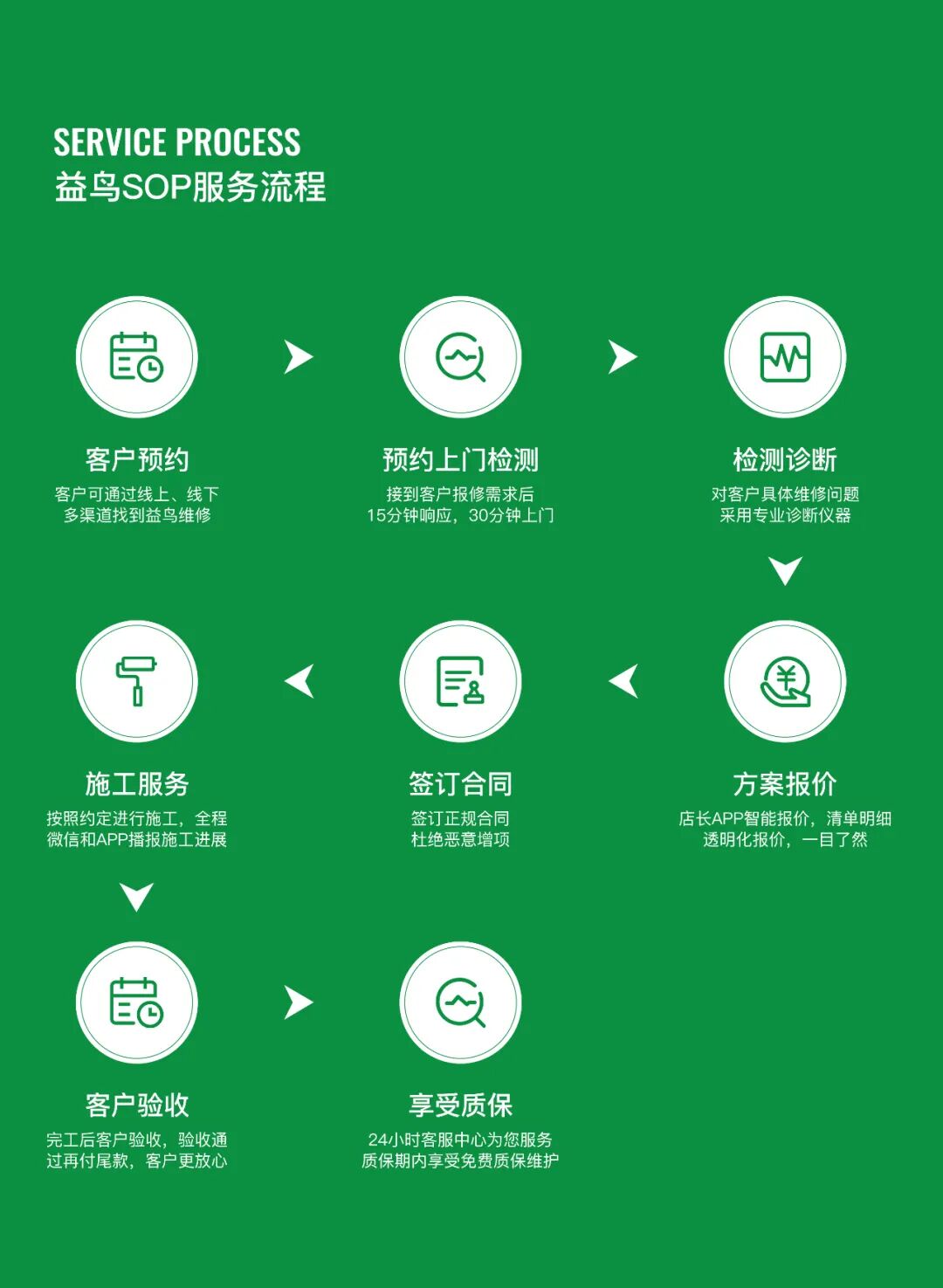
Yiniaokeji's full service process
FreeS: What skepticism have you faced in your entrepreneurial journey?
Chen Junhua: One argument is that partial remodeling (局改) is fake demand. We've been at this for five years, interacting with customers daily, serving tens of thousands of clients. We should have more authority to speak on this. Partial remodeling is absolutely not fake demand—it's suppressed real demand. Many families want partial remodeling, but the supply side fails to motivate them, so this demand gets suppressed.
Others ask whether partial remodeling can actually make money. Under traditional organizational methods and craft techniques, partial remodeling is indeed hard to profit from. But Yiniaokeji's model is different. Based on our own experience, whether at the single-project, single-store, or single-city level, we are already profitable.
/ 02 / Delivery Is Core; Digitization Is the Future
FreeS: How do you differ from competitors? Where is your core moat?
Chen Junhua: Basically none of our competitors resemble Yiniaokeji.
First, there's a difference in business focus. Most competitors have scattered operations. The consequence of being unfocused is inability to accumulate sufficient sample sizes and core technical systems in any single business area.
Second, there's a difference in core business. Yiniaokeji is highly specialized, and we focus on the most technically demanding segments within maintenance and remodeling—water leakage and wall renovation. Anyone with relevant experience knows that diagnosing water leakage sources is extremely demanding of a technician's skill. Most property management companies or unskilled workers can't solve it. Wall renovation is similarly challenging—ensuring quality while shortening timelines tests technical capability heavily. Currently, in these two major segments, we can not only achieve scale but have also accumulated critical data and technology.
Finally, there's a difference in business model. Many competitors use platform models with contractor rates around 90%, investing heavily in marketing and customer acquisition to monetize traffic. The consequence of outsourcing is that maintenance relies entirely on individual experience—purely traditional methods—with no possibility of service standardization or worker professionalization. Therefore, service quality, experience, and delivery are prone to problems, which has long been an industry pain point. Yiniaokeji operates a fully self-employed model, with advantages in data collection, lessons-learned accumulation, and stronger delivery capability. We've always approached delivery challenges from the most fundamental logic.
To Solve Delivery Pain Points, Solve Scalable Talent Output
FreeS: You mentioned earlier that industry pain points lie in service quality, experience, and delivery. What are their root causes?
Chen Junhua: Five years ago, when Yiniaokeji was founded, we recognized that delivery is core and digitization is the future. Five years later, this has gradually become industry consensus, yet companies that can actually solve this problem remain rare. We say delivery is core—then what is the core of delivery? People.
FreeS: Behind the people problem is actually the problem of scalable output.
Chen Junhua: Exactly. We can look at this from both supply and demand sides.
On the demand side, as we've discussed, market demand for maintenance and remodeling services is rising significantly in both volume and quality, and will continue to grow. On the supply side, the industry reality is obvious aging among service workers—mostly between 40 and 60 years old—with insufficient new entrants and a declining total workforce. Meanwhile, the industry has never achieved standardization or professionalization. Service levels and quality struggle to match rising market demand, which further prevents industry scaling, intensifies the supply-demand contradiction, and creates a negative cycle.
FreeS: How does Yiniaokeji plan to break this pattern?
Chen Junhua: Currently, supply-side scaling is mainly constrained by two factors: lack of standardization and high dependence on veteran workers; and traditional craft techniques lacking appeal to young people. We must address the root causes.
First, build standards and achieve full-chain digitization. To build standards, datafication is prerequisite. And to achieve datafication requires massive data entry and accumulation—data that must be comprehensive, authentic, objective, and reliable. The fully self-employed model helps Yiniaokeji achieve this. Currently, our digital system has absorbed over 100,000 real-world cases, with more to come. These 100,000-plus cases are equivalent to the combined experience of 100,000 veteran workers. These years of accumulated data are continuously processed by the system to extract a sufficiently standardized, ever-improving operational process covering the full workflow from proposals, materials, labor, craft, quality control, to acceptance—empowering personnel through the system interface.
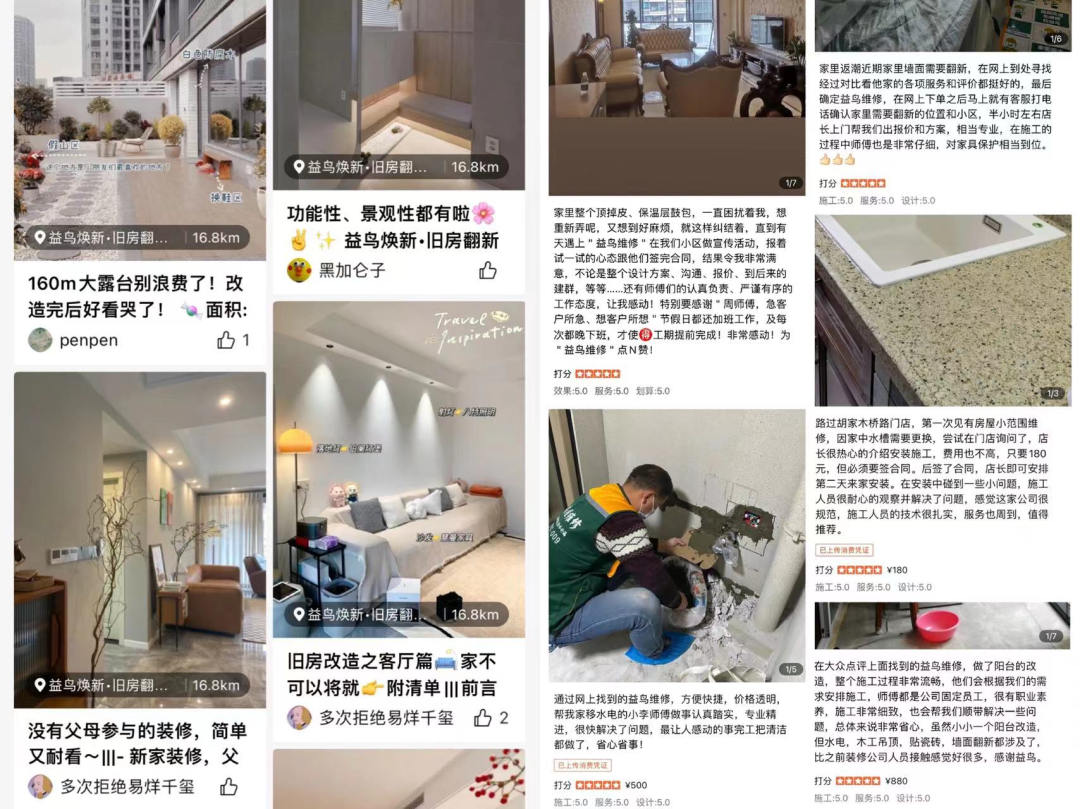
Yiniaokeji has received numerous authentic positive reviews on its platform, with "solid technical skills," "conscientious and responsible," and "meticulous and professional" being frequent descriptions of its technicians
FreeS: Can you give an example of system-to-personnel empowerment?
Chen Junhua: Say a customer has a water leakage problem. Traditionally, workers might rely on intuition. They look around, don't use detection equipment, and tell you based on experience that it's probably a pipe or waterproofing issue. After considerable effort, they open it up and discover it wasn't what they suspected. Wrong "diagnosis," opened for nothing. Or it is indeed a pipe issue, but the worker can't precisely locate the leak point—maybe they punch five or six holes in the pipe before finding it, which also increases costs.
At Yiniaokeji it's different. We have a standardized "diagnostic" process: which data to check in what sequence, what problems different data feedback indicates, deriving conclusions step by step. After "confirmation," the system pushes two or so solution options, listing all information on materials, labor, timeline, process control, results, and costs, for the customer to choose the suitable option.
Selected offline remodeling cases from Yiniaokeji
FreeS: Like treating a house for illness, except different "doctors" use different "diagnostic approaches."
Chen Junhua: Right. Through this mature system's assistance, we can effectively reduce dependence on workers' existing experience, improve efficiency, save costs, and facilitate personnel training and development.
FreeS: Another scaling problem is how to replenish "fresh blood." How can young people be attracted to join this industry?
Chen Junhua: We mainly approach this through engineering technology innovation. Through materials and process innovation, we're transitioning from traditional wet construction to dry construction, converting processes previously completed on-site into prefabricated, assembly-style operations.
First, this is the industry's future direction. The construction sector widely faces problems of high resource consumption, high emissions, and rough construction methods. As the country vigorously advances its "dual carbon" strategy, more energy-efficient and environmentally friendly prefabrication is the industry trend. For example, household tiles—tile production is high-emission. Once national control policies emerge, traditional methods won't be sustainable; there will necessarily be a shift to prefabricated, pre-made approaches.
Additionally, labor costs are rising. In Beijing today, you can't find a worker for 40,000 RMB to make a countertop. If technical methods don't innovate, relying solely on increasingly scarce veteran workers, costs will keep rising and companies will struggle to profit. So through engineering technology innovation, making operations simpler and more respectable, lowering entry barriers while also solving delivery volume, quality, and consistency issues. Cost reductions will correspondingly increase worker incomes.
So: one is full-chain digitization, the other is engineering technology prefabrication and assembly. Whoever in the industry first masters these capabilities will capture greater market share and achieve scale and brand.
/ 03 / At This Stage, Self-Operated Model Is the Inevitable Choice for Full-Chain Digitization
FreeS: Since this is the trend, everyone will invest resources. To do it well, what capabilities matter most?
Chen Junhua: Everyone sees the trend, but actually doing it—there are many pitfalls.
First, digitization. As I mentioned, many competitors use platform or outsourcing models. Without large volumes of comprehensive, authentic, objective, and reliable data, full-chain digitization is very difficult to achieve. So most competitors' digitization remains stuck in the "first half"—design, supply chain, front-end customer acquisition, review systems, and so on. While they've achieved decent results in these areas' digitization, once it reaches implementation, problems abound.
The reason is: as long as the personnel scaling problem remains unsolved, it stays a supplier's market. No matter how well you design the system, if workers won't do it or can't do it well, it won't land.
Additionally, on engineering technology: maintenance and remodeling is a traditional industry, and core competitiveness in engineering technology lies not in R&D capability but in understanding operational details.
We frequently interact with large supply-side manufacturers. Supply chains are highly fragmented—materials makers only make materials, tool makers only make tools, making resource integration difficult. Since the maintenance and partial remodeling market hasn't fully opened, manufacturers devote limited attention and have relatively lagging industry understanding.
So even though everyone knows engineering technology innovation is the future direction, execution quality varies widely. The key is who understands customers, understands their pain points, knows how widespread these pain points are, how to solve them, and what commercial scale they can achieve. This is precisely Yiniaokeji's advantage.
FreeS: You must have stepped in plenty of pits along the way?
Chen Junhua: Yes. That's why I say copying the model is easy, but the pitfalls along the way—only those who've walked through them know.
FreeS: For example?
Chen Junhua: Take delivery. Over the past five years, Yiniaokeji's biggest investment has been solution trial-and-error costs. Despite our accumulated cases, new problems always emerge in existing home maintenance and remodeling. If we follow existing experience to propose solutions, mistakes are inevitable. Wherever it's our fault, we pay for it. But these error resolution processes are precisely our experience and lessons-learned accumulation. We tag these problems and mark them in our system, refining our standardized processes. Next time a worker encounters this type of problem, it can be readily solved.
Take wall renovation as an example. Partial remodeling differs from new renovation—the latter tears everything down and rebuilds, with relatively standardized craft and materials, making estimation easier. In the existing home market, every household's situation and problems differ. For instance, wall flatness varies, so materials needed vary completely. Initially, due to incomplete experience or technical considerations, our workers often made inaccurate estimates. Overestimating wasted materials; underestimating required additional delivery, wasting shipping costs.
But as we handled more cases and data grew richer, experiences and lessons accumulated in our system. Now, our big data calculations effectively assist workers in judgment, avoiding unnecessary costs.
FreeS: Do people think your model is too heavy?
Chen Junhua: The so-called "heaviness" comes from our self-operated model. But choosing self-operation stems from our fundamental thinking about the industry. Because without self-operation, we can't guarantee data collection and case accumulation. Without these accumulations, full-process digitization and intelligent transformation are impossible, and we can't accumulate sufficient customer needs and data to design and develop products. Without solving these problems, scalable output is impossible. So at the current development stage, self-operation as the primary model is an inevitable choice. But once this stage is worked through, when our system is mature enough and has scaling capability, more model options become available.
Yiniaokeji has been around for six years. The early stages are indeed slower. But once you cross that threshold—when I reach 100 stores, then from 100 to 200, 200 to 400, 400 to 800, speed accelerates. Yiniaokeji is on the right path and constantly accelerating.
04 Entering to Reap Large-Scale Immediately Is Impossible; Industry DNA Is Required
FreeS: If platforms also enter this business, are you afraid?
Chen Junhua: Not afraid. In recent years, we've also had business cooperation with some platform companies. Platforms previously monetized traffic, but as online traffic monetization becomes harder, everyone's returning offline hoping to capture services. While platforms can smoothly export demand through their existing business structures' traffic, they easily get stuck at implementation. We've communicated with relevant divisions of some platform companies. They're quite puzzled about how to achieve standardization. And this is precisely our core advantage.
Our growth DNA is completely different. Our industry understanding didn't fall from the sky—it grew from the ground up. Like crops, it needs sowing, fertilizing, pest control to gradually grow. Without this DNA, coming in wanting to reap—and wanting large-scale reaping immediately—is impossible. So I'm not afraid. What Yiniaokeji needs to do is steadily accumulate according to our own logic.
FreeS: What were Yiniaokeji's key developments in 2021?
Chen Junhua: We mainly did four things.
From Single Store, Single City to Regional Development
Previously, we mainly radiated from Chengdu to southwestern cities like Chongqing and Guiyang. In 2021, beyond our existing southwestern region, we expanded to East China, North China, and South China. In East China, we went to Shanghai with two stores; in South China, two stores in Shenzhen; in North China, one store in Beijing, opened in November 2021. We've completed the leap from single-store, single-city to regional development model. Next, we'll further expand regionally based on these three central cities.
System Digitization Transformation and Upgrade
Initially, we were mainly building standards; after standards were established, we began pushing system informatization. In 2021, we completed full-chain digitization transformation from scratch, achieving full-process standardization for all projects from pricing to labor, materials, timeline, and organization.
Comprehensive Financial System Upgrade
After launching the new financial management system, we successfully refined financial granularity to the "item" level. Settlement by project—each project's labor, materials, and profit are clearly tracked, ensuring financial compliance. Based on financial and intelligent system upgrades, our internal controls, whether reimbursement or quality and cost management, improved substantially.
Talent System Building and Refinement
To replicate across multiple cities, the biggest challenge is talent output. Previously, our management relied on knowledge and experience accumulation and transmission; now we've also systematized management concepts and experience, empowering more people through the system.
FreeS: Besides the worker group you mentioned earlier, what other categories does the talent system include?
Chen Junhua: Talent is mainly two blocks: store managers and workers. We've designed different incentive plans for different groups, with the core purpose still being to solve scalable talent output.
For store manager reserves, we launched the "Mountain Peak Plan." The plan covers theoretical and practical learning tasks at different periods (3 days, 30 days, 3 months, etc.), how to learn, how veteran store managers mentor, and corresponding assessment and certification systems.
For workers, we have the "Star Journey Plan." We divide workers into different levels, with different capability requirements and salary levels for each. We adjust levels and salaries based on actual delivery capability. An important capability requirement is mentoring new hires. Additionally, experience accumulation and driving offline customer repurchases are also capability assessment dimensions.
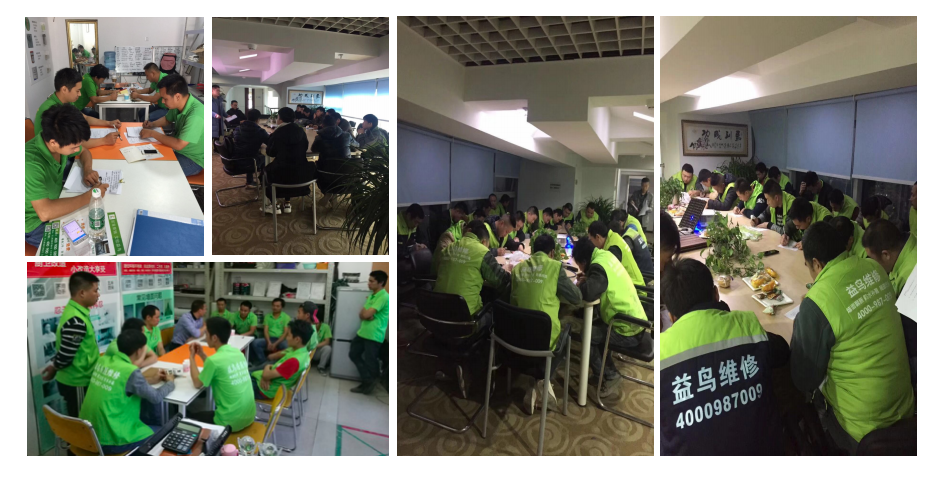
Unified offline training for technical personnel
We further launched the "Thanos Plan," aiming to promote outstanding store managers and workers in marketing. These three plans have been running for over half a year with good results, helping us solidify talent depth and thickness, laying groundwork for future city replication.
05 How to Cross the Geographic Expansion Threshold?
FreeS: You mentioned regional expansion earlier. How is Yiniaokeji's city store model performing currently?
Chen Junhua: The most important and difficult issue in services is validating and solving geographic expansion. Our city store model is running well. In cities like Chongqing, Wuhan, and Guiyang, break-even is achieved within three to six months. For newer cities, what we need to continue refining is service "variance"—keeping service levels at a more stable standard.
Our city selection follows regional layout first—East China, South China, Southwest, North China—then selecting central cities from each region, like Shanghai, Shenzhen, Beijing, Chengdu, then expanding from central cities to surrounding cities with GDP exceeding one trillion RMB. For example, from Shenzhen to Guangzhou and Dongguan; from Shanghai to Suzhou, Hangzhou, and Hefei; from Beijing to Tianjin.
FreeS: How do you reduce service "variance"?
Chen Junhua: It's still based on experiences and lessons accumulated through case accumulation, with continuous iterative optimization of the system. For example, after arriving in Beijing, our people grew from around a dozen to over twenty. Every day on every project, these twenty-plus people generate work experiences that can be accumulated. After accumulation, we organize and distill the best solutions, sharing them with everyone.
FreeS: In the city model, from investment to profitability, roughly how long does it take?
Chen Junhua: It's getting shorter and shorter. At the starting stage in Chongqing, it basically took two years. Wuhan and Guiyang took one year. Newer cities like Shenzhen, Shanghai, and Beijing can break even in three to four months.
FreeS: Do you serve both B-end and C-end?
Chen Junhua: Yes. Currently online customer acquisition is less efficient than offline. Offline, one channel is B-end, accounting for about 70% of our business last year—for example, property management companies. Previously in the Southwest, we partnered with top 20 property companies, representing about 80% of our B-end customer acquisition. Starting this year, beyond property channels, we'll expand multiple offline B-end channels based on stores: for example, real estate agencies (KE Holdings' home services is already testing cooperation); chain housekeeping and cleaning services, etc.
The other is using B-end to acquire online customers, then doing C-end裂变 and customer referrals. This portion isn't as large as B-end yet, but repurchase and referral rates already exceed 35%.
FreeS: How are Yiniaokeji's future directions set?
Chen Junhua: Broadly two lines: business line and technology line.
Business line focuses on business growth.
In 2021, our energy mainly went to filling capability gaps. Without focusing on business growth, we still achieved 70% year-over-year growth. In 2022, our target is 100% plus.
FreeS: How to achieve this?
Chen Junhua: Two parallel routes.
First, scale through city replication. Currently we're in 7 cities; by end of 2022 we'll increase to 15, and further expand to 30 in 2023.
Second, while strengthening core business, expand categories. 2022 is Yiniaokeji's "product year." Strengthening core business helps increase market share and also helps push up average ticket size and expand business scale. Category expansion mainly means developing auxiliary businesses beyond core business, strengthening mining of existing customers, using high-frequency services to drive low-frequency services.
Our first city was Chengdu. Now Chengdu achieves annual revenue of 30 million RMB—and this is with only 1% market share. By strengthening core business, we hope to increase market share to 10%.
FreeS: How do you plan to execute on the technology line?
Chen Junhua: The technology line includes information technology and engineering technology.
Starting 2022, we've formally clarified Yiniaokeji Technology's company positioning.
Yiniaokeji has always had an information system; what we want is for this system to complete the upgrade from standardization to informatization, digitization, and ultimately intelligence, eventually becoming industry infrastructure that empowers the entire supply chain. From the engineering technology perspective, we'll innovate in materials, processes, and other aspects to replace traditional inefficient solutions. We'll devote more resources and focus to technology improvement.
06 "Customers' Urgent Needs" and "Workers' Sense of Achievement"
FreeS: Returning to the beginning—why did you choose to start Yiniaokeji?
Chen Junhua: I come from the building maintenance industry myself, previously working on building structural treatment. You could understand it as performing "surgery" on structures like bridges, tunnels, and dams. But from a business perspective, this industry has a low ceiling. I always hoped to find an entrepreneurial direction with large market size, strong growth potential, that could operate marketization, with good cash flow.
During my search, one day my home's exterior wall leaked, and the interior wall cracked from water damage. The property management fixed the exterior wall but wouldn't repair the interior, instead compensating me 3,000 RMB per wall. I went through considerable trouble to find a worker through a friend. Three days, 1,000 RMB spent. The worker's cost was about 500 RMB.
This struck me. Wall renovation has high margins—it's good business. But why was finding a worker so difficult?
I'd always done strategy at enterprises, so I'm sensitive to such matters. After this incident, I spent about three months researching the home and maintenance remodeling industry. I discovered this is a nationwide pain point. When lights or faucets break, property management can handle it. When appliances break, there's brand after-sales service. But for water leakage or wall renovation, property management can't do it, large renovation companies won't take it, and some casual laborers will but with no service quality guarantee. So my assessment: first, this market is large; it's a universal pain point; and it can operate marketization. So I started Yiniaokeji.
FreeS: From being troubled by maintenance problems yourself to solving major headaches for more customers—that's the joy of entrepreneurship.
Chen Junhua: Yes. On one hand, we can help more customers solve urgent needs; on the other, we can also serve more workers. Yiniaokeji's workers are mostly aged 25-35. Our selection criteria have three requirements: over 5 years industry experience; under 35 years old; service consciousness. Previously, they operated solo with unstable work and life, sometimes facing unpaid work. After joining Yiniaokeji, they have teams, achieved professionalization, and some have settled in big cities. For them, this is no longer just a hand-to-mouth craft but a stable career with upward mobility, experiencing more professional respect and achievement. Being able to serve more workers and customers, contributing to industry transformation—this is what drives us to keep going.

▲How to Build a Global Cross-Border E-Commerce Brand? | FreeS Going Global Series
▲Dialogue with Zhang Liaoyuan: Two Years Post-IPO, How Does Three Squirrels Think About Its Next Step? | FreeS Interview ▲Building Virtual Idols: The Pits and Thresholds | FreeS Interview ▲In the Buzzing Cross-Border E-Commerce Track, What Infrastructure-Level Opportunities Exist? | FreeS Interview ▲"DJI Is Already So Big, How Do You Survive?" A Story of Taking on Giants | FreeS Business School