Li Feng X Liu Changke: The Depths and Heights of K12 Education Over the Years | FreeS Fund Open Talk
How Do Education Industry Veterans See the Future?


Five Questions About Education
▍ Who Is Suited for Education?
What's special about education is that it carries some functions of basic social services. Founders of education companies need to strike a good balance between educational ideals and commercialization. Commercializing too aggressively or too quickly will undoubtedly hurt brand value, but if the idealism runs too strong, commercialization becomes constrained — a risk many teacher-founders face.
▍ What Matters Most for an Education Company?
Education consumption features high price points and low frequency, which demands strong service orientation. It's similar to industries like renovation, wedding services, and healthcare — all need a "floor guarantee" on brand, ensuring service quality never drops below a certain standard.
Education also involves a disconnect between the consumer and the payer. Usually the student attends class while the parent pays. This makes brand extremely important for education companies, because brand helps users reduce decision difficulty and form stable expectations.
In the two-sided market formed by education supply and demand, the biggest challenge for platforms is providing high-quality supply at the greatest scale — and this is where their long-term value lies.
▍ What Builds an Education Brand?
Based on accumulated experience, we believe the common factor in how education companies build brands is: whether they can provide good educational services to good students.
There are two reasons for this. First, good students serve as role models for both their peers and parents, with the ability to influence others' learning choices. Second, good students have better discernment — they know which education products are superior. If good students are willing to participate, that education company has a high probability of earning strong word-of-mouth.
The two education and training institutions currently valued above $10 billion — New Oriental and TAL (XRS) — both developed along this path.
New Oriental started with TOEFL and GRE courses. Over twenty years ago, only top students took this kind of training. The product was difficult to build in the early stage, but once done well, it immediately became New Oriental's brand foundation. TAL was the same. Its core brand was built on early elementary school math olympiad coaching and participation in the "Hua Luogeng Cup" competition, aligning with the aspirations of many good students and parents.
▍ How Can Students Achieve Good Learning Outcomes? How Do You Measure Education Product Quality?
In the vast majority of cases, education and training needs to solve the problem of how to motivate student interest in learning. If students are interested in self-directed learning, devote more time, and concentrate more intensely within limited time, they can generally improve learning efficiency and achieve good results.
▍ One indicator that can measure whether an education company is developing healthily: whether marketing and sales expenses account for a low proportion of total revenue.
First, low user acquisition cost means the brand has good word-of-mouth, and users will actively help spread the brand.
Second, this allows institutions to invest more capital in finding better teaching resources, enabling teachers to receive reasonable returns, create greater value, and provide more student services. At both New Oriental and TAL, this proportion is low — whether for children's training with high repeat consumption rates, or adult training with very low repeat consumption rates.
In short, education brands that can achieve organic growth rather than relying on high-ratio marketing and sales spending will ultimately prove to be sustainable, quality education brands.
Qingqing Jiajiao (轻轻家教) is one such example.
Before Qingqing Jiajiao emerged, offline one-on-one tutoring was already everywhere, competition was fierce, and it was no longer as profitable as when it first emerged ten years prior. Founder Changke Liu identified a problem in this model's value distribution: assuming a parent paid 100 yuan in tuition to an institution, 40–45 yuan would go toward marketing expenses for acquiring new users, while only 20–22 yuan could be allocated to the teacher, correspondingly reducing the value of the teacher's service. Institutions didn't earn much either — after deducting rent, management costs, and staff expenses from what remained, there was basically nothing left.
Liu wanted to enable parents to purchase education services commensurate with the price paid, while making the businesses of both teachers and institutions sustainable. He co-founded Only Education (昂立教育) in 1991, serving successively as general manager and chairman. In 2014, Only Education restructured and went public through a merger with Xinnanyang, becoming China's first K12 education listed company. In 2015, Liu left Only Education and co-founded Qingqing Jiajiao.
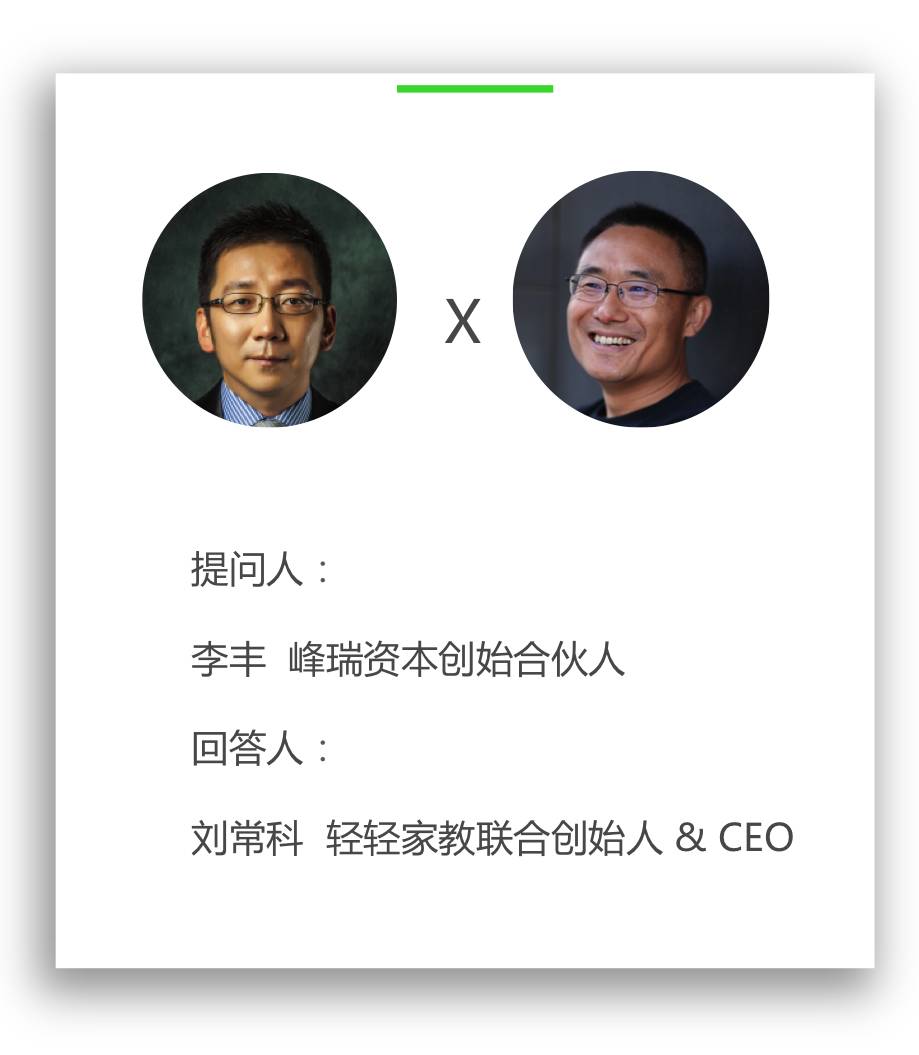
In this article, we spoke with Liu about his views on the questions above, and the various choices this 26-year veteran of the education industry faces. A video of our conversation is attached at the end — we welcome your thoughts.

After the Education O2O Tide Receded, There's Still No Such Thing as a Free Lunch
Li Feng: Education O2O had a period of aggressive expansion in 2014 and 2015, but most players had to find alternative paths when they couldn't make the O2O math work. How do you assess the current market situation? What is Qingqing Jiajiao working on now?
Liu Changke: When thinking about what to do now, we're actually thinking about what opportunities might exist in the education industry three to five years out.
We see three major trends.
First, the education and training market will display a typical dumbbell structure. On one end are large institutions like New Oriental and TAL — thanks to brand dividends, demand dividends, and technology dividends, more and more resources flow in and scale keeps growing. This makes it increasingly difficult for small and medium institutions to survive, and teachers attached to these platforms get squeezed out one by one, becoming freelancers. So on the other end, the tutoring market will see more and more freelance teachers.

▲ The education and training industry will display a dumbbell structure.
These teachers will inevitably live platform-dependent lives in the future. Only through platforms can they gradually build their credit systems through transaction records in an open market, thereby obtaining market-based pricing. Additionally, teachers need teaching assistants on the platform to help handle many tedious tasks.
Second, technology and data will enormously transform the education industry. Teachers will make decisions through data; students will receive personalized guidance through data. We're also consciously using technology and data to drive company development, including building data profiles for teachers and students.
Third, user age structure is changing. Post-80s generations have become parents, and their consumption habits differ considerably from those of the 60s and 70s generations: they are naturally accustomed to purchasing goods online, want more choice in products, and have higher transparency demands for platforms; they are willing to pay for professional services rather than personally solving every problem. The previous generation of parents spent considerable time on their children's education, but post-80s parents care more about having their own time.
Combining these characteristics, we now offer both in-home tutoring and online courses.
Li Feng: Qingqing Jiajiao has been operating for over two years. What adjustments have you made in business direction?
Liu Changke: We took some detours in business direction. Initially, we focused more on information matching. Then we tried incorporating the transaction element, but found that still wasn't enough. Now we've reached the third step: cutting into every aspect of the overall teaching service, making everything teachers need to do before, during, and after class into quantifiable data that is completely transparent to all participating parties. Reaching this step, I believe, is what matters and is correct.
Looking at industrial history, it was only when Ford Motor Company invented the assembly line in 1913 that industrial production efficiency dramatically improved, but the service industry has never gone through this step. In fact, the emergence of smartphones makes it entirely possible for the service industry to also form an efficient production line, with every link driven by data, and every role generating and utilizing data.

▲ The service industry needs an efficient, data-driven production line.
What Qingqing Jiajiao is doing now is building a user data-driven system at the foundation of the service chain. This is difficult at the start because teachers on our platform are not our full-time employees. But once established and formed into an open, shared system, future development space will be substantial.
Currently Qingqing Jiajiao operates in 20 cities nationwide. Opening each city requires teaching assistants to negotiate with teachers, bring them onto the platform, and bond them with parents. Once this step is complete, they can operate their business within this data chain. Starting from Q2 this year, we've gradually moved into K12 comprehensive subject online one-on-one services.
Li Feng: When education O2O was still in vogue, you raised several rounds of funding in succession, but by Q3 2015, right when the industry was going crazy, you chose to stop city expansion. Of course, in hindsight this was the right call — expanding before the business model was fully adjusted would have burned more money. Looking back, what was your reasoning at the time?
Liu Changke: Starting in the second half of 2014, O2O was scorching hot. Dianping, Meituan, DiDi, Kuaidi — everyone was racing to expand into new cities. The investment community, PEDaily included, was all preaching the same gospel: don't worry about profitability yet, just build scale first. Subsidies were everywhere. Our two competitors were doing exactly that.
Given that individual teachers' ability to survive on a platform depends on building a personal credit system on that platform, around June or July that year we tried running some subsidies to achieve a cold start. But we always felt conflicted and torn inside about this approach. It never felt like it created real value.
For education institutions, what matters more is "quality," not "quantity." This is different from other industries. Other sectors can race to claim territory, build "quantity" first and then improve "quality." But education provides non-standardized services. From the consumer's perspective, if you scale up but only deliver 60 out of 100, the impact on students and parents is enormous.
At that point we were already operating in 10 cities nationwide. Zhang Bangxin of TAL was firm in his view: there's no need to cater to capital, just keep doing what aligns with this industry's natural laws.
We subsequently suspended our subsidies. That decision was incredibly difficult at the time. But it kept us from being dragged under later. By March this year, our revenue could already cover labor and venue costs in newly opened cities, achieving break-even offline.
Looking back, "doing what's right rather than what's easy" is extraordinarily hard. The difficulty lies in needing a relatively clear judgment about the future, then working backward to evaluate the present and make trade-offs. Otherwise you easily get held hostage by immediate pressures.
Li Feng: In April 2016, you started charging service fees on tuition income that teachers received through the platform. Were there concerns at the time? Did any teachers leave the platform because of this?
Liu Changke: For a business to survive, internet models often talk about "the wool comes from the pig." But looking at the experience of institutions like TAL and New Oriental, we haven't seen a method where it "comes from the pig." It still has to "come from the sheep."

▲ The education industry still follows the model of "the wool comes from the sheep."
We provide platform services to both teachers and parents, and we charge service fees to both. If they accept it, it means our services have value. If they don't, we need to examine whether we're doing the right thing. We also communicated with teachers in advance, honoring our contractual spirit. Most teachers saw that we kept our word, and it didn't affect retention rates.
Education is not entertainment.
"Learning" always requires discipline
Li Feng: Online education previously focused mainly on adults. You're now doing online education for K12. How long until this market takes off?
Liu Changke: Within the next 2-3 years. Two reasons: first, post-80s parents are more accepting of online education. Second, children currently in the K12 phase are naturally accustomed to multi-screen living and adapt well to online education products.
We tend to think only middle and high schoolers need tutoring. But actually, both Qingqing's door-to-door tutoring business and its one-on-one online courses have roughly 50% elementary school students each. Demand for comprehensive subjects among these children will rise quickly. Some online oral English products have already played a market-education role — people are getting used to learning in online formats. Soon, online math and Chinese will become acceptable too.
Following market trends, besides continuing to deploy offline door-to-door one-on-one comprehensive tutoring, Qingqing formally established its online division this year to push into online one-on-one comprehensive tutoring. From the supply side, we've accumulated a teacher base with credit and evaluation systems, plus established effective quality control systems. This will be Qingqing's core competitive advantage in the online one-on-one personalized tutoring market. Based on this core advantage, Qingqing will be a major participant in K12 online tutoring going forward.
Li Feng: "Time" is the only element in business that has zero elasticity. Kids' time is getting sliced ever thinner, with too many things they want to learn — many of which can't be internetized. Sports, for example, can only happen offline. So parents and kids themselves will find every possible way to utilize fragmented time. Whether live-streaming, recorded video, or video clips, all can serve this purpose.
Liu Changke: Time is the battlefield. We mentioned three trends in education just now, but one thing remains unchanged: learning still requires motivation and discipline. It needs an environment — being with teachers and classmates, having an atmosphere of knowledge transmission. And this atmosphere is very hard to replicate online.

▲ The companionship and motivational atmosphere of tutoring is what online education struggles to replicate.
Online education practitioners really need to consider this. I've always believed we shouldn't overemphasize technology's role. "Learning" involves human nature. It requires you to break out of your comfort zone to acquire valuable knowledge, and this requires motivation and discipline. This is also why some offline institutions have grown very fast these past two years. We're also trying to create this kind of learning atmosphere.
Li Feng: The parts of education that moved online first are, coincidentally, the parts less important from an exam perspective. Take English teaching — what took off online first was oral practice. Then there's history, composition, and other interest-based tutoring. These aren't rigid demands for urgently improving test scores. But education ultimately isn't a tool, nor is it entertainment. Structure and system matter enormously. Looking at the entire education landscape, will other things gradually move online too?
Liu Changke: When Chinese children learn English, ages 5-8 they get sent to places like Disney English training centers. Parents of children this age typically want them to have a foreign teacher environment. But once the child passes 8, exam pressure mounts, and parents may prefer sending them to New Oriental instead. So no matter how the industry changes, as long as we're still in China's exam-oriented environment, education genuinely needs some systematic quality, and that system needs to create slight pressure on students to some degree. We can't escape this.
Controlling supply-side quality,
but there's no single standard for "good teachers"
Li Feng: Both New Oriental and TAL shared an early characteristic: most teachers were full-time, with labor contracts at the institution, not part-timers hired from schools. Income from teaching at the institution was nearly the teachers' entire income source, so these teachers had stronger willingness to follow the quality standards the institution set. At New Oriental, this ratio was about 2/3; at TAL it was even higher. They had sufficient control over teachers — the supply side — and built quality standard systems on that foundation. But Qingqing's platform mainly has freelance teachers. How do you build an evaluation system?
Liu Changke: New Oriental, TAL, and these training institutions mainly run classes. Twenty kids per class, teachers graded-assess each child's learning status and develop targeted teaching plans. In one-to-many formats, standardized teaching and research systems matter. When we say Shanghai Middle School has good teachers, New Oriental has good teachers, TAL has good teachers — the traditionally defined "good teacher" all comes from class-based teaching.
But actually, China also has a massive one-on-one education market. In this market, there's huge variation between students and between teachers. A good teacher isn't necessarily the right teacher. For a child with strong rebellious tendencies, if the teacher takes a strict approach, the child might immediately quit. Then this "good teacher" is wrong for that child's personality.

▲ In the one-on-one education market, the right teacher matters more than the good teacher.
Zhang Bangxin once said that whether a child learns well is determined by three dimensions: learning motivation, accounting for 40%-50%; learning environment, 20%-30%; and learning skills, 20%. Personalized learning mainly addresses the learning motivation dimension — teaching according to aptitude. From the perspective of how to encourage students to learn, it's very hard to have a unified standard for evaluating teachers. Of course, teachers must meet baseline teaching skill requirements.
Li Feng: How do you accommodate "personalization" while guaranteeing "fit" as a platform? How do you control teaching quality?
Liu Changke: With a larger selection pool, you can naturally find the right fit. Traditional tutoring used to have very narrow options; that's now broadening.
Additionally, we've always emphasized "transparency."
TAL grew so fast precisely because it did one thing right in its early days: allowing parents to sit in on classes. Parents have the ability to judge teachers' competence. This seems like a small thing, but it actually solved a persistent puzzle for traditional education institutions — how to supervise and evaluate teachers. Especially for elementary students, keeping kids happy is easy; close the door, the teacher plays some games with them, but the child might not actually learn anything. At first glance this seems costly — TAL's classrooms were half again as large as other institutions', specifically to accommodate parents listening in — but it made the entire system increasingly transparent and efficient.
We've also tried to build a quality control system at the foundational level to regulate teachers' teaching and service quality. Before class, teachers must use the app to inform parents what will be covered. During class, some teachers have enabled parent audio online旁听功能. After class, teachers give class feedback and assign homework. Throughout the process, teaching assistants and parents participate, generating various evaluation data. We've consistently worked to use technology and data to make the teaching process transparent and teaching/service quality controllable.
Many people see us as an education service company, but I actually believe we are a data technology company. Currently, we have over a hundred excellent product and technical staff, mainly from internet companies like Dianping and Trip.com Group.
Right now, our product and engineering team is among the best in the country when compared to other education and training institutions. We may not be as strong as New Oriental or TAL Education Group, but we are focused on doing one thing well. Their tech teams probably work on many different things at once — that's something we're very proud of. Qingqing is now entirely a technology- and data-driven company. It is fundamentally different from traditional offline institutions. And precisely because of this, we've been able to grow so quickly.
Li Feng: This is somewhat similar to the situation New Oriental faced when it was first founded over 20 years ago. In 1993, the training industry opened up to private enterprises. New Oriental did one thing: when a course reached 80% completion, they had students rate their teachers. I studied GRE at New Oriental back then and gave my teachers ratings too. It wasn't until 1999 or 2000, when I myself became a teacher at New Oriental, that I learned this score determined 25% of my income for that term and how many classes I'd be scheduled for next term — which in turn determined my total earnings. This has since become an industry standard.
Tying teachers' income to student evaluations was a major turning point. Before that, society held teachers in very high regard. Teachers had no service consciousness and had never been trained to deliver their work as a service. The rating system was the first time teaching quality supervision was brought out into the open. Only then did teachers begin to realize they needed students' approval, rather than just lecturing about whatever they wanted to talk about.
Now that teachers have become a typical representative of the service industry, whether platform mechanisms can better preserve and extend teachers' value becomes critically important. In other words, having an accumulated evaluation system makes "am I a good teacher?" a more meaningful question. Reputation plays a huge role in driving teachers to continue in this profession.
Liu Changke: Among post-80s parents, the mindset now is that hiring a teacher for lessons means purchasing a service. Purchasing a service means having choice and being able to control quality. We clearly felt that before 2015, many parents didn't have such strong demands. But now, consumption habits are changing very rapidly. Most parents naturally feel that teachers should come to their homes, rather than sending their children to institutions.
This trend is becoming increasingly obvious. Looking at the data, our city expansion this year has been very fast — sometimes opening five new cities simultaneously, with month-over-month growth of 15-20%. This kind of performance is unimaginable for traditional education institutions.
Building Infrastructure for Freelancers
Li Feng: In the early 2000s, people didn't see teaching at private training institutions as a career young people could pursue long-term. Over the past decade or so, an increasingly large group has incorporated training institution teaching into their career planning, gradually making it a viable career choice. Your business model is essentially built on the continuously expanding population of freelance teachers. How did you arrive at this trend judgment?
Liu Changke: The number of teachers we've listed (made visible to consumers) has reached over 10,000. Currently, there are no more than five education institutions in China that truly have over 10,000 teachers. And every month, several thousand more teachers submit applications on our platform.
These teachers have fully adapted to platform-based survival. One manifestation is that they increasingly value building credit on the platform. When some teachers have their courses taken down, they constantly appeal to us, explaining that a particular student no longer needed their guidance for various reasons and that their courses shouldn't be removed. Another manifestation is that most teachers aren't actually good at communicating with parents. They want the platform to handle that communication, which saves them a lot of mental effort — they can just focus on teaching well.
Li Feng: When we looked at WeWork in the US, we found its emergence had some special historical causes. After the financial crisis, large amounts of prime real estate in New York sat vacant and available for lease. People wanted to rent at relatively cheap prices, or through a rent-sharing model — that's what created WeWork's opportunity. Now, one-third of people in WeWork are freelancers. While they could work from home, they prefer having a way to engage with the world. WeWork offers various office facilities and opportunities to collaborate with others. For these people, shared office space functions as a platform, a piece of infrastructure.
Freelancers currently make up about 40% of the US workforce. In China, this proportion will rise very quickly over the next five years. One reason is rising incomes, which lead everyone to want more freedom in their lives. Another is the finer division of labor brought by social progress — a person's specific professional service or skill gets carved out from the whole. At this point, infrastructure becomes very useful.
This is similar to how the emergence of WeChat Official Accounts allowed many journalists to make a living independently. As long as their content was good, advertisers would come to them, and the distribution problem was solved. In other words, journalists' writing skills could be abstracted out, as long as the infrastructure above and below in society was ready.

▲ As the proportion of freelancers rises, improving infrastructure becomes very meaningful.
Liu Changke: Exactly. Doctors find it hard to practice outside hospitals because their profession requires so much equipment, but teachers are essentially just one person with very few other constraints, so it's easy for them to become freelancers.
Over the years, education and training institutions have cultivated large numbers of freelance teachers. Meanwhile, many university students work as tutors during college. After graduation, they could have found regular jobs, but felt tutoring was a good career and became freelance teachers. Additionally, I believe that due to compensation issues, many public school teachers will gradually strike out on their own.
What we want to do is become an important platform for freelance teachers in the future dumbbell-shaped structure.
Our model is entirely based on mobile internet, fully leveraging the sharing economy — sharing venues, sharing teachers — to reduce costs. Traditional institutions need to lease space and hire people to expand, yet their venues sit empty Monday through Friday with students only coming on weekends, and staff are underutilized too. This creates enormous management pressure. Our teaching assistants work Monday through Friday and do home visits on weekends. Our management difficulty is much lower than offline traditional institutions. This is also an important reason why Qingqing Jiajiao can develop so quickly.
A 15-minute edited video of the conversation is available here, click to watch:
(Feel free to share to Moments. For republication on other official accounts, websites, or mobile apps, please reply "republication" to learn the rules and contact "FreeS Fund" for authorization. Copyright belongs to FreeS Fund.)


▲ Li Feng: The Key to Service Industry Upgrades Is Making Users Unwilling to Go Back