Li Xiang × Li Feng: What Might 2023 Look Like? | New Year Outlook

Anticipate as much as possible to give yourself more room to react.
This column comes from a wide-ranging macro conversation between Li Xiang and Feng Shu on the "High Energy" podcast. Li Xiang is the curator of the Detailed Talks book series and editor-in-chief of the Dedao App. The conversation was recorded in mid-January 2023. At that time, the difficult year of 2022 had just come to a close, and standing at the starting line of 2023, some people were filled with anticipation while others harbored concerns. People longed for the return of normal life, only to find that bidding farewell to the dizziness and discomfort brought by a prolonged period of turbulence was no easy task. We're sharing this direct and substantive conversation with you, hoping it offers one way of looking at things. After all, no matter how unpredictable the winds and waves, what matters is finding the anchor that keeps you steady inside — that is, a rational understanding of macroeconomic patterns and frameworks. What's interesting is that some topics they discussed over half a month ago have since been validated by data and also resonate with important capital market news from the past week.
In this two-plus-hour conversation, Feng Shu and Li Xiang discussed how to observe the continuity of macroeconomic policy, how to view "antitrust," where economic policy in 2023 might be headed, what possible paths economic recovery could take, how to formulate win-win policies or strategies, and what mindset we should bring to the new year.
We've edited and excerpted portions of the podcast. For the full version, please go to the Xiaoyuzhou App or Apple Podcasts, search for and subscribe to "High Energy."
Engagement Giveaway
Feng Shu mentioned in the conversation that "one timing worth watching is the Spring Festival — how ordinary people spend the holiday this year will largely determine how the year starts." What new observations did you make during the Spring Festival? Feel free to share your observations and thoughts in the comments section. The 6 readers with the most thoughtful comments will receive a FreeS Fund custom edition of The 2030 Trends: Eight Megatrends That Will Reshape the World. We look forward to searching for certainty amid change and staying sharp together.
01
In the process of reopening, almost no country experienced such a "deep V" as China
Li Xiang: Last time, Feng Shu, you mentioned that the biggest problem facing the economy right now is the decline in demand for borrowing and purchasing goods. Recently, people have felt this quite directly. On one hand, there's been a series of policy moves trying to boost confidence across the board. But on the other hand, there's also divergence in expectations for economic development in 2023. For example, with foreign trade under pressure, domestic consumption will be very important. But there's uncertainty about how much consumption will rebound after reopening, and whether COVID might resurge.
Li Feng: Yes, as you said, 2023 still holds plenty of uncertainty. One timing worth watching is the Spring Festival — how ordinary people spend the holiday this year will largely determine how the year starts. (Note: According to Ministry of Culture and Tourism data, during the 2023 Spring Festival holiday, domestic tourist trips nationwide reached 308 million, recovering to 88.6% of 2019 levels; domestic tourism revenue reached 375.843 billion yuan, recovering to 73.1% of 2019 levels. National Tax Service VAT invoice data also showed that during the 2023 Spring Festival holiday, sales revenue in consumption-related industries grew 12.2% year-over-year, with goods consumption and service consumption growing 10% and 13.5% respectively.) Capital market performance over the past four weeks (the last three weeks of December and the first week of January) is also worth watching. Before the policy pivot, people were full of expectations for economic performance after "reopening." However, in the second and third weeks of December, the stock market saw a noticeable drop. This was because although reopening happened, cities quickly fell into a "COVID tsunami" — pedestrian and vehicle traffic on the streets dropped noticeably, and people found that the economic situation seemed to have gotten worse.
Although many countries globally reopened passively, almost none saw such a massive population reach peak infection so quickly in such a short time as China did. This exceeded many people's imagination and inevitably caused psychological shock. Those two weeks in the capital markets reflected this market anxiety. But then, starting from Christmas, in Beijing — which was hit first by the reopening wave — commercial consumption began to rebound. In the last few days of December and the first week of January, the recovery speed of contact-based consumption industries similarly exceeded market expectations. So, in the last week of December and the first week of January, as relevant policies were rolled out, the capital markets began to see relatively large-scale rises again.
We did some internal research comparing China's situation with other countries, and you'll find that in the reopening process, almost no country experienced such a "deep V" in offline consumption industries and capital markets as China did — dropping sharply within a month, then recovering quickly.
02
Three Urgent Issues for 2023
Li Xiang: What new changes do you think we'll see in China's economy in 2023?
Li Feng: Whether 2023 itself turns out good or bad depends on many variables. What we can do right now is return to the macro level and try to anticipate what policy moves there might be.
The macro economy is arguably the biggest thing that is determinately happening. These things may not seem to immediately and completely affect our daily lives, but as important, relatively long-term variables, they will eventually feed back into our everyday existence. Specifically in my work in early-stage investing, typically after investing in a company, we accompany it for seven or eight years or even longer before it succeeds or reaches listed company scale. With such a long cycle to go through, the biggest factors affecting a company beyond the entrepreneur themselves are mainly what the biggest macro variables and drivers will be over this five-to-ten or even fifteen-year period.
Over the past two to three years, we may have noticed that people around us, in conversations and on social media, have been talking about the macro. However, one difficult thing when studying the macro is that you have to work hard to jump out of the parts where you're influenced by emotion, detach from your current position or viewpoint, and try to connect these relatively long-term (policy) dots — whether horizontally or vertically. This has been very beneficial for me.
Returning to the question of "what policy moves there might be," we need to first answer another question: What are the most urgent problems that policymakers need to solve?
First is employment, especially youth employment. In November 2022, the surveyed urban unemployment rate for labor force aged 16–24 was 17.1%, compared to 17.9% in October. The 2023 graduating class of college students nationwide is expected to reach 11.58 million, an increase of 820,000 year-over-year. Young people are important voices in society, and most young people have two or more families behind them (parents, grandparents...). If young people don't have jobs, it affects confidence in the economy and policy among broader groups of people.
Second is domestic and foreign trade economic growth. In other words, what can make the economy recover and maintain growth.
Third is the structure of economic growth — that is, what kind of economic growth do we want, and how should the next wave of stimulus be released to make the growth structure more reasonable in coming years, better able to increase the added value for individuals, enterprises, and the entire supply chain.
Overall, there are mainly three directions: employment, economic growth scale, and economic growth structure. These three directions have some differences in importance but are basically of similar magnitude. So, logically, when rolling out policies, those that can benefit more than one of these three directions simultaneously will be prioritized. Of course, behind this there's also a foundational proposition: common prosperity.
Currently, there's different interpretations of "common prosperity" at the societal level. When we understand policy, we can't just look at it in the present moment — we should observe and verify it over a longer timeline. To understand "common prosperity," we can summarize its evolution in three sentences: The first is "let some people get rich first"; the second is "build a moderately prosperous society in all respects"; the third is "common prosperity." In other words, it's the progression from letting some people get rich first, to letting more people get rich, to letting most people get rich.
03
For Economic Recovery, Watch the "One Foundation, Three Pillars"
Li Feng: Having covered the main problems policy urgently needs to solve, let's now think about how policy might stimulate and how the economy might recover.
We can imagine the entire economic plate as a building. First look at the foundation. For China's current economy, real estate undoubtedly falls into the foundation category. The foundation needs to be structurally sound and have a certain thickness. With the foundation solid, to ensure the floors built upward can be taller and larger, we need to consider the building's pillars. There are mainly three pillars: finance, infrastructure, and industry added value.
Finance is essential for supporting economic structure, while also playing connective, regulatory, and transformative roles. (Note: According to a notice released by the CSRC on February 1, on February 1, 2023, the comprehensive reform of the stock issuance registration system was officially launched. On the same day, the CSRC solicited public comments on the main institutional rules for fully implementing the stock issuance registration system. This was positive news for capital markets at the start of the year.) (For more on financial structure adjustments, the flow of money, and other content, please scan the code to listen to Episode 13 of the Macro Conversation podcast.)
Infrastructure makes economic structure sufficiently sound and efficient. Infrastructure comes in hard and soft forms, including both traditional infrastructure like expressways and high-speed railways, and digital infrastructure like 5G internet, data centers, artificial intelligence, and industrial internet. Traditional and digital infrastructure are the basis for ensuring high-speed operation of industrial chains, and also determine how stable, tall, and large the building can ultimately be built.
Moreover, when the economy returns to normal growth tracks, we need to increase industry added value, enabling better value creation at each link in the industry. As industry added value increases, we can play a more proactive and reasonable role in the global trade system and industrial chain division of labor.
What are the beams above? Domestic demand. China's domestic demand is large enough — even in the current weak domestic demand environment, China's domestic demand is almost on par with the global leader, the US.
Overall, development across various industries can add bricks and tiles to the building, but these are all horizontal, each with its own development characteristics. To lay these bricks and tiles, the foundation must be solid and deep, and the three pillars must advance together. As for the specific "bricks and tiles," for various industries to develop, the opportunity lies in "new supply and new structure forged by new demand." By increasing technological content and added value, we forge new supply; new demand further drives the upgrading and competition of new supply, thereby creating some new structural opportunities.

Once new demand, new supply, and new structure connect, it becomes very powerful. New energy vehicles in 2022 were a typical example. (For more analysis on new energy vehicles, please click the link to read "A Conversation About 2022 and 2023")
/ 04 /
The Core Problem "Antitrust" Aims to Solve Is Market Participant Pluralism
Li Xiang: After the Two Sessions, the broad policy direction should be basically set, right?
Li Feng: It should be. Some policies have already come out recently, including loosening measures for certain sectors. Actually, back in mid-2022, when I was talking with executives at some internet platform companies, I said platform economy would be "let out."
Li Xiang: What was your basis for that judgment at the time?
Li Feng: Before answering that, let's expand a bit and look at the characteristics of China's platform economy.
China's platform-based internet companies have comparable business models to their American counterparts, but their development paths differ significantly. In the US, various industries gradually achieved full marketization — full competition — full social division of labor offline before the internet emerged. The internet served more as an efficiency tool for offline mature industries, a means of information transmission and media. We can see that America's largest internet platforms are mostly pure information transmission, matching supply and demand information, with higher per-capita efficiency — Google, Facebook, and Microsoft, for example.
In China, many industries entered the internet era before completing full competition and full social division of labor. Then, based on data-driven new infrastructure platforms, supply and demand developed continuously, new social division of labor began to emerge, and efficiency iterated. Platform internet enterprises almost developed simultaneously with their corresponding offline industries and began industrial competition.
Take Alibaba as an example. After the Asian financial crisis, in 1999, China decentralized foreign trade autonomy — doing foreign trade no longer required going through foreign trade export companies for quotas and approvals, and private production enterprises and research institutes were granted self-operated import and export rights. As an aside, at the end of 2022, the state announced the cancellation of the foreign trade enterprise registration system, further clearing qualification obstacles for domestic market entities to engage in foreign trade. In Alibaba's early development, domestic production capacity was rapidly increasing and needed more export channels. China joined the WTO in 2000. Taobao was founded in 2003. Taobao's rise was almost simultaneous with the offline physical retail industry. Around 2000, China's commercial real estate began developing, and Gome and Suning also entered their golden years during that period.
So, having developed to this point, Taobao represents not just the digitization of retail, but the development of retail itself. In other words, Taobao has become part of the industry, or even a large part of it, deeply embedded in the industry and symbiotic with it — not a digital iteration after the industry finished developing.
Precisely because these platform enterprises developed together with their industries, and their digitalization level is relatively high, they have brought massive employment opportunities. For example, Taobao gave rise to new professions like online store models, online customer service, and online store decoration. Or if it weren't for food delivery, ride-hailing, or e-commerce, your shopping frequency, restaurant visits, and commuting methods might all be different.
Li Xiang: The leverage effect of these platform enterprises in promoting employment is very obvious.
Li Feng: Right. Actually, internet platform enterprises have always played an important role in solving youth employment.
Let's trace back a bit. The reform and opening up that began in 1978 effectively transformed rural labor into industrial workers. Taking Deng Xiaoping's second southern tour speech in 1992 as an opportunity, township enterprises welcomed another great development opportunity. Cities began implementing economic system reforms, and the number of migrant workers entering cities for work expanded dramatically. According to data from the Chinese Academy of Social Sciences Institute of Economics, by 1995, township enterprises' economic aggregate had risen to a pivotal position, with value-added accounting for 1/4 (25.3%) of national GDP, and industrial value-added accounting for nearly 1/3 (30.8%) of national industrial value-added. Hundreds of millions of migrant workers, or new workers, began to become the main body of China's industrial workers.
Around 2012, internet platform enterprises began to rise, and large numbers of new professions were created — food delivery riders, courier workers, ride-hailing drivers, and so on. These new professions don't require high education levels, and because their industries were rapidly expanding and urgently needed large numbers of labor providers, they gave many people opportunities for employment and development in cities.
According to a 2021 survey report by Meituan Research Institute, 77% of riders came from rural areas, and the composition of riders converged with the industrial flow path of migrant workers — flowing from secondary industry to tertiary industry. Not just riders, but express delivery, commerce and trade, and other service industries also became important channels for new worker employment. While creating employment, the development of new service industries also generated good social value and added value, enhancing China's social carrying capacity as it enters an aging society.
Back to the matter of "embedding in industry." Let's take Ant Group as an example. Many financial innovation companies in the US haven't changed consumer credit scoring and clearing mechanisms. Because each link in US finance has gone through full competition and is already quite mature. These financial innovation companies just provide new information supply-demand matching methods on a relatively mature industry chain foundation. Ant Group is different — besides matching supply-demand information, they also launched a separate clearing and settlement mechanism, where consumers settle with Ant, and Ant then clears with banks in batch form. Ant became the underlying clearing and settlement party. At the same time, front-end consumer credit scoring is also done by Ant itself. So Ant is not an information platform, but a financial industry player.
When an enterprise's social and industrial influence grows to a certain extent, it may hit the "antitrust" line. However, it's important to note that "antitrust" doesn't only target internet platforms.
Since the reform and opening up in 1978, China's economy has overall been "state retreating, private advancing," transitioning from complete public ownership to a market economy. However, before the internet industry emerged, China's most typical development industries were manufacturing, distribution, and services. In the process of gradual opening and marketization, first, these industries didn't have monopolistic characteristics, and second, they hadn't temporarily developed to monopolistic levels.
So, at that stage, because of economic structure issues, the antitrust stick mainly hit state-owned enterprises. For example, from the 1980s, China's telecommunications industry experienced multiple rounds of splitting and reform restructuring waves. To some extent, the development opportunities of two well-known enterprises, Huawei and Tencent, occurred against the backdrop of telecommunications reform restructuring and diversified competition. The power grid, finance, aviation, energy, and other industries also similarly experienced so-called antitrust and diversified development. Usually the first step was separating government from enterprise, with enterprises operating and accounting independently, splitting to improve efficiency; the second step was capital structure diversification; further down was diversified economic entities.
So, the core problem that "antitrust" aims to solve has always been market participant pluralism. But at that stage, except for SOE leaders, most people probably didn't feel much pain.
Entering the internet era, because the internet industry has Matthew effects and more easily forms positive monopoly cycles, market entities weren't diversifying but rather becoming less diverse, and these entities also intervened in industry operating rule-making. So in recent years, the antitrust stick began hitting private enterprises, especially internet platforms.
/ 05 /
Whether the Timing, Strength, and Manner of Policy Rollout Are Reasonable Is Often Hard to Evaluate in the Moment
Li Xiang: China's first Anti-Monopoly Law was passed in 2007 and implemented in 2008.
Li Feng: Before this, "antitrust" for SOEs — whether separating government from enterprise or splitting SOEs — could directly solve problems through administrative orders alone.
Li Xiang: People more easily understood these measures as part of SOE reform and restructuring.
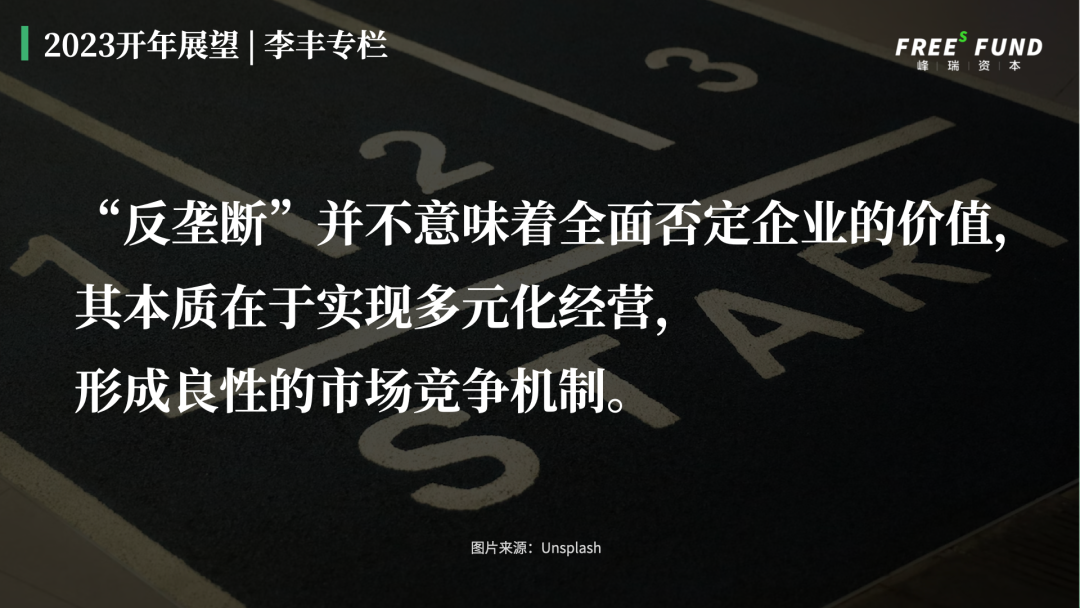
Li Feng: Yes. So when I inferred in mid-2022 that platform enterprises would be "let out," it was also because "antitrust" doesn't mean completely negating enterprise value — its essence lies in achieving diversified operations and forming healthy market competition mechanisms. For example, there were indeed "choose one of two" problems in e-commerce and food delivery industries before.
So entering 2023, we've already seen many signs. Recently, Jiangsu, Shandong, Shaanxi, Henan, Hunan, and other places have all introduced relevant policies supporting platform economy development.
Why?
Because internet platforms represent both industrial efficiency improvement and massive creation of new employment positions, especially for young people — whether ride-hailing drivers, food delivery riders, Taobao shop owners, store decoration, Wangwang customer service, or livestream hosts, and so on.
Developing platform economy can both promote economic growth and enhance economic growth value — exactly what we said at the beginning, industries beneficial to employment, economic growth scale, and economic growth structure. So I've always tended to believe that after solving the diversified competition situation, platform economy will certainly receive policy support.
So, we can't simply understand recent policy changes as a "180-degree turn." Whether the timing, strength, and manner of each current policy rollout are the most reasonable is very hard to evaluate in the moment. Only looking back after a long time can evaluation be relatively accurate. One difficulty in understanding macroeconomic policy is distinguishing which are to solve current thorny problems and which are continuity policies as part of long-term planning. What's crucial is being able to discard surrounding noisy public opinion and relatively detached, objectively and neutrally try to stand in policymakers' shoes to think.
Enterprise founders or major decision-makers also need to make strategic and operational decisions for the enterprise itself — in a sense, this is similar to formulating macroeconomic policy. Sometimes corporate strategy is to solve problems from past development processes, and part of strategy is future-oriented, that is, where the company hopes to go in the medium to long term. In peaceful times, we usually strive to plan a development route containing medium to long-cycle planning and strategy. But when suddenly hit by huge internal and external shocks, this relatively smooth line will experience violent fluctuations.
If we view the country as a company. Over the past four years, China Inc. has encountered quite a few challenges. In March 2018, the US-China trade war broke out. Throughout 2019, beyond the trade war, the US-China tech war was added on top. In 2020, we spent more than half a year dealing with the sudden pandemic's huge impact on national health and economic development. In 2021, the pandemic still fluctuated. In 2022, the Russia-Ukraine conflict began early in the year, and additionally throughout the year we needed to solve the balance between pandemic and economy and economic stabilization issues.
So, from the second half of 2018 to the end of 2022 when China eased pandemic restrictions, except for a period in 2021, almost every year there was at least one event so large that enough policies had to be adjusted that year to respond. So for most time points over the past four years, our policy space didn't look too large.
Li Xiang: Because more important and urgent matters needed to be solved.
Li Feng: Yes. If we can understand this problem, we can better understand policy changes and adjustments. Looking back, you'll find that economic policy changes over the past few years have been relatively frequent — sometimes policy adjustments happened within a quarter, sometimes the policy change cycle was even shorter, and the directions of change also differed.
/ 06 /
What Is the Reasonable Thread for Interpreting Macro Policy?
Li Xiang: Yes, only during a period in 2021 was there still some policy space.
Li Feng: Roughly around the end of Q1. Compared with other major global economies at that stage, China's macroeconomic data performance was relatively good.
Now that things have opened up, looking ahead from 2023, when reviewing the continuity of macroeconomic-related policies, we probably need to pick up the thread from the first half of 2018, filtering out the fluctuations and interference of the intervening period, to see policy continuity. Actually, in 2018, quite a few policies oriented toward domestic demand were introduced — things like "building a unified national market, deepening factor marketization reform" — these all had relevant groundwork, but due to some横空出现的问题 [suddenly emerging problems], large-scale stimulus wasn't done during these intervening years.
So, to some extent, the most reasonable way to read macro policy is to connect the dots of policies introduced during periods of relatively low policy pressure and ample policy space. Of course, this line splits into two strands: one visible, continuing reform and opening up; the other hidden, addressing the social costs and consequences behind three decades of high-speed economic growth — what we call "pulling up the radish brings up the dirt."
What I want to say is that people often approach certain policies with emotion, yet many policies are actually designed to solve legacy problems along a continuous thread, to address the difficulties of another segment of the population. Because we may not find ourselves in their shoes, we overlook the objective existence of these problems.
China's demographic structure and age structure are changing, and so is its economic development structure. If these problems accumulate for too long, they could become intractable obstacles to sustained growth. So before they harden, we need to find an appropriate resolution path — one that can facilitate economic growth and structural adjustment while trading time for space.
**/ 07 / ** Behind Last-Mile Logistics and the Supply and Marketing Cooperatives
Li Xiang: What about policy space in 2023?
Li Feng: I'm relatively optimistic. COVID's impact on policy space is already quite small. Currently, what could significantly affect policy space would be external factors — things like China-U.S. relations, regional conflicts, and so on. If another major unexpected event occurs externally, it could squeeze policy space again and make long-term policy incoherent.
Li Xiang: Earlier when you compared the economic pie to a house, you mentioned three pillars: finance, infrastructure, and industry value-add. Do we still have substantial room in infrastructure?
Li Feng: Good question. I think the current infrastructure opportunity lies in last-mile logistics. Last-mile logistics refers to infrastructure at the township, village, and county levels and below — beyond traditional infrastructure like railways, highways, and bridges, this also includes digital infrastructure. According to the National Supply and Marketing Cooperatives "14th Five-Year" Public Agricultural Product Cold Chain Logistics Development Special Plan, during the 14th Five-Year period China will build 600 county-level origin agricultural product cold chain logistics centers, each supporting multiple field-side freshness warehouses, forming a county-village three-tier cold chain logistics service network.
This can solve many problems. First, it's somewhat COVID-related — whether vaccines or other public health medical supplies, these biological products require low-temperature storage. The lower you go into counties and townships, the harder epidemic prevention and treatment become, and one important reason is that cold chain infrastructure doesn't reach down there.
Second, this also involves the "supply and marketing cooperatives" that have attracted considerable attention. The supply and marketing cooperative system has actually always existed; what's being emphasized now is, in essence, about revitalizing county-level economies, resolving urban-rural income disparities, and on this foundation achieving common prosperity — letting most people become prosperous.
Farmers' income mainly comes from agricultural products. Agricultural products have two problems: one is selling agricultural inputs downward — fertilizers, pesticides, seeds, and so on — which involves cost issues; the other is selling upward, which involves income issues. Agricultural products are characterized by regional and seasonal variation. We often see news about farmers somewhere harvesting lots of vegetables and fruits, and if they can't sell them within a certain timeframe, the whole year's work is for nothing.
The supply and marketing cooperatives serve two main functions: first, they ensure that in the process of selling agricultural inputs downward, the markup at each环节 doesn't get too high. Second, they're responsible for collecting agricultural products upward — after farmers finish planting, the cooperatives purchase from them. Because sales channels are limited or unsmooth, and because material allocation often involves information asymmetries, the agricultural and sideline products that some farmers can't sell can be purchased by the cooperatives, then stored in local cold chain warehouses, with production-sales matching done afterward, thereby solving farmers' income problems.
Furthermore, these grassroots cold chain facilities also help improve consumption convenience at the grassroots level and boost domestic demand. In the past, because cold chain infrastructure was inadequate, many fruits from Southeast Asia sold at higher prices in townships than in cities. The establishment of cold chains also plays an important role in consumption upgrading in townships. State investment in infrastructure can also mobilize more social enterprises to participate.
So overall, county-level cold chain construction benefits both the下沉 of public health resources and consumption upgrading in下沉 markets. With the empowerment of digital tools, it can also improve efficiency across the entire industry chain.
Li Xiang: Speaking of which, I'm curious — as the digitization of services becomes increasingly advanced, will there be a centralization trend?
Li Feng: After services go "online," they certainly won't be as dispersed as offline, but it's also hard to achieve single monopoly. Because market demands and standards for services vary considerably. Finance is among the more highly digitized service industries, so let's look at finance. In financial markets, the needs of high-net-worth individuals, middle-income earners, and those with insufficient loan qualifications differ vastly — it's hard for one product or company to satisfy all groups. Moreover, no matter how digitized services become, trust-building still requires interpersonal interaction.
**/ 08 / ** Accepting Emotional "Inertia," Moving Beyond Emotional "Inertia"
Li Xiang: Finally, let's return to the outlook for 2023. Whether it's myself or friends around me, people generally feel the new year can't get worse, yet we're still shrouded in anxiety about uncertainty.
Li Feng: This kind of "inertia" is normal. When you've just emerged from a very bad situation, you dare not hold overly high expectations for the future — just as when you've come down from a very good situation, you don't easily hold overly negative expectations. As I said at the beginning, whether 2023 itself is good or bad depends on many large variables. All we can do is make the best possible predictions and secure more room to react for ourselves.
Reader Engagement
In the conversation, Feng mentioned that "one time point worth observing is the Spring Festival — how ordinary people celebrate this year will largely determine how the year opens." During the Spring Festival period, what new discoveries did you make? Feel welcome to share your observations and reflections in the comments section. The 6 readers with the most thoughtful comments will receive a FreeS Fund custom edition of the book Trends 2030: Eight Megatrends That Are Transforming the World. We look forward to searching for certainty amid change together, and staying sharp.


▲ Beyond Chatting and Drawing, AI Can Also Help You Work Out Online | FreeS Fund Dialogue
▲ 20 Industry Research Reports + 1 Podcast for You, Wishing You a Smooth Start to Work
▲ One Chart to Understand Changes and Opportunities in China's Industry Chain | Li Feng Column
▲ One Chart to Understand Globalization or Deglobalization | Li Feng Column
▲ How Will Humans Work in the Future? | FreeS Report 26
▲ Farewell to a Year of Inflection Points: Will 2022 Be Better? | Li Feng's New Year Outlook
▲ If You Don't Lose the Domestic Rat Race, You'll Win Globally | Li Feng's New Year Consumer Outlook
▲ 2022: Where Are the Next-Gen Consumer Opportunities? | Li Feng Column
▲ Why Are Chinese and American VC Drifting Apart? | Li Feng Column