Harvard x MIT x Stanford x CMU x Berkeley, Meeting Gen Z | FreeS Fund North America Campus Recruitment

Welcome aboard. Join the innovators and build something new.
The post-90s generation is already old news. The new cohort born after 1995 — Gen Z — has entered the workforce.
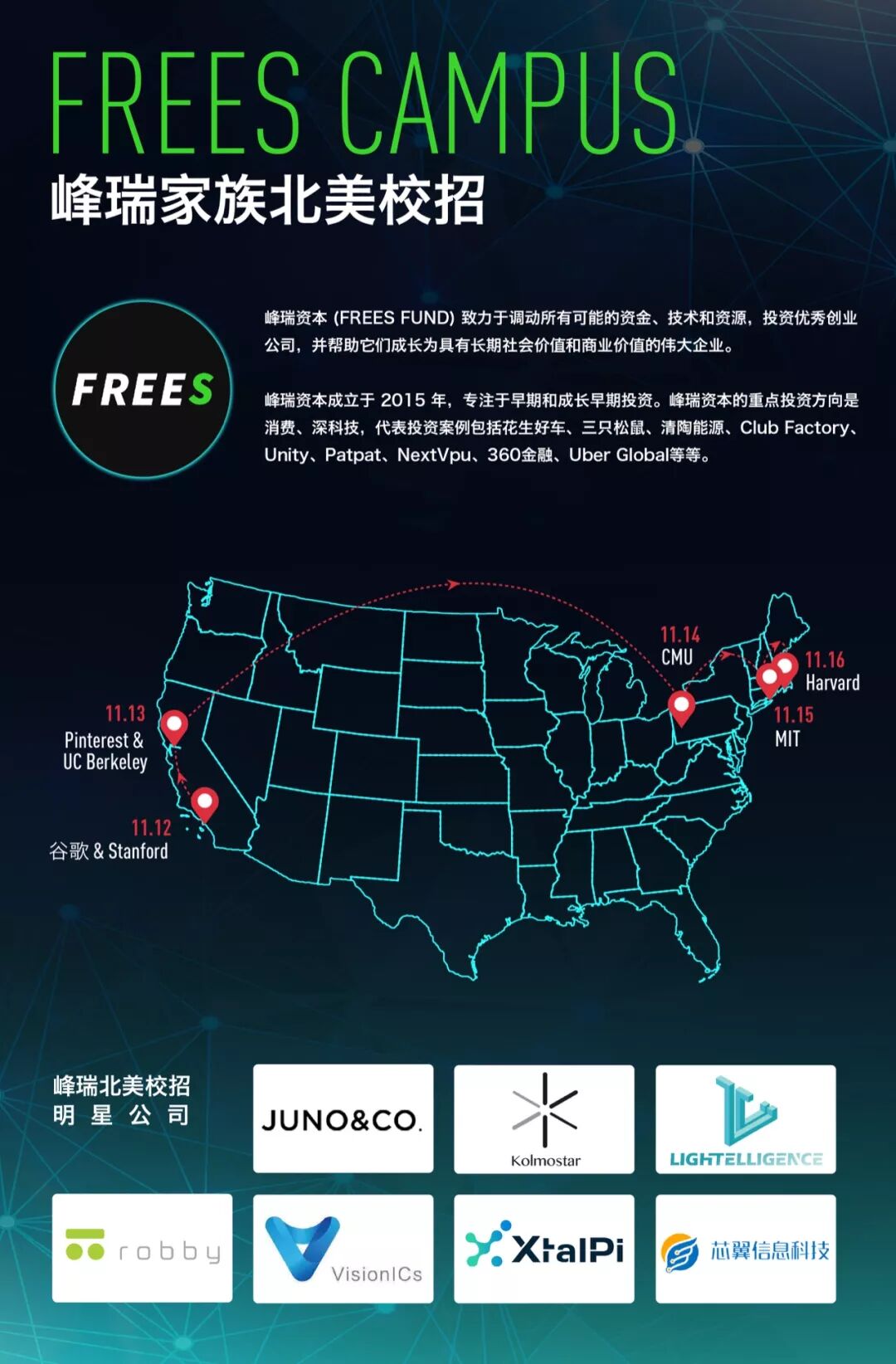
From November 12 to November 17, that's next week, a delegation led by "Uncle Feng," who spent eight years doing cross-border investment between China and the US, will take seven of the hottest rising stars from the FreeS Fund family to the top schools: Harvard, MIT, Stanford, UC Berkeley, and CMU, to meet face-to-face with Gen Z, who make up one-quarter of North America's population.
Digital natives, willing to pay for quality, young and fresh, rule-breakers, delightfully weird, more entrepreneurial, uninhibited, individualistic, multi-hyphenates, rebellious, more pragmatic and rational about career choices... Even Xiaorui from FreeS Fund, a bona fide Gen Zer, thinks the labels slapped on this generation are a bit much.
So do these technically brilliant CEOs and serial consumer entrepreneurs really understand this generation just beginning to make its mark in the workplace? What are they looking for? Below, Xiaorui's fresh interviews with seven CEOs (in alphabetical order by surname).
01
"I hope they're more opinionated, more delightfully weird"

Kyle Jiang, CEO of JUNO & Co., serial entrepreneur, UC Berkeley graduate.
JUNO & Co. is a buzzy North American beauty startup that develops its own high-value beauty products, aiming to become the Xiaomi of cosmetics.
Xiaorui: Boss, what kind of people are you looking for?
Kyle Jiang: We need people who can do marketing, design beauty tools, and handle data analytics. The requirements? First, curiosity, plus an interest in makeup (everyone wants to look good, regardless of gender). Second, we're a startup, so we especially need people with an entrepreneurial spirit. Since we have offices in Shenzhen, Beijing, and Silicon Valley, you need to be okay with business travel. Also, our users are mainly in Europe and America, while our supply chain is mostly in China, so we particularly need bilingual talent.
Xiaorui: As the only consumer company in this campus recruiting tour, what's special about JUNO compared to tech companies?
Kyle Jiang: We're doing quite well in the US. Because our products are innovative and our approach is unique, we became the hottest beauty brand in America by search volume in August-September 2018, and we've sold to over 100 countries. Right now, there are lots of sellers on Taobao and Xiaohongshu buying our products to resell back to China.
If we had to put a label on it, our company is especially fun. We're very young, with an average age of 26 — I'm on the older side at 31. We like hiring young people because we hope they're opinionated, more delightfully weird. In other words, we don't like people who are too rigid, too by-the-book.
Xiaorui: Tell us about your youngest employee.
Kyle Jiang: A 24-year-old woman in marketing. She tests every product we launch (basically our "Chief Experience Officer"). The younger the woman, the better her instincts for this.
02
"Want innovative thinking, not people who mechanically check boxes"

Li Cheng, founder, chairman, and CEO of CoreXVision, PhD from Texas A&M University.
CoreXVision possesses world-leading optoelectronic conversion device design and single-photon detection imaging technology, aiming to rapidly commercialize world-leading single-photon detection technology and integrated circuit chip design capabilities in China.
Xiaorui: Boss, what kind of people are you looking for this time?
Li Cheng: We want energetic, opinionated young people who can return to China and build something with us. Simply put, I appreciate young people with innovative thinking who are self-improving — I don't like people who just mechanically complete assigned tasks.
Xiaorui: How do you get these young people to come with you?
Li Cheng: We're building products that don't yet exist in industry — this is absolutely a new field. We're not copying chips from Texas Instruments, Qualcomm, or Broadcom. We're designing chip prototypes based on our own innovative ideas combined with market needs. Our company is mainly composed of PhDs and professors from top North American universities, plus industry veterans with over 20 years of experience. Our technology is world-leading, and our goal is to build globally leading high-performance, high-tech integrated system chip products for artificial intelligence, machine vision, and future IoT applications, among other fields.
To get practical: we also have a company in Silicon Valley, and we can help with H-1B visas, though you'll spend half your time on business trips to China.
Xiaorui: As the "scientist uncle" in the company, how do you get along with fresh PhD graduates?
Li Cheng: Don't sit in the general manager's office — sit with your employees.
03
"Veterans have their advantages, fresh faces have their strengths"

Li Rui, CEO of Robby Technologies, PhD in machine learning from MIT.
Robby Technologies was founded by two MIT PhD graduates in artificial intelligence and is developing autonomous delivery robots for last-mile logistics.
Xiaorui: Boss, what positions are you hiring for? What traits are you looking for?
Li Rui: We're hiring engineering positions, including machine learning, computer vision, systems integration, and so on. Most important is professional competence — bonus points if you've proactively done projects in school. Then, proactivity is key. At a startup, running into all kinds of problems is completely normal. What matters is having the right mindset and actively exploring and seeking solutions. Also, you need to fit with company culture.
Xiaorui: What is our culture like?
Li Rui: Our culture is relatively open and free, while also requiring you to be very low-key and detail-oriented. For example, when writing code, you can't get a single punctuation mark wrong. Beyond doing your job well, we like interesting people with their own little hobbies.
Xiaorui: So what kinds of people and things do you find interesting?
Li Rui: For example, we have a colleague who's excellent at golf — to the point where he once won a regional championship in Taiwan. That's a highlight, even though it has nothing to do with his work. Having more people like this in the company makes the whole place more interesting, and everyone enjoys working together more.
Xiaorui: Campus recruiting targets graduates and soon-to-be-graduates. What do you expect to get from young people?
Li Rui: Veterans have their advantages, fresh faces have their strengths. The strength of fresh faces is strong learning ability, quick to pick things up, flexible, with a certain degree of innovativeness — not that veterans aren't innovative. Youth is a huge asset. I heard Facebook keeps its average employee age around 26.
04
"Our company culture is as diverse as Boston"

Dr. Shen Yichen, founder and CEO of Lightelligence, PhD in applied physics from MIT.
Lightelligence is an MIT-born AI chip design company. Its AI chips are based on the Google TPU architecture, but replace traditional electronic matrix computation units with silicon photonics technology, using light as the medium for AI computation — achieving far superior speed and energy efficiency compared to traditional electronic chips.
Xiaorui: Boss, what directions are you hiring in?
Shen Yichen: Our company needs talent in three areas: AI, such as people skilled in machine learning algorithm development; people with optics backgrounds, preferably in nanophotonics; and chip industry people. For the first two categories, we can recruit from schools. Chip industry people generally need 10+ years of industry experience.
Xiaorui: Sounds like there's quite an age gap between the AI and chip teams. Any generation gap when they work together?
Shen Yichen: The average age difference between our algorithm and chip teams is about 15 years, but it works out quite well. First, everyone is very interested in what we're doing. The chip team, though older (35+) and very specialized in chips, didn't know much about AI before, so they're especially willing to learn from younger colleagues. Meanwhile, young people without much industry experience can also learn from seasoned veterans. Curiosity connects everyone.
Xiaorui: What about you — any challenges working with these young people?
Shen Yichen: Nope, I get along with everyone regardless of age.
Xiaorui: What does your ideal young colleague look like?
Shen Yichen: All the traits of a good employee! We're a research-heavy company — 70% of people are PhDs, over 30% are MIT PhDs — so we hope everyone has curiosity. Also, people from three directions need to collaborate, so teamwork is very important. Plus, we're a startup, so we need optimistic people with strong mental resilience.
Xiaorui: Anything else special about Lightelligence?
Shen Yichen: We have people of every ethnicity. Right now we're about 20-something people, only a quarter are Chinese, Americans are more than half, and many other nationalities — Bulgarian, Palestinian, Iranian. In terms of composition, our company culture is as diverse as Boston. So there's lots of cultural mixture, lots of interesting interactions.
05
"Without global talent, it's hard to solve global problems"

Tong Tao, co-founder and CEO of Kolmostar, PhD in electrical and computer engineering from Harvard University.
Kolmostar focuses on developing low-power (milliwatt-level) and high-precision (centimeter-level) GPS positioning algorithms and solutions, giving IoT devices, mobile phones, and autonomous vehicles low-power, low-cost, ultra-high-precision GPS positioning capabilities.
Xiaorui: Boss, what kind of people are you looking for?
Tong Tao: We provide autonomous vehicles and mobile devices with centimeter-level high-precision outdoor positioning capability in complex urban environments. This capability is foundational for future autonomous vehicles to interact with high-precision maps, their surroundings, and people around them, and to drive safely. We need people with strong backgrounds, self-drive, and the motivation and determination to solve global problems. The expertise we need covers cutting-edge applied mathematics research, including information theory and statistical signal processing; software engineering across the full stack from embedded to servers; and algorithms, such as signal processing algorithms, image processing, and so on.
Xiaorui: Any way to convince people to return to China?
Tong Tao: It's actually not easy. Many people may want to work in the US for a while after graduating; some return to China, then come back to the US after a while. Our company is one of the few tech startups that can truly offer work opportunities on both sides of the Pacific. My co-founder is based in the US, I spend most of my time in China, and we have R&D teams on both sides — both offices are important. You can choose to work in the US and experience Silicon Valley culture, or come back to China and get grounded in the local scene.
Against the backdrop of the US-China trade war, people tend to panic and feel anxious about bilateral relations. We need to take a longer-term view, to stand in the day after tomorrow and look at what's happening today. Every so often, it's normal for countries to renegotiate world order and interest distribution. The trade war will settle down. What we firmly believe is that the bridge between China and the US will continue to generate tremendous value. Talent that can operate across both countries will remain scarce, and we hope to help people develop that capability.
Xiaorui: Your co-founder is more than 10 years older than you. What's it like working together? Any challenges?
Tong Tao: Right, I'm 31, my co-founder is 47. He's worked in Silicon Valley for many years. Most important is that everyone has curiosity, aims big, works hard to do good technology and good business, and is committed to providing products and services to global customers. These are what bind our whole team together.
06
"Come build something that establishes a whole new school of thought"

Wen Shubao, founder and chairman of XtalPi, PhD from the Chinese Academy of Sciences, postdoc at UC and MIT.
XtalPi is a world-leading drug discovery technology company powered by computational innovation. Based on cutting-edge computational physics, quantum chemistry, molecular dynamics, artificial intelligence, and cloud computing technologies, it provides fast, precise intelligent drug discovery technology for global innovative pharmaceutical companies.
Xiaorui: Boss, who are you recruiting this time? What traits do you appreciate?
Wen Shubao: We're an AI pharmaceutical company. We want to find people who can break out of the pharmaceutical industry's conventional thinking and ideas, to explore AI applications in new drug discovery together. We'd hope they have passion, innovation, and a sense of mission — after all, health and life-and-death are ultimate propositions.
Xiaorui: So, is AI pharma a good opportunity?
Wen Shubao: This is a chance to establish a whole new school of thought. Don't be fooled by how hot AI is right now — in autonomous driving, facial recognition, and other fields, the giants have already claimed the territory. In other words, there aren't that many opportunities left. AI application in new drug discovery is a new field. We're the company establishing the school of thought in this field, and you'd be a key player in it. Imagine the sense of achievement from letting patients use drugs created by AI. And there's no ceiling — a single successful drug can reach $10 billion in sales.
Beyond that, Shenzhen has excellent talent programs. For PhDs from top global universities (top 150 worldwide), as soon as XtalPi signs a labor contract with them, we can help them apply for 3.2 million RMB in talent subsidies, tax-free! Our company already has more than 10 such "peacock talents."
Xiaorui: Boss, as a post-80s, how do you get along with young post-95s?
Wen Shubao: 90% of our company is young people. We already have several post-95s, the youngest born in 1997. I'm 37, on the older side. I hope the company can feel something like home. When I was in Boston, I'd invite Boston colleagues to my place for parties during holidays. In Shenzhen, we do karaoke together, play badminton together, and HR organizes lots of fun team-building activities.
"You won't have to take many detours"

Dr. Xiao Jianhong, CEO of Xinyi Technology, PhD in RFIC from Texas A&M University.
Xinyi Technology is a world-leading IoT chip startup whose products are widely applicable to smart cities, smart logistics, Industry 4.0, smart agriculture, wearables, and other fields.
Xiaorui: Boss, what directions are you hiring in?
Xiao Jianhong: We're looking globally for young people interested in developing in chip design and IoT. This time we're hiring for many positions, from底层 chip design, RF/analog, SOC circuit implementation, to communication algorithms, to software, as well as business development and human resources.
What I value most is whether someone has self-drive. They're not just here for a job — they know what they want to do and are willing to work toward their goals.
Xiaorui: What can someone gain by joining Xinyi?
Xiao Jianhong: We're building a very complex communication SOC. Cross-departmental communication and collaboration is very frequent and intensive — you can learn a lot through this process. Second, our company has renowned American professors and industry veterans like former Broadcom executives. When people join, they can follow experienced industry leaders in building something, and these veterans can give newcomers comprehensive guidance. At the very least, you won't have to take many detours. Also, in the chip赛道, our company's chip technology is industry-leading, and the company has strong growth potential.
Xiaorui: Boss, you're at the tail end of the 70s generation, while this campus recruiting targets mainly post-95s. How do you work with such a diverse, individualistic so-called Gen Z?
Xiao Jianhong: Honestly, this is a challenge for me. I'm willing to sincerely learn, like tackling a project难题, to find common ground with young people and communicate with genuine effort. Chip companies generally skew older in average age — I'm 39 this year, and I find most founders are around my age. Precisely because of this, we want to recruit more smart, self-motivated young people. The future belongs to them.
But seriously, I don't pay much attention to age. Once people join the company, I probably won't care much about how old they are. I'll care more about what they do, what they want to do, where their gaps are, and how we can work together to do better.

If you're interested in any of these seven trailblazing innovative companies, we'll see you in North America next week!
- November 12: Stanford
- November 13: UC Berkeley
- November 14: CMU
- November 15: MIT
- November 16: Harvard
We've also prepared a gift for attending guests and partners — a very S-green hat. Uh, the team already had a blast with them in the office today.

A like for you who made it to the end, plus a little bonus: add Xiaorui from FreeS Fund (WeChat ID: freesfund) to reserve your spot early. Note: Name + School + Major. No matter how packed it gets on-site, we'll save you a seat.

I'm Xiaorui from FreeS Fund, scan me to reserve your spot
Of course, these innovative companies are also hiring domestically in China. If any of these bosses or positions caught your eye, please send your resume to hr@freesvc.com, with the email subject line in this exact format: Company you want to join + Name + School + Major.