Your Eyes Hold the Galaxy: How Colored Contact Lenses Became a Hit in One Chart | FreeS Research

China's Young People Embrace the Colored-Contact-Lens Era
Contact lenses (CL), which adhere directly to the tear film of the cornea and are physiologically compatible with the human eye to achieve vision correction — this is what we commonly call "invisible glasses." So, is "Meitong" a generic term for all cosmetic lenses?
This is a misconception.
Meitong is a proprietary trademark of Johnson & Johnson (originally designed to help people with eye injuries conceal ocular defects), a series of cosmetic contact lens brands created by the company specifically for the Asian market. Its English trademark is 1∙DAY ACUVUE® DEFINE®. On August 23, 2004, Johnson & Johnson applied to register "Meitong" as a trademark in China, with the registration expiring on September 27, 2029. Today, Meitong has been widely adopted as a generic term for the entire category.
Johnson & Johnson was also the first company globally to adopt "sandwich" technology (oxygen-permeable夹心) to produce cosmetic contact lenses. Color contact lenses generally consist of three layers: two transparent corneal contact lens layers sandwiching a professional pigment coating in between — like a "sandwich."
So just how big is the Meitong market? Why has it become wildly popular in Japan and South Korea in recent years, and why did it take off in China in 2020?
According to research by Guosheng Securities, the global ophthalmic pharmaceutical market grew from $24.7 billion in 2015 to $33.7 billion in 2019, representing a compound annual growth rate (CAGR) of 8.0%. Data from Alcon, Inc. shows that the global ophthalmic medical device and vision care products market reached $23 billion in 2017, with an expected CAGR of 4% from 2018 to 2023. Among this, the vision care market was approximately $14 billion in 2017, with the contact lens market at roughly $8 billion, accounting for 57%. If we combine the ophthalmic pharmaceutical market with the ophthalmic medical device and vision care products market as the total ophthalmic market, the global ophthalmic market in 2019 was approximately $58.6 billion (excluding ophthalmic medical services). Specifically for the Chinese market, in 2018, China's optical eyewear market, including both online and offline channels, reached 51.4 billion yuan, up 11% year-over-year. Contact lenses and care solutions grew even faster, with an increase of about 20%. In 2019, Meitong sales through offline and e-commerce channels were approximately 10 billion yuan, with industry-wide YoY growth of about 25%, with online channels growing even faster.
According to predictions by Mob Research Institute, by 2025, China's Meitong industry market size could reach 50 billion yuan, with China poised to become the world's most important market. Behind these impressive projections lies China's massive myopic population base and the youthification of myopia. As reported by Nature, 60 years ago, 10%–20% of Chinese people suffered from myopia. Today, myopia rates among teenagers and young adults have reached 90%, with an increasingly younger onset. As of 2019, China's population wearing corrective lenses for myopia was approximately 460 million. Myopia rates among high school and college students have continued to climb past 87%. Color contact lenses (i.e., Meitong, colored lenses) account for a significant portion of sales within the entire contact lens industry. One important reason color contact lenses (i.e., Meitong) have been fervently pursued by consumers: like frame glasses, they solve the myopia problem, but unlike frame glasses, they discard the orthodox, unattractive, and inconvenient frames, making the eyes themselves appear brighter and more captivating.
"There's a galaxy in your eyes."
In this piece, we examine China's contact lens (including color contact lens) terminal market from an investment perspective, analyzing it along two dimensions:
- Looking at the industry evolution trends behind its growing user base: from the vertical axis, it has evolved from a medical product to a consumer product, then iterated into a fast-moving consumer good (FMCG), then叠加 the explosion of beauty makeup, further developing into beauty-cosmetic hybridization. How did this process occur?
- Surveying the market developments of Meitong in the US, Japan, South Korea, and other markets, then returning to the conditions of China's domestic market.
- From the horizontal axis, what is the innovation formula for consumer product entrepreneurship in China, with Meitong as a representative example?
Six Trend Predictions for Meitong's Rise
Although China's contact lens and color contact lens industry developed later than in developed countries, it has the potential to become the world's most important market. This judgment is based on the following six trend predictions:
Trend 1: As a relatively high-risk Class III medical device, contact lenses (including color contact lenses) are exhibiting a trend from medical product to consumer product, and from consumer product to FMCG, across demand, supply, and distribution channels.
Trend 2: Since daily disposables are single-use consumer products with advantages including greater safety and hygiene, more convenient portability, and reduced incidence of complicating eye diseases, they are increasingly favored by young consumers. With the proliferation of short-cycle replacement products, especially daily disposables, the overall market size for contact lenses and color contact lenses will experience exponential growth, with users' LTV significantly enhanced.
Trend 3: Contact lens penetration rates increase with a country's economic development. Morgan Stanley research reports that China not only has the world's highest proportion of vision-corrected population, with youth myopia rates rising year over year, but also maintains a relatively low contact lens penetration rate of approximately 10%, far below Japan's 32% and Taiwan's 34%.
Trend 4: China is poised to become an important region driving global contact lens category (including color contact lenses) consumption growth. As Chinese consumers continue to pursue categories that deliver greater beauty, quality, and happiness, acceptance of color contact lenses continues to rise. In 2017, the Asia-Pacific region contributed over half of global color contact lens sales revenue, with mainland China, Japan, and Taiwan as the primary drivers of industry growth.
Trend 5: The beauty-cosmetic hybridization trend for contact lenses is becoming increasingly pronounced. Among online channels, consumers purchasing zero-prescription color contact lenses exceed 30%, with this proportion trending higher as age decreases. As part of overall makeup looks, more and more consumers purchase Meitong to coordinate with full makeup, outfits, and hair accessories, achieving eye修饰 and beautification effects.
Trend 6: As domestic brands gradually replace imported brands, Meitong penetration will continue to increase. Chinese brand owners are more sensitive to changes in consumer demand, channel transformation, new traffic patterns, and new technology iterations. They better understand how to cater to China's new generation of young consumers, thereby enjoying multiple dividends from category growth, supply chain migration, and media channel changes, growing into emerging leading brands.
Contact Us
We hope to provide fresh perspectives. We look forward to ongoing exchanges with entrepreneurs and industry experts in the consumer sector. Please contact qianhui@freesvc.com, or add Feng Xiaorui on WeChat (ID: freesfund) to connect with us.
Color Contact Lens Industry Research
By Qianhui Sun (qianhui@freesvc.com)
The Three-Part Evolution of China's Meitong Terminal Market (1): From Medical Product to Consumer Product
"I've been to the hospital several times recently, all for... getting! Contact! Lenses!" So began a 2016 Douban post describing the experience of getting contact lenses in the US. Even if you've never gotten glasses or contact lenses in America, you've probably heard that "getting glasses in the US is rather complicated."
First, in American hospitals, optometry and ophthalmology are two separate departments. Second, if you need contact lenses, you need to schedule an eye exam, typically conducted by a specialized contact lens doctor. During the exam, beyond checking your eyelids and fundus, the doctor will also inquire about your medical history and family medical history before determining your corneal curvature and prescription. Additionally, the doctor will help you select an appropriate wearing schedule. After some trial fitting, they'll give you several pairs of contact lenses to take home and try. You'll then schedule a follow-up appointment with the eye doctor for re-examination. If everything checks out, you can go purchase contact lenses. But you're not done yet. When buying contact lenses, you must strictly follow the doctor's recommendations regarding brand, style, and replacement schedule. Sales platforms will verify the clinic and doctor information you provide; if anything doesn't match, you can't complete the purchase. Want to switch products? Sorry, you'll need to go through the entire process again. Precisely because this process is so cumbersome, numerous online posts in recent years have expressed hopes for simpler, more convenient ways to purchase contact lenses, and some e-commerce platforms have attempted to bypass examination procedures to make buying contact lenses less burdensome.
From a policy and regulatory perspective, Meitong's situation in China is not substantially different from that in the US. In China, contact lenses are classified as Class III medical devices, with warnings that implantation in the human body carries risks of injury and disability. In 2012, the China Food and Drug Administration (CFDA) officially incorporated Meitong into medical device regulatory scope. In 2014, the CFDA issued guidance on the purchase and use of decorative color plano contact lenses:
"Decorative color plano contact lenses, which directly contact the cornea, are managed as relatively high-risk Class III medical devices. These products must undergo safety and efficacy evaluations before market launch, and obtain medical device registration certificates before they can be manufactured, sold, and used. Manufacturers of such products must obtain a 'Medical Device Manufacturing Enterprise License.' Distributors of such products must obtain a 'Medical Device Distribution Enterprise License.'" The guidance also reminded consumers:
"If you need to wear decorative color plano contact lenses, you should purchase from medical device distribution enterprises with relevant operating licenses, and confirm that the purchased product has obtained a medical device registration certificate. Do not贪图 cheap prices by purchasing unregistered products from non-regular merchants or online shops. Wearing color contact lenses carries the same requirements as wearing regular contact lenses. You should carefully follow product instructions and ophthalmologist guidance for eye health examinations, and for handling, wearing, removing, cleaning, disinfecting, and storing lenses." Interestingly, compared to the US, Meitong's sales channels in China are far more diverse, and purchasing methods are infinitely more convenient. To draw an analogy: getting contact lenses in the US is like a medical consultation, after which you need a prescription to get medication; buying contact lenses in China is more like going to a pharmacy to purchase medicine yourself.
In China, as a Class III medical device product with high manufacturing and sales barriers, whether walking into a shopping mall or browsing Taobao and Tmall, purchasing contact lenses or colored Meitong products from正规 shops that meet regulatory requirements is completely uncomplicated or troublesome — it's not much different from buying a daily necessities item.
It can be said that the convenience of online channels has accelerated the trend toward quick, FMCG-style purchasing of contact lenses or Meitong. This is what we refer to as the process of color contact lenses evolving from medical products to consumer products.
Bidding farewell to the American model of cumbersome, multi-step on-site examinations by doctors and optometrists, short-term trial wearing, and long-term determination of wearing schedules, and moving toward consumers who, based on understanding of their own eye conditions and relevant data, can easily obtain products through正规 channels on their own — we believe the trend of "from medical product to consumer product" in China's contact lens (including Meitong) terminal market is taking shape.
The Three-Part Evolution of China's Meitong Terminal Market (2): From Consumer Product to FMCG
Contact lens replacement cycles can be divided into daily disposable, bi-weekly, monthly, quarterly, semi-annual, and annual disposable, among others. Initially, Korean Meitong products that became popular in China were annual disposable products packaged in glass bottles. In recent years, short-cycle products have become trendy. The same is true in neighboring Japan.
Starting in 2011, the Japanese government ceased approving sales licenses for contact lenses with replacement cycles longer than one month. However, due to existing inventory needing to be消化, a four-year缓冲 period was granted. By 2015, this缓冲 period had expired, and products with replacement cycles longer than monthly could no longer legally exist in Japan. That same year, new legislation stipulated that starting April 2015, sales of semi-annual disposable (including semi-annual) and longer contact lens products were strictly prohibited, as such long-cycle products' protein deposits could not be completely eliminated, complication rates were high, and they were deemed harmful to eyes.
Clearly, the Japanese government's legal constraints on contact lens replacement cycles were largely motivated by consumer health protection. What's interesting is that, as a result, this actually accelerated the rapid growth of Japan's colored contact lens market. Shorter replacement cycles mean higher consumption volumes.
Looking at China, short-cycle colored contact products are also gaining popularity. The volume of related posts on Xiaohongshu is one reflection of this trend. Searching for "annual disposable" on the platform yields 30,000+ posts; "monthly disposable" returns 20,000+ posts; while "daily disposable" generates 80,000+ posts — far exceeding the combined total of "annual" and "monthly."
Data from one colored contact manufacturer corroborates this: since beginning mass production of daily disposable lenses in mid-2019, daily disposables surpassed 15% of total sales revenue within a year and have continued climbing steadily.
As daily disposables become more widespread, colored contact sales volumes will rise quickly. Being single-use products requiring no cleaning or maintenance, daily disposables offer advantages of greater safety, hygiene, and portability that increasingly appeal to consumers. And the shorter the replacement cycle, the larger the consumption volume — meaning substantially higher user LTV as well.
03
The Three-Step Evolution of China's Colored Contact Terminal Market (3): From FMCG-ification to Beauty & Cosmetics-ification
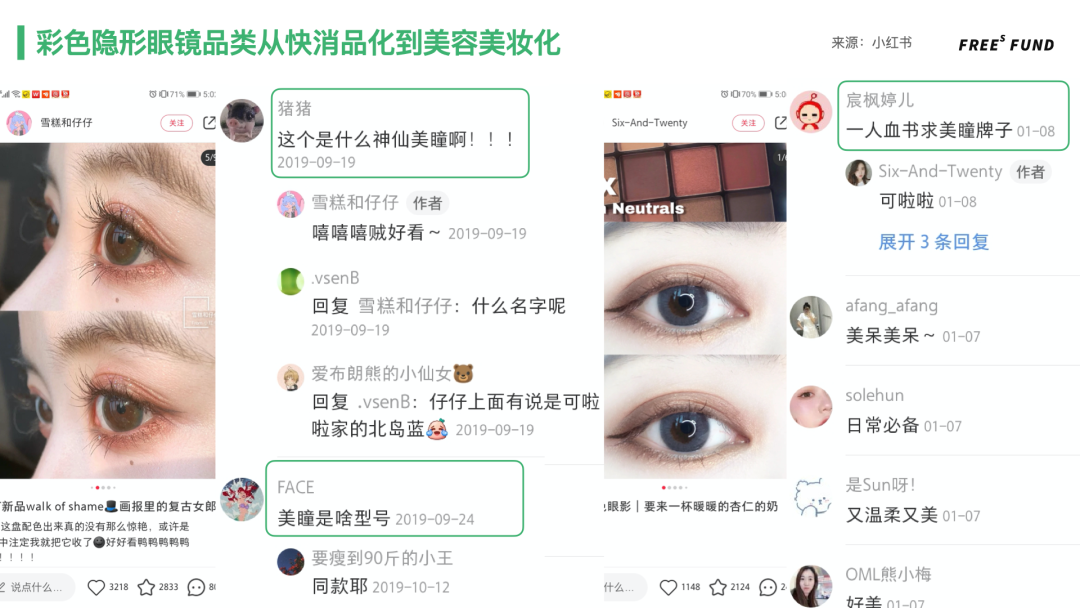
In our view, a major reason the colored contact category is experiencing explosive growth relates to the penetration and expansion of beauty and cosmetics in the Chinese market.
Over five years, beauty product penetration in China grew from roughly 20% in 2016 to nearly 50% in 2020. At the 24th China Beauty Expo's beauty strategy launch event, Secoo's 2019 Secoo Premium Beauty White Paper revealed that among 2019 domestic beauty product purchasers, 74% bought color cosmetics and fragrances.
When facial enhancement becomes routine for women, especially post-95s and Gen Z young women, it's easy to imagine colored contacts being treated as part of the overall makeup look. In other words, makeup users are increasingly in the habit of selecting colored contacts that complement their clothing, hair accessories, and complete makeup look. We call this process the category's evolution from FMCG-ification to beauty & cosmetics-ification.
This will undoubtedly further elevate the category's penetration and growth potential, unlocking enormous market space. We're inclined to believe that colored contacts — combining aesthetic appeal with irreplaceable functionality — will become a category favored by China's next generation of mainstream young consumers. In China, contact lenses including colored contacts represent an emerging incremental market. Compared to other Asian countries, China's contact lens penetration remains relatively low.
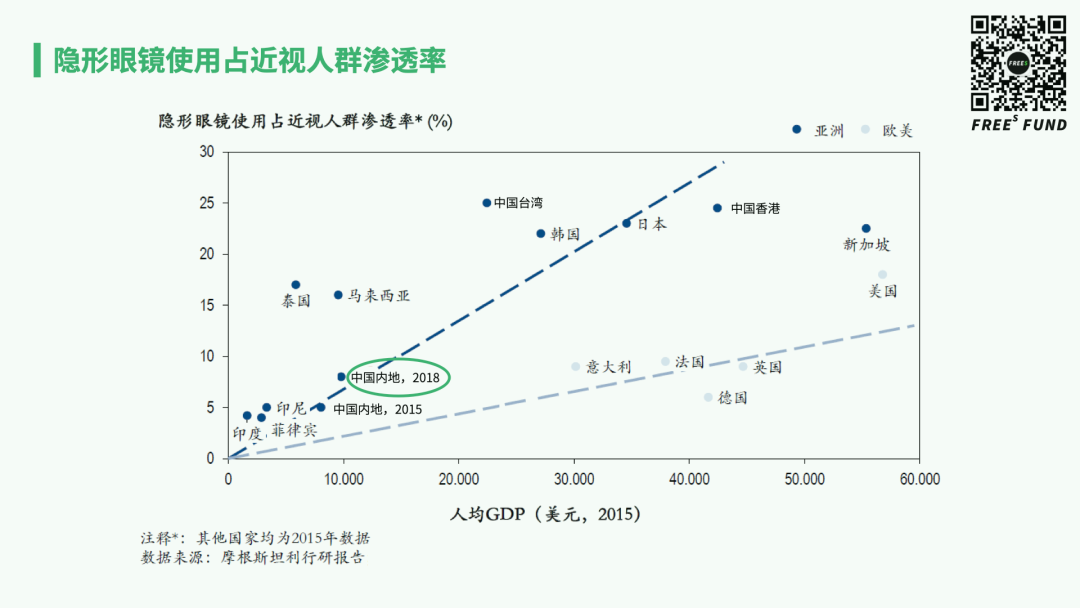
Contact lens adoption rates rise with a country's economic development. Morgan Stanley research shows that China has the world's highest proportion of vision correction needs, yet contact lens penetration sits at only about 10% — far below the US at 25%, Japan at 32%, and Taiwan at 34%.
Compared to this low contact lens adoption rate, colored contacts actually enjoy quite high acceptance in China. According to ArteryNet statistics, domestic corneal contact lens (contact lens) wearers represent only 7-8% of myopic populations, roughly 48 million people, yet colored contact users number approximately 20 million. As contact lens penetration increases, there's still substantial room for colored contact user numbers to grow.
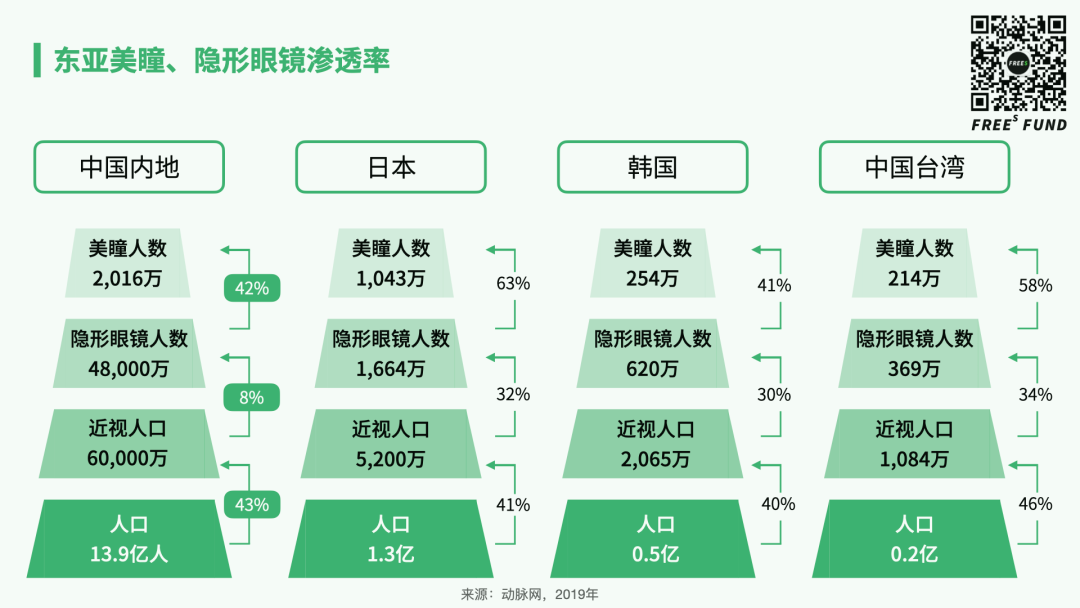
Alibaba Health's 2019 Colored Contact Consumer Insights Report contains an interesting finding: across online channels, 32.9% of consumers purchase plano (zero-prescription) colored contacts, with this proportion trending higher among younger age groups. This means people without myopia are also embracing colored contacts.
04
What's the Innovation Formula for Consumer Product Entrepreneurship in China, Using Colored Contacts as an Example?
Viewed horizontally, contact lenses especially colored contacts are undergoing rapid supply chain responsiveness and technological iteration; this enables substantial improvements on the product side that users can actually perceive — whether in raw materials, functionality, aesthetics, or design; simultaneously, this is amplified by new content formats and traffic media reaching users more effectively. If these three dimensions each advance half a step forward simultaneously, with mutual reinforcement and amplification, they create opportunities for relatively enduring brands.
Let's look at this China consumer product entrepreneurship innovation formula from FreeS Fund founding partner Feng Shu, and it becomes easy to understand.
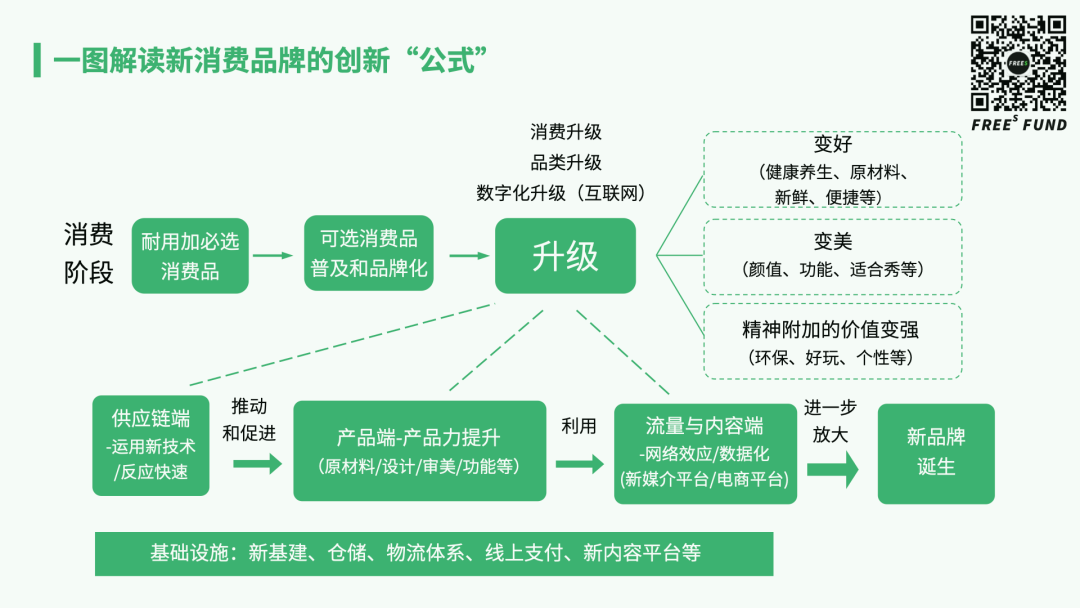
The top row of this chart introduces China's consumption stages. Most first-, second-, and third-tier Chinese cities are currently in the final stage: "upgrading." The typical characteristics or directions of upgrading are consumers pursuing "better," "more beautiful," and stronger "spiritual added value." Taking "better" as an example, this includes not only increasingly premium raw materials, but also fresher, healthier, and more convenient experiences.
The second row, the middle one, we can understand as: China possesses unprecedented global supply chain capabilities and consumer markets. And happens to be able to apply them to product capability and product design, so consumers can tangibly feel supply chain-side technological innovation.
Then going further down, the traffic and media side faces another transformation. Media changes consumer perception of products and brands; traffic changes the efficiency of user reach. Each time such major changes occur, it means you gain an additional advantage — something especially pronounced in China: the internet and rapidly shifting traffic structures and media forms serve as amplifiers.
The combination of these three dimensions (supply chain, product, traffic and content) — if all are achieved — yields the largest, most sustained advantage, with opportunities to build relatively enduring brands. However, if you only achieve one of the three dimensions, you may rise quickly and fall just as fast.
Additionally, the bottom row in the chart is called connectivity efficiency — logistics, warehousing, and other infrastructure. Regarding infrastructure's impact on overall chain efficiency, FreeS Fund's WeChat account has two related articles; welcome to check them out in the "Li Feng Column."
Returning to colored contacts: FreeS Fund portfolio company Tongxue is a contact lens group company owning multiple brands including Kilala and Mitata. Founder Songgeng Zhao entered the colored contact industry in 2007. Let's examine how this innovation formula works through Kilala and Mitata.

▍Colored contacts belong to the upgrading category
Evidently, contact lenses and especially colored contacts, as an eye care solution replacing framed glasses, align with consumer demands for greater beauty, quality, and individuality. We categorize this as an upgrading category.
▍The possibility of mature supply chains shifting to China
Currently, colored contact supply chains are concentrated in South Korea and Taiwan; China's colored contact supply chain system remains relatively immature.
However, we've already seen that some domestic contact lens/colored contact manufacturers have begun absorbing and improving foreign technologies and design concepts, drawing on international advanced lens materials and automated production experience. In flexible manufacturing, pattern innovation, fit, comfort, and even production capacity, there has been very noticeable iteration and progress.
With rapidly growing domestic consumer demand, fast market development, maturing technology, and stable process iteration, we have reason to expect that contact lens supply chains will gradually shift to China — perhaps today is merely the beginning.
▍"Dear client, here's the multicolored black you requested"
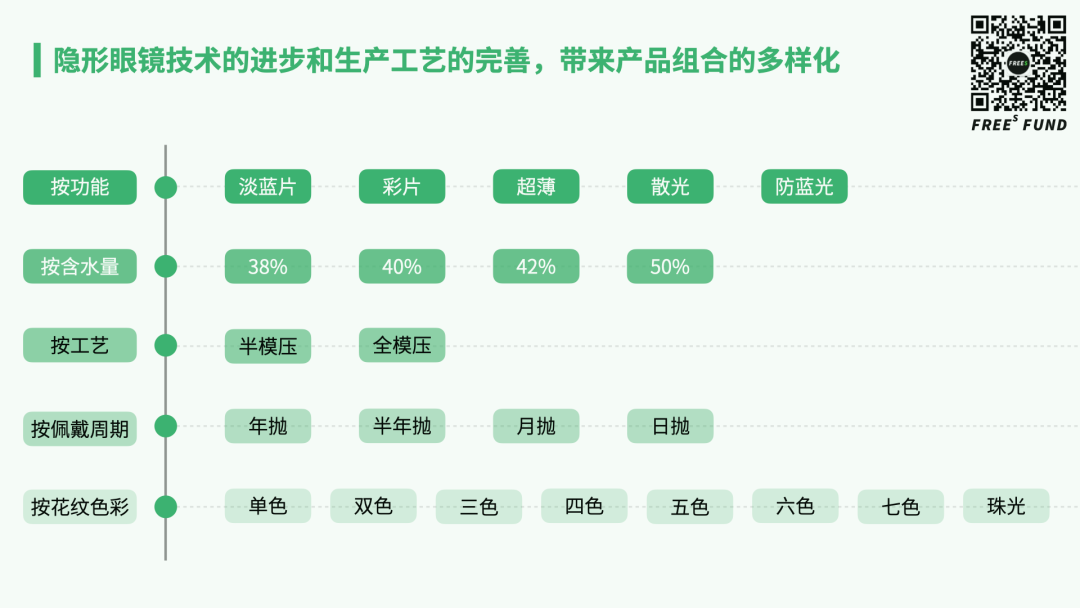
From clear lenses to colored lenses, technological advances and production process improvements have brought diversifying product combinations that users can perceive.
Colored contacts generally have three layers: two transparent corneal contact lenses sandwiching a colored pattern layer, like a "sandwich."
As production processes have evolved, from Kilala and Mitata's product matrices we can already see not just single-, dual-, and tri-color colored contacts, but potentially products combining six or even seven colors. Yes, there is multicolored black here.
Additionally, the emergence of functional products like ultra-thin lenses, toric lenses for astigmatism, and blue-light-blocking lenses provides more and better solutions for people with different vision needs. The iterative development of materials, technology, and processes enables increasingly diverse product types and presentations under Tongxue, better satisfying user demands.
▍The colored contact category is naturally suited to video dissemination and online sales
A major challenge for colored contacts is that diameter, color, prescription, oxygen permeability, water content, and countless other indicators create infinite SKU combinations. Too many SKUs create extreme difficulty and problems for offline multi-point display and inventory management — thus, the category is naturally suited to online sales.
Meanwhile, given colored contacts' strong association with color cosmetics without brand conflict of interest, and their powerful visual impact, they're well-suited to display and spread through livestreaming and short video formats. And precisely in today's China, e-commerce is developing rapidly, media formats and traffic structures are simultaneously transforming, and young domestic consumers are increasingly forming the habit of browsing video content and making instant online purchases.
Finally, it's worth noting that mainstream new media platforms like Douyin are also gradually experimenting with relaxing content restrictions on contact lens-related categories. Changes in traffic platforms and content are bringing new growth dividends to colored contact brands like Kilala and Mitata.
05
Investment Case Study: Tongxue
Tongxue is a contact lens group company whose portfolio includes brands such as Kilala and Mitata. As a leader among domestic independent colored contact lens brands, its sales revenue in the first eight months of 2020 grew by approximately 300% year-over-year. Since May of this year, Tongxue has surpassed Hydron and Bausch & Lomb to become the top-ranked brand in the online colored contact lens category. It currently also holds the #1 position in both online long-cycle and short-cycle replacement lens categories.
Founder Songgeng Zhao entered the contact lens industry in 2007 and has witnessed multiple cycles of change across marketing, supply chain, distribution channels, consumer demand, and regulatory oversight. He led his team to establish years of deep collaboration with a publicly listed Taiwanese manufacturer that was among the earliest in the region to expand into international contact lens production. By leveraging rapidly accumulated front-end user data and demand feedback, his team pushed supply chain partners to undertake technological innovation and technology transfer, achieving breakthroughs in materials, patterns, coloration, layering, and functionality — driving rapid improvement in product competitiveness. We have reason to believe in the explosive potential of colored contacts as a growth category in the coming years, and reason to expect that Tongxue's major brands have the opportunity to maintain their first-mover advantage and continue leading the industry.
Reader Giveaway We welcome your thoughts and reflections in the comments section. By 9:00 PM on October 1, the six readers with the most thoughtful comments will each receive a FreeS Fund custom notebook.
Now Hiring: Investment Professionals | Beijing, Shanghai, Shenzhen
We are seeking investment professionals in Beijing, Shanghai, and Shenzhen across three focus areas: biopharma, deep tech, and consumer/TMT. We welcome candidates with industry backgrounds who are interested in investing, and we also appreciate referrals of exceptional candidates. Please send your CV to hr@freesvc.com. Please include in the subject line: Application for "[Specific Position]" - "[Work Location]"
Click here for full job details: "Entering Our Sixth Year, FreeS Fund Is Hiring Investment Professionals | Doing What's Right, Not What's Easy"

▲ Financial Transformation Begins: How to Build the Next "Hundsun"? ▲ Three Squirrels' Liaoyuan Zhang: A Once-in-20-Years Brand Opportunity — How to Win in Three Steps | FreeS Fund 2020 CEO Annual Meeting
▲ FreeS Report 17: What New Opportunities Will Emerge in the Ancient Jewelry and Accessories Industry? | FreeS Research ▲ How Did Saturnbird Beat Nestlé and Starbucks to Become #1 in Instant Beverages During 618? | FreeS Research — Learning from Investing ▲ 2020: Consumer Brand Entrepreneurship Enters an Era of Multiple Simultaneous Growth Drivers | FreeS Research ▲ Double 11 at Halftime: What Did Chicecream, Saturnbird, Botaniera, and Huasheng Haoche Get Right? ▲ The Category Logic Behind the Hype — Using Coffee Industry Investment as an Example ▲ Breaking Through for Early-Stage Brands: From Traffic Thinking to Content Thinking | FreeS Research ▲ From the Rise to the Calm: Is E-Commerce Livestreaming a Feature or a Business Model? (Part 1) | FreeS Research ▲ Where Is the Endgame for E-Commerce Livestreaming? | FreeS Research