How to Win Over Gen Z Consumers in China and the US? A D2C Streamlined Skincare Brand's Thinking and Strategy

How does a D2C minimalist skincare brand break through?

Allbirds, which uses natural materials like eucalyptus and sugarcane to make shoes. Ripple Foods, a pea milk that uses less water and emits less carbon. Burrow, a sofa that can be assembled by hand in ten minutes. These emerging DTC (Direct-to-Consumer) brands are winning over more fans in the Chinese and American consumer markets. According to survey data from the American brand PR firm Diffusion, 40% of American consumers purchased from a DTC brand in 2019.
At a Speaker Series event organized by the Chinese Entrepreneurs Organization, Kyle Jiang, founder of the streamlined skincare brand JUNO, and Weili Dong, head of FreeS Fund North America, sat down for a conversation on "Cross-Border DTC Consumer Brands: How to Redefine the Trillion-Dollar Skincare Market." They explored the following topics:
- What advantages do DTC brands have over traditional brands?
- What do Gen Z consumers want in skincare products?
- How do new consumer brands cold start? How do you attract users through TikTok?
- What are the biggest differences between Chinese and American consumers?
- What are the advantages and challenges for Chinese teams building brands in the US?
We hope this brings fresh perspectives, and welcome your thoughts in the comments. (P.S. There's a surprise at the end.) We welcome entrepreneurs and industry experts to continue the conversation with us. We also welcome those with industry backgrounds and an interest in consumer investing to join us (hr@freesvc.com).

01 Why create a streamlined, transparent, natural beauty and skincare brand?
"What you don't add matters more than what you do"
Weili Dong: What's the story behind Juno? What led you to create it?
Kyle Jiang: Most beauty brands still focus on ingredients as their selling point, chasing components that sound "expensive" or "impressively obscure," or slapping seven or eight featured ingredients on a single product. But the actual active ingredients in such products may be extremely low.
We've worked with beauty and skincare labs for years, and we know that for every additional featured ingredient you add to a skincare product, you need to add more stabilizers and preservatives. I used to do data analytics at Bayer — they mapped out every ingredient and its function with complete clarity.
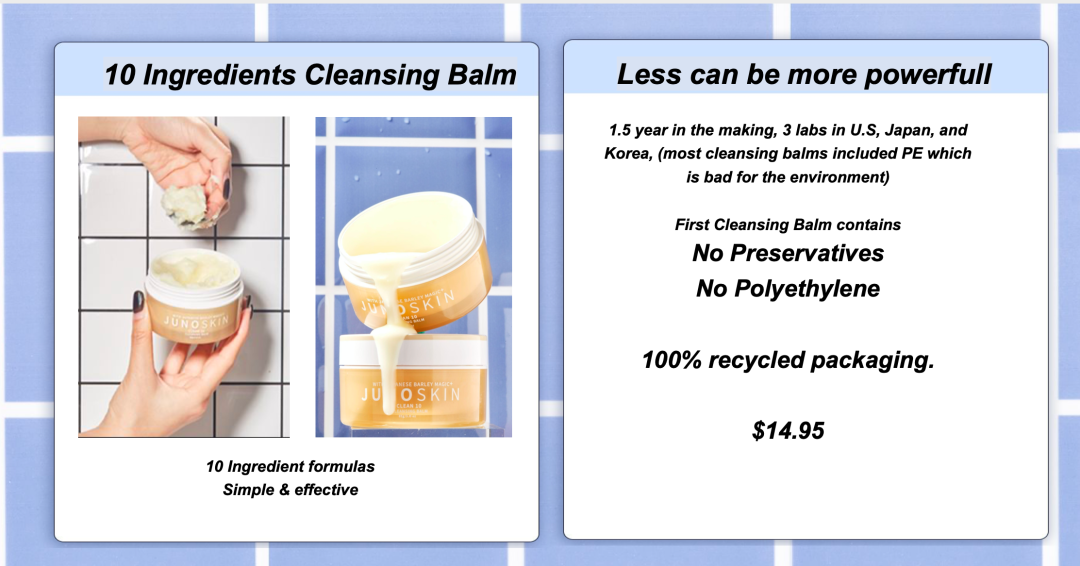
So I started thinking about creating a streamlined, transparent, natural beauty and skincare brand. "What you don't add matters more than what you do" — that was the founding vision and basis for Juno. The first core product in Juno's skincare line was a cleansing balm with just ten ingredients.
In my previous home lifestyle startup, I had to collaborate with many beauty and personal care brands. We found that many users were quite cautious when buying skincare products, asking lots of questions before purchasing. For example, faced with products claiming the same benefits, they didn't know how to choose. Or they weren't even sure which ingredients their skin might be sensitive to. When we relayed these questions to the brands — including some sold at Sephora — they tended to simply ignore them.
My other American co-founder was employee #1 at IPSY, the largest American beauty e-commerce platform (with roughly $1 billion in annual sales). Over five years, she helped the company grow from zero to several million users. She had served hundreds of beauty brands and previously worked at Tatcha and Ulta. She had her own vision for beauty and mature market experience. We hit it off and created Juno together.
Finding Like-Minded Partners
Juno is currently hiring globally for marketing managers, VP of operations, e-commerce operations, data analysts, independent site engineers, web designers, and brand designers. Friends interested in joining Juno, please send your resumes to elizabeth@thejuno.com
How does a brand cold start?
Weili Dong: Before starting their own brands, many people often ask how to cold start. I'm curious — how did JUNO cold start and acquire its first users?
Kyle Jiang: The prerequisite for a cold start is knowing your domain inside out. Knowing it doesn't mean simply understanding it from data — you need years of work experience, years of observing users and the market. Additionally, your team's DNA needs to align with your direction. These are two preconditions.
You also need an entry point. In a mature market, you need to find user pain points to切入; in a growing market, you need to find categories about to explode.
The American beauty and skincare market is very mature, so we chose to enter through a base makeup line with strong visual impact and skincare properties. Juno's base makeup has skincare benefits. Our innovative products — a fuzzy makeup sponge and a skincare primer — took off in the US and quickly helped us retain hundreds of thousands of users. In the process of operating these products, we built relationships with influencers, media, and offline channels.
After establishing some brand recognition in base makeup, we chose the cleansing balm product to切入 into skincare. Because in our view, cleansing balm is the bridge connecting base makeup and skincare.
Coincidentally, right when we entered cleansing balms, American user demand for makeup removal products was also shifting rapidly. For the longest time, American users mainly relied on makeup remover wipes. But wipes involve repeated rubbing of facial skin, which isn't great for the skin and doesn't necessarily clean thoroughly. Plus, cotton pads are single-use and not environmentally friendly. Any one of these reasons was enough to make most users start rejecting wipes. In Korea's beauty and personal care market, cleansing balms appeared earlier. They're more eco-friendly than cotton pads and less damaging to skin.
Additionally, industry data and conversations with R&D and users further solidified our decision to enter through the cleansing balm category and make it our core product.
Interactive Giveaway
What are your thoughts on DTC brands? We welcome your thoughts in the comments below. We'll give Juno cleansing balms to the 6 readers with the most thoughtful responses. (Deadline: 9:00 PM, June 30.)
02 How does a brand truly capture users' minds?
Weili Dong: How does Juno capture users' minds? What are your brand moats?
Kyle Jiang: You have to become the category leader to capture users' minds. Juno's first-stage goal is to become the world's #1 cleansing balm — when people think of cleansing balm, they think of Juno first. After entering the skincare market through cleansing balm, Juno wants to establish the concept of streamlined skincare. Our second-stage goal is for users to think of JUNO when they think of streamlined skincare.
JUNO's cleansing balm uses only ten ingredients. Comparable cleansing balms on the US market are priced around $30–50, while JUNO is $15. Our ingredients and pricing are more competitive than similar products. Most young Americans don't chase luxury brands. Overpriced products struggle to gain footing among young people.
With this foundation, we communicate openly with users on social media platforms, educating and "planting seeds" with them, combined with our team's promotional capabilities and overall brand strength, to ultimately capture consumers' minds.
By May 2021, we had become #1 in makeup removal on Amazon, with our official website growing roughly 10x.
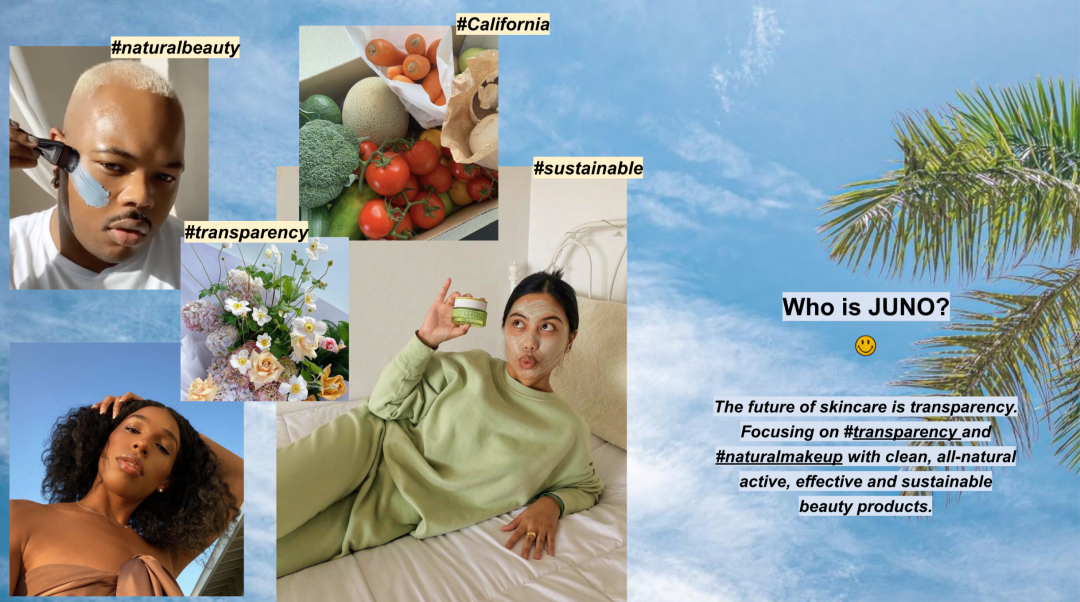
Beyond the cleansing balm product itself and the streamlined skincare brand concept, capturing users' minds — especially for Gen Z consumers — requires strong brand values, including diversity, transparency, and social responsibility. Gen Z consumers now care whether products are tested on animals, whether they're environmentally sustainable and recyclable. They also care deeply about energy diversification, transgender inclusion, and aesthetic diversity across races.
JUNO's cleansing balm contains no microplastics, which is a major technical breakthrough and also helps shape JUNO's brand value. Most personal care products on the market, including cleansing balms and toothpaste, contain microplastics because they provide exfoliation and cleansing effects. When people use these products, thousands of microplastic particles flow into rivers and oceans, polluting the environment and affecting animal and plant growth. JUNO's consumer base cares deeply about environmental protection, and JUNO will continue to push breakthroughs in microplastic-free formulas and more eco-friendly packaging materials.
03 How to find the "right time," "right brand," and "right people"?
Weili Dong: What do you think are the most important factors in creating a new brand?
Kyle Jiang: A brand is a belief. In the process of building a brand, you need to analyze emerging demographic needs, track market trends, and accumulate experience working with channels. Every环节 involves understanding local culture.
First, you need to pinpoint your user group and position your brand accurately. Juno's main user group is currently Gen Z. A brand must first understand what consumers need now. With the emergence of various social media platforms, users' information sources have become extremely broad. When choosing skincare products, they care deeply about whether they identify with the company's philosophy, and they'll scrutinize the entire ingredient list. If a brand has social responsibility and supports environmental causes, that's a huge plus for these users. My 15-year-old niece can easily explain how niacinamide and hyaluronic acid work.
After identifying your audience, you need to find the right direction. We're entering the skincare market with streamlined skincare, and on this foundation, we need to find breakthrough points to elevate the brand. Our user surveys found that 65% of JUNO users consider themselves to have sensitive skin, yet many don't even understand what's causing their allergic reactions.
More importantly, you need to find the right timing. If I had started streamlined skincare five years earlier, Gen Z consumers wouldn't yet have become a significant consumer force, the market would still have been dominated by major brands, and new consumer concepts wouldn't have emerged. Today, the channels and business models for consumer brands are changing, and users' consumption philosophies are evolving, creating space for brands like JUNO to grow.
Overall, in building a brand, what we care about is whether we can achieve significant disruption and innovation, and whether our products can exceed consumer expectations.
One point I want to emphasize: "right time," "right brand," and "right people" don't appear simultaneously. In the entrepreneurial process, you need to keep executing while keeping pace with evolving consumer needs, in order to catch the critical moment when these three align.
Weili Dong: Speaking of the "right people," how do DTC brands like JUNO optimize user experience?
Kyle Jiang: Compared to traditional brands, DTC brands are primarily online-channel-based in their business model, not overly dependent on offline channels, and can face consumers directly. Our pricing and margin structure have advantages over traditional brands. We can redirect the channel cost savings toward using better ingredients in our products. Therefore, DTC brand users' LTV (life time value — the total economic benefit a company receives from all interactions with a customer) tends to be more enduring than pure offline brands. We need to leverage this advantage to create极致 products.
In terms of promotion, DTC brands are better at using new media to acquire and retain users more efficiently. From an R&D and operations cycle perspective, DTC brands significantly shorten the time from product development to maturity to hit product status, compared to traditional brands.
04 How do new consumer brands attract users through TikTok?
Weili Dong: You just mentioned that "in terms of promotion, DTC brands are better at using new media to acquire and retain users more efficiently." In JUNO's process of operating TikTok and other new media, what tactics and experiences can you share?
Kyle Jiang: First, we're positioned at Gen Z consumers. When developing products, beyond considering consumers' product needs themselves, we already consider how the product can be传播 and showcased on the new media platforms that Gen Z consumers frequently use.
To promote a brand on TikTok, you absolutely must understand young people first, including what trends they're into.
Previously, we posted more videos on Facebook, so when we first started on TikTok, we also posted some very long videos.
But later, we discovered that TikTok users prefer videos where creators simply pick up their phones and talk directly to them. Compared to high-definition, heavily edited videos, they prefer native content. These young people like authentic textures, videos with natural backgrounds or green plants, topics like environmental protection. Though not directly beauty-related, this content helps us judge many trends. Today's youth pursue natural, healthy, transparent, and unadulterated aesthetics. They're quite different from the Instagram generation, which further solidified our product direction.
Second, the team needs to treat launching videos on TikTok like launching a product, iterating constantly. We spent considerable time exploring every dimension — duration, beat drops, topic angles, visual presentation — to figure out how to showcase every second of video. JUNO's US-based team of over 10 people shoots more than 30 hours of content daily. We post videos across different accounts and analyze the data. When a video goes viral, we analyze why. Then we apply those methodologies to shoot more videos, iterating step by step.
Weili Dong: In the Chinese market, many consumer brands are deploying short videos and livestream commerce. How do American consumer brands think about livestream selling?
Kyle Jiang: TV live shopping has always occupied a huge market in America. As American users spend more and more time on their phones, the rise of video livestream commerce may only be a matter of time. Many methods Chinese consumer brands use for livestreaming can serve as reference for overseas brands — we've tested some before with good results. What I think is missing on the US side is whether MCN institutions can build out the livestreaming environment, and whether they can cultivate consumers' habit of shopping through online livestreams.
What's the biggest difference between Chinese and American consumers?
Weili Dong: Juno's products are mainly sold in the Chinese and American markets. In your view, what's the biggest difference between Chinese and American consumers?
Kyle Jiang: On the consumer side, I've found that the Chinese market tends more toward hit-product dominance. Once a particular product becomes a爆款, everyone latches onto that one product. China currently also has livestream selling, which hasn't yet taken off in the US. In the US, users care whether a brand, beyond making good products, outputs values like environmental support.
Weili Dong: In the current US DTC brand market, what are the specific advantages of American local entrepreneurs versus Chinese entrepreneurs? How do you create DTC brands better suited for American users?
Kyle Jiang: China's overall market competitive environment is much more intense than other countries'. Building consumer brands in China demands extremely high standards for brand tactics, product iteration, and team capabilities. Brands need to quickly capture demand, quickly iterate, and quickly find new channels — the entire cycle is very fast. Our team spent over a year in China and learned many tactics that are领先 for the American market.
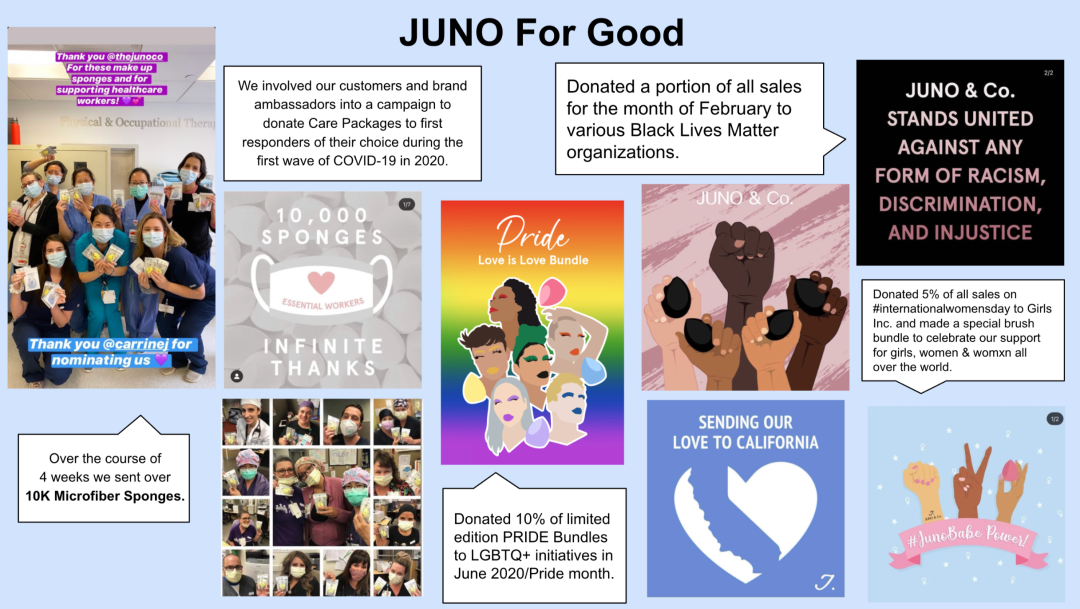
Overall, Chinese entrepreneurs better understand how to use Google, Facebook, and Instagram information feeds as customer acquisition channels. American entrepreneurs, because they understand brands and local culture better — for example, on social issues like LGBT, Black Lives Matter, and supporting Asian communities — they输出 more culture, launching politically correct, fun, interesting brand campaigns or video content to move consumers. These two approaches are quite different.
Juno happens to combine both aspects: first, our brand achieves environmental protection, streamlining, and transparency. Second, we leverage the information feed投放 and overall execution capabilities we learned in China — that's the combination.
How can China create DTC brands more recognized by American users? As I discussed earlier, you need to understand what the user profile looks like, what their preferences are, what media they use, and how they express themselves on those platforms. Only after understanding these points can you better create brands they love and provide them with brand value and products.
How to洞察 user needs?
Weili Dong: From the beginning until now, how has JUNO maintained communication with customers? Many people might think, if I could know the customer's pain points, I could help solve them well. But the question is how to know those pain points. What suggestions do you have for this?
Kyle Jiang: I think communicating with users is also a huge advantage of DTC brands. Most American brands are offline-channel-based and lack communication with users. After traditional brands do online promotion, they don't aim to drive users to their official websites but rather to traditional channels like Sephora. Users then give feedback to Sephora's buyers, not the brand.
As a DTC brand, JUNO collects massive amounts of user needs daily from private messages, emails, and even face-to-face conversations. JUNO requires the team to respond to all user messages the same day, summarize these needs daily, and sync them with the promotion team, buyer team, and product R&D team. Our R&D team must read all user reviews every day. Through communicating with users, discovering needs, making good products, and getting the brand message across — everything else follows naturally. This is actually a huge advantage of DTC brands.
Weili Dong: Does this direct interaction with consumers help DTC brands iterate products quickly?
Kyle Jiang: Yes. Most traditional American brands lack user communication, resulting in slower product iteration speeds. Meanwhile, DTC brands like JUNO, with online channels as the主导, significantly shorten the cycle from product development to maturity.
Typically, a new traditional beauty and skincare product takes 1–1.5 years to launch in traditional channels, so major brands usually need to prepare product promotion a year in advance. The whole process includes spending 3–6 months communicating with offline store buyers, roughly 9 months producing the product, and over 3 months distributing inventory across US channels. This doesn't even include the subsequent time for collecting user feedback and iterating products.
JUNO's strategy, by contrast, faces consumers directly. For example, JUNO's cleansing balm launched in October 2020; by March 2021, we had completed 4 product iterations, finally making this cleansing balm a product that exceeded user expectations. More importantly, when developing products, we already thought about how to showcase our products through short videos.
What are the advantages and challenges for Chinese teams building brands in the US?
Weili Dong: As a Chinese entrepreneurial team, what do you see as the biggest advantages and challenges of building brands in the US?
Kyle Jiang: We're a relatively international team, with core members distributed across China, the US, and Latin America. China's e-commerce market has produced many brands in recent years, and their growth speed is also very fast.
There are several clear advantages to founding consumer brands in China:
First, China's supply chain advantage lies in response speed. We develop products in the US, but from development to mass production, there are many adjustments needed in between. Chinese supply chain speed advantages can help brands shorten production cycles. Secondary upgrades and restocking after mass production also require supply chains that can respond quickly. Independent sites like JUNO's official website, unlike offline channels, don't require massive inventory stockpiles — we can stock based on promotion cycles. At the same time, to scale an independent site, you need to operate more SKUs. And Chinese supply chains have major advantages for multi-SKU, rapid upgrade, and restocking models. JUNO has also started producing some products in the US and Korea, because the US and Korea have richer raw materials. We arrange production based on different category characteristics and different countries' strengths.
Second, China's consumer product tactics are very advanced. From O2O to e-commerce platforms, Chinese consumer brands have various tactics. JUNO's products were able to scale quickly in the US because we drew on Chinese tactics, optimizing CAC (customer acquisition cost), LTV (user lifetime value), and other metrics in operations, while combining them with American local R&D advantages. The result of operating this way: our user acquisition cost is one-third of comparable products in our category.
Finally, I believe combining Chinese and American local team entrepreneurs is more suitable for globalizing products. Because TikTok, Facebook, and Instagram are all globally deployed. If a play works in the US, using part of a US team plus some other countries' localized teams makes it easy to globalize a product.
For JUNO, most of our members are in China, one-third are in the US, and several are in Latin America. Chinese team costs are one-third of US costs, and execution is also quite strong. Plus local teams in other countries can help JUNO push products globally.
What are your thoughts on DTC brands? We welcome your thoughts in the comments below. We'll give Juno cleansing balms to the 6 readers with the most thoughtful responses. (Deadline: 9:00 PM, June 30.)
How to Build Your Corporate Brand Strategy from 0 to 1? | FreeS Free Talk
Early-Stage Medical Beauty Investment Moving Toward Underlying Technology | FreeS Research Institute
We are currently seeking investors in biopharma, deep tech, and consumer/TMT across Beijing, Shanghai, and Shenzhen. We welcome those with industry backgrounds and an interest in investing to join us, and also welcome recommendations of excellent candidates. (For specific job descriptions, please click the "read more" link at the end.) Please send resumes to hr@freesvc.com. *Email subject line please indicate: Application for "Biopharma / Tech / Consumer / Investor" – "Work Location"
We are also seeking interns in investment research, legal, finance, HR (portfolio direction), and video content operations. Interested students are welcome to apply. (For specific job descriptions, please click the "read more" link at the end.)
Internship duration: 3–5 months, 3–5 days per week on-site, Beijing-based preferred.
Please send resumes to hr@freesvc.com
*Email subject line please indicate: Position applied for – Name – School – Major – Minimum internship commitment of x months – x days per week on-site – Earliest start date