$1 Billion! BioMap and Sanofi Partner to Develop AI Drug Discovery Models Based on Large Foundation Models | BlueRun Ventures Headlines
The First Commercial Partnership Based on Large Language Models in the Life Sciences Sector
On October 10, BioMap and Sanofi announced a partnership to co-develop leading models for biotherapeutic drug discovery, built on BioMap's Life Science AI Foundation Model.
This marks the largest collaboration in the life sciences field based on foundation models. BlueRun Ventures was an investor in BioMap's Series A round, and we look forward to seeing foundational models catalyze the emergence of entirely new species of innovation that redefine future technology and life itself.
How should we understand this BioMap-Sanofi deal? It represents the first commercial partnership in the life sciences built on a large foundation model, with milestones tied to model development rather than drug R&D progress — offering a fresh case study for the distinctive MaaS (Model as a Service) business model in the era of large models.
Under the agreement, BioMap will receive $10 million in upfront payment and multiple near-term model development payments. With additional payouts tied to preclinical development, clinical development, regulatory, and commercial milestones, the total deal value exceeds $1 billion.
In 2020, Baidu founder, chairman, and CEO Robin Li and BV Baidu Venture CEO Liu Wei co-founded BioMap. Within just a year, BioMap closed a Series A round of over $100 million, and that same year made strategic investments in cutting-edge life science and technology companies including BioMap Intelligence and DeepWise. On the business development front, BioMap has established partnerships with multiple frontier companies including Jingzhun Biotech, Harbour BioMed, GenomiCare, Prisma Biotech, and NeoX Biotech. In three years, BioMap — with its AI large model "xTrimo" exceeding 100 billion parameters — has become a force to be reckoned with in the AI pharma landscape.
Protein Large Language Models Take Center Stage
In 2023, the AI wave ignited by ChatGPT swept across the globe, revealing new possibilities for generative AI in pharmaceutical applications. In biopharma R&D, "Reverse Moore's Law" means successfully developing a new drug requires $1 billion and ten years — the notorious "Double Ten" rule.
Thanks to life science AI foundation models encompassing AI task models and large language models, researchers can now innovate at every stage of drug discovery, including target identification, molecular design, and optimization. As foundation models mature, researchers are gradually acquiring zero-shot capabilities, accelerating the drug discovery process.
This collaboration will leverage BioMap's customized foundation models and world-leading AI expertise, combined with Sanofi's proprietary data, protein engineering innovation, and deep biologics development experience, to create leading protein large language models and AI task models for biologics design and multi-parameter optimization.
In March this year, BioMap launched AIGP — AI Generated Protein — a platform powered by life science large models, aiming to harness AI's capacity for designing novel proteins to jointly develop frontier drugs and other life science projects with industry partners, while simultaneously driving technological advances in the AIGP platform itself.
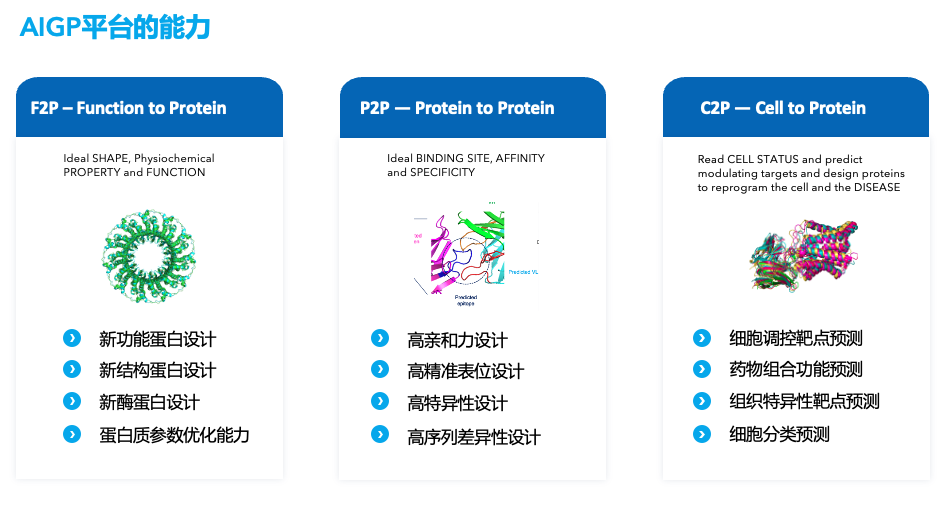
Behind AIGP lies xTrimo (The Cross-Modal Transformer Representation of Interactome and Multi-Omics), a cross-modal large model with over 100 billion parameters that BioMap has spent three years building, designed with a four-layer nested architecture. To date, xTrimo has achieved SOTA (state of the art) performance across 26 downstream prediction tasks spanning antibody structure, antibody function, drug R&D, disease treatment, and cell biology research, and continues to iterate and evolve.
Using xTrimo, BioMap learns from cross-species, cross-modal life information to understand the fundamental principles of how proteins are structured and function, how they interact, and how they combine and regulate cellular functions — thereby deciphering the natural language of life: proteins. The AIGP platform features three functional modules: Function to Protein Design (F2P, designing/optimizing proteins based on functional metrics such as structure, function, and developability); Protein to Protein Design (P2P, designing antibodies and other proteins that bind to given target proteins such as antigens in specific ways); and Cell to Protein Design (C2P, identifying target proteins that regulate cellular functions and designing corresponding regulatory proteins for given cells).
In July, BioMap unveiled xTrimoPGLM, its protein language model — the first and largest foundational protein language model in the life sciences field, trained on 100 billion data points from billions of protein sequences. Based on the GLM (General Language Models) paradigm, xTrimoPGLM successfully integrates pre-training methods for two fundamentally different task categories: protein understanding and protein generation. Ultimately, across 15 protein tasks spanning four major categories — protein structure, protein developability, protein-protein interaction, and protein function — xTrimoPGLM outperformed baseline models on 13 tasks, with overall performance exceeding that of models including Meta's ESM-2.
As the first and largest AI foundation model in the life sciences domain, xTrimo provides the foundation for BioMap's ongoing development of large models targeting different objectives. Currently, BioMap is applying its various large models in collaborative applications across tumor multi-omics, single-cell analysis, and other fields.
Betting Nearly $10 Billion, Sanofi Aims to Become the First Large-Scale AI-Driven Pharma Company
Notably, this is not Sanofi's first foray into AI partnerships.
Over the past two years, Sanofi has engaged in comprehensive collaborations with multiple AI pharma companies, computer firms, and AI medical data companies through a series of acquisitions and partnerships.
In 2021, Sanofi partnered with Owkin, whose AI-driven platform uses patient data from diverse medical centers to build models and predict patient responses to treatment.
That same year, Sanofi collaborated with Baidu to apply Baidu's mRNA optimization algorithm — LinearDesign — to the development of mRNA vaccines for infectious diseases and cancer.
In 2022, Sanofi acquired Amunix Pharmaceuticals, which uses AI to engineer drugs that activate only in tumor tissue without harming healthy tissue.
Also in 2022, Sanofi entered into a large-scale partnership with AI pharma company Exscientia with a $100 million upfront payment, to develop up to 15 drug candidates in oncology and immunology.
In the same year, Sanofi partnered with AI pharma companies Insilico Medicine and Atomwise to leverage their AI-driven platforms to accelerate drug development.
According to public information, Sanofi's four major AI pharma collaborations in 2022 alone totaled over $8.7 billion in scale, with upfront payments exceeding $1.14 billion — representing 15.83% of its annual R&D investment. The largest of these carried a $100 million upfront payment, a figure that sent shockwaves through the entire AI pharma industry.
In June this year, Sanofi went further, announcing it would go "All In" on AI and data science to accelerate breakthroughs for patients. CEO Paul Hudson declared emphatically: "Our goal is to be the first pharma company powered by artificial intelligence at scale."
Compared to other pharma giants, Eli Lilly and Company CEO David Ricks has also stated in interviews that AI is "one of the most exciting technologies I've seen in a long time," with potential to disrupt the entire industry. To date, Lilly's largest investment in domestic AI pharma is its $250 million partnership with XtalPi.
This underscores Sanofi's determination and confidence in the AI pharma space.
Before its focused push into AI pharma, Sanofi — despite being the world's largest vaccine developer — suffered repeated setbacks in COVID-19 vaccine development, failing to capture the mRNA vaccine windfall and falling behind Pfizer, BioNTech, and Moderna in progress and commercialization.
In 2021, seeking to stage a comeback in mRNA, Sanofi spent $3.2 billion acquiring mRNA company Translate Bio, betting on next-generation mRNA technology. But shortly thereafter, Sanofi concluded that the COVID-19 vaccine market had become saturated and suspended its mRNA COVID-19 vaccine program.
According to its June announcement, Sanofi is driving digital transformation company-wide and has launched an AI application called plai. In research, Sanofi has established multiple AI programs to shorten research timelines by improving predictive models and automating time-consuming processes; in clinical trials, increasing digitization and insights from plai are enabling Sanofi teams to rethink how to conduct trials more effectively; in manufacturing and supply, Sanofi is digitizing quality assessment processes.
Players Rush In: Global Pharma Giants Mine AI Pharma's Golden Age
Since the founding of the first AI pharma company, Schrödinger, in 1990, the global AI pharma industry has evolved through over 30 years into a golden age.
Starting in 2015, a wave of AI pharma startups emerged rapidly, including XtalPi, Yiyao Technology, Galixir, StoneWise, and Suikang Pharma.
Traditional pharmaceutical companies have not stood idle, entering the AI pharma track through strategic partnerships and equity investments. WuXi AppTec, for instance, has invested in multiple AI-enabled drug discovery companies; Hengrui Medicine partnered with French company Iktos, which specializes in AI-driven new drug design platforms, to license its AI drug R&D platform.
Meanwhile, internet giants have also sought their share of the blue ocean in AI pharma R&D. In 2020, BioMap — now partnering with Sanofi — and its portfolio company DermBiont were both initiated by Baidu; that same year, Tencent launched its first AI-driven drug discovery platform, iDrug; Alibaba also partnered with the Global Health Drug Discovery Institute to develop an AI drug R&D and big data platform. Subsequently, Huawei, ByteDance, and other internet companies have built drug discovery platforms based on their AI algorithm strengths.
After 2020, the AI pharma industry entered a rapid development phase, with the track becoming increasingly crowded. The frequency, scope, and depth of collaborations between AI+new drug companies and pharmaceutical firms have continuously expanded, with some AI+drug discovery companies beginning to conduct independent full-pipeline drug development — giving rise to the AI Biotech business model.
The BioMap-Sanofi partnership marks the largest collaboration in the life sciences field based on foundation models. Previously, domestic AI pharma company XtalPi also signed an AI small-molecule drug discovery collaboration with Eli Lilly and Company, targeting an undisclosed novel target, with XtalPi using its proprietary small-molecule drug discovery platform ID4Inno™ to develop a first-in-class drug addressing unmet clinical needs, with upfront and milestone payments totaling up to $250 million.
Globally, Novartis has partnered with Microsoft to leverage Microsoft's AI tools to discover, develop, and commercialize new drugs; Roche and Moderna have made major acquisitions of AI startups. Pharma giants are pursuing three parallel paths — independent development, acquisitions, and collaborative development — to ensure they don't fall behind in the new wave of AI-driven drug discovery.
The BioMap-Sanofi collaboration, with milestones tied to model development rather than drug R&D progress, offers AI pharma companies another source of confidence. After all, in the biopharma field governed by the unyielding "Double Ten" rule, any technology capable of shortening R&D timelines will find countless biopharma companies willing to pay for it.
Founded in Silicon Valley in 2005, BlueRun Ventures is a venture capital firm focused on early-stage startups.
Currently, BlueRun Ventures manages multiple USD and RMB dual-currency funds in China, with assets under management exceeding RMB 15 billion, making it one of the largest early-stage funds domestically. The firm invests primarily at Pre-A and Series A stages, covering hard tech and innovative interaction, enterprise technology, new consumer, and healthcare sectors. It has cumulatively invested in over 150 startups, including Li Auto, Waterdrop, QingCloud, Guazi.com, Qudian, Songguo Mobility, Ganji.com, Energy Monster, Yuntu Semiconductor, Machenike, Clouds Intelligence, Axinnet, and BioMap.
BlueRun Ventures has been ranked #1 in Zero2IPO's "China's Top 30 Early-Stage Investment Institutions," #1 in ChinaVenture's "China's Best Early-Stage Venture Capital Institutions TOP30," and named among Preqin's Top 10 venture capital fund managers globally for sustained high-return performance.
Additionally, BlueRun Ventures has repeatedly received honors from Forbes China, 36Kr, Cyzone, Caixin Media, CBNweekly, Jiemian, and other media institutions, including "China's Best Early-Stage Institution of the Year," "China's Top Venture Capital Institution," "Most Entrepreneur-Friendly Early-Stage Institution of the Year," and "Most Influential Early-Stage Institution of the Year."