BlueRun Ventures Adds to Stake as NanoCore Chips Closes Over RMB 1 Billion in Series B Funding to Accelerate Edge-Cloud Collaborative 3D Computing-in-Memory LPU Chips | BlueRun Family

Pushing Large Model Inference Toward Edge-Cloud Collaboration
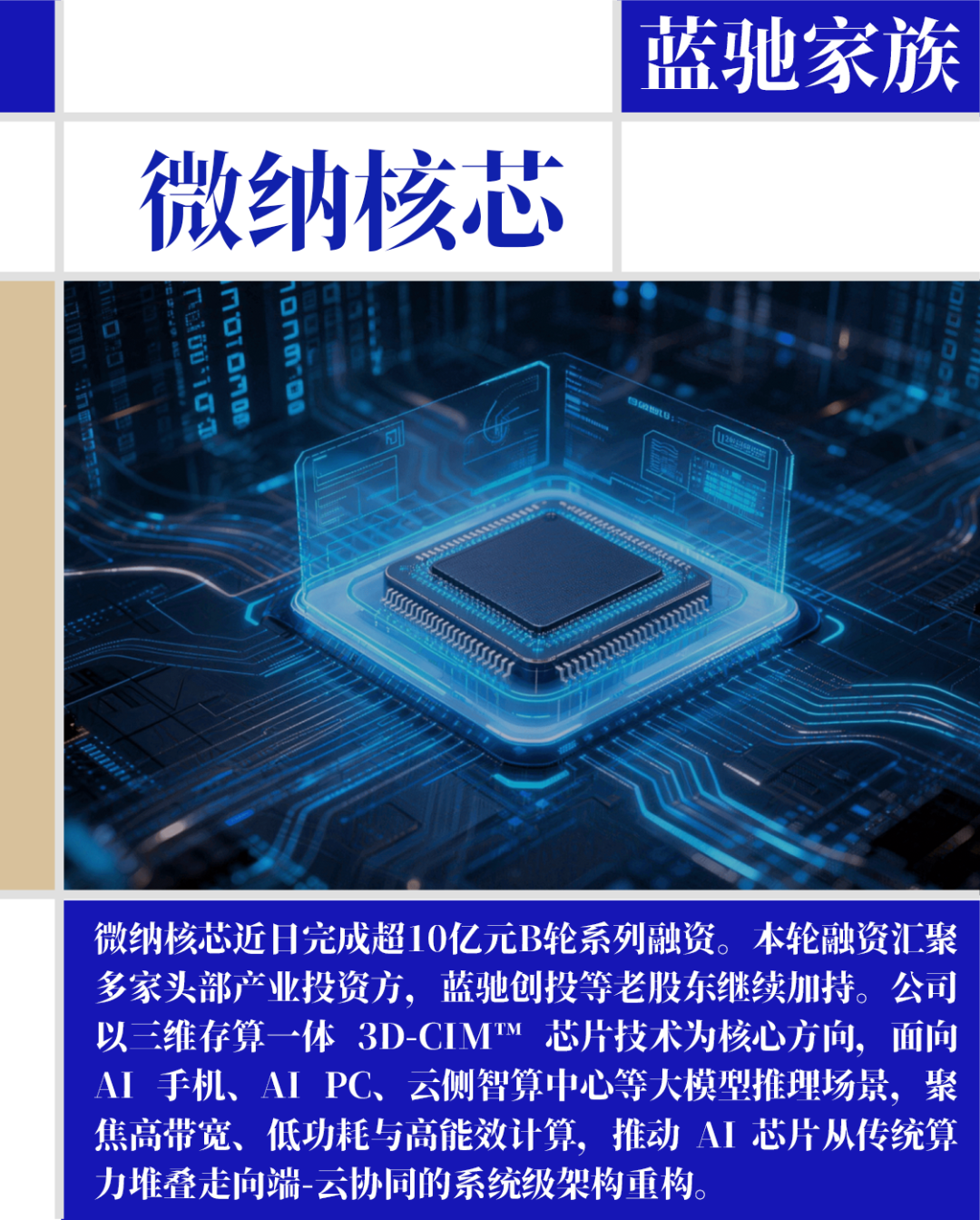
Hangzhou Winicore Electronic Technology Co., Ltd. (hereinafter referred to as "Winicore"), a global leader in compute-in-memory AI chips, recently completed its B3 and B4 funding rounds, bringing the total Series B financing to over RMB 1 billion. This round attracted multiple strategic and financial investors, reflecting strong recognition of the company's globally pioneering 3D-CIM™ (3D Near-Memory + Compute-in-Memory + RISC-V Compute-in-Memory) chip technology for AI computing applications. Winicore will use this financing as a catalyst to accelerate edge-cloud industry collaboration and ecosystem development, driving the democratization of AI computing power. BlueRun Ventures led Winicore's Series B round and continued to increase its stake in this financing round. BlueRun has long been investing in edge AI and remains bullish on the architectural restructuring opportunities for AI chips under the edge-cloud collaboration trend.


As large language models rapidly proliferate, the AI industry is gradually shifting from "training-driven" to "inference-driven." Compared to training, inference must continuously handle massive volumes of requests, while new application paradigms such as agents, multimodal interactions, and real-time engagement are significantly increasing AI inference demands and system loads.
Against this backdrop, the industry is evolving from "centralized cloud inference" toward an "edge-cloud collaborative inference" architecture. Compared to pure cloud-side inference, edge-side inference offers inherent advantages in real-time response, privacy protection, offline capability, and system cost—driving the migration of large model inference to terminal devices. Companies like Apple and OpenAI are successively launching new-generation AI terminals that support on-device large model inference.
Large model inference is catalyzing a restructuring of AI chip architectures. David Patterson, Turing Award winner at Google DeepMind, recently noted in his research that mainstream architectures such as GPUs and TPUs face significant memory bandwidth and latency bottlenecks in large model inference scenarios, and the industry is accelerating its exploration of novel AI computing architectures such as "compute near memory." Especially in mobile scenarios, large model inference must operate continuously under extremely low power and limited area constraints, placing higher demands on compute density, energy efficiency, and data bandwidth. China's 15th Five-Year Plan recommendations call for cultivating and strengthening emerging and future industries, with the integrated circuit sector explicitly targeting "advancing breakthroughs and applications in compute-in-memory, 3D integration, optoelectronic fusion, and other technologies."

Winicore's globally pioneering 3D-CIM™ architecture (3D Near-Memory + Compute-in-Memory + RISC-V Compute-in-Memory) fundamentally eliminates data movement overhead, breaking through data bandwidth, compute density, and energy efficiency bottlenecks on mature process nodes.
With the B3 funding in place, the company's two core product lines have entered a critical productization phase:
PCIe-CIM™ Series: Large model inference coprocessors for AI phones, AI PCs, cloud intelligence centers, and all-in-one machines. Core R&D and simulation verification are complete, and the technical approach has gained recognition from leading terminal and cloud vendors.
LP-CIM™ Series: A globally leading near-memory + compute-in-memory solution, developed in deep collaboration with memory original manufacturers to provide extreme energy efficiency solutions for edge AI. Productization is progressing steadily.
Currently, the company's edge AI chips are gradually entering the product cycle. Since completing product definitions with multiple leading terminal and memory manufacturers in 2024, the company finalized supporting main chip models and completed software-hardware compatibility assessments with mainstream mobile customers in 2025. Going further, in 2026 the company established strategic partnerships with several edge-side large model companies to jointly advance the "chip-model synergy" ecosystem.
On the cloud side, Winicore's 3D-CIM™ architecture employs a localized data circulation system that can significantly improve cluster system efficiency compared to the data movement systems in GPUs. The larger the Mixture of Experts (MoE) model scale, the more pronounced the 3D-CIM™ architecture's advantages. The company has already formed deep partnerships with several cloud and server manufacturers to jointly advance board-level architecture design, with the goal of completing board card sampling within the year.
With the strong backing of strategic investors including Xiaomi, Luxshare Precision Industry Co., Ltd.'s industrial investment arm, Lenovo Capital and Incubator Group, China Fortune-Tech Capital, Jinqiu Fund, GigaDevice, China Mobile's supply chain leader fund, Biwin Storage, and a well-known large model company, Winicore is entering the fast lane of commercial development. Going forward, the company will continue pushing the boundaries of compute-memory fusion technology, providing autonomous and controllable high-performance computing support for the AI industry in China and globally.

 BlueRun Ventures Leads Winicore's RMB 100 Million+ Financing Round | BlueRun Portfolio
 BlueRun Ventures Leads SiClink's Focus on Visual Reconstruction, Exploring New Directions in Brain-Computer Interfaces | BlueRun Portfolio
 BlueRun Leads OriginFlow's Angel Round, Using NeuroScale Paradigm to Crack Embodied Intelligence Data Bottleneck | BlueRun Portfolio