A Conversation with Huaiting Zhang of Yuaiweiwu: The Veteran Founder Who Doesn't Take Detours | BlueRun Ventures Family Spotlight

"Founders never truly fail."

This article is republished with permission from LatePost, by Honghao Gao
In an era of AI frenzy, some choose to slow down and ask: Who should technology serve? Yuaiweiwu is a native AI technology company built on this question, aiming to use AI for technology for good and educational equity — to erase the most unequal thing among humans: the cognitive gap. Founder and CEO Huaiting Zhang was once a core leader of Baidu's "Fengchao" commercial system, and later co-founded and served as COO of Gaotu Techedu (formerly known as GSX). In Zhang's view, education is the most suitable scenario for AI implementation, and AI will transform services into manufacturing, potentially breaking the education industry's long-standing impossible triangle: large scale, high quality, and low cost. BlueRun Ventures was Yuaiweiwu's angel investor, and continued to invest in its Series A, B, and C rounds. On January 10, at BlueRun Ventures' "Buming Entrepreneurship Camp," Zhang shared a personal vignette that captures his identity as an education practitioner. His child was in ninth grade, standing at the crossroads of attending high school domestically or abroad. Zhang didn't give an answer directly. Instead, he had the child research: Which technological directions are at the forefront? What does your heart gravitate toward? Which regions globally lead in these fields? Factor in geopolitical variables too... Ultimately, he returned the choice to the child. As Jaspers said: "Education is a tree shaking another tree, a cloud pushing another cloud, a soul awakening another soul." We republish this LatePost interview with Huaiting Zhang, hoping AI can reshape the form of education, allowing everyone to grow fully at their own pace, staying kind and empowering others.
Many people call Huaiting Zhang "Big Brother." "Big Brother" isn't a title earned through seniority. It means you've fought battles, taken losses, and turned things around. When others need you most, you're out front.
In 2005, Zhang joined Baidu and helped build Fengchao from scratch. The modeling team he led produced Wenyuan Dai, Hua Su, Dong Zhang, Mu Li, Bohai Yang, Yuqiang Chen, Shixi Chen, and Lin Wang — top scientists and star entrepreneurs alike.
By then, Zhang was already someone who "could lead a team."
Nine years later, he co-founded GSX (later renamed Gaotu Techedu). When the company hit its hardest times, he took money from his personal account to pay year-end bonuses for the team. Before IPO, his stake dropped from 22% to 6%, with shares distributed to the team over time. He rarely brings these things up.
Another nine years passed. When the entire industry was at its most pessimistic, its most confidence-depleted, he started his second company, choosing AI education. "When no one else is doing it, I do it — that's the best opportunity." In 2023, at age 46, he founded Yuaiweiwu. A few phone calls went out; old subordinates returned to the fold. Today, the company is valued at nearly $1 billion.
His angel investor, ZhenFund managing partner Yusen Dai, summarized that "big brother" entrepreneurs most easily fall into two traps: making the scope too big, trying to become fat in one bite; and carrying too much idol baggage, always wanting to unveil some grand masterpiece. "But Huaiting doesn't fit either of those."
Over the past three years, Yuaiweiwu has raised four rounds, all from top-tier funds, but totaling only $150 million — less than what Moonshot AI or MiniMax raise in a single round. During the angel round, investors fought to give him $80 million; Zhang kept only $25 million. "Couldn't take that much."
While competitors threw out seven-figure salaries to compete for AI talent, he told prospects, "Sorry, I really can't offer that kind of money." Zhang said he's started companies before and knows that survival matters more than anything. He takes zero salary and personally participates in every funding round.
He didn't have the company start with large models. Instead, they entered through mature businesses like live-streaming large-class courses. Without stable data sources, clear usage scenarios, and a viable business model, building large models "is death."
"Survive" was never just a slogan. It's experience paid for with his body.
Zhang has been injured. His back still holds two steel plates and six screws; during rehabilitation, his calf atrophied, and he had to relearn walking like an infant. These experiences give him clearer understanding than most of what resilience in entrepreneurship means.
Our interview ran from 7:30 p.m. to 2 a.m., until the entire office building went dark. He said "peak of stupidity" at least twenty times — more often as a reminder to himself not to be pushed forward by past experience.
He misses the simplicity and purity of the old internet world, yet doesn't fear the noise of the new AI era. When hearing which star founder gave themselves a million-dollar salary, or which star AI company claimed everyone could leave by 5 p.m., Big Brother had only one thing to say:
"One man, ten paces, one death; a thousand miles, no trace. Affairs concluded, brush off the clothes, hide body and name."
"I can do it, I'm the best fit, no one else is doing it — then I'll do it"
LatePost: You started your company in March 2023, less than two years after the "double reduction" policy took effect, when the market was at its most pessimistic — several top online education companies had seen their stock prices fall over 90% from peaks. Where did you get the courage to re-enter this industry?
Huaiting Zhang: One day in late February 2023, I suddenly received a news link from a friend — Huiwen Wang announcing his $50 million startup with capital in hand. The friend asked me, "Huaiting, don't you have any ideas?" I said, "What could I think?" He said, "I think you could do an AI startup too. If you jump in, I'll be your first angel investor." He knew I wasn't in good shape then, searching for my next chapter in life.
So I called former Baidu colleague Mu Li (former Amazon Chief Scientist, co-founder of BosonAI) to confirm two questions: Are model capabilities there yet? Is the combination of AI and education worth doing? If yes, do it immediately!
Looking back, if I hadn't decisively entered at that time, half a year later, some resources might not have been available.
LatePost: Did anyone advise you to do AI, but not education?
Huaiting Zhang: Many investors asked me, why choose something so hard, so difficult? My answer was simple: one, the social value is enormous; two, I can do this; three, I'm the best person to do it. Since no one else is doing it, I'll do it — that's the best opportunity.
Actually, entrepreneurship is always a march toward death from the start. It's not that good environments guarantee success, or bad environments guarantee failure.
LatePost: Did you get word that policies would change?
Huaiting Zhang: I judged that space for AI education would open up. What does great power competition rely on? AI. AI competition is talent competition. Talent competition is competition in cultivation paradigms and efficiency. And AI can precisely break education's impossible triangle — large scale, high quality, low cost.
LatePost: I heard for your first funding round, investors offered $80 million, but you only took $25 million.
Huaiting Zhang: Fundraising was originally supposed to end in two calls. First was with Chang Chen (founding partner of Gaorong Ventures); he said Gaorong must lead. Then a call with Gu Kai (founding partner of Ferryman); he said whatever I did, save him allocation. Plus what I invested myself, that was enough.
Yusen (Dai, ZhenFund managing partner) had been discussing AI + education opportunities with me; learning I was starting up, he immediately decided to invest. Now we were over-allocated. Then Jui (Chan, BlueRun Ventures managing partner) and Terry (Zhu, BlueRun Ventures managing partner) suddenly invited me to dinner, saying they wanted to lead. I said I was sorry, this round could only go to Gaorong, who had supported me before. Runxin (Yang Runxin, K2VC investment vice president), who had been following Wei Liu's entrepreneurial activities, also insisted on participating. Soon Qingsheng (Zheng, HSG partner) heard the news too; I had participated in the Ostrich Club run by Sequoia and ZhenFund. I said, why don't you join in the second round, the first round is really too small. But Sequoia was insistent — they were also an Ostrich Club organizer, and per agreement, had to split allocation equally with ZhenFund.
LatePost: And your first round procedures weren't even finished before you started the second round.
Huaiting Zhang: Right. Xi Cao (founding partner of Monolith) heard we were starting up, talked with me for over an hour, and gave an offer with post-money valuation doubling. So we just signed both round one and round two agreements simultaneously.
LatePost: Why did so many investors fight to give you money?
Huaiting Zhang: Because investors had indeed made money on our previous ventures. Gaorong, Qifu — their investments in GSX returned roughly 100x.
LatePost: Why didn't you think about taking more?
Huaiting Zhang: $80 million — how do you value that? Our founding team was only willing to dilute 20%. If we took $80 million, that means at least a $400 million valuation, and our company had nothing at the time. That sounds unreliable; we're not that stupid.
Actually the third round was oversubscribed too. Alex (Zhou, Qiming Venture Partners managing partner), Qi Hu (Qiming Venture Partners executive director), and Dingzheng (Li Dingzheng, Qiming Venture Partners vice president) came to the company, decided to lead; total offers including existing shareholders were about $120 million, we only took $60 million. The fourth round was also led by Qiming. Yuaiweiwu is one of their largest investments ever; very grateful to them.
LatePost: In nearly three years you've only raised $150 million total. Moonshot AI and MiniMax each raised over $1.5 billion.
Huaiting Zhang: First time starting GSX, we didn't know which direction to go. Xiao Wang (founding partner of Unity Ventures) advised: prepare money for three shots, because entrepreneurship is like shooting — if the first shot misses, fire the second.
At that time, Xiaomi held China's Series A funding record at $41 million. We ended up taking $50 million, precisely to have room for trial and error.
This time starting up, we knew clearly from the beginning what we wanted to do. The question now isn't preparing more shots, but how long until this shot produces results.
Can't find a better scenario than education for AI implementation
LatePost: Some investors describe you as a traditional education company in AI clothing, because after founding, you started with traditional online live-streaming large-class courses.
Huaiting Zhang: If they could see clearly, they wouldn't say that. This is just a phase.
On day one, every single co-founder said we should build a large model. I was the only one who said we should start with online education. Everyone shook their heads — they'd done online education before, and it was brutal. But I believed it was the only viable path. Build the application first, then let that pressure drive the algorithm. Otherwise, going straight to AI meant death. If you don't get your hands dirty in real business, roll up your sleeves and wade into the mud, you have no idea how to get across that mountain.
LatePost: Sounds like you didn't give them much room to object?
Huaiting Zhang: I told them, if you want me as CEO, this is how we're doing it.
Our head of HR once told me that people were working too hard, that AI entrepreneurship shouldn't be like this. I said I didn't know how to explain it to her then, because she hadn't been through it. But remember this: entrepreneurship means being swept forward, willingly or not.
LatePost: You don't sound optimistic about startups building large models directly.
Huaiting Zhang: I've just been running through the logic, over and over. Where exactly is the core advantage for a startup building large models?
Data matters most, and truly high-quality, unique data is basically all in the hands of big companies. On commercialization — do you have clear applications and scenarios? If not, what does your model monetize with? On compute and capital, big companies already own servers and can sell cloud services. Startups have to buy compute with fundraised money. As for algorithms, I've done algorithms — you get caught up in two or three months, half a year at most. With so much open source, staying ahead long-term is extremely hard. Though maybe my understanding is still limited.
LatePost: So you don't believe general-purpose large models can replace vertical ones?
Huaiting Zhang: At least not in education.
Large models are probabilistic. Education's underlying logic is "guarantee." Photo-based homework help never monetized well because it didn't guarantee correctness, let alone effectiveness. If you had a child, would you let ChatGPT teach them directly?
What we're building is an "educator large model." More important than getting answers right is understanding teaching: adjusting pace based on student response, personalizing instruction, converging AI's uncertainty into a deterministic experience.
LatePost: If large models keep leapfrogging over the next three years, does this path still work?
Huaiting Zhang: Education's uniqueness is this: the same content, for different students — whether they can absorb it, how to teach it effectively — varies enormously. If a model can interact with a student long-term, understanding their level, interests, and learning efficiency, it can continuously adjust content and methods, forming a true data flywheel (the model grows smarter through human interaction), achieving true personalized teaching.
By comparison, data flywheels in AI healthcare and AI law are actually harder. Diagnostic rules and legal standards are relatively consistent for most people; individual variation isn't as large. Public data can train decent models.
LatePost: Why are you so convinced education is the best scenario for AI implementation?
Huaiting Zhang: Because it satisfies three things simultaneously: data flywheel, high-frequency usage, and commercial闭环 [closed loop].
Large models essentially do associative inference within knowledge networks — inherently close to generalized education services. Education covers all demographics, entire lifespans. Learning is high-frequency, continuous, behaviorally stable. Data is dense; experiences stabilize more easily. Willingness to pay and commercial ceiling are both high enough.
Few industries have all these conditions at once.
LatePost: If you're so clear on this, why not build application and model simultaneously?
Huaiting Zhang: Too idealistic. Where do the people come from? Good AI talent was asking for several million, even over ten million a year. And back then, large model companies were popping up everywhere, with ByteDance and Alibaba throwing money around. What did we have to attract reliable people?
LatePost: What do you have now?
Huaiting Zhang: Now we have business, data, growth. Back then we had nothing.
LatePost: What really remains from these three years of dual-teacher large live classes?
Huaiting Zhang: First, users. We have real paying users and complete teaching relationships. When pivoting to AI, we didn't start from zero acquisition — we directly switched usage patterns. Second, teaching methodology. We now call it "star teacher AI one-on-one." The "star teacher" comes first for a reason.
At cold start, if you push an AI teacher directly, why would parents trust it? Only when this teacher has actually taught enough classes, formed stable methodology, will parents accept its AI digital twin.
Now 1 million users have experienced our AI one-on-one courses, with completion rates over 92% — higher than live-streaming classes. Single-session accuracy rates improved from 59% to 83%. We do continuous user回访 [follow-up visits]; satisfaction has been relatively stable.
LatePost: When do you expect to completely abandon traditional business?
Huaiting Zhang: Starting February this year, the first batch of users experienced AI one-on-one. We scaled up in July. Now many users actively choose AI tutors. Our expectation: within one to three years, most users will shift to "AI one-on-one tutors."
LatePost: If you had to summarize in one sentence, what will AI turn education into?
Huaiting Zhang: Turning services into manufacturing. That is, providing personalized services at scale while guaranteeing quality — potentially breaking education's long-standing impossible triangle: large scale, high quality, low cost.
LatePost: Your company name is unusual. Why "Yuaiweiwu"?
Huaiting Zhang: Education is great love. AI can also be read as "love." We hope love and AI dance in harmony, humanity and technology complementing each other.
We're a native AI technology company. We hope through AI to achieve tech for good, education for all, erasing what may be the most unequal thing among humans — the cognitive gap. But we also know technology is a double-edged sword. AI needs "great love" too, like martial artists in wuxia novels who chant scriptures to dispel the violence in themselves. Including in the future — can we enable carbon-based and silicon-based life to coexist harmoniously? Because silicon-based life will surpass carbon-based life in many ways.
How do you recruit top talent? Sorry, I really can't pay that
LatePost: Everyone's competing for top technical talent now. Some big companies can offer annual salaries over 100 million. But I heard many technical people actually take pay cuts to join you — from tens of millions a year down to hundreds of thousands?
Huaiting Zhang: How could I possibly pay that?
I've founded companies before. I know surviving matters more than anything. If I spent all my investors' money and the company died, how embarrassing would that be?
LatePost: If there were an extremely talented person willing to join, who just wanted 10 million a year, you still wouldn't give it?
Huaiting Zhang: Sorry, really can't pay that. How much have I even raised? Ten million for one person a year, ten people is 100 million, a hundred people is a billion. I've only raised a billion total.
If you made 100,000 a month at a big company, and I also give you 100,000, should I still give you options? Theoretically, no. But startup risk is obviously higher. If you're unwilling to trade lower cash for higher uncertain upside, that means your risk expectation is already priced like a big company's.
What I can offer is: take less today, for tomorrow's outcome. If you can't accept that, it's a stage mismatch. I've rejected many such people. Have to ensure the company survives first.
LatePost: With clear salary disadvantage, how do you compete with large model companies for talent?
Huaiting Zhang: We're not competing on the same dimension. They do general-purpose large models; we do vertical industry, with proprietary interactive data in education and high-frequency application scenarios, where model self-feedback cycles are faster.
Also, after these two years of shakeout, many people understand better the competitive intensity and uncertainty at large model companies. In AI education, we have a chance to reach global leadership.
LatePost: Do you actually tell them this?
Huaiting Zhang: I do. Some top candidates we pursued for over half a year, with cumulative communication exceeding dozens of hours. They finally couldn't resist and joined, hahaha...
Recently a well-known big company's foundation model lead joined us.
LatePost: We've interviewed Zhilin Yang and Junjie Yan. They represent two talent philosophies — Yang believes in recruiting geniuses; Yan believes in recruiting 80th-percentile people and managing them well. Which are you?
Huaiting Zhang: Closer to what Yan said. Maybe I'm just an ordinary person, not a genius. What's most important in a team isn't solo combat, but having each other's backs.
LatePost: During your Baidu Fengchao period, you worked alongside technical talents like Zhang Dong (founder of AiMi Learning), Hua Su (co-founder of Kuaishou), and Wenyuan Dai (founder of 4Paradigm). What's your management experience?
Huaiting Zhang: First clarify the goal, then minimize interference. Truly capable people need space — don't micromanage.
We once had a genius engineer who liked sleeping days and working nights, but could crack the hardest problems. We let him work on his rhythm. Management can't be one-size-fits-all; it has to be tailored.
LatePost: Why couldn't Baidu retain these people, or you?
Huaiting Zhang: Similar reasons — saw opportunities, but couldn't execute internally.
The day I resigned, Yiming Zhang asked to meet. He asked: "How many organic results before one commercial ad is optimal?" I said, one in four was already the limit — that was field experience.
In 2013, mobile data was still relatively expensive. Those years I pushed a project internally at Baidu called "Butterfly Plan" — partnering with carriers to let users browse news in the Baidu app without data charges, covering costs through ads. News was刚需 [rigid demand]; once habit formed, the mobile entry point would be secured. But the project was ultimately rejected. I even told Yiming then: if Baidu actually did this, Toutiao would be under pressure.
LatePost: What's the easiest pitfall in managing technical talent?
Huaiting Zhang: Managing everyone the same way will definitely fail.
Engineering teams have high确定性 [certainty]; can manage tighter. Strategy and algorithm people have low确定性 [certainty]; must give space, but can't be completely pressure-free. For top algorithm competitors like Bohai (Yang Bohai, 2005 ACM-ICPC World Finals champion team member) and Shixi (Chen Shixi, who with Tiancheng Lou was known as "Lou of the North, Chen of the South"), the most important thing is giving enough space — don't get in the way.
On management: Hire slow, move fast on adjustments, use people hard, treat people well
LatePost: You're the only AI company we've seen that scrolls messages on meeting room screens: "Please turn off lights when leaving," "Put chairs back," "Take your trash with you."
Huaiting Zhang: (laughs) I personally lead everyone to put chairs back after every meeting.
Many people consider themselves high-end talent, but don't do high-end things. I want everyone in the company to become someone who "thinks of others," not just someone who says I'm awesome, look at me. Our values are "love yourself, love your partners, love the world." The first rule of loving partners: kindness matters more than cleverness.
LatePost: We've interviewed many AI companies, especially technical founders. They find talking culture and values early on somewhat embarrassing. You seem completely unbothered.
Huaiting Zhang: Give it time. What truly binds people in a company is the soil. The soil is your culture — mission, vision, values. If you want to build a great company, you must have your own culture.
We started researching our mission, vision, and values at the same time we began discussing our startup direction. Over time, you come to understand where its power lies.
LatePost: We once interviewed a star AI founder. When asked why his company had no co-founders, he replied, "Do I need co-founders?" But you not only have four co-founders, but two founders (Huaiting Zhang and Wei Liu)?
Huaiting Zhang: I'm an ordinary person. Entrepreneurship is a march toward death — you need a group of high-caliber partners with complementary skills and aligned values working together to even have a chance.
LatePost: How did you recruit them?
Huaiting Zhang: We'd worked together for years with strong trust. Basically, a phone call and they joined. With Wei Liu, I called for ten minutes. Then we called Huiyan (Wang Huiyan, product lead) and Guixing (Liang Guixing, growth lead), and together we got Wang Lin (technical lead), who was far away in Hangzhou, to come back to Beijing for a chat.
At the time, Jianbiao (Ji Jianbiao, operations lead) had just joined a company valued at 2 billion yuan as a partner two weeks prior, with a cash income of several million yuan annually and 3-5% equity. When he learned we were starting a company, after a brief conversation, he unhesitatingly gave up everything to join.
LatePost: You've shared that your standards for people are: hire slowly, move people quickly, use people intensely, treat people well. Which do you find hardest in practice?
Huaiting Zhang: None are easy. "Hire slowly" means considering factors comprehensively, not literally moving slowly. If you hire the wrong person, the cost is high. "Move people quickly" means separating personal feelings from role decisions — when you spot a problem, having the courage to adjust swiftly.
Actually, these four phrases need to be followed by two more: "set rules" and "build consensus." Before any management decision, define the rules clearly and establish shared understanding. Then two more: "high targets" and "frequent coaching." Targets must be set high, and team coaching must be diligent.
LatePost: What's the most important management lesson you learned from building Gaotu Techedu?
Huaiting Zhang: Partners must be high-caliber. Only then can the organization stay healthy, and when it scales, the founding team has the capacity to manage it. If partners are limited, it's hard to attract excellent talent — second-rate managers hire third-rate people, and talent density collapses.
Managing ten, a hundred, a thousand, or ten thousand people requires fundamentally different capabilities. When an organization grows large without corresponding experience at that scale, serious problems emerge. By then, if you ask them to leave and recruit higher-level replacements, equity redistribution becomes another challenge.
LatePost: How do you prevent partners from becoming organizational bottlenecks?
Huaiting Zhang: Our current co-founders have all led teams from several hundred to tens of thousands, so they won't be bottlenecks today. Besides, AI companies don't need tens of thousands of people.
On Competition: Watch the Sharks, But Also the Hungry Wolves
LatePost: Breaking through in AI entrepreneurship today feels harder than in the mobile internet era — first, AI is consensus, not non-consensus, so giants are running alongside you; second, you're starting from zero on people, money, resources, brand, and business.
Huaiting Zhang: We used to say you need to watch both the sharks and the hungry wolves. Sharks are the giants; hungry wolves are fellow entrepreneurs. But today, entrepreneurship in education is particularly difficult.
LatePost: Who do you see as the most competitive shark?
Huaiting Zhang: For now, it's still those major online education incumbents. Of course, we have some differentiated competitive advantages. In the AI education track, there are few who understand both models and education and have achieved results — Yuaiweiwu is relatively rare in that regard.
LatePost: Several leading online education companies moved into AI quite early, but progress hasn't been particularly fast. Why?
Huaiting Zhang: I can't really comment on others. For a startup like us, the only path is to be sufficiently focused and sufficiently fast — no other options.
We're a native AI technology company. When we started, I first judged whether the AI technology inflection point had arrived, then determined which industry was most suitable — that's how we landed on AI + education. At the technical level, we benchmark against top technology companies, not traditional education companies.
In China, driving bottom-layer technology evolution through concrete business applications tends to be more realistic. ByteDance's recommendation system, Alibaba's cloud, Baidu's Kunlun chips — all emerged this way. We also hope to gradually accumulate end-to-end multimodal capabilities through real teaching scenarios.
LatePost: What's the fundamental difference between traditional education companies + AI versus native AI education companies?
Huaiting Zhang: The difference isn't actually attitude toward AI, but system structure.
Traditional companies rely on stable processes and tend to hire "experienced people." AI-native companies are the opposite — old processes are failing, and every link from growth, conversion, service to renewal needs reconstruction.
For example, traditional internet companies use linear waterfall workflows: research, development, validation — the entire process is lengthy, trial-and-error costs are high, and product managers get trapped in documentation and inefficient communication. Now with AI, you can complete deep research in minutes, generate an interactive MVP in 1-2 hours, and eliminate most problems through rapid iteration before development even begins; what gets handed to engineering is a code repository with validated logic, so engineers don't start from zero and can launch in 1-2 weeks; product managers transform from "document writers" to "product builders" focused on creativity and product logic.
LatePost: What core technology does AI education truly need? Where are you now?
Huaiting Zhang: Essentially, it's a full-stack capability built around teaching scenarios.
Not single-point technology, but deep integration of digital humans, voice, large models, and engineering: digital humans need to approach real human interaction; voice needs to adapt to real classrooms with multi-emotional expression; models need to cover education verticals across multiple subjects; engineering-wise, it needs to support massive concurrency and extremely low latency.
LatePost: There are already quite a few top-tier voice model teams in the market, like Doubao, MiniMax — what makes you think you can do better?
Huaiting Zhang: Because we're doing voice for education scenarios. We have dedicated data training models to understand subject-specific terminology, judge whether phonetics and words are pronounced correctly, and handle cases where children's pronunciation is incomplete. Generalized models don't need to consider these.
LatePost: When do you think AI education will explode, and what's the signal?
Huaiting Zhang: I don't think it's far. The signal is when it gets discussed and used at scale.
The Veteran Entrepreneur Avoids Detours, But Has Blind Spots
LatePost: How do you see the difference between the internet world of a decade ago and today's AI world?
Huaiting Zhang: The world back then felt more simple and pure. Now it's very noisy — I even heard some entrepreneurs, after raising funding, paying themselves eighty or a hundred thousand yuan monthly salaries. For every round we raise, I quietly invest my own money alongside.
LatePost: Some investors describe you as the archetypal "big brother" entrepreneur — wealthy, resourceful, charismatic, and also experienced.
Huaiting Zhang: I'd call myself a veteran entrepreneur. And even with all that experience, no one can guarantee success every time.
LatePost: What's the biggest difference between big brother entrepreneurship and prodigy entrepreneurship?
Huaiting Zhang: Most likely, you won't take too many wrong turns. What happens to most companies after two and a half years? Direction needs adjustment, path needs adjustment, early employees likely leave, co-founders may fall apart. Yuaiweiwu has been around for two and a half years — the co-founder team has been very stable, and neither direction nor path has changed.
LatePost: In mid-2024, the narrative that "large model progress is slowing" became popular. Under external pressure, startups began buying traffic, making more product types. Of course, they've since collectively reflected and returned to technology.
Huaiting Zhang: They took a lot of investors' money and spent it quickly, so they may face investor pressure. Our investment terms have no ratchets, no buybacks, and investors haven't asked me to do anything — they trust our judgment.
Of course, saying this I may be standing at the peak of Mount Stupid.
LatePost: You've said "peak of Mount Stupid" many times today.
Huaiting Zhang: After anything happens, I immediately reflect on whether I did right or wrong.
LatePost: You've been through two entrepreneurship cycles. What's the biggest difference between entrepreneurs today and your generation?
Huaiting Zhang: Theoretically, entrepreneurs should get stronger generation by generation, but the difficulty keeps rising too.
Mobile internet-era founders fought their way up in an environment already dominated by giants. AI-era founders need to understand both models and industry; find balance between model uncertainty and business fault tolerance; and build entirely new AI-native organizations.
More practically, AI entrepreneurs start out comprehensively behind giants on brand, resources, capital, talent, and scenarios. Competing under these conditions, the difficulty is compounded.
LatePost: You met Yiming Zhang in 2014, and later competed with him in online education. How do you see his evolution?
Huaiting Zhang: I met him in 2014 and we talked for three hours. He was basically asking about how to do advertising — he was still quite green then. But like machine learning, where you start matters less than whether you can quickly find the direction of gradient descent, and the speed of that descent. The ultimate difference between people lies in which path you choose, and the acceleration that path itself gives you.
When I saw Yiming again in 2020, his level was already far above mine. He'd gone through so much tempering domestically — competing with Tencent, competing with Baidu, and also facing international challenges.
LatePost: War can make a person grow rapidly.
Huaiting Zhang: People are forged through battle. When my partner Wei Liu joined Gaotu Techedu in 2015, he was just a frontline colleague responsible for business analysis. But then he was called upon in a crisis to explore the online large-class model, building Gaotu Class from zero to one, growing revenue from 20 million to 6.4 billion in four years, expanding the team from 7 people to 25,000, and later going through the 2020 online education war and the 2021 "double reduction" policy — his growth speed was witnessed by the entire industry.
LatePost: Among all the successful entrepreneurs and investors you've met, who do you want to become?
Huaiting Zhang: I still want to build enterprises. As a child, I loved reading Gu Long, Jin Yong, Liang Yusheng, Wen Rui'an's martial arts novels. In ancient times, I probably would have practiced martial arts; today, the tech industry is another jianghu, and technology is the martial art. I very much love what Li Bai wrote in "The Knight-Errant": "In ten steps, one man dies; for a thousand li, no trace remains. Having finished affairs, I brush off my clothes; my name and fame, deeply I conceal." I think that's a wonderful realm.
LatePost: The veteran entrepreneur avoids detours, but what might be the blind spots?
Huaiting Zhang: The blind spot is when you treat your previous success path as a dependency, you fail to see potential problems.
For example, we used to believe that the organizational capability to manage large teams was crucial — this was Gaotu Techedu's core competitiveness. But organizational capability in the AI era probably isn't about managing large teams, but about using AI to enable human-machine collaboration, operating the enterprise as a self-evolving intelligent agent.
From Baidu to Gaotu Techedu: What's False? What's Real?
LatePost: Every time you faced a career crossroads, you chose the less conventional path. In 2005, for instance, you turned down Microsoft and IBM for Baidu — which offered the lowest salary and had only a few hundred employees at the time.
Huaiting Zhang: Baidu was the only pure internet company among my offers, and the interview experience itself left a deep impression.
Their offices had vast stretches of transparent glass. I was in the middle of my written test when I looked up and saw Mengqiu (Mengqiu Wang, now founding partner at Qingliu Capital, then Baidu's senior technical director) with short hair, wearing slippers, leading a group of engineers clattering past. I thought to myself: "Wow, so relaxed, so tech — I like this place."
LatePost: A decade later, Baidu had reached its peak, yet you resigned with nothing lined up.
Huaiting Zhang: I'd started several internal projects, each handed off halfway through. This happened three or four times, and eventually I thought: forget it, I'll do my own thing.
In March 2014, I took my team to Baidu's Silicon Valley research center, and while there visited Google, LinkedIn, Apple, and Microsoft to catch up with friends. I was 37. Everyone was talking about new things; many were starting companies. I asked myself: why am I still at Baidu? Because the pay is good, the income stable, or because Baidu can carry what I want to do next? Two weeks after returning from Silicon Valley, I handed in my notice.
I didn't actually know what I'd do next. I just told myself: if you don't cut off your retreat, you'll never set out.
LatePost: I heard Yiming Zhang came to see you the very day you resigned from Baidu?
Huaiting Zhang: Yiming's goal was straightforward. ByteDance wanted to build an ad recommendation system. Phoenix Nest was the most advanced at the time, so Zhenyuan (Zhenyuan Yang, ByteDance VP of Technology) recommended me to him for it. The target was 5 billion RMB in annual ad revenue.
LatePost: In 2014, Baidu's ad revenue was roughly 40 billion RMB, while ByteDance's commercialization team had just five people at the start of that year. What was your first reaction to Yiming Zhang's 5 billion target?
Huaiting Zhang: I thought it was doable.
LatePost: Why didn't you join ByteDance?
Huaiting Zhang: For me, wouldn't that just be going back to the same thing?
Later, Larry (Larry Chen, founder of Gaotu Techedu) approached me about building an online education company together. Starting from zero was genuinely challenging. Plus, after years of traffic monetization, I wanted to try something different — and education was deeply meaningful. I heard Yuqiang (Yuqiang Chen, co-founder of 4Paradigm) eventually built the first version of ByteDance's ad recommendation system.
LatePost: Do you remember how you felt when you finally started your own company?
Huaiting Zhang: Only after leaving did I realize my past success came from the platform's power, not my own abilities. Many people at big companies feel impressive — try starting from zero and you'll see.
LatePost: After leaving Gaotu Techedu in 2019, you spent time investing and attending various EMBA programs. What was that period like?
Huaiting Zhang: I didn't invest to make money, but to stay sharp on where the era and industry were heading.
Those years were a painful process of cognitive iteration. We'd taken Gaotu Techedu public in five years — making a ten-billion-dollar company seemed not so hard. Then "double reduction" hit, then COVID. Suddenly I felt my understanding of the world was far off, with no clear direction forward.
I attended many programs trying to grasp how the world works. Once we had to do a secondary market case analysis. It turned out no analysis was needed — at that moment, whatever company you analyzed, the stock was falling. Quite funny: the previous cohort's experience was whatever company they studied, the stock rose. Later I realized: against major trends, whether a specific company's fundamentals are good or bad barely matters.
LatePost: What was the most important lesson from everything you experienced in those years?
Huaiting Zhang: I understood "borrowing the false to cultivate the true." What's false? What's true? Reputation, power, status, money — these are false. People chase them, yet they can vanish overnight. Reputation, for instance: public collapses happen almost daily. Many founders go from celebrated prodigies to dishonored defaulters. The CEO holds the most power in a company, yet perform poorly and the board removes you.
LatePost: Then what's "true"?
Huaiting Zhang: In pursuing these desires, you undergo tremendous tempering. Your cognition, capabilities, values develop and take shape. And the true friends who remain through all the hardship — these are what's real.
Entrepreneurs Never Fail
LatePost: Why are you here talking with us until 2 a.m. instead of being in New Zealand or Singapore?
Huaiting Zhang: Why would I be in New Zealand or Singapore?
LatePost: Retired, and wealthy.
Huaiting Zhang: Clearly I've returned; I'm not retired. Former Israeli Prime Minister Shimon Peres said: if what you're going to do tomorrow doesn't excite you more than what you did yesterday, you're old.
LatePost: You're that afraid of getting old?
Huaiting Zhang: The core of fearing old age is whether you live with vitality each day. I don't want to live like a walking corpse.
LatePost: You're financially secure. You could be experiencing and enjoying a rich, varied life. Why do you believe entrepreneurship — working 15 to 16 hours daily — keeps you young?
Huaiting Zhang: I think enjoying life gradually leads to complacency. From a life sciences perspective, if you're in deep thinking every day, your brain cells keep generating new ones — this keeps you young.
LatePost: What's been your greatest gain from your second venture so far?
Huaiting Zhang: I often tell new hires: you come here not to work for the boss or the team. You borrow this era, this company, this organization to elevate your cognition and grow your own capabilities. So whether it's the people you encounter or the experiences you have, everything ultimately serves your cultivation — the growth of cognition and ability is what's real.
It's the same for me. Building this company is, in a sense, like playing a game. You face enormous monsters one after another, and figure out how to defeat them.
LatePost: From today's perspective, isn't the monster every big and small company faces ByteDance?
Huaiting Zhang: In the online education era, ByteDance launched Dali Education too — yet Gaotu Techedu, then five years old, still listed on the NYSE.
LatePost: So what's your next monster?
Huaiting Zhang: I think the next monster is whether we can make AI education truly world-class.
The internet era was high-frequency beats low-frequency. The AI era is high intelligence directly碾压 low intelligence — like when DeepSeek emerged, many large model companies pivoted. I'm wondering: could some company suddenly launch an AI education business that far surpasses us in cognition, pedagogy, personalization, reliability, safety, and experience?
LatePost: You said many entrepreneurs have their obsessions. What's yours?
Huaiting Zhang: My obsession is this company — making it succeed. I tell the team: if we're not the global #1 AI education company, I at least want us in the top three.
LatePost: From our conversation, I can tell you want to do something significant. But I don't sense any particular mission toward education itself?
Huaiting Zhang: How does one demonstrate mission — by telling a moving story? Does actually getting it done count?
LatePost: Your colleagues' highest praise for you is "resilience." What do you think resilience in entrepreneurship means?
Huaiting Zhang: Making decisions facing toward the goal, not toward the difficulties.
When we first founded Gaotu Techedu, I held 22% of shares, but only 6% at IPO. Those dozen-odd percentage points all went as incentives to later joiners. From a human nature perspective, who would do that willingly, without any resentment? But the company had limited cash, we needed to motivate partners to keep going, and we didn't want investors to suffer. There was no other choice but to give away my own shares.
In late 2017, the founding team discussed: we couldn't use the company's limited cash for year-end bonuses. After much deliberation, I hid it from my family, went to the bank at noon to withdraw my own savings, carried the cash back to the office, and stuffed red envelopes with 1,000, 3,000, 5,000 RMB to hand out at the year-end meeting that afternoon. I just felt: if we didn't give the team bonuses, the team would fall apart.
LatePost: Why could you do what most people couldn't?
Huaiting Zhang: Probably resilience built from being an athlete as a child. Poor health as a kid — gymnastics at 4, swimming at 6, long-distance running and soccer at 10. I even became a national third-level swimmer, receiving government subsidies.
In 2002, the year before my master's graduation, I injured my back and had major surgery — two steel plates and six screws implanted. Post-discharge, I needed eight months of bed rest, unable to even turn over, drinking only through straws. To graduate on time, I wrote my thesis lying face down every day. My parents worked, so no one was home during the day. I'd lie prone from 8 a.m. to 6 p.m., bathroom visits inconvenient, so I drank as little water as possible. When I could finally start recovery, my leg muscles had completely atrophied — I had to relearn walking from zero like an infant. My back muscles had fused to the steel plates; every time I sat or stood was like tearing, then healing, then tearing again. I got through it all.
LatePost: What do you most want to achieve in your second venture?
Huaiting Zhang: Education for all, teaching according to aptitude — completely transforming the educational paradigm of thousands of years.
I've always believed the greatest inequality between people is the cognition gap, and the greatest charity is leveling everyone's cognition. Yet for millennia, education has been either one-on-one or one-to-many; either unscalable or poor quality when scaled. Changing the educational paradigm for our descendants — how significant is that?
LatePost: You said your first venture was to prove your capabilities. What do you want to prove this time?
Huaiting Zhang: Nothing. I think once this company succeeds, I'll step back — preferably with no one paying attention, and go do other things. That would be most comfortable.
LatePost: What counts as "succeeding"?
Huaiting Zhang: In secular terms: going public, making money, growing influence — that's one kind. But to me, what's more important is self-understanding, cognition, and cultivation through the process.
LatePost: Are you afraid of entrepreneurial failure?
Huaiting Zhang: Entrepreneurs never fail, because everything that matters already grows on you through the process.

AgiBot Secures Tens of Millions of Yuan Order from Fulin Precision, Marking a Scaled Commercial Breakthrough for Industrial Embodied Intelligence | BlueRun Ventures Family Headlines

A Group of Young People Built a "Senior Version" of Xiaohongshu to Help Elders Live Their Best Retirement | BlueRun Ventures Family Headlines
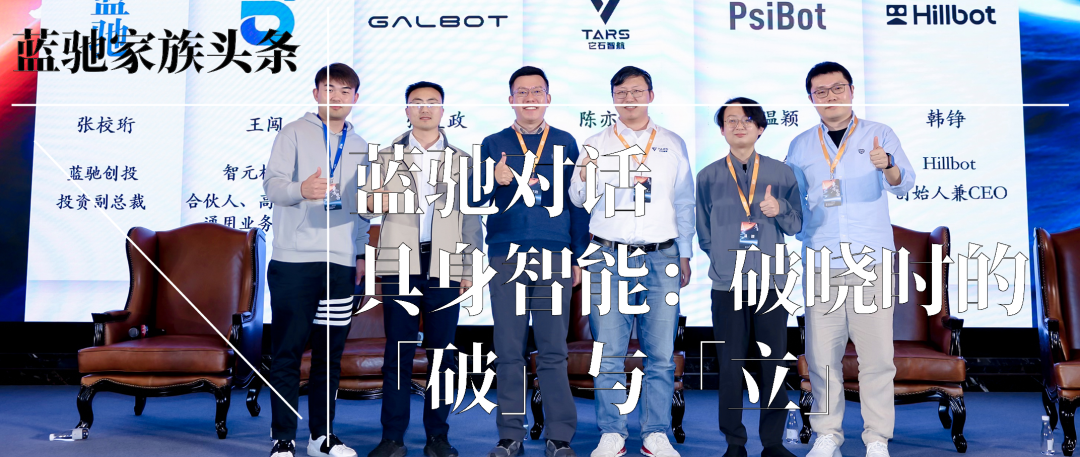
BlueRun Ventures Dialogues with AgiBot, Galaxy Universal, Tashi Zhihang, Lingchu Intelligence, Hillbot — Embodied Intelligence: The "Breaking" and "Building" at Dawn