A Group of Young People Built a "Senior Version" of Xiaohongshu to Help Retirees Live Their Best Life | BlueRun Ventures Family Headlines

A sense of purpose is essential to retirement; social connection is the antidote to loneliness.

This article is republished with permission from LatePost, by Shanshan Wang
HongSong is a distinctive interest-based learning and social platform for middle-aged and older adults. Recently, the LatePost team interviewed Li Qiao, the platform's founder and CEO. Li shared what inspired him to start HongSong, the logic behind its product design, and his insights into the silver-haired user demographic.
BlueRun Ventures was HongSong's seed-round investor and has continued to back the company in multiple follow-on rounds. With tremendous patience and enthusiasm, HongSong uncovers the unmet needs of the silver-haired population, leveraging the latest AI technology to continuously optimize its accessible product form. We republish this article in anticipation that HongSong will become a new relational space for this demographic.

Five years ago, Li Qiao founded HongSong — an online interest-learning product for retirees. His inspiration came from observing his own family. That year, his mother had just retired. The formidable woman who used to stride out in high heels had vanished, replaced by someone who spent her ample new free time playing mahjong and scrolling through short videos. "The post-1960s generation spends their retirement with phones in hand — this is an irreversible reality. Rather than fight it, why not go with the flow and build an app that better serves their spiritual needs?" Many people only truly start being themselves after retirement, Li said. Interest-based pursuits are a hard need for this group.
Before founding HongSong, Li held positions including President of Ground Transportation at Trip.com Group, CEO of the Ride-Hailing Division, VP at Qunar, and Product Manager at Tencent's Mobile QQ. When the founding team first asked retired acquaintances what interest courses they most wanted to learn, makeup class won by a landslide — not an answer young people would have guessed.
Starting with that makeup course, HongSong initially expanded its interest course offerings through WeChat mini-programs. It later added "little assistant" companion services, then upgraded to AI companion "Song Xiaozhi." This year's focus is pushing the HongSong app, encouraging users to post and share more UGC content to foster a stronger community atmosphere.
Currently, HongSong has accumulated over 10 million registered users (including 1 million paying course subscribers), making it the largest vertical interest-based social platform for retirees in China. Users generate 400,000 to 500,000 pieces of UGC content monthly, all aggregated on the HongSong app. Li believes HongSong's ultimate form is an "elderly version" of Xiaohongshu, providing rich interest-based content and social-emotional value for retirees.
HongSong's first growth inflection point came in 2023. After achieving a self-operated closed loop, the team scaled from just over 100 people to more than 1,000 within six months. The average employee age is 29.
At its Beijing headquarters, a full-wall cartoon mural greets visitors at the entrance. It depicts a group of emotionally expressive young people — some playing hulusi flutes, some applying makeup, some singing into microphones, some displaying calligraphy works, others traveling with backpacks... These are all interest-based content products HongSong has launched, and also represent how these young team members envision a fulfilling retirement life.
If We Don't Go Crazy Now, We'll Only Get Older
LatePost: Did you start HongSong because you saw the silver economy as one of the few remaining blue-ocean markets?
Li Qiao: The scenario HongSong wants to capture isn't the senior silver economy broadly — it's "retirement." Most people only truly begin being themselves when they retire, when material needs are reasonably satisfied and they finally have the leisure to enjoy life. So our product firmly切入 from interests as a hard need, helping older adults self-actualize their aspirations for a good life.
Our first course was makeup class, voted on by the retired relatives and friends our founding team gathered.
LatePost: Right, we were raised to delay gratification — working hard when young to accumulate security for our later years.
Li Qiao: When Chinese people talk about post-retirement life, they love saying, "If you don't work hard in youth, you'll regret it in old age." People carry heavy pressure when young, and the flip side of that pressure is actually a beautiful expectation of that pressure-free life after old age.
LatePost: Why did you want to build a product for elderly users?
Li Qiao: It started with a simple observation of my family — in 2019, after my mother retired, she had too much free time, spending her days either on Douyin or playing mahjong. But I realized my grandparents' retirement was very different from my mother's generation. They practiced calligraphy, painted, exercised, even translated foreign books — in short, they did lots of things they loved. I felt my mother was "too idle," and the essential change was that her generation of retirees was universally "on their phones," but this purely entertainment-driven time-killing didn't actually make her happy.
The reality that elderly people are generally "online" is here to stay, but most online products aren't specifically designed to provide genuinely good content and services for retirees. Broadly speaking, they don't offer better retirement lifestyles.
LatePost: Health and social connection are both hard needs for elderly people. Did you consider building for those?
Li Qiao: Health as a hard need should be left to professional institutions like hospitals. Also, I think society somewhat over-interprets elderly health issues. The real common sense is: people have a very long healthy period after retirement. Illness and suffering are concentrated in the final three to five years of life.
There's also a societal bias that older people can't keep up with the times. In fact, elderly people have higher demands for reliability and consistency. They weren't online before, so information was scarce. Now they can all access the internet on their phones, and this variable creates the possibility of scale for business.
Every elderly person has the desire to pursue a good life. What this era should be thinking about is what products and services we can create to适配 this demographic. That's true tech for good.
LatePost: Some users avoid products labeled "for the elderly."
Li Qiao: Not admitting you're old is just subjective emotion. Objectively, what topics you like, what kind of people appreciate your content, how your social relationship chains change — these reveal what life stage you're actually in.
People leave community products from their previous life stage when they reach a certain age. We used QQ most in our student days; now we're all on WeChat. Is there really that much difference in their chat functionality? Not really. What social product will people use after 55 — that's what HongSong is thinking about.
I'm an '85s generation user who likes Xiaohongshu — I don't just consume content, I write comments too. But when I turn 55, I probably won't like it anymore. And Xiaohongshu probably wants to drop me too, since it has to keep iterating to cater to young people's tastes.
From Senior University to Elderly Xiaohongshu
LatePost: HongSong's interest courses started with piano and erhu, which have certain barriers in terms of equipment preparation and learning difficulty. Didn't you consider starting with simpler course topics to boost paid conversion rates?
Li Qiao: Not really. When you mention equipment requirements or skill complexity, you're already feeling pressure about learning itself because you have expectations for results. But when elderly people learn an instrument, it's because they genuinely aspire to that interest — just participating makes them happy. This is what we've consistently guided in our teaching: don't put too much pressure on yourself first. If you can finish one lesson, you'll feel a real sense of achievement.
This is the difference between elderly interest learning and K-12 courses. They participate to achieve a freer, more fulfilling life, to find meaning in their existence — to fill those extra 8 or 10 hours a day after leaving the workplace.
And music is a general education that easily gets more people involved. We did some research and found piano and electronic keyboard ownership in Chinese households is actually quite high. The family might have bought it for the child to learn, and now it can be passed to grandma and grandpa. And households with pianos tend to have decent economic conditions.
LatePost: The "little assistants" are essentially human customer service, right? Why did they become one of your distinguishing features?
Li Qiao: Only 30-40% of conversations between users and little assistants are course-related inquiries. A huge amount of content has nothing to do with classes. Many elderly people share personal life stories, their views on life, memories of their past — their careers, families, children. We don't limit chat duration or topic scope for little assistants. What they're fulfilling is retirees' need to "be listened to."
What HongSong does is far more than interest courses; it shouldn't be confined to the education category. For retirees, the purpose of learning an interest course was never to receive education — it's a lifestyle.
LatePost: The little assistants' average age is only 26. Isn't it hard to maintain patient communication daily?
Li Qiao: We all say listening to elderly people ramble is annoying, but it's mainly annoying when it's your own parents. Of course, employee筛选 and training matter too. In fact, many little assistants find meaning in providing this service. This team is more stable than outsiders might imagine; many have been doing it for several years.


At HongSong's offline lawn concert in September 2025, teachers and students interacted on-site (swipe left/right to view)
LatePost: Is HongSong an online education product?
Li Qiao: From the very beginning of entrepreneurship, I already envisioned that HongSong's endgame would definitely be community — an "elderly version" of Xiaohongshu. Interest learning is the scenario we set up; retirees who aspire to a good life will join, reconnect with society, filter out classmates and friends through shared interests, and generate more social interaction.
LatePost: The leap from interest courses to community is quite large.
Li Qiao: From an entrepreneurial perspective, the problems I needed to solve were what form would carry such a community environment, and determining the right timing to make the community attribute concrete.
Users initially came for content; at this stage, we focused on whether they were willing to pay for interest courses. Next, users renewed for the service we provided — HongSong isn't a one-time transaction business; little assistant service is a long-term companionship for users. Now we're focused on a third thing: whether HongSong can become a good community, and whether user-created content can be well seen.
Education services naturally have content retention attributes. We just launched a product called "HongSong Notes," using AI capabilities to help users more easily record daily life, learning experiences, life stories, then share with one click.
LatePost: HongSong users have abundant short video material of performance works. Why don't you build an elderly version of Douyin?
Li Qiao: We're very firm: we won't build an "elderly version" of Douyin. Douyin is a content media product; its focus isn't user retention and interaction volume, but getting users to rapidly and frequently switch between content — otherwise it creates ad inventory backlog.
Also, the cost for elderly people to produce polished short videos is still too high. What HongSong wants to be is a content community where users don't need to deliberately cultivate content — it's unpretentious but highly interactive. Once users invest too much, their expectations rise too high, and eventually commercialized content even emerges.
One thing we absolutely won't do is encourage elderly people to make money. I believe we should advocate a mainstream value: when people are old, being happy together matters most, not thinking about making money off each other. We also have a principle for our physical e-commerce business: we don't encourage elderly people to stockpile. None of our consumption items allow payment by loan. These are compliance red lines we've set.
LatePost: What kinds of interactions do users have on the HongSong app?
Li Qiao: Uploading UGC content, liking, commenting — these are all interactions. My insight is that elderly people's desire to participate in community interaction, express opinions, and be seen — these诉求 are very strong. Online platforms further unlock their desire to express. This is their authentic life state; we just need to respect and meet their needs, respect common sense and do the right things.
LatePost: How does AI technology help HongSong build community?
Li Qiao: AI intelligence first manifests in a kind of "proactivity" — proactively helping you organize chat content into one-click shareable feeds, helping users reduce repetitive work and inefficient thinking. Users only need to make a final "say yes or no" decision, lowering the UGC barrier.
The second capability is virtual companionship. AI can listen, respond, and remember; its companionship effect is decent. My father even uses Song Xiaozhi (HongSong's AI application) to solve some college entrance exam problems. He also asks Song Xiaozhi who the top scorer was in Chongqing's college entrance exam the year he took it. These conversations are the embryonic form of users' UGC personal stories.
LatePost: How accepting are your users of AI?
Li Qiao: Most HongSong users are around 60 years old, and they're quite willing to engage with new technology. They really enjoy chatting with AI, averaging 7-8 rounds of interaction per conversation, initiating 3-4 conversations daily, with voice conversations accounting for 30% and text exchanges 70%. They're really not that old, hahaha.
LatePost: HongSong currently has 800,000 DAU. How much growth do you expect next year?
Li Qiao: Our community product is usable upon registration, which dramatically lowers the barrier compared to paid courses. UGC content already has the雏形 of scale; random topic裂变 will create opportunities for further破圈. I expect DAU to grow two to threefold next year.
LatePost: Will your business model change?
Li Qiao: HongSong's paid users converted through referrals from existing students account for 30%, and we haven't launched any "referral" incentive mechanisms. HongSong achieved break-even last year.
What we're more urgently focused on this year is polishing AI services and building up the community. When community enables better content裂变传播, customer acquisition costs for interest courses will drop significantly. From the paid course product perspective alone, I hope we can lower prices further so more people can access our course services. What we want to build isn't a one-time course-selling business, but long-term companionship. So we'll invest our focus and resources into these longer-term priorities.
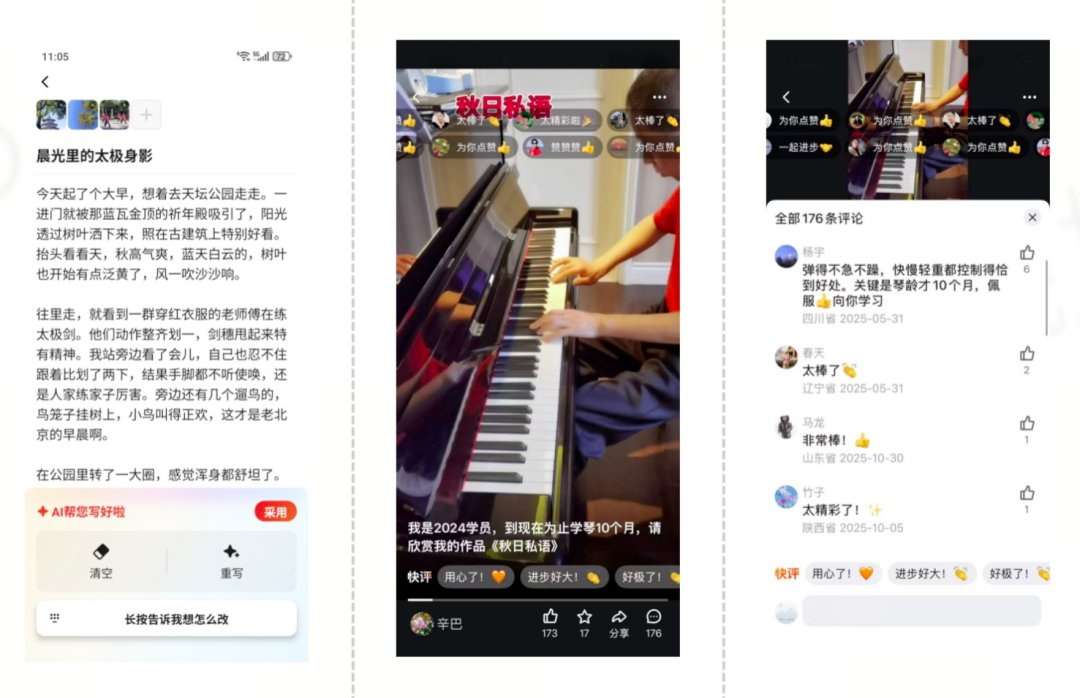
UGC content and comment interactions in the HongSong app
"My Style Is Nine Stable, One Win"
LatePost: You previously led teams at major tech companies to开拓 new businesses. How did that help with entrepreneurship?
Li Qiao: I left Tencent to co-found a music software called "Duomi" with friends — that was also entrepreneurship. Later I spent six years at Trip.com building the ride-hailing division, then overseeing all of Trip.com's ground transportation business. These experiences were all about building a product and team from zero to one. I already had an entrepreneurial mindset then; each stint was an active choice of direction, and it was a process of diversifying my capabilities.
Many people are driven by desire when they创业; they only think about what they want. But there aren't that many great opportunities in this world. Don't harbor huge expectations, or you'll end up anxious. But when opportunities come, we never let them pass. Historically, not once — including in my personal career — have I ever let one go.
LatePost: What kind of culture do you think suits startups?
Li Qiao: Many people casually talk about wolf culture; I think most of the time it's just busywork and self-delusion. The more limited people's knowledge, capabilities, and resources, the more easily they're swept up by such emotions. I don't like this kind of emotionally hijacked corporate culture.
What I preach at HongSong is "nine stable, one win." What does that mean? I guarantee nine hands where I try not to lose, and when I spot an opportunity in one hand, I must bite down hard — that's my style.
In 2023, after we achieved a self-operated PMF closed loop, the team rapidly scaled from 100+ to 1,000+ people in six months, completing organizational buildup at the fastest speed. We were the first in the market to proactively invest in the little assistant fulfillment team, hiring all the professional talent available in the market at the time. From recruitment to training, this investment was indeed substantial, but employees entered an extremely wolf-like cycle for delivery, fulfillment, and growth speed.
LatePost: Products for elderly people aren't exactly rare. Why hasn't a platform-level company emerged yet?
Li Qiao: The perception of fast versus slow is essentially about when consensus aligns — the moment consensus is reached, who's most likely to be the winner becomes immediately visible. But before consensus is established, the winner has already put in tremendous effort, possibly five or ten years of preparation.
So when you stand outside judging fast or slow, or whether there's红利 or not, you're not seeing the full picture.
LatePost: The last VC investment boom in the silver economy was around 2021.
Li Qiao: I think in recent years the industry has been in a process of gradually focusing consensus, with gathering energy growing stronger. Of course, there are indeed some cognitive gaps between market and entrepreneurs.
Many VCs tell me that to do silver economy, you should benchmark against Japan, because globally Japan does it best. But our market differs from Japan in two ways: first, China's population scale, including its aging population scale, far exceeds Japan and the West; second, mobile internet penetration among China's elderly and the level of information infrastructure are also incomparable to other markets.
Therefore, the corresponding product and business landscape will also differ enormously. The Japanese model simply exchanges services for revenue, but our product's underlying logic is that users are all here with us — the platform holds user time, and commercialization prospects will manifest in the value of information channels.
LatePost: What are your expectations for your own retirement life?
Li Qiao: I long for retirement, but I also know myself very well — I'll never actually be able to retire.
Every time I discuss HongSong with someone, I also ask them two questions: Will you retire, and what do you most want to do after retirement? Of course, a small minority still answer that they may never retire.
By Shanshan Wang
Cover image source: HongSong

 HongSong Fully Integrates DeepSeek AI, Silver-Tech Innovation Breaks the "Dimensional Wall" | BlueRun Family Headlines
  In the AI Era, Winning the World's Admiration with Bare Hands | Buming Entrepreneurship Camp Recruitment Open
  Genspark Completes $275 Million Series B, Launches AI Workspace to Drive Paradigm Shift in Work | BlueRun Family