Deep Dive: Why the Next Stop for General-Purpose Agents Is the Agentic Browser?

The Next Stop on the Road to General Agents

On June 10, 2025, Genspark officially launched the Genspark AI Browser, drawing widespread industry attention. Coincidentally, Perplexity also introduced its Comet browser this year, while the Arc team released Dia. Additionally, numerous teams including Fellou, Doubao, and Chrome have successively bet on the Agentic Browser.
Why has the agent browser become a focal point of intense competition? BlueRun Ventures believes: whether AI can deliver the results users want depends on whether it can better understand user context, as well as user workflows and intent. The browser is one of the keys to unlocking this treasure, but it's also an inevitable battleground that everyone can see. How to earn user trust and convince them to switch to your browser is the most challenging hurdle.

In 2025, the AI tech world remains as noisy as ever, but a new storm eye is quietly forming. While most people still categorize Agents into general-purpose and vertical types based on domain applicability, an emerging Agent species defined by its technical载体 is quietly gaining industry consensus — the Agentic Browser.
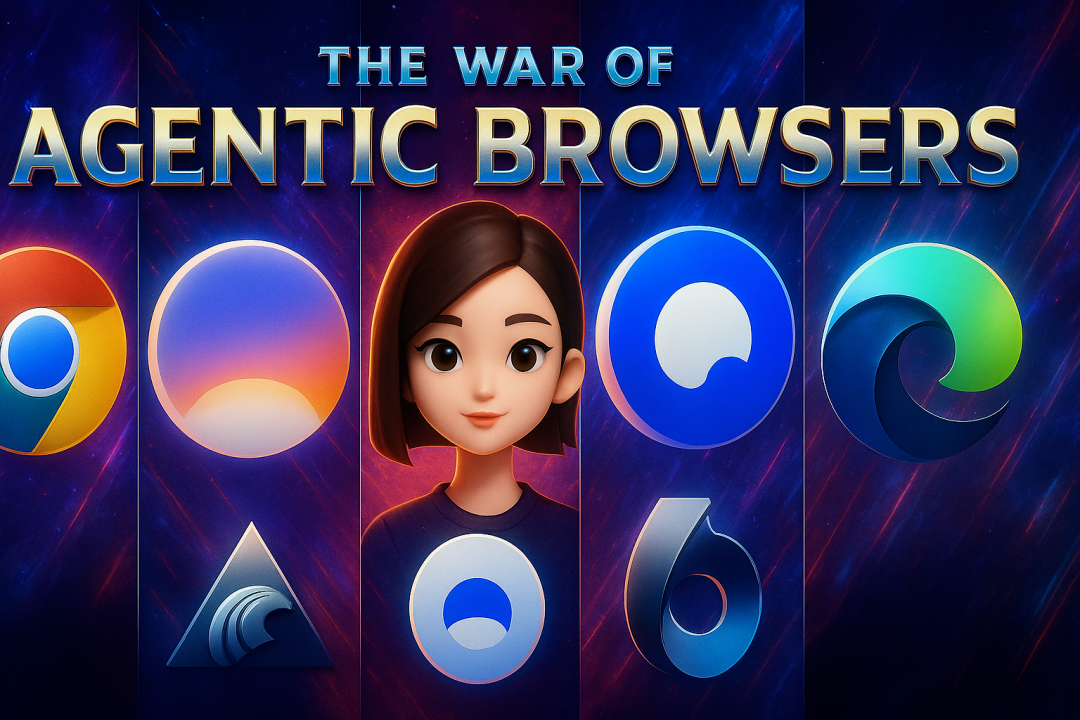
From the closely watched Comet and Dia overseas, to domestic players like Fellou and Doubao, as well as traditional browser vendors Chrome, Quark, and QQ Browser. An "AI Renaissance" centered on browser form is poised to unfold. Even OpenAI, having poached talent from Chrome in late 2024, is rumored to be secretly building its own browser as a new technical载体 for ChatGPT.
Faced with such rapid industry shifts, I can't help but wonder:
- In the inaugural year of Agents, when it should be a blossoming of Agent applications with countless apps and web services emerging, why has an "Agentic Browser" suddenly burst onto the scene?
- What forces are quietly driving this behind the scenes?
- What exactly does this somewhat unfamiliar term "Agentic Browser" represent? How is it different from the AI Browser we commonly refer to?
- Why have players deeply invested in general-purpose Agents unanimously turned their focus to this seemingly traditional browser track?
- Could Agentic Browser truly be the next stop in the evolution of general-purpose Agents?
- How can this "relic" born in the last century possibly bear the industry's ultimate vision for general AI Agents?
This article attempts to answer these questions through research and systematic analysis. 9,000+ words, roughly 15 minutes to read.
30-second speed-read (you'll barely retain anything) version:
- Ecological cage: Traditional operating systems and browsers are leveraging their ecosystem dominance to restrict the capabilities and development of general-purpose AI agents
- Paradigm shift: The core of Agentic Browser is "acting on behalf of the user," not merely "assisting user browsing"
- Key battlefield: The essence of future AI competition is the battle for control over users' cross-application, full-chain "context"
- Optimal载体: Due to its content universality, user habits, and cross-application capabilities, the browser is the natural载体 for general-purpose Agents
- Ultimate path: The future of Agentic Browser is to become a new AI operating system, spawning a customized hardware ecosystem

Story source: Public interview with Perplexity CEO, slightly dramatized without altering key factual accuracy
To understand the signs of this transformation, let's turn our attention to a company called Perplexity.
In early 2024, Perplexity founder Aravind Srinivas stood in a Motorola conference room, his presentation brimming with visions of the future, attempting to persuade the veteran phone manufacturer to set Perplexity as the default AI assistant on its new phones. Yet no sooner had the demo ended than a warning call from Google dashed the spark of collaboration like a bucket of cold water: "If you pre-install Perplexity, Motorola may lose its official Android authorization and access to the Play Store." Under such pressure, the collaboration instantly evaporated.
This was no isolated incident. We've seen how Microsoft's Windows system has deeply bound Copilot, to the point where users can't even easily uninstall it; Apple's iOS ecosystem layers permission barriers against third-party AI assistants. Aravind Srinivas keenly realized that traditional OS vendors, wielding their formidable "ecological hegemony," were silently strangling the survival space of AI innovators.
What troubled the Perplexity team even more was that traditional browsers we use daily, like Chrome, functioned as data fortresses (through the browser's same-origin policy), imprisoning users' precious data within each website owner's "walled garden." This meant that general-purpose Agents like Perplexity couldn't access users' real shopping records, social activity — even basic cross-site tasks like "help me compare hotel prices across several platforms" were impossible to execute.
At an internal meeting, data presented by engineers revealed the harsh reality: when users searched "help me book a trip to Bali," because Perplexity couldn't access internal data from platforms where users were already logged in, like Booking.com or Skyscanner, it could only offer generic, impersonal suggestions. By contrast, Google could effortlessly tap into Gmail calendar information and Maps historical footprints to directly generate highly personalized travel plans.
"We're dancing in shackles."
Aravind Srinivas's sigh captured the helplessness of many AI Agent developers.
The turning point came in the U.S. Department of Justice's antitrust lawsuit against Google. When media exposed the proposal to "force Google to divest Chrome," the Perplexity team smelled opportunity and convened an emergency strategy session overnight. They deeply grasped: the browser is the key to breaking the existing OS格局 and unleashing AI Agent potential. It could not only cleverly bypass iOS and Android pre-installation blockades, but also potentially access users' full-dimensional data legally and compliantly — from browsing duration, private transaction information, to complex cross-site behavioral patterns — all of which would become "fuel" driving efficient AI Agent action.
Just three months later, a browser named Comet was officially released to the public. Its ambition was not merely to become a better information portal, but to aim directly at the AI operating system.
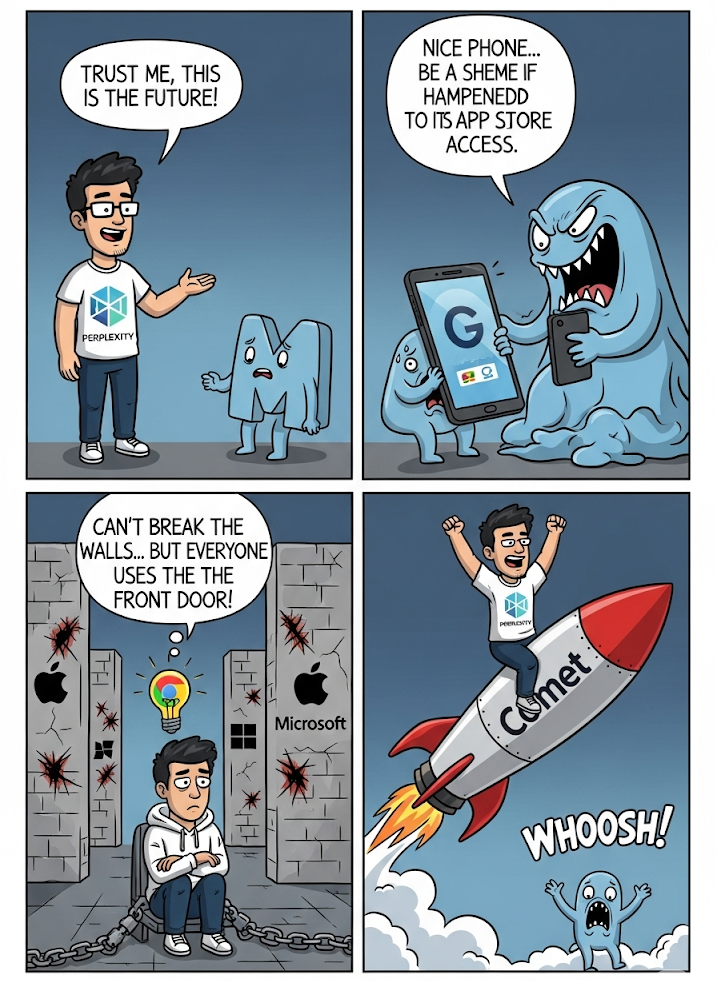
The Comet Agentic browser represents not merely a tool upgrade, but is regarded by Perplexity as the "Normandy landing" against OS hegemony and the realization of its AI Agent vision. From this story, we can faintly glimpse the ideals of general-purpose Agents, the limitations of AI search, the transitional form of traditional AI browsers, and the disruptive potential carried by Agentic Browser.

Before delving into why Agentic Browser might be the next stop for general-purpose Agents, we need to clarify several easily confused concepts:
- General Agent:
We can understand this as an intelligent entity with autonomous understanding, planning, and execution capabilities. Its goal is to provide assistance across broad domains and diverse tasks like a human assistant, rather than being limited to specific functions. It emphasizes autonomy and generality. Representative products: ChatGPT, Manus, Flowith, Doubao, etc.
- AI Search:
This focuses more on using AI technology to improve search result relevance and presentation. For example, understanding more complex query intentions through natural language processing, or directly providing answers in summary or Q&A format rather than merely listing links. Perplexity's original form was closer to an advanced AI search engine. Its core lies in information acquisition and understanding. Domestic Metaso Search also falls into this category.
- AI Browser:
This typically refers to browsers that integrate some AI functions on top of traditional browser foundations. For example, sidebar AI assistants, webpage content summarization, intelligent translation, etc. They improve browsing efficiency and experience to some extent, but their core architecture and interaction models haven't fundamentally changed. AI browsers are more like adding a navigation system to existing vehicles, enhancing assisted driving capabilities. Domestic examples like QQ Browser and Quark previously belonged to this category.
- Agentic Browser:
This represents a deeper level of evolution. The Agentic Browser doesn't merely integrate AI as an auxiliary tool — it treats the browser itself as the platform and environment where an Agent executes its tasks. The emphasis is on the browser empowering the Agent with stronger contextual awareness, task execution, and cross-application operation capabilities. The goal is to enable the Agent to proactively and deeply "act" within the browser environment, rather than merely passively responding to user commands.
To put it simply:
- General-purpose Agent: Everyone's "universal AI assistant."
- AI Search: Fundamentally about "searching for the most real-time, accurate, and in-depth information and answering questions better."
- AI Browser: Focuses on "better assisted browsing."
- Agentic Browser: The key is "acting on your behalf better."
If the general-purpose Agent represents the industry's ultimate vision for AGI product capabilities — an intelligent entity capable of understanding and executing any task — and AI Search specializes in information acquisition, enabling machines to better "know," then the browser, as the universal carrier of the digital world, bears the user's cross-application, cross-scenario capabilities for context acquisition, understanding, and action. And the Agentic Browser is precisely the best fusion of general-purpose Agent and AI Search capabilities available today.

Increasing signs indicate that the browser — this internet gateway we can hardly live without in our daily lives — is gradually revealing enormous potential to become the optimal vehicle for general-purpose Agents. This is no accident; it is determined by the browser's unique properties and the critical role it plays in the digital ecosystem. We can examine this trend through several key dimensions.
- Context control capabilities
- Local OS control capabilities
- Cross-application connectivity
- The browser as the natural vehicle for general-purpose Agents
- The browser as the optimal path for latecomers to reach OS and endpoints
A: The Agent Era Is Not Just a Battle for Attention, But a Battle for Context Control
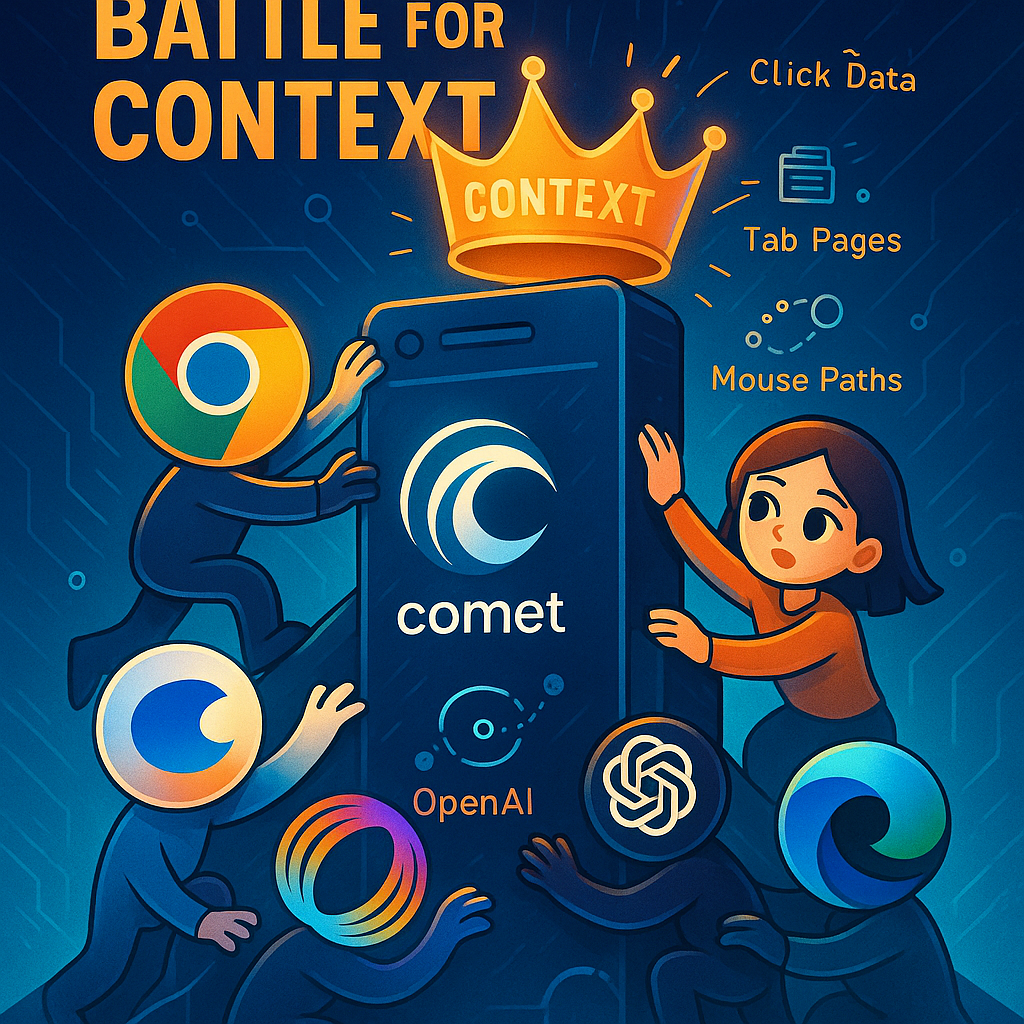
In the era of rising Agents, merely competing for user attention is no longer sufficient. The deeper contest lies in control over "context." Context is the cornerstone for Agents to understand user intent, provide personalized services, and execute tasks efficiently — and even more critically, it is the essential source of end-to-end user feedback signals under RL-enhanced model training paradigms. In this regard, the depth and breadth of context that browsers can provide are unmatched by other application forms.
Context Depth
The browser is the most direct and persistent window through which users interact with the digital world. Every click, every input, every page dwell time, even the speed and trajectory of mouse scrolling — all contain rich behavioral patterns, latent preferences, and immediate needs.
- User Preference Context: Because Agents can execute a more diverse range of task types within the browser environment, they can collect richer user behavior data. Through temporal analysis of this data, building precise user profiles and dynamic preference models becomes far more feasible than with single-function apps.
- For example, some cutting-edge Agentic Browser explorations, such as Fellou's VIEP (Visual Interaction Element Perception) technology, attempt to analyze the acceleration curves of user mouse trajectories to judge attention intensity toward different elements on a page — was it a quick swipe, or a prolonged hover? This granular observation enables AI to dynamically adjust its intervention strategies and provide more appropriate assistance.
- Another example: Dia Browser's proposed "smart cursor" concept, which attempts to transform user text-highlighting actions into semantic markers (for instance, yellow highlighting might represent "important argument," while blue highlighting might indicate "questionable content"). This approach builds a much more fine-grained user intent map for AI than simple keyword searches ever could.
Context Breadth
The browser naturally possesses the ability to cross application boundaries.
- It can record all webpages a user has historically visited, regardless of which website or platform they belong to (such as GitHub, Taobao, Trip.com Group, etc.).
- It can perceive all tabs currently open, understanding tasks the user may be processing in parallel.
- It can record historical conversations with built-in AI assistants, forming continuous interactive memory.
- Going further, through user authorization and native login interactions, Agentic Browser even has the potential to acquire contextual information from within various isolated applications.
- Moreover, it can connect to applications on the user's local computer — calendar, email client, local file system, even memo apps — truly achieving comprehensive integration of digital life context.
This combination of deep and broad context acquisition capabilities makes the browser an unparalleled "sensory organ." It allows the Agent to no longer grope in the dark like the blind men touching the elephant, but to understand the user's true needs and environment within a more complete, more dynamic picture — thereby making smarter decisions and taking smarter actions.
B: Local OS Control Capability Is Essential for Solving Full-Scenario Problems
For a general-purpose Agent to truly deliver on its "general-purpose" value, merely staying in the cloud or within sandboxed applications is far from enough. It needs the ability to interact more deeply with the user's computing environment, which includes control over the local operating system. In this regard, the browser, as a special type of application, demonstrates unique advantages in reaching local resources compared to traditional apps and pure web services.
Taking Fellou's architecture as an example, it clearly shows how integrating the three capabilities of Browser, Agent, and Workflow Automation enables deep control and coordination of local resources.
- Direct Access to OS and File System: Traditional web applications are constrained by the browser's security sandbox, with strictly limited access to the local file system. However, emerging Agentic Browsers are attempting to break through this restriction. For example, Fellou's design enables direct interaction with the operating system, control over the file system, and even calling locally installed applications such as calendar, email client, and even command-line tools. This transforms the browser from merely a webpage displayer into a "super terminal" connecting every aspect of the user's digital ecosystem.
- Flexible Hardware Resource Scheduling: To execute tasks efficiently, Agentic Browser also needs intelligent hardware resource scheduling capabilities. Fellou's proposed Hybrid Shadow Workspace technology is an interesting attempt in this direction. It can dynamically allocate computing resources based on task type:
- Local Instant Response: For short tasks requiring quick response, such as "help me create a new calendar event," the Agent can directly call local computer resources to complete it, ensuring low latency.
- Local Virtualized Execution: For relatively time-consuming tasks that still need access to local data, such as "organize my emails from the past week and generate a to-do list," the Agent can run in an isolated local sandbox environment. The benefit is that it can leverage local data without interfering with other operations the user is currently engaged in.
- Cloud Desktop Collaboration: For tasks with low dependency on the local environment or requiring powerful computing capabilities, such as "analyze contributor activity in a large GitHub codebase," execution can seamlessly switch to the cloud.
This deeper control capability over the local OS means the Agent can handle broader, more complex affairs for users. It is no longer limited to browsing web content and simple interactions, but can truly penetrate into the user's workflow, becoming a more capable digital assistant. Perplexity CEO Aravind Srinivas has also explicitly stated that the browser is the best container for building AI Agents, with a key reason being its potential for OS-level resource scheduling capabilities.
The Fellou team even plans to release an Agentic Browser evaluation benchmark, aiming to construct a task set spanning different operating environments, device types, and application scenarios. They hope to systematically validate the actual productivity gains of Agentic Browser in real production environments through this benchmark. This undoubtedly also reflects, from one angle, industry expectations for browser capabilities in local control.
The ultimate vision is to develop Agentic Browser into a fundamentally new AI Operating System (AIOS).
It would not merely be a vehicle for applications, but a reconstruction of the human-computer collaboration paradigm. Like the Agent Store ecosystem, users could encapsulate their experience and knowledge into domain-specific vertical Agents (for example, "cross-border e-commerce bestseller selection assistant") and share or use them on the platform. This would form an open platform resembling an "AI app store," further strengthening its system-level extensibility and depth of local resource integration.
OpenAI's GPTs represent an already embryonic Agent Store — all that's missing is a powerful carrier.
C: Cross-Application Connectivity
In today's digital world composed of countless applications and services, information silos and operational fragmentation are universal pain points for users. A core mission of the general-purpose Agent is to break down these barriers and achieve seamless cross-application connection and coordination. And the browser, by virtue of its unique ecological position and technical characteristics, is becoming the ideal platform to carry this mission.
Imagine: how many daily tasks require us to shuttle between different apps or websites?
- Booking a trip may require simultaneously opening Trip.com Group or airline apps, hotel booking platforms, map services, food review apps, and travel guide communities.
- Completing a market research report may require gathering information from news portals, industry databases, social media, and other sources, then consolidating everything into a document editing tool.
The cost of this switching and integration is often enormous.
The emergence of Agentic Browser provides new thinking for solving this problem. It is not merely an information aggregator, but strives to become an action coordinator.
-
Browser control over local OS and applications: As discussed earlier, Agentic Browser is breaking through the limitations of traditional web pages to seek deeper integration with the local operating system. This means Agents can directly invoke locally installed applications through the browser. For example, a user could issue a voice or text command to the Agent in their browser: "Email the report I just downloaded to Zhang San, with a note reminding him about next Wednesday's meeting." The Agent can understand the instruction, locate the file, launch the email client, fill in the recipient, subject, and body, even attach the file automatically, and wait for the user's final confirmation before sending. Going further, through multi-agent collaboration protocols like MCP (Model Context Protocol), the Agent in the browser can interact with other agents or services following the same protocol—whether local or cloud-based—enabling atomic recomposition of more complex cross-platform operations.
-
Cross-website workflow automation: This is one of the areas where Agentic Browser can truly shine. We perform repetitive operations across different websites every day. A content creator might need to regularly aggregate and back up posts from Xiaohongshu, Douyin, and WeChat Official Accounts; a market analyst might need to daily scrape competitor pricing and sales data from multiple e-commerce platforms. Agentic Browser can automate these tedious, cross-website workflows through its built-in Workflow Automation layer.
- Fellou has demonstrated some compelling cases: "Automatically follow all Twitter bloggers mentioned in an article," which involves jumping from one content platform to another social platform to execute follow actions. "Filter graphics cards on Amazon that meet specific criteria and automatically add them to cart," a typical e-commerce scenario automation. "Sync the top eight daily products from Product Hunt to a Notion database automatically," achieving cross-application data integration and flow. Fellou even developed a framework called Eko for dynamic task planning and resilient execution, enabling better adaptation to dynamic changes like website redesigns and ensuring stable, reliable automation.
-
Breaking the closed ecosystems of traditional giants: Large internet companies often build their own closed ecosystems where data and services circulate internally but remain difficult for external parties to leverage efficiently. Agentic Browser, with its "Deep Action" capabilities, has the potential to break this pattern to some degree.
- Accessing private sites: Traditional AI tools can typically only process publicly accessible web data. But Agentic Browser can, with user authorization, securely log into private sites requiring authentication—LinkedIn, Taobao, Lark documents, corporate intranets—and execute more complex operations, such as "Help me scrape all job postings on LinkedIn matching specific job descriptions."
- Building an open agent ecosystem: Through the Agent Store concept, developers can package their solutions for specific websites or tasks into standalone Agents and share them. For example, a "Taobao Precision Price Comparison Assistant" Agent could help users find the best value options amid Taobao's complex product listings. This open ecosystem indirectly challenges platforms' data monopolies, enabling data and capabilities to flow and combine more freely.
By virtue of its position as the primary gateway to the internet and its natural affinity with various web services, the browser is evolving into a powerful cross-application connectivity hub. It is no longer merely a "door" to individual websites, but more like a bustling "crossroads" and efficient "traffic control system," allowing information and operations to flow smoothly between different destinations.
D: The Browser Is the Natural Universal Agent Carrier
When we step back from specific technical features to examine the browser's role in the broader digital ecosystem, we find it naturally endowed with many qualities that make it an ideal carrier for universal Agents. This is not an overstatement, but a result shaped by its historical evolution and user habits.
First, the browser is a universal container for internet content. The birth of the World Wide Web was founded on the core concept of connecting global information through hyperlinks, and the browser is precisely the client tool that realizes this vision. Whether news portals, social media, e-commerce platforms, online office suites, or entertainment streaming—almost all internet services ultimately present themselves as web pages. This universality of content forms makes the browser a natural, zero-additional-adaptation "universal interaction interface." If a universal Agent wishes to roam freely across the vast digital world, the browser is undoubtedly the flattest, widest starting point.
Second, the browser carries deeply ingrained habits at massive scale. Decades of internet development have conditioned users to instinctively turn to the browser for information and services. When we encounter a problem, we reflexively open a browser to search; when we need to shop online, we habitually type in the e-commerce site's address. This inheritance of user habits is crucial for the popularization of universal Agents. Integrating Agent capabilities into environments users already know is far easier than forcing users to learn an entirely new interaction paradigm. Agentic Browser stands precisely on the shoulders of this "giant"—it enables Agent capabilities to reach massive users in a more natural, lower-barrier way.
Third, the browser itself is an ever-evolving "mini operating system." From its origins as a simple HTML rendering engine to today's powerful platform supporting complex web applications, extensions, local storage, and hardware acceleration, the browser's functional boundaries continue to expand. It has its own process management, memory management, security mechanisms, and has even begun encroaching on areas once core to operating systems: file system access, device API calls, and more. This "quasi-operating system" characteristic provides the "soil" and necessary "infrastructure" for universal Agents to exercise their capabilities. Agents need environments to perceive and tools to act—and modern browsers can provide precisely that.
It is this universality of content, inheritance of user habits, and evolutionary nature of platform capabilities that together form the solid foundation for the browser as a natural carrier for universal Agents. Unlike domain-specific apps with their scenario limitations, or purely backend services lacking direct user interaction interfaces, the browser—this seemingly "ancient" tool—is radiating entirely new vitality and possibility amid the latest technological wave.
D: The Browser Is the Natural Universal Agent Carrier
When we discuss the browser as a carrier for universal Agents, we can take a longer view. The browser's future evolution is not limited to becoming a smarter web-surfing tool—it even has the potential, following the validated path of "browser → operating system → hardware," to develop into a new ecological core of the digital era, with the imaginative space to become "another Apple."
Looking back at tech history, the emergence of Chrome OS and Chromebooks has already demonstrated the technical feasibility of this path. Google successfully created a lightweight, cloud-first operating system by combining its powerful Chrome browser kernel with a Linux foundation, and spawned Chromebook as an entirely new hardware category. Though Chrome OS's ecosystem scale and market share still lag behind Windows or macOS, it clearly proved: a browser-centric approach, building upward to an operating system and extending downward to customized hardware, is a viable path.
So what new imagination does Agentic Browser add to this path?
-
From "information gateway" to "task hub": Traditional browsers mostly play the role of information access gateways. Agentic Browser, through deep integration of Agent capabilities, is transforming the browser into a "task execution hub" for users' digital lives. When the browser can proactively understand user needs, intelligently plan tasks, and execute operations across applications, it is effectively already playing part of an operating system's role—managing users' digital task flows.
-
An "AI-first" operating system kernel: Future Agentic OS design philosophy may shift from traditional "application-first" or "file-first" to "AI-first" or "task-first." This means the OS's resource scheduling, interaction design, security model, and more would all be built around better supporting Agent operation and more efficiently completing user-delegated tasks. This could give rise to entirely new operating system architectures and human-computer interaction paradigms.
-
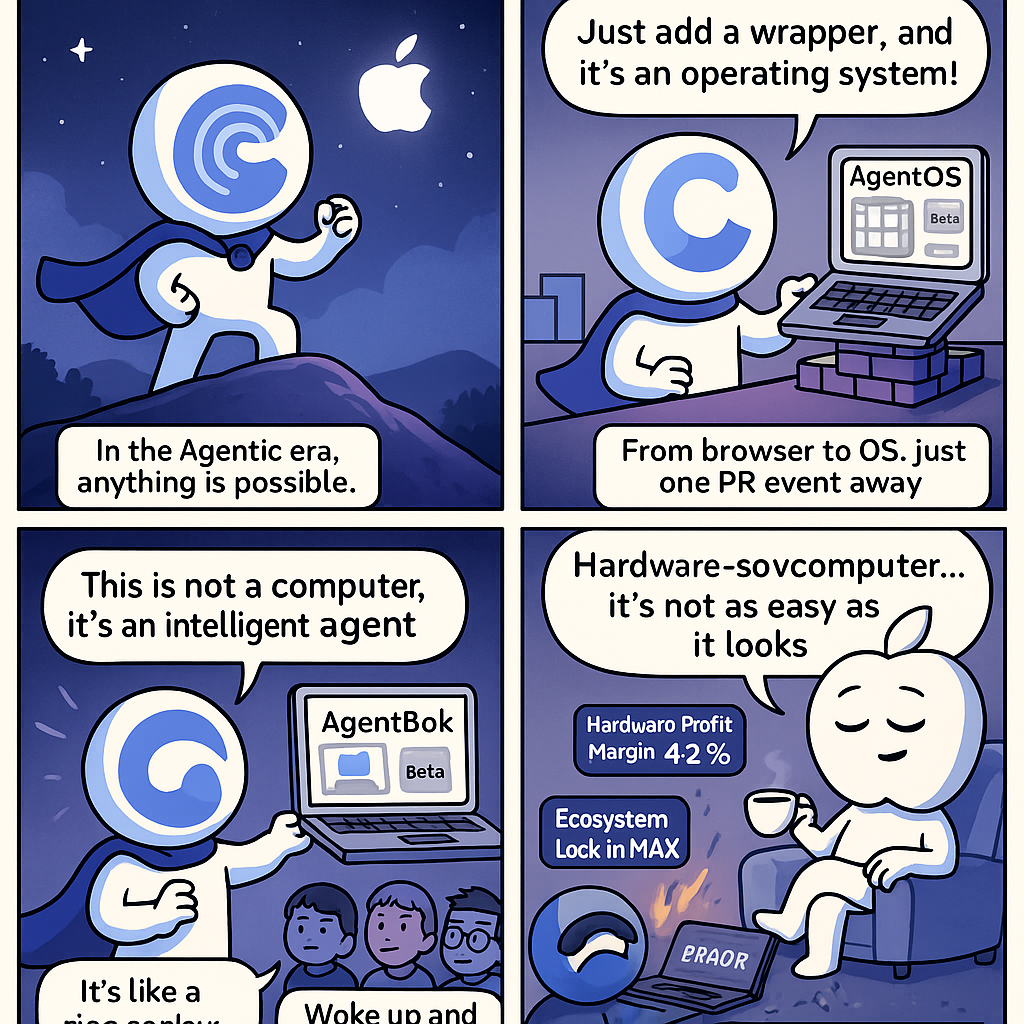
Hardware customized for Agents: Once an Agentic Browser-based operating system ecosystem gradually matures, dedicated hardware optimized for it would follow naturally. Such hardware might integrate specialized AI acceleration units at the chip level, feature more advanced sensors to enhance Agent perception of the physical world, or emphasize multimodal interaction and immersive experience in its design. Imagine future "AgentBooks" or "AgentPads" whose core competitiveness might no longer be traditional CPU clock speeds or memory size, but the intelligence level and task execution efficiency of their built-in Agents.
-
A new balance of open and closed: Apple's success owes much to the extreme experience and high profit margins enabled by its integrated hardware-software closed ecosystem. This new path led by Agentic Browser may also seek a new equilibrium between openness and closure. On one hand, it may maintain the openness of the Web, attracting broad developer participation in building the Agent ecosystem; on the other, it may build differentiated competitive advantages through control of core Agent capabilities, OS features, and hardware design.
This is not distant fantasy. When the browser can deeply understand our intentions, manage our digital lives, and seamlessly connect cloud and local, software and hardware, it possesses the potential to become the core of the next-generation computing platform. Just as personal computers and smartphones each defined an era, the new species emerging from Agentic Browser as its starting point may be gestating the tremendous energy to define the next. This road from browser through operating system to customized hardware is full of challenges, but also brimming with exciting possibility.

The direction of the tide is already clear. From Perplexity's struggles and breakthroughs to the bold explorations of pioneers like Fellou and Dia, it is evident that Agentic Browser is no fleeting concept or hype cycle. It is the inevitable choice for general-purpose Agents seeking better habitats to unlock greater potential. It is not merely an extension of AI search, nor a simple upgrade to traditional AI browsers. The core of Agentic Browser lies in transforming the browser from a passive "information window" into an active "intelligent workshop." It endows Agents with unprecedented depth and breadth of contextual awareness, opens critical links connecting local operating systems and cross-application services, and inherits the browser's innate content universality and massive user foundation.
This transformation is no longer competing for users' attention, but for deep control over the "context" of users' digital worlds — and the "agency" built upon that foundation. With its unique ecological niche, the browser is becoming the central battlefield of this contest.
In the future, Agentic Browser may well follow in Chrome OS's footsteps, growing upward into a new AI-first operating system and extending downward into hardware tailor-made for Agents. This is not merely a reconstruction of existing digital ecosystems, but a profound reinvention of the human-machine collaboration paradigm.
The road ahead is long and arduous, but with the direction set, we press forward through wind and rain. The story of Agentic Browser has only just begun. We have every reason to believe that the door to a more intelligent, more autonomous digital world is slowly opening.
Finally, a prediction: OpenAI's Agentic Browser will be officially released before autumn. Mark my words — happy to be proven wrong.


Genspark CEO Kun Jing: I See AGI, and I Hope I'm Wrong | BlueRun Ventures Family Headlines
Stop Asking Me What an AI Agent Is | BlueRun Ventures x Volcano Engine Event Recap