The Road to AGI | BlueRun Ventures' Jianping Shi: Intelligent Computing and AI-First Applications, the Post-Cloud Era

A Major Step Toward Artificial General Intelligence
How far is humanity from artificial general intelligence (AGI)?
For a long time, this was a question without an answer. But from ChatGPT to GPT-4, we are increasingly seeing the gates to AGI slowly opening, and humanity is entering the era of cognitive intelligence.
After deep reflection, we issued the "AGI Pioneer Call to Action" a few days ago. BlueRun Ventures hopes to build the AGI Pioneer Club, helping those of you determined to conquer the new AI era quickly find like-minded companions. (The entrance to the BlueRun AGI Pioneer Club is at the end of this article; welcome, AGI pioneers, to scan the QR code and sign up.)
With the same goal in mind, we are officially launching the "Road to AGI" column, sharing our deep thinking on AI today and our depictions and projections of AGI. The first piece comes from BlueRun Ventures Investment Partner Jianping Shi, who combines academic and industry perspectives to answer what kind of tsunami the arrival of the cognitive intelligence era will bring to humanity's digital civilization.
Last July, artificial intelligence once again entered the public consciousness:
After Midjourney's release, ordinary users could generate highly creative, high-quality images through their own prompts, iterating and refining until the final output met or even exceeded expectations;
StabilityAI open-sourced the Stable Diffusion model, which spread rapidly, enabling the developer ecosystem to customize and train prompt-to-image products for specific needs, scenarios, and iteration speeds.
Then in November, the well-known AI company OpenAI released ChatGPT. For the first time, ChatGPT demonstrated human-like language patterns, with capabilities for dialogue, Q&A, language understanding, and translation — once again exceeding ordinary users' expectations of cognitive intelligence capabilities. This marked another major step forward for humanity on the path to AGI.
What larger trends lie behind the explosive growth of Midjourney and ChatGPT? For the information revolution and humanity's digital civilization, is there a tsunami-level transformation and value creation opportunity even greater than mobile internet and cloud computing? What might it be?
01
Cognitive Intelligence Is the Next Frontier of AI Development
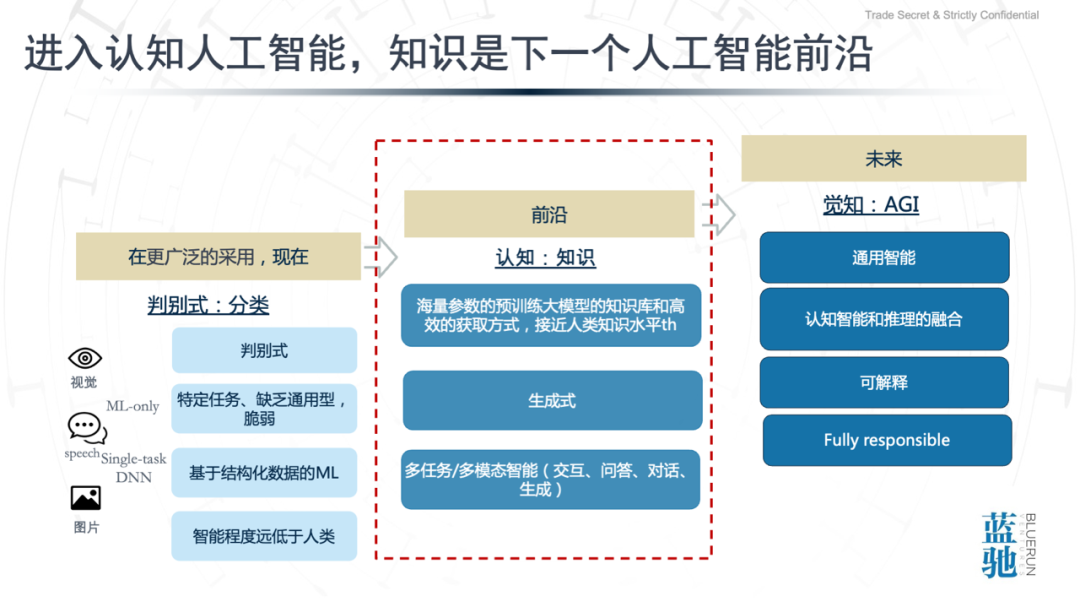
What is cognitive intelligence? Cognitive AI is a form of artificial intelligence designed to simulate human cognitive intelligence, which includes abilities such as learning, understanding, analysis, Q&A, communication, memory, generation, and reasoning. Cognitive AI uses advanced models, algorithms, and machine learning techniques to analyze, reason, understand, and learn from large volumes of data, both structured and unstructured. These systems can learn, recognize, generate, make predictions, and produce insights similar to human reasoning.
The next frontier of artificial intelligence AI has existed for decades; China has been exploring AI and implementing it in various scenarios for at least ten years. Mainstream AI has still operated on structured data, using traditional machine learning algorithms for analysis and prediction, feature engineering for analysis and recommendation, or deep neural networks for image classification and recognition.
But thanks to recent advances in large language pre-trained models and generative models, AI in the digital world has for the first time achieved human-like levels of understanding, dialogue, and generation of human language and text. The development of AI has entered the era of cognitive intelligence.
02
The Era of Cognitive Intelligence Has Begun
Innovation and rapid development in underlying architecture, algorithms, and models have driven the opening of the cognitive intelligence era, from quantitative change to qualitative change. The core factors powering the takeoff of cognitive intelligence include AI OS, large language foundation models, retrieval models, and pre-training, fine-tuning, prompt engineering, and various feedback-based reinforcement learning techniques.
AI OS Operating systems have the following characteristics: (1) strong abstraction capabilities; (2) industry de facto standards; (3) industry infrastructure and application ecosystems built upon them. The OS is the most fundamental base for industry ecosystem and application development. PC development benefited from Windows OS, the internet from Linux, and cloud from virtualization OS and Kubernetes. The rapid development of AI also requires an OS base with similar characteristics.
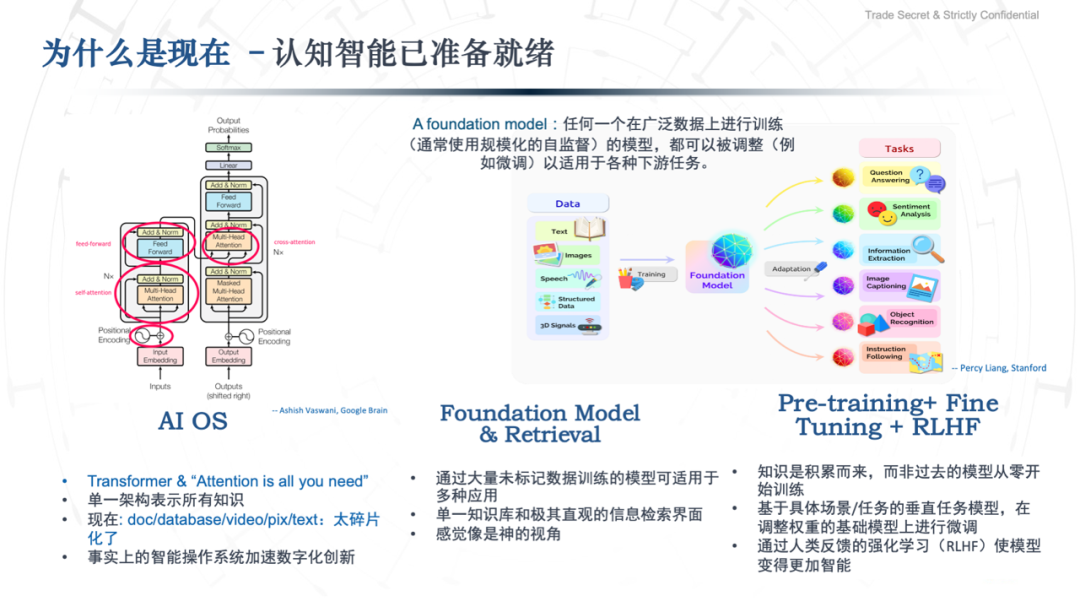
AI's large language models (LLMs) are based on transformer and attention architecture, which has extremely strong abstraction and expression capabilities for human knowledge and its various forms. For the first time, humanity is using a single architecture in the digital world to express knowledge across all modalities.
Due to its powerful abstraction and expression capabilities, this architecture has already become the industry's most mainstream AI model architecture. Beyond widespread LLM use, applications for images and other modalities are also being developed or explored, with strong momentum toward becoming the de facto standard for foundation models.
This de facto standard has begun to drive infrastructure and industry ecosystem development based on transformer LLMs. Moreover, more and more people recognize that the combination of transformer architecture and large language models has enabled rapid iteration of language-based cognitive intelligence.
Large Language & Retrieval Models What is a foundation model? Any model trained on broad data (typically using large-scale self-supervision) that can be adapted (such as through fine-tuning) for various downstream tasks.
A large language model (LLM) can be understood as a database. For the first time, humanity has preserved all historical knowledge at maximum scale in this "database" through efficient compression. The ChatGPT model derived from LLMs uses natural language dialogue — the most familiar mode for humans — to understand user intent, accessing knowledge through progressive, extremely efficient, open-ended patterns. Generative large models can also progressively generate high-quality content by understanding human intent.
Pre-training, Fine-tuning, Prompt Engineering, and "X" Feedback Reinforcement Learning Techniques Cognitive intelligence foundation models are not only general, open-ended intelligence; through fine-tuning, prompt engineering, and other techniques, general cognitive intelligence models can be better adapted to serve all industries — such as finance, healthcare, education, information technology, and media — and various scenarios — such as R&D, sales, and customer service.
Through various live usage feedback mechanisms combined with reinforcement learning capabilities, the knowledge database expands while the model better aligns with user intent (whether human, system, or machine). Through use, the model continuously improves.
The human-like language processing capabilities of cognitive intelligence, its de facto technical architecture, open and general scenarios, rapid iterative evolution, and ability to serve professional and specific scenarios all mark cognitive intelligence's entry into the mainstream track of artificial intelligence.
03
Intelligent Computing and AI-First SaaS
Will Lead the Next Wave in the Computing World
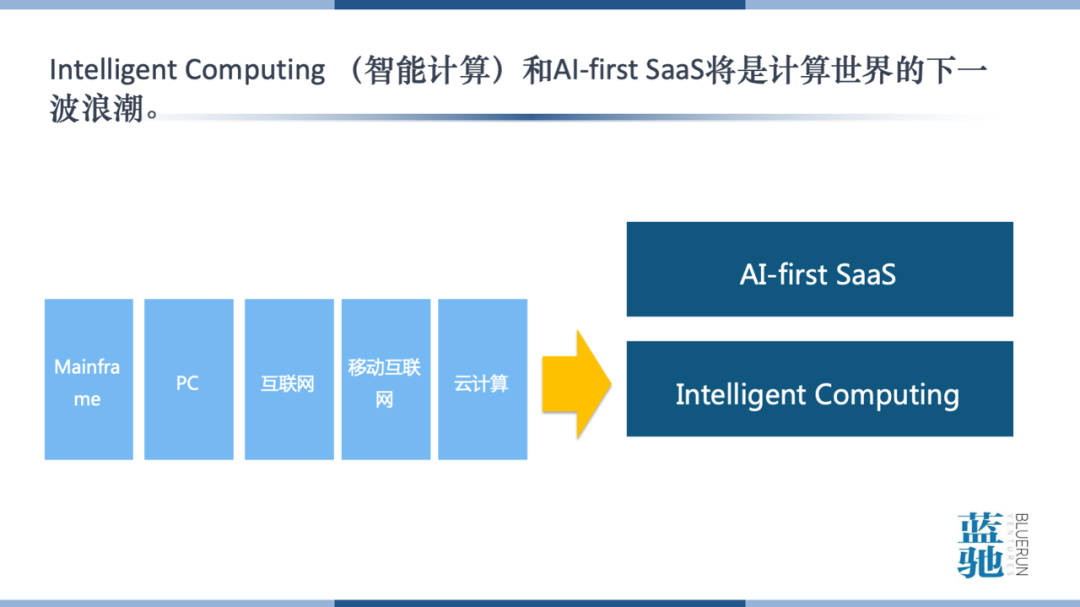
The information computing era The development of humanity's digital civilization depends on innovation and evolution in computing paradigms. From mainframes in the 1950s, PCs in the 1980s, the internet in 2000, mobile internet in 2010, to the ongoing development of cloud computing, each evolution of computing paradigms has driven the development of individual and enterprise digital civilization, and each transformation has boosted global economic efficiency and scale.
From mainframe to cloud computing was the information computing era, structuring information in the digital world for computation, simulation, and even prediction within the data world. Beyond digitization and structuring, information computing is characterized by determinism — that is, with the same data input, the output is always consistent, performing with considerable certainty in a known environment that meets human expectations.
What is intelligent computing? Intelligent computing is a computing paradigm based on natural language capabilities, with cognitive models possessing human-like cognitive intelligence abilities — learning, understanding, analysis, Q&A, communication, memory, generation, and reasoning — at its core. Intelligent computing has the following characteristics: (1) exploratory nature; (2) non-determinism (or probabilistic); (3) more efficient understanding of human intent; (4) cognitive abilities at least exceeding human average levels.
The arrival of the intelligent computing era is the result of natural language processing technology's innovation, development, and accumulation from quantitative change to qualitative change. Innovations in natural language processing technologies emerging over the past five years — large language pre-trained models, dialogue models, generative models — have triggered the arrival of the intelligent computing era. The core of intelligent computing is cognitive intelligence capability.
What are AI-First applications? Applications developed with cognitive intelligence as the core capability are AI-First applications. AI-First applications enable the applications themselves to possess human-like cognitive intelligence capabilities, enhancing ordinary people's cognitive intelligence to higher levels through intelligent assistant applications, elevating interaction between machines, systems, and humans from information intelligence to the higher dimension of cognitive intelligence. Humanity's digital civilization has for the first time entered cognitive intelligence, and development has entered a brand new stage.
04
An Outstanding Example of AI-First Applications:
New Bing & Edge Browser
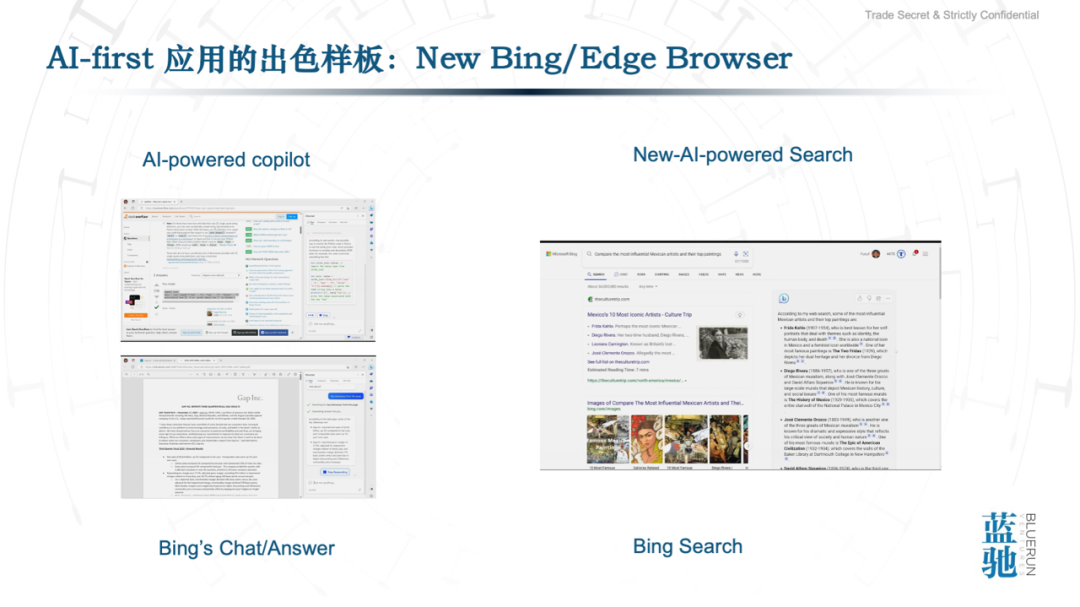
Microsoft's release of New Bing and Edge Browser presents an excellent example for future AI-First applications.
AI-powered copilot — Edge Browser's chat & answer In Edge Browser, the AI-powered copilot can engage in continuous chat, consultation, Q&A, translation, rewriting, generation, and simple reasoning with users. Moreover, the copilot continuously monitors user interactions with websites, returned content, and history, automatically engaging in intelligent interaction with users based on this context, providing a completely new experience.
New AI-Native search — New Bing Search New Bing's search is based on a next-generation LLM customized for search, more powerful than ChatGPT, called the Prometheus model. This is an AI-native search platform driven by next-generation AI large models, improving search relevance, annotating answers, providing the latest search results, and enhancing security.
Applications in the intelligent computing era Almost all applications should add copilots or in-place intelligent assistants, enabling more efficient, higher-quality completion of target tasks within software through human-intelligent assistant interaction.
Application developers can take a bigger step forward, using large models as the application base to make them AI-native applications, elevating their core capabilities to the level of cognitive intelligence.
05
Cognitive Intelligence Is Redefining
How Software Is Built
The core tool for building humanity's digital civilization is software development tools; the core承载 platform is software. The software industry also needs to evolve and upgrade in response to change. Each time a computing platform undergoes major transformation and development, its dependent software development models, frameworks, toolchains, and computing platform infrastructure are reconstructed. We believe that to better adapt to the intelligent computing era, the paradigm of software development will also be reconstructed, and the magnitude of this reconstruction may exceed expectations. What specific forms will settle remains to be seen — we need to let the dust settle.
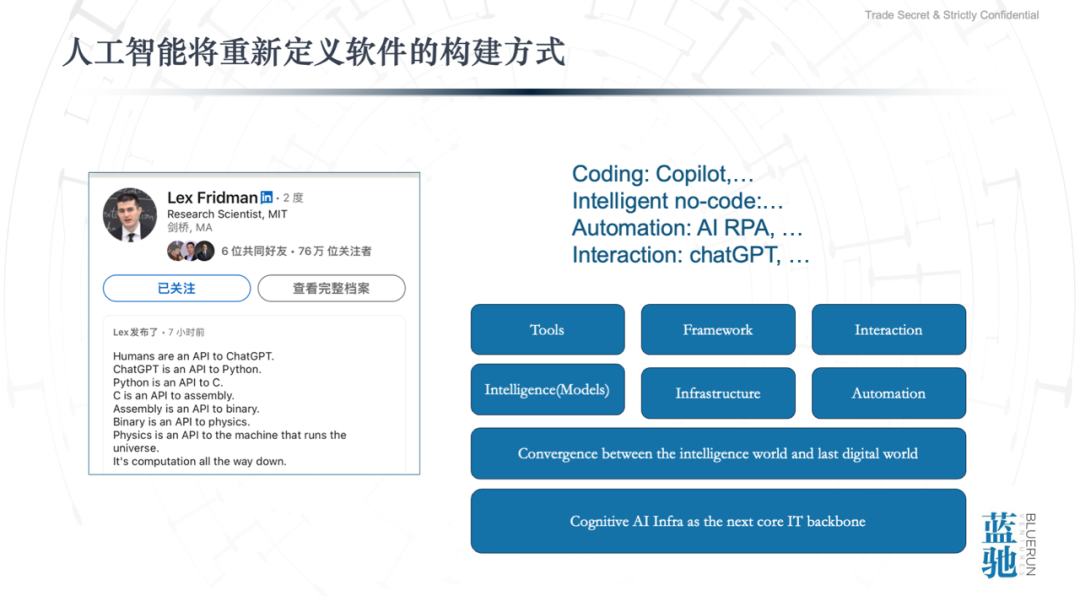
The next frontier of artificial intelligence The emergence of RPA (robotic process automation), low-code tools, and PaaS platforms has made software development more customizable and accessible. With the development of AI generative models, AI code development assistance tools like copilot will be able to provide software development engineers with annotation, code completion generation, syntax suggestions, and error correction functions, enabling developers to write code more efficiently.
AI-First application development In the process of developing next-generation AI-First applications — involving logic and interaction development frameworks, tools, automation, data and cognitive models, and more optimized AI-first-oriented runtime, as well as associated infrastructure — opportunities exist for upgrades and transformation.
AI-First cognitive AI architecture Even human understanding of the brain remains quite primitive. Many industry practitioners are exploring next-generation Cognitive AI architecture from theoretical and engineering perspectives to better support AI-First applications.
06
The Core Pillar of AI-First Applications
Is the "Cognitive Intelligence Model"
What is the most core change in AI-First applications? I believe its core pillar is the "cognitive intelligence model."
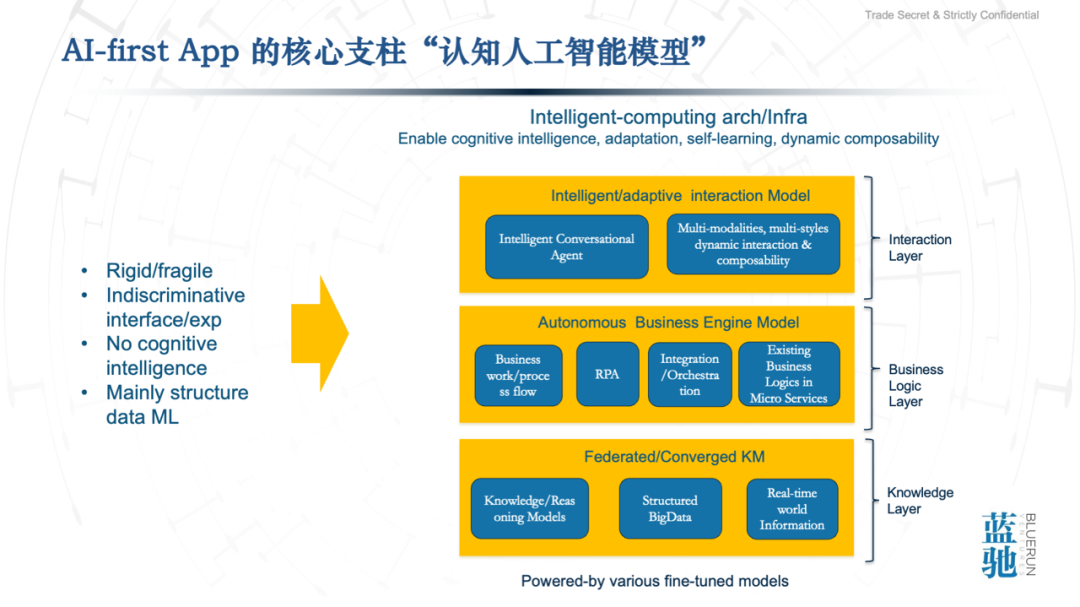
Fragile, rigid software Software is the platform of humanity's digital civilization. But software is extremely fragile — its business logic and data models are developed according to current business needs, and with each change in business requirements, software needs modification or even reconstruction. Software is also extremely rigid. For example, at the user interaction layer it is almost fixed — whether you are a first-time user, beginner, or advanced user, there is only one interaction interface. Truly excellent user experiences are rare, and possibly even scarcer in B2B scenarios.
Cognitive intelligence model as the core pillar of software I believe the "cognitive intelligence" model is the backbone of AI-First applications, and applications will evolve from data-driven to AI model-driven. Let's assume software still has a 3-layer architecture (though this may also change): data layer, business logic layer, and interaction layer.
(1) Knowledge Layer In the digital world, the core assets of enterprise business are data and knowledge. These unique enterprise knowledge and comprehensively collected data will be aggregated and captured by cognitive models, which will be the core models driving enterprise business scenarios and various interaction scenarios.
(2) Business Layer In the future, the enterprise business layer will also be driven by cognitive models, achieving business logic powered by cognitive intelligence. Only then can enterprise logic be more dynamically adaptive and better suited to changing business needs and diverse users (including employees, ecosystem partners, end users, or customers) — rather than the current hard-coded, rule-defined, or even structured-data-dependent machine learning capabilities that implement business logic.
(3) Interaction Layer ChatGPT has shown us a human-like intelligent interaction interface with stunning intelligent capabilities. But its interaction capabilities are still quite basic; next-generation intelligent interaction holds much new imaginative space. Driven by cognitive intelligence models, interaction interfaces, content, and structure will dynamically, personally, and intelligently generate and interact based on user intent understanding.
If we agree with this trend, it is inevitable that the software architecture of AI-First applications and software development models and stacks will undergo transformation.
Cognitive intelligence model as the core pillar from a full business process perspective From a business perspective, cognitive intelligence models can also empower or even serve as the core pillar driving full business processes — from product definition and design, production, marketing, to service — using cognitive intelligence to improve efficiency, enhance experience, and even create new value.
Core competitiveness in the intelligent computing era is the enterprise's unique cognitive intelligence model In the big data era, industry consensus held that data was the core enterprise competitive advantage. In the intelligent computing era, enterprises' core differentiating competitiveness will be cognitive intelligence models based on their internal data.
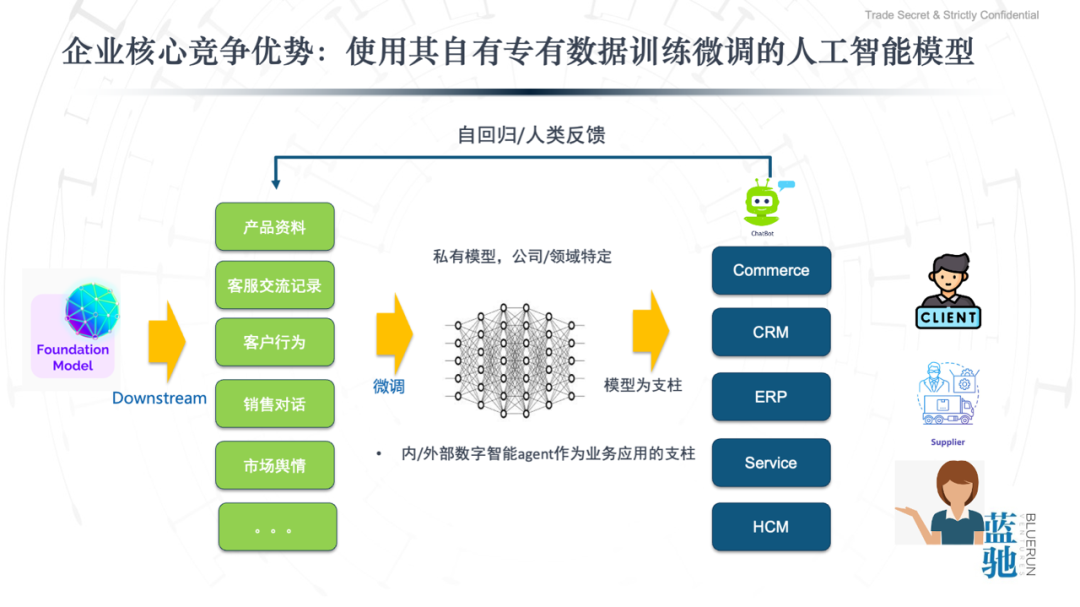
The core pillar of AI-First enterprise applications is the cognitive intelligence model. Future enterprise applications such as e-commerce, CRM, ERP, service, HCM, and almost all scenarios have opportunities to be empowered and driven by cognitive intelligence models, or even reconstructed.
From product development, production, marketing, sales, internal management, product delivery to after-sales service, and upstream supply chain — all structured and unstructured data沉淀 from the information era across the full spectrum of enterprise operations, as well as unique enterprise knowledge accumulated from the cognitive intelligence era onward, will become training data for the enterprise's distinctive cognitive intelligence model. Moreover, feedback data generated from enterprise digital systems, internal company processes, and interactions with users and partners can continuously iterate and upgrade the enterprise's proprietary cognitive intelligence model through reinforcement learning, better aligning the model with user or system intent.
The enterprise's unique cognitive intelligence model will be the complete digital expression and preservation of the enterprise's brand, positioning, culture, knowledge, and core capabilities. This may be a series of models representing the cognitive capabilities of various departments, roles, and positions within the enterprise, empowering or even replacing communication between internal roles, and communication and service between the enterprise and customers, and the enterprise and ecosystem partners. It may be a series of core pillar models for information systems, better serving the cognitive intelligence dimension of information system decision-making capabilities. It may be a virtual training instructor for enterprise training, continuously providing in-context, work-scenario-based training, guidance, and capability enhancement for enterprise employees.
Salesforce recently released Salesforce EinsteinGPT, the first generative AI CRM model. AI-generated content will super-efficiently cover enterprise processes including sales, marketing, service, e-commerce, and IT. We believe any competitive enterprise must have its own unique cognitive intelligence model, driving all aspects of the enterprise, providing unparalleled experience, efficiency, and value creation for employees, customers, and partners.
07
The Fusion of the Intelligent World and the Information World
Since humanity invented the first computer in the 1950s, information technology innovation has empowered all industries, not only reducing costs and increasing efficiency for enterprises, but also opening new revenue streams and business models. In this development process, the information digital world has created and沉淀 a large amount of information technology infrastructure, development tools, industry applications, and digital capabilities — such as various elastic computing and orchestration capabilities of cloud computing; enterprise management software like CRM, ERP, and Service Cloud; various enterprise and personal productivity and collaboration software; various big data-based BI, reporting, and insight analysis software; enterprise internal integration and workflow engines and visual orchestration capabilities. For more efficient and real-time collaboration between internal enterprise systems and external ecosystems, enterprises have even built digital ecosystems to better serve their customers, opening internal capabilities to third parties in various API forms. Enterprises have invested tremendous human and financial resources in building these extremely valuable, core competitive advantages.
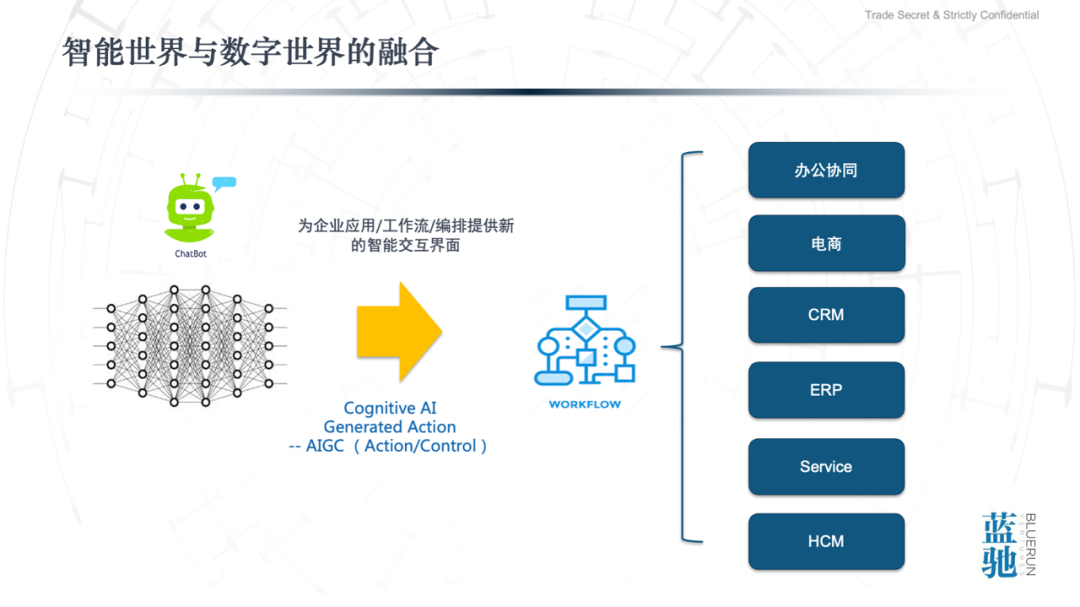
With the arrival of the intelligent computing era with cognitive intelligence as a higher dimension, the intelligent world and the information world will each contribute their strengths and merge:
(1) Cognitive intelligence provides the next generation of more natural, more intelligent, more democratized human-system intelligent interaction interfaces
LLM-based dialogue models have achieved human-like levels of language understanding and generation, making human-machine dialogue at human natural language levels and quality possible. This dialogue can not only satisfy human needs for more efficient knowledge discovery, but may also, through next-generation dialogue intelligence models, use humanity's most natural language interaction mode to enable free communication and interaction between humans and various digital systems and applications in the information world.
(2) More flexible, open, dynamic, and personalized reconstruction of internal enterprise processes and working methods
Digital world information system interfaces and interfaces are relatively rigid, but internal enterprise processes and working methods continuously evolve with business and efficiency needs. In the future, enterprise employees with appropriate permissions will be able to more flexibly and dynamically reconstruct internal enterprise systems, workflows, and data flows through natural language interaction according to business and personal needs. This is the future transformation of enterprise integration and RPA under the AI-first concept.
The intelligent world is like the human brain; the information world is like human limbs for perceiving, executing, and feeding back to the physical world. The intelligent world and information world complement each other to constitute a complete human digital civilization world. The fusion of these two worlds can not only open new experiences and value for enterprise employees. This fusion will also occur in personal daily life, communication, social interaction, and other open social life scenarios, bringing completely new experiences and new heights of life happiness to human daily life.
08
Who Will Be the Heroes of the Intelligent Computing Era?
The PC computing era made Microsoft, the internet computing era made Google and Taobao, the mobile internet era made TikTok, Meituan, and Uber, and the cloud computing era made AWS and Salesforce. In the future intelligent computing era, who will become the new heroes leading this era? We all eagerly anticipate. Although we cannot predict who now, we believe all B2C and B2B scenarios in the intelligent computing era are worth rethinking, exploring, enhancing, or even completely rebuilding.
Are you an AGI pioneer? Welcome to scan the QR code or click "read more" to sign up for the "BlueRun AGI Pioneer Club" 👇👇👇

More exciting content




Originating in Silicon Valley, BlueRun Ventures was established in 2005 and is a venture capital firm focused on early-stage startups.
Currently, BlueRun Ventures manages multiple USD and RMB dual-currency funds in China, with assets under management exceeding RMB 15 billion, making it one of the largest early-stage funds in China. Its investment stage focuses on Pre-A and Series A, covering hard tech and innovative interaction, enterprise technology, new consumption, healthcare, and other sectors. It has cumulatively invested in over 150 startups, including Li Auto, Waterdrop, QingCloud, Guazi.com, Qudian, Songguo Mobility, Ganji.com, Energy Monster, Yuntu Semiconductor, Machenike, Yunsheng Intelligence, Anxin Wangdun, and BioMap.
BlueRun Ventures has been ranked #1 in Zero2IPO's "China Early-Stage Investment Institutions Top 30" and ChinaVenture's "China Best Early-Stage Venture Capital Institutions Top 30," and was named by Preqin among the Top 10 venture capital fund managers globally for sustained high-return performance.
Additionally, BlueRun Ventures has consecutively received honors from Forbes China, 36Kr, Cyzone, Caixin Media, CBNweekly, Jiemian, and other media organizations as "China Best Early-Stage Institution of the Year," "China Top Venture Capital Institution," "Most Entrepreneur-Friendly Early-Stage Institution of the Year," and "Most Influential Early-Stage Institution of the Year."