When AI Makes Individuals More Productive, Why Don't Companies Get Stronger? | Booming Talk

The key to AI Native isn't upgrading your tools — it's rewriting your organization.

"The key to AI Native isn't tool upgrades — it's organizational rewiring."

In March 2026, a16z partner George Sivulka published a long essay in his newsletter titled Institutional AI vs Individual AI, which quickly ignited debate across Silicon Valley. The article opens with an unsettling fact: AI has made every individual 10x more productive. Yet no company has become 10x more valuable because of it.
Sivulka draws an analogy to the electric revolution of the 1890s. New England textile mills rapidly swapped steam engines for electric motors — but for the next thirty years, output barely grew. The technology had far outpaced the organization. Not until the 1920s, when factories were fundamentally reimagined — assembly lines, dedicated motors on every machine, workers performing entirely different tasks — did electricity's value truly materialize.
"We changed the motors, but we didn't redesign the factory." That line stings in 2026.
From this, Sivulka proposes seven distinctions between "Individual AI" and "Institutional AI": the former creates chaos, noise, and bias; the latter creates coordination, signal, and objectivity. The former saves time; the latter expands revenue. The former gives you tools; the latter teaches you how to use them. The former responds to prompts; the latter acts proactively. He even predicts: all B2B AI companies built over the next decade will rest on these differences.
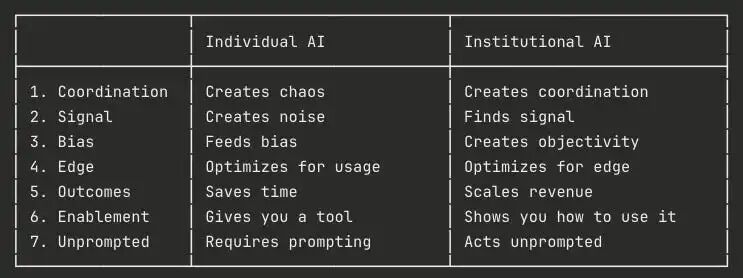
Sivulka's proposed contrast between Individual AI and Institutional AI. Source: Institutional AI vs Individual AI
The essay circulated widely in Chinese tech circles, but most discussion remained at the framework level — people loved debating which mattered more, "Individual AI" or "Institutional AI," while rarely pressing a more fundamental question: where exactly does the leap from individual efficiency to organizational value get stuck?
Almost simultaneously, Block CEO Jack Dorsey and Sequoia Capital managing partner Roelof Botha published a more radical piece: From Hierarchy to Intelligence. Dorsey traces two millennia of organizational history — from the Roman legion's eight-man contubernium, to the Prussian General Staff, to the world's first org chart spawned by American railroads — and reaches a conclusion: hierarchy is fundamentally an information-routing protocol, built on a simple human constraint: one leader can effectively manage roughly three to eight subordinates.
"Narrowing span of control means adding layers of command, and more layers means slower information flow. For two thousand years, all organizational innovation has tried to circumvent this tradeoff, but never broken it."
Block's solution: use AI to build a company's "world model" — a continuously maintained digital mirror of the entire enterprise's operations — so information no longer depends on cascading management to propagate. In this model, organizational roles collapse to three: Individual Contributors (ICs), Directly Responsible Individuals (DRIs), and Player-Coaches. Permanent middle management is eliminated.
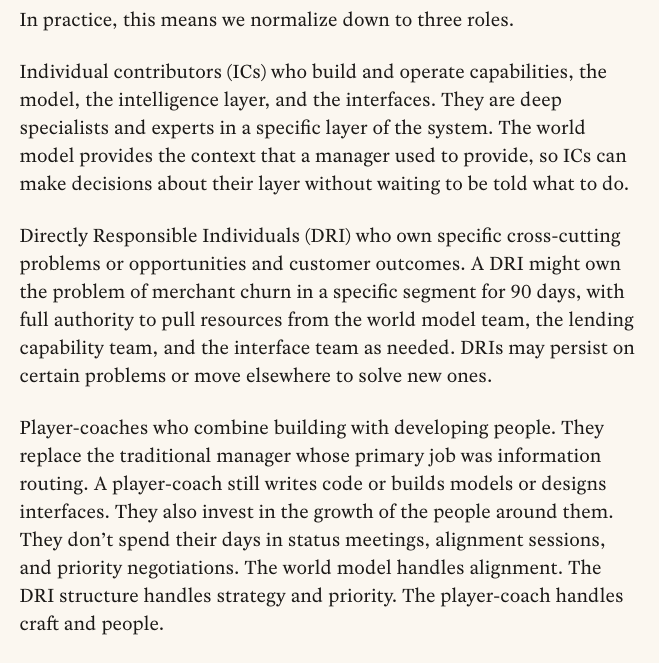
In practice, Block simplifies team roles into three categories: ICs who autonomously decide using the world model, DRIs with cross-domain resource allocation authority, and Player-Coaches focused on technical and people development — replacing traditional management's information-transfer function. Source: From Hierarchy to Intelligence
Both essays express a fundamental inquiry into "what is a company, really?" — and the AI-era organization is a proposition BlueRun Ventures has long been tracking.

In BlueRun Ventures' interviews with portfolio companies over the past two-plus months, we found that AI's impact on organizations is far more complex and multidimensional than any single framework can capture. Sivulka proposed seven pillars; Dorsey proposed a world model. But in actual entrepreneurial practice, founders face a tangle of interlocking, even contradictory, real-world problems.
These contradictions themselves may be more valuable than any framework.
Here, we want to approach AI organization through three contradictions, in debate form, presenting BlueRun's and its portfolio companies' thinking on AI organizational questions.
🗣️ Debate One: Should You Innovate on Organizational Form?
This was the first point of divergence we encountered in interviews — and both sides have strong arguments.
Trooly.AI founder Whisper, after speaking with Huiwen Wang, received advice that eased his anxiety: "Don't spend too much time thinking about organizational innovation. Really study Drucker's management principles and you'll already be at 80%. Because innovating is an easy way to make mistakes."
Whisper developed a pragmatic framework: AI Native, at its core, is just flattening driven by unit-efficiency gains — what once took a thousand people might now take a hundred, but the CEO still can't manage everyone directly, so you still need three layers. OKR remains the most suitable management system. He even argues that models where employees "find their own direction" on day one fundamentally suit research institutions like Bell Labs or DeepMind, not commercial companies — "If you're a commercial company doing this, you're doing charity."
DINQ co-founder Kelvin's observations could hardly differ more. He finds that traditional companies share highly similar org structures, but AI Native companies each "look quite different" — they grow organically according to business needs, exhibiting "inverted pyramid" structures where the most creative people drive decisions, and bottom-up trumps top-down. More importantly, he believes company boundaries are dissolving: "Is Xiaolongxia even a company anymore? It barely has boundaries. Lots of people are working for you; they're just not your employees."
This isn't about right or wrong. Whisper faces an AI startup needing rapid business-model validation; for him, the cost of getting organizational form wrong far exceeds the payoff from innovating on it. Kelvin faces a community-driven product with a thriving creator ecosystem; traditional company boundaries have indeed lost meaning for him.
BlueRun's observation: AI's organizational impact is not uniform. It depends on your business model, who your customers are, how long your value chain is. Trying to explain all AI Native companies with one model is like trying to manage all enterprises with one org chart — still a residue of industrial-age thinking.
🗣️ Debate Two: Does Individual Efficiency Gains Always Translate to Organizational Efficiency?
This is the core proposition of Sivulka's essay, and the most frequent source of confusion we heard in interviews.
Yuanli Intelligence founder Fan Zhang has an exceptionally clear-eyed view of this. In his estimation, many people take for granted that "individual efficiency" gains bring "organizational efficiency" gains, but in reality, organizational efficiency and individual efficiency are two independent things. Many entrepreneurs constantly encourage employees to use AI without organizational-level holistic design — it's like letting a bunch of new drivers speed down country roads without traffic lights: everyone moves faster, but traffic gets more congested.
Zhang believes individual efficiency gains can even increase organizational entropy: "If everyone can build their own CRM in five minutes, companies often end up flooded with low-quality, shoddy software, and information infrastructure collapses."
This is almost a Chinese footnote to Sivulka's dictum that "Individual AI creates chaos, Institutional AI creates coordination."
Farbata founder Andy expresses the same view. He believes an organization's most important goal is "coordination" — the purpose of coordination is cooperative effects where 1+1 exceeds 2 — but this requires a capable decision-maker. "If someone with excellent engineering architecture thinking is directing AI, then AI's efficiency improves dramatically. But if it's someone with poor engineering architecture thinking, it actually creates massive production risks," Andy says.
But AI also has clear problems on the efficiency front. Take code generation: AI can assist in generating lots of code, but if someone with excellent engineering architecture thinking is directing AI, efficiency improves dramatically; if it's someone with poor engineering architecture thinking, the generated code actually embeds numerous hidden risks, creating massive production hazards. This brings us to organizational AI capability. An organization's most important goal is coordination — the purpose is cooperative effects where 1+1 exceeds 2, plus clear division of labor. Decision-makers need to make judgments and formulate decisions based on various inputs, requiring complex, precise logical reasoning within existing cognitive frameworks — all things current transformer-based large model technology struggles with. Moreover, continuously adjusting strategy based on various inputs during execution is something individual AI technology can hardly achieve. Multi-agent intelligent coordination that produces organizational AI's intelligent leap is a highly worthwhile research direction.
But Zhang offers a more advanced prescription: enterprise AI transformation must come from top-level strategy, not grassroots emergence. "A coachman using a steam engine only improves carriage efficiency; a horse breeder using a collar harness only improves horse-rearing efficiency. Entrepreneurs need to start from the end goal, using AI's first principles to redesign business objectives," Zhang says.
From this, Zhang distills the core characteristics of the new-era organization: small teams, high intellectual density, blurred job boundaries, results-oriented — echoing Block's proposed IC/DRI/Player-Coach three-role structure.
Romangic founder Richard expresses a similar view. He believes that in the AI era, any organizational role that can be codified should be codified. Code is AI's native language; once codified, organizations can be strung together beautifully by AI. "Docs as Code, Design as Code, Infra as Code, Test as Code, Workflow as Code..." Richard says.
Meanwhile, Richard notes that many small teams previously couldn't be bothered to "reinvent the wheel" (having perfectly good, mature, usable solutions available, yet insisting on building from scratch — i.e., redundant labor) because development ROI didn't justify it. In the AI era, because the cost of building wheels has dropped dramatically, and with wheels in place AI can autonomously run longer operational sequences, the ROI of "wheels" rises significantly. Tearing down old systems and rebuilding with AI workflow may yield greater returns.
🗣️ Debate Three: What's the Most Underestimated Challenge of the AI Era?
In Sivulka's essay, the seven pillars remain fundamentally B2B-centric — signal, bias, advantage, revenue — all assuming a measurable "correct answer" exists.
But in consumer-facing domains, "correct" itself is subjective. AI Native organizations must solve not just human-AI "alignment," but human-AI "resonance" across aesthetic, intuitive, and emotional dimensions. Daqian Technology founder Qiuqiu, for instance, believes the cost of aligning context with AI is the most underestimated challenge of the AI era.
Qiuqiu's company builds consumer entertainment products (multiplayer interactive narrative entertainment), and questions like "how many layers of rules can human 'happiness' be abstracted into?" or "how do you turn experience-based, aesthetic things into benchmarks?" are all deeply subjective, hard to quantify — making human-AI alignment far costlier than for tool-type products.
Qiuqiu found that when teams use AI heavily (such as vibe coding), work shifts from linear to nonlinear — product managers no longer write PRD documents but directly hack together prototype demos, then discuss around the deliverable. This nonlinearity brings efficiency gains but also new alignment challenges.
Her solution isn't adding reporting processes but engineering automated checkpoints: "Ensuring people-people and people-AI consistency in contextual understanding is the only way to meaningfully improve efficiency."
Moreover, Sivulka uses Palantir as a benchmark case for "process engineering" companies in his essay — but expanding the view to China reveals far richer practical samples.
Ouyang Jie, senior partner and VP of China Stone Management Consulting Group, once divided organizational design solutions into three eras: agricultural age "starting from people" (using loyalty to substitute for systems), industrial age "approaching through coordination" (using systemic rationality to substitute for individual uncertainty), and AI age "building transparent organizations and intelligent enterprises" (using information transparency to dissolve control needs, using algorithmic intelligence to substitute for hierarchical decision-making).
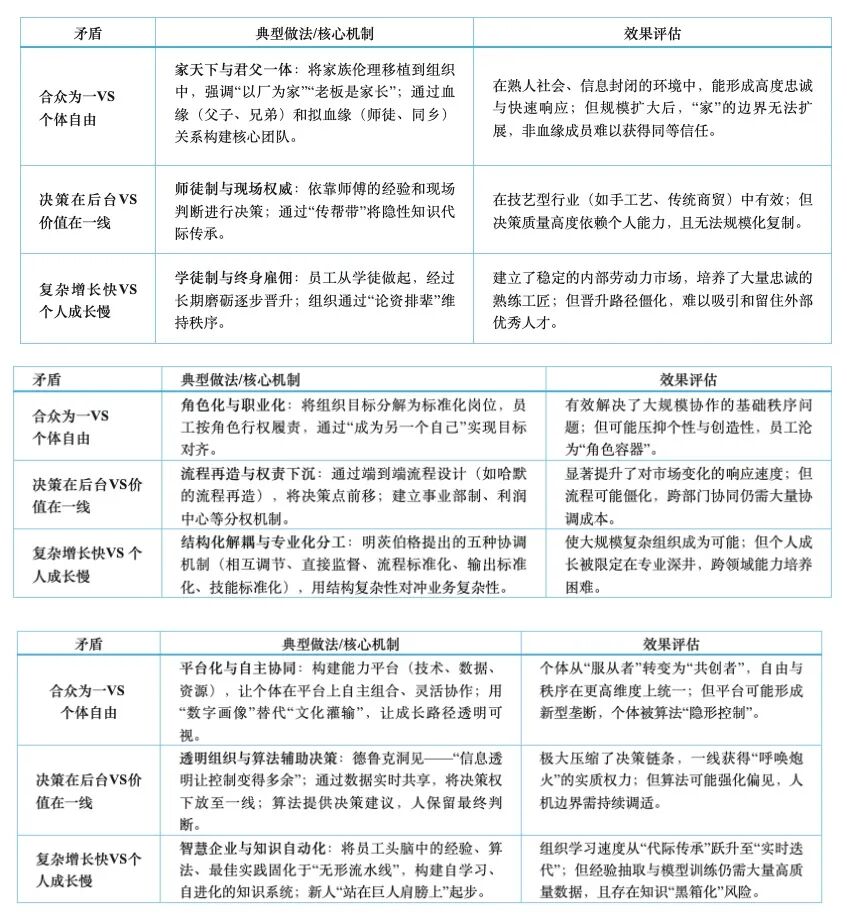
Organizational approaches and effectiveness evaluation across the agricultural, industrial, and AI eras. Source: China Stone e-Insight, "The Logic of Organization in the AI Era Has Fundamentally Changed"
Using Meituan's rider management platform and Freshippo's new retail as examples, he demonstrates the embryonic form of AI-era organization: dynamic matching for 6 million riders completed in seconds by algorithms; top riders' route choices and communication techniques extracted as model features to feed back into the system — experience no longer accumulates in individual brains but in the system itself.
This view resonates with Sivulka's "Institutional AI acts proactively." But unlike the American context, Chinese practice often occurs in labor-intensive scenarios, facing millions of frontline workers rather than Silicon Valley's knowledge workers. This scale difference itself constitutes a distinct organizational challenge.

Returning to BlueRun Ventures' perspective. In continuous tracking of portfolio companies, we've gradually formed several core judgments about AI-era organizations:
First, AI Native is not a fixed organizational form but a continuously evolving capability. Take BlueRun portfolio company Simplexity Robotics as an example — a company starting from real-world scenarios, committed to building embodied intelligence products with high user value through high-ceiling unified models, efficient data closed loops, and highly reliable robotic hardware. Simplexity founder Peng Jia believes that if AI hasn't truly become productive force, if employees' daily working hours haven't shortened, "then all discussion of AI Native is castles in the air," Jia says. What we watch isn't how founders describe their organizations, but whether AI has genuinely changed how value is created inside the organization.
Second, the leap from "individual efficiency" to "organizational efficiency" requires a new kind of "alignment infrastructure." The "human-AI alignment" challenge Qiuqiu identified is fundamentally an information-theory problem: when an organization's intelligent nodes expand from purely human to human-AI hybrid states, the dimensions and complexity of alignment increase dramatically. Whoever can first build this alignment infrastructure — whether through automated checkpoints, engineering methods, or new collaboration protocols — can truly convert individual AI efficiency into organizational value.
Third, the most valuable AI Native companies will redefine "company boundaries." When AI massively amplifies individual capability, traditional employment relationships and organizational structures are being re-examined; traditional large organizations will become more efficient, and super-individuals will contribute more value to society. As Kelvin puts it, for the same business, same scale, same revenue, "one company with 100 people, another with two people — I think that's something highly likely to appear."
Fourth, the true moat lies not in the ability to use AI, but in the ability to organize AI. A recent Science paper, "Neural basis of cooperative behavior in biological and artificial intelligence systems," notes that every historical intelligence leap hasn't been individual hardware upgrades but the birth of new "collaborative structures." Language, writing, institutions — enabling many minds to work together. The most powerful future systems won't be built from the smartest components, but from the best-coordinated components.
Hillbot's Zheng Han has deep practical experience with this. His company is currently studying Qian Xuesen's systems engineering thinking, blending each person's different strengths and backgrounds into a unified whole to jointly complete robot systems engineering more complex than language models, multimodal models, or autonomous driving — with a core R&D team of roughly 100-150 people.
Fifth, the bottleneck in AI-era organizational transformation often isn't middle management, but the CEO's cognitive awakening. When people discuss AI Native organizations, the first reflex is often "eliminate middle management." But at BlueRun, we see middle management as performing cross-module semantic translation, technical path prioritization, and team morale and rhythm sensing — capabilities AI is far from fully replacing.
On the other hand, we've observed that companies truly achieving AI efficiency at the organizational level share a commonality: not how many layers they cut, but the CEO's deep, hands-on understanding of AI's capability boundaries. Only when the CEO has awakening consciousness and willingness to first change their own thinking can they drive organizational transformation on the ground.
"Remember the lesson of the 1890s textile mills. The factories that electrified first lost to the factories that redesigned their shop floors," Sivulka wrote at his essay's close.
As we can see, BlueRun Ventures' portfolio companies are in the midst of this "redesigning the shop floor" process — some insist on using classical management to reach 80% before seeking breakthroughs; some are building entirely new inverted-pyramid organizations; some are solving human-AI alignment challenges; some are practicing systems-engineering-style team building; some are exploring "anti-industrial" personalized paths.
BlueRun believes the prerequisite for redesigning the shop floor is understanding what your shop floor actually produces. Every company needs to answer the fundamental question Block posed — what does your company understand that is genuinely difficult to understand, and is that understanding deepening every day?
If the answer is "nothing," then AI is just a FOMO story.


2026 AI Disruption: How Does OpenClaw Affect AI Entrepreneurship? What's New with Models and Applications? | BlueRun AI Annual Outlook
 BlueRun AI Annual Outlook: Survival, Evolution, and Narrative for China's AI Entrepreneurs | Booming Talk
  Genspark CEO Kun Jing: Stop Asking How to Deploy AI, First Give Every Employee Unlimited Token Access