BioMap Launches AIGP Platform, Bringing Life Sciences to Its "ChatGPT Moment" | BlueRun Ventures Headline

Where AI Foundation Models Can Make Their Mark in Life Sciences
Large language models + life sciences = ?
BioMap is attempting to answer that equation. For two years since its founding, the company has been cultivating large models for the life sciences, building out "xTrimo," a leading large-scale pre-trained model in the field. Yesterday in Beijing, BioMap unveiled AIGP (AI Generated Protein), a life-science large-model-driven platform, opening up its capabilities to a broader circle of industry partners.
In the view of Song Le, BioMap's CTO and Chief AI Scientist, life-science large models, much like ChatGPT, require continuous refinement through closed-loop validation and data supplementation via high-throughput, multi-round wet-lab experiments. The external launch of AIGP also means the platform will now serve more partners across a wider range of scenarios — scientific research, environmental protection, materials, consumer applications, and beyond.
BlueRun Ventures led BioMap's Series A round, and we look forward to seeing AI large models realize their value in life sciences. Below, we share an interview with Dr. Song Le that illuminates how "xTrimo" achieves this — enjoy.
ChatGPT's debut showcased the power of large language models to the world — power that stems from improved generalization, enabling models to handle dialogue, text generation, translation, and more. The ability to fine-tune large models into specialized domain models has also become apparent, unlocking AI's potential across fields.
Among these, life sciences is a domain that has long drawn attention without being particularly "flashy." Yet it may well be one of the most important application areas for AI large models, with the potential to simultaneously generate commercial and social value.
DeepMind introduced AlphaFold, its protein structure prediction model, as early as 2018. By 2022, the series had predicted the structure of nearly every known protein globally. Meta also launched its protein structure prediction model, ESMFold, in 2022.
BioMap similarly believes that AI has entered a golden age of large models, driven by advances in data, compute, and model architectures. The life sciences in particular have accumulated massive datasets that require purpose-built large models to unlock their value. BioMap sees significant potential for these models in drug discovery.
Against this backdrop, BioMap began constructing the "xTrimo" life-science large model system from its founding in 2020, aiming to combine cutting-edge AI with biotechnology to build a high-throughput dry-wet closed-loop biocomputing engine. The goal: model the complex patterns of proteins, immune cells, and immune systems to develop novel protein-based therapeutics, reprogram immune systems, and treat dozens of immune-related diseases.
What specific value can the "xTrimo" system create, and how? To address these questions, Dr. Song Le spoke with 36Kr and other media outlets on the afternoon of March 3.
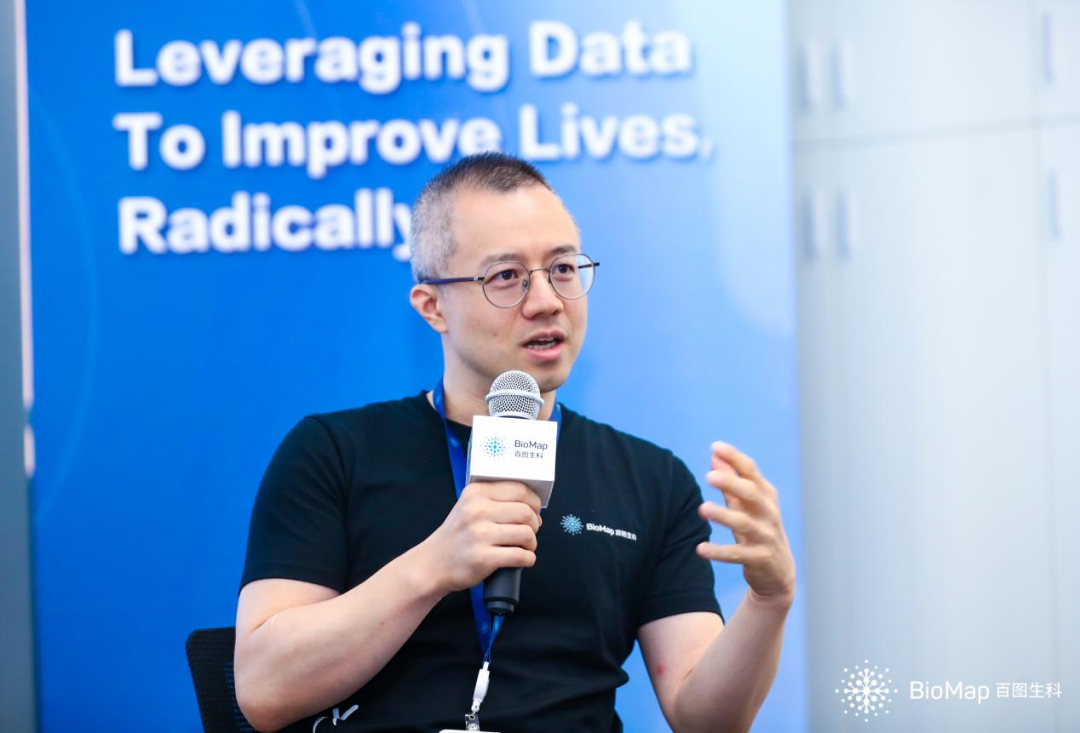
Dr. Song Le, CTO and Chief AI Scientist, BioMap
According to BioMap, "xTrimo" (Cross-modal Transformer Representation of Interactome and Multi-Omics) is the world's first and currently largest super-large-scale multimodal model system in life sciences. It comprises a hundred-billion-parameter pre-trained model and multiple downstream task models, organized in a four-layer nested architecture capable of modeling individual proteins, protein-protein interactions within cells, cells themselves, and cellular systems.
The following is adapted and edited from BioMap's media briefing:
01
Where AI Large Models Can Make Their Mark in Life Sciences
While successful new drug development yields high returns, it also carries high risk. The process is typically characterized by long cycles, substantial capital requirements, and significant technical hurdles — so much so that biopharma has long referenced the "rule of tens" or "reverse Moore's law": roughly $1 billion and over ten years to bring a single new drug to market.
Target discovery, compound synthesis, and screening are critical steps in this process. In BioMap's view, AI large models can potentially improve both the efficiency and effectiveness of these stages.
First, leveraging predictive capabilities, researchers can more rapidly discover novel proteins and cellular forms, exploring new targets and drug design directions.
Biological evolution operates through natural selection at multiple levels — protein sequences, protein-protein interactions, gene expression within cells. These outcomes are not random. Training on data encompassing these layers allows large models to simulate evolutionary processes to some degree, conferring predictive power. As Dr. Song Le noted: "While biological data has exploded over the past decade, small tools struggle to mine and apply it effectively."
Second, by improving the accuracy and reliability of compound synthesis and screening, models can reduce subsequent experimental iterations, cut trial-and-error costs, and accelerate early-stage drug development.
Building on general pre-trained models, sufficiently accurate downstream task models can be developed with far less data. Higher success rates in model-predicted outcomes translate to fewer experiments and closed-loop iterations. Dr. Song Le explained that with sufficiently accurate predictions, unnecessary experimental steps can be eliminated, saving costs.
Additionally, by incorporating critical end-stage considerations — toxicity, metabolism, and the like — into the model upfront, drugs designed from model outputs stand a better chance of passing clinical trials, indirectly improving efficiency at that stage as well.
BioMap constructed the "xTrimo" system to explore evolutionary patterns from proteins to complex organisms, then generate purpose-built proteins to meet specific needs. By generating proteins and "conversing" with biological systems, the approach aims to accelerate the pace of artificial protein design evolution and address core pain points in the life sciences industry.
During pre-training, BioMap fused understanding and generation training paradigms, training general protein and cell representation models on hundreds of millions of cross-modal biological data points, and employed AutoML to accelerate discovery of optimal model architectures for diverse biocomputing tasks. On this foundation, "xTrimo" can represent individual proteins, protein-protein interactions, immune cells, and immune systems across multiple biological scales, understanding associations between biological data types.
To date, "xTrimo" has achieved state-of-the-art results on protein structure prediction, antibody sequence generation, and cell representation, with progress on cell function prediction and de novo drug design. BioMap currently has multiple AI-driven drug pipelines in lead optimization, and has partnered with industry players on large-molecule drug design for difficult-to-drug targets including GPCRs and ion channels.
02
Why Training Data Matters
The ability to build more accurate downstream models with less data demands strong representation and generalization capabilities in the base large model — which in turn requires training on more data, with staggering compute costs.
BioMap notes that training a hundred-billion-parameter model may require thousands of GPUs running for three to five months, with data needs in the TB-to-trillion scale. To meet this, BioMap partnered with Baidu Cloud to build a heterogeneous bio-supercomputing platform supporting dynamic allocation of thousands to tens of thousands of GPUs and corresponding CPU resources. Rough estimates suggest that several training runs annually for a model of xTrimo's scale would cost over 100 million RMB in compute alone.
Beyond compute investment, mining and leveraging high-quality data is another critical challenge. Dr. Song Le emphasized that data accuracy and quality directly impact model performance, especially for downstream tasks. For instance, accurately predicting antibody-antigen affinity is essential for selecting optimal antibodies.
However, despite the abundance of existing biological data, its origins in diverse technologies and methods create cross-modal characteristics that present two key challenges for mining and utilization.
First, inconsistency and noise in biological data. Ensuring quality and consistency requires appropriate algorithms and tools for preprocessing and cleaning, addressing variations in data quality and signal-to-noise ratios across different technologies.
Second, the complexity of cross-modal data integration and analysis. Biological data is multimodal, multiscale, and multidimensional, typically requiring interdisciplinary collaboration with specialized expertise to process and analyze.
In data collection and curation, this means ensuring accuracy and reliability on one hand, and establishing correspondences to integrate protein-protein interactions, single-cell data, and more into unified databases for systematic utilization.
To this end, BioMap performed meticulous alignment of public data, supplemented by internal lab data as a high-quality addition.
For public domain data, BioMap's bioinformatics engineers re-measured and evaluated it against their own experimental systems to validate correlations and accuracy across datasets. These measurements inform data weighting during model training. The company also invested a year in establishing data correspondences — pairing proteins with genes, linking interacting genes or proteins, and so on.
For internal data acquisition, BioMap designed and built a high-throughput experimental validation system to enable an end-to-end, dry-wet-data-based AI drug discovery closed loop. Its omics lab, for example, processes samples from over ten tissue sources, collecting 10 million single-cell sequencing data points annually.
Currently, private lab data accounts for roughly 10% of the total. Yet this private data is essential for fine-tuning general models into specialized domain models. Dr. Song Le observed: "Large models need real experimental data for continuous supplementation — feeding the model data on researchers' targets and diseases of interest to fine-tune specialized models and improve predictive power, analogous to ChatGPT's reinforcement learning from human feedback."
To enable cross-modal data integration and analysis, BioMap assembled a team spanning AI algorithm talent, bioinformatics engineers, data scientists, and biology and medical specialists. The company emphasizes that collaboration across these disciplines is key to building the model system, innovating architectures, and driving subsequent experiments through to pharmaceutical applications.
03
From Drug-Making to Addressing Broader Societal Challenges
Compared to DeepMind, the David Baker Lab, and others pursuing life-science problems through large models, BioMap differs on two levels.
First, as noted, BioMap's scope extends beyond single-point technologies like protein structure prediction to encompass protein-protein interactions and beyond. In BioMap's view, DeepMind focuses on diffusion-model-based protein generation, but such single-point technologies alone are insufficient for drug optimization — a process requiring diverse specialized expertise.
After model construction, bioinformatics engineers and scientists must interpret whether outputs and predictions are reasonable; biologists and medical specialists must conduct real experiments and manage high-throughput systems for data feedback and continuous model improvement. This is partly why BioMap established its dry-wet-data-based AI drug discovery closed loop from inception.
The other reason for this experimental closed loop — and BioMap's second key difference from DeepMind, the Baker Lab, Meta, and others — is a more comprehensive commercialization strategy in drug development. Rather than pursuing single technical breakthroughs or pure research, BioMap aims to rapidly apply large model capabilities across biopharma and life sciences more broadly. To accelerate development across dozens to hundreds of drug pipelines, the company built a complete platform in Suzhou spanning antibody discovery, protein printing, and antibody engineering and optimization.
BioMap also plans to explore protein design applications beyond disease treatment, including environmental protection and energy — for instance, enzymes that efficiently degrade plastics or accelerate specific energy production processes.
Realizing this vision will likely require continuously advancing engineering capabilities, building broader partnership networks for data flywheel effects, and avoiding premature capture by commercial interests.
As OpenAI's achievements in large language models demonstrate, improved general model capabilities owe much to accumulated engineering strength, which in turn benefits from dense, multidisciplinary talent. This is a key focus for BioMap: strengthening exchange and learning across its interdisciplinary team, generating new ideas and perspectives through continuous collision.
In target discovery algorithm development, for example, the algorithmic task involves predicting post-perturbation cell state changes. With limited directly usable data and state descriptions spanning tens of thousands of gene dimensions, direct modeling is difficult. Through collaboration between biology researchers and AI algorithm developers, BioMap innovatively developed the xTrimoCell model for predicting functional changes in immune cells post-perturbation.
In partnership building, BioMap launched its "Distinguished Developer Program" for frontier biotechnology experts, drug development specialists, and clinical teams, providing research funding and engine capabilities for high-quality translational medicine projects. It also collaborates with clinical research institutions and professional societies like immunology committees on specific projects and topics. Additionally, BioMap plans to open interfaces to some model capabilities in the near future.
Commercially, BioMap is exploring multiple collaboration formats with pharmaceutical companies, not limited to licensing out, but including joint drug development. While economic returns are essential for any business, maintaining research focus before profitability is equally critical in drug discovery, where innovation difficulty is high.
We believe the novel methods proposed by the research team can serve as a powerful tool to advance precision medicine in drug combination therapy, particularly in recommending entirely new drug combinations.
This article is republished from 36Kr. Original link: https://36kr.com/p/2171371113967879?channel=wechat




Founded in Silicon Valley in 2005, BlueRun Ventures is a venture capital firm focused on early-stage startups.
The firm currently manages multiple USD and RMB dual-currency funds in China, with assets under management exceeding 15 billion RMB, making it one of the country's largest early-stage funds. BlueRun invests primarily at Pre-A and Series A stages across hard tech and innovative interaction, enterprise technology, new consumer, and healthcare sectors. It has backed over 150 companies including Li Auto, Waterdrop, QingCloud, Guazi, Qudian, Songguo, Ganji.com, Energy Monster, Yuntu Semiconductor, Machenike, Cloudsaint, Anxin, and BioMap.
BlueRun Ventures has been ranked #1 on Zero2IPO's "China Top 30 Early-Stage Investment Institutions" and ChinaVenture's "China Best Early-Stage Venture Capital Firms TOP30," and was named among Preqin's Top 10 VC fund managers globally for sustained high returns.
The firm has also received consecutive honors from Forbes China, 36Kr, Cyzone, Caixin Media, CBNweekly, Jiemian, and other media, including "China's Best Early-Stage Firm of the Year," "China's Top Venture Capital Firm," "Most Entrepreneur-Friendly Early-Stage Firm of the Year," and "Most Influential Early-Stage Firm of the Year."