BlueRun Ventures and Hillhouse Lead Investment in Lingchu Intelligence, Marking the Dawn of the Embodied Intelligence Era Through Reinforcement Learning | BlueRun Ventures

Building an Industry-Leading General-Purpose Operating Agent
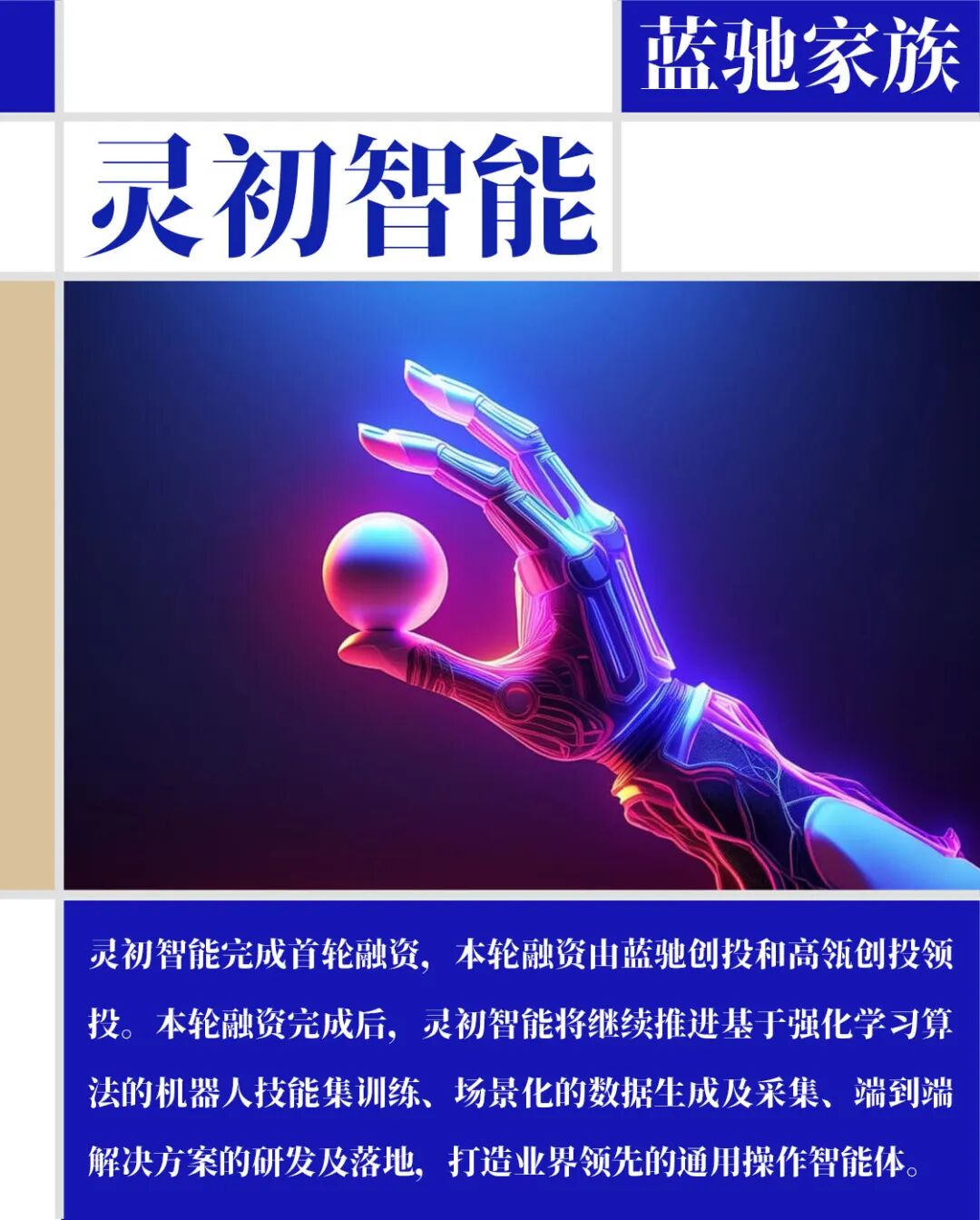
Lingchu Intelligence (灵初智能) recently completed its first funding round, led by BlueRun Ventures and Hillhouse. Following this round, Lingchu will continue advancing robot skill training based on reinforcement learning algorithms, scenario-specific data generation and collection, and the R&D and deployment of end-to-end solutions — with the goal of building an industry-leading general-purpose dexterous manipulation agent. Lingchu founder Dr. Qibin Wang brings nearly 20 years of successful execution experience in mobile phones, smart speakers, and robotics, having repeatedly closed the full industrial loop from product definition and development to launch and global expansion — a true veteran who deeply understands how to commercialize robotics. Co-founder Dr. Xiaojie Chai has spent 15 years in robotics and autonomous driving, with expertise spanning algorithms, simulation, engineering, and full-stack technology, plus data-closure experience from L4 product deployments — a battle-hardened R&D expert with extensive mass-production experience.
Lingchu has also been called the embodied intelligence company with the highest density of scientists. The company established the Peking University–Lingchu Intelligence Joint Laboratory on Embodied Dexterous Manipulation with Peking University, with Dr. Yaodong Yang from the Institute for Artificial Intelligence serving as chief scientist to lead collaborative research projects.
Dr. Yang is a prominent young scholar in reinforcement learning. He earned his PhD from UCL, the birthplace of modern deep reinforcement learning. His research group has produced a series of significant results in the field, including leading a Chinese team to develop multi-agent reinforcement learning algorithms published in Nature Machine Intelligence for the first time, and leading a Chinese team to win the NeurIPS 2022 Embodied Dexterous Manipulation championship.
Meanwhile, the PKU–Lingchu Joint Laboratory will also collaborate with Dr. Yitao Liang on long-horizon task planning for embodied intelligent agents. Dr. Liang has long focused on injecting knowledge into machine learning to improve performance and generalization, achieving a series of important results in the open-ended environment of Minecraft. He uses LLMs to decompose and plan complex tasks, giving the "brain in a vat" of large models hands and feet to act autonomously in embodied scenarios.
Beyond the PKU joint lab, co-founder Yuanpei Chen is a robotics-obsessed Gen Z prodigy. As a visiting scholar at Stanford University, he studied under Karen Liu and Fei-Fei Li, and achieved the world's first demonstration of using reinforcement learning to simultaneously control dual-arm, dual-hand multi-skill manipulation in the real world. Additionally, Associate Professor Ying Wen from Shanghai Jiao Tong University's School of Artificial Intelligence is a key member of the technical team. His group developed the multimodal decision-making large model DB1, which surpassed DeepMind's generalist decision-making Gato model, and introduced over 100 scenario tasks grounded in real-world applications, providing powerful tools for actual business needs.
Led by a product veteran and joined by this highest-density scientist team, Lingchu has assembled what it calls a "hexagonal squad" spanning the 1970s through 2000s generations — a versatile team with technical depth, product sense, and execution capability, much like the human-like operations they excel at through reinforcement learning (RL)-based embodied intelligence, featuring more advanced technology, greater commercial potential, and stronger combat effectiveness.
High generalization, high dexterity, and high success rate form the "impossible triangle" of embodied intelligence. High generalization means robots executing complex tasks on different objects in changing environments; high dexterity manifests as precise, flexible task execution (such as building with LEGO or bimanual manipulation); high success rate means stably and correctly executing tasks under perturbations (95% during product validation, above 99.9% at scale). Balancing all three is extremely challenging: generalization requires general models and learning algorithms emphasizing data diversity; dexterity demands fine-grained models and precision-focused learning algorithms plus specific control methods; robustness also imposes requirements on control algorithms. Reinforcement learning is the core technology for improving embodied intelligence across all three dimensions, enabling agents to train with low-cost synthetic data in simulation environments, autonomously explore and learn optimal solutions through trial and error, enhance dexterity even beyond human limits, and improve robustness.
Lingchu has been deeply cultivating full-stack capabilities based on reinforcement learning since its early days, building technical moats in embodied intelligence starting from dexterous manipulation before expanding to general-purpose manipulation. Its developed hierarchical end-to-end model leads the industry, comprising the Psi-P0 planning model and Psi-C0 control model. Psi-P0 leverages large-model interactive reasoning to understand how actions affect the environment, decomposing complex tasks to achieve task generalization; the Psi-C0 model, proposed by Yuanpei Chen, uses a two-layer architecture combining human motion data and deep reinforcement learning — the upper layer trains a reference trajectory generator on human data, while the lower layer uses generated trajectories to guide reinforcement learning training, solving the generalization-dexterity dilemma — this was also the world's first use of reinforcement learning to control dual-arm, dual-hand multi-skill manipulation in reality.
The Psi-C0 control model addresses the training challenge of chaining multiple skills in sequence. Chen and Stanford jointly proposed Sequential Dexterity, which chains multiple dexterous manipulation policies to complete long-horizon tasks. In real-world block-building tasks, it chains four skills — searching, reorienting, grasping, and inserting blocks — to improve overall success rate. This was also the world's first long-horizon task achieved through reinforcement learning-based dexterous manipulation, demonstrating the generalization of multi-skill composition.
Dr. Liang's Psi-P0 enables task decomposition and planning for complex tasks in open-ended environments. The task complexity and accuracy it supports surpass contemporaneous work from OpenAI (VPT) and Nvidia (MineDojo). As shown in the video below, we can further build memory to give embodied models lifelong learning capabilities — the ability to improve themselves based on their own experiences.
Human-like exploration, construction, and combat with different tools in an open world
On product planning, Lingchu will enter through 2B service industries, guided by high-value scenarios from leading customers, developing integrated skill sets to achieve commercial deployment, while rapidly iterating hardware, algorithms, and data systems to continuously improve the generalization, dexterity, and success rate of its overall embodied intelligence solution — offering the optimal answer to the "impossible triangle" in the embodied intelligence field.
Lingchu founder and CEO Qibin Wang stated: "We are deeply grateful for our investors' strong support. Our team, combining industry veterans and high-density scientists, possesses a complete technology stack. We will build integrated software-hardware solutions at the frontier of embodied intelligence, expanding applications in advanced manufacturing, retail logistics, and 2B service industries, rapidly achieving data closure and commercial deployment. In the dawn of the embodied intelligence era, we look forward to growing spiritually with our partners and jointly creating an intelligent future."
BlueRun Ventures commented: "The embodied intelligent robotics market holds tremendous potential. We believe general manipulation capability executing complex tasks is a critical technical bottleneck for embodied intelligence deployment. The Lingchu team is among the top technical teams globally in reinforcement learning and embodied models. Furthermore, the team understands industries and scenarios, possesses underlying technical architecture capabilities, and has ample product deployment experience and supply chain advantages. We believe that as embodied intelligence technology gradually matures and the industrial chain and ecosystem become more complete, the embodied intelligent robotics market will enter a period of rapid growth. We are very optimistic about the development potential of embodied robots in the global market."
About Lingchu Intelligence: The company's English name is Proto-Sentient Intelligence, abbreviated as PsiBot. "Proto" means "beginning" — original, primordial, pioneering — which aligns well with the company's focus on reinforcement learning as its advantage in embodied intelligence innovation. "Sentient" means "spirit" — consciousness, intelligence — representing the ability to autonomously complete cognition and interaction with the world, bit by bit, through human-like operations. True to its name, Lingchu Intelligence will leverage the most cutting-edge and innovative technology to give embodied intelligence applications spirituality, ushering in the dawn of the robotics era.


A new drug king is about to be born — is there another billion-dollar target in peptides? | BlueRun Perspectives
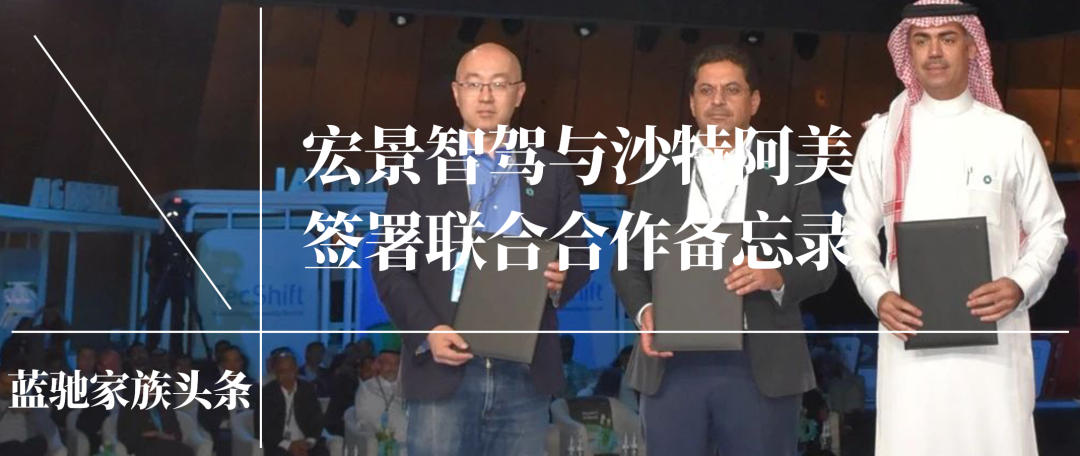
Machenike Signs Joint Cooperation Memorandum with Saudi Aramco | BlueRun Ventures Headlines

TCab Tech Completes Hundreds of Millions of RMB in Series B Funding | BlueRun Ventures