BlueRun Ventures Headlines | Zhilin Yang: Advancing Toward the Uncharted Snow-Capped Mountains

"If your ideal is something everyone can think of, it adds nothing to the total stock of human ideals."
BlueRun Ventures founder Zhilin Yang sat down today with Tencent Technology's Xiaojun Zhang for an exclusive interview on large model entrepreneurship. He said, if everyone thinks you're normal, if your vision is something anyone could come up with, it adds nothing to humanity's total stock of ambition.
That's why we must walk the path of being undefined and daring to go first. BlueRun Ventures was an early investor in Moonshot AI. We will, as always, firmly support exceptional founders in exploring the dark side of the moon and the mysterious beyond of AI.

Just one year ago, AI scientist Zhilin Yang made a precise calculation in Silicon Valley. He realized that if he decided to launch a large model startup with AGI as its goal, he needed to raise over $100 million in capital within the coming months.
Yet this was merely an entry ticket. A year later, that number had multiplied by 13.
The competition among large model companies is less a scientific competition than, first and foremost, a brutal contest of money. With capital providers tightening their purse strings, you must outpace rivals in finding more funding, buying more GPUs, and poaching more talent.
"It requires the aggregation of talent and capital," said Zhilin Yang, founder and CEO of Moonshot AI, the large model company established on March 1, 2023.
Over the past year, domestic large model companies have seemed to exist on a precarious and narrow edge of survival. On the surface, each holds substantial funds. But on one hand, they must immediately pour freshly raised capital into extraordinarily expensive R&D to catch up with OpenAI — first matching GPT-3.5, then before even reaching GPT-4, Sora arrived; on the other hand, they must tirelessly search for viable application scenarios to self-verify that they are companies, not merely capital-devouring research institutes; and even that isn't enough, as whether through IPO or acquisition, the exit path for each project remains entirely unclear.
Among Chinese large model founders, Zhilin Yang is the youngest, born in 1992. Industry observers describe him as a steadfast AGI believer and a founder with technical charisma. Much of his academic and professional background relates to general AI, with over 22,000 paper citations.
For large models, China's tech community swung abruptly from feverish enthusiasm to chill pragmatism focused on accelerated commercialization around mid-2023. This inevitably placed large model CEOs in violent tension between idealism and reality. In China's AI ecosystem where everyone shouts PMF (Product/Market Fit) and commercialization, this founder with a research background is notably less anxious.
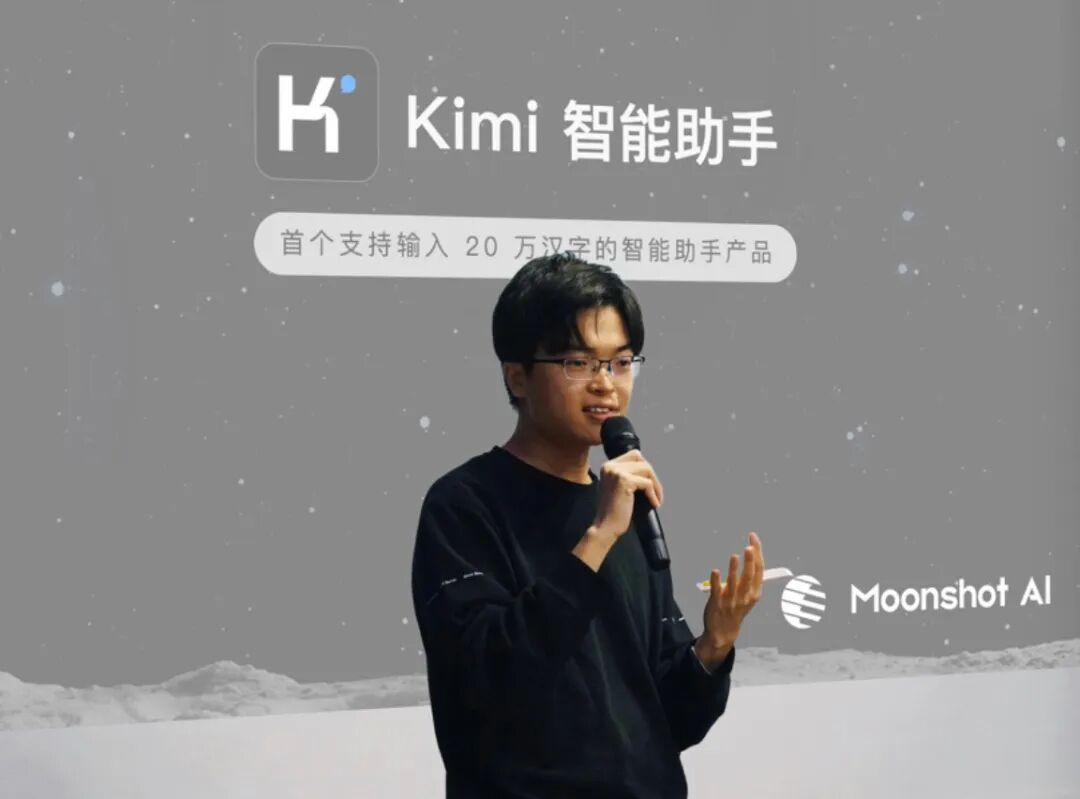
Moonshot AI is the smallest among leading domestic large model companies, with just 80 people. Unlike his rivals, he hasn't pursued the safer B2B business or sought landing points in vertical scenarios like healthcare or gaming. Instead, he has built one and only one consumer product — the AI assistant Kimi, supporting 200,000 Chinese character inputs. Kimi is also Zhilin Yang's English name.
Zhilin Yang tends to view his company as constructing a system combining science, engineering, and business. You might imagine him erecting an AI laboratory above the human world, conducting experiments with one hand while dropping cutting-edge technology into the real world with the other, finding application opportunities through human interaction, then delivering those applications into consumers' hands. The ideal scenario: the former burns through billions or tens of billions in capital; the latter earns it back hundreds or thousands of times over — however you hear it, it sounds as thrilling as "walking a tightrope."
"AI isn't about finding some PMF in the next year or two, but about how to change the world over the next ten to twenty years," he said.
This abstract and idealistic thinking inevitably makes one nervous for him: can a young AI scientist find room to survive in pragmatic China?
In February 2024, Moonshot AI bucked the trend to complete a major funding round. According to sources, it raised over $1 billion in Series B at a $1.5 billion pre-money valuation, led by Alibaba with Monolith, Xiaohongshu and others participating. Post-money valuation reached approximately $2.5 billion — making it the highest-valued unicorn in China's large model arena at present. (They declined to comment on this matter.)
During this third funding round, we spoke with Zhilin Yang about his entrepreneurial journey over the past year, a cross-sectional glimpse of domestic large models' sprinting year.
His company didn't locate in the Sohu Internet Plaza, the gathering place for large model enterprises. For a company with total funding of roughly 9 billion RMB, this office in Quantum Core Tower appears crude and worn. There's not even a company logo at the entrance, only a white piano standing guard.
The meeting room sits in a corner, dim and dark with its small windows, winter heating humming from the AC unit. In the gloomy light, Zhilin Yang described his perception of the past year: "A bit like driving on a road with continuous snow mountains ahead, but you don't know what's inside, and you're walking step by step."
Below is the full interview with Zhilin Yang.
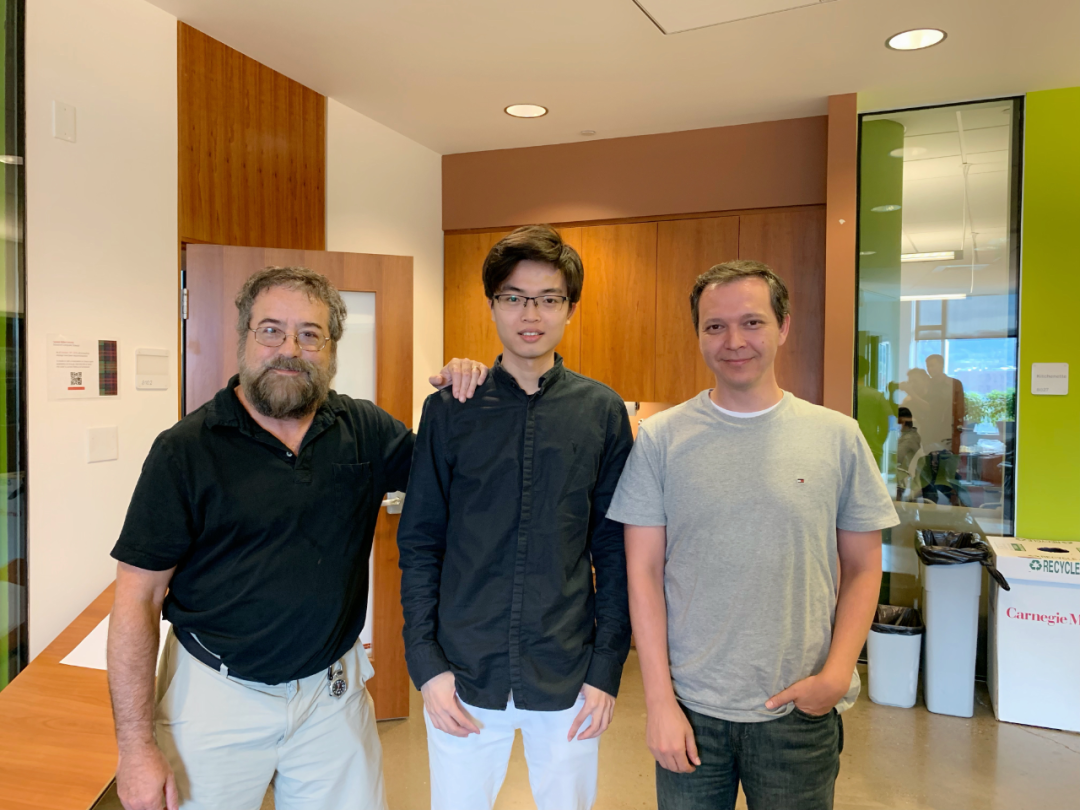
Zhilin Yang with advisors Ruslan Salakhutdinov (right) and William Cohen (left)
At the Beginning
"Ride the wave"
Tencent News Deep Dive: How have you been lately?
Zhilin Yang: Busy, lots going on. But still very excited. Standing at the beginning of an industry with massive room for imagination.
Tencent News Deep Dive: I noticed a pure white piano at your company entrance.
Zhilin Yang: There's even a Pink Floyd album on it. I don't know who put it there, suddenly noticed it a couple days ago, haven't had time to ask. (Pink Floyd is the British rock band that released the album The Dark Side of the Moon.)
Tencent News Deep Dive: November 2022, the day ChatGPT launched — what were you doing?
Zhilin Yang: I was preparing for this, looking for people to form a team, bouncing around new ideas. Seeing ChatGPT was very exciting. Three to five years earlier, even in 2021, it would have been unimaginable. This high-level reasoning capability was very difficult to achieve before.
I sensed many variables in the market: on one side capital, on the other talent — these are the core production factors for AI. If the variables held, we might genuinely build a company for this — an organization built for AGI going from zero to one became possible, that was a major epiphany. An independent company made more sense, but it's not something you can do just because you want to. ChatGPT catalyzed the variables, making the production factors available. Still, you have to ride the wave.
Tencent News Deep Dive: After deciding to found an AGI company, what preparations did you make? How did you assemble these two production factors of capital and talent?
Zhilin Yang: It was a winding process. ChatGPT took time to diffuse. Some people learned of it early, some late; some initially skeptical, then shocked, then convinced. Finding people and money was tightly bound to timing.
We started concentrating on our first funding round in February 2023. If we had delayed until April, basically no chance. But if we had done it in December 2022 or January 2023, also no chance — COVID was still happening, people hadn't processed it — so the real window was one month.
At that time, there was one night in the US when I did precise calculations. After calculating, I felt we needed at least $100 million within a few months. Many in the market hadn't started fundraising, many thought you couldn't possibly raise that much. But later it proved possible, even more than that.
The talent market began moving. Inspired by ChatGPT, many people had this realization in March or April 2023: this is the only thing worth doing for the next decade. You need to actively reach the right people at the right time. If it had been two years earlier, talent concentration wouldn't have been this high. Then more people were doing traditional AI, or AI-related businesses, not general AI.
Tencent News Deep Dive: To summarize, February was the fundraising window, March-April the hiring window?
Zhilin Yang: Pretty much.
Tencent News Deep Dive: Where in the US did you run these numbers that night? How exactly did you calculate?
Zhilin Yang: I was in the US for one to two months from late 2022 to early 2023, meeting people.
At my place. Calculate your corresponding FLOPs (Floating Point Operations), training cost, inference, user base.
Tencent News Deep Dive: What was the atmosphere in Silicon Valley at that moment?
Zhilin Yang: The product was starting to have many early adopters, concentrated in tech circles. We were in that circle ourselves, so we felt it more deeply. Silicon Valley big tech companies do performance reviews every six months, and people started using ChatGPT to write them. Some people normally didn't write very professionally, but with ChatGPT everyone seemed suddenly proper.
Undercurrents were stirring. Many people considered where their next job would be or starting companies. Many friends we spoke with later started companies themselves. And there was strong FOMO (Fear of Missing Out). Everyone couldn't sleep. Whether midnight, 1am, 2am, if you looked, people were always there. A bit anxious, a bit FOMO, but also very excited.
Tencent News Deep Dive: What time did you finish calculating that $100 million figure?
Zhilin Yang: It wasn't too bad, the calculation itself didn't take that long.
But after calculating I couldn't tell too many people. Even if I did, no one would think this was doable.
Technical Lineage
"Liberating yourself from infinite polishing"
Tencent News Deep Dive: When the VC industry mentions you, they say "the founder is very smart, has technical charisma, and the team has many technical stars." So before discussing large model entrepreneurship, I'd like to talk about your academic background.
You did your undergraduate at Tsinghua University's Computer Science department, PhD at Carnegie Mellon University's School of Computer Science — has your direction always been AI?
Zhilin Yang: I was born in '92, undergraduate class of 2011, from sophomore year until now over a decade in this direction. Initially more scattered exploration, looking around, did some work with graphs and multimodal, converged on language models in 2017 — at the time felt language models were a relatively important problem, later felt they were the only important problem.
Tencent News Deep Dive: What was the AI industry's general perception of language models in 2017, and how did it evolve?
Zhilin Yang: It (at the time) was a model used to rank speech recognition results. (Laughs) After you recognize a segment of speech, there are many results, you use a language model to see which has higher probability, output the most likely result — very limited applications.
But you realized it's the fundamental problem, because you're modeling the probability of the world. Language is limited, but it's a projection of the world; theoretically, if you make the token space larger, you can build a general world model. Everything in the world — how it arises, how it develops — can be assigned a probability. All problems can be reduced to how to estimate that probability.
Tencent News Deep Dive: Your academic mentors are quite renowned — your PhD advisors were Ruslan Salakhutdinov, Apple's head of AI, and William W. Cohen, then chief scientist at Google AI. They were each in both industry and academia.
Zhilin Yang: Industry and academia were more integrated in recent years, but the trend is shifting: more valuable breakthroughs will come from industry. That's the inevitable pattern of development. You start with exploratory research, then gradually shift toward more mature industrialization. But that doesn't mean research isn't needed during industrialization — it's just that pure research alone will struggle to produce valuable breakthroughs.
Tencent News Deep Dive: What did you learn from these distinguished mentors?
Zhilin Yang: I learned the most at Google, where I interned for a long time. At the end of 2018, I started working on Transformer-based language models. The biggest lesson was freeing myself from infinite polishing — that was crucial.
You should look at what the big direction is, the big gradient. When you have ten paths in front of you, ordinary people think about how to brake for a pedestrian on this path — short-term details. But which of these ten paths to choose matters most.
This field had this problem before. For example, on datasets of only one or two million tokens, looking at how to lower perplexity (a measure of a model's uncertainty or confusion when predicting sequences), how to reduce loss (the error or loss function value during training), how to improve accuracy — you get trapped in infinite polishing. People invented many weird architectures; these are polishing tricks. After polishing, it might get better on that dataset, but you don't see the essence of the problem.
The essence is: analyze what's missing in this field? What's the first principle?
Why did scaling law become a first principle? You just need to find a structure that satisfies two conditions: sufficiently general, and scalable. General means you can model all problems within this framework; scalable means as long as you put in enough compute, it gets better.
This was the thinking I learned at Google: if something can be explained by more fundamental principles, you shouldn't over-polish at the upper level. There's an important quote I strongly agree with: if you can solve something with scale, don't solve it with a new algorithm. The maximum value of a new algorithm is enabling better scaling. When you free yourself from polishing, you can see more.
Tencent News Deep Dive: Was Google also a follower of scaling law back then? How did it implement first principles?
Zhilin Yang: There was already a lot of this thinking, but Google didn't implement it very well. It had this mindset, but it couldn't organize itself into a true moonshot. It was more like: here are 5 people pursuing my first principle, there are 5 people pursuing their first principle. There was no top-down coherence.
Tencent News Deep Dive: During your PhD, you published papers with Turing Award winners Yann LeCun and Yoshua Bengio, and you were first author on both. How did these academic collaborations come about? — I mean, they're Turing Award winners, not your advisors. What attracted them to you?
Zhilin Yang: Academia is very open. As long as you have good ideas, meaningful problems, it's fine. Two brains or n brains produce more than one brain. This applies to developing AGI too. An important AI strategy is "ensemble" (using ensemble methods, combining predictions or results from multiple different models or methods to achieve better performance) — it's essentially the same thing. When you have diverse perspectives, you can spark many new things. Collaboration is hugely beneficial.
Tencent News Deep Dive: Did you first have an idea, then take it to them to see if they were interested?
Zhilin Yang: More or less that process.
Tencent News Deep Dive: Which is harder — winning over academic big shots or winning over capital big shots in fundraising? What are the similarities?
Zhilin Yang: "Winning over" isn't a good term. The essence behind it is collaboration. Collaboration requires mutual benefit, because mutual benefit is the premise of collaboration. So there's no real difference — you need to provide unique value to others.
Tencent News Deep Dive: How do you earn their trust? What do you think your talent is?
Zhilin Yang: No particular talent, just working hard.
The Old System No Longer Applies
"AGI Requires New Organizational Forms"
Tencent News Deep Dive: You just said "more valuable breakthroughs will happen in industry" — including startups, and big tech's AI labs?
Zhilin Yang: Labs are history. Google Brain used to be the biggest AI lab in industry, but it was inserting a research organization inside a big company. Such organizations can explore new ideas, but struggle to produce great systems — they could produce Transformer, but not ChatGPT.
The development model will evolve into: you're building a massive system, requiring new algorithms, solid engineering, even a lot of product and commercialization. Like the early 2000s — you couldn't research information retrieval in a lab; you had to put it in the real world, with a massive system, a product with users, like Google. So research or education systems will shift their function, becoming mainly about cultivating talent.
Tencent News Deep Dive: How would you describe this new organizational form? Is OpenAI its prototype?
Zhilin Yang: It's the most mature organization right now, still gradually evolving.
Tencent News Deep Dive: Can we understand this as an organization established for humanity's grand scientific goals?
Zhilin Yang: I want to emphasize: it's not pure science. It's a combination of science, engineering, and business. It has to be a commercial organization, a company, not a research institute. But this company is built from zero to one, because AGI requires new organizational forms — one, the production method is different from the internet; two, it shifts from pure research to a combination of research, engineering, product, and business.
The core is: it should be a moonshot, with a lot of top-down planning, but with room for innovation within that plan — not all technologies are determined. There are bottom-up elements within a top-down framework. Such an organization didn't exist before, but organizations must adapt to technology, because technology determines production methods; mismatch means ineffective output. We believe it probably needs to be redesigned.
Tencent News Deep Dive: During last year's OpenAI coup, Sam Altman had an option to join Microsoft and lead a new Microsoft AI team. What's the essential difference between that and being CEO at OpenAI?
Zhilin Yang: You need to produce a new organization within an old culture — that's very difficult.
Tencent News Deep Dive: You want to build "China's OpenAI" — can we say that?
Zhilin Yang: Not quite accurate. We don't want to be China's something, and we don't necessarily want to be OpenAI.
First, true AGI is definitely global. There's no AGI company that, due to market protection mechanisms, can only serve a regional market — that doesn't exist long-term. Globalization, AGI, and having a product with massive user volume — these three are ultimately necessary conditions.
Second, is it OpenAI? Look at 2017-2018: OpenAI had terrible reputation. People in our circle looking for jobs generally considered places like Google. Many people talked to Ilya Sutskever (OpenAI's chief scientist) and thought this guy was crazy, too full of himself — OpenAI was either crazy or a scam. But they invested early, found non-consensus, found the only first principle that works in AI now: scale through next token prediction.
I believe there will be companies greater than OpenAI. A truly great company can combine technological idealism, and realize it through a great product co-created with users — AGI will ultimately be something co-worked with all users. So it's not just technology; you also need utilitarianism and practical pursuit. The perfect combination of these two.
But we should learn from OpenAI's technological idealism. If everyone thinks you're normal, if your ideal is what everyone can think of, it adds nothing to humanity's total ideal.
The First Step of the Moonshot Is Long Context, What's the Second?
"There Will Be Two Milestones Next"
Tencent News Deep Dive: Back to when you decided to start a company — you immediately launched your first funding round after returning to China?
Zhilin Yang: It started in February (last year) in the US, some remote. It ended up mainly with domestic investors.
Tencent News Deep Dive: $100 million in the first round?
Zhilin Yang: Not the first round, later it exceeded that. Completed two rounds in 2023, nearly 2 billion RMB total.
Now it's the third round. We haven't officially announced fundraising, can't comment now.
Tencent News Deep Dive: Some say that starting in the second half of 2023, no one was willing to invest in foundation model companies anymore — are they wrong?
Zhilin Yang: There still are. You can indeed see sentiment shifts, it's not that no one invests — at least currently there's quite a lot of investment interest in the market.
Tencent News Deep Dive: Besides capital and people, what other key decisions did you make in 2023?
Zhilin Yang: What to do. That's the advantage of companies like ours — at the highest level of decision-making, we have technical vision.
We do long context, which requires judgment about the future. You need to know what's fundamental, what's the next direction. Still first principles, the "process of de-polishing." If you focus on polishing, you can only look at what OpenAI has already done and figure out how to replicate it.
You'll find that in Kimi (AI assistant), doing lossless compression of long text creates a unique product experience. Reading English literature, it can help you understand very well. If you use Claude or GPT-4 today, it doesn't necessarily do well — this required advance planning. We've been working on it for over half a year. That's very different from seeing a long context trend today, quickly assembling two teams, and developing at maximum speed.
Of course the marathon has just begun; there will be more differentiation ahead, which requires you to预判 in advance what is a "valid non-consensus."
Tencent News Deep Dive: When was the decision to do this made?
Zhilin Yang: February or March, decided when the company was founded.
Tencent News Deep Dive: Why is long text the first step of the moonshot?
Zhilin Yang: It's very fundamental. It's the new computer memory.
Old computer memory grew by several orders of magnitude over the past few decades, and the same thing will happen with new computers. It can solve many problems we face today. For instance, current multimodal architectures still need tokenizers, but with lossless long-context compression, you don't need them anymore — you can just feed in the raw data. Going further, it transforms the new computing paradigm into a more general-purpose foundation.
Old computers could represent everything with 0s and 1s; everything could be digitized. But today's new computers can't do that yet — they don't have enough context, they're not general-purpose enough. To become a general world model, you need long context.
Second, it enables personalization. The core value of AI is personalized interaction; the value ultimately lands on personalization. AGI will be more personalized than the previous generation of recommendation engines.
But personalization isn't achieved through fine-tuning — it's enabled by supporting very long context. Your entire history with the machine is context, and this context defines the personalization process. It can't be replicated. It becomes more direct dialogue, and dialogue generates information.
Tencent News Deep Dive: How much room is there to scale this further?
Zhilin Yang: Tremendous. On one hand, there's a long road ahead just for expanding the context window itself — several orders of magnitude.
On the other hand, you can't just expand the window, can't just look at the numbers. Whether it's millions or billions of tokens today doesn't mean anything. You have to look at the reasoning capabilities it achieves within that window, its faithfulness to the original information, its instruction-following ability — you shouldn't pursue a single metric in isolation, but rather combine metrics with capabilities.
If both dimensions keep improving, you can do an enormous amount. You might be able to follow an instruction that's tens of thousands of words long, and the instruction itself can define many agents, highly personalized.
Tencent News Deep Dive: Is the work on long text reusable for catching up to GPT-4? Are they the same thing?
Zhilin Yang: I don't think so. It's more of a dimension upgrade — a new dimension that GPT-4 doesn't have.
Tencent News Deep Dive: Many people say the major Chinese LLM companies are all doing roughly the same thing — catching up to GPT-3.5 in 2023, catching up to GPT-4 in 2024. Do you agree?
Zhilin Yang: Comprehensive capability improvement is definitely a key objective, so there's some truth to that — as a latecomer, there's inevitably a catch-up process. But it's also one-sided. Beyond comprehensive capabilities, there's room to develop unique abilities and achieve state of the art in certain directions. Long context is one. DALL-E 3's image generation was completely outdone by Midjourney V6. So you need to do both.
Tencent News Deep Dive: What proportion of time and resources do comprehensive capabilities versus new dimensions each consume?
Zhilin Yang: They need to be combined; new dimensions can't exist independently of comprehensive capabilities, so it's hard to give a direct ratio. But you need sufficient investment to do new dimensions well.
Tencent News Deep Dive: Will all these new dimensions for you be carried on Kimi?
Zhilin Yang: It's definitely a very important product for us, but we'll also have some other experiments.
Tencent News Deep Dive: What do you think of Guangmi Li's (founder of Shi Xiang) comment that Chinese LLM companies today don't yet have very high technical differentiation?
Zhilin Yang: I think we're doing okay — we've already created a lot of differentiation. It's related to timing; you should see more dimensions this year. Last year everyone was just building the framework, getting things running first.
Tencent News Deep Dive: If the first step of the moonshot is long text, what's the second step?
Zhilin Yang: There will be two major milestones ahead. First, a truly unified world model — one that can unify various different modalities, a truly scalable and general architecture.
Second, enabling AI to continuously evolve without human data input.
Tencent News Deep Dive: How long until these two milestones are reached?
Zhilin Yang: Two to three years, possibly faster.
Tencent News Deep Dive: So three years from now, we'll be looking at a completely different world.
Zhilin Yang: At today's pace of development, yes. The technology is still in its infancy, in a phase of rapid growth.
Tencent News Deep Dive: Can you imagine what might appear three years from now?
Zhilin Yang: There will be some degree of AGI. Many things we're doing today, AI will also be able to do, even better. But the key is how we use it.
Tencent News Deep Dive: For you, for Moonshot AI as a company, what's the next step?
Zhilin Yang: We'll go after these two things. Many other problems are derived from these two factors. When we talk about reasoning and agents today, they're products of solving these two problems. There will be some polishing work, but no fundamental blockers.
Tencent News Deep Dive: Will you go all-in on catching up to GPT-4?
Zhilin Yang: (GPT-4) is a necessary path to AGI. The core is, you can't be satisfied with just achieving GPT-4-level results. One, you need to think about what the real non-consensus is now — beyond GPT-4, what's next? What should GPT-5 and GPT-6 look like? Two, and more importantly, what unique capabilities do you have in this?
Tencent News Deep Dive: Other LLM companies publish their model capabilities and rankings; you don't seem to do this?
Zhilin Yang: Leaderboard-chasing means very little. The best leaderboard is users — let users vote. Many leaderboards have problems.
Tencent News Deep Dive: Is reaching GPT-4 fastest among Chinese LLM companies your goal? Does fast versus slow matter?
Zhilin Yang: It definitely matters. If you extend the timeline far enough, eventually everyone will get there. But it depends on what "early or late" means in terms of cycle length. A cycle of half a year or more is meaningful, and it also depends on what you can do with that cycle.
Tencent News Deep Dive: When do you expect to reach GPT-4?
Zhilin Yang: Should be soon, but can't disclose a specific timeline yet.
Tencent News Deep Dive: Will you be the fastest?
Zhilin Yang: That needs to be viewed dynamically, but we have a probability.
Tencent News Deep Dive: After launching Kimi, what's your north star metric?
Zhilin Yang: Today it's making the product better and achieving more dimension upgrades — new dimensions. For example, you shouldn't just compete on one search scenario; search is just a small part of what makes this product valuable. The product should have much greater incremental value. Being 10% or 20% better than traditional search engines isn't very valuable — only something disruptive is worthy of the three letters AGI.
Unique value is your incremental intelligence. You have to seize this point; intelligence is always the core incremental value. If only 10%-20% of your product's core value comes from AI, it doesn't work.
I'm Not Anxious About Commercialization at All
"User scaling and model scaling need to happen simultaneously"
Tencent News Deep Dive: Mid-2023 was a huge watershed — the market swung rapidly from euphoria to coldness. What was your perception?
Zhilin Yang: I don't fully agree with that assessment. We actually completed a funding round in the second half. And new things kept coming out. Today's model capabilities were unimaginable at the end of last year. More and more AI companies have rising user numbers and revenue. It keeps proving value.
Tencent News Deep Dive: What felt different for you between the first and second halves of the year?
Zhilin Yang: Not much change. Variables definitely exist, but returning to first principles — how to give users a good product. Ultimately, we need to satisfy user needs, not win a competition. We're not a company built to compete.
Tencent News Deep Dive: The industry believes a notable difference between the first and second halves of 2023 was a shift in focus. The first half talked about AGI more; the second half started talking about how to commercialize, how to monetize. Did you do this?
Zhilin Yang: I definitely want to do AGI — it's the only meaningful thing for the next ten years. But that doesn't mean we don't do applications. Or rather, we shouldn't define it as an "application."
"Application" sounds like you have a technology and you're trying to apply it somewhere, with a commercial closed loop. But "application" isn't the right word. It's complementary to AGI. It's itself a means to achieve AGI, and also the purpose of achieving AGI. "Application" sounds more like a purpose: I'm making it useful. You need to combine Eastern and Western philosophy — you want to make money, but you also need ideals.
Today users have helped us discover many scenarios we never considered. They use it to screen resumes — something we never designed for, but it naturally works. User input in turn makes the model better. Why does Midjourney work so well? It did scaling on the user side — user scaling and model scaling need to happen simultaneously. Conversely, if you only focus on applications and don't pay attention to model capability iteration, don't pay attention to AGI, your contribution is limited.
Tencent News Deep Dive: Allen Zhu (Managing Partner at GSR Ventures) only invests in LLM applications. He has a view: the hardest core is PMF for AIGC — if ten people can't find PMF, a hundred people can't find it either; it has nothing to do with headcount or cost, don't throw money at it. He said, "Train with LLaMA for two or three months, you can at least reach human top 30 level, immediately replace people." What do you think of his view?
Zhilin Yang: AI isn't about finding some PMF in the next year or two, but about how to change the world over the next ten to twenty years — these are two different modes of thinking.
We're firm long-termists. When you achieve AGI or stronger intelligence, everything today gets rewritten. PMF matters, but if you're in a rush to find PMF, you'll likely get disrupted by dimensional reduction. Dimensional reduction has happened too many times. Many people used to do customer service, dialogue systems, slot filling — some companies reached decent scale. But they all got dimensionally reduced, painfully so.
That doesn't mean it's invalid. If you find a scenario today where current capabilities create massive incremental value from zero to one, but the one-to-N expansion space is limited — that scenario works. Midjourney is one. Or copywriting generation, relatively simple tasks where the zero-to-one effect is obvious. These are application-only opportunities. But the biggest opportunity isn't there. If your goal is commercialization, you can't think about it separately from AGI. "I'll just do applications for now" — fine, but in a year you'll probably get crushed.
Tencent News Deep Dive: You could secretly upgrade the underlying model.
Zhilin Yang: But you can't make it bigger than theirs. Technology is the only new variable of this era; everything else is unchanged. Back to first principles: AGI is the core of everything. From that, we derive: a super app definitely requires the strongest technical capabilities.
Tencent News Deep Dive: What about using open-source models? (Latest news: Google announced open-sourcing Gemma.)
Zhilin Yang: Open source lags behind closed source. That's also a fact.
Tencent News Deep Dive: Could it just be temporarily behind?
Zhilin Yang: Doesn't look like it right now.
Tencent News Deep Dive: Why can't open source catch up to closed source?
Zhilin Yang: Because open-source development doesn't work like it used to. Before, everyone could contribute to open source. Now open source itself is still centralized. Many open-source contributions probably haven't been validated by compute. Closed source has talent concentration and capital concentration. In the end, closed source will definitely be better — it's a consolidation.
If I had a leading model today, open-sourcing it would probably be irrational. It's more likely that laggards would do that, or open-source small models to disrupt things — if it's not open-sourced, it has no value anyway.
Tencent News Deep Dive: How do you push back against the anxiety domestically? People say that if large model companies don't quickly produce落地 scenarios and products that meet investor expectations, they won't be able to raise their next round.
Zhilin Yang: You need a balance between long-term and short-term. Having absolutely no users, no revenue — that definitely won't work.
You can see that from GPT-3.5 to GPT-4, a lot of applications were unlocked; from GPT-4 to GPT-4.5 to GPT-5, it will probably continue to unlock more, maybe even exponentially. The so-called "scenario Moore's Law" is that the number of scenarios you can use increases exponentially over time. We need to improve model capabilities while finding more scenarios — that kind of balance.
It's a spiral. It depends how much you allocate to short-term versus long-term. You pursue the long-term while staying alive. You absolutely can't skip the long-term, or you'll miss the entire era. Drawing conclusions today is genuinely too early.
Tencent News Deep Dive: Do you endorse Huiwen Wang's (Meituan co-founder, Lightyears Away founder) proposed "dual-wheel drive"?
Zhilin Yang: That's a good question. To some extent, yes. But how you actually execute it makes a huge difference. Can you really do some "probabilistic non-consensus" things?
Tencent News Deep Dive: My understanding of their dual-wheel drive is that you also need to quickly find that new application scenario, otherwise you don't know how the technology lands.
Zhilin Yang: It's still the difference between model scaling and user scaling.
Tencent News Deep Dive: Domestically, besides you, who else thinks in terms of model scaling?
Zhilin Yang: I'd rather not comment on that.
Tencent News Deep Dive: Most people probably think in terms of user scaling. Or could you say this is the difference between the academic school and the commercial落地 school?
Zhilin Yang: We're not the academic school. The academic school absolutely doesn't work.
Tencent News Deep Dive: Many large model companies land through to B (after all, to B has higher确定性). Do you do that?
Zhilin Yang: We don't. We decided from day one to do to C.
It depends what you want. If you know it's not what you want, you won't FOMO. Because even if you get it, it's nothing.
Tencent News Deep Dive: Are you anxious? Over the past year.
Zhilin Yang: More excited, thrilled. Because I've thought about this for a very long time. We're probably the earliest people who wanted to explore Moonshot AI. You realize you're actually building a rocket, every day discussing what fuel to add to make it go faster, how to keep it from exploding.
Tencent News Deep Dive: Summarize the "probabilistic non-consensus" decisions you've made — besides to C and long context, anything else?
Zhilin Yang: More in the process. Hope to show everyone soon.
Tencent News Deep Dive: China's previous generation of entrepreneurs got their payoff in applications and scenarios, so they focus more on product, users, data flywheel. Can you, representing the new generation of AI entrepreneurs, represent the new future?
Zhilin Yang: We also care deeply about users. Users are our ultimate goal, but it's also a co-creation process. The biggest difference is that this time it will be more technology-driven — still that horse carriage versus automobile problem — right now we're in the leap from horse carriage to automobile. You should think as much as possible about how to give users an automobile.
Tencent News Deep Dive: Do you feel lonely?
Zhilin Yang: Haha... that's an interesting question. I think it's okay, because we have several dozen, almost 100 people fighting together.
GPT-4 Hasn't Caught Up, and Now Sora
"Right now it's a bit like GPT-3.5 for video generation, a step-function improvement"
Tencent News Deep Dive: Sora's sudden appearance this year — how much was within your expectations, how much was a surprise?
Zhilin Yang: That generative AI could achieve this effect — that was expected. The surprise was timing — earlier than previously estimated. This also reflects how fast AI is developing now; much scaling红利 hasn't been fully captured yet.
Tencent News Deep Dive: Last year the industry judged that in 2024 large models would definitely compete on multimodal narratives, and video generation quality would rapidly improve like text-to-image did in 2023. Is Sora's technical capability above, meeting, or below your expectations?
Zhilin Yang: It solved many previously difficult problems. For example, maintaining generation consistency over a relatively long time window — that's the key point, a massive improvement.
Tencent News Deep Dive: What does it mean for the global industry landscape? What new narratives will large models have in 2024?
Zhilin Yang: One is short-term application value, further improving efficiency in production processes — though of course we hope for more extensions on top of current capabilities. Two is combining with other modalities. It itself is world modeling; with this knowledge, it's excellent supplementation for existing text. On this foundation, whether in agents or connections to the physical world, there's quite a bit of space and opportunity.
Tencent News Deep Dive: What's your overall assessment of Sora?
Zhilin Yang: We were already planning a similar direction, working on it for some time. Directionally, no big surprises — more the technical details.
Tencent News Deep Dive: What technical details should be studied?
Zhilin Yang: A lot OpenAI hasn't fully explained either. They gave the broad strokes, with some key details. You have to judge from its effects or existing information, combined with our previous experiments. At least for us, in the development process we'll add more data points, have more data inputs.
Tencent News Deep Dive: Previously for video generation relative to text generation, what were the main bottlenecks? What solutions can we see OpenAI found this time?
Zhilin Yang: The main bottleneck, core issue was still data — how do you scale fitting this data? It hadn't been validated before. Especially when your motions are complex, the generation effect is photo realistic. Under these conditions, being able to scale — they solved these this time.
What remains is also not fully solved, like needing a unified architecture. The DiT architecture is still not very general. Modeling the marginal probability of visual signals alone — it can do that very well. But how to generalize into a general-purpose new computer? You still need a more unified architecture; there's still space there.
Tencent News Deep Dive: Did you read OpenAI's Sora report — Video Generation Models as World Simulators — what key points are worth highlighting?
Zhilin Yang: I read it. Given current competitive dynamics, the most important points they definitely wouldn't write out. But it's still worth studying — this was originally付费 content, you'd have to spend money on many experiments to know. Now you know some things without spending money on experiments, you roughly have some understanding.
Tencent News Deep Dive: What key signal did you extract from it?
Zhilin Yang: This thing is to some extent scalable. Additionally, it also gave relatively specific guidance on how to do the architecture. But it's also possible that different architectures don't necessarily have such essential differences on this matter.
Tencent News Deep Dive: Do you endorse that statement of theirs — "Scaling video generation models is a promising path toward building general-purpose simulators of the physical world"?
Zhilin Yang: I strongly agree. These two things optimize the same objective function — no big question there.
Tencent News Deep Dive: What do you think of Yann LeCun jumping out again to oppose generative AI? His view is: "Modeling the world by generating pixels is a waste, and doomed to fail. Generation works for text because text is discrete with a finite number of symbols. In that case, handling uncertainty in predictions is easy. Handling prediction uncertainty in high-dimensional continuous sensory inputs is very tricky."
Zhilin Yang: I now think that by modeling the marginal probability of video, you're essentially doing lossless compression — no essential difference from language models' next-token prediction. As long as you compress well enough, you can explain the things in this world that can be explained.
But there's also important unfinished business: how does it combine with existing already-compressed capabilities?
You can understand there as two different compressions. One compresses the raw world — this is what video models do. The other compresses human-generated behavior, because human-generated behavior passes through the human brain, the only thing in the world that produces intelligence. You could say video models do the first, text models do the second — though video models also somewhat contain the second, since some human-created videos contain the creator's intelligence.
It will probably ultimately be a mix, needing to learn from different angles through these two methods, but both ultimately help with intelligence growth.
So generation may not be the end goal — it's just the compression function. If you compress well enough, the generation quality will follow. The reverse is less clear: if a model can't generate, is it still possible to compress extremely well? That's an open question. It's possible that strong generation is a necessary condition for excellent compression.
Tencent News Qianwang: Sora and last year's ChatGPT represent two different milestones. Which is more significant?
Zhilin Yang: Both are important. Right now it's like the GPT-3.5 moment for video generation — a step-function leap. The model is still relatively small, and larger models are clearly on the horizon, bringing deterministic improvements in quality.
Tencent News Qianwang: Some have argued that Google's Gemini breakthrough matters more for multimodal work.
Zhilin Yang: Gemini followed GPT-4V's path, incorporating understanding into the mix. Both matter. The ultimate challenge — putting everything into a single model — remains unsolved.
Tencent News Qianwang: Why is unifying everything in one model so difficult?
Zhilin Yang: No one knows how yet. There isn't a validated architecture.
Tencent News Qianwang: What happens when you combine Sora with GPT?
Zhilin Yang: Sora can immediately enter video production workflows. But combined with language models, it could bridge the digital and physical worlds. You could also execute tasks more end-to-end, since your world modeling has improved — it might even enhance your understanding of multimodal inputs. So you'd get more fluid switching between modalities.
To summarize: your understanding of the world deepens, enabling more end-to-end tasks in the digital realm, and potentially building bridges into the physical world to accomplish real-world tasks. That's the starting point. Autonomous driving, household chores — theoretically these are all concepts about connecting to the physical world.
So the digital-world breakthrough is certain, but there's latent potential for reaching into the physical world too.
Tencent News Qianwang: What does Sora mean for domestic large-model companies? What's the response strategy?
Zhilin Yang: No real difference. This was always the deterministic direction.
Tencent News Qianwang: Domestic companies haven't caught up to GPT-4 yet, and now Sora arrives. The two worlds seem to be diverging further. Are you anxious?
Zhilin Yang: It's just objective reality. But the actual gap may still be narrowing — that's the pattern of technological development.
Tencent News Qianwang: Meaning the curve starts steep and gradually flattens?
Zhilin Yang: Exactly. I wasn't particularly surprised — OpenAI has been working on next-generation models all along. But objectively, the gap will persist for some time, and even gaps between domestic companies will persist. We're in a period of explosive technological growth.
But in two or three years, it's possible that China's top companies will have done more foundational work — building technical infrastructure, developing talent reserves, and cultivating organizational culture. With that refinement, they could potentially lead in certain areas. But it requires patience.
Tencent News Qianwang: Could China and the US ultimately develop completely different AI technology ecosystems?
Zhilin Yang: The ecosystems could diverge from a product and commercialization perspective. But technologically, general capabilities won't follow fundamentally different paths — foundational general capabilities will converge. Because AGI's space is so vast, differentiation built on top of general capabilities is more likely.
Tencent News Qianwang: There's an ongoing debate in Silicon Valley: one model rules all versus many specialized smaller models. Where do you stand?
Zhilin Yang: I'm in the first camp.
Tencent News Qianwang: Will China and the US diverge significantly on this?
Zhilin Yang: I don't think so in the end.
"I accept that failure is possible"
"It has already changed my life"
Tencent News Qianwang: Large-model entrepreneurship is somewhat anomalous in China — you've raised enormous sums, yet much of it must be spent on scientific experiments. How do you convince investors to put up the money?
Zhilin Yang: It's no different from the US. The amount we've raised isn't actually that large. So we need to learn more from OpenAI.
Tencent News Qianwang: I want to know — how much more to reach GPT-4? To reach Sora?
Zhilin Yang: Neither GPT-4 nor Sora requires that much. The money now is really reserves for next-generation and beyond — frontier exploration.
Tencent News Qianwang: Chinese large-model startups have taken money from tech giants, but those giants are also training their own models. How do you see the relationship between startups and giants?
Zhilin Yang: There's both competition and cooperation. Their primary objectives differ. Look at any major tech company's top priority today — it's different from an AGI company's top priority. That priority shapes actions, outcomes, and ultimately your position in the ecosystem.
Tencent News Qianwang: Why do giants invest small amounts across multiple large-model companies rather than making a concentrated bet on one?
Zhilin Yang: It's a stage thing. There will be more consolidation ahead — fewer companies.
Tencent News Qianwang: Some say the endgame for large-model companies is acquisition by giants. Do you agree?
Zhilin Yang: Not necessarily, though deep partnerships are possible.
Tencent News Qianwang: What might such cooperation look like?
Zhilin Yang: OpenAI and Microsoft represent the classic model — there's much to reference and also optimize.
Tencent News Qianwang: Looking back at the past year, where have the twists and turns of entrepreneurship shown themselves?
Zhilin Yang: Many external variables — capital, talent, compute, product, R&D, technology. There were highlight moments and difficulties to overcome. Compute, for instance.
There was a lot of back and forth. Periods of tight supply, then improvement. At the most extreme, prices changed daily — one day a machine was 260, next day 340, then dropped back. A dynamic process requiring close attention. With constant price changes, strategy had to keep shifting — which channels, buy or lease, many choices.
Tencent News Qianwang: What drove these dynamics?
Zhilin Yang: Geopolitical factors, production batches, market sentiment shifts. We observed many companies offloading compute — they realized they didn't necessarily need to train these models. Market sentiment and decisions changed, supply-demand followed. The good news: market supply has improved dramatically recently. My personal judgment is that compute won't be a major bottleneck for at least the next one to two years.
Tencent News Qianwang: You seem to think constantly about organization. How have you built your team?
Zhilin Yang: Hiring philosophy evolved. AGI talent globally is extremely limited — few with experience. Our earliest profile focused on finding the right geniuses. This proved very successful. People with prior experience in model surgery, direct experience training ultra-large-scale models — they could deliver quickly. Including Kimi's launch, our capital efficiency and organizational efficiency were actually quite high.
Tencent News Qianwang: How much did it cost?
Zhilin Yang: A fairly small number — small money for big results, compared to many other expenditures. For a long time we were 30-40 people. Now 80. We pursue talent density.
The talent profile later shifted. Early on we hired geniuses, believing their ceiling determined the company's ceiling. Then we added more dimensions — product and operations people, leader-types, people who execute to the extreme. Now it's a more complete, resilient, battle-ready team.
Tencent News Qianwang: How do you assess your progress after one year of large-model entrepreneurship in China?
Zhilin Yang: We've built a rocket prototype and are now test-firing it. We've assembled a team, figured out some fuel formulations, and can more or less see the outline of PMF.
You could say we've taken the first step toward the moon.
Tencent News Qianwang: What do you think of Yann LeCun's view? He's skeptical of current technical approaches, arguing that self-supervised language models can't acquire true world knowledge, and that scaling up increases the probability of errors — hallucinations. He proposes "world models."
Zhilin Yang: No fundamental bottleneck. When the token space is large enough, it becomes a new type of computer solving general problems — that's a general world model.
His point matters because everyone can see current limitations. But the solution doesn't require an entirely new framework. The only thing that works in AI is next-token prediction plus scaling law — as long as tokens are sufficiently comprehensive, it's all doable. The problems he identifies exist today, but they're solved by making the token space more general.
Tencent News Qianwang: He's magnifying the limitations.
Zhilin Yang: I think so. But the underlying first principles are sound — just some smaller technical problems remain unsolved.
Tencent News Qianwang: What do you think of Geoffrey Hinton repeatedly raising AI safety concerns?
Zhilin Yang: Safety concerns actually indicate his tremendous confidence in upcoming capability improvements. They're two sides of the same coin.
Tencent News Qianwang: How to solve hallucination?
Zhilin Yang: Still scaling law — just scaling different things.
Tencent News Qianwang: What's the probability that scaling law ultimately proves unworkable?
Zhilin Yang: Approximately zero.
Tencent News Qianwang: What do you think of your CMU classmate Qi Lu's view: OpenAI will certainly surpass Google, it's just a question of whether 2x, 5x, or 10x?
Zhilin Yang: The most successful AGI company will definitely be larger than all current companies. No question — it could be double, triple what GPT represents. It may not be OpenAI, could be another company, but such a company will exist.
Tencent News Qianwang: If you happened to become CEO of this AI empire, what would you do to protect humanity?
Zhilin Yang: We're missing some preconditions to think about this now. But we're certainly willing to cooperate and improve with different roles in society, including more safety measures in our models.
Tencent News Qianwang: What are your goals for 2024?
Zhilin Yang: First, technical breakthroughs — we should be able to build models far better than what we had in 2023. Second, users and products. I hope to see more users at scale, and stronger stickiness.
Tencent News Qianwang: What are your predictions for the global large model industry in 2024?
Zhilin Yang: We'll see more capabilities emerge this year, but the overall landscape won't change dramatically from today — the top players will stay ahead. On the capabilities front, there should be some fairly significant breakthroughs in the second half of the year, many coming from OpenAI. They definitely have a next-generation model in the works — could be 4.5, could be 5, but it feels like a high-probability event. Video generation models will definitely keep scaling.
Tencent News Qianwang: What are your predictions for China's domestic large model industry in 2024?
Zhilin Yang: Three things. One, we'll see new and distinctive capabilities emerge. Because of the groundwork laid earlier and the right teams in place, domestic models will lead the world in certain dimensions. Two, we'll see products with much larger user bases — that's highly likely. Three, there will be further consolidation and a divergence in strategic paths.
Tencent News Qianwang: What's the one thing you fear most as a founder?
Zhilin Yang: Not much, really. You just have to charge forward without fear.
Tencent News Qianwang: What would you say to your peers?
Zhilin Yang: Let's all keep at it together.
Tencent News Qianwang: Name one thing about the large model industry that you don't know but most want to find out.
Zhilin Yang: I don't know what the upper limit of AGI looks like, what kind of company it will produce, and what products that company will create. That's what I most want to know right now.
Tencent News Qianwang: As AGI continues to develop, what's the one thing you least want to see happen?
Zhilin Yang: I'm fairly optimistic about this. It can push human civilization to its next stage.
Tencent News Qianwang: Has anyone ever told you that you're too idealistic?
Zhilin Yang: We're also very grounded. We've actually done things, not just talked about them.
Tencent News Qianwang: If the money you have today were the last you'd ever raise, how would you spend it?
Zhilin Yang: I hope that never happens, because we'll need a lot more money in the future.
Tencent News Qianwang: What would make you feel you had failed, if you didn't achieve it?
Zhilin Yang: It's not that big a deal. I accept that there's a probability of failure.
This has completely changed my life. I'm filled with gratitude.
Founded in Silicon Valley in 2005, BlueRun Ventures is a venture capital firm focused on early-stage startups.
The firm currently manages multiple USD and RMB dual-currency funds in China, with assets under management exceeding RMB 15 billion, making it one of the largest early-stage funds in the country. BlueRun invests primarily at Pre-A and Series A stages, covering technology, consumer, and healthcare sectors. It has backed nearly 200 startups, including Li Auto, Waterdrop, QingCloud, Guazi.com, Qudian, Ganji.com, Energy Monster, Gaussian Robotics, Songguo Mobility, Yuntusemi, Machenike, Cloud Saint Intelligence, Anxin Network Shield, and BioMap.
BlueRun Ventures has been ranked first on Zero2IPO's "Top 30 Early-Stage Investment Institutions in China" and ChinaVenture's "Top 30 Best Early-Stage VC Firms in China," and named among Preqin's Top 10 VC fund managers globally for sustained high returns.
The firm has also received consecutive honors from Forbes China, 36Kr, Cyzone, Caixin Media, CBNweekly, Jiemian, and other media organizations, including "China's Best Early-Stage Firm of the Year," "China's Top Venture Capital Firm," "Most Founder-Friendly Early-Stage Firm of the Year," and "Most Influential Early-Stage Firm of the Year."