BlueRun Ventures in Conversation with Moonshot AI, Qianshou Technology, Yuanli Intelligence, and Daqian Technology — AI Pragmatists: The China Path from Technology to Value

From Technology to Value: The Chinese Path
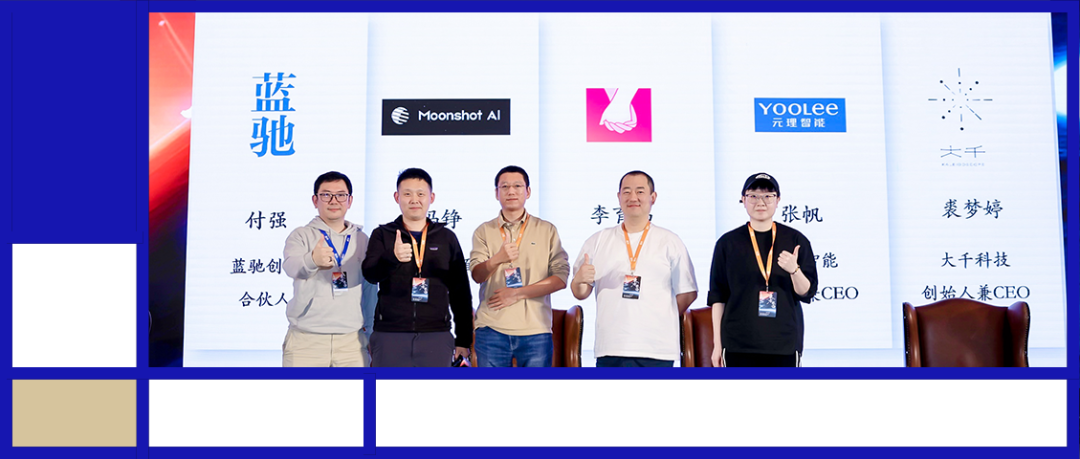
In the era of large AI models, the ecological boundaries between models and applications, corporate strategic choices, and the future form of intelligence are being redefined. Will model companies really "swallow" all applications? How can application companies find an "unchanging core" amid rapidly shifting paradigms? In practical deployment, how do practitioners overcome deep-rooted "mental blocks" and choose the "most suitable model"? In this in-depth conversation, Fu Qiang, investment partner at BlueRun Ventures, and four industry leaders from the frontiers of models and applications — Feng Zheng from Moonshot AI, Li Yuwei, CEO of Qianshou Technology, Zhang Fan, founder and CEO of Yuanli Intelligence, and Qiuqiu, founder and CEO of Daqian Technology — engaged in a fascinating discussion around these critical questions.
From the supremacy of model performance to the economics of application choice, from eliminating internal "mental blocks" to ultimate expectations for AGI, their insights and practices offer profound inspiration for understanding business strategy and technological evolution in the large model era. Selected highlights from the conversation follow:

Fu Qiang: Looking back at human history, from the steam engine to electricity to the internet, we find that all technologies create value through a process of diffusion from an initial critical point to every aspect of the world. When a technology can be applied in daily life to solve concrete human problems, that's when it truly creates value. The guests here today are precisely practitioners making AI effective across different life scenarios. Let's start with brief introductions, especially on how you're using AI.
Feng Zheng, Moonshot AI: I'm Feng Zheng from Moonshot AI. We focus on foundational large models. Many of you may have experienced our model capabilities through the Kimi app, web interface, or API. In July this year, we open-sourced the 1T-parameter Kimi K2 model, which has already seen extensive developer adoption domestically and internationally. Kimi's API delivers performance very close to Claude's, but at a dramatically lower price, giving developers more options. On the web side, we've launched two model-level products: Researcher, which independently completes complex research, averaging nearly a hundred searches and generating 10,000-word reports with polished presentation pages; and the newly released Agent product OK Computer, which can call real-time data sources through MCP for data analysis and use generative models to build websites.
Li Yuwei, Qianshou Technology: I'm Li Yuwei from Qianshou Technology. We focus on the vertical赛道 of AI-powered dating and relationships. We believe AI could potentially replace matchmakers entirely, yet traditional matchmakers remain irreplaceable in delivering and solving users' practical problems. Whether AI can democratize matchmaking, allowing ordinary people to access highly professional, efficient services at very low cost is what we're currently trying to achieve.
Zhang Fan, Yuanli Intelligence: I'm Zhang Fan from Yuanli Intelligence. We help enterprises build self-evolving intelligent agents, hoping to help transform foundational intelligence into productive capability. I previously led commercial products and monetization at Zhipu AI, where all efforts went toward solving supply-side problems (chips, foundation models, APIs). But beyond supply, there's demand — helping enterprises find scenarios and more easily convert intelligence into productive capability. Our goal is to help businesses use intelligence to solve real commercial problems.
Qiuqiu, Daqian Technology: I'm Qiuqiu from Daqian Technology. Unlike efficiency-focused companies, we create multiplayer interactive narrative entertainment products oriented toward joy and emotional fulfillment, offered in both offline and online formats. The product form has users and friends each playing roles, receiving missions in virtual stories and completing them, with all actions generating interesting narratives that get visually expressed. Offline, it's a 4-6 person, 1-1.5 hour "hahaha" social experience requiring no reading; online, it's a lightweight, gamified interactive variety show format. AI plays two major roles in the product: first as script director, converging players' divergent expressions and continuously advancing the plot; second as visual director, transforming rational expressions into emotional visual communication, generating fun short clips.

Fu Qiang: We've heard it said that AI applications are all wrappers, with no value, no moat. How do you three application-side founders view this? Where do you believe the moat lies?
Qiuqiu, Daqian Technology: The core moat in the broad entertainment industry lies in whether you can encode experiential, aesthetic, and sensory factors into data-driven rules. Since entertainment has limited static data, the moat is whether you can leverage dynamic interaction data generated by users in real scenarios, and based on customized rules, reverse-generate consumable content. For example, the minimum creative unit in short dramas is dialogue, measured in seconds, with attention to how many emotional beats to place in each line. This is a classic case of taking experience-level quality content, making it rule-based, and defining and iterating it with algorithm teams in mathematical form at the minimum creative unit level.
Thus, application moats in entertainment mainly come down to two points: First, whether you have the ability to define benchmarks for your industry, encoding the偏感性, non-rational aesthetics and experience. Second, whether you can accumulate substantial dynamic interaction data through this process and use it to improve output capability. This is our core moat on the application side.
Zhang Fan, Yuanli Intelligence: From an enterprise perspective, the key to "wrapper" accusations is model content. The ideal state is around 50% model content, like electric vehicles doing far more than 50% of deep work on top of "electricity." Simply connecting to APIs, writing prompts, and packaging them as simple applications lacks moat. Application development goes through three stages:
Stage one is Workflow: executing via rule-based systems, where moat lies in proprietary prompts or RAG within the process. Stage two is autonomous model decision-making: abandoning fixed rules, with moat dependent on acquiring more diverse context and presets. Stage three is deep integration: preserving the model's planner capabilities while maintaining ability to intervene, enabling the model to make optimal decisions based on the enterprise's own scenarios.
Li Yuwei, Qianshou Technology: The moat in dating services lies in the tight integration of people and business — service must involve people and is hard to simply剥离 or "wrap." The key to this business is mutual satisfaction, unlike one-directional e-commerce; its variables are highly unstable and continuous, requiring real-time information processing and finding balance points. This service evolves constantly with the business and cannot be achieved through simple wrapper approaches.
Fu Qiang: Then let's pivot to the model company. There's another view — model fundamentalists believe models will swallow the world, swallow all applications, that application-layer moats aren't real moats, and the future belongs to models. Do you agree with this view? How do you see model吞噬世界?
Feng Zheng, Moonshot AI: This is a hard question to answer. Our view is "model as product." Models have strong generalization capabilities, and in domains like Researcher or OK Computer, model companies exploring these areas can achieve better results and performance, so competition is fiercest there and model companies have advantages, often catching up from behind.
However, model companies won't swallow all applications because application scenarios are too vast. The heavy responsibility of model companies is to explore the upper limits of intelligence (such as shifting from providing tools to directly delivering reports/results) — this is what's more interesting and where effort should go for model companies. Meanwhile, we provide capabilities to all developers through APIs to meet the massive unmet needs in the world. Additionally, applications aren't 100% model; there's other logic, content, and structure, and falling model costs will create new business model space. So the "models swallow everything" view isn't accurate.
Fu Qiang: Real-world scenarios are complex and diverse; models empower rather than take over all scenarios — this is also the opportunity for application companies. Next, please share your biggest "mental block," what pitfalls it caused, and how you overcame it.
Feng Zheng, Moonshot AI: Model performance is everything — users can perceive good model products. With performance improvements, even the same product feels different to users. For example, Kimi OK Computer's reports are being resold on Xianyu, showing the immense value of intelligence improvements. For us, improving intelligence has always been the most important thing.
Fu Qiang: I want to follow up — since you say what you learned is that improving intelligence matters most, does that mean there was a period when you didn't think so?
Feng Zheng, Moonshot AI: We've always believed this; it's just that as model performance has gradually improved, everyone's conviction and confidence in this belief has steadily strengthened and become more firm.
Li Yuwei, Qianshou Technology: Our initial "mental block" was pursuing the model with the best unilateral output results. But after deploying models in business, we found what's truly needed is the most suitable model**, which must comprehensively evaluate factors like call speed, cost, and stability. This lesson led to overturning large amounts of original assumptions and massive重构 when it came to model adoption and business rollout.
Zhang Fan, Yuanli Intelligence: From an enterprise perspective, we've seen many challenges because the paradigm of this entire era changes very rapidly. For example, just looking at model application paradigms: in 2023, people believed application companies must have their own models, leading to companies like Character AI and Inflection. But by 2024, the paradigm shifted — models and applications began separating, with companies like Cursor and Perplexity achieving great applications without building their own models.
Entering 2025, we're seeing many vertical models emerging that integrate with industries, whether C-facing or B-facing in law, medicine, etc. So enterprises need to constantly adapt to these paradigm shifts. At a more fundamental level, we should think more clearly about how to separate what changes from what doesn't, to find the unchanging core. We often use a metaphor: the model is like sea level in an ocean, constantly rising. If you choose to build a lighthouse, it will keep getting submerged; so you should think about how to build a boat — how to decouple from the model's own capabilities, continuously apply its latest intelligence, and build what the model cannot do on top of it. This is a direction every entrepreneur should carefully consider.
Qiuqiu, Daqian Technology: We follow the principle of "if you're going to make mistakes, make them fast and small," so there aren't any particularly memorable major mistakes. But I've summarized two important lessons: First, regarding industry applications, when making To C content entertainment products, we realized current model capabilities are better suited for "productivity tools" rather than simple "tools" — like a professional chef's knife versus a home kitchen knife; our initial attempt to use "tools" to produce To C consumer-grade content failed because the content didn't meet user standards. Only by shifting to productivity tools, selecting the right users, and generating content through interaction could we achieve consumer-grade output. Second, when promoting AI coding internally, the huge obstacle encountered wasn't insufficient model performance, but rather context alignment capability between humans and AI** — we significantly improved delivery capability by investing substantial time in multi-dimensional requirement determination and adding checkpoints to continuously align human and AI context.

Fu Qiang: I'd like to look toward the future. Given that AI is growing today, I want to first hear from the application side. What capabilities do you hope AI will develop next, and how would such capabilities empower your own products or businesses?
Zhang Fan, Yuanli Intelligence: I have a foundational assumption: is intelligence infinite? Looking back at the past 5,000 years of human history, our brain capacity hasn't changed significantly; the productivity each person creates today essentially comes through education, division of labor, and collaboration. This leads to a most fundamental question: is intelligence symmetrical? We used to say large models have asymmetric intelligence — on one hand winning math olympiad gold medals, on the other hand unable to count letters in a word.
People generally view this as a model flaw, but I believe it's precisely a characteristic of intelligence, not a flaw, because humans themselves are asymmetric. Therefore, I believe for AI to further develop and truly enter industries, it must shift from "modeling for knowledge" to "modeling for productivity." It should be productivity-oriented, building capabilities for education, division of labor, and collaboration on top of foundation models. The core reason is that we believe in different scenarios, with different environments, model intelligence should be asymmetric.
Therefore, my greatest expectation for future AI is finding a general method to adapt to this asymmetry of intelligence. What we're trying is an approach similar to combining reinforcement learning with business, making the model a self-evolving system within its environment, business-result-oriented, forming countless branches to amplify foundation model capabilities and transform them into productivity. The most critical aspect is how to get models to model learning. This is my greatest hope for models' future.
Qiuqiu, Daqian Technology: Our expectation reverses to a key metric we focus on when cultivating industry newcomers internally — iteration capability, meaning a model's ability to learn new knowledge without forgetting old knowledge, precisely finding the internal logical relationships between new and historical knowledge. In this process, we particularly focus on models having stronger multimodal in-context learning capabilities**, to leverage continuously emerging dynamic new capabilities, skills, and knowledge in the industry, achieving long-term, dynamic autonomous learning — for example, being able to internalize and learn new knowledge by watching professional industry videos, which would greatly enhance industry delivery capability.
Li Yuwei, Qianshou Technology: From a practical present-day perspective, the greatest hope is that models become cheaper and faster. I believe cheapness is itself a capability — if it can be fast enough and cheap enough, many qualitative changes should already have occurred. Looking to the future, we're certainly waiting for AGI realization; it's just a matter of time.
Fu Qiang: So will these hoped-for model capabilities be realized? When? I've heard there's still a long way from cost reduction to AGI. These different wishes — from application-side hopes to cost reduction and AGI realization — when might model companies possibly deliver on them?
Feng Zheng, Moonshot AI: These can't really be called wishes, because they'll all be realized soon. The reason large model companies are confident is that from an algorithmic perspective, reinforcement learning has already provided a visible path for models to gradually improve learning capabilities — it just needs time to mature. Significant intelligence improvements may be achievable on a two-, three-, four-, or five-year horizon. Meanwhile, cost optimization is also very important; it will unlock new business models, and Chinese companies especially have clear advantages here, which will create many new possibilities.
Fu Qiang: I want to follow up here — from the model company's perspective, what is AGI**? Are you targeting this goal in your work?**
Feng Zheng, Moonshot AI: The origin of our company name "Moonshot AI" is exploring AGI. In simple terms, AGI originally referred to models being able to do what an average person can do, but now people have tacitly raised the standard to "models being able to do all the work that all average people can do." Based on existing infrastructure, algorithmic structures, and development trends, even this high-standard AGI has a very good chance of being achieved in the coming few years.
Fu Qiang: Let's move to our next topic: the China-US model ecosystem. Today's theme is "Dawn Breaking in the East." The China and US model ecosystems differ greatly in technical capability, cost, and "friend circles." I'd like to hear from you application-side founders: when deploying applications in real scenarios, how do you choose models? What factors do you consider? Do you use overseas models? What are their respective strengths and weaknesses? And how do Chinese model advantages help your applications succeed?
Li Yuwei, Qianshou Technology: For now, we still approach this pragmatically. For scenarios requiring complex computation and demanding reasoning, we may use some overseas models. For high-volume, broad-coverage situations, we basically choose Chinese models — this is a very pragmatic selection angle. And when handling specific Chinese scenarios and Chinese-language problems, domestic models often produce much better results than foreign ones.
Zhang Fan, Yuanli Intelligence: From my perspective, it divides into two aspects. If you're an individual using AI, you'll certainly use the best model, but frankly, foreign models and domestic ones are already very close in performance. Even a 2% difference for individual use might be worth it after ten iterations of reflective thinking.
But from an enterprise application perspective, people should focus more on how to apply models rather than which model to choose, because foundation model performance differences have converged to a very small range. In enterprise applications and specific domain applications, we should build scenario-specific optimal solutions on top of foundation models; the tiny differences between foundation models no longer matter. I recommend everyone use domestic models — better cost-performance, better flexibility.
Qiuqiu, Daqian Technology: From our internal perspective, this isn't purely a China-US model selection issue, because in most scenarios, Chinese and American models are already evenly matched. Essentially, enterprises need to position themselves and choose different model strategies according to different stages**: Stage one is defining benchmarks — only choose the best; stage two is small-scale rollout, selecting based on performance indicators defined by user experience gained in stage one; stage three is large-scale rollout, where latency and cost-performance become the top priority decision logic; finally, when the industry matures and accumulates vertical data moats, it evolves toward small model training or fine-tuning. Thus, enterprises need to precisely position their current stage to formulate model decision strategies.
Fu Qiang: Is it possible for Chinese models to become what people call "the best" in the near future? If possible, how do we get there?
Feng Zheng, Moonshot AI: I believe Chinese models are already among the best today — this itself is huge progress. Chinese large model companies are using 1% of the resources of their US counterparts yet achieving very close efficiency levels, suggesting our efficiency may be 100x that of American peers. Many American developers actually prefer Chinese models — for example, a well-known American investor mentioned migrating significant workloads to the K2 model, and the CEO of a nearly $10 billion US cloud code services company posted detailed metrics on Twitter stating K2's model performance accuracy is 50% higher than other cutting-edge American models. So this is already happening; we're very confident.
Fu Qiang: Alright, then for our final question today, and the simplest one: please share one vision — how do you hope to use AI to change the world through your product or service?
Qiuqiu, Daqian Technology: AI is in some ways an enhancement of various productive efficiencies. What I particularly look forward to is massively efficiency-izing the acquisition of emotional fulfillment**, so that when more people are exhausted, suffering, or in any negative emotional state, "making you happy" becomes simple and efficient.
Zhang Fan, Yuanli Intelligence: We hope to transform foundation models' foundational intelligence into business productivity. We hope that in every enterprise's own domain, they can quickly achieve their own AGI and even ASI (artificial superintelligence), transforming it into productivity, driving more demand-side development, and thereby bringing more resources to the supply side.
Li Yuwei, Qianshou Technology: Right now we definitely want to first solve China's singles problem, the finding-a-partner problem. In the future, we hope to have the opportunity to help address China's population problem**.
Feng Zheng, Moonshot AI: The goal is to explore the upper limits of intelligence, hoping to better improve everyone's work and study efficiency**, so people can have more time for entertainment and life.
Fu Qiang: Then our goal is to support all of you, to help all your dreams come true**.